
Guest post by Nat Wilson Turner.

Thursday’s New York Times brings back their old RussiaGate spirit with a front page banner headline about “foreign interference” and data center opposition.
Here’s a key quote:
…a push by foreign adversaries to seize on what polls have shown is deep ambivalence — verging at times on hostility — about the spread of the data centers needed to power A.I. in the United States and elsewhere.
China, Russia and, to a lesser extent, Iran have sought to use state media outlets to turn the controversy over data centers in the United States into “a domestic fracture point,” according to a new analysis by Alethea, a threat intelligence company, which identified scores of articles and posts on social media this year.
These campaigns, whose impact on public opinion remains to be seen, have raised alarms in Washington, where A.I. is seen as a top issue heading into this year’s midterm elections.
The foreign efforts appear intended to stoke the debate over data centers that has united political figures across the political spectrum — from Senator Bernie Sanders of Vermont, a progressive, to Stephen K. Bannon, the erstwhile adviser to President Trump.
“Foreign actors aren’t manufacturing American debates over the future of A.I., they are exploiting them,” said Jessica Brandt, a former official with the Office of the Director of National Intelligence who tracked foreign influence efforts during the Biden administration.
The goal, she added, is to “deepen our divisions in order to dent our appeal and weaken us from within.”
Interesting sources, some company called Alethea and a former Biden admin DNI spook as our sources.
We’ll come back to them later, but first I’m curious as to why the NYT is only now covering this story when OpenAI put out a press release saying basically the same thing on June 10 except focused solely on China.
After all, OpenAI’s report was convincing enough to sway such luminaries as Senator Tom Cotton (R-AR), Republican Leaders on the House Energy and Commerce Committee, Rep. Brett Guthrie (R-KY), Interior Secretary Doug Burgum, The Bitcoin Policy Institute and prominent tech investor Kevin O’Leary, per WIRED.
And what did the man Elon Musk calls “Scam” Altman’s company have to say that swayed such shrewd and critical thinkers?
In this report, we describe two clusters of ChatGPT accounts likely originating from China that we banned after they used our models in support of apparent covert influence operations that promoted narratives in an attempt to manipulate a legitimate debate about American AI and wider tech policies.
The first cluster generated social media comments and images claiming that data center buildouts for AI were increasing electricity prices for average families. We named this cluster the “Data Center Bandwagon” campaign.
The second cluster generated comments and images criticizing US tariffs as attempts to dominate technological competition and specified in their prompts that the content should not include China’s leader Xi Jinping in the output and instead include only President Trump. This cluster was connected to a network of likely inauthentic social media accounts that were also likely targeting OpenAI by claiming ChatGPT user data had been compromised. These allegations were entirely false. We named this second cluster the “Tech and Tariffs” campaign.
The targeting of OpenAI and US data center buildouts is significant not because the operation appears to have shifted public opinion, but because it shows PRC-origin influence operators testing narratives against AI infrastructure – a foundation of US technological leadership, economic growth and the broader democratic AI ecosystem.
Although as Ben Nimmo, principal investigator of intelligence and investigations at OpenAI, said, per Politico:
“Neither campaign appears to have gained much authentic engagement,” Nimmo said during a Wednesday press briefing. “They’re important for what they reveal about the intentions of influence operators from China, and the narratives they’re testing and seeking to amplify, but not for the impact.”
And you’ve got to trust Ben Nimmo, despite keeping his LinkedIn resume refreshingly brief — as if he emerged fully formed at OpenAI like Venus on the halfshell, he’s actually left quite the trail, like a snail slicing itself open on an Occam’s razor of foreign disinformation.
Nimmo was named one of TIME’s “Democracy Defenders” in 2024. I can’t resist quoting from Ben’s TIME bio :
When Ben Nimmo first began tracking online influence operations targeting elections in 2014, he had to scroll for hours on Twitter, studying how networks of fake accounts tried to hijack partisan narratives.
A decade later, AI is changing the game—not just for foreign threat actors, but for those working to counter them. “So much of the conversation is around how the bad guys might use AI,” says Nimmo, who now works as the principal threat intelligence investigator at OpenAI (a TIME licensing and technology partner). “My all-time favorite misquote from Harry Potter is: We can use magic too.”
…
In May, OpenAI announced it had removed five covert influence operations, detected by Nimmo’s team, based in Russia, China, Iran, and Israel. All were trying to use the company’s AI tools to manipulate public opinion.
A big lesson from 2016, when Russia mounted a vast operation to meddle in the U.S. presidential election, was that influence operations were “a bit like mold in the bathroom,” says Nimmo. “They thrive in the dark, and they thrive when nobody is looking to wipe them up.”
Of course the dude was involved with “investigating” RussiaGate. I also find it interesting that he references 2014. What else happened in 2014? Oh yea, the Maidan Coup in Ukraine.
Coincidentally Nimmo was a press officer for NATO in 2014. Can you say “unprovoked”?
From there it was onward and upward for Ben, who founded the Atlantic Council’s Digital Forensic Research Lab (DFRLab) in 2015, where he developed his oft-cited “Four D’s of Disinformation: Dismiss, Distort, Distract, and Dismay.” We’re dealing with a regular William of Ockham, here.
I wouldn’t want to rush past Ben’s time as Graphika’s first head of investigations (2019-2021) or as global lead of threat intelligence at Meta (2021-2024). Meta — doesn’t get more reputable than that, amirite?
I should also point out that WIRED pretty well demolished OpenAI’s claims with Molly Taft’s June 12 piece “China Didn’t Make Americans Hate Data Centers.”
Local opposition to data centers in the US has skyrocketed in recent months. A poll released last week from climate outlet Heatmap shows that more than half of Americans support a moratorium on data center development. Separate polling released in early June from UK-based policy research agency Public First shows that support for data centers in the US was the lowest of 15 countries surveyed.
They also quoted some experts, including someone from Graphika (which makes me wonder if Ben didn’t place an angry call to a former colleague or two):
- Dina Sadek, an analyst at Graphika: ““Our ongoing research indicates that domestic US actors are leading the online anti-data-center conversation”
- Kyle Chan, Fellow at the Brookings Institution: ““If you’re looking for prominent people from China who can speak about [AI], they are going to be the very people who would be in contact with and providing advice to the Chinese government—especially in academia, where there’s a lot of back and forth between academic experts and advising the government on policymaking. The framing of it can certainly sound ominous, but almost by definition, you would want people who matter in the Chinese AI debate to be there.”
- Graham Webster, research scholar at the Center for International Security and Cooperation at Stanford University: “You see US media covering these types of data center discourses,” he says. “It’s totally normal for the English-language Chinese media to pick up storylines that are in the US media. It’s just how wire services work…(Chinese coverage of data center opposition in the US is) part of a broader pattern of Chinese state media and connected actors amplifying legitimate social grievances in the US to make the US look bad. I’d be cautious in estimating the impact of these efforts before seeing more evidence…”
Hell even what’s left of TIME magazine managed to debunk this crap in a piece authored by Rebecca Lissner, Senior Fellow for U.S. Foreign Policy at the Council on Foreign Relations of all places (they’ll come up again later:
Popular opposition to data centers is likely the canary in the coal mine. Propelled by concerns about data centers driving up the price of electricity and water, and creating pollution, community resistance against data center construction is growing across the country.
…
I heard immediate, tangible complaints about the impact of AI on their communities: electricity bills climbing skyward and the incessant hum of data centers disrupting once-quiet neighborhoods.Rather than a boon to the local economy, data centers were seen as a drain on local resources—operations that benefit from generous incentives, drive up utility costs for communities, and generate few permanent jobs in return. Tech industry insiders were bullish on the need for rapid AI innovation. Nearly everyone else sounded a note of deep pessimism.
So if the crack OpenAI team’s report wasn’t persuasive enough to merit coverage from the Gray Lady, what can we learn about former Biden administration official with the Office of the Director of National Intelligence Jessica Brandt and the team at Alethea?
After all they did provide news that “fit to print” by the “paper of record.”
Let’s start with Jessica Brandt. From the article screenshotted above:
Jessica Brandt’s career has come full circle. Her first job after college was at the Council on Foreign Relations, and she is currently the senior fellow for technology and national security. In between, she held positions at the Brookings Institution and the German Marshall Fund, before becoming the first director of the Foreign Malign Influence Center within the Office of the Director of National Intelligence (ODNI).
…
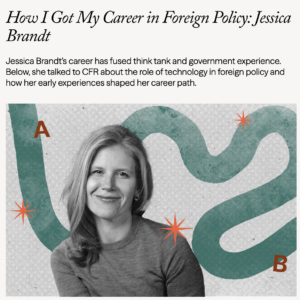
And what a “welcome back from summer vacation, kids” essay it is:
CFR: What did you want to be when you were little?
Brandt: I don’t think I had a clear idea early on, but I knew I wanted to do something that combined my interest in government, history, politics, and travel.
CFR:When do you feel like your interest in foreign policy really developed?
Brandt: As a young person, I dragged my family around to history museums and historical sites. So that was an interest very early on. Over time, I developed an interest in politics, and then the broader world.
I definitely had a chapter as a young person where I wanted to be a marine biologist or a voiceover artist in an animated film. But what felt like a handful of different interests in politics and government and travel eventually came together in a career in foreign policy.
CFR: I was surprised, and delightfully so, that you actually started your career at CFR when you finished college. You joined CFR’s National Program and Outreach team. How did that happen? Were you drawn to the organization, or was it just sort of luck of the draw as you were applying?
Brandt:When I had a chance to come to the Council, I jumped on it. I worked on the National Program and Outreach team when we were launching a spate of programs doing outreach to non-traditional foreign policy constituencies. I got to talk to religious leaders, state and local officials—which continues to be a constituency I care a great deal about—academics, and others. I loved that work, connecting non-traditional audiences with the foreign policy research that the Council does.
CFR: That’s so cool. After a few years, you went to get your master’s in public policy from Harvard, and then after that, you joined Brookings. What drew you to the think tank world, rather than maybe going straight into government or private sector?
Brandt:It’s a good question. I think the kind of policy work that researchers at a think tank do is the careful work of examining trade-offs, proposing options and ideas, and finding ways to balance competing equities for the greater good. I was drawn to that opportunity.
Brandt:Before grad school, I had the opportunity to live and work abroad. In my twenties, I worked for a joint Israeli-Palestinian organization. Though I now work on a very different set of issues, the experience I had there left me with an appreciation for what civil society organizations can accomplish, and also with the conviction that there are some things that only governments can do—difficult decisions that only governments can take. That’s what led me to the master’s program and left me very interested in eventually working for the government.
CFR: I noticed that in that first stint at Brookings, you were also special advisor to their president.
Brandt:Yes, I had an opportunity to work for Strobe Talbott, who I greatly admired. I learned so much working for him as he led Brookings. Strobe was a journalist for twenty-one years, the editor of Time magazine, and got his start as a journalist. I think he always had a journalist’s fascination with people and with stories and connected with human beings in that way. I learned a great deal from the way he brought a journalist’s mind and a journalist’s approach to foreign policy problems. I also learned a lot about how organizations work. I’m so grateful to have had that opportunity.
Isn’t that cute, I’m sure Strobe Talbott, known as the house “Russia Hand” in the Clinton administration really enjoyed mentoring her and sharing his learning and wisdom. It takes a long time to expand NATO all the way to Russia’s borders but ol’ Strobe got the project off to a strong start.
There’s no evidence that he had the kind of relationships with his interns that made his boss’s second term so notorious and he was certainly no chick magnet like the late great Ron Brown, but a mentor’s a mentor and an intern’s an intern and there’s no better teacher of Russophobia than ol’ Strobe.
Now on to the crack team at Alethea. It’s Girlboss country, but don’t worry, there’s an experienced daddy in the background, too.
According to their web site, Alethea was founded in 2019 by Lisa Kaplan whose origin story according to her Linked In profile is that in 2018 “Kaplan served as the Digital Director on the Angus King for US Senate campaign, where she developed and implemented a proactive and defensive digital strategy to identify, understand, and respond to disinformation campaigns by analyzing social media and other relevant data to determine reach and impact on voters. She is among the first who can share first hand experience from the front lines.”
Lisa is also a 2013 graduate of Goldfarb Center for Public Affairs at Colby College in Maine. Go Mules!
So we’re dealing with an incredibly credible expert.
Don’t believe me? Check out her 2021 video on “How to Protect Yourself from Disinformation” (409 views in 5 years for the incredibly popular Girl Security channel which has 115 subscribers).
Her four key insights for avoiding disinformation are brilliant and insightful:
- Look at the author
- Look at the date
- Get to know your own algorithm
- Think before you share
So yea, obviously any study released by a a person who’s bringing genius level insights like this is worthy of front-page coverage on the NYT. Go Mules!
But Alethea is more than just a one-woman show, Senior Advisor Brian Besanceney has quite the LinkedIn resume, featuring several years in “Public Service”:
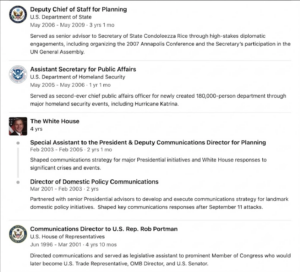
Notably he was running DHS public affairs during Hurricane Katrina. Heckuva job, Brian!
Followed by several years in the “private sector”:
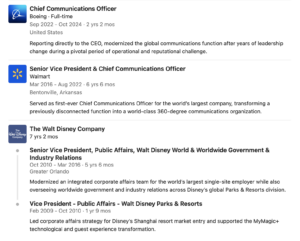
Wow, Disney, Wal-Mart and Boeing. That’s heavy duty.
And our boy Brian was Comms Director for Boeing from 2022-2024? AKA the dead whistleblower years, the cabin door blew off years.
Surprisingly he didn’t last out the year, although his work was recognized by the influential MEK Group:
Essentially building an ongoing case study on how not to handle crisis communications, Boeing first issued tepid and faceless statements in 2019 and didn’t fare much better in 2024. Various sources reported widely that Boeing didn’t seem to know what to do, flattening confidence in an industry that lives on trust and confidence.
Experts noted that the dry statements seemed to be written jointly by a lawyer and an engineer. No empathy. No assurances, No proactive statements promising action and building confidence. No credible compassion. No video of the Boeing CEO striding aboard a 737 Max to confidently demonstrate its airworthiness firsthand.
No wonder Brian moved on before the year was done.
I hope this odyssey through the resume of some our top Disinformation Experts nonsense purveyors and propagandists served to delight and distract, if not warn and alert.

Feral Finster
Surely by now you know that facts do not matter, only the relative status of the argument and the speaker. If the NYT (PMC high priests) says something bad (high status) about Russia (low status) then it will be treated as gospel by the goodthink set, regardless whether the argument is absurd on its face or not.
Any stick will do to beat a dog. Hell, the original Russiagate conspiracy theory is so wacky that it would have gotten its proponents laughed out of the 1962-era John Birch Society (cue up an image of some half-sloshed Bircher gesturing with his thumb “get a load of this guy over there!”), but millions of democrats and liberals treat it as an article of faith to this day.
If there’s no evidence, it just means they’re Very Clever.
Jan Wiklund
So Ben Nimmo is out again. He was one of the originators of Integrity Initiative, a British thinktank used for smearing NATO opponents and opponents of military spending in general. I suppose you can easily check it out.
Nat Wilson Turner
@Jan Wiklund
Great lead, thanks!
Dan Kelly
Thank you Nat.
I wonder if some of the writers we follow aren’t themselves ‘left’ enough in that they seemingly ‘get fooled again’ and again and again.
Just taking a comment from your latest over at NC:
‘Mirkinson and Chan are out to lunch. In the real world culture matters in politics. Count me on Team Klippenstein/Stoller. We need Platners to win the working class at large. Period.
The AOCs will crash and burn. And yeah sometimes they’ll have had messy lives because they weren’t scheming to run for office since they were 14.’
https://www.nakedcapitalism.com/2026/07/graham-platnerkayfabe-machine-maine-democratic-party.html#comment-4440850
So, both Stoller and Klippenstein – who approach things a little differently as writers with Klippenstein perhaps playing a bit of a more ‘objective’ role – both these guys were nevertheless very very friendly towards AOC et al initially and for a ridiculously substantial period of time beyond when a solid majority of ‘we the people’ had already seen right through them.
So I for one am very wary of paying too much mind to their ideas on the specific candidates going forward.
Because if this is the attitude…:
‘…Count me on Team Klippenstein/Stoller. We need Platners to win the working class at large.
Period.
The AOCs will crash and burn…’
…then we are in a lot of trouble because for all the other good work these writers do when the rubber hits the road they aren’t any better at actually gauging the candidates.
At all.
So, it’s not about ‘team Stoller/Klippenstein’ – and I am just using them as an example and again, I am not disparaging all the substantive work that particularly a Matt Stoller does on the ins and outs of the system and what have you….
But…..in the end, they are horrible at ‘intuiting’ people for lack of a better way of saying it.
Thanks again for all you do Nat.
Mark Level
Great piece as usual, Nat W.T., though obviously (as Finster notes) a “Dog Bites Man” story, the Epstein/ Spook Class up to their usual hijinks, the type that get lots of innocent people killed, or just enslaved if they are “lucky.”
In Ronald Reagan’s Heyday, T-shirts showing a pointing gun with “I’m from the Government and I’m here to help you” an anti-gubbmint and pro-Business marker, the only thing that has changed is insert the word “civil society” (cutout) for gov’t. We know who’s paying though, and it definitely excludes anyone who’d want a Civil Society and not Endless Resource Wars, Coups, Invasions, and looting for the few. Poor minorities forced economically into the military can pay the price in blood and lost limbs.
If Tom Cotton, who got a WaPo Editorial Board member fired c. 2019 after that man recruited him to write a piece on BLM, Tom’s piece said simply and clearly, get cops out there with submachine guns to mow those Niggers down, that’ll learn ’em! is for it, well that says several mouth-fulls. Ben Nimmo an Oligarchy Protector, nothing to do with democracy. CFR telling the truth and not repeating discredited Rachel Maddow histrionics a bit of a surprise, but good for them.
Jessica Brandt’s C.V. is terrifying, but you gotta love her 3rd Position, with the “Foreign Malign Influence Center within the Office of the Director of National Intelligence. (ODNI). She should sideline for Hollywood, I’m sure Mike Myers could hire her freelance for his next Dr. Evil Flick, enemy team Gay Assassin Russkies Bringing Anarchy Greatly Enhanced, aka “GARBAGE.” All spooked-up since her teens, impressive!! A Tracy Flick psychopath type, knew in High School (I’m sure we all know the film Election) she wanted to go to exotic places on the taxpayer dime and kill people!! I love when they pick wispy blondes for jobs like this, she looks so wholesome until she garrotes you from behind, for reading “subversive” literature.
Of course eventually she’ll get Orwell’s Face We All Deserve, will look like Madelyn Albright and Hillary Clinton, killing half a million children before invading a country based entirely on lies, killing a million plus more of all ages, it “was worth it”.
“That’s so cool!” I bet her job with the joint Israeli-Palestinian Org was training Palestinian Authority thugs to beat, arrest, and kill their own for the Zionist Ubermenschen, what fun. “Promoting Democracy”, once Hamas rightly won an election, US and Israel annul the results, no more elections in Palestine, Gaza for a quarter century.
It’s like Chile which had to be couped because “the people were so stupid” to elect a Democratic Socialist. A Fascist-Torture state is what the Chileans deserve, thank USA, Nixon and Kissinger for 4 decades of mass murder, rape and looting, Latin Americans deserve no better.
As to Strobe Talbott, his parents must’ve asked Thomas Pynchon for help naming their child, just perfect for a Ghoul & Spook. A real power player in Disinfo, Misdirection, Lies that get lots of innocent people killed, and a few Psychopaths rich and powerful beyond belief.
“Alathea” is Greek for “Truth,” so their org is literally named “Pravda.” (That might piss off LAS.) Very subtle.
Brian Besanceney (even Pynchon couldn’t invent such a stupid name) worked for BushCo in New Orleans letting the Natives die and the schools get privatized and Charity Hospital, which went all the way back to the days of Huey P. Long, and actually treated poor black people got shut down forever. Your sarc is inappropriate Nat, he did a “Heckuva job!” just as asked. And for Boeing; hey at least the families of all the dead passengers got decent payouts, right?
“Crisis Communications” info indeed, sometimes spread by actual Crisis Actors. MEK a corporate brand and a CIA-sponsored Terrorist Group (briefly even in the US, legally designated as such), the Mujahadeen El-Khalk. Again, not subtle. Maybe history not repeating but at least rhyming.
As a retired Librarian, that “Girl Security” Expert has items one and two right, Credibility Evaluation 101. “Know your own algorithm”!? Uhm, no, that’s what the spooks are there to do, know how to turn you against your fellow citizens and into an asset for the Epstein Class. #4, “Think Before You Share.” Think what the Surveillance State will think about your shares, they must be pro-Government, Pravda comrades!! Don’t want your Social Credit Score to drop, then someone accidentally leaves some uranium in your backyard in a box.
“Loose Lips Sink Ships!!” Loose Spooks Kill Kooks who don’t comply.
Thanks Nat. Read a great piece of yours some weeks back on Russia/Ukraine in Naked Capitalism. I look forward to checking out your newish website. Thought I saw the url in the initial post, seems to be hiding. Please share with the audience again.
Nat Wilson Turner
Thanks Mark, It’s https://www.natwilsonturner.com/p/the-old-gray-lady-runs-russiagate
Mark Level
Yes Nat, I know the url for this specific article. I tried to sign up for your Substack but can’t without kicking down the Benjamins. I may be in a position to do this soon, BUT for the moment I’m looking at a very long move in August when my lease is up, sadly can’t commit. But in the near future, I can hopefully add you to my supported sites. Thanks again, we sure need truth-tellers, and you know your way around.
Oh and thank you to Dan Kelly not just for calling out Stoller et al for credulity viz the Op that is A!O!C!, but also for directing me that some of my commentary from IW.N also appears with a simple Google search. First one I saw was when I raised my brief relationship with Eric Swallwell, 3 face-to-face talks, first when he was a seemingly good candidate against a fascist R. woman locally, then when he spoke at my school, for whatever reason people interested that I briefly knew a Pol who was first honeypotted by a young, Chinese agent, later got all rapey.
Kind of relevant given the recent Plattner kerfluffle too. My closest friend went to school with Swallwell’s younger siblings or cousins, that’s why he spoke at the school where we both worked. Typical grifter, in over his head, no street sense, now disgraced.
Nat Wilson Turner
The content at NWT will always be free so please subscribe to get the emails and pay what you can when you can.
Mark Level
Thanks, Nat, I will try again. Currently Mercury Retrograde, I tried this (it worked for Simplicius, who I check in on from time to time), and was blocked. Will be more persistent tomorrow after coffee.
mago
One has to wonder who these two bit grifter hypocrite cons are talking to beyond themselves and the deluded believers who see a commie under every bed and Jesus in the sky.
Ha ha. Communism. The attempt to resurrect that limp dick scare factor couldn’t get it up with a double dose of viagra.
It was lame in the day, but destroyed many a creative person’s life and career.
They (whoever they are) keep pulling out the same old tired playbook because it worked then so they think it’ll work now. And it still does kinda sorta.
Cue the Stones: rape and murder/it’s just a shot away shot away . . .
There ain’t a rock big enough to contain these creatures.
They’ll keep crawling out from under it.
Joe
@mago
“They” keep using the same playbook because they’re all 90 years old. Gerontocracy is alive and well, ask Mitch McConnell.
DMC
The College of Cardinals has a mandatory retirement age but the US Legislature doesn’t. If they had to retire at 70, how many congress creatures would we finally be rid of?