
The horizon is not so far as we can see, but as far as we can imagine

Tag: End of Democracy

The Death Of Democracy

Something I’m seeing in a lot of smart people (and stupid ones too, usually for different reasons) is a loss in faith of democracy.

In one sense this is simple: Democracy hasn’t been delivering for going on 50 years now. Things keep getting worse.

The graphic below is illustrative, but wrong:
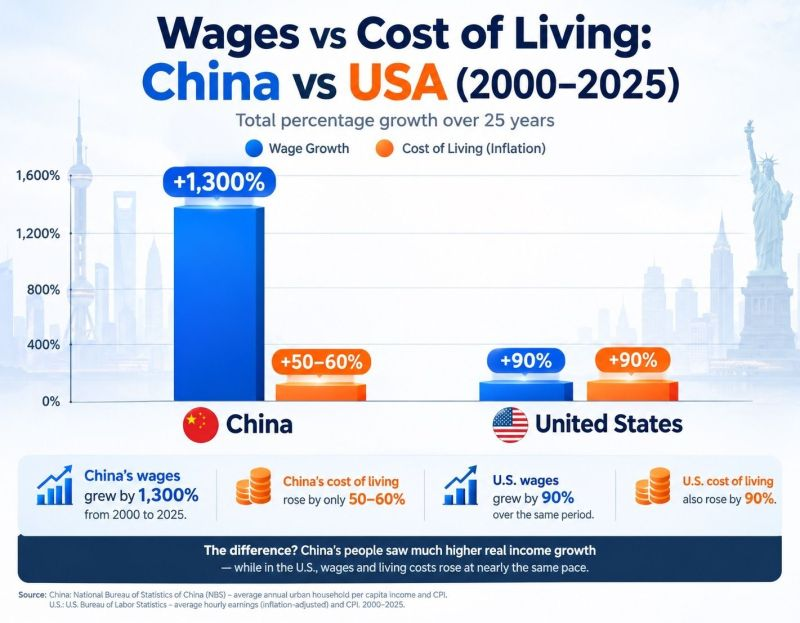
It’s wrong because I think everyone knows now that inflation, as measured in the West, is vastly understated. Wages have been rising slower than costs. I feel it on my own life, I have more income than I did ten years ago, and I can’t afford the lifestyle I had before: we’re talking simple things, like mostly eating cheap cuts of pork for meat, and not beef or even chicken. Consumer goods are sometimes cheaper, but usually not, but even when they are they break and are so expensive to repair with all the fancy digital crap in them that it makes more sense to throw them out and by a new one.

Tuition is way up. Medical is way up. In countries where it’s free or cheap, the quality is way down due to defunding, since our elites wants for profit medicine and the first step is making the public alternative crap. Food is up. Housing and rent are way up. Cars are way more expensive (real price, not hedonically adjusted.)

People see that nothing good seems to happen in democracies: life gets worse and worse. When something good does happen, some right wing government gets in power and reverses it, but more often right wing governments make everything worse and liberal governments don’t reverse anything they do, they just accelerate at a slightly slower pace.

So people are looking for alternatives.

This isn’t strange or unusual. In the post-war period many nations wanted to be democracies. They looked at America and Europe and assumed that democracy was part of what made them well off.

Today the shoe is on the other foot: we see how well China is doing. We read how cheap healthcare, food and housing are and we think “it must be the party system.”

The obvious advantage of the party system is that you can do long term policy. When you see nations which did industrialize after WWI what stands out is that they did so in de-facto one party states, places that were run for decades by the same party like Japan, South Korea and Taiwan.

They see that oligarchs have bought democracy, that what people want doesn’t matter to outcomes, unless elites also want it and that in China the population actually feels that the Party pays attention to what the people both want and need.

So they reason that we should switch to party systems because they seem superior. A sardonic twist on how everyone was down on the Party after the fall of the USSR.

The USSR shows that Party systems aren’t a panacea: they can fail too.

But, basically, democracy is going to keep taking hits and keep becoming less popular. It has failed on multiple fronts: sent industry to china, let housing prices get out of control, knew about climate change and not only didn’t do anything, but accelerated it. Geopolitical stupidity like creating the conditions for a Russia/China/Iran de-facto coalition and multiple insane wars from which ordinary benefit benefited not one whit.

As climate change gets worse and worse it will discredit both Democracy and Capitalism. I don’t think the Chinese have done nearly as much as they should have or could have, but with their heavy electrification program, their mass planting of forests and so on they’re the only nation which has done anything significant. Not good, but better than us.

Democracy has proven unable to reign in capitalism. China executes or life imprisons billionaires who break the law, we bail them out and immunize them from their crimes by fining their companies, but not them, leaving them still rich.

It all adds up to a horrid indictment of our system, and people are not going to put up with it forever. Liberal capitalism and liberal democracy, and perhaps democracy almost entirely, will be replaced by Party systems throughout the world over the next couple generations, starting, I’d guess, in about 15 years or so.

Failure, greed and incompetence have consequences, and the democracy will one of the casualties of our elites depravity.

What I write here is for the benefit of everyone, but alas, I live in capitalism and I, and the site, take money to keep running. If you value the writing here and can, please subscribe or donate.


x

By The People? For the People?

The simplest measure of a government’s legitimacy is whether or not it works for the benefit of the people. Democrats also believe the government should be selected by the people.

America does not meet either criterion at this time. Yes, there are elections, but the duopoly means that voters tend to choose from a small slate, pre-selected by others. The most visible occasion of this was when Obama had every Democratic presidential nominee candidate drop out so that Biden could defeat Bernie Sanders. Year in, year out, most of the candidates put up for election are those chosen by party insiders.

This is not always true, of course. It is less true on the Republican side, where primarying incumbents often works and where a vocal but grassroots minority does have significant power in choosing candidates. On the Democratic side it’s mostly true, but some candidates do slip thru: Mamdani for New York City mayor being the most recent example.

Still, overall, it’s questionable that Americans really choose their own government, and that’s true in most Western countries. In Romania, for example, the unacceptable candidate who was going to win was simply arrested and banned from running and there is a movement to make Germany’s AfD illegal. In Canada the party leaders simply refuse to allow pro-Palestine candidates, even those who are selected as candidate by their riding, to run.

The more accurate view is that political parties in most ostensibly democratic countries are political oligarchies. How much this is true varies. First past the post system tend to have very strong oligopolies, while proportional representation countries allow more flexibility.

Perhaps worse when outsider candidates do break thru and win they usually don’t wind up voting for and doing what they ran on. You can see this (though it’s a bit of a stretch to call him an outsider) with Trump. It’s visible with AOC, the darling of the left who has voted for almost all Israeli aid packages and who has clearly decided to become an insider.

So first there’s a huge barrier to electing people who support outsider views, then most of them are co-opted. If there’s a real threat of an outsider taking the top seat, the establishment works hard against them. We saw that with Corbyn, where one academic study found that about 80% of all news stories lied about his policies.

It’s fair to say that most Western countries don’t really have “government by the people.” The mechanisms still, partially, exist. The form is there, but the reality isn’t. They’re political oligarchies. (The EU is worse than the US.)

And we all know that most Western governments aren’t “for the people.” For fifty years they’ve been immiserating their own people, becoming rich themselves and forcing money upwards, creating a financial oligopoly on top of the political oligopoly. I often say that for most Westerners their most dangerous enemies are their own politicians. Putin isn’t a danger to you as a EU member or America. But Macron or Von Der Leyen are. They’re the ones destroying your standard of living and piecemeal destroying social supports. This is even more the case in Britain, where there hasn’t been a Prime Minister whose primary legacy wasn’t hurting most Britons since the 70s. (Well, maybe Tony Blair had that as his secondary goal, his primary goal being hurting Iraqis to toady to America.)

Great systems are judged by their great opponents. For much of the 20th century that was the USSR and it is not entirely a coincidence that when the USSR was strong, Western governments treated their people well. Of course that isn’t all there is to it, there were the oil shocks, Vietnam, etc… But the West was ideologically scared of communism and when it seemed to work, they felt they had to make capitalism work.

These days the great opponent is China, and the one party communist state running a hybrid capitalist/socialist economy. And the problem for the West is that China’s government, while not “by the people” is definitely “for the people”. They’ve brought more people out of poverty than anyone else ever has. They keep rent and housing and health care prices low, as deliberate policy. Incomes are lower than in the West, but costs are much lower. You can buy enough food to feed someone for a week for $50 in most of China, with ease.

They also create the future: high speed trains, for example. They build real public infrastructure. I was very impressed when they built rest and relaxation places for delivery workers: they cared that such workers were miserable and exploited. And they build things like this:

Now it’s fair to say that this isn’t precisely “socialism” vs. “capitalism”. There was a time when the West built lots of public parks and so on. It’s the difference between a real rich society and a financialized society. One has plenty of excess capacity, the other has plenty of money but very little actual ability to build and create and no desire to do so if someone can’t make an unfair profit from it.

The problem for the West is simple: China is better governed than almost any (perhaps actually any) Western country. And that governance shows plenty of signs of being in the interests of the vast majority of Chinese, whose lives it has vastly improved. Democracy itself is in danger. If it doesn’t produce better results for ordinary people, and if it’s basically fake anyway, why keep it?

The risk here is that the anti-democratic forces in the West aren’t the CPC, they’re billionaires who think the problem with the current government is that it still does some things for ordinary people which aren’t primarily about benefiting billionaires. They’re fascists, at best.

Democracy, if it wants to survive as a major force in the world, needs real reform (all so-called reforms in the West over the past 50 years have been about hurting ordinary people to benefit rich people). If it isn’t re-aligned to work for the majority, its day as a major force in the world faces a bloody sunset.

This site is only viable due to reader donations. If you value it and can, please subscribe or donate.


Powered by WordPress & Theme by Anders Norén