Ian Welsh

The horizon is not so far as we can see, but as far as we can imagine

Postliberalism, Liberal Apogee, Routine Elite Failure and Then?

I was alerted to Nathan Pinkoski’s “Actually Existing Postliberalism,” by N.S. Lyons’ response “The Post-Cold War Apotheosis of Liberal Managerialism,” and enjoyed both tremendously.

Pinkosi’s piece is an excellent short history of the public-private partnership currently aiming for absolute global cultural control via the weaponization of finance that he calls postliberalism.

I thought it would be fun to excerpt all the times Antony Blinken’s name appears in the piece.

First mention:

When Bill Clinton took office, he continued the pursuit of openness. In 1993, he ratified NAFTA and relaxed the ban on homosexuals in the military. However, he made it clear that the old liberalism was not enough. Eager to extend the reach of democracy and confront foreign enemies who stood in its way, his administration developed new tools to advance America’s global power. In September, National Security Advisor Anthony Lake outlined a new paradigm. His speech, “From Containment to Enlargement,” bespeaks a political revolution. It provided the blueprint not only for the foreign policy agenda of nearly every U.S. president since then, but for the convictions of every right-thinking person. Lake’s speechwriter was Anthony (sic) Blinken.

Second mention:

After Biden was sworn in as president, his administration shelved a plan to overhaul sanctions policy. A consensus held that if the kinks of the past could be worked out, then the Americans and Europeans had all the weapons in place to launch a devastating financial first strike against their preferred targets. Planning began in the first year of the new administration, with Secretary Blinken’s State Department taking the lead. So by February 2022, just as the Russian invasion of Ukraine faltered, the arrangements were already in place. The strategic possibilities seemed limitless. Russia could be brought to its knees; Putin would follow in the ignominious footsteps of ­Milosevic and Gaddafi.

The execution of the strike was dazzling. The scale, especially the involvement of SWIFT and the targeting of Russia’s central bank, caught the Kremlin by surprise. It was ­Barbarossa for the twenty-­first century. Yet the first strike did not yield the promised results. Nor did the second, third, or fourth. Putin’s approval ratings soared, Russia’s industrial output increased, and its military continues to grind away at the Ukrainian army. Despite implementing nearly 6,000 sanctions in two-plus years, the euphoria of spring 2022 (let alone that of the holiday parties of 2011) is long gone. Although American policymakers have said again and again that they have mobilized a global coalition against Russia that has left the country isolated, that is not the case. The map of the countries that have imposed sanctions on Russia closely resembles the map of the countries that have legalized same-sex marriage. Economic warfare against Russia has exposed the limits of the global American empire.

Lyons applauds Pinkoski’s essay but rejects the notion that this is a revolution against liberalism — instead, it is its apogee.

Sadly, he doesn’t mention Blinken, but he does elaborate on the frightening ambition of this movement:

The managerial ideal is the perfect frictionless mass of totally liberated (that is, totally deracinated and atomized) individuals, totally contained within the loving arms of the singular unity of the managerial state. To achieve its utopia of perfect liberty and equality, liberalism requires perfect control.

This ideal is, of course, the very essence of totalitarianism. Yet if we wonder why the distinction between public and private has everywhere collapsed into “the fusion of state and society, politics and economics,” this is the most fundamental reason why. Perhaps, for that matter, this is also why the U.S. and EU now habitually sponsor LGBT groups in Hungary or India, and finance human-trafficking “human rights” NGOs in Central America and the Mediterranean: because managerialism’s blind crusade to crush any competing spheres of social power has gone global.

In response, a comforting tonic from The Archdruid, John Michael Greer at Ecosophia, whose reader “Dave” asks him:

I’ve noticed a growing and extremely worrying trend of the “elites” of politics and entertainment pursuing reckless and (to me) clearly wrong courses of actions that blow up in their faces, and then instead of honestly looking at the situation they’ve had a large hand in creating and doing a mea culpa, either doubling down and getting mad at regular people when they’re less keen to do what the elites tell them, or trying something else without ever really honestly accounting for their mistakes. The actions remind me of signs of elite collapse that this blog has talked about for years now and it’s very surreal and worrying to see happening in real time. What is going on and why can’t the “elites”, the people with access to more data and resources and advisers than anyone else, seem to realize what’s going wrong? Do they not care or are their actions part of a larger plan, not to sound conspiratorial?

Greer’s response was just what I needed to hear:

Dave, I don’t think that it’s any kind of plan. Quite the contrary, this is normal elite failure, the thing that comes right before an elite replacement crisis. Just as the capitalist elite of the 1920s crashed and burned, and was replaced by a managerial elite in the 1930s and 1940s, the managerial elite of the 2010s is crashing and burning, and will be replaced by an entrepreneurial elite in the 2020s and 2030s. The entitled cluelessness of a class that has remained in power too long is a familiar thing; comparisons to French aristocrats just before the French Revolution also come to mind.

Although, honestly if this means that Elon Musk and company are going to win what Chris Hedges calls “The Choice Between Corporate and Oligarchic Power”eek!

Kamala Harris, anointed by the richest Democratic Party donors without receiving a single primary vote, is the face of corporate power. Donald Trump is the buffoonish mascot for the oligarchs. This is the split within the ruling class. It is a civil war within capitalism played out on the political stage. The public is little more than a prop in an election where neither party will advance their interests or protect their rights.

And what do the oligarchs want?

Warlord capitalism seeks the total eradication of all impediments to the accumulation of profits including regulations, laws and taxes. It makes its money by charging rent, by erecting toll booths to every service we need to survive and collecting exorbitant fees.

Trump’s cohort of Silicon Valley backers, led by Elon Musk, were what The New York Times writes, “finished with Democrats, regulators, stability, all of it. They were opting instead for the freewheeling, fortune-generating chaos that they knew from the startup world.” They planned to “plant devices in people’s brains, replace national currencies with unregulated digital tokens, [and] replace generals with artificial intelligence systems.”

As much as I eagerly anticipate the long-overdue fall of our current elite, I truly dread what’s coming up in their wake.

The End of Austerity & Reindustrialization

Austerity Is Mostly Stupid… Mostly.

This blog is for understanding the present, making educated guesses at the future, and telling truths, usually unpleasant ones. There aren’t a lot of places like this left on the Web. Every year I fundraise to keep it going. If you’d like to help, and can afford to, please Subscribe or Donate.

But there is some logic to it, especially in places like Britain. The fundamental problem is de-industrialization. You can print as much money as you want, sure, but if almost everything you need is made or grown or dug somewhere else well, you have a problem. The US avoids this thru having dollar hegemony, for now, but the UK doesn’t have that and the Euro ain’t what it used to be either. The solution is simple in concept: you need to re-industrialize with than printed money.

(This is a theme and topic we’ve covered before, but forgive me running thru it again from another angle.)

Industrializing or reindustrializing is hard, especially with open markets. You need very careful use of tariffs and subsidies, and you need to cut deals with the current hegemonic industrial power: aka. China. You need real industrial policy, in other words. And neoliberalism doesn’t believe in that.

Instead neoliberalism believes in this weird idea that markets are self-correcting and that whatever markets do is right. Nor does it believe in increasing wages for domestic demand, because it came to power during the oil shocks/stagflation period.

Raising wages and thus general domestic demand when you don’t produce enough domestically means money flooding out of the country. This isn’t necessarily bad. A lower pound or Euro is an export subsidy and helps reindustrialize, but it’s still a hard sell and it has to managed.

You can’t let the trade and balance of payments deficit grow too large. And you have to manage domestic demand: pushing people to buy what is produced locally and making imports for consumer goods expenisve, while funneling import buys towards capital equipment.

This playbook has been run many times. Japan, South Korea, Taiwan, the US in the 19th century, China most recently. We know how to do it. But it does require discipline and an ideological change from neoliberalism, plus a willingness to cooperate with the main industrial power

It’s damn near impossible to industrialize or re-industrialize without aid from the current industrial hegemon. That means getting into a trade war with China is counter-productive. You need to import capital goods from them, and sell them what you produce at competitive prices.

Japan and the USA had Britain. Japan (2nd time), South Korea, China and Taiwan had the United States. You need the markets, knowledge and capital goods.

This mean, in effect, that you need to cut a deal with the current industrial power. They don’t precisely have to be good deals (China offered to make American rich people richer), but the deal has to be something they want.

For US/China one obvious deal is to let them get goods like EVs into the US without tariffs if they build branch plants and help create a supply network in the US. Another obvious deal is to stop supporting Taiwan so much & another is to let them have the South China sea. The EU and Britain can make the same deals.

If the last two bother you, well, look at it this way: they’re going to get Taiwan and the South China Sea anyway, you’re just making it easier for them. You’re giving up things you’re going to have to give up anyway.

This requires a psychological change among Western elites. They need to be willing to admit that they are no longer the top dogs, at least economically and that they can no longer just impose the terms they want.

The longer you leave cutting deals with China to help you reindustrialize, the worse deals you’re going to get. Leave it too long, and reindustrialization may be essentially impossible.

Of course there’s much more to it than this. A complete rejiggering of internal markets is necessary. You have to gut finance and put it at the service of industry. Private equity has to be destroyed wholesale. People can only get rich by exporting or making goods for the domestic market which replace imported goods. Anyone doing significant import of anything but capital machinery (with an eye to building your own) can only be allowed to survive, not prosper.

Generally speaking, to use econo-speak, incentives have to be aligned for re-industrialization, and dis-aligned for anything predatory. Betraying elites must be crushed.

There is no solution to declining standards of living in the Anglosphere and the EU without re-industrialization (maybe Canada and Australia could find another way.) You’ve got to either produce what you need, or produce what others want to buy from you. It’s that simple.


Georgia Is Forging A Unique Path In The Post-Soviet Space

Earlier today I responded to a comment asking if Armenia and Georgia are next after the Ukraine.

I wrote: “Armenia has long been a Russian client state. They will remain one for the foreseeable future. Georgia is divided. When Georgia attacked Russian positions in South Ossetia in 2008 both Russian forces in and around South Ossetia and jointly with Abkhazian forces, Russia occupied Zugdidi, Gori, Poti and Senaki and the Abkhaz captured the Kodori Gorge. Through these actions Russia effectively split Georgia into three parts and there will be no Georgian admission into NATO. In fact, my buddy Mamuka who lives in Tbilisi, Georgia told me earlier this year, “we just have to make our peace with our giant neighbor to the north, like Mexico has made its peace with the USA.” He’s not wrong.”

Artin DerSimonian echoes, albeit much more eloquently and with more convincing evidence and arguments, exactly what I said: “While Georgia has condemned Russia’s actions in Ukraine at international fora and has provided humanitarian aid to Kyiv, Tbilisi has also reopened direct flights with Russia, refused to adopt European sanctions (though generally restricting sanctions-busting trade) or supply arms to Ukraine, and increased its bilateral trade turnover. While some have been understanding of Georgia’s uniquely challenging position amid the war in Ukraine, others have been less forgiving and more circumspect of the underlying motivations of the ruling party’s actions.”

You can read his full article here. It is an outstanding piece of analysis, reminiscent of the arguments I had with Georgians when I visited the country in 2003. It was as clear as a window pane that Georgia must inevitably find an accomodation with its giant neighbor to the North, just as Mexico has done with the United States. Right or wrong, a giant neighbor next door is an ugly reality that must be faced honestly.

As DerSimonian writes, “If that initial strategy falls short of achieving our desired outcomes, then our next step ought to be adjusting our existing policies to fit the realities that develop beyond our borders without unnecessarily alienating those whom we seek to influence.”

It’s wonderful to see at least one nation in the post-Soviet space acting with some strategic and diplomatic maturity. That it is the Georgians is even better. I hope they prosper and solve their dreadful seperatist issues.


‘Extraordinary’ Corruption at RTX (formerly Raytheon)

A few weeks ago a friend of mine from Nicaragua visited. One aspect of American culture he admired was our lack of corruption.

“Oh dear, Marlon,” I replied. “We are a deeply corrupt nation. The difference between our two nations is that in Nicaragua you have both ‘corruption of the poor,’ such as bribes to police officers, bribes to health inspectors, home inspectors, low level bureaucrats and the like and ‘corruption of the rich’ which is usually institutionalized, a part of the legislative process, includes the corrupt purchase of large scale national rents collection, and is unambiguously unethical. Everyone, in Nicaragua, wets their beak, whereas only the rich and powerful in America participate.”

Today Responsible Statecraft offers up the epitome of American corruption:

“RTX (formerly Raytheon) has agreed to pay nearly $1 billion in fines, which is one of the highest figures ever for corruption in the arms sector. To incur these fines, RTX participated in price gouging on Pentagon contracts, bribing officials in Qatar, and sharing sensitive information with China.”

Price gouging? Of course. Bribery in Qatar? No surprise. But sharing sensitive information with China meets my definition of treason. Plus, a billion dollars in fines is much more than the cost of doing business. That’s a penalty that hurts the bottom line.

What makes me sickest is that this is a company that profits off of patriotism, and the demonization of foreign groups, like civilians in Yemen, Gaza and the Ukraine.

Meanwhile, Russia has rebuilt its defense industry to serve the Russian national interest, not corporate titans. If, heaven forbid, we get into an all out war, and cannot “win” (loosely defined) within six weeks, we’re toast. Our defense industry is simply not tooled up for that kind of capacity and we’ve undergone far too much de-industrialization to keep up with our peer competitors manufacturing capacity. That’s a sobering thought.

2024 Fundraising Update

We’ve raised something over $5,400 since the fundraiser started, meaning we’ve reached the first goal of $4K and our $2,500 out from $7,000 tier, at which point I’ll do 3 reviews of important books. At 10K, which is $4,600 out, I’ll write an article on:

…the fundamental process which keeps society together, how it fails and renews and under what conditions it fails to renew.

And at $13,000, I’ll write:

an article on the weaknesses of North American style police, and how a determined and ruthless opponent could take advantage of those weaknesses to rip them a new one.

I really appreciate everyone who’s given. Donations and subscriptions from readers which have kept this blog alive and running. Times are hard, since Covid each fundraiser has become more difficult, because people are hurting, in particular from inflation.

I think this is a place where we tell the truth as we know it and where we try to make educated guesses about what the future holds. Every year it seems there are fewer places like this left.

If you’re in trouble financially, if food or shelter or medicine is an issue, please don’t give.

But if you can afford it, and you like my writing, I’d appreciate it if you did.

SUBSCRIBE OR DONATE TO OUR 2024 FUNDRAISER

A Rare Balanced Update On The Russo-Ukrainian War

As one commenter noted, “Never thought I’d live in a world where I would be hyped for the Austrian army dropping a new video.”

You can watch it here, as I do not know how to embed it in Word Press.

By the way, if you want to understand Putin, you read Dostoevsky, Notes from the Underground, not Mein Kampf to suggest otherwise is an abdication of being intelligent.

Nota bene: Crime and Punishment is the best novel ever written. Just saying.

Nota bene duo: the Ukrainian drone attack at 5:05 on the Russian soldiers is terrifying.

Week-end Wrap – Political Economy – October 20 2024

by Tony Wikrent


Strategic Political Economy

MASTER PLAN, Ep 10: The Master Planners’ Heist Of The Century

[The Lever, October 15, 2024]

By 2010, the master planners had firmly gained the upper hand. Their victory in Citizens United allowed corporations to spend unlimited amounts of money to influence elections, giving business interests unprecedented power in politics. But the master planners’ onslaught wasn’t quite over. In this episode, we show how they embarked on a bold heist to crack the vault protecting democracy itself. It’s the heist story of the century, in three acts.

First, the schemers needed to take out the security cameras: The disclosure laws that in some instances still required the names of big-money donors to be reported. In a perverse act of mental gymnastics, petrochemical tycoon Charles Koch’s Americans for Prosperity sought to eliminate these laws by weaponizing a 1950s ruling that had protected civil rights activists in the Jim Crow South.

In the second part of the heist, the schemers went after the last remaining cops on the beat. They manufactured a scandal at the IRS, the country’s last remaining campaign finance regulators, over the targeting of so-called “social welfare” nonprofits — many of which were fronts for dark money groups.

Finally, the master planners needed a getaway plan, a way to prevent prosecutors from coming after them as they made off with the loot. They found their opportunity with the appointments of Neil Gorsuch, Brett Kavanaugh, and Amy Coney Barrett to the Supreme Court.

As high-profile bribery and corruption convictions fell, the message was clear: The system is rigged, and political officials are ready to play for pay.

Key findings referenced in this episode include:

  • See the evidence from the case in which a Virginia jury convicted former Gov. Bob McDonnell and his wife Maureen for accepting $175,000 in gifts and loans from a businessman — including a $10,000 white leather coat, shopping sprees, use of a Ferrari, and a $6,500 Rolex.
  • In the 2016 case McDonnell v. United States, a wave of amicus briefs flooded the Supreme Court attacking the legality of the anti-bribery laws used to convict the former Virginia governor. Chief Justice John Roberts cited these briefs as evidence of “bipartisanship,” but they mostly came from influential figures in the money and politics sphere, including corporate lobbyists and Federalist Society members like John Ashcroft and Ted Olson. Other notable supporters filing briefs included Christian Right attorney Jay Sekulow and Citizens United mastermind James Bopp Jr. Even Justice Lewis F. Powell’s former corporate law firm joined in, representing a coalition of elite business owners.
  • Indicted New York City Mayor Eric Adams’ lawyers recently filed their first motion to dismiss the bribery and fraud charges lodged against him, heavily relying on Supreme Court rulings that have weakened anti-corruption laws. The motion points to overturned convictions in corruption cases discussed in this episode, including those of McDonnell, former Enron CEO Jeffrey Skilling, small-town mayor James Snyder, and New York power broker Sheldon Silver.
  • Read law professor Zephyr Teachout’s article on how both liberal and conservative justices on the Supreme Court have expressed skepticism about anti-corruption law, narrowing the definition of corruption and limiting public power.

Germany Honors Biden For Destroying Nordstream & Their Economy

I cannot believe this is happening:

Germany honored U.S. President Joe Biden for his contribution to trans-Atlantic relations on Friday, ahead of his meetings with European allies on Russia’s war in Ukraine and the conflict in the Middle East.

TIME Magazine: Germany Honors Biden for His Contribution to Trans-Atlantic Ties as the U.S. Election Looms

Germany Honors Biden for His Contribution to Trans-Atlantic Ties as the U.S. Election Looms

The sheer delight the pathetic “Traffic Light” coalition government takes in abasing itself before the US hegemon is pornographic in its shameless indecency. Especially the same week that the Danes reported this:

Just days before the Nord Stream gas pipeline attack in September 2022, warships belonging to the U.S. Navy were on the scene and ordered nearby officials to keep away.

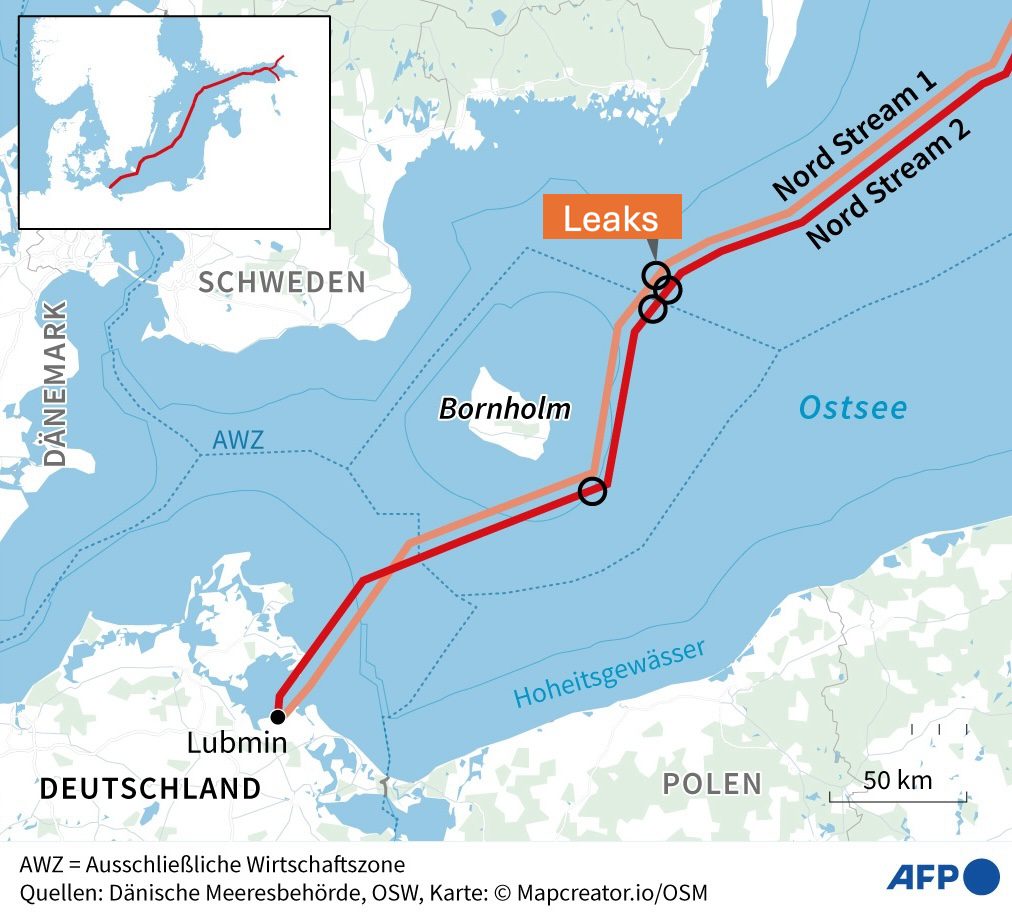
That is according to John Anker Nielsen, who is harbour master at Christiansø, the easternmost part of Denmark in the Baltic Sea, northeast of the island of Bornholm and close to the sites of the Nord Stream explosions.

Map showing the route of Nord Stream 1 and 2 in the southern Baltic Sea and location of the leaks. AWZ=Exclusive Economic Zone
Map: AFP / Nadine EHRENBERG, adapted

Nielsen late last month told a reporter at Politiken, a major Danish daily, that he went out with a rescue team four or five days before the blast to check on nearby ships with switched-off radios, suspecting there might have been an accident, only to find U.S. warships, whose staff ordered the team to turn back immediately.

Never forget Biden threatened Nordstream:

Biden: If Russia invades uh that means tanks or troops crossing the uh the border of Ukraine again then uh there will be uh we there will be no longer a Nordstream 2. We will bring an end to it.
Reporter: What? How would you how will you do that exactly since the project and control of the project is within Germany’s control?

Biden: We will. I promise you we’ll be able to do it.

and Nuland did it too. This video is still up on the State Department’s official Facebook page because they’re proud of it:

“If Russia invades Ukraine, one way or another, Nord Stream 2 will not move forward.”

And Never forget what Nuland said at a Senate Foreign Relations Committee hearing on January 26, 2023:

“I am, and I think the administration is, very gratified to know that Nord Stream 2 is now, as you [Ted Cruz] like to say, a hunk of metal at the bottom of the sea.”

Blinken celebrated it as an economic opportunity:

“…ultimately this is also a tremendous opportunity.  It’s a tremendous opportunity to once and for all remove the dependence on Russian energy and thus to take away from Vladimir Putin the weaponization of energy as a means of advancing his imperial designs.  That’s very significant and that offers tremendous strategic opportunity for the years to come…”

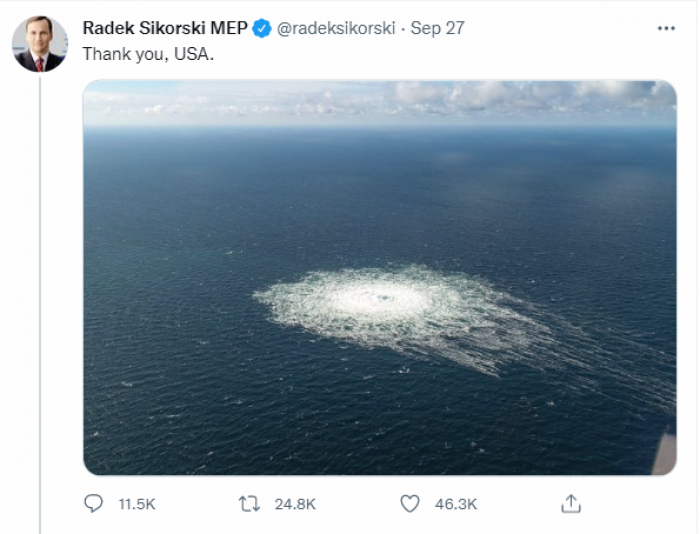
And then there was this from Anne “It’s Time to Prepare for a Ukrainian Victory” Applebaum’s husband who’s a Polish official:

Former Polish FM thanks US for damaging Nord Stream pipeline

The consequences of this have been the deindustrialization of Germany:

German industry increasingly struggles to compete on the world stage. Particularly hard hit are its mighty chemical and heavy industry sectors, which are now in rapid decline. One of the main drivers is policies that have made energy costs skyrocket, and there Germany serves as a canary in the coal mine for other leading industrial nations.

It’s kind of grimly amusing that Forbes’ use of the euphemism “policies that have made energy costs skyrocket” rather than say “self-defeating sanctions on cheap Russian gas combined with the biggest act of industrial sabotage in modern history” and it also doesn’t mention that it’s been America’s policies that have deindustrialized Germany.

It’s also so humiliating as an American that the neo-conservative cabal of psychopathic nitwits has been in sole control of US foreign policy since the Clinton administration and now they have a lock on US corporate media as well.

The above mentioned Anne Applebaum provided the perfect example of their delusion and idiocy with her September, 2022 prediction that Ukrainian victories in Kharkov would bring down Putin.

But that brings me back to Germany’s pathetic ruling coalition. This is how well they’ve done in recent state elections:

In the eastern states of Saxony and Thuringia, the far-right AfD received more than double as many votes as the three parties which make up the federal coalition government — the center-left Social Democrats (SPD), environmentalist Greens and neoliberal Free Democrats (FDP) — combined. These parties’ results are each in the single digits. The Greens in Thuringia and the FDP in both states even failed to meet the 5% threshold to be represented in the state parliaments.

And on the left:

newly established populist party, the Sahra Wagenknecht Alliance (BSW), managed to score votes in the two-digit range in their very first election.

The German people are chomping at the bit to vote out the gang of traitors who have allowed the US to annihilate their economy.

Although in fairness, they also gave the last US President who walloped the Germany economy the same award:

“Biden received the highest class of Germany’s Order of Merit, which was also bestowed on former U.S. President George H.W. Bush for his support of German reunification.”

Kind of fitting that the era of American unipolarity is framed this way. Bush at the beginning. Biden at the end. The Germans footing the bill for American foreign policy.


Page 78 of 512

Powered by WordPress & Theme by Anders Norén