
Ian Welsh

The horizon is not so far as we can see, but as far as we can imagine

The Geithner Plan’s Unpleasant Consequences

Asian fan

Image by rom

The Geithner Plan, combined with the other steps taken by the Federal Reserve and the Treasury, make fairly clear the Obama administration’s plan.  The sardonic summary would be “to continue the work of Hank Paulson”, but the more serious one would be, “we’re going to throw money at this problem untill it goes away.”  The end result will be riptide inflation, and an economy that suffers from the Japanese sickness where the good times just never, ever, seem to return.

It is unclear how much money has been spent, guaranteed and loaned at this point.  Given that back in February the number was $9.7 trillion, and that trillions have been committed since then, I think it’s safe to say that we’re over $12 trillion.  This is a lot of money.  The entire US GDP for 2008 was about $14 1/2 trillion.

The Fed has even decided to buy treasuries, which is the absolute definition of “printing money” since it amounts to one part of the government funding the other part of the government.

All of this money is going to land somewhere.  What we are going to see is another bout of riptide inflation, where some parts of the economy (such as wages and housing prices) are in deflation, while other parts are inflating.  My guess where the money is going to land?  Oil prices again.  It’s already begun.  Put all that money into the hands of speculators and they have to park it somewhere.

Likewise when America buys its own treasuries, that means that the treasury bubble is going to start deflating.  Private investors aren’t going to want to invest in a Ponzi scheme which is coming to an end.  The US dollar has also very likely peaked, and we’re going to see it deflate over the next year.

All of this was avoidable.  What should have been done was to take steps to deal with oil inflation: such as  a 55 mph speed limit, 3 day weekends at major corporations, and so on.  Such steps should have been instigated the second Obama took office, or put into the bailout bill or the stimulus bill.

The result instead is riptide inflation/deflation combined with a falling dollar and more difficulty financing this expansion in any way that isn’t nakedly printing money.

Then we come to the Geithner plan, which amounts to the federal government subsidizing hedge funds to buy toxic securities at overvalued prices using mostly money from the Federal Reserve and the FDIC in order to make sure they don’t have to ask Congress for money, since they know Congress would never give them another trillion and a half or so.

At the end of the day, the FDIC and Fed are backed by the US government, so any losses will have to be made up for by the American taxpayer.  (In the old days, this was known as “taxation without representation”.)

There will most likely be losses, because a good chunk of the loans to hedge funds are non-recourse, meaning that if the value of the security goes down, it’s Uncle Sam who’s  on the hook for most of the loss, not the hedge fund.  Likewise the funds will be heavily leveraged, allowing them to pay higher prices than otherwise. Add to that the continuing collapse of  housing prices and the economy, and you have a situation where the target is moving.  As the economy gets worse, more and more people default on their mortgages, leading to a decrease in housing prices and thus the prices of securities built on top of housing.

Which leads us to the stimulus bill.  The Stimulus bill is not large enough or constructed well enough.  So even if it works in a technical sense (gets GDP growth above zero) it’s probably not going to really turn the economy around in the ways that matter: recovering jobs and increasing wages.   Without these two things increasing, and without a clear direction for the economy other than hedge funds receiving massively leveraged loans to play paper games—which worked so well before the crisis, you just know we should try it again—housing will keep decreasing, demand will not recover properly since consumers won’t have money to spend, and the assets underlying the financial crisis will continue to decline in value.

Because the  government has loaned money to buy up the assets, and guaranteed much of the remainder of it, the government will be on the hook for the losses. (And by “the government,” I mean “your tax dollars.”)

What happened in Japan after their bubble is instructive.  Instead of taking the toxic waste off their banks hands, or forcing write downs, they allowed zombie loans and zombie banks to sit around doing not much of anything.  They also tried large Keynesian stimulus, but every time it looked like it might be working, they backed off.  The end result was, and is, 20 years where the Japanese economy never really got good again.  Short periods of modest growth were followed by recessions, over and over again.

Defenders of the Geithner Plan would say that we’ve learned from Japan’s mistakes.  What we’re doing is taking the loans off the banks’ books, so we don’t have zombie banks.  This misses the point, even assuming the government does eventually manage to move all the bad debts from the banks and into taxpayer hands, which is questionable since the losses are a moving and increasing target.

Why?—Because in macroeconomic terms it really doesn’t matter who has the debt, it doesn’t matter who is impaired.  If the government has all the debt and winds up crippled, and government spending and loans wind up crippled, the effect is virtually the same as having crippled banks hanging around.  The debt still has to be paid off.

The key difference here is between “paid off” and “wiped out”.  “Paid off” means the full value gets paid back (minus whatever inflation the US has, which may be a lot). ” Wiped out”, on the other hand, is what would occur if private banks, firms and investors were forced to take their own losses.  In that case, when the full value of the investor or firm was gone, any remaining value would simply disappear.  If a bank goes bankrupt owing $200 billion, and the bankruptcy windups leave only $100 billion of proceeds, then the remaining $100 billion goes away.  Yes, that $100 billion may wipe out some other people, but it’s done. It’s over with.  It’s finished.  You can’t get blood out of a stone, and when a firm or person is wiped out, they’re wiped out.

Instead the decision has been made, in effect, to pay back the full amount of the losses—and not to force those who made the bad bets to pay them back, but to put as much as possible of the losses onto the government and make taxpayers pay them back.

Since we’re talking about trillions of dollars of losses, in a declining economy, that means impairment of both government and private spending for years to come.

The end effect will likely be little different than what happened in Japan, with the exceptions that the US may see significant inflation, and that as net importer rather than a net exporter, the US probably can’t keep this up for 20 years.  Which means that at some point in the future it will either have to default on the debts, inflate them away or have a financial collapse.

None of this is necessary, and there are still ways thing could be done better.  The administration is set to announce their regulatory reforms next week.  If those reforms are thorough and complete, ending the existence of “too big to fail firms”, sharply increasing tax progressivity and putting firm limits on leverage, then perhaps the pain to come will be worth it, if only because steps will have been taken to make sure it doesn’t happen again.  But if real regulatory reforms aren’t put in place soon, the future will be bleak indeed.
There Was a Class War. The Rich Won.

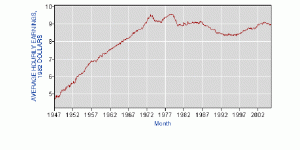
Average Hourly Wages For Goods Producing Workers

Average Hourly Wages For Goods Producing Workers

What happens if there’s a class war and only one side bothers to show up and fight it? That’s what happened over the last thirty years. There was a class war, and the rich won. Period. It’s over, they kicked our knees out from under us, put on their steel-toed boots and spent the last thirty years telling us that they were going to trickle on us and we’re going to like it and beg for more.

Seems like hyperbole? It’s just the numbers. The top left shows the manufacturing wage earner’s hourly wages. Not “family income” which includes both of you going to work, but hourly wages. The only reason it’s goods producing is they go back longer, but other charts show the same pattern.

So, if you’re an ordinary slob, you haven’t had a raise in over 30 years. In fact, your real wage peaked over 30 years ago and it’s never recovered.

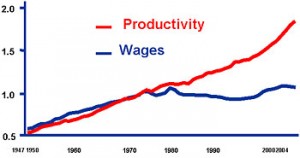
productivity and wages

productivity and wages

This would be ok if the US hadn’t been getting richer, getting more productive, ever since then, but I’m sure you won’t be surprised to hear that productivity  has kept going up. Yet somehow wages didn’t.

Damon Silvers, whom we can thank for the wages and productivity chart, thinks it has a lot to do with a hostile anti-union environment and with the simultaneous decline of progressive taxation. I’d say he’s got a big part of the picture though not all of it. The key part that he has right is simply that deliberate government policy meant an end to wage increases. Those deliberate government policies benefited the rich greatly, and the people in Washington and New York who made most of the decisions were very close to the people who benefited the most.

The main problem was that real consumption of stuff that requires energy, specifically oil, could not be allowed to increase faster than the combination of oil supply increases and efficiency increases.  (We now produce twice the real GDP/barrel of oil we did in the 70s.) If consumption did overtake supply, not only would you get real widespread inflation, but you’d risk losing control over the price of oil.

We saw in 2008  what happens when you lose control over the price of oil.

The second big problem was that the oilarchies who were getting a lot of money with the new, higher price of oil, were not consumer societies and the money they were gaining was not being spread around. Rather it was pooling in the hands of a few nobles, chiefs and robbers, and those folks needed something to spend that money on. Despite what you might expect, trashing hotel rooms, doing blow and buying hookers can only use up a small amount of money, at least when you’re really really stinking rich.

In short, rich oilarchs were sitting on a pile of money and they wanted to buy things with it. Western things. Western…companies. There were two obvious ways for the West to deal with that. You could put on some form of ownership controls, whether formal or informal, or you could make your rich rich enough to compete with the oilarch rich by inflating the value of the paper assets that they were competing over. Europe  mostly chose to just say: “No, you can’t buy that.” American elites were smarter though; they realized that this was a chance to become stinking rich.  If our rich people were rich enough, they could bid up the price of companies and assets so the oilarchs couldn’t snap them up.

So they made themselves rich. They reduced taxation on themselves in a number of ways, they broke union power, they got rid of old New Deal laws that had stopped speculation from getting too bubblicious and they went on a bubble spree—shoving money into various different asset classes, driving them into the stratosphere, taking the profits and then letting the taxpayer eat the loss. They took as much public infrastructure private as they could and they did so for cents on the dollar. They imported manufactured goods from the East to keep goods inflation down and they exported jobs to low-cost domiciles to keep wage push inflation down.

They also ran, in most periods, very tight dollar policies, so that there were fewer dollars around than the rest of the world needed. Needing dollars badly, people had to sell to the US cheap. And since everyone from outside the US wanted in on whatever the bubble of the day was, they kept giving the US real stuff (oil, goods) for pieces of paper. Those pieces of paper represented something real, at the end of the day: they represented the future. But the future always seems a long way off until suddenly it’s today.

It was a death bet. And back in the late 70’s and late 80’s it was a good bet. Heck, it was even a good bet for many over the last ten years. If you expect to be dead before the bill arrives, who cares how big the bill is? Tim Russert just won that bet. Reagan won that bet. Jesse Helms won that bet. It was a good bet for a lot of powerful men (and a few powerful women) in their late forties or older.

But some people lose death bets, and most people reading this today will lose this bet. You had your chance to die, now you’re going to get to live and pay. I suppose it’s better than the alternative, but I don’t imagine you’re going to enjoy it much.

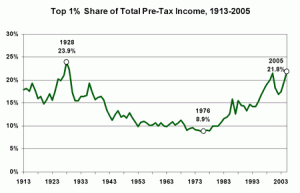
Top 1% share of income to 2005 by Piketty and Saez

Top 1% share of income to 2005 by Piketty and Saez

So look at the last chart and remember: there was a class war. Most Americans never even showed up for it. And the rich won. Now they’re going to try and keep and expand their gains. As Naomi Klein has pointed out at great length, when things go wrong, it’s very easy to sell people snake oil, to take advantage of their fear and their despair.

Roosevelt told the American people not to fear. That there was nothing to fear but fear. Elsewhere other leaders whipped their people into fear, and after fear, into fear-driven aggression and hatred.

Even in lesser crises leaders will appear who offer to solve the problem without telling you how. In the eighties Americans turned from Jimmy Carter, with his negativity and his call to solve fundamental problems in fundamental ways to Reagan, promising “morning in America”. And let’s be honest: Reagan sort of fixed the problems. His fix, in one form or another, lasted almost twenty years, till kid Bush broke it. Sure it wasn’t a permanent fix, and sure it was fixed on the back of the middle and working classes and the cost was not having things like healthcare, the offshoring of huge numbers of jobs and so on. But gas prices went down. Interest rates went down. Inflation was tamed. Suburbs sprouted like weeds. Reagan delivered.

And the rich won their class war.

Reagan was working with a strong America. A fundamentally healthy America. He could afford to run the place down, because it was still in good repair, the baby Boomers were still young, and so on. The cost of Reagan’s “fix” has been that ordinary people haven’t had a raise for over 30 years.

The next such “fix” won’t leave wages even, it will, in real terms, halve them.

Originally posted at FDL on July 13, 2008 in slightly different form. Nothing has changed, except that the next class war is on, and the rich are winning this one, too.

Senator Specter To Oppose the Employee Free Choice Act

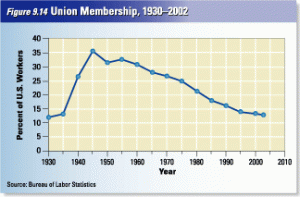
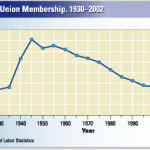
historical union membership

historical union membership

Or, to put it more simply:

1) Specter, who is in danger of a strong challenge from the right during his nomination contest in 2010, is moving right to secure his flank.  If he had planned to run as an independent, he’d be planning to vote for EFCA.
2) Right now there are no other Republican Senators who say they’ll vote yes.  Even once Al Franken is confirmed to the Senate at least one Republican will have to be turned.

    Getting EFCA through is likely to be a bruising fight.  But it’s the one thing Democrats union allies absolutely want and need to have.  They won’t forgive Obama or Congressional Dems who blink on this because without it, the union movement in America will likely continue its long term decline.

    Homeland “Security” Costs $50 Billion… for what?

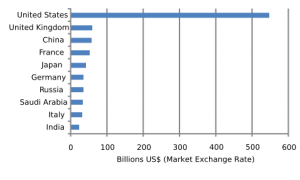
    Top 10 Countries by Military Spending 2007

    Top 10 Countries by Military Spending 2007

    Joshua D Foster explains how fear and statistical illiteracy inflate America’s security budgets in Psychology Today:

    Consider, for example, that the 2009 budget for homeland security (the folks that protect us from terrorists) will likely be about $50 billion. Don’t get us wrong, we like the fact that people are trying to prevent terrorism, but even at its absolute worst, terrorists killed about 3,000 Americans in a single year. And less than 100 Americans are killed by terrorists in most years. By contrast, the budget for the National Highway Traffic Safety Administration (the folks who protect us on the road) is about $1 billion, even though more than 40,000 people will die this year on the nation’s roads. In terms of dollars spent per fatality, we fund terrorism prevention at about $17,000,000/fatality (i.e., $50 billion/3,000 fatalities) and accident prevention at about $25,000/fatality (i.e., $1 billion/40,000 fatalities).

    People fear things that are highly unlikely to kill them, such as flying on an airplane, much more than things that are much more likely to, such as crossing the street or driving a car. As a result they make irrational decisions about how to spend both time and effort. This is why basic statistics should be taught in every school and no one should be allowed to graduate before they pass.

    Disproportionate fear is particularly the case when it comes to security and military spending in the US. The US spends almost half the world’s military spending and too many Americans seem to think that it needs to spend more, not less.  Heck, the US intelligence budget alone is over $43 billion while China spends $70 billion on its entire military.

    Delusional is too kind a word for it, and I’m not sure insane even covers it, so lets go for understatement and call it “counterproductive” and “a waste of good money”.  Slash the military budget in half and the US will still spend more money on its military than any possible combination of attackers.  Do the same to homeland “security” spending and the intelligence services, and you’d have all the money you need for refitting the country for energy independence, which would make the country far more secure than lots of jet fighters meant to fight the USSR and airport screeners with rubber gloves.

    Does the Geithner Plan Reduce Credit Default Swap Risk Too?

    Credit default swaps (CDSs) are still a big issue. Estimates of how much of the market is at risk vary, but the lowest I’ve seen is about $15 trillion.  If that goes bad, we’re probably talking another $3 or $4 trillion of damage.

    While I agree that CDSs are an issue, I also think that taking bad assets off firm’s hands makes defaults on CDSs more unlikely, and thus reduces exposure to them.

    Of course, this really depends on whether the fundamental problem lies with the economy or the financial market—or both.  If the economy keeps going south, then bailout after bailout will be needed, defaults will happen anyway, and CDSs will be called.  If the combination of fixing the financial sector plus the stimulus bill and military spending is enough to stop the economy’s downward spiral, on the other hand, then Geithner’s plan may well do the trick (once a couple more trillion are spent). We’ll see.

    (Aside: Interest rate and currency swaps are about a 7 times larger market than CDSs.  The real risk is a currency meltdown by a major economy.)

    Market Rallies On News of Trillion Dollar Giveaway

    Image by TW Collins

    Image by TW Collins

    Is anyone really surprised the DOW is up almost 500 points, after Geithner promised to give private investors almost $1 trillion to gamble with?

    The details of the giveaway are fascinating.  I sure wish that I could get financing like this to play the market:

    Under one part of the plan focused on bad loans, the Treasury will provide up to 80 percent of initial capital alongside investment by private funds. The FDIC would then offer debt financing for up to six times the pooled amount.

    Now, unless I’m messing up my math, that’s 24/1 leverage.  If older details hold, and the 80% is a non-recourse loan, meaning that it’s secured only by the value of securities bought, then it’s even sweeter.

    PIMCO has announced it’s interested in participating, which means that the plan has succeeded in one sense—it has the buy-in of some very smart money.  That doesn’t mean that it’s necessarily good for taxpayers, or that it will be good in the long term for the economy, necessarily, but at least it isn’t being laughed out of Dodge.  On the other hand, would you refuse 24/1 to one financing?  Or even matching funds, as contained in part two of the plan?

    I sure wouldn’t.  And PIMCO have been scavengers before.  They bet heavily in Fannie and Freddie bonds after it was clear Fannie and Freddie were insolvent, which was a bet that the government wouldn’t shear bondholders when it bailed out Freddie and Fannie.  Smart bet, but not a good return for taxpayers, who would have been better served by letting Freddie and Fannie’s debtholders lose money.

    I am becoming increasingly convinced that my original call was the right one: that the various bailouts would lead to Japanification.  For 20 years now, since its own bubble burst, Japan has had an economy which slips in and out of recessions like clockwork and which never ever really got good again.  In Japan’s case, the lousy economy was in large part because they left a lot of debt debt on the books of private corporations.  In America’s case, the debt may be transfered to taxpayers, but the end result is likely to be the same, only compounded by attempts to create secondary bubbles so that the toxic waste regains enough value to claim a win.

    Given that Geithner’s trillion dollar giveaway has been greated ecstatically by the financial sector, I expect we’ll see more money used in this fashion.  This plan appears to be good for about $2 trillion of lousy debt ($1 trillion from the matching 1/1 program, $1 trillion from the high leveraged portion).  Total current toxic waste on the banks books is probably about $4 trillion, which will still have to be dealt with.

    That money will have to be paid off, eventually.  Doing so will cost the US  and the world a great deal of future growth, and individuals a great deal of future income and employment.  As things stand right now, I don’t think employment levels as measured by employment/population ratios will recover in the forseeable future—post recession “full” employment will just be lower than pre-recession “full” employment.  There are still some ways this could be made to work for everyone, and I’ll discuss those at a later date.

    Employee Free Choice Threatened by New Lobbying Campaign

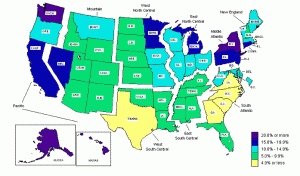
    2007 Union Membership By StateA new big business lobbying campaign against the Employee Free Choice Act (EFCA HR1409/S.560) threatens to eviscerate the bill. Starbucks, Whole Foods and CostCo are lobbying together to weaken the pro-labor Cardcheck Bill.

    The proposed provisions would tighten some organizing rules in favor of workers and keep the secret ballot, but at the expense of eliminating mandatory arbitration. Mark Ambinder reports that the new provision would also require 70% or workers to sign cards to form a union (cardcheck) vs 50% yes vote by secret ballot.

    historical union membership

    historical union membership

    I don’t see any appeal for organized labor in this “compromise”.  First, mandatory arbitration is a big deal because in many cases firms simply drag out negotiations forever, making sure there is no contract—even when unions are recognized.  And 70% is a high hurdle.   As compromises go, this one will do nothing but compromise unions’ ability to organize more workers and negotiate contracts.

    Even if you don’t care about workers’ right to unionize, the fact is that where unions are strong, Democrats win.  Republicans know this, which is why they’ve done everything they can to weaken unions.  Unions also raise wages generally in the population.  As Nathan Newman notes, even non-union workers benefit from unions, because employers increase wages to be competitive, so they aren’t too easy to unionize.

    This is a battle worth fighting.

    The AIG Bonus Clawback Bill Won’t Work But Here’s What Will

    Historical top tax ratesLast week the House passed a bill designed to claw back bonuses over $250K from recipients of TARP money.

    Now I’m a class warfare guy on the side of regular folks (as opposed to the rich, who are winning the current war and won the last one), but this bill is counterproductive and won’t work.  It is too easy to work around and it is targeting the wrong people.

    1. The clawback only affects bonuses, leaving a loophole where TARP recipients can just recategorize bonuses as salaries.
    2. If the clawback applied to all income, then employees would be moved to contract status or to companies which haven’t received TARP money (even if artificial companies have to be created for the purpose).
    3. The threshold of $250K of household income is not that high, as Henry Blodgett points out.  Don’t get me wrong, no family making that amount is poor, but they are still affluent.  (I’ve never made anything close to it, so this isn’t a personal thing.) At the same time, they aren’t filthy rich, either, and they shouldn’t be taxed as if they were.

    But concentrating on bonuses for employees at firms which have been bailed out misses the point.  It’s not just those firms whose employees need to be taxed more heavily, it’s everyone.

    The logic for increasing taxes is simple enough. For the last 20 years, American executives have been able to pay themselves such large bonuses that in 3 to 5 years they could amass enough money that hey would never need to work again.  This executive compensation system created the incentive to do whatever was required in order to get those bonuses—leading to flagrant risk taking and outright fraud.  It also led to a short-term focus on the business.  When executives know that it doesn’t matter to their personal financial well-being if their firm exists in 5 years, they don’t worry about the long term consequences of their decisions.  All that matters is booking “profit” now, so you can get money now, and become rich now.

    Wall Street and the banks didn’t make any money in the last 10 years, for all that they booked record profits.  The combined losses of the financial firms is larger than their entire reported profits.  What they did was sell synthetic securities based on dubious assumptions about the future—that the housing bubble would continue forever, there would never be another recession,  and defaults wouldn’t cluster; and book the entire calculated future profits of these securities as profit in the year they were created.  Of course, those future profits were fictional, but the bonuses based on them were in real money.

    In order to make sure this never happens again compensation needs to be restricted in every firm, not just in the US, but in the industrialized world.  Executives and salespeople and auditors and loan officers (if banks decide to rehire any) need to know that ten years from now if a loan goes bad that they’re going to be on the carpet for it, that they might lose their job for it, and that they will still need a job in 10 years.

    I recommend 7 measures to restrict compensation:

    Page 531 of 532

    Powered by WordPress & Theme by Anders Norén