Ian Welsh

The horizon is not so far as we can see, but as far as we can imagine

Star Trek

Saw the movie today.  Every friend whose seen it has liked it, so my expectation were high, but the movie met them.  In fact, I’d go so far as to say it may be the best Star Trek movie.  I was never a Star Trek geek, and I never liked any of the series after the original, so take it for what it’s worth.

What was striking about the movie, to me, is that it was primarily about the relationship between Spock and Kirk.  Now, of course, that was the central relationship in the original series, but what I mean is the movie was about the relationship, not about saving the world.  Oh sure, Spock and Kirk have to save the world (and, er, not a spoiler) and of course they do, but the core of the move is the emotional relationship between the two men, and how they have to learn to both like and respect each other.  In particular, Spock has to learn his own weaknesses (something which, I think, needs to be done for Kirk in a sequel).

(Actual spoilers below)

In Memoriam

black-angel-by-sy-parrishIt’s Memorial Day.  I gather for many it’s just another long weekend, but I know that for many it’s what Remembrance Day is for Canadians like myself: a day to remember those who have died in war.  I won’t say “died to protect our freedom” or any such trite BS, because with few exceptions, most wars had nothing to do with protecting anyone’s freedom, but they did die, nonetheless, for us.

Their blood is on our hands, sticky and wet, and it will never dry. Why?

Because we live in democracies.  Because we elected the leaders who sent them to war.  Whether you think those wars are justified, or not, at the end of the day, we bear the collective guilt of their deaths.  They died due to the decisions we made, the society we live in.

Oh, we can say “I did everything I could to oppose the war”, whether that’s Iraq or Vietnam, or some other war.  But even if that’s true, well, you failed, didn’t you?  (Didn’t I?)   And so off went the young men and women, and they died, or they were maimed, or their brain case got knocked around and they came back shaking, and they wake up screaming at night, and they can’t control their emotions and they’ll never be the same again.

It’s one of the ironies of democracy that we’re all responsible, collectively, and yet each of us, individually, can say “but not me, I voted against him” or “I protested against that policy”.  And because it’s true, each of us can feel, in the end, that the deaths and suffering caused by the society, whether in war, or through a horrific medical system, or through abuses in the penal system, aren’t our fault.

But is it true?  Or is it true instead, that we failed, that we support the system with both our consent and our tax dollars, and that we are therefor complicit in what it does?

I don’t know.  But I do know this, on this Memorial day, even if it’s not a Canadian holiday, I’m thinking of those who died, both soldiers and civilian.

And at the very least, I know I failed.

Glenn Greenwald Hammers Preventative Detention

And no, it’s not like holding POWs for the duration of a normal war.  Go read.

How Owning Genetic Materials Drives Farmers Into Bankruptcy and Suicide

A fascinating interview with Vandana Shiva by Lohan discusses how companies like Monsanto, through their ownership of agricultural seeds, drove Indian farmers into bankruptcy and caused mass suicides. In a decade, about 200,000 farmers have commited suicide in India.  Why?

“In 1998, the World Bank’s structural-adjustment policies forced India to open up its seed sector to global corporations like Cargill, Monsanto and Syngenta,” Shiva wrote. “The global corporations changed the input economy overnight. Farm-saved seeds were replaced by corporate seeds, which need fertilizers and pesticides and cannot be saved. …

…

When Monsanto’s Bt cotton was introduced, the seed costs jumped from 7 rupees per kilo to 17,000 rupees per kilo. Our survey shows a thirteenfold increase in pesticide use in cotton in Vidharbha. Meantime, the $4 billion subsidy given to U.S. agribusiness for cotton has led to dumping and depression of international prices.

Squeezed between high costs and negative incomes, farmers commit suicide when their land is being appropriated by the money lenders who are the agents of the agrichemical and seed corporations. The suicides are thus a direct result of industrial globalized agriculture and corporate monopoly on seeds.

Rising prices for inputs, lower prices for the crops.  Simple enough, really.

The first suicide that we studied took place in Warrangal in Andhra Pradesh in 1997. This region is a rain-fed dry region and used to grow dry land crops such as millets, pigeon pea etc. In 1997, the seed corporations converted the region from biodiverse agriculture to monocultures of cotton hybrid. The farmers were not told they would need irrigation. They were not told that they would need fertilizers and pesticides. They were not told they could not save the seeds. The cotton seeds were sold as “White Gold,” with a false promise that farmers would become millionaires. Instead, the farmers landed in severe unpayable debt. This is how the suicides began.

Likewise these crops require a lot more water and that has led to a severe drawdown of aquifers.

VS: India is a land of varied climates, from rainforests to deserts. Seventy percent of Indian farming is rain-fed (dependent on rain not irrigation). Introducing inappropriate crops and cropping patterns has aggravated the water crisis and precipitated more frequent crop failure. Ecological agriculture needs 10 times less water than chemical farming. Green Revolution varieties, hybrids and GM crops are all bred for irrigation. On the one hand, this puts pressure on farmers in low-rainfall zones to drill tube wells, which fail — on the other hand, it leads to more frequent crop failure.

To summarize: first world subsidies on agriculture lead to first world prices that are artificially low, which leads to dumping, which reduces the price of the crops.  Something Shiva doesn’t mention is that each time a third world country moves to cash crops, that too depresses the prices as there just aren’t that many cash crops.  Having to buy seeds every year, having to buy pesticides and fertilizers and having to irrigate all increase the cost of farming significantly, and also cause drawdown of aquifers.  Once those aquifers are gone (and they are being drawn down faster than the water is being replaced) the areas in question won’t be able to grow any meaningful crops at all.

Patenting life forms is inherently problematic.  At the current time the law is that if a genetically modified seed drifts onto your land, and interbreeds with your crops, the company that owned the seed now owns all of your seeds, which you must destroy if it insists.  So once GMO seeds are introduced into an area, it becomes difficult to impossible for farmers not to use them.

The destruction of biodiversity in crops, which started with the Green Revolution, has alikewise moved into turbo-seed which have to be bought every year, which are genetically engineered, don’t change.  Monoculture crops are very vulnerable to disease and pests, but worse than that as older species are lost, we lose their genetic heritage, which could have much of value.  They may have medicinal uses we don’t know about, may have genetic features that make them resistant to specific pests or disease, or better for certain environmental conditions, and so on.  Once they’re gone, they’re gone for good.

In any case, the world needs less monoculture agriculture and more ecological agriculture.  Not just because it is more sustainable and the world is on track to create massive dust bowls in the US, China and India due to overuse of water, but because grain based diets are inherently less healthy than more varied vegetable diets.  A huge amount of the current pandemic of degenerative diseases in the 1st world, which is at its worst in the US, can be laid at the feet of the the Standard American Diet (SAD), which consists of far too much sugar, starch, grains and corn based foods denatured of natural nutrients.  This diet has contributed heavily to an epidemic of obesity, diabetes, heart disease and cancer.  Likewise, what was once known as “adult onset diabetes” is now common in childhood, and obesity.

The real cause of the first world’s crisis in health care costs is that people are just sicker than they used to be, not just when they get old, but at every stage of their life.  And that is largely a reflection of how we now eat, combined with lack of regular exercise.  As nations famed for their good health adopt a more American diet (like the French) the incidence of obesity and chronic degenerative disease immediately rises.

It is thus in the first world’s interests to stop with the heavy subsidization of grain and corn, to allow third world nations to protect their farm economies from foreign competition and to move, themselves, to an agriculture which produces more highly nutrient dense vegetables and less grains and corn.  This will pay back, in the long run, with lower healthcare costs and a healthier, more producitve population.

And as a side benefit, there will be a lot less farmer suicides.

The Thought Crimes President

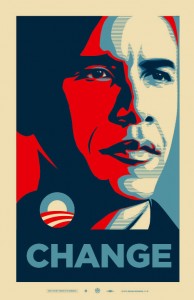
Obama Change Poster

Obama Change Poster

Obama today, on how he intends to give up liberty to get safety:

Finally, there remains the question of detainees at Guantanamo who cannot be prosecuted yet who pose a clear danger to the American people.

I want to be honest: this is the toughest issue we will face. We are going to exhaust every avenue that we have to prosecute those at Guantanamo who pose a danger to our country. But even when this process is complete, there may be a number of people who cannot be prosecuted for past crimes, but who nonetheless pose a threat to the security of the United States. Examples of that threat include people who have received extensive explosives training at al Qaeda training camps, commanded Taliban troops in battle, expressed their allegiance to Osama bin Laden, or otherwise made it clear that they want to kill Americans. These are people who, in effect, remain at war with the United States.

In other words, people who have committed no crime which can be proved in a court of law, including the crime of conspiracy, will be held indefinitely without a trial.  Note that Obama wants to use military commissions to try some detainees, which means that these detainees can’t be found guilty of anything even under military law.

This is punishment for a thought crime.  It is also exactly the same rationale used by the Bush administration.

Obama also said something else which is a continuation of Bush administration excuses:

In the midst of all these challenges, however, my single most important responsibility as President is to keep the American people safe. That is the first thing that I think about when I wake up in the morning. It is the last thing that I think about when I go to sleep at night.

Now, this is simply wrong.  Here’s the Presidential oath of office, as enumerated in the Constitution:

“I do solemnly swear (or affirm) that I will faithfully execute the office of President of the United States, and will to the best of my ability, preserve, protect and defend the Constitution of the United States.”

Nothing about the most important duty being to keep Americans safe.  The first duty is to preserve, protect and defend the constitution.

What’s the constitution have to say about punishing people without a trial?  Well, the fifth amendment says:

No person shall be deprived of life, liberty or property without due process of law.

In other words, you get a trial.  What about the idea that civilian courts shouldn’t have jurisdiction?

The privilege of the writ habeas corpus shall not be suspended, unless when in cases of rebellion or invasion, the public safety may require it.

Note that America is not invaded, and it is not in the throes of a rebellion.

Heck, this isn’t even just violating the constitution, it doesn’t even match up to the Magna Carta, a document 800 years old:

No free man shall be taken, imprisoned, disseised, outlawed, banished, or in any way destroyed, not will we proceed against or prosecute him, except by the lawful judgment of his peers and by the law of the land.

Which is to say, you can’t be punished without being convicted by a jury of your peers.

The danger with Obama is, in certain respects worse than that of the Bush administration.  Bush certainly wrapped his actions in the flag, but less so in the Constitution.  The phrase “the constitution is not a suicide pact” implicitly admitted that what was being done didn’t meet a strict interpretation of the constitution, but hey, they couldn’t have really meant those words for “bad people”.

Obama instead implicitly claims to come to praise and protect the constitution, not to bury it:

Fidelity to our values is the reason why the United States of America grew from a small string of colonies under the writ of an empire to the strongest nation in the world.

Having said that, he then wants to do things which go explicitly against the values in the Constitution. If those aren’t American values, then I certainly don’t know what are.

America was born in a fight against tyranny.  The idea of the executive being able to hold people indefinitely without trial is inherently despotic and destructive of liberty.  The only way to determine guilt is with a trial.  As Benjamin Franklin (who knew a thing or two about American values) said, it is better [one hundred] guilty Persons should escape than that one innocent Person should suffer.

Ben Franklin also said something else, which has been quoted a great deal in the last eight years, for good reason:

Any society that would give up a little liberty to gain a little security will deserve neither and lose both.

The idea that safety can be purchased by giving up liberty is simply wrong.  Americans have much more to fear from a President who can lock up folks indefinitely without a trial than they do from al-Qaeda.  Republicans, think about a Democrat able to do it (say Hilary).  Democrats, think about the next Bush (and there will be one) able to do that.

In terms of foreign policy, America’s great strength, as Obama explicitly recognized, was its values.  Those values gave America moral authority and made other countries feel that America was in the right.  An America which holds people without trial, which violates the right of habeas corpus and which violates its own constitutional values is no beacon to the world and cannot effectively argue for its own values.  Such an America is just another self-interested power player, little different from any other.

Obama is certainly the master rhetorician he has been acclaimed as.  He has wrapped an essentially un-American policy in American values, and used the same rationale as George W. Bush, that he has to take away a little liberty, in order to give Americans a little more safety.

And perhaps he has a point.  Perhaps some of the prisoners, if released, will go back and take up terrorist activities again.  Let us assume, for the point of argument, that they will.

Does that mean that we punish them for crimes they have yet to commit?  Does that mean we assume that we know that all of those chosen by Obama to be punished will commit crimes?  Does that meant that it is not better that 100 guilty men go free rather than one innocent man be falsely imprisoned?

And where do we draw the line?  Once we’ve decided that thought crimes are worthy of preventative punishment, once that is a principle embedded in the law, who else are we going to lock up whom we can’t prove has committed a crime, not even that of conspiracy, because we think they may commit one in the future?

That’s not a power any human being should have over another.

But it is the power Obama has demanded, has arrogated to himself, just as George Bush does.

If that isn’t against American values, then at long last, I don’t know what American values are.

But I think it is clearly anti-American, and I think all those who have said “give me liberty or give me death”, or similiar phrases, recognize in their hearts that what was done under Bush and what Obama is attempting to do are fundamental violations of the values that made America what it is.


Disrespecting the Poor

The Washington Post hits on how much it costs to be poor – the way that the poor are forced to pay more, not less, for virtually everything; if not in money, then in time.

A friend of mine put it most simply.  Poor people spend time to save money.  Well off people spend money to save time.  That’s how you know where you are, assuming you aren’t living beyond your means.

The WP article isn’t bad, but it doesn’t really get the full flavor of poverty.  When you look poor, and if you’re poor long enough you will, you just get treated worse by virtually everyone.  They know you don’t have money, know you don’t have power, and thus know they can push you around, disrespect you or just ignore you.

My favorite story along this line is when I was barely making ends meet by doing odd jobs helping people move, doing yard work and painting houses.  One day after painting a garage, I walk into a bank with the check from the day’s work (this is in the eighties).  I’m disheveled, covered in dried paint, and look awful.  The teller wants to hold the check for two weeks.  I can’t wait that long, I need the money for rent.  I walk out of the bank.

I go back to the rooming house I’m living in. I shower, shave and comb my hair.  Then I go find my last set of good clothes – gray flannels, dress shirt, blazer, tie.  I put them all on, and I head back down to the bank.

Unlike a lot of people who are poor, I haven’t always been poor.  I went to one of the most elite private schools in Canada (ranked second at the time, after Upper Canada College).

I wait in line, and irony of ironies, I get the same teller.

She cashes the check.

Yeah…

But I don’t say anything, because I know she could capriciously change her mind.  I just walk out.

A couple years later, during the same extended period of poverty, I get to the point where I can’t even pretend to be middle or upper class.  And on occasion I get rousted because, while I’m clean, I look pasty, my clothes are threadbare and my glasses are literally taped up.  One time a security guard throws me off the property of a hotel I went into to use a pay phone.  In another case, I get tossed off the University of Ottawa campus: I’m beyond the point where I can fake being a student, even though I’m the right age, and was one just a few years before.

In the last ten years, since I ascended back into the middle class, I’ve never had any such situation come up.

Odd that.

The worst thing about being poor is the way you are treated.  There is no rule more iron, in my experience, that the less you get paid, for example, the worse you will be treated at work.  Clerks in stores treat you worse.  Government bureaucrats can often barely conceal their contempt.  And so on.

The upside, I suppose, is that people show you who they are.  The rare person who treats you exactly the same as they do everyone else is revealed as the shining gem they are.  In particular the friends who stick by you even when you’re down and out show themselves to be real friends, as opposed to those who follow the rule given in so many self-help books to cut off less successful friends, and thus reveal their complete moral bankruptcy to the world.

You learn who you can actually trust, who actually cares about you, and who is actually a decent human being who doesn’t enjoy being able to kick down on someone they figure can’t kick back.

It changes how you see people.  Oddly, before I was poor I thought practically everyone was scum (I was a cynical teenager).  Being poor convinced me that there were some truly good people in the world–people who would help you, be kind to you, or just treat you respectfully, even when there was nothing in it for them.

In ugliness and deprivation, beauty and kindness are much much more obvious.  All the more so, because so few meet this test and pass.

Who Are the Radicals? Hamas, or America?

Had a conversation with a friend who kept insisting Hamas are radicals because they pay suicide bombers to kill people and engage in propaganda.

Personally I’ve never understood why people get so upset by suicide attacks when bombs dropped from airplanes kill far more people.

I guess Americans are radicals, since they spend billions of dollars funding people to blow up other people and Americans have killed a ton more people in the last eight years than Hamas has.  Heck, Hamas isn’t even in contention, it’s apparently orders of magnitudes less radical than America.

I just don’t get it.  I really really don’t get why people get so caught up on the form of things, rather than the end effects.

I have no idea what the word radical means, I guess.  Perhaps it means”they don’t kill people in the ways we approve of, and they believe in a different religion than us”.  Or something.  I just don’t know.

But if funding people to kill other people is the metric, well then, Hamas are hardly radicals at all compared to most governments in the world.  Pikers, in fact.

As for propaganda, they’re just not very sophisticated.  American propaganda is far better and far more pervasive.  How many Americans thought Iraq was behind 9/11?  How many do today?  Without even having to use Mickey Mouse.

Propaganda makes you radical?

Welcome to the Radical States of America – which funds more murders and engages in more propaganda than Hamas could ever hope to.

And without even as much justification.  What did Iraq do to America compared to what Israel has done to Palestinians?

The consequences of (yet again) failing to stand up to the banks

sunset-by-vj-fliksThe Senate just stopped limits on credit card rates.  Sometimes it takes a socialist to say the obvious:

“When banks are charging 30 percent interest rates, they are not making credit available,” said Mr. Sanders, who noted credit unions are limited to 15 percent. “They are engaged in loan-sharking.”

The banks have been given, loaned and guaranteed trillions. They are given access to money at very close to zero percent.  They then lend it out at much much higher rates.  As Sanders notes, 1/3 of credit card holders are being charged more than 20%, some as high as 40%.

That’s usury.  More to the point, it means that for all intents and purposes they aren’t making credit available.

Does anyone wonder why consumer spending dropped again?  Would you borrow at 20% to 40% to buy anything other than food or pay for housing, when jobs are still being lost at over half a million a month?  No one with any sense would.

Months ago I noted that the simplest way to get banks lending again would be to either have the Fed lend directly to consumers, or have the FDIC take over a major bank like Citigroup or Bank of America and use that bank to lend at decent rates.

Instead of doing that, the Bush and then Obama administrations decided to give money, guarantees, loans and nearly free money to banks which were impaired and which needed to gouge their customers as hard as they could to make a profit.  The result is that treasury secretary Timothy Geithner keeps saying the financial sector is fine, while more Americans lose jobs, consumer spending drops, banks won’t allow homeowners to get out from under bad mortgages even when it would save the bank money, and a new round of foreclosures is on its way.

On top of that, the mark to market rule was changed to allow banks to keep assets on their books at mark to model (ie. mark to fantasy) values.

All of this money will have to be paid back eventually.  The strategy is simple enough.

1) Give the banks money.

2) Let them not acknowledge as much of their losses as possible.

3) Allow them to gouge taxpayers for as much as possible, to dig themselves out of the hole over a number of years.

The end result of this is going to be Japanification—at best.  Not a “lost decade” as many folks have said, but a semi-permanent wavering between slight job gains and job losses, where a good economy never, ever, comes back.  And because the US, unlike Japan, is not a net exporter, it’s questionable how long Japanification can work in the US, in any case.

The banks took trillions of dollars of losses.  The refusal to make them take their losses; the refusal to wind up any of the big banks; the refusal to recognize that what is important isn’t the banking system but what the banking system does, and thus the unwillingness to cut past the big banks and lend directly means that those trillions of dollars of losses are going to have to be paid back by consumers and taxpayers.  You will pay.  You will pay not just in high interest rates, but in lower wages, and for many of you, a lack of jobs.  The economy will not, before the next recession after this downturn, return to the same level of employment the US had before this crisis.

All of this because neither party, and neither President, had what it took to stand up to the banks.

(What a good policy would have looked like.)

Page 523 of 532

Powered by WordPress & Theme by Anders Norén