Ian Welsh

The horizon is not so far as we can see, but as far as we can imagine

On Labor Day Weep for Labor

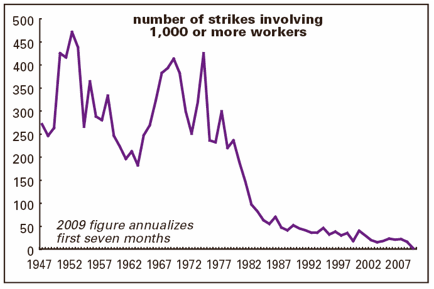
Really, everything else about Labor in America is just commentary on this graph:

strikes-involving-more-than-1k-workers

You have exactly the rights you are willing to fight for.

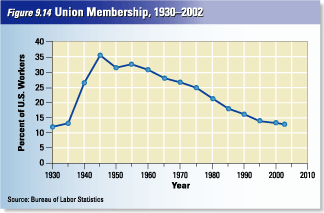
historical-union-membership

Hard not to decide that Reagan broke the unions, isn’t it?  The number of strikes crashed off a cliff even faster than did membership.

And, in case you didn’t realize, the Employee Free Choice Act (EFCA) is already dead on arrival.  Something may pass with that name, but it will not allow workers to create a union just by putting a check mark on a card, and it will not have quick mandatory arbitration of first employment contracts so that employers don’t just refuse, for years, to give unionized workers a first contract, effectively voiding the unionization.

Public Option Won’t Reduce Costs

winged_caduceusWell, now Matt Taibbi is saying it, maybe progressives will listen:

In the end, the Blue Dogs won. When the House commerce committee passed its bill, the public option no longer paid Medicare-plus-five-percent. Instead, it required the government to negotiate rates with providers, ensuring that costs would be dramatically higher. According to one Democratic aide, the concession would bump the price of the public option by $1,800 a year for the average family of four.

In one fell swoop, the public plan went from being significantly cheaper than private insurance to costing, well, “about the same as what we have now,” as one Senate aide puts it. This was the worst of both worlds, the kind of take-the-fork-in-the-road nonsolution that has been the peculiar specialty of Democrats ever since Bill Clinton invented a new way to smoke weed. The party could now sell voters on the idea that it was offering a “public option” without technically lying, while at the same time reassuring health care providers that the public option it was passing would not imperil the industry’s market share.

The public option, isn’t.  As I noted quite some time ago.  It will not reduce costs, it is questionable that it is even viable.  And yet progressives are going balls-to-the-wall for a non-viable public option which won’t even reduce costs rather than, at the least, fighting for a real public option?

Folks, you are being sold a bill of goods.  The people shilling for this version of the public option, whether politicians or others, are shilling for something that won’t work (not that even a nominal public option is likely to be in the final bill).

The best thing that can happen, at this point, is for nothing to be passed.  Because right now it looks most likely you are either going to be forced to buy insurance without an option to buy a government plan, or you’re going to be forced to buy insurance with the possibility of buying government insurance that’s no cheaper than private insurance, and which may not even be able to stay in business (it does have to succeed without any subsidies.)

Badtux says it best when it comes to what should have happened, what still should happen, but what won’t happen:

Or Obama can lead. He can say “Enough. You tried, you failed. We will expand Medicare to all.” Then the Republicans have to run against Medicare, and if they do that, they’ve lost. Medicare is the most popular government program aside from Social Security, and anybody running against Medicare is taking on old folks as well as taking on something that’s already a known quantity. You can’t say Medicare has “death panels” because it doesn’t. You can’t say Medicare rations care, because it doesn’t — it won’t pay for everything, but you can always buy Medi-Gap coverage from private insurers for the things it won’t pay for. And the bill would be literally 5 pages long, most of which would be boilerplate around the three paragraph payload, one paragraph expanding Medicare to everybody, the second one which raises the Medicare payroll tax to 4/4%, the third which adds a 5% Medicare surcharge to the income tax for everybody who makes over $500K/year. I’ve worked the numbers and that would pay for every dime that’s currently being paid through private insurance, and leave enough to cover the current uninsured. Three paragraphs. That’s all it would take.

But yeah, that’s not happening.  So… get ready to pay out for insurance you can’t afford, with co-pays so high you can’t afford to use it even after you’ve been forced to cough up for it.

Plus ca change

216,000 Jobs Lost in August, Unemployment up .3% to 9.7%

The manufacturing sector lost 63K, the financial sector 28K and Construction lost 65. Health care added 47.4 thousand jobs.

One of the more interesting findings is that up till April government jobs were increasing, since April they have declined.  The decline isn’t huge, but it exists at all levels of government.  For some reason the postal service in particular seems to be shedding jobs.

Though the job loss is less than we’ve seen in the past it’s surprisingly uniform: except for health care and social assistance everything else is either down, or just barely increasing.  Fundamentally, every industry without pricing power is taking it on the chin, but if you’re sick, you’re sick, so the medical industry retains the ability to hire.  I suspect that the manufacturing numbers would be much worse if defense related manufacturing was removed.

The broadest measure of unemployment, which includes all discouraged workers and folks who work part time but want full time work is up .5% to 16.8%.

Men have lost jobs a lot faster than women.  The female unemployment rate has increased by 2.5% in the last year compared to an increase for males of 4.3%.

America continues to be hollowed out.  The stimulus will start hitting harder over the next few months, and we should see somewhat better numbers but my long term forecast remains the same: before the next recession, the US will not see a recovery to the same percentage of people employed as before the recession.  My forecast for the year was a technical recovery of GDP before the end of the year (it looks like we might even have one for the second quarter, which is sooner than I expected) and no job gains before next year.  Might be wrong on the second as well, but any job gains will be nominal and below the 150,000 level just required to keep up with population increases.

The job market is certainly not going to feel good this year. I expect it to remain hard to find a new job right through the end of 2010.  Since the likelihood of a new civilian stimulus bill is low, and all stimulus will have to be run through the defense department and the Afghan war, I would suggest that those who can see what they can do about getting a security clearance.  The best paid jobs with the best benefits will be in the defense industry for the time being—unless you’re able to finagle a high end job in the finance industry, and be kept afloat with trillions of dollars of Federal Reserve money, of course.  In which case, buddy, could you spare some change?

[Employment situation release from BLS (pdf)]

Restructuring America’s Military

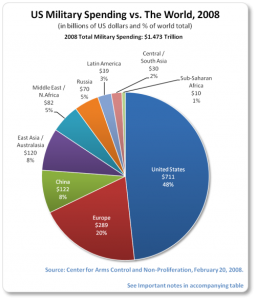
Military spending by country, 2008

Military spending by country, 2008

Here’s a truth for you.  No one, and I mean no one, can invade the US.  The US spends more on its military than the next 10 nations combined, and more naval tonnage than the next 13 navies combined.  For this the US gets an army which, sorry American jingoists, is bloody awful at brushfire wars.

The US army should be cut in three quarters, at the very least.  The air force should be disbanded, since it refuses to do its job anymore (it hates doing close support of troops and its planes are too expensive to be used in most circumstances, which is one main reason for the rise of drones) and the army and navy can pick up the necessary pieces.

The navy should be America’s main arm, but even it needs some cuts, and the carrier flotillas need a serious rethink, they’re nothing but big targets in the case of a war against a real enemy..  The army should be a much smaller expeditionary force, designed so it can be ramped up in the case of the sort of war that requires a mobilization.

The US cannot afford its current military.  The budget should be cut in half, at a minimum.  That budget, and the huge distortions that the military industrial complex is inflicting on America, are a large part of what is destroying America as an economic power.  The best and smartest techies are flooding into the military industrial complex as fast as they can get security clearances, because post dot-com bubble it pays far better and has far better salaries than any other part of the economy except the financial industry. Certainly the military industry isn’t the only thing destroy America’s economy (who needs them when you have the banks) but in the long term, they’re doing more than their fair share.

With a much smaller expeditionary force the US will stick to bombing and shelling, and occasionally kick over small Caribbean countries, which is as it should be, because even the large army has proved radically bloody incompetent at very great cost for almost zero results (what, exactly, is the benefit to the US of the Iraq war?  An Iraq aligned with Iran?)

And Americans need to stop talking about being invaded.  No one can, no one will.  You’re a continental power with a huge nuclear arsenal, even if they could get to your borders, the idea of invading a continental mass the size of the US is insane: there is no one who can do it.

Go back to a pre-WWII army, with a relatively large navy (though not as large as what you have, which is over 50% of the entire world’s naval tonnage).  You’ll be fine.  Honest.  And so will the world.  The world is not being made safer by US brushfire wars and neither is America.

And hey, maybe you can take the money and give yourselves real universal healthcare as opposed to some garbage bill that forces you to buy insurance you can’t afford to use.

Some inconvenient truths

Glenn Greenwald:

Last year, after I wrote critically about a well-known journalist who frequently appears on the TV and is considered “liberal,” he emailed me (after first asking me to agree that our conversation would be private) to warn that I should be more “careful” about attacking “allies” if I wanted to expand my platforms and get on television.  That’s how the culture works.  Those are the weapons which politicians — and journalists — use to try to punish those who criticize them and reward those who refrain from doing that.

This is the way the world works.  I haven’t seen that it’s limited to journalists and politicians though.

It’s not just about attacking “allies”, though.

A gaffe is when you tell a truth that isn’t socially acceptable.  There are a lot of those, including the truth about Obama, especially early in the year (he’s not a progressive, never has been and sells out liberal interests any time he can, and this has been clear for a long time.)

The truth about healthcare is that Obama and the Dem leadership just want to find a way to close the Medicare “D” loophole, and in exchange for being allowed to, they are offering a mandate.  This is taxation by another name (being forced to buy a product you wouldn’t otherwise buy is just a tax), and a regressive tax at that, but Americans don’t want to be taxed directly so they are taxed indirectly.

It is also a crass sell out of Millennials. Old folks will get their “no recissions” and “guaranteed issue”, while youngsters will be forced to buy insurance they can’t afford to use (while at the same time the combination of first time home prices and tuition loans already have them crushed and have priced the lower and lower and middle class almost completely out of post-secondary education.)

As for the fundraising to reward public option people in the House, folks forget that money is fungible.  Every dollar raised for them is a dollar more than party organs and fundraisers can, and will, spend on Blue Dogs.  Why?  Because most progressive Reps are not in swing districts, they don’t need a lot of money.

Another unpleasant truth is that the way the bailout is being paid for is simply another hidden tax.  Banks are allowed to keep their bad loans on the books, and not write them down.  They receive money at concessionary rates while they have increased the rates they lend out to consumers.  Those increased rates lead to the money that will be used, over a decade or so, to pay down the bad loans.  It’s done this way rather than just raising taxes, because Americans won’t pay taxes.  And because doing it this way is regressive, instead of having, say, significant increases in progressive taxation, so that the rich pay for their own bailout (which is what should have been included in the first stimulus bill.)

Finally, on stimulus, the only effective stimulus that Obama is going to be able to get through going forward is military stimulus, and that’s why the Afghan war is not going to end any time soon.  Obama had his chance to do it properly, at the beginning of his term, he chose to waste his capital on an ineffective tax cut and a dog’s breakfast of a stimulus bill which established no real direction for the economy, didn’t deal effectively with underlying economic weaknesses, and which failed to bail out the states properly.  From now on, stimulus must be run through the Pentagon, since Blue Dogs and Republicans can’t vote against military spending.

I may discuss these issues at greater length later.  Or I may not.  Who knows.  It’s pretty clear there’s little appetite for the truth, either at the elite level, at the blogging level, or at the popular level.  People want to be told comforting lies and contrary to the old saying about how in the land of the blind the one eyed man is king, in the land of the blind, the one eyed man is very, very unwelcome.  Getting things right, repeatedly, is exactly what most pundits avoid like the plague.  Virtually every major pundit has been wrong about the majority of important issues, the majority of the time.

I guess that’s what people want.

Whoever could have predicted Obama would sell even a nominal Public Option out?

Granted, it’s Politico, but at the least it’s a trial balloon:

Obama is considering detailing his health-care demands in a major speech as soon as next week, when Congress returns from the August recess. And although House leaders have said their members will demand the inclusion of a public insurance option, Obama has no plans to insist on it himself, the officials said.

Spare Me The Tears: Liberal Activists Aren’t Showing Up For Obama and Democrats Because of Democratic Decisions

Robert Reich seems to think left wing activists can’t organize, as evidenced by them not doing really coming out for Obama’s health care “plan” (whatever that is).  Since left wing activists put together massive marches against the Iraq war, for example, it’s nonsense that they can’t do it.  So why haven’t they?

Our real activists, as a group, believe in single payer.  They are not going to march, or even show up at Townhalls in large numbers in order to push some wishy -washy bill that has a public option which sucks wind (and none of the bills have a good public option.)

Obama and Democrats deliberately demotivated the base by telling them that single payer was off the table, arrested them when they dared insist on talking about it, and disrespected them in every way possible.

Of course the activists aren’t showing up.  Who the hell would expect them to?  If Obama or Democrats in general want activists, who by definition are hardcore people who actually believe in liberalism to show up and fight for them, they need to offer liberalism, not warmed over centrist pap.

Republican activists are worked up, and liberal activists are demotivated, and that’s a direct result of Democratic decisions.  I’m tired as hell of hearing activists being blamed for decisions made by craven, triangulating politicians.

Message to Obama and other Democratic leadership: Stand for actual liberalism; for actual workable policy; and activists will stand with you.   Liberals and progressives stand with liberals and progressives.

That isn’t you.

So quiver alone, until you find the courage to have some convictions.

Update: a friend tried to tell me otherwise, pointing to rallies of 1,000 to 2,000 over the last weekend.  My answer:

Ah, then the majority of people at town halls are and have been supporters of the public option, yes?  You’re out-numbering and out-organizing the right wing, yes?  You don’t need liberal activists who favor single payer.  That’s /so/ good to know.

So very glad to hear it.  Not what I heard from Eric Massa, for one, at NN09 “90% of people at my town halls are against heatlh care reform”, but perhaps since then you’ve turned things around.

And of course, you are having huge rallies, right?

You will excuse me, however, if rallies of 1,000 or 2,000 people don’t impress me.  How many people came out to protest the Iraq war, for example?  (Answer, even in the US, rallies of 100,000 to 200,000.  Even in later years 10 to 20K was not uncommon).

Where are the activists?  Why are the unions having to carry this?  Why are your rallies an order of magnitude or two lower than rallies for another big cause that occurred recently?

So yes, I think I’ll say that the activists are not showing up.

Um Yeah, TARP is “profitable”

Seriously, the idea that TARP is making money is overly narrow, and those who are claiming TARP is turning “profits” don’t understand how this works.

The FED has large special loan facilities to banks, in which it gives them money in exchange for underwater securities.  The FDIC has guaranteed huge amounts of debt issue by the banks.  The FED is letting banks keep bad securities on their books at whatever value they want to claim.  And they are loaning out money at concessionary rates while banks jack up interest rates to consumers, earning spreads of well over 20%.

So yes, the banks are making “profits” and so is TARP.  But not only wouldn’t they be making profits without massive subsidization and what amounts to accounting fraud, whether or not the government is making money overall, or will in the end, on its full panolpy of loans, guarantees and cheap cash is unclear.

Money is fungible.  Give money to one part of an entity, or enable it to borrow money cheaper than it should be able to (that’s what FDIC guarantees are about), or don’t make it recognize losses on its books, and it can take the “profits” it creates and send some of them to repay TARP loans.

TARP is making money because it was decided that it had to make money.  So instead of forcing banks to take losses, or withdrawing special loan facilities, or ending concessionary rates, or making banks retire guaranteed bond issues and reissue them  without the guarantee the banks were encouraged to “repay” TARP.

But if you think that means that the overall panolpy of government aid to banks was profitable, you aren’t looking at the whole picture. It’s like making 5 loans to your deadbeat cousin, and he pays back one while not being able to pay back the others and you say “I made a profit!”  Not yet.

But I’m sure Bernanke and Geithner are pleased that so many folks have fallen for their shell game.

Page 514 of 532

Powered by WordPress & Theme by Anders Norén