
Ian Welsh

The horizon is not so far as we can see, but as far as we can imagine

McChrystal continues to undercut Obama

It seems McChrystal, the Afghanistan theater commander, continues to undercut Obama to the media: in this case noting that Obama has only talked to him once.

Well well.  I hope Obama is pleased that he ok’d McChrystal for the job, eh?

You reap what you sow, and Obama is getting the commander he promoted: a political officer happy to use the media to get his way, whether that hurts the Commander in Chief or not.

A lot like his mentor, Petraeus.

Petraeus and his cadre should have been been sidelined when Obama took office, for their rampant political actions during the Bush administration.  They proved they were political officers, and Republican inclined officers.

But as usual, Obama wanted to play nice with conservatives.

He’s getting what he deserves, but I’m sure he won’t learn from it, since so far he’s shown no ability to understand the fundamental point that playing nice with modern American conservatives doesn’t work.

(One might suggest that McChrystal is standing up and saying honestly what he thinks he needs to “win” the war as did General Shinseki before the Iraq war.  Even if one takes that view, he should still be canned for insubordination.    The difference between him and Shinseki,  is that Shinseki gave his testimony to Congress, he didn’t run around to the media undercutting President Bush.)

Parable of the Scorpion and the Frog

One day, a scorpion looked around at the mountain where he lived and decided that he wanted a change. So he set out on a journey through the forests and hills. He climbed over rocks and under vines and kept going until he reached a river.

The river was wide and swift, and the scorpion stopped to reconsider the situation. He couldn’t see any way across. So he ran upriver and then checked downriver, all the while thinking that he might have to turn back.

Suddenly, he saw a frog sitting in the rushes by the bank of the stream on the other side of the river. He decided to ask the frog for help getting across the stream.

“Hellooo Mr. Frog!” called the scorpion across the water, “Would you be so kind as to give me a ride on your back across the river?”

“Well now, Mr. Scorpion! How do I know that if I try to help you, you wont try to kill me?” asked the frog hesitantly.

“Because,” the scorpion replied, “If I try to kill you, then I would die too, for you see I cannot swim!”

Now this seemed to make sense to the frog. But he asked. “What about when I get close to the bank? You could still try to kill me and get back to the shore!”

“This is true,” agreed the scorpion, “But then I wouldn’t be able to get to the other side of the river!”

“Alright then…how do I know you wont just wait till we get to the other side and THEN kill me?” said the frog.

“Ahh…,” crooned the scorpion, “Because you see, once you’ve taken me to the other side of this river, I will be so grateful for your help, that it would hardly be fair to reward you with death, now would it?!”

So the frog agreed to take the scorpion across the river. He swam over to the bank and settled himself near the mud to pick up his passenger. The scorpion crawled onto the frog’s back, his sharp claws prickling into the frog’s soft hide, and the frog slid into the river. The muddy water swirled around them, but the frog stayed near the surface so the scorpion would not drown. He kicked strongly through the first half of the stream, his flippers paddling wildly against the current.

Halfway across the river, the frog suddenly felt a sharp sting in his back and, out of the corner of his eye, saw the scorpion remove his stinger from the frog’s back. A deadening numbness began to creep into his limbs.

“You fool!” croaked the frog, “Now we shall both die! Why on earth did you do that?”

The scorpion shrugged, and did a little jig on the drownings frog’s back.

“I could not help myself. It is my nature.”

Then they both sank into the muddy waters of the swiftly flowing river.
Corrente Needs Money

Corrente, and Lambert, the man behind Corrente, needs some money  to keep going and keep body and soul together.  Corrente’s one of those blogs that hits far above its traffic.  Sure, no one in the a-list admits to reading it, and neither does anyone in Congress, but both groups do.  And Corrente is particularly valuable, agree or disagree with its take on issues, because it will say things that others, busy triangulating between what’s right and what they think is possible, won’t.

So, if you’ve got a few extra bucks, and you appreciate what Corrente does, throw them a few.

The Problem With Healthcare Reform Isn’t the American People

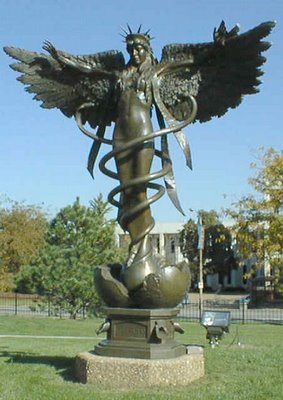
winged_caduceusEzra Klein has an article whose thesis is that as Americans don’t directly pay the full cost of their healthcare since employers pay a large chunk, or they’re on Medicare, Medicaid or some form of socialized medicine (the military and the Veterans administration) Americans aren’t for radical change.

The problem with this is simple enough.  Polls find that a super majority of Americans, from 70% to 80% want a public option.  A straight up majority want single payer.  That certainly qualifies as radical change.

Americans may not pay the full cost of insurance, but they are well aware of the full cost of health care.  About 60% of all bankruptcies are caused by health bills, everyone who is self-employed knows the full cost, and people who get sick routinely had claims denied or lose coverage.  The full cost of healthcare becomes evident when you get sick, and the health care you thought your insurance provided doesn’t actually appear, or you have to fight tooth and nail for it.

Everyone may not have experienced these costs and problems directly, but I’d be willing to lay long odds that almost no Americans haven’t had them happen to a friend, co-worker or family member.

And so, contra-Ezra, in fact Americans are ready for radical change.  Even if you don’t consider the public option radical, single payer is, and a majority of Americans want it.  One might argue that that the intensity of desire for change is not there, that there haven’t been huge crowds in support of health care change, but the problem there is Obama has been rather wishy-washy. He isn’t offering single payer, which is what would get the hard left out in large numbers, and he isn’t even willing to say that his bill must have a strong public option.  His plan, and those offered by the House and Senate, have a mushy feel to them.  “Might pass this, might not, and we aren’t committed to it.”

It’s hard to get worked up for mush and so, by and large, people aren’t.

But still, it’s clear Americans want radical change of the health care system.  It’s the politicians who don’t.

Specifically Democratic conservative Senators like Baucus and Conrad, virtually every Republican Senator, and President Barack Obama, who ruled out radical change in the form of single payer and who won’t insist on even a bad public option, let alone a truly robust one, are the ones who don’t want radical change.

And yes, it’s probably because American politicians don’t feel the cost of health care: they’re fully covered, and virtually all of them are millionaires.

So, no, the problem isn’t American citizens not having the appetite for necessary radical change.  The problem is American politicians.

Left Wing Self-Defeatism And How To Win

One constant theme which needs dealing with is the idea that the country is more conservative than liberal and that centrists are needed to hold off horrible conservative things from happening.

More than that, this is an argument for oligarchy.  What I see is that the majority of people, in poll after poll, want single payer.  A huge majority want the public option, yet odds are decent you won’t even get that.

When people talk of left-center coalitions the center part includes a large number of Senators (like Diane Feinstein) who won’t do what the majority of their constituents want them to do.  At this point “centrist” =  “captured by monied interests.”

Odds are if Obama wanted single payer, the House could pass it.  It’d be close, but they could get it done.  The House is the more representative body of the two bodies, the Senate is deliberately retrograde.

When I look at the US what I see is a banana republic.  And then I see people who think that the Senate, or even the House, actually does what the American people want.  Again and again, Congress does things that the majority disagree with.  In 2006 the Dems were elected to end the war in Iraq, for example, and refused to do so (though again, the House at least went through the motions, the Senate didn’t even make an effort).  Oh, Congress will sometimes do what the majority want—when that’s what it was going to do anyway.

The plan to fix this is simple enough and always has been. Obama was a right wing democrat and this was clear early.  I told people that repeatedly through the primaries and into the election.  Once he was chosen as the nominee I told people not to work for him or give him money, because he could win or lose without netroots or progressive support (it was a drop in the bucket compared to what he was getting elsewhere and was not decisive for him), and to take their time and money and spend it on electing progressive members of Congress, where that amount of money and volunteers could be decisive.

People who hold progressive and liberal policy views are a much larger proportion of the population than the right wing crazies are, they are in fact a majority of the population, though you’d never know it from listening to the gnashing of teeth of some folks.

If the right wing crazies could capture the Republican party, liberals and progressives, who already make up the largest block in the House, and who massively outnumber Blue Dogs, can certainly do the same to the Democratic party.

If, of course, they stop telling themselves self-excusing lies about how the country doesn’t agree with them on basic issues like healthcare, when, in fact, the country does.  Americans may not call themselves liberals, but when you look at their actual policy positions they are more liberal on most (not all, but most) issues than they are conservative.  That’s a gap in self-perception it should be possible to jump.

It takes real work for the centrists and right wing to keep Liberals and Progressives down.  Notice that almost all of Obama’s whipping is towards the left, towards progressives, not to the right.  The right wing of the Democratic party is more or less doing what he wants (forget the rhetoric, again, look at who he and Rahm whip), it’s the left wing he’s scared of, because if they got their act together they could stop him from passing anything.  The Blue Dogs in the House do not currently have a veto, the Progressives, if they want to use it, do.  And that’s why they get the back side of Obama and Rahm’s hand so often.

The left is the most dangerous force in American politics today.  The entire resources of the lobbying industry and of centrist Democratic interests are required to keep it in check, not just during legislative season, but during elections, when the DCCC and the DSCC do their very best to make sure that progressives don’t win primaries, and when they do, that they’re starved of resources.

So time to spine up.  If you’re a left wing Democrat, you belong to the scariest force in American politics.  The crazy right will have some good cycles yet to come, mainly due to Democratic establishment incompetence and preference for mushy middle candidates but demographics are against them.  Don’t write Republicans off yet, but they are failing.  You—the left—are the rising force, and everyone in the center and the right, is doing everything they can to keep you down.

Don’t let them, and don’t believe lies about how you’re some tiny minority whom the American people don’t agree with.

Meet the New Boss

Obama supports extending Patriot Act provisions.

I assume, by this point, no one expected anything else?

If not, forgive me, but you’re the living definition of denial.

The fundamental truth about the Obama administration is that it is the Bush administration run by slightly less incompetent, marginally less evil people:

  • The Iraq occupation will end when Bush wanted it to.
  • The Bush administration’s campaign of eradication of fundamental civil liberties, including the gutting of the 4th amendment and holding people without trial, continues.
  • The Afghan war continues, and is even being escalated.
  • The signature issue of “health care reform” is a scheme which will force citizens to buy private insurance which, because of lack of effective controls, will increase in price faster than wages or inflation.
  • Obama and Geithner have followed the Bush/Paulson financial policies, virtually to the letter, spending trillions bailing out Wall Street and creating a financial sector which has fewer, larger actors with more political power than before.
  • Obama continues to exert pressure primarily on Progressives rather than on Blue Dogs in order to obtain relatively more conservative rather than liberal bills. (This is not an accident.)  The most liberal bill always comes from the House, the conference committee bill is inevitably closer to the more conservative Senate bill.  (This is not an accident.)
  • Unlike Bush Jr, Bush Sr., Clinton, and Reagan, Obama has not replaced the prior administration’s district attorneys wholesale, instead leaving in place the majority of the Bush administration DA’s who had survived Rove’s purges intended to make sure they were loyal Republican apparatchiks.
  • Obama has not cleaned out the administration in general of Bush-era appointees and plants; indeed he has filled less spots than either Clinton or Bush II had by this point in their terms—and no, it’s not because the Senate won’t confirm them.
  • Obama appointees will be forced to resign if the right wing (aka Beck) goes after them hard, but if progressives don’t like them, tough luck.
  • Obama’s economic team is filled with people who created the framework which allowed the financial meltdown to occur, who didn’t see it coming, and whose solution to it is to give money to their friends and colleagues and try and get another bubble started.
  • Etc.

In most meaningful ways, Obama is running a slightly kinder, gentler and very moderately less-stupid version of the Bush constitutional framework.

Plus ça change plus c’est la meme chose.

Welcome to The Long Grey Suck

(Note: comments weren’t working, they are now, so feel free to comment if you like.)

From the Globe and Mail (via Corrente):

While other countries were bailing out major companies by purchasing their shares and debt or taking ownership stakes, the German government took a different tack this year, bailing out payrolls instead, in order to keep layoffs and large-scale unemployment at bay and stave off the personal bankruptcies and home foreclosures that would result.

The result has been a political dividend for Ms. Merkel, whose ruling Christian Democrats face a Sept. 27 national election. In 2005, she was swept to office after a sharp rise in unemployment levels forced then-chancellor Gerhard Schroeder, a Social Democrat, to call an election.

This time around, she can boast that unemployment has held steady for two straight months, at 7.7 per cent, below the Eurozone average of 9.5 per cent. Without the kurzarbeit, Germany would have seen unemployment rise.

It has also turned the attention of world governments to Germany, where some forecasters believe the economy is recovering faster than among its neighbouring countries. If growth can resume next year, Ms. Merkel’s payroll-boosting scheme will have paid off, saving the country from the worst effects of the downturn.

This is a crude version of what I was arguing for last year, by the way.  I wanted support for homeowners and so on, which would have put a floor under the crisis.  The US situation, since it was the epicenter and originator of the paper behind the crisis, required different actions, but the basic idea of supporting ordinary people so there wasn’t a demand collapse and a spiral of bankruptcies and foreclosures was the point.

What we’re seeing right now in the US is that foreclosures are up, consumer credit is crashing through the floor, and employment is still declining.  The engines of demand in the US economy area almost entirely government driven at this point, which is fine, but because ordinary people weren’t helped, the requirement is for that stimulus to continue (mainly through Afghanistan once the stimulus bill runs out).

A stimulus is supposed to kick a country out of a recession or depression, not be required indefinitely.  And right now, to slightly change what we used to say about the Bush economy, the economy is “isn’t dying, as long as you don’t unplug the life support”.

Welcome to Japan, 1990.  Get ready for a long grey suck.  All because Obama, Bush and Bernanke thought that specific financial corporations were identical to banking, and that throwing money at banks was more important than fixing the underlying economic problems created by financialization and bubbles.

Obama Explains the “Rules of Reform”

Obama in his speech last night:

“I am not the first President to take up this cause, but I am determined to be the last.”

“…under my plan, individuals will be required to carry basic health insurance”

“I have no interest in putting insurance companies out of business.”

” we believe that less than 5 percent of Americans would sign up” (for the public option)

“Nothing in our plan requires you to change what you have.”

(editor note: or allows you to, if you have insurance through an employer.)

Clearer Obama:

As Health Secretary Sebelius said, we are determined to create a health system in this country which is designed so it can never become single payer.  My mandate system, forcing you to buy insurance from insurance companies with inadequate subsidies, will preclude that possibility and save the American consumer for the American insurance and pharmaceutical industries.

Rule 1: the best way to make money is to have the government force people to buy your product.

Rule 2: Any major industry with a revenue stream is entitled to that revenue stream forever, no matter how bad the service they provide is, or how much they overcharge.

Rule 3: Any failure of the system will be paid for by forcing ordinary people to pay to bail out the elites who failed.  Making the rich pay for their own mistakes is unacceptable.

Comparing the House Bill’s Cost to the Baucus Proposal

Emptywheel has crunched the numbers on the Baucus plan, and has come up with how much money it will leave families if they actually have to use the insurance for any significant health care problems.  Here are her numbers for a family of four earning 300% of the poverty levels or $66,150.

Federal Taxes (estimate from this page): $8,710 (13% of income)

State Taxes (using MI rates on $30,000 of income): $1,305 (2% of income)

Food (using “low-cost USDA plan” for family of four): $9,060 (13.5% of income)

Home (assume a straight 30% of income): $20,100 (30% of income)

Bad Max Tax: $20,610 (31% of income)

Total: $59,785 (89% of income)

Remainder for all other expenses (including education, clothing, existing debt, transportation, etc.): $7,215 (or 11% of income.

Now, the House bill stops subsidies at EXACTLY the same level, 400% of poverty level. We can use Emptywheel’s numbers for all of this.  The difference is that the House plan limits premiums to 10% of gross income at 300% (pg 137, pdf), and out of pocket expenses to $10,000 per family.

So that makes the House Tax: $10,000 + 6,615 = 16,615 or 25% of income (as opposed to 31%).

The difference between the House plan and the Baucus plan is $4,025. Total expenses are $55,7607, or   The remainder for all other expenses is $11,240 or 17% of income.

It’s not a meaningless difference, $4,025 a year is $335 a month.  But it’s not huge , either.

Now, one might say the real difference is that the House plan has a public option, which will drive down costs.  At best that’s questionable.  I don’t think so, neither does Taibbi, and neither do various other people.  Yes, a good public option would, but the House plan has a crippled public option.  I strongly expect that most people at 300% are going to be paying 10% of their income, because that’s what insurance companies are going to charge them, since that’s what they can charge them.

If you object to the Baucus bill because it will force families to buy insurance that will still financially cripple them, then there’s little reason not to object to the House Bill for the exact same reason.

Update: Dave Johnson points out the following (which would be true of Marcy and my numbers):

It seems you want to deduct the $20K insurance premium from gross income before you calculate the federal tax, so fed tax shouldn’t be $8710, it should be

$66,150 – 20,610 = 45,540 * 13% tax = $5920 tax.

The difference is $2,790 to both the Baucus and House plan numbers. Which is slightly better for both of them. I leave it to readers to decide if it’s enough better to make either of them a good deal.

Page 513 of 532

Powered by WordPress & Theme by Anders Norén