Ian Welsh

The horizon is not so far as we can see, but as far as we can imagine

Socially how the next 20 odd years will play out

Ok, let’s get down to brass tacks.  The riots in Britain are an important event, and combined with the decision to double down on austerity they tell us a lot.  This is my baseline, loose model for the next generation.

The decision has been made by Cameron and society in general that the way to respond to the riots is to crack down, hard.  They are sentencing people to long sentences for minor crimes (a year for stealing a bottle of water) and they are extending the punishment to families, kicking people out of housing if a member of their family was arrested.  They are discussing cutting people off from social networks, and in Calfornia today the powers that be cut off cell phone service during an entirely non-violent protest.

The decision has been made to double down on repression.  To extend repression to families, a logical extension of our socieity’s obsession with family as above all else, and a very aristocratic thing to do, which reeks on the 17th century.  In terms of social media, Wikileaks was the bleeding edge of this, when Paypal, VISA and Mastercard cut off Wikileaks, despite them having been convicted of no crimes, it was clear that access to the modern economy would be held hostage for those who didn’t play the way the oligarchs wanted them to play.

Repression of this sort always spirals.  Cut-offs from the internet, from cell phone use, from specific sites, will continue to spread.  Sometimes they will be temporary and blanket.  Sometimes they will hit individuals.  Sometimes they will hit specific sites in specific areas.  Access to the modern credit economy will continue to be used as a weapon.  There will also be continued removal of the right to travel, with no-fly lists moving to trains, and later to bus stations and eventually there will be a ramp up of stops of automobiles.

This sort of stuff is easy to get around, right now, by anyone relatively bright and even slightly technologically savvy.  So there will be a renewed, and successful push towards what might be called the biometric surveillance state.   You will carry ID, your biometric data will be centrally located as well as stored on ID, and this data will be used to control what privileges you have access to (you have no rights.)

Meanwhile, on the other side of the equation, throwing youngsters into prison for very minor crimes is a mistake.  It will harden them, and connect them.  This is especially true in British prisons, because British prisoners are a hardened bunch of criminals.  But it is a mistake no matter where, because in America and Britain, having ever be thrown in jail means your life is over.  Every decent job does a criminal record check, and if you have a criminal record, you will never ever have a good job again.  At that point you might as well become a criminal, and why not a revolutionary?

Which leads to the crackdown on hackers.  Throwing young, bright, technically savvy young adults in with the criminal element is, again, a mistake.  The rise of the surveillance state means that tech savvy is going to become very important to anyone who doesn’t want to live by what might be called “Society’s new rules”.  And  the young hackers have a revolutionary mindset.  The combination of men with nothing to lose, with men who have tech skills and believe society is corrupt and needs to be brought down, will be explosive.  And since the biometric security state will be done on the cheap, by the sort of incompetents who run the current wars and the current security apparatus, there will be plenty of cracks in the system to exploit.

Likewise the increase in punitive sentences is a mistake, pure and simple, because it means people have less to lose.  If a relatively minor crime gets you in for years, and destroys your life, many will make the calculation that they might as well fight, might as well use violent force, rather than be taken.

Meanwhile the ranks of the permanently unemployed will swell.  At this point companies simply don’t want to hire anyone who has been unemployed for longer than about 3 months, and have a strong preference for the currently employed. If you don’t find a new job in 3 months, you are probably never going to have a good job again.  The data is clear on this, what is also clear is that the developed world has made a hard turn for austerity, one which will do damage for years to come.  A decade is modestly optimistic.

This will increase social disorder, of course, and our lords and masters and the remnants of the middle and working class who scream “they’re criminals, pure and simple”, will double down on repression, again and again.

This is, of course, a big mistake.  It may turn into a relatively stable solution set in some countries, but they won’t be places you want to live unless you have the morals of totalitarian, and in others it will lead to revolutions, while in others it will lead to outright failed states.  We can hope that a few will turn aside from this path.  So far in Europe only one country has, Iceland.

As with most of my predictions, folks will scoff at this one, think I’m hysterical, and doom-monger, and so on.  But this is just social mechanics played out over time.  This is the glide path, it can be stopped, but it is unlikely to be.

Hard and Complicated Aren’t Synonyms

The chart above is my second favourite chart. It’s a chart of per capita health expenditures over the last forty odd years and what I want you to look at is Canada and the US. You’ll see that at one point Canada actually spent more per capita than the US, then over less than a decade our costs dived to about 2/3rds of yours and then started paralleling your costs again.

What happened in that time period is that we went to single payor universal health care. Since then our metrics have been as good, or better than the US, with the exception of waiting times for optional surgery.

Now this isn’t actually a post about healthcare, it’s about language.

Specifically I’m sick of the idea that “the US doesn’t have any simple problems.”

Actually, many of the US’s problems are simple, and health care is just one of them.

The problem is the use of simple as a synonym for easy; and hard as a synonym for complicated.

See, stopping smoking isn’t complicated. All you have to do is… not smoke. But it’s hard as dickens, which is why so many people fail to do it.

Now a lot of US problems are like this and health care is one of them. The US spends about 16% of its GDP on healthcare, clocking in at 2 trillion. Changing to a single payor universal system will slash about a third of that. Savings: about 650 billion dollars. Everyone knows this who isn’t paid not to know it – every other country in the world that has universal health care pays about a 1/3 or less than the US and when Canada switched, its costs dropped by a third.

This isn’t complicated. But it is hard. It’s hard for the same reason that quitting smoking is hard, or that losing weight is hard – that 650 billion dollars extra is something the US is addicted to. That money pays for jobs and profits at insurers, drug companies and to hospitals and to some doctors.

That’s a lot of money, and the people who are currently making a living, or a huge profit from it, don’t want to lose it. So they’ll fight tooth and nail to not end the gravy train. The 20% to 30% administrative margins in health insurance companies as opposed to the 2% to 3% margins in Medicare are money that someone is getting. The price is that 50% of bankruptcies are caused by medical costs; that 43 million Americans are unemployed and that American companies like Ford and GM have huge medical costs that companies like Toyota don’t have.

So it’s not complicated to fix US healthcare – just go to comprehensive healthcare, probably modeled after France or Germany (who do as well or better on practically every metric), and voila – no more uninsured, much fewer bankruptcies, improved competitiveness and 650 billion dollars in profit and administrative costs that could actually be used for productive enterprise. Hard, because a lot of people make a lot of money from the status quo. But not complicated.

The US has a lot of problems like this. The debt and the deficit can be fixed by simply increasing tax rates and closing loopholes. Raise marginal rates on the rich, who can definitely afford it, end preferences for unearned income (which is taxed at half or less the rate of your paycheck) and make it so that corporations and people are taxed at the highest applicable tax rate on all their income so they can’t try and hide some of it overseas and get a lower rate, and you’d be back on track.

Or – to put it even more simply, don’t spend more than you bring in. It’s simple, and the Bush administration, after the Clinton administration had put the budget back on track, simply decided to max out the credit cards to give the rich tax breaks.

Social Security – simply get rid of the cap on contributions at 100,000 and it’ll be in the black. Heck, even without doing that it’ll be decades before it can’t pay. This one isn’t even simple, it’s just “there is no problem”.

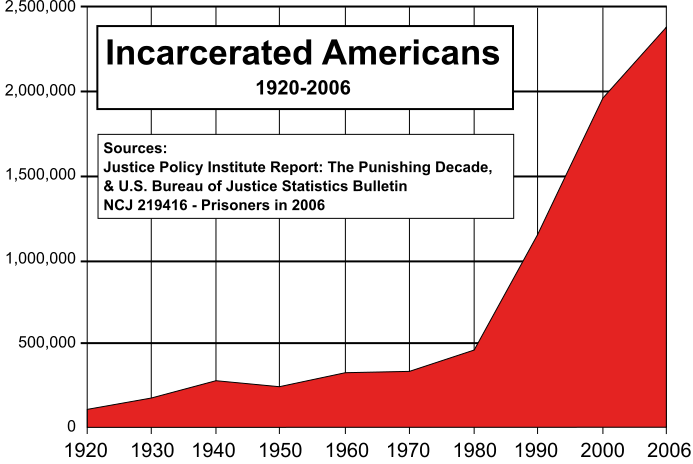
Prison Incarceration – the US has more people per capita in jail than any other nation, edging out Russia back at the turn of the century. This is largely a result of draconian anti-drug laws, yet drug consumption hasn’t gone down, indeed, quite the contrary. When you do something for 30+ years and it doesn’t work, the answer isn’t to do it harder, the answer is to stop doing it. Get rid of mandatory sentencing requirements, 3 strikes laws and stop putting people away for possession of any but the worst drugs. Legalize marijuana. Legalize most opiates. Legalize mild forms of coca so people can get their kick without crack or cocaine. The prison population will drop, drug use won’t go up significantly, and the steady assault on your civil liberties will slow down (the war on terror was just the war on drugs on crack, really.)

One could go on like this for quite a while, including in foreign policy (stop supporting authoritarian regimes because you’re scared of regimes with popular support) and economics (restructure the economy so that making things makes more money than playing securities games) and education (don’t tie school money to property taxes). The solutions in many cases are clear and they aren’t complicated. But they are hard because many people benefit from the way things are done now. But one shouldn’t confuse hard and complicated and one shouldn’t think that just because someone is mainlining pork today they have a right to mainline pork forever.

(One also shouldn’t confuse logistically complicated with conceptually complicated.  We live in a society which is very very good at logistics.  Walmart, FedEx, UPS, the US military and many other organizations are logistical wizzes.)

When I look at America what I see isn’t a nation with problems it can’t solve, instead what I see is a nation with problems it won’t solve and what I see is a lot of people to whom the status quo is really good (including most Congresscritters) who try and sell Americans that there’s nothing they can do.

Politics is about fixing problems. Anyone who tells you that simple problems are complicated and can’t be solved, but only managed, needs to be kicked out of office. Because the one thing I’ll tell you is this – problems you don’t actually try to fix, don’t get fixed. Losing weight is hard, but if you never try, you’ll never succeed.

Cutting health insurance companies and drug companies off the gravy train will be hard. But if you don’t do it, you’ll never have good universal healthcare.

Your choice really. America has everything it needs, still, to choose life and a renewal of the American dream. But I wonder if it will, or can. Every great nation has its period in the sun come to an end, and in almost every case, it’s internal rot that brings them down. America has renewed itself in the past, does it have the guts and the integrity left to renew itself one more time?

(This is a re-post of a post originally published May 14, 2007. Some minor changes have been made.)

The monopoly of violence and simple solutions to supposedly insoluble problems

One of the interesting things happening in Britain is the formation of ad-hoc groups for neighbourhood defense.  People have noticed that the police can’t defend them, and have decided to defend themselves.

This it is not a good thing for the State, which is why the police are strongly against it.  This is potentially the beginning of the breakdown of the monopoly of state violence, and the beginning of the creation of militias.  Normally, of course, I’d be aghast at the creation of militias.  They lead to nasty sectarian strife, etc… and if they take off, that’s exactly what will happen.

But what they also are is a crack in the social contract between state and citizens, an acknowledgement that the State can’t defend its own ordinary people.  And as you walk down this path, citizens start questioning their support for the State, period — whether in taxes, or in obedience to the State’s law.

Normally, again, this is a bad thing.  Heck it’s a bad thing here, but just as with the riots it is a natural reaction to the current situation.  When the State doesn’t do its job properly, whether that’s running the economy for everyone’s benefit, not just a few; or whether that’s maintaining the basic monopoly of violence (which includes basic social welfare so that the designated losers of the system don’t resort to uncontrollable violence), people start opting out.

States which don’t perform their basic functions become failed states.  There are a lot of ways to get there, but one of them is to allow the highest inequality in the developed world to exist in your capital (sound familiar?).  Those people lash out, you can’t repress them effectively anymore, others step up to do what should be your job.

Those who say there is no solution are, as usual, full of it.  There is a solution, and it is obvious.  Britain had plenty of money for the Iraq War, had and has plenty of money for Banker salaries and a housing bubble.  A chunk of that money could have easily made sure this didn’t happen, but the choice was made to have rich bankers and bomb Muslims: those were Britain’s priorities.

But if you wanted to fix it, first you clamp down hard (you now have no choice, because you didn’t care about these people), then you offer them a future.  You basically give everyone who wants a job, a job, put ex (or current) sergeants and corporals in charge, move any non-married men and women out of the city, and put them to work fixing and building things. There are always roads and buildings to be repaired, ditches to be dug, farmers who need help and so on.   You hire out of work tradesmen, and they teach them skills.  You pay them decently, you feed them, you house them, you give them skills.  After 4 or 5 years, you start putting them back into the private work force, and you subsidize their first job.

This isn’t rocket science, it is dead obvious.  Yes, it is expensive, but it is less expensive than the Iraq War or bankers bonuses.  And it is a hundred times more humane, and will prevent further occurrences while improving race relations, your economy, your tax base and you workforce.

When people say there are no simple solutions they are, in the current context, almost always full of shit.  What they mean is that there are no simple solutions which are socially acceptable either to the governing class or to society as a whole.

Innocents were already being hurt in Britain

So a guy gets hurt in the riots.  He lives in the most unequal city in the developed world. He is a part of the society which condemned these people to hopeless lives, to the point where they rioted, after 333 of them died in police custody over 13 years with not one cop being convicted of anything.  They rioted after a black man was shot and the police lied about it.  They rioted when there is one job for ever 58 applicants where they live, where right out of high school most of them will never hold a job.

Riots aren’t pretty, if you don’t want them to happen, make sure your society doesn’t abandon a racial minority to squalor and hopelessness.

You should all know better. Yes, it’d be nice if they were more targeted against the people who have fucked them the most, but y’know, that’s the way riots go. Hell, even clearly political riots like the Greek ones started out with the rioters fucking up their own neighbourhoods.

This is why you don’t let things get to the point where people riot, don’t let their lives be completely intolerable. As Stirling noted, even soulless technocrats from the liberal era understood that.

I have sympathy for the victims, but so what? I have more sympathy for the 333 people who died in police custody. They lost a lot more. And it may not be that shopkeeper’s fault, but that’s how these things go. When you treat people like sub-humans, they eventually show you what that means.

I am not going to play the gutless liberal game of condemning people who have been treated like animals for lashing out in pain. Is Britain a democracy, or not? If it is, then everyone is complicit, if it isn’t then a revolution is needed and anyone who isn’t working towards one is complicit. And in the meantime, a lot of innocents are going to get hurt, that’s what happens in unjust societies.

If people won’t help those in pain, then those in pain will share the pain. That’s what happens, especially when you’re talking young men who never had a chance, who were born with no future, and society just doesn’t care.

British bankers were making millions, billions, and British government couldn’t find enough money to help these people? To give them jobs?

And British society tolerated those priorities?

How many of you would have to die in police custody before you rioted?

The answer, in London, is at least 333 since 1998, and no convictions of cops.

Much higher percentage of blacks than their percentage of the population, of course.  333 dying in police custody.

Per year, that’s about 25.

Now, there are two possibilities as I see it. Either:

1) the police are beating a ton of people, and some of them can’t take it; or,

2) they are deliberately beating certain specific individuals to death.

Which do you think it is?

Added on top of what we know about the London police’s relationship with Murdoch’s papers, where they were receiving millions of pounds in bribes, I think it’s a safe conclusion to reach that the Met police are rotten from top to bottom.

(note: corrected from “mostly blacks” to much higher percentage.  My bad.)

Correction : the IPCC reports show most died due to neglect rather than deliberate harm.  Not sure I entirely buy it, but there it is.  Mea culpa, I jumped the gun.  Beat me up in comments as appropriate.

London Riots #3: Context

Wow, just wow:

One journalist wrote that he was surprised how many people in Tottenham knew of and were critical of the IPCC, but there should be nothing surprising about this. When you look at the figures for deaths in police custody (at least 333 since 1998 and not a single conviction of any police officer for any of them), then the IPCC and the courts are seen by many, quite reasonably, to be protecting the police rather than the people.

Yeah.  Ok.  Go read the rest.  What is surprising is that they hadn’t already rioted.

No war but class war, folks.  The rich understand this, and they have been practicing it.

London Burning #2

The oligarchs are overplaying their hand.

Noone expected this. The so-called leaders who have taken three solid days to return from their foreign holidays to a country in flames did not anticipate this. The people running Britain had absolutely no clue how desperate things had become. They thought that after thirty years of soaring inequality, in the middle of a recession, they could take away the last little things that gave people hope, the benefits, the jobs, the possibility of higher education, the support structures, and nothing would happen. They were wrong. And now my city is burning, and it will continue to burn until we stop the blanket condemnations and blind conjecture and try to understand just what has brought viral civil unrest to Britain. Let me give you a hint: it ain’t Twitter.

Notice some other things: Kettling doesn’t work against prepared protesters.  They broke the kettling attempts with bolt cutters.  Notice the masks.  These people have put some thought into what they’re doing.

Next step, next riots, if they keep thinking things through, will be systematic destruction of the CCTV system, taking out police stations, and occupation of the financial district.

Another quote:

In one NBC report, a young man in Tottenham was asked if rioting really achieved anything:“Yes,” said the young man. “You wouldn’t be talking to me now if we didn’t riot, would you?”

“Two months ago we marched to Scotland Yard, more than 2,000 of us, all blacks, and it was peaceful and calm and you know what? Not a word in the press. Last night a bit of rioting and looting and look around you.”

Eavesdropping from among the onlookers, I looked around. A dozen TV crews and newspaper reporters interviewing the young men everywhere ‘’’

There are communities all over the country that nobody paid attention to unless there had recently been a riot or a murdered child. Well, they’re paying attention now.

What was that quote from someone whose named started with J?  Something about those who make peaceful revolution impossible make violent revolution inevitable?

Don’t think this isn’t a big deal. This is a major capital.  London is one of the world’s great cities and a hub of the financial system.  And the rioters are showing it can be done, that if people fight the police rather than sitting passively, the police suddenly aren’t all-powerful.

Oh, and don’t take hope, a future and respect away from young men in large numbers. Smart oligarchies/aristocracies understand that you have to keep a certain number of the violent classes employed. Not for their sake, but for the oligarchs.

The London riots

As I wrote before:

Meanwhile in England, the Cameron government’s massive slashes to education hit virtually all at once, making an entire cohort of young people know exactly who just did their level best to destroy their lives.  This is important, to put it bluntly, young males who don’t have enough money to settle down with a young female are extraordinarily dangerous to the state.

The Conservative austerity measures are destroying the possibility of a future for a generation of young people.  There is this weird idea amongst English elites, which I encountered in person during my London visit, that the problem in England is their welfare culture.  In other words,after a financial crisis virtually entirely caused by the rich, the response has been to slash spending on the poor and middle class to pay for bailouts for the rich, who, by any sane reading of the crisis, caused the disaster.

Round after round of bailouts have failed, because they keep just throwing money at the problem.  As I wrote in 2008:

So you’re in a boat, and it starts taking on water. You grab a bucket and start bailing. What do you tell the rest of the crew?”Find the hole, and plug it.”…

… If you don’t patch the hull, if you don’t make significant regulatory changes at the same time as you are creating a bailout bill, you’re just buying time. The ship may stay afloat as long as you don’t stop ferrying buckets of money to the financial sector, but it’s still got a massive hole in the hull and it’s still taking on water.

Any bailout bill that does not have significant regulatory changes will not solve the problem. It will, at best, kick it down the road for as long as taxpayers are willing to fork over a hundred billion a month or so to keep it from exploding. It may even make the problem worse because of moral hazard—heads the financier who makes a bet wins, tails the government bails him out.

This has played out again, and again, especially in Europe, where lawmakers do bailout after bailout of banks (they’re not bailing out the governments, they’re bailing out their creditors), refusing to do what must be done, which is a massive restructuring of all the debt in the key nations (100 year bonds, paying 1%, say) or an outright default.  They are making ordinary people pay for their masters sins.  And they are putting the worst of it on the people who they feel are least powerful: the young, immigrants, the poor and so on.

The response to a system which refuses to do the right thing, which offers Coke-Pepsi politics (if you don’t like Coke, you can always have Pepsi!) is turning more and more violent. If electoral politics offers no solution, people will look for one elsewhere.

Our elites live in a bubble. They think that what happens on the street doesn’t really effect them.  There will come a day when many of them will be wrong.  They’re playing with their lives, with our lives, and with the lives of their families and loved ones.

What will happen in each country will be different.  Some will get a man on horseback, some will screw in the repression and hang on, turning into aristocracies, others may find what many on the left are insisting on, a Robespierre. And maybe one or two will do the right thing, stop the bailouts, stop the reforms, and make a commitment to restructure in a way which creates a future for everyone.

Maybe.

Page 461 of 532

Powered by WordPress & Theme by Anders Norén