Ian Welsh

The horizon is not so far as we can see, but as far as we can imagine

The complete inability to manage obvious problems: California Drought Edition

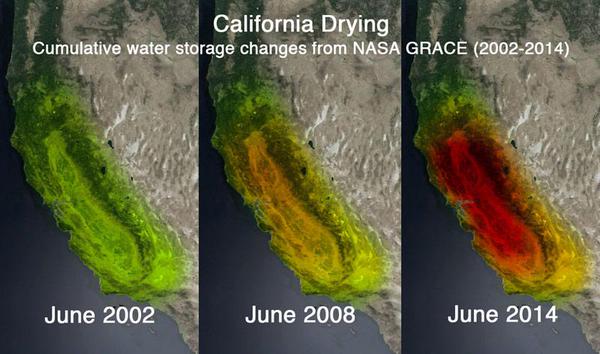
California DryingSo, California has about a year’s worth of water supplies, and groundwater is being depleted so fast wells are going dry.

This problem has been coming for years.  There should have been rationing, at the last, last year and probably before, since climate models indicated the strong possibility of the drought continuing.  Moreover farmers should have been forced to move over to less water intensive crops (subsidize the move.)

The total inability to manage obvious problems is one of the hallmarks of our age.  Everyone with any sense knows there’s a problem, everyone with any sense knows at least part of the solution, and we don’t even do the obvious things to fix the obvious problems.


(I am fundraising to determine how much I’ll write this year.  If you value my writing, and want more of it, please consider donating.)


Until a new generation comes of political age or absolute catastrophe wipes out the political class, this will not change.  It’s not quite true that old dogs can’t learn new tricks, but few politicians, senior civil servants or corporate executives are capable of acting in ways different from those that brought them to power.  As with science, the graveyard makes the conversions.

What Intellectual Judgment Is

Intellectual judgment is not “common sense”, it is its own thing. Many people with excellent intellectual judgment are lousy at running their own lives.  Instead intellectual judgment is about understanding the limits of intellectual systems.

Every intellectual system has premises, axioms and assumptions. There are some things which simply are not true, or cannot be proved as true. They are often approximations of the truth–they are close enough to the truth under certain circumstances. If you do not understand where and when they break down, you will go wildly wrong when you push discipline towards its extremes. You must also be aware of the fact that other people will game your system, that when your assumptions are known, other people will then subvert them.

Any system which says ALL people are or do X is almost certainly wrong if it’s saying anything that isn’t trivially true. All people do not maximize utility (in fact, no one does). Everyone does not act in self interest all the time. Everyone does not act altruistically. Prices do not always convey information about how valuable something is. Supply and demand do not always determine price. Perfect information is rarely available, and people are not even close to rational, except on rare occasions when they are. Entrepreneurs succeed as much by luck as anything else, compensation has little correlation with how hard people work, many people are willing to die for their beliefs, but definitely not all; etc, etc…


(I am fundraising to determine how much I’ll write this year.  If you value my writing, and want more of it, please consider donating.)


Intellectual judgment requires knowing the limitations of any system you’re using, what it’s good for, what it’s bad for, where it breaks down. Good policy judgment requires understanding human nature, not in the operational sense that a good salesman does, but in the sense of understanding how people react to incentives, ideas and laws–how they are shaped by them, how they shape them, how they get around them, how they come to believe in them or how they subvert them.

It’s almost impossible to teach this (almost) and learning it requires both real world experience and deep thought on psychology, history, mass psychology, anthropology, sociology, cognitive science and humanities. Start with Machiavelli, and move on.

Fundraising update: $1,484.36 to go to 5 articles a week

As of publication, we’ve raised $414 in recurring donations (which count 3x), and $3,273.64 in non-recurring donations, for an effective total of $4,515.64.  I am immensely grateful to everyone who has donated, and this puts us solidly in the two significant posts a week level, and not too far from 5 posts a week.

If you haven’t given, you can afford to give, and you value my work, please consider donating or subscribing.  The amount of writing I do takes time and it is work.

DONATE OR SUBSCRIBE

If you haven’t read them already, there are new articles on the preconditions for Keynesian stimulus to work; a concrete example using those conditions; an article on Venezuelan sanctions and their relation to the Melian dialogue which prophecized the fall of Athens; and an article on how intelligence can cause disaster if it is detached from judgment and creativity.

The Dangers of Intelligence without Creativity or Judgment

Larry Summers, 2013

Larry Summers, 2013

A friend once said to me “once you’re at a certain level of intelligence, most people you meet are either about as smart as you, or stupider.”

I’m at that level of intelligence, I suspect many of my readers are as well. If I go into a 10,000 person organization which doesn’t select primarily for intelligence, I expect to either be the smartest person in the room, or as smart as the smartest person in the room. In an org that does select for intelligence, I still expect to be able to keep up, and to be smarter than most, even if they know more about the subject than I do. (Plus, lots of very high IQ people have terrible intellectual judgment).

Divide intelligence into three parts, (yes, you can divide other ways):

1) processing power and pattern recognition (measured pretty well by IQ)

2) Creativity

3) Judgment

A lot of people only have the first, they are very smart ordinary people, they will get to the same solution a modestly bright person would, just a heck of a lot faster. The folks who put up their hands first in class, whose self-worth is based around .


(I am fundraising to determine how much I’ll write this year.  If you value my writing, and want more of it, please consider donating.)


High IQ people without 2 or 3 and preferably both, are extraordinarily dangerous if the problem isn’t straightforward. They are the brilliant people who can completely fuck things up. Think Larry Summers — he really is VERY high IQ, I know people who know him. Brad DeLong has very little of either, though he’s very very smart. (He’s very good when his emotions aren’t involved, his historical economic work is excellent). is much more common than and .

It isn’t primarily intelligence based, but empathy also has a multiplicative effect in certain circumstances.

Around about 4 standard deviations IQ starts to go really off tracks without , because at that IQ level people can make connections between almost anything, the pattern recognition is in overdrive.

To use a metaphor, think of processing power and pattern recognition as the engine of a motorcycle.  Think of creativity and judgment as the rider.  In a straightaway, powering down the highway, no other vehicles on the road, what matters it the engine.  As long as the rider can stay on the bike, the guy with the highest IQ will win any race.

But the more difficult the road conditions, or when you go off road, the more the rider matters.  The guy with the big motor, faced with erratic drivers and lousy weather is likely to get himself, and possibly others, killed.  The good rider will make it thru.

Learning how to think is, in many ways, more important than raw processing power.  The raw processing power will hold you back (to an extent, there are accounts of people raising their IQ by over a standard deviation thru concentrated intellectual effort), but too much power and too little judgment will get you killed, and too much processing power and no creativity will just get you where everyone else would have gone, but faster. Better hope that’s the best place to go.

(Adapted from a comment from 2013.)

What the Melian Dialogue tells us about the End of Empire (Venezuelan security threat edition)

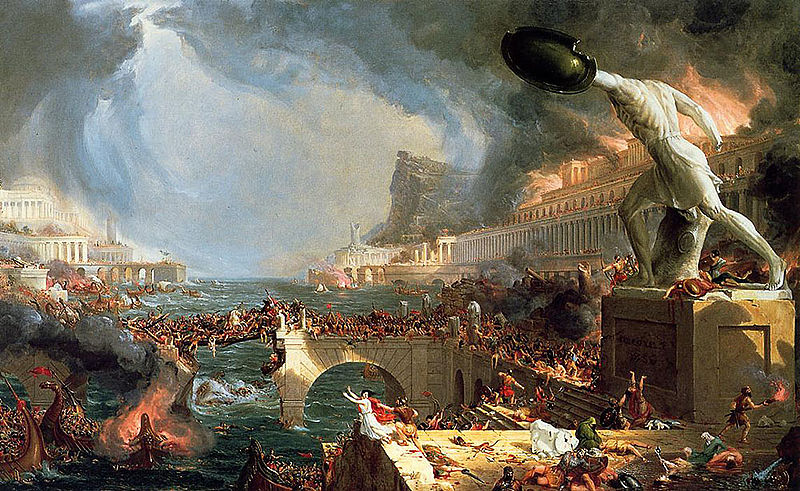
The Course of Empire by Thomas Cole

The Course of Empire by Thomas Cole

I’ll just point out that in no way can Venezuela be considered a security threat to the United States.  And the “human rights violations”, while some are real are far less than routinely committed by many US allies, including Saudi Arabia, while Venezuela is more democratic, again, than many countries the US has not imposed sanctions on.

This sort of bullying is exactly the sort of thing which will lead to the end of American hegemony.  Though less severe, one is reminded of the Melian dialogue.  The Athenians argue that the powerful do as they will and the weak as they must, and that the Melians should surrender.  If they do not, the Athenians will slaughter the men and sell the women and children into slavery.

The Melian reply in part, is thus:

But do you not recognise another danger? For, once more, since you drive us from the plea of justice and press upon us your doctrine of expediency, we must show you what is for our interest, and, if it be for yours also, may hope to convince you: Will you not be making enemies of all who are now neutrals? When they see how you are treating us they will expect you some day to turn against them; and if so, are you not strengthening the enemies whom you already have, and bringing upon you others who, if they could help, would never dream of being your enemies at all?


(I am fundraising to determine how much I’ll write this year.  If you value my writing, and want more of it, please consider donating.)


The irony of the Melian dialogue is that both sides are right: the Melians are destroyed, and would have been better off if they submitted.  But the destruction of Melos is indeed one of the contributing factors to the eventual fall of Athens, because while Sparta may be nastier internally, they are also less dangerous to other city-states than Athens is.

The analogy is not perfect, because even with all of Venezuela’s problems, much of the population is better off resisting the US than it would be conceding (the poor and the darker colored citizens have benefited immensely under the Bolivaran revolution).

But America, and the West’s continued insistence that nations will kneel or suffer is very similar and is already damaging American power.

The Quick and Clean Guide to Fixing the Economy (Keynesian Stimulus #2)

dawnHow would one do a Keynesian stimulus properly today?  Remember, the preconditions for Keynesian stimulus to work are that it not overly aggravate bottlenecks (not send oil to $150/barrel, for example); that it not aggravate overused sinks (carbon); and that the money not pool uselessly at the top.  Keynesian stimulus must create widespread demand.  Further, in a world with bottleneck constraints, sink problems and overuse of even renewable resources, it should help resolve those problems.

Create Widespread Demand While Mitigating Sinks and Bottlenecks

1) Every federal building in America to go to energy neutral at least, or energy surplus ideally.  That’s a massive stimulus.

2) In order for a house to be “conforming” and thus qualify for federal loan guarantees it must be energy neutral at least, as well.

3) A subsidized waiver system for retrofitting civilian buildings to be energy neutral—the cost of which is paid back by savings, so homeowners pay nothing, and commercial guys pay little.  You can create a securities market for the certificates to bring private money online.

4) No mortgage can be conforming if any laws or homeowner agreements forbid the homeowner from growing their own food or selling it.

5) All new condominiums and apartment complexes must provide for growing food, through hydroponics or other means.  Without it, they are, again, not conforming or the income from them gets taxed higher.

6) Substantial tax breaks for telecommuting. (See section below for how to make corporations do this.)

7) Move to a high speed rail system, subsidize electric cars with certificates (buy one while turning in a non-electric car and the government pays half), and so on.

These actions give you a massive renewable buildout, fast.  Most of the jobs are domestic (even if panels are bought from China).  They reduce energy use significantly, including peak turbine oil use and they enable people to grow food when needed, reducing pressures on various carbon sinks and renewable resources.


(I am fundraising to determine how much I’ll write this year.  If you value my writing, and want more of it, please consider donating.)


Reform the Tax System

8) Move back to high marginal income tax rates.

9) Move back to high marginal corporate tax rates, to force companies to start spending their money and to make tax incentives work again: at 80% tax rates the corporations will be very happy to do whatever the government wants them to do in exchange for a 20% tax rebate.

10) Reform the tax code so money earned in the US cannot be moved overseas to avoid said taxes.

11) Make stock buybacks rare (again, to force corporations to spend their money or give it to shareholders).

12) A punitively high inheritance tax on any inheritance over 5 million or so, with no loopholes.

13) A carbon tax.  Imports from any country will be charged that carbon tax at the rate of their carbon expenditure. Countries which will not allow proper inspections to determine said tax rate will be hit with the highest rate.These actions both stop money from pooling at the top and bring money off the sidelines.  The rich can spend it or have it taxed away.

There are many other things one could (and should) do (property taxes being at least partially based on carbon production and energy use, for example), this is just an outline and high-points.  It doesn’t include “how to get there”, but it is important for people to know that there are other options that would work other than status-quo neo-liberalism. If people don’t believe better worlds are possible, they won’t fight to get to those worlds.

Nor would this program work for every country, it requires a powerful country with the ability to impose conditions.  It would, however, work for the US.

When Keynesian Stimulus Works

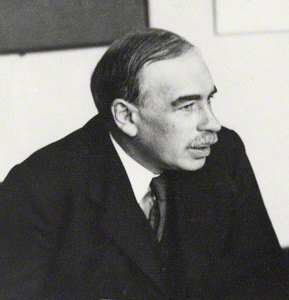
John Maynard Keynes

John Maynard Keynes, 1933

It has become fashionable in many circles to denigrate Keynes and Keynesianism because unconventional monetary policy hasn’t worked.

I’m not going to mince words, people who make that argument are idiots.  Unconventional monetary policy is not Keynesian stimulus.

Keynesian stimulus is about widespread demand: giving money to rich people is not Keynesian stimulus.  The government spends, or even just gives money to people to increase their spending.

Unconventional monetary policy is not Keynesian stimulus.

Further, Keynesian stimulus only works where there aren’t supply bottlenecks. If you were to do (actual) Keynesian stimulus today it wouldn’t work, because oil would rocket past $150/barrel and the economy would immediately collapse.

Keynes did not concentrate on this issue because it wasn’t a problem in his time period: the world, and more importantly, the world’s keystone economy, America, was awash with the stuff.  It wasn’t a bottleneck.  The only bottleneck, before the US went off gold, was the gold-standard.

The bottleneck issue is also relevant to sinks and renewable resources: spending money indiscriminately in a way which leads to more commercial fishing, say, would be moronic, given collapsing fish stocks.  Spending it in ways which lead to vastly more carbon or methane would also be idiotic.


(I am fundraising to determine how much I’ll write this year.  If you value my writing, and want more of it, please consider donating.)


We are facing challenges Keynes did not, but that doesn’t mean he wasn’t right, that means that the policies he suggested need to be modified for the changing times. If you cannot do so, you do not understand either Keynes, or your own time.

This is the great problem with the work of the great political philosophers; of the sages: they come up with a solution specific to a time, and fools think that it should be applied verbatim for all of time, while other fools think “if it doesn’t work verbatim, it’s all crap.”  Doing Keynesian stimulus would be simple, if it was desired. You just make sure the money gets to ordinary people and is used to reduce carbon emissions and uses of other bottleneck resources, while making sure that money doesn’t pool at the top.  (Stopping money pooling at the top is mostly a solved problem. Start with 90% tax rates on all income over 1 or 2 million or so, close loopholes, and don’t privilege any income.)

But Keynesian stimulus hasn’t been done, either smart or stupid: not even the widespread demand part has been done.  So people who rag on about “Keynesianism” are ragging on about a straw man: a policy which has not even been pursued.

Keynes wouldn’t have any problem prescribing solutions for today’s economic problems, and neither should anyone who understands his work.  And those who deride Keynesianism either don’t understand it, or don’t actually want to see widespread prosperity.

Fundraising Update: 2 articles a week reached, with a push can make 5 articles a week

In the first week of fundraising we’ve raised $334 in recurring donations, and $2,808 in one-time donations.  Multiplying the recurring donations by three puts the total raised to $3,810, which is over the $3,000 needed for two articles a week for three months.

The next threshold is $6,000 for 5 articles a week—$2,190 away.  If you haven’t already given, and you value my writing, I hope you will consider doing so.

DONATE OR SUBSCRIBE

If you haven’t read it already, there’s a new article on the problems with non-fiction today, and I’ve kicked my most popular, ever, article, on the difference between ethics and morals to the front page.  That might seem like an esoteric topic, but the difference is the difference between a good society to live in, and a lousy one.

Page 411 of 532

Powered by WordPress & Theme by Anders Norén