Ian Welsh

The horizon is not so far as we can see, but as far as we can imagine

Jeremy Corbyn’s Electile Dysfunction

(POST BY MANDOS, just in case you didn’t notice)

I have a theory about why Jeremy Corbyn seems so unpopular in the UK, despite the fact that he represents a lot of policy positions that are in themselves popular. My theory is that, deep down, in their collective subconscious (if not their actual consciousness), the British public doesn’t think that Corbyn will send fighter jets to bomb people in foreign countries on under-substantiated suspicions.

Oh, to be sure, there are lots of other problems faced by Corbyn worth discussing, like an extremely disloyal caucus (although disloyalty is probably not the right word as it presumes that they had once been loyal, and they’d made it clear from the beginning how little they thought of him). But the antiwar thing is basically a deep psychological show-stopper in terms of the electability of leader in any medium-to-major military power.  People may not precisely articulate this discomfort with a leader who doesn’t seem like he’d attack small countries on a small suspicion when world politics suggests that said lethal use of military force is a diplomatic, strategic thing to do.

Now there are actually other things you can do to satisfy this urge. For example, Theresa May already proved her willingness to harm innocents with a pathologically, maniacally, cruel immigration policy, for which she was responsible. That policy has made her credible, governmental. You know that May will send fighter jets to foreign countries when the media requires it.

Now, you may ask, why is being bombing-credible, or at least cruelty-capable so important for the election of a leader? The reason why is that the leader is supposed to Protect Our Children. (I’m using “our” figuratively here, since I’m not British.) You’d do anything for your child, right? If you’re an upstanding, caring parent, that is.  So consider the very slim chance that someone in a foreign country may concoct a successful global takeover plot when you’re dead and your children are old people.  Surely avoidance of such demands a low threshold for long-distance war. After all, it’s either your children or theirs, right?

But Corbyn is perceived as a repudiation of Blair. And there’s nothing that defined Tony Blair more as a politician, nothing that placed him more in history than his willingness to go to war on thin evidence. Corbyn and his core support base are visibly angry at that. And that is, at a ground, atavistic level, killing Corbyn’s candidacy. (As I said, among other things.) Blair may be unpopular now, but most people are willing to issue negative judgements after the fact, having voted for the man before the fact. Blair already Protected Our Children, was believed to be credible on this front, and won elections.

You may protest: There are lots of other things that threaten people’s children, like lack of health care, unemployment, impending global enviropocalypse, and other very real but rather imperceptible problems like those. My experience of watching how the European refugee crisis unfolded, particularly in anglophone media and public opinion watching from outside, is that people perceive threats very differently, and react more viscerally to a low-probability threat from other individual humans than they do from higher-probability things like their own potential poverty or workplace safety and suchlike. An incident of lawlessness in Cologne, perpetrated by a tiny fraction of the refugees and not only them, overshadowed in Western media all of the other things that humans, including refugees, face. Because we have to Protect Our Children.

To be sure, lest someone object, a lot of this attitude descends and is transmitted by certain sorts of elite opinion-makers like newspaper columnists and so on. Yes, that is so. But they are working with a public that is highly primed for this visceral syllogism.

Does my theory about Corbyn’s unpopularity demand that this situation remain so forever? No: I don’t counsel despair. My theory is about explaining what has happened so far. People always have the possibility to choose otherwise. Maybe even in time for the next British elections. You never know.
If Trumpcare Fails

Update: And, they have pulled the bill. Now Trump needs to get a win. (Note: This would have been a loss if it had actually passed, though Trump may not realize that.)

It will be for the best for both America and Trump. The original deal was bad, and the deal that Ryan and Trump have negotiated would have been disastrous–literally worse than no bill at all.

This is true for Americans, who would have worse quality care, along with less, more expensive coverage; and it is true for Trump, who promised something better and whose marginal followers will know he betrayed them. Indeed, polls have shown a collapse of Trump’s approval ratings since the first viewing of the draft bill.

If Trump is pushing for a vote when he knows he doesn’t have the vote, perhaps there’s some dim idea of that fact in there. A bad deal, as Trump knew in the 1980s, is worse than no deal at all.


The results of the work I do, like this article, are free, but food isn’t, so if you value my work, please DONATE or SUBSCRIBE.

Ideology Precedes Policy Which Determines Outcomes

Ok, so…

The results are rather worse than that, actually, and anyone who reads this blog regularly is aware that, for example, working class white male wages peaked in 1968, in real terms. It’s not as if every other demographic has gotten off, either. Slowly the scourge has worked its way thru the demographic and socioeconomic classes, till practically everyone but the top 5% or so is being hit to some extent or another, even if they haven’t lost lifespan—yet.

Marcy Wheeler asks:

Which got me wondering: to the extent this is driven by a failure in ideology — by the failure of the American dream — which comes first, the failed ideology or the rising mortality rates?

…

. But as we try to figure it out, we ought to be focusing at least as much on how to roll out life and meaning that can sustain Americans again as we are on blaming Putin for our recent failures to do that.

Ideology tells tells you how the world works, what to do, how to do it and why you’re doing it. For example, NeoLiberal ideology has an axiom that “jobs are created by those who have money.”  On the face of it, this seems obvious: nobody without the ability to pay you has ever given you a job, I’d bet.

The corollary of this is “the more money that rich people have, the more jobs there will be”. So, under Neoliberal ideology, you funnel money to the rich and corporations and they create jobs.

Doesn’t actually work, mind you, but that’s what the ideology says.

The ideology also says “money is earned by people because they fill the needs indicated by the market, which represent what people and society want.”

Which means “if you have a lot of money, you deserve to have it because you got it filling other people’s needs”.  It also then follows that people with a lot of money are the sort of people who are good at providing what other people want, so therefore they should have more money so they can provide even more.

Poor people, by this ideology, do not deserve to have much money, because if they were doing something that other people wanted a lot of they’d have a lot of money.

Etc, etc…

Ideology tells people what policies to pursue. Those policies then create results.  With different ideologies, you get very different results.  FDR’s New Deal and the Keynesian consensus after WWII had as its thesis “the more money ordinary people have, the more they will buy, creating demand for products, which will create more jobs.” It also had “money in the hands of rich people doesn’t create demand and does create political problems which damage markets, therefore we should keep them from having too much money.”

The result of those propositions was the best economy in American (and European history), with growth rates higher in the middle and lower classes than in the upper and the rich classes (rich is not upper class, it is beyond.)

Ideology Determines Policy.

Policy Determines Outcomes.

(One might ask “what determines ideology”. Part of the answer will be in the upcoming “Creation of Inequality booklet” I’m about three-quarters finished.)


The results of the work I do, like this article, are free, but food isn’t, so if you value my work, please DONATE or SUBSCRIBE.

The Basic Psychological Structure of Our Society Does Not Work

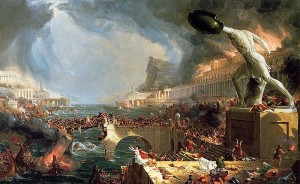
The Course of Empire by Thomas Cole

The Course of Empire by Thomas Cole

Here’s the thing. Our society only works after generational crises which don’t destroy it. After the Napoleonic Wars, the survivors made Europe more or less work. They got a good long run out of it–a surprisingly long one–but it began going south starting around 1870, and it blew up with WWII.

It went south in ways that are recognizable, by the way. For example, the British Empire pushed laissez-faire trade policies which made the rich richer, but gutted the British manufacturing base over time, moving much of it, ironically, to America.

The system went into crisis from 1914 to 1945, and the Americans took it over and ran it basically well up until the early 70s, about 25 years. Then it went into decline. It’s hard to tell exactly when the end-game crisis start(ed) until we can look back, but if we aren’t in it right now, we’re close.

1945 to 2008 is 63 years. If you count up through to today, it’s 71 years. If the crisis isn’t seen to have started for another ten years, it will be 81.

But the core point here is that it’s very hard to create people who can run a system.

A common refrain is that prosperity destroys character. But that’s not quite right: The people who created the good post-war economy were the FDR types, mostly. People who were adults in the 20s and 30s, who saw what went wrong.

People have a hard time learning from other people’s experiences. They have to see it themselves. So, in the early 70s there is an attempt to get rid of the short-sale uptick rule (you can only short a stock on an uptick of the stock) and it dies in the face of massive backlash. A couple decades later, those people are dead, and even more wholesale revisions to the rules are put in place to prevent another Depression. Finally, Clinton kills Glass-Steagall, the main spar, wholesale, something entirely unthinkable in 1960 when the population had lived through and remembered the reasons Glass-Steagall existed in the first place.

But the rot goes deeper than just, “It’s hard to learn what you didn’t experience.” It goes to the core of how we raise ourselves and our children.

School, as we do it, is a terrible way to raise people. What it actually teaches us is to, “Do what you’re told, when you’re told. Wait to be told how to do things, don’t figure out things for yourself, and give the approved answer, not one you came up  with  yourself.”

It trains drones. It trains people who are meant to spend their adult lives under supervision, doing what they are told, when they are told, and giving their bosses the answers their bosses want.

Those people make fine wage slaves, yes, but they don’t make good citizens. They have been failed to be taught how to think for themselves. Even worse, they have been taught that if a thought of their own should come up, they should keep it to themselves.

Meanwhile, school interactions with peers are terrible. When we call something “high school” we mean horrible peer pressure bullshit. A few people remember high school fondly, but most people remember it as one of the worst times of their lives.

Wage slavery, and I use the term slavery very deliberately, is a terrible system if you want a democracy or a Republic. Mass production consumer societies, in which we choose from menus rather than creating anything ourselves, are terrible for democracies or Republics.

The ways we school people, the jobs most people work at, and the methods through which we distribute goods to people (through money gained by sitting down, shutting up, and doing what you are told) are antithetical to free, egalitarian societies. Only a crisis which forces people to think for themselves and where they have to be trusted for a while can briefly create people suited to political freedom.

But we can’t have world wars and depressions all the time, for what I assume are obvious reasons. So we stagger along, brief good periods sliding into shit periods, regularly.

Of course there is more to it than this, such as cycles of destruction of capital and labor and so on, but much of that is manageable–in theory. It isn’t manageable in practice, not because it couldn’t be done, but because our society–we, ourselves–don’t create the people who can do it.

Freedom, democracy, equality: these things are not compatible with how we order our economic affairs, how we raise our children, or how we condition our adults.

We will not reverse course, this cycle; that doesn’t happen and it won’t. It’s too late. But there is always another cycle. If we don’t want the next cycle to be as disastrous as this one, we must figure out a better way to run our economy, to educate our children, and to live as adults. A way suited to people fit to be free.

This doesn’t mean “work or starve” as many libertarian morons would think; it means allowing real choices to be made, which requires an absence of existential fear while still including consequences. It means teaching children to to be something other than “good workers.” It means jobs that aren’t “you’re a kneepad for the boss or you lose everything.” It means a power structure that does not concentrate wealth and power in the hands of a few and create a gate around access to the good life, which fosters outside of it a subservience born of the desperate knowledge that the good life comes from good jobs, which are in scarce supply.

All of this is do-able. In some sense, most of it isn’t even all that complicated. But that doesn’t mean any of it is easy, and it is hardest because we have been trained to exist in a poverty of imagination, an inability to imagine worlds that are much better than the one in which we live.

We have the technology. What we don’t have is the people. We aren’t the people who can run a good society (this is obvious, as we haven’t).

But as people, we can re-create ourselves and our descendants. Biology is only half destiny, the rest is in our hands.

So far, we’ve been acting like bacteria in a petri dish, rushing to destroy our environment through unchecked, stupid growth.

Let us hope we can prove ourselves wiser than that. Or, instead of us instructing ourselves, Nature will instruct, and her lessons will be harsh.


The results of the work I do, like this article, are free, but food isn’t, so if you value my work, please DONATE or SUBSCRIBE.

Trump Is Now Breaking His Core Promises

On January 26th, I wrote that Trump had yet to break his core promises; that his actions at that point were consistent with the major promises he had made during the election. He had ended TPP, was moving on the immigration bill, was working on the wall, and so on.

He might have lied about a lot of things, but he had yet to lie about what mattered.

However Trump made promises that lay at the core of his ur-promise, which was to make things better for those who the old economy had failed. He is now making those promises into a lie.

Trumpcare is clearly worse than Obamacare. It will not cover things Obamacare covered, will cover fewer people and will cost more.

The budget is a direct strike at the poorest and weakest and at people who voted for Trump in regions whose support he needed, like the Rust Belt. It’s one thing to “cut the state,” it’s another to cut programs that feed hungry adults and children. The extra money to the police state and military will help his people, but not as much as the cuts and the Trumpcare failure will cost them.

He has yet to move on NAFTA, a core promise.

It’s not possible for me to look at what Trump is doing and say, “This will really make a difference to his core supporters.” It won’t.

It’s quite possible than Trumpcare won’t pass, and it’s almost certain that Trump’s budget will take some huge hits before passage as well. But both indicate a failure by Trump to take his promises, and his ur-promises seriously.

Course correction is possible but unlikely. It is rare for Presidents to change from who they are during their first year: Obama never changed from the man who bailed out bankers and the rich, and fucked over small people, for example.

In one sense, this changes little. It will continue the loss of faith in the political system, continue America’s decline and continue on the glide path to the age of war and revolution our world is in. It will happen faster than it would have under Clinton, and more Americans will suffer sooner, but the trend lines remain intact.

In another sense, this is a lost opportunity, not to do the right thing, though some of what Trump promised was the right thing, but to restore some faith. Trump failing, but doing what he promised would be quite a bit different than Trump not even trying to keep his ur-promise, the same as Obama (Change!) or Bush.

So it has been, and it looks like, so it shall be.

So be it.


The results of the work I do, like this article, are free, but food isn’t, so if you value my work, please DONATE or SUBSCRIBE.

The Fed Hikes

So, the Fed has raised its rate by .25 percent. This is bad policy, and it is bad politics.

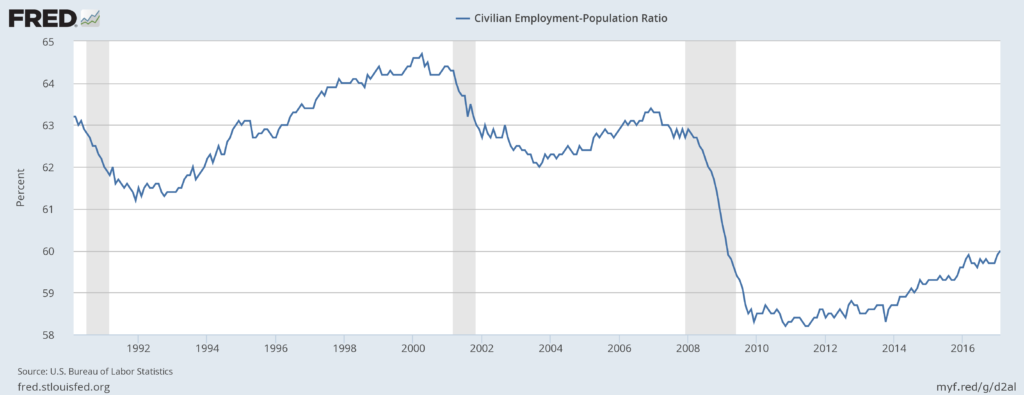
Employment Population Ratio

Employment Population Ratio

The unemployment rate is at 4.7 percent. As I have discussed before, the primary use for the unemployment rate is to determine wage push pressure, not whether people can get jobs (they can’t, and have given up).

Even by that policy, whose intention and largely successful result has been to keep employees from getting raises much higher than inflation, thus flushing money to the rich, 4.7 percent is not full employment. This raise is early.

That leads us to the politics. Yellen has been quite clear in her opposition to Trump’s avowed economic policies and that she intends to use Federal Reserve policy to neuter them. Given Trump hasn’t done anything yet but make promises he may well break, this seems premature, but the perception on the right will be, and possibly accurately, that Yellen, who barely raised at all in eight years of Obama’s economy, is suddenly raising when a Republican is President.

It’s not a good look, and I don’t see any reason to give Yellen the benefit of the doubt. Americans have only barely begun to get raises that put their income higher than before the financial collapse, with millions still unable to find work, and she raises rates?

The Federal Reserve is both irredeemably corrupt and anti-democratic, as well as an incompetent tool of the rich. At the least it needs to be brought back under Democratic control, a wing of the Treasury department, as it was before 1951.

In the meantime, this is another spike in Trump’s chances of a good Presidency, another spike in the jobless coffins of too many Americans, and another way of making sure that the rich get all the gains while everyone else eats their scraps.

(See Also: Trump’s Coming War With the Fed.)


The results of the work I do, like this article, are free, but food isn’t, so if you value my work, please DONATE or SUBSCRIBE.

Trump Couldn’t Buy Coverage Like This

All the semi-scandals don’t add up to one cover like this.

As for Trump’s program, I am so far largely unimpressed, not as a matter of ideological opposition, but of pragmatics. His health care plan is bad, and will hurt people who voted for him in ways they will notice: increased cost, less health care, and more suffering and death. It’s not the sort of chintzing which can be waved off.

So far he has no solid stimulus proposal (and such as the one he had was, it wasn’t very good). He  hasn’t acted on free trade, beyond cancelling the TPP, which wasn’t in effect anyway. His proposed cuts to the non-military budget will have a negative trickle down and will not be good for the economy. Bannon’s okay with that, he has an ideological desire to destroy the post-WWII state, but Trump needs his people to feel good.

The one perhaps clever thing Trump has done is his asked for a 54 billion dollar increase to the military budget. Jobs created this way will tend to go to Trump supporters and communities. If you’re dedicated to slashing the rest of the bureaucracy, this is an excellent offset.

Well, it could be, depending on how many jobs it produces. The dollars/job correlation on defense funding is pretty lousy, and if I were Trump/Bannon I’d be leaning hard on the Pentagon to spend this in ways which will actually produce jobs, whether directly in the military, outsourced, or manufacturing.

Much remains undetermined, but so far Trump’s made only one potentially smart economic move. Let’s wait and see, within a couple months we should have a fuller picture and thus a better idea of his likely fate.


The results of the work I do, like this article, are free, but food isn’t, so if you value my work, please DONATE or SUBSCRIBE.

Arctic Permafrost Defrosting and the Age of War and Revolution

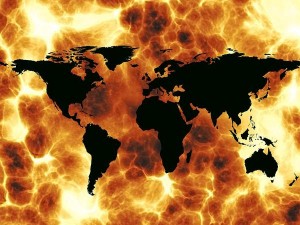
Globe on FireFor well over a decade, I have written that we are past the point of no return on climate change. My reasoning was that hothouse gasses already in the atmosphere, or which were for sure going to enter the atmosphere given our lack of action, were enough to trigger massive carbon and methane releases.

Methane is a far more potent greenhouse gas than carbon…

We’ve seen that methane, which accounts for only 14 percent of emissions worldwide, traps up to 100 times more heat than carbon dioxide over a five-year period. This means that even though carbon dioxide molecules outnumber methane 5 to 1, this comparatively smaller amount of methane is still 19 times greater a problem for climate change over a five year period, and four times greater over a 100 year period.

It is even more potent in the short run. Meanwhile, the arctic circle was about 30 degrees warmer this year than normal, and permafrost is un-perma-ing.

Huge slabs of Arctic permafrost in northwest Canada are slumping and disintegrating, sending large amounts of carbon-rich mud and silt into streams and rivers. A new study that analyzed nearly a half-million square miles in northwest Canada found that this permafrost decay is affecting 52,000 square miles of that vast stretch of earth—an expanse the size of Alabama…

…Similar large-scale landscape changes are evident across the Arctic including in Alaska, Siberia, and Scandinavia

There is no way we are avoiding near-worst case scenarios for climate change without aggressive geo-engineering (completly unproven, and requires political willpower). We will see temperature increases in some parts of the world which are currently highly populated. These increases will make those places uninhabitable outside of air conditioning. Changes in rainfall patterns will large current agricultural powerhouses to fail; an effect which will be compounded by the fact that we have vastly drained and polluted our groundwater in prime agricultural areas.

Later on, we will see vast rises in the ocean level. Virtually every city sitting on a seashore today will be gone in a hundred years, some of them a lot sooner.

This stuff is baked into the cake. It is essentially unavoidable. It has been effectively and politically unavoidable for quite some time now.

Do not expect the political, economic, and social arrangements you favor to survive this. The waves of refugees will be magnitudes larger than those currently shaking the Middle East and Europe. There will be water wars; people will not sit still while they are dying, they will fight. Some of those wars will involve, at the least, the use of tactical nukes.

Capitalism, Democracy, the Chinese Communist Party, etc…any system and group of people who can reasonably be blamed for this, will likely be on the block. When hundreds of millions to billions start dying, they will not go gently into that long dark night. No, they and those they leave behind will look for people, ideologies, and organizations to blame, and they will plenty of them, because everyone and everything who had any power has failed to prevent an entirely forseen and largely preventable disaster.

Our failure will not be considered acceptable to those who pay the bill, and our “capitalism” and “democracy” and “corporations” and “free trade” and everything else you can think of will be on the block, liable for destruction.

This is coming on faster than many expected. Added to ecosphere collapse, the current cyclical capitalist sclerosis, and vast arsenals, it is going to be immensely damaging.

If you aren’t old, or sick, you’re going to suffer some of this. If you’re young, you’re going to suffer a lot of this, assuming you aren’t an early casualty.

So it is. So it shall be. We were warned, we chose not to act, because corporations needed profits or something.

So be it.


The results of the work I do, like this article, are free, but food isn’t, so if you value my work, please DONATE or SUBSCRIBE.

Page 356 of 532

Powered by WordPress & Theme by Anders Norén