Ian Welsh

The horizon is not so far as we can see, but as far as we can imagine

How Smart Stupid People Fuck Up the World

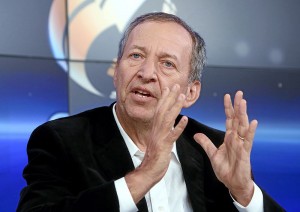
Larry Summers, 2013

Larry Summers, 2013

One of the most aggravating things in the world, at least to me, are smart stupid people.

Think Larry Summers. IQ around 170, people who know him say he’s brilliant, and he’s been wrong about almost everything that mattered. Among his highlights, perhaps the most important was pushing to repeal the Glass-Steagall Act, which was perhaps the most important in causing the housing bubble and financial collapse.

If you don’t like IQ (and I understand and don’t want this to become an IQ debate) call it processing power. Some people have more of it, a lot more.

Being really smart, but being a bad thinker, just gets you to the wrong place faster. Worse it makes you more certain you are correct.

Being really smart, as smart people with a bit of insight realize in their teens or twenties at the latest, means never having to say “I was wrong.” You can almost always find a reason, a work-around, to maintain the opinion you wanted.

Oh, sometimes you are wrong about something you can’t quite deny, perhaps you predicted an election incorrectly. But in such cases you can still keep your model by finding something your model didn’t include, and shouldn’t have to. Think the bright lads and lassies behind Clinton’s campaign: “It was the Russians! They cheated! Our campaign should have won!” Never mind that they didn’t send Clinton or significant resources to the most important battleground states, which she lost by very low margins, and which their model considered “easy wins.”

Nope, they weren’t wrong and neither was their model, it was all Russians. (See “Everything Cost Clinton the Election.“)

So: Very smart means you get there faster, wherever there is, and that you almost never have to admit you’re wrong.

Bad, bad combination.

Further, our education system trains smart people to be authority-worshiping idiots. In school, you get the best marks for getting the answer teacher wants in the way teacher wants. You get kudos for being the kid seated at the front who puts up their hand first.

Get the approved answer fastest, in exactly the approved way.

So you learn models, and you execute them as you learn them. If the models are right, great, but the models are never right. (No, sorry, this is true in every social science and in the physical sciences–whenever you’re dealing with anything that doesn’t amount to engineering.)

Our educational system teaches people to be calculators, not thinkers–to run quickly through models and get the expected results from running the models. If the models are wrong, say, for example, people aren’t utility maximizers (if you could even figure out what that is) as opposed to rational decision makers, resources and sinks aren’t substitutable (think carbon sinks/aka. climate change, or soil) then running your models will run you (and society) off a cliff.

To revisit a prior analogy, processing power, or IQ, is the power of a motorcycle’s engine. Actual ability to think well is the skill of the rider. If you’re going down a freeway with no other vehicles, the only thing which matters is the power of the engine.

But if you’re going off-road, through twisty paths, with other vehicles all around, the skill of the rider becomes paramount. Without a skilled driver, all a good engine is going to do is make you crash sooner and worse (possibly taking other people with you.)

People get very confused about this. I have a good, smart friend who praises Dick Cheney for being a smart hard-worker. If even someone like him couldn’t get things to work…But Cheney was a smart person applying a number of world models. His model of how the bureaucracy and the US government worked worked with each other and how to in-fight and how to control a bureaucracy (government, or the contractors surrounding government) was brilliant and correct. His model of how the world outside that government-industrial complex worked was, well, almost completely wrong.

So he pushed to invade Iraq as part of a project to invade and remake the Middle East and it blew up in his face, because how he thought the world worked was wrong outside a narrow, but very important, area. (After all, being correct about how the world’s only superpower’s government and contractors work is powerful.)

How he thought successful societies work and are run, how he modeled what would happen in a power vacuum (when current Iraq elites were removed), and how he imagined what military force could and couldn’t do were all wrong. His larger context economic, political, and military models were all wrong.

This doesn’t mean he wasn’t brilliant. It doesn’t mean he didn’t have a lot of processing power. But in practice, in the world beyond his world, he was an absolute moron and everything he touched (that didn’t involve power in the Government-Industrial complex) blew up.

In the old days we used to call this Doctor Complex. Doctors make life and death decisions. They have a lot of authority (and had a lot more 30 to 60 years ago.) A good doctor in his field was a veritable God (surgeons have the worst cases of this complex). People hop when he or she says frog, and they save lives regularly.

So they tend to think because they are good at this, they are good at everything.

No one is good at thinking about everything. I’m not (I get electoral results wrong often enough I’m a contrary indicator). No one is.

The first part of being a first rate thinker, then, is knowing where you think well and where you don’t. The second part is knowing why. If you don’t know the conditions for your own good thought, then you don’t know when and where your models will fail. You see this all the time with “genius” traders or investors: Their model works in a particular type of market or economy, but when that changes, it doesn’t. They didn’t actually have a complete model, and, in many cases, they just had rules of thumb for which they didn’t understand the reasons.

Machiavelli made this a keystone of his political philosophy: You should change with the times, but most people won’t or can’t. When the conditions of their success go away, so does their success.

Processing power, absent understanding of how to think, including an understanding of the conditions of one’s own models, leads to disaster. You must understand what you were trained to do, as well, or like Summers and so many economists, you will be wrong about almost everything. Models exist to do things, and often what they exist to do is ideological–not to explain something, but to create something or justify something. Confusing those three functions will drive you off a cliff.

So, brains are good. Big bulging brains are wonderful. But like high explosives or big motorcycle engines, used incorrectly all they do is blow up in your face, or cause huge accidents,

Don’t rely too much on processing power. Learn how to think, and above all, learn about what you’re bad at thinking about. (Then, if you care enough, learn why and fix it.)


Money would be rather useful, as I don’t get paid by the piece. If you want to support my writing, please DONATE or SUBSCRIBE.
Week-end Wrap – Political Economy – November 24, 2019

by Tony Wikrent
Economics Action Group, North Carolina Democratic Party Progressive Caucus

Strategic Political Economy

Mike Pompeo scorns the law because powerful men like him never have to follow it

Robert Fisk [Independent, via Naked Capitalism 11-22-19]Dylan Ratigan: The Super Rich Have No Country.

[YouTube, via Naked Capitalism 11-22-19]

“This is a 2 hour tour de force nailing down the failures of the media and Democrats on the GFC. Great explanation of the whole GFC too.”

[Common Dreams, via Naked Capitalism 11-22-19]

The Carnage of Establishment Neoliberal Economics

[Atlantic, via Naked Capitalism 11-21-19]

“A passion for affordability” became one of the company’s new, unloved slogans, as did “Less family, more team.” It was enough to drive the white-collar engineering union, which had historically functioned as a professional debating society, into acting more like organized labor. “We weren’t fighting against Boeing,” one union leader told me of the 40-day strike that shut down production in 2000. “We were fighting to save Boeing.”

….Stonecipher, who promptly affirmed: “When people say I changed the culture of Boeing, that was the intent, so that it’s run like a business rather than a great engineering firm.” A General Electric alum, he built a virtual replica of GE’s famed Crotonville leadership center for Boeing managers to cycle through….

The company that once didn’t speak finance was now, at the top, losing its ability to converse in engineering… It wasn’t just technical knowledge that was lost, Aboulafia said. “It was the ability to comfortably interact with an engineer who in turn feels comfortable telling you their reservations, versus calling a manager [more than] 1,500 miles away who you know has a reputation for wanting to take your pension away. It’s a very different dynamic. As a recipe for disempowering engineers in particular, you couldn’t come up with a better format.” ….

“If in fact there’s a reverse takeover, with the McDonnell ethos permeating Boeing, then Boeing is doomed to mediocrity,” the business scholar Jim Collins told me back in 2000. “There’s one thing that made Boeing really great all the way along. They always understood that they were an engineering-driven company, not a financially driven company . If they’re no longer honoring that as their central mission, then over time they’ll just become another company.”

[Business Insider, via Naked Capitalism 11-22-19]


How Neoliberal Thinkers Spawned Monsters They Never Imagined
Lynn Parramore [Institute for New Economic Thinking, , via Naked Capitalism 11-20-19]

Neoliberalism thus aims to de-regulate the social sphere in a way that parallels the de-regulation of markets.

Concretely this means challenging, in the name of freedom, not only regulatory and redistributive economic policy but policies aimed at gender, sexual and racial equality. It means legitimating assertions of personal freedom against equality mandates (and when corporations are identified as persons, they too are empowered to assert such freedom). Because neoliberalism has everywhere carried this moral project in addition to its economic one, and because it has everywhere opposed freedom to state imposed social justice or social protection of the vulnerable, the meaning of liberalism has been fundamentally altered in the past four decades.

That’s how it is possible to be simultaneously libertarian, ethnonationalist and patriarchal today….

Hayek really believed that markets and traditional morality were both spontaneous orders of action and cooperation, while political life would always overreach and thus required tight constraints to prevent its interventions in morality or markets. It also needed to be insulated from instrumentalism by concentrated economic interests, from aspiring plutocrats to the masses. The solution, for him, was de-democratizing the state itself. He was, more generally, opposed to robust democracy and indeed to a democratic state. A thriving order in his understanding would feature substantial hierarchy and inequality, and it could tolerate authoritarian uses of political power if they respected liberalism, free markets and individual freedom….

We need to understand why reaction to the neoliberal economic sinking of the middle and working class has taken such a profoundly anti-democratic form. Why so much rage against democracy and in favor of authoritarian statism while continuing to demand individual freedom? What is the unique blend of ethno-nationalism and libertarianism afoot today? Why the resentment of social welfare policy but not the plutocrats? Why the uproar over [American football player and political activist] Colin Kaepernick but not the Panama Papers [a massive document leak pointing to fraud and tax evasion among the wealthy]?

….corporate dominance of elections becomes possible when political life as a whole is cast as a marketplace rather than a distinctive sphere in which humans attempt to set the values and possibilities of common life. Identifying elections as political marketplaces is at the heart of Citizens United.

These critiques of neoliberalism are always welcome, but they inevitably leave me with irritated and dissatisfied with their failure or unwillingness to mention the political philosophy of republicanism as an alternative, or even a contrast.

The key is found in Brown’s statement ” It also needed to be insulated from instrumentalism by concentrated economic interests, from aspiring plutocrats to the masses. The solution, for him [von Hayek], was de-democratizing the state itself. He was, more generally, opposed to robust democracy and indeed to a democratic state.”

Contrast this to Federalist Paper No. 10, Madison’s famous discourse on factions. Madison writes that 1) factions always arise from economic interests [“But the most common and durable source of factions has been the various and unequal distribution of property.”], and 2) therefore the most important function of government is to REGULATE the clash of these factions [“The regulation of these various and interfering interests forms the principal task of modern legislation, and involves the spirit of party and faction in the necessary and ordinary operations of the government.”

In a very real sense, neoliberalism is an assault on the founding principles of the American republic.

Which should not really surprise anyone, since von Hayek was trained as a functionary of the Austro-Hungarian empire. And who was the first secretary of the Mont Pelerin Society that von Hayen founded to promote neoliberalist doctrine and propaganda? Non other than Max Thurn, of the reactionary Bavarian Thurn und Taxis royal family.

Economic disequilibrium

Open Thread

Use the comments to this post to discuss topics unrelated to recent posts.

Toward a Land Ethic

**GUEST POST By Eric Anderson**

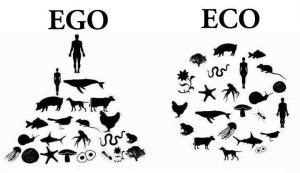
If you don’t know where you are, you don’t know who you are.
— Wendell Berry

I’ve thought a lot about immigration in my time, and confess, I’ve never thought very highly of it. Which, of late, seems to be an extremely unpopular position among liberals. But it’s not that I’m anti-immigrant, per se. It’s that I’m militantly pro-place. I sympathize with my place.

Not being inhumane, I do empathize with the plight of the refugee. However, their plight will always remain at one remove from me. I learned this from a pretty smart fellow who once observed that empathy is a problematic emotion because it is near automatic with those who are like us, and virtually non-existent with those who are not. Whereas, sympathy is a more useful emotion because it represents the care we feel about someone else who we want to feel better. Thus, we tend to help those we care about.

That being said, I submit that a land ethic exists in applying the aforementioned insight to the land we live on, with at least equal the gravity we apply it to people. Should you disagree, perhaps you have never discovered who you are, because you’ve never stayed in one place long enough to learn to care about it.

I am my place. We are inseparable, and my love of my place insuperable. I know its wrinkles, contours, temperament and fundament as I know the same of my wife and child. And as with my family, if I leave my place, my place suffers for the knowledge and support I remove. The converse seems true as well. Should I immigrate, I become a stranger in a strange land. I become a stranger to myself, who in my ignorance, suffers and longs for my place — which contagion cannot help but afflict those around me.

When times are hard, politically or otherwise, to abandon place is to be a traitor to oneself. And as cliché as it may sound, I mean it when I say that I will stay, fight, and die for my place because I am the steward of my place. It’s my family. To run from it is to run from myself. And if I run once, I will be running the rest of my life in shame.

Such cowardice drains the life from the place and the culture it’s built upon because the first to leave are always those with the most resources to do so. The materialists. Those who don’t know who they are because all they think about are themselves – and how to enhance their self with more material. Which flight begins a spiral, enabling the further destruction of place, because those having the most resources to confront the problems facing that place, remove them when they flee.

And here we are. Take a look in the mirror at your materialistic nation born of immigrants. Daily borne by the fear of trying to replace knowing who we are, with status symbols of what we are, because to know no place is in our blood. To empathize with those like us who flee in fear is genetically encoded in our blood. It is this difference between empathy for people, and sympathy for place, that allowed us to commit genocide upon the entire Native American population. Cowardice destroyed an entire civilization that knew better than any other who they were, because they intimately knew where they were.

I’ll be forever grateful for the fact that, by some turn of chance, I got lucky enough to know who I am. Blessed in knowing that I am my place. Blessed to know that the atoms and soul of my constituent parts are of my place. So please, don’t come to my place and destroy what I am, because you don’t know your place well enough to value who you are, enough to die for it.

Heaven is getting to eternally inhabit a mental picture of your favorite place.

Hell, is transience.

Accepting and Using Climate Change

Odin with the ravens Thought and Memory

A couple days ago I was thinking about the problem of surveillance states and I realized, “This problem is likely to become less of one because of climate change.”

And I started thinking about all the opportunities and good things climate change makes possible.

My grieving was done.

My pre-grieving, I suppose.

I see grieving for climate change and ecological collapse everywhere. Informed people who have done their homework know it’s going to be bad, really bad, and that they and those they care about are going to be hit by it. For a lot of people it rises to the level of trauma, even though most of it hasn’t happened yet. It’s like the moment you really know you’re going to die or that something else horrible WILL happen. You can get caught on it, and traumatized by something which isn’t here yet.

But then there’s the point at which you hit acceptance.

Alcoholics Anonymous has a prayer, ““God grant me the serenity to accept the things I cannot change, courage to change the things I can, and wisdom to know the difference.”

But acceptance doesn’t mean resignation. It doesn’t mean “oh, nothing can be done.” If I know there’s going to be a famine I can stock up food. If I know I’m going to die, I can write a will and say my goodbyes. If I know  here is going to be climate change I can take that into account in my actions going forward.

Knowing something is going to happen, and that it can’t, or won’t, be stopped is freeing and empowering. I am now able to stop worrying about the fact that it is going to happen, and plan for it.

When I was young I used to read a lot of adventure novels. One of the criticisms of such fiction is that the protagonist’s seem to just shrug off bad events: They aren’t effected much emotionally. But what they do do is take those events into consideration in their plans and actions.

Adventure fiction thinking is a pretty good way to live your life, actually, if you can pull it off. What is, is. What will be, will be, but you can adapt to it.

Here’s the truth about climate change: It’s going to suck more ass than anything since the Black Death. That’s a lot of ass.

But it’s also an opportunity. You want change? You don’t like society today?

I don’t. I mean, I fought like the dickens to avoid climate change because the price of this change is too high. Like billions of dead too high.

But we lost. It’s happening.

And horrible as it is, it’s still an opportunity. The good will go away, but so will a lot of the bad.

The society created after the Black Death was, in many ways, much better than the one that came before.

That’s our challenge. There will be real breakdowns in how we run our society. The challenge is to replace with them with something better.

Some things better.

And because you’ve accepted the truth of climate change and that it isn’t going to be stopped, you have an advantage over the deniers. Those who act in alignment with what IS and what will be are always stronger, more nimble and more capable than those running around in denial.

Climate change is coming. It’s going to suck horribly.

How are you going to use it to make your life and everyone else’s lives better?

(See also, The Philosophy of Decline and Collapse.)


Some money would be rather useful, as I don’t get paid by the piece. If you want to support my writing, please DONATE or SUBSCRIBE.

Assange Was Right All Along

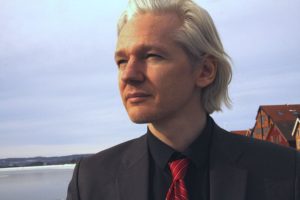
Julian Assange (he looks far worse now, but couldn’t find any non-copyrighted images)

So, you may have read that Sweden has dropped its sexual assault investigation and charges against Julian Assange.

Now that Assange is in British custody, and facing extradition to the United States, that is.

Oh, the Swedish prosecutor says it’s because so much time has gone by, but that didn’t stop them before.

Assange always claimed the idea was to get him into custody, then extradite him to the US. Now that he’s in custody and going to be extradited to the US, the Swedish charges are moot. If the Swedes had really been most concerned about those charges they would have accepted Assange’s offer to go to Sweden as soon as he had a written guarantee of no extradition to the US.

As for the US charges, at the end of the day they are charging a publisher for publishing information in the public interest. Reporters have, in the past, discussed how to get the information with sources, and not been charged. This is an over-reach, and against someone who is not an American citizen and was not in America during any of the “crimes”.

Assange has few supporters now: Woke types figure he’s a sex offender; Democrats hate him for revealing that the DNC was conspiring to help Clinton win the primary against Sanders (that’s the truth, and if you don’t like it, it’s still the truth, and still something the public should know), and; Republicans hate him for revealing Bush’s war crimes.

As for reporters, most of them really hate him: You just have to read the Guardian’s deranged complaints about how he was messy and didn’t act like one of the club, or watch their crazed jeremiad against him. Assange did their job and did it better than most of them, and, oh, they hate him for it.

And they think because he didn’t work for an official news source that precedents set in his prosecution for helping whistleblowers and for extra-territorial US law won’t be used against them.

They won’t.

Assange may or may not be the nicest guy (the hate mail I received last time for mentioning this was quite something), but that’s irrelevant: He was acting as a journalist and publisher, and the information he released was in most cases information that the public had the right to know. Any mis-judgements are nowhere near as bad as those the New York Times made when they published the Bush administration’s lies to push the Iraq war, for example. (And remember when the Intercept burned their own whistleblower? You can’t trust the media with your identity.)

Nor does it matter if he was partisan: Most press is partisan, and no one thinks that means it isn’t press (perhaps they should, but they don’t. I can’t imagine the Murdochs want them to either).

Assange embarrassed everyone: the Republicans, the Democrats, the identitarian left and “professional” journalists. For that, he will burn, and because of that, he has no friends left.


Some money would be rather useful, as I don’t get paid by the piece. If you want to support my writing, please DONATE or SUBSCRIBE.

How to Fix Fake News

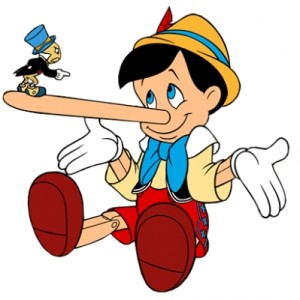
Pinocchio and Jiminy Cricket, provided by Seth Borenstein from scriptsandscriptors.wordpress.com.

By Eric Anderson


The reason fake news exists is not complicated. The majority of journalists don’t follow a professional ethical code. It’s not that they don’t have an ethical code. It’s that they – or more likely their paymasters — don’t want to be held accountable for breaking it.

Four basic elements comprise the Society of Professional Journalism’s (SPJ) voluntary code of ethics: (1) seek truth and report it; (2) minimize harm; (3) act independently, and; (4) be accountable. But because there aren’t any penalties for not following the code, journalists are perfectly free to: (1) report lies; (2) maximize harm inflicted upon their paymasters enemies, for; (3) a corporate paycheck upon which they are absolutely dependent, and; (4) be left completely unaccountable for the damage done to society. What? You didn’t swoon?

Of course you didn’t. Because, the public already knows this to be the norm practiced by the large majority of “professional” journalists today — as demonstrated by the 2017 Gallup/Knight Foundation Survey on Trust, Media, and Democracy. The survey found that an overwhelming majority of Americans (84 percent) believe it is harder to be well informed and to determine which news is accurate. The same percentage also increasingly perceives journalists to be biased and they struggle to identify objective news sources. And again, hold on to the table: The survey concludes that “[a]mid the changing informational landscape, media trust in the U.S. has been eroding, making it harder for the news media to fulfill their democratic responsibilities of informing the public and holding government leaders accountable.”

Given such a trenchant indictment, and amid the obviously changing informational landscape, one might think the SPJ would be inclined toward some out-of-the-box thinking in an effort to address this catastrophic lack of public trust. Wrong! Just witness the puerile arguments regarding the reasons the SPJ doesn’t enforce their Code of Ethics:

• The SPJ thinks that encouraging fellow journalists and the public to hold news reports and commentary up to ethical scrutiny is the most effective antidote to questionable reporting — not quasi-judicial proceedings;
• And that establishing a quasi-judicial system, such as those found among other professions, would inevitably lead to actions by governments, thereby restricting protected speech;
• And that protected speech is vulnerable and placed in jeopardy whenever it’s allowed to be confused with, or limited by, the professional responsibility to act ethically;
• And that professional enforcement of ethics for news reporting would require more detailed provisions and case law that are far beyond their resources to provide, even if desirable, because no set of rules, however detailed, could possibly apply to all the nuances and ambiguities of legitimate expression;

These are nothing more than excuses as to why the SPJ advocates no action be taken to reform journalism in the modern age. Which begs the question: What action has the SPJ taken?

Well, it seems the SPJ has “entered into a partnership with Bloomberg to teach ethics to professionals.” Fox? Meet henhouse.

And, given that the hens are allowing the fox to rule the roost, it would be remiss to not ask another question: Can we really, in good faith, allow journalists to call themselves professionals?

I’m pretty sure the noted sociologist Eliot Freidson would not. Freidson posited five elements that define a professional:

(1) Adherence to an ideology that asserts a greater commitment to doing good work than to economic gain and to the quality rather than the economic efficiency of work

(2) Performs specialized work grounded in a body of theoretically-based, discretionary knowledge and skill that is accordingly given special status

(3) Possesses exclusive jurisdiction in a particular division of labor created and controlled by occupational negotiation

(4) Occupies a sheltered position that is based on qualifying credentials created by the occupation

(5) Has completed a formal training program that produces qualifying credentials, which are controlled by the occupation and associated with higher education

With good reason, all five factors apply to what are traditionally called the “white collar professions.” Because when doctors lie, people die — witness the opioid epidemic. When lawyers lie, people die. Don’t believe me? Do a quick web search of “dishonest prosecutor death penalty.” When engineers lie, people die –witness Boeing. In short, when professionals that broker in public trust tell lies, people needlessly die — witness Judith Miller. And witness, too, the utter lack of accountability that followed her comeback.

Fortunately, the factors outlined above also contain the cure to the changing informational landscape’s problem with fake news. Journalists can create sheltered positions that are based on qualifying credentials created by the occupation, combined with a formal training program that produces qualifying credentials that are controlled by the occupation and associated with higher education. Which, in turn, would result in truly professional journalists that assert greater commitment to doing good work than to economic gain, and to the quality rather than the economic efficiency of their work.

And hear the SPJ protest: Requiring the establishment of a quasi-judicial system, such as those found among other professions, would inevitably lead to actions by governments, thereby restricting protected speech! It might. But it doesn’t have to.

Coming full circle, we arrive back at the point where the SPJ has utterly failed to think outside the box.

Licensure does not need to be required in order to be effective. It can be voluntary, because the U.S. Constitution also enshrines another fundamental right – the right to enter into and be bound by contract. Just think, for a moment, the profound trust that would be instilled among the public for the journalists who were willing to put their necks on the line – for the truth.

Thus, the answer to the fake news problem can be solved as easily as it was created. A few brave and principled journalists just need to form a new organization that allows them to submit to licensing requirements, wherein their peers can sanction and revoke licensure like every other “professional” organization in the US that brokers in public trust. And for that, one can only hope their efforts will be applauded and secured throughout the remaining history of what once was, and still can be, a noble profession.

Until that time, journalism deserves every ounce of shame thrown upon its practice.

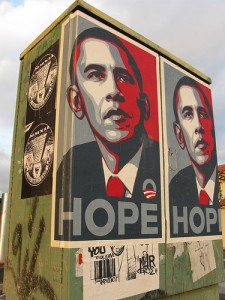
Hope Is Bullshit

by Shepard Fairey

I am unintersted in “hope.”

Or as we called it in the Obama bullshit years, Hopium.

Hope is not a plan. Hope is bullshit.

Luck is real, but you don’t count on luck other than in the sense that the harder you work, and the more things you do, the more likely you are to “get lucky.” But luck is usually the odds coming in, and bad luck is as real as good.

In term of climate change, there is no reason for hope. It’s going to be bad and, in almost all cases, signature events are happening sooner than expected: We’re losing Greenlandian, Arctic, and Antarctic ice sooner than expected. We’re getting artic methane releases 70 years ahead of schedule. Every time an event comes in, it’s sooner or worse than the models predicted.

This is because of how systems work when they leave bounds–because they tend to accelerate, we can expect this sort of thing to continue. It’s going to get worse, sooner.

That’s the “luck” we’ve made. We’ve put half the greenhouse gases in human history into the atmosphere in the past 30 years, which is to say, after the time when we knew for a fact we were cutting our own throats.

Obama ran on hope in another sense, and created an economy which did nothing (and worse than nothing) for African Americans and which was shit for somewhere between 80 percent to 95 percent of the population. His signature health care plan was garbage, and in his period the price of various drugs rose to historical heights. He tripled the rate of drone murders over Bush (Trump has ramped them up even further), and so on.

He was human garbage, a man who bailed out bankers and then helped them steal people’s houses with fraudulent paperwork, then had his attorney-general immunize them with fines worth less than what they stole.

But this man is worshiped by many Democrats, because, hey, he was only human garbage, and Trump is a shambling mound of garbage (but has yet, note, to start any new wars, though he’s been happy to keep Obama and Bush’s wars going).

Oh, and because he was black, and that mattered more, to many people, than the fact he was human garbage.

Obama’s done very well since he left office, making lots of speeches and millions of dollars. Bankers have been very grateful and have shown their gratitude–just as they did for Bill Clinton (another mound of garbage, who cut welfare to hurt the weakest in the US, killed Iraqis with his sanctions that included medicines, and instituted judicial “reforms” which swelled America’s prison population while ending financial regulations intended to avoid financial collapses).

None of these people ever intended to do the right thing, and if you listened carefully you knew that. The best you could hope is that they were the lesser evil: a smaller mound of garbage than their opponents.

In the Democratic primaries, there was always a better option and that option was never chosen, because most Democrats are bad people who want Reaganism with a side of “but we don’t really mean it.”

Nothing is going to get better until we, whichever we we belong to, start choosing better leaders, whether presidential, or more local. Those leaders must want to actually do “good.” Yes, good. You know, taking care of the hungry and the sick, and not burying single payer and the public option like Obama did. (Yes, yes he did, and he wound up passing the OCA without Republicans anyways. He made a choice, and his choice was evil.)

Or perhaps taking care of poor people, including blacks. Or not allowing pirates in suits to gouge people on drug prices, or perhaps *gasp* not vastly expanding fracking, which is what Obama did and bragged about, even as he signed the Paris Accords, knowing he had no intention of honoring them.

Nor did virtually anyone else who signed them, of course, and anyone who thought otherwise is either a fool or on the payroll.

Mounds of garbage. Merkel, Blair, Cameron, Trudeau, Harper, your country’s leader, odds are. People who have always wanted to do as much evil as they could, and as little good as they could get away with. (Remember nothing happened to Greece Angela Merkel was not okay with–and all so German banks could be bailed out indirectly. It would have been embarrassing to just blatantly bail them out. So a lot of Greeks died and suffered.)

There is no “hope” as long as our leaders are people like this. None.

Don’t get hooked on hopium.

We need to elect leaders who want to do as much good as they can, and as little evil as possible. Sanders in the US, Corbyn in Britain.

But we don’t want those leaders, not as a whole, do we?

We’ve been offered them, we have a chance to elect them.

But will we?

Because they have plans, and those plans are to do good.

That’s the only hope you’ve got.


The results of the work I do, like this article, are free, but food isn’t, so if you value my work, please DONATE or SUBSCRIBE.

Page 288 of 532

Powered by WordPress & Theme by Anders Norén