Ian Welsh

The horizon is not so far as we can see, but as far as we can imagine

Week-end Wrap – Political Economy – March 22, 2020

Week-end Wrap – Political Economy – March 22, 2020
by Tony Wikrent
Economics Action Group, North Carolina Democratic Party Progressive Caucus

The Financial Collapse

The Fed Backfires: Shock and Awe Rate Drop to 0%, Emergency Bond Buying Program Leads to Limit Down Drops in US Equity Futures as Real World Coronavirus Damage Worsens
[Naked Capitalism 3-16-20]

Reserve Requirements
[Federal Reserve, Naked Capitalism 3-19-20]

[Twitter below via Naked Capitalism Water Cooler 3-17-20]

I can’t believe I’m entering the second global financial meltdown of my adult life and more or less the same people are still in charge of everything

Fed Announces Program for Wall Street Banks to Pledge Plunging Stocks to Get Trillions in Loans at ¼ Percent Interest
Pam Martens and Russ Martens: March 18, 2020 [Wall Street On Parade]

Veterans on Wall Street think of it as the cash-for-trash facility, where Wall Street’s toxic waste from a decade of irresponsible trading and lending, will be purged from the balance sheets of the Wall Street firms and handed over to the balance sheet of the Federal Reserve – just as it was during the last financial crisis on Wall Street.

Capitalism in the time of COVID

Open Thread

As usual, feel free to use the comments to discuss topics unrelated to recent posts.

Lessons of the Virus: Who Creates Value and What the Good Life Is

So, we’re going into a recession, and will likely soon be in a depression. Why? Because the workers have to stay home. It seems that the workers, do, after all, create the value.

Marx giggles in his grave.

We notice also who actually matters, who is actually necessary in society. The people who grow food. The people who take care of sick people. The people who make medicine. The people who distribute food and goods. The grocery and drug store workers. The garbage men. The people who work in sewage, water, power, and keeping the telecom backbone up.

Everyone else? Might be nice to have, but they aren’t necessary, and that includes most of the bosses. Some coordination is needed, yes, but it’s not as rare a skill as bosses like to pretend.

Meanwhile, we have makers making ventilator valves, as firms threaten to sue them stop them. It turns out that a valve which can be made for $1, normally costs $11,000.

There’s your capitalism, children: Ghouls who vastly overprice goods so they can get rich off of other people’s death and suffering.

Nations are scrambling to give workers forced to stay home money, because if they don’t, the economy will slide off a cliff. It turns out, as we should have learned in the Depression (and did, but forgot) that it is people who buy things; the demand, that matters if you want a great economy.

Over in China, it has been calculated that seventy-seven thousand lives were saved by the decrease in pollution caused by all the factories shutting and taking the cars off the road. Coronavirus may have saved more lives than it killed.

Now, some of what those factories produce we need (ventilators, for one, but remember the price markups), but a lot of it we don’t. We could work half as much, not have stuff we don’t need, and spend time with our friends and families. Maybe even see our kids. Wouldn’t have to have school babysit them for most of the day, because parents are away.

Just do less, divide the money more equally, and do without shit we don’t actually need.

We’d be healthier, guaranteed, as the pollution dies down and stress drops through the floor. We’d be happier, and in their spare time a lot of people would make the cool stuff they always wanted to make, but couldn’t, because they were doing corporate drone jobs.

Coronavirus is going to suck more than anything most people still alive in the West can remember (though older gays will understand.) But there’s a lesson here, if we’re willing to take it.

This is going to be a hard lesson to take, because central banks and politicians are moving to bail out the rich (they did so first, and are still doing so), and so they will retain their money and power and try to use it to buy up assets on the cheap after smaller business go bankrupt, but focus on the problem. Everything the rich have they have not because they “earned it” or because they actually create more value than a janitor or nurse, but because the laws are written to allow and the politicians and central banks funnel them endless money, while picking them up every time they fall, wiping the boo-boos off and giving them trillions of dollars.

It’s all politics, in the end. It’s all power.

Now the politicians they own, in their incompetent handling of the coronavirus, are going to be responsible for the death of millions.

These are unnecessary deaths. Countries which acted promptly and competently did not and are not seeing large numbers of deaths.

This means the politicians are guilty, at best, of negligent homicide. Death from incompetence, by corrupt, venal politicians owned by billionaires and mega-corps.

A better way is possible. But not if these people stay in power. They must be removed.

If we don’t remove these politicians and business leaders more of us will die. Many, many more.


The results of the work I do, like this article, are free, but food isn’t, so if you value my work, please DONATE or SUBSCRIBE.

A Company Handling Crisis Communication Correctly

So, in Canada, the biggest grocery chain is Loblaws. They also own the largest chain of drug stores, Shopper’s Drug Mart (which they should never have been allowed to buy). Loblaws is about as upscale as the mass market goes, above it is Whole Foods (which doesn’t have a lot of Canadian stores), and some specialty supermarkets.

I shop quite a bit at Loblaws because it’s near me. It’s slightly highly priced, though you can get some cheap stuff if you shop carefully and take advantage of their specials. Some years back, they were part of a cartel fixing bread prices. At least in my local stores, the employees tend to be sullen, which is a reflection on the stores and Loblaws, not the employees. The rare exceptions are usually middle aged or older part-time workers who have the strength of personality to remain cheerful despite the store atmosphere.

All that background aside, and understanding that there’s a lot I don’t like about Loblaws, I haven’t seen better corporate communication, or heck, government communication than what I’ve received from Loblaws (since I have their points card). It’s reassuring, clear, and matter-of-fact. I’m going to put it below, because I want people to see what good comms and crisis management looks like.

Hi Everyone,

Things continue to move fast and change quickly.

Earlier today the Canadian Government announced they are restricting our international borders to limit the impact of COVID-19. As each of us try to understand how that will affect our daily lives, our friends, and our families, I wanted to reach out again.

Those who went shopping recently will have seen extraordinary numbers of people in stores, long lines, and aisles empty of product. This was a result of extreme levels of buying as millions of Canadians stocked up their kitchens and medicine cabinets. I’m sure the many photos of bare shelves on social media only increased your level of concern.

First and foremost. Do not worry. We are not running out of food or essential supplies. Our supply chain and store teams are responding to the spikes in volume and quickly getting the most important items back on the shelf. Volumes are already normalizing somewhat, and we are catching up. There are a few items, like hand sanitizer, that may take longer to get back, but otherwise we are in good shape.

Another concern you may have is that your supermarket or drugstore could raise prices on the items you and your family need most. Do not worry. This will not happen at our stores. We will not raise a single price on any item to take advantage of COVID-19.

Some of you may also be worried that your local Shoppers Drug Mart or supermarket could close as part of shutting down certain stores and services. Do not worry. We have been in contact with both Provincial and Federal governments. We all agree that food and drug stores are essential services and we must do what we need to in order to keep them operating and serving every community in the days and weeks ahead.

It won’t be business as usual. But, you will be able to count on us. Our teams from across the country, at stores in every community, have been hard at work around the clock to live up to that commitment.

Please keep in mind our service relies on keeping them, and in turn you, safe and healthy. That is our top priority, and it may mean limiting the number of people in our stores at any given time as well as asking customers to keep a certain distance from each other while shopping to reduce the risk of making one another sick.

We are prepared for this, and to support those most in need, we are opening some of our stores early with dedicated hours for seniors and people living with disabilities to come before the crowds. We are also encouraging those customers who cannot shop our stores to take advantage of our e-prescribing and PC Express options like click-and-collect and home delivery. Last week we lowered delivery prices and eliminated pick up fees and, just like in our stores, we’ve seen a spike in volume.

We are managing the rising number of orders and ramping up our systems as quickly as we can so customers can shop online with confidence. However, it will be difficult for us to meet all the additional demand, possibly limiting availability for people who are sick, in self-isolation, or at elevated risk. So, I would ask that if you are healthy, mobile, and symptom-free, please do your best to make it into the store.

All of us will face uncertainty and new challenges over the coming days. Our stores and our services will be far from perfect. But, we will do everything in our power to make sure you have what you need for yourselves and your families.

As we have more updates we will continue to communicate, online, in-store, and through our PC Optimum app.

For now, let me leave you with four things:

  1. We have the food, drugs, and essential products you need and that supply will continue even as Canada restricts its borders.
  2. We are going to make sure our stores stay up and running to serve your community.
  3. We will not, under any circumstance, change our actions or prices to take advantage of COVID-19.
  4. Please be patient with us when you are shopping, and don’t forget to practice social distancing.

Over the last few days, it has been remarkable to witness Canadians supporting one another in our aisles: Bags carried to cars. Crowds parting so young moms could check out. Cheers for speedy cashiers. Customers helping stock shelves.

One example in particular stood out. A few days ago, someone stuck a handmade sign to the front of a store. It reads “Be kind”. This is great encouragement to cap off perhaps one of the most-tense weeks of our 100 years running stores, and to help all of us prepare for what is next.

Be kind to each other. We will get through it.

Galen Weston

Again, I don’t much like Loblaws management, but this is sterling communications and action and shows calm and good will. One can be cynical, but whatever the motives, this is how it’s done.

(Also, why the hell do people keep buying all the fresh meat? Does everyone have a huge freezer? I don’t get it.)


The results of the work I do, like this article, are free, but food isn’t, so if you value my work, please DONATE or SUBSCRIBE.

How Bad Is Coronavirus Going to Be and What Should We Do?

Depends where you are, but the basic rule is that without social distancing it will kill a LOT of people and we have left social distancing too late in a lot of countries.

Florida, for example, has 4,704 ICU beds and five million seniors over 60.

Assume even five percent need care, and you have catastrophic numbers. There will be, for all intents and purposes, no care in most cases.

Britain is going to be terrible, and I’m expecting in excess of a million deaths.

Necessary steps are still not being taken. In Canada, I’m just beginning to see (in Ontario and Quebec) call ups of retired nurses and doctors. Facilities capable of making masks, ventilators, and other equipment should have been federalized already, and re-tooled. (We have little of this, by the way, the West has shipped most of the manufacture of medical devices offshore.) Many years ago, I noted that there should be a registry of retired health care workers who were willing to be called up in a crisis, but fortunately, most people will answer the call.

New hospitals, from pre-fabs or by taking over other buildings, should be going up in major urban centers in the US, the UK, and Canada. A registry of people who have had the virus should be put in place, and we should be prepping to train teenagers to care for people, since they are virtually immune.

All rent, mortgage, water, credit card payments, interest charges, car payments, etc, etc. need to be put on  hiatus. Landlords can’t charge renters, banks can’t charge mortgage payments to landlords, etc., all through the chain. Nor should payments be deferred. They aren’t made now, or ever.

A temporary UBI needs to be put in place, probably based on regional cost of living, and checks or deposits should go out every week during social distancing. Just send them to everyone who isn’t a minor. If you’ve stopped payments on everything, then the UBI can be relatively small, if not, it has to be large.

Central banks can then give banks enough money to stay afloat, etc.

None of this is particularly hard to think up, it’s just a question of doing it. The problem is that it reveals that a lot of our economic relationships are basically bullshit (something the Great depression and WWII generations learned, which we’ve forgotten). They are social fictions, perhaps useful, perhaps not, which can be put aside when necessary.

If these things are not done, a huge swathe of small businesses will disappear during this crisis, and never return. They can’t go even two weeks without income. If we have to shelter longer, which we may well have to in some places, then the carnage will be even worse.

But a lot of people can’t afford to not be making money for even two weeks, they live paycheck to paycheck.

Understand that if these policies aren’t put in place, that people who have money afterwards will swoop down and buy all the distressed property, just like they did after 2008 — because rich people are being bailed out through central banks, even if no one else is. They’ll have money, small businesses and landlords will be broke, and they’ll be able to buy cheap. They’re chomping at the bit to do so.

I’ll put up a post on how to deal with the psychology of being mostly confined to one’s home, and unable to be with other people soonish.


The results of the work I do, like this article, are free, but food isn’t, so if you value my work, please DONATE or SUBSCRIBE.


Economics of a Flu Pandemic: Part II

Republication of this article from 2010

I just finished reading the Nesbitt Burns Investors Guide to Avian Flu. It’s a good report, but the advice to investors is limited (basically, expect a flight to safety such as gold and US treasuries and keep money on the side to buy up distressed properties after the pandemic.) They do a very good job of detailing the history of flu pandemics, the current state of preparedness and the likely consequences. (They’re essentially the same as the ones I discuss in my essay in the FluWiki, but Sherry Cooper and Donald Coxe run through them in much more detail and style.)

The more I look into this the more pathetic it all seems. Our society, as a whole, has no surge protection – no ability to take shocks. We have no excess beds, no excess equipment, no excess ability to produce vaccines or medicines, nothing. Everybody has worshiped at the altar of efficiency for so long that they don’t understand that if you don’t have extra capacity you have no ability to deal with unexpected events. And now some people are suing the Ontario government for their SARS handling, which I fear will perversely make the government less willing to do what needs to be done when a crisis hits.

Public healthcare in a pandemic or epidemic is a triage operation. You isolate people and you shut things down deliberately, and people are going to die because of the decisions you make. If nurses and doctors decide that their own lives are more important than those of the sick, or if ordinary citizens decide to break quarantine or travel restrictions, then there could be complete disaster. The moment of the SARS outbreak that caused me the most fear was when there were reports of people fleeing Beijing. In a real pandemic situation, all that would do is spread the disease further and kill even more people.

In a pandemic, no one should be out and doing things who doesn’t need to be. Take food – it should be delivered to each person’s door and left there, once the delivery person leaves, the occupant comes out to get the food. No interpersonal contact other than that which is unnecessary.

When I was approached to write about the economics of a pandemic, my first thought was: “Find out what happened during the Spanish Flu pandemic.” Apparently, Coxe thought the same thing and his conclusion is that because our society and economy is so much more integrated and so much more connected (for example the flu had to spread by ship back then), and so much more “just in time” that it isn’t really a model you can use. We’ll likely get hit harder, faster, and because many locations have such limited inventories, relying on getting it as they need it, the supply disruptions are likely to be much worse. I can’t find any flaw with his argument.

The lack of urgency on the part of governments is rather distressing:

It is hoped the Canadian studies will begin late next summer. February’s federal budget set aside $34 million for production of trial batches of an H5N1 vaccine. But Canada’s flu vaccine manufacturer, ID Biomedical, still has not been given the go-ahead to do the work.”We’re close to entering into a contract. Hopefully it will be done shortly,” Health Minister Ujjal Dosanjh said Monday.

The company has said it would take 12 months from contract signing to vaccine delivery, because it must build and license a special high-biosecurity facility within its existing vaccine plant.

Now, I don’t know the details of what is required to set up such facilities, but I’m not getting a huge sense of urgency from the government here. The contract should be signed now and whatever is necessary to build extra facilities should be done, as well as whatever is necessary to get them up and operating faster. I do understand that biosafety is an absolute necessity, but getting these facilities up too late is as good as “never.” Let’s be frank, 34 million is peanuts. How much money did they lose trying to create the gun registry (a database no larger than many commercial databases successfully brought in for much less)?

I would suggest to politicians that if an influenza pandemic does occur, and people decide you didn’t do everything you could have to prepare for it, that, at the very least, you will no longer have a political career. At the worst, well, you won’t be alive to worry about it.

There aren’t enough respirators, there aren’t enough hospital beds, there isn’t enough vaccine production capacity or antiviral production capacity. There is so little being done to deal with those deficiencies that there might as well be nothing being done. Doubling production isn’t what is necessary, production needs to be ramped up by orders of magnitude. If it’s never used, oh well, it’s better than building a bridge to nowhere in Alaska which even Alaskans don’t want.

I don’t know when there will be an influenza pandemic. No one does. It’s an odds game. But right now, the odds aren’t so good. It’s time to spend some money and buy some insurance against the possibility. Put the facility in your riding and tell your constituents how you just got them some jobs.

But do it.

(This is a reprint, at a reader’s request. You can find part one of Economics of a Flu Pandemic here.)


The results of the work I do, like this article, are free, but food isn’t, so if you value my work, please DONATE or SUBSCRIBE.

Week-end Wrap – Political Economy – March 15, 2020

by Tony Wikrent
Economics Action Group, North Carolina Democratic Party Progressive Caucus

Health Crises

The comprehensive Ars Technica guide to the coronavirus
[Ars Technica, via Naked Capitalism 3-13-20]WORTH REPEATING: In 2018, Trump fired the entire US pandemic response team.
[Twitter,
via Naked Capitalism Water Cooler 3-12-20]

These were the experts with decades of experience dealing with precisely the kind of situation we are in today.
Trump did not replace them.
He eliminated the positions.

Snopes: TRUE – The Trump administration fired the U.S. pandemic response team in 2018 to cut costs.
[Snopes]

Rear Adm. Timothy Ziemer abruptly departed from his post leading the global health security team on the National Security Council in May 2018 amid a reorganization of the council by then-National Security Advisor John Bolton, and Ziemer’s team was disbanded. Tom Bossert, whom the Washington Post reported “had called for a comprehensive biodefense strategy against pandemics and biological attacks,” had been fired one month prior.


It’s thus true that the Trump administration axed the executive branch team responsible for coordinating a response to a pandemic and did not replace it, eliminating Ziemer’s position and reassigning others, although Bolton was the executive at the top of the National Security Council chain of command at the time.


[New York Magazine, via Naked Capitalism 3-13-20]

What we are seeing right now is the collapse of civic authority and public trust at what is only the beginning of a protracted crisis. In the face of an onrushing pandemic, the United States has exhibited a near-total evacuation of responsibility and political leadership — a sociopathic disinterest in performing the basic function of government, which is to protect its citizens.

Things will get worse from here. According to a survey of epidemiologists released yesterday, the coronavirus outbreak probably won’t peak before May….

Trump is, of course, the last man in the world you would want in charge right now. In an extremely illuminating interview with Gabriel Debenedetti published this morning, Obama’s Ebola czar Ron Klain described his response to that threat, which he suggested was a relatively good model for how the U.S. might have responded to this one. That response began with 10,000 public-health workers sent to fight and investigate the disease. This administration has sent none, which means it has been, practically speaking, flying blind about the nature of the coronavirus and the challenges it represents to public-health systems. In fact, it’s worse than that; for all intents and purposes, the administration hasn’t been flying at all, spending the last three months sitting by entirely idle and indifferent, rather than scaling up testing regimes, issuing protocols, and preparing for a major surge of patients by developing contingency plans to expand hospital capacity around the country wherever it became needed.

“The Dismantled State Takes on a Pandemic”
[The New Republic, via Naked Capitalism 3-13-20]

Conservatives won their war on Big Government. Their prize is a pandemic.

Lambert Strether of Naked Capitalism pointed to this amazing passage:

“As a clinician like yourself,” [Robert Redfield, the director of the Centers for Disease Control and Prevention] said in his answer, “I guess I anticipated that the private sector would have engaged and helped develop it for the clinical side.” He finished his response with more bewilderment: “I can tell you, having lived through the last eight weeks, I would have loved the private sector to be fully engaged eight weeks ago.”

Lambert Strether continued: 

The Economics of a Flu Pandemic (Virus)

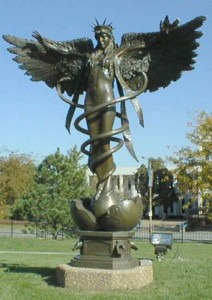
winged_caduceusReposted from 2009 – obviously, we do now have a pandemic.

While I don’t think the current swine flu outbreak is all that likely to turn into a pandemic, I’ve had some requests to re-post my article on flu pandemic economics.

Overview

When I was approached to write about the economics of a flu pandemic, my first reaction was “What’s there to write about?” Because, in the normal terms that people consider personal economics (such as how to diversify your portfolio, and so on), there isn’t a lot to talk about. Most of the obvious losers (medical insurance companies, hospitals, airlines, freight companies) and so on will either be bailed out by the government afterwards or aren’t quite the obvious losers that they seem. There is, perhaps, an argument for investing in drug companies and medical supply companies, on the assumption of an increase in demand, not so much during the pandemic, but after it. However even that sort of play is dubious, because the reaction to how the system performs in any pandemic situation may not rebound to the benefit of private companies.

But economics isn’t really about the stock market, it’s about how rare assets are allocated. And as such, there’s a fair bit we can talk about when it comes to a pandemic.

First, let’s lay out the basic scenario. I am assuming a serious pandemic, with all non-essential travel shut down for the duration (kiss your vacation goodbye), with both infected individuals and any individuals who have come into contact with them instructed to quarantine themselves, or being forcibly quarantined.

I am also assuming a pandemic large enough to overwhelm the health systems in most countries which get hit. There are not enough beds, not enough ventilators, and most likely not enough anti-virals to go around in most countries. There certainly won’t be enough trained medical personnel.

The situation will be much like that in wartime. Government will concentrate on keeping key infrastructure operating. Power, sewage, water, emergency services, and food distribution. Distribution of most goods through the system will be discontinued, since people can be asymptomatic and still carriers, it will be decided to keep any cross-country travel to a minimum. Most retail outlets will close, either voluntarily or by government fiat. Food will be trucked either into distribution centers or into supermarkets which agree to stay open and will be rationed out exactly as in wartime. As such, a black market will certainly appear.

Preparations

If you think that such a pandemic is likely to occur, then the steps you should take are much the same you would take for any natural disaster. Because the banking system will likely shut down during the crisis (and bank machines will likely not be restocked even if they do not go down due to loss of system personnel) you should have a stock of money at home to allow you to buy whatever you need which is available. If you can arrange to have independent power generation, you should do so. You should have a good supply of canned food and water. Make your estimate of how much you need and double or triple it. Others will not have planned, and you do not want to find yourself not being able to help friends, family, and neighbors. In addition, you will want to have tradeables available for the black market. Money will be a poor second to having goods people want. In this regard, stocking up on some medical items such as surgical masks and OTC medicines will be especially wise. I’m not encouraging profiteering, but you will need something you can trade which people want. Badly.

In terms of personal finances, other than investing your money in survival goods like food, water, candles, kerosene lamps, and stoves and so on (in case of a power out), and taking some money out for use in buying what goods are available, there’s little to do. Make sure you have an up-to-date, written statement of your assets every month, so that if records are lost you can successfully argue with your bank/broker about what situation you were in.

Most stock markets will shut down for the duration of the crisis, either voluntarily or by government fiat. However, some may stay open. The action on those exchanges will be wild, and probably very depressing. Ignore it for the duration. Don’t sell, don’t buy unless you are a trader who knows exactly what you’re doing. Many companies will get bailed out after the pandemic is over, and what the stock price will be a year from the pandemic is impossible to tell.

The most important thing you can do before the actual pandemic starts is make sure your personal relationships with whomever you live with are in good shape, that you have a circle of friends and family you can trust and that you have a relationship with your neighbors and any important people in your neighborhood. Leaving aside personal health factors, one of the most import predictors for survival will be the strength of your social ties to others. You may need help. Almost certainly someone in your family or social circle will need help. Make sure it’s there, by making sure ahead of time that people like you and want to help you and can’t bear the idea of you suffering or dying alone.

During…

The primary economic effect of a pandemic will be the slowing of almost all non-related economic activity to a crawl or even a halt. The primary tool of public health in any pandemic situation will be quarantine and the primary goal will be slowing or halting the spread of the disease, not just within a given community, but from community to community. As such, both international and domestic trade, including trucking, train, and air freight, will take a phenomenal dive. Nothing that is not a necessity will travel. For all intents and purposes the official economy will be driven down to little more than essential services and the shipping of essential goods like food, medicine, and goods necessary to maintain essential services.

Don’t expect to be getting a paycheck during this period unless you work in an essential service. Most companies will either shut down voluntarily, be shut down by government fiat, or will operate with a skeleton staff. And don’t expect to be able to cash your check or get money out of the bank – odds are they’ll shut down and even if the ATMs stay up, they likely won’t be restocked with money.

What there will be is a black market. In situations like this there is always a black market. There’ll be people selling food, water, and medicines (a lot of the medicine will be fake) and medical supplies like masks. If you want or need any of these things, you’ll either pay though the nose or have to have something to barter. In general, I discourage people from getting involved in black markets. But you may not have a choice and if you don’t, then make sure you have something to barter with.

Because public transit will likely be either shut down or operating on a much-reduced schedule, consider how you’re going to travel if you need to. For urban types, a bicycle is good. For suburban types, make sure you have gas, because there will be, almost guaranteed, gas rationing and long lines for gasoline. Rural types are advised to store gasoline or diesel fuel.

After

The long term effects of a pandemic are hard to judge. It really depends on a few things: how many people die; what the demographic profile of those who die is, and; how the public reacts to the disaster.

In a situation with relatively light casualties, say one percent of the population, the world will go on. Everyone will know someone who lost someone, or will have lost someone themselves. But the bottom line, sad as it is, is that it won’t make a huge difference. Demand will drop and thus it won’t have a huge effect on employment one way or the other; it’ll reduce GDP noticeably, but not disastrously, and otherwise, it’ll be business as usual with sadness.

However, if we have heavy casualties, with the worst casualties inflicted on healthy people between the ages of 20 to 40 the effect will be quite noticeable. It will put a lot of pressure on increasing retirement ages, decreasing retirement benefits (as programs like SS are paid for by current workers) and will mean that countries will have to consider encouraging more immigration. There will be a significant demand shock and GDP will take a big enough hit to be noticeable. Because some things can’t be downsized proportional to the loss of population, the employment situation will probably be better than before (assuming it doesn’t throw us into a depression, which it might).

In either the low- or high-end casualty estimates, the government will either bail out or take over a lot of companies, including health insurers, airlines, and freight companies. The worse things are, the less likely it that companies will be bailed out. Government revenue will take a significant hit in these scenarios, but especially in the heavy casualty scenario, and they will not be able to bail out everyone.

But the real question regarding the long-term effect is how the public reacts. If the public and private health systems crack under the strain, and many people die who could have been saved, then the outcry is likely to be something fierce. Everything will be up for grabs – and it’s hard to say if it’ll lead to more public health care, the scalping of politicians, or the weakening of drug patent laws. It could lead to an end of health insurance companies and drug companies as we know them today – or, they could turn the tables and claim it was the public system that failed.

But it’s safe to say that there’ll be less travel, less trade, and more care taken to ensure diseases don’t spread in the future. Get used to being checked every time you cross a border, and don’t be surprised if you see a lot less foreign goods on store shelves.

The real economic fallout will be determined by politics, not economics, per se. The political decisions made will determine the fate of entire industries, and trade and travel for some time to come.

Politics almost always trumps economics.


The results of the work I do, like this article, are free, but food isn’t, so if you value my work, please DONATE or SUBSCRIBE.

Page 276 of 532

Powered by WordPress & Theme by Anders Norén