
Ian Welsh

The horizon is not so far as we can see, but as far as we can imagine

The Real Republican Platform

I don’t much like Frum, but he’s 100 percent right on this and it’s worth reading. Nor is it all “Republican,” some of this is shared by a lot of Democrats. I’m going to summarize, since the Atlantic has a very limited amount of free views.

1) Lower taxation is the most important economic policy.

2) Covid is no big deal. Reopen, let people die, the numbers aren’t that big.

3) Climate change is either no big deal or can be dealt with with technology, it’s not worth spending money on.

4) China is the US’s enemy, and when China loses, the US wins, and vice-versa.

5) The post-war order is dead — NATO and the WTO. The EU is a rival, Britain and Japan are subordinates; Canada, Australia and Mexico are satraps (he says dependencies).

6) You deserve as much health care as you can afford.

7) Voting is a privilege, not a right, and can be restricted.

8) Anti-black racism is BS, it’s whites and Christians and so on who are discriminated against now.

9) Abortion rights need to go. (Interestingly, he dances around this one a bit, while stating the other mostly clearly.)

10) Secret money and conflicts of interest are no big deal.

11) The border wall is good, and a long delay in granting illegal immigrants rights is good.

12) The protests should be crushed by granting police more powers. (Dances around this a bit too.)

13) Trump and his surrogates acting up on Twitter and so is just a reaction to worse excesses of his critics.

If you have free articles left at the Atlantic, this is worth reading in full. My take is that it’s accurate; this is the real Republican platform. Frum says it is kept secret because while Republicans agree, most non-Republicans don’t. Remember that there are a lot of independents and non-voters.

All of these points are more or less known, and each point has been discussed by various people in detail, but what Frum has done is put them clearly and in one place. He’s a little obscure on abortion rights, BLM, and that the US has subjects, not dependencies.

The attitude to China is shared by Democratic elites. The attitude to the EU isn’t, though the UK is understood to be a lackey and Japan is the most important US ally after the UK. Until they get serious and get their own nukes and figure out a way to deal with their oil dependency issues, they can be considered subordinates.

Canada is scared of the US, the relationship isn’t of a child to a parent (well, not a non-abusive one), it is of a servant to a master. My fellow Canadians won’t like that, but it’s true. Mexico has an even worse relationship with its “master.” As for Australia, they’ve decided the master they have is better than the other possible master, which would be China, and they’re probably right.

It is also true that Democrats generally believe in low taxes as well. They don’t believe in them quite as much, but they do believe. They aren’t taking Covid that seriously, and while they mouth off about Climate Change, they have never done anything but accelerate it. Remember that Obama/Biden vastly increased fracking and bragged about it, and that Biden’s policy platform removed the pledge to end subsidies to oil companies.

As for health care, Democrats and Republicans aren’t that far apart. Democrats want to subsidize some for the poor and middle class, but they don’t want to end the fact that the quality and amount of care one receives is primarily based on the ability to pay, and that it is a market purchase.

With respect to BLM, Biden has promised to give police more money, saying it will be spent on anti-racism training, and so on. (That’s been done before, and you see the results.) Both parties want the police to have more money, not less.

Finally, while Democrats are nowhere near as bad as Trump on corruption and secret conflicts of interest, they are bad, very bad.

Frum’s done a real service here by spelling out Republican beliefs carefully.

What’s interesting, however, is the extent to which Democrats (the ones who run the party), agree. Democratic voters sometimes don’t (they want Medicare for all — at about 80 percent now), but what they say they want really isn’t relevant when they won’t vote for it in the primaries.


Everything I write here is free, but rent isn’t, so if you value my writing, please DONATE or SUBSCRIBE.



Why QAnon Resonates

QAnon posits that there is a conspiracy of pedophiles in the deep state, including celebrities, politicians, and bureaucrats who oppose Donald Trump. Supposedly, Trump is in a struggle with them.

The specific QAnon allegations have, so far, turned out to be false.

But it still resonates, and the reason why isn’t complicated.

It’s because, while it’s wrong in the specifics, it’s right in the generality.

Jeffrey Epstein ran an island where underage girls (not pre-pubescent, but below the age of consent) were procured for important men. I haven’t been able to find a full list of visitors, but a partial list includes Trump himself, Bill Clinton, Thomas Pritzker (the executive chairman of Hyatt Hotels), Kevin Spacey (unlikely to have slept with underage girls, I’d think), comedian Chris Tucker, Prince Andrew, Les Wexner (ex CEO of LBrands, worth over $7 billion), modeling executive Jean-Luc Brunel (a modeling exec, not a customer, but claimed to be a procurer), ex-New Mexico Governor Bill Richardson, former Maine Senator George Mitchel, Harvard physicist Lawrence Krause, Woody Allen, Kenneth Star (attorney), and Alan Dershowitz. (Source one, Source 2.)

The current US attorney general represented Epstein in 2007 and got him a plea deal.

What’s interesting about that plea deal is that it happened because Jim Acosta, the prosecutor was told he belonged to intelligence and to leave it alone.

Sounds pretty deep state to me.

There are also strong claims that Epstein also worked for Mossad, Israel’s intelligence agency.

What’s shocking about Epstein isn’t that he got away with it so long, but that with a blackmail list like the one he must have had, that he was ever taken down.

It is clear is that some of the most powerful people in the world (and the full list must be much, much longer) were in Epstein and his handlers’ power; he had the goods on them.

What also seems almost certain is that at least a part of the deep state was running Epstein and using him to blackmail important people.

Now, the idea that Donald J. “Grab Them by the Pussy” Trump is crusading against pedophiles is ludicrous. But is it far-fetched to think that many of his opponents in the deep state (and many of his supporters) are deeply dirty, and are involved in blackmailing powerful people after setting them up with underage girls?

Close to a sure thing.

QAnon is wrong on the details, wrong on the “sides,” but right that the state is deeply corrupt, deeply evil, and involved in deeply disturbing acts. And, of course intelligence agencies are blackmailing politicians–including politicians in their own countries.

As the saying goes, even paranoids have enemies, and yes, Virginia, the deep state was, in at least one case we know of, apparently protecting a ring for providing men with underage women and then (almost certainly) blackmailing them.


Everything I write here is free, but rent isn’t, so if you value my writing, please DONATE or SUBSCRIBE.

Week-end Wrap – Political Economy – August 23, 2020

by Tony Wikrent

The Pandemic

[Twitter, via Naked Capitalism Water Cooler 8-20-20]

Estimated cost of recent epidemics/pandemics:
SARS (2003) – $40 billion
H5N1 (2006) – $40 billion
H1N1 (2009) – $45 billion
Ebola (2014) – $55 billion
COVID-19 (2020) – $8.8 TRILLION
Investing in public health preparedness is FAR cheaper than the economic impact of a pandemic.
3:57 PM · Aug 19, 2020
15.7K

Something Remarkable Just Happened This August: How the Pandemic Has Sped Up the Passage to Postcapitalism
Yanis Varoufakis, August 22, 2020 [Lannan Foundation, via Naked Capitalism]

Following the crash of 2008, capitalism changed drastically. In their attempt to re-float the crashed financial system, central banks channelled rivers of cheap debt-money to the financial sector, in exchange for universal fiscal austerity that limited the middle and lower classes’ demand for goods and services. Unable to profit from austerity-hit consumers, corporations and financiers were hooked up to the central banks’ constant drip-feed of fictitious debt.

Every time the Fed or the European Central Bank or the Bank of England pumped more money into the commercial banks, in the hope that these monies would be lent to companies which would in turn create new jobs and product lines, the birth of the strange world we now live in came a little closer. How?

As an example, consider the following chain reaction: The European Central Bank extended new liquidity to Deutsche Bank. Deutsche Bank could only profit from it if it found someone to borrow this money. Dedicated to the banker’s mantra “never lend to someone who needs the money”, Deutsche Bank would never lend it to the “little people”, whose circumstances were increasingly diminished (along with their ability to repay any substantial loans), it preferred to lend it to, say, Volkswagen. But, in turn, Volkswagen executives looked at the “little people” out there and thought to themselves: “Their circumstances are diminishing, they won’t be able to afford new, high quality electric cars.” And so Volkswagen postponed crucial investments in new technologies and in new high quality jobs.

But, Volkswagen executives would have been remiss not to take the dirt-cheap loans offered by Deutsche Bank. So, they took it. And what did they do with the freshly minted ECB-monies? They used it to buy Volkswagen shares in the stock exchange. The more of those shares they bought the higher Volkswagen’s share value. And since the Volkswagen executives’ salary bonuses were linked to the company’s share value, they profited personally – while, at once, the ECB’s firepower was well and truly wasted from society’s, and indeed from industrial capitalism’s, point of view….

My difference with fellow lefties is that I do not believe there is any guarantee that what follows capitalism – let’s call it, for want of a better term, postcapitalism – will be better. It may well be utterly dystopic, judging by present phenomena. In the short term, to avoid the worst, the minimum necessary change that we need is an International Green New Deal that, beginning with a massive restructuring of public and private debts, uses public financial tools to press the oodles of existing liquidity (e.g. funds driving up money markets) into public service (e.g. a green energy revolution).

“Meatpacking Companies Dismissed Years of Warnings but Now Say Nobody Could Have Prepared for COVID-19”

[ProPublica, via Naked Capitalism Water Cooler 8-21-20]

“[A] ProPublica investigation has found that for more than a dozen years, critical businesses like meatpackers have been warned that a pandemic was coming. With eerie prescience, infectious disease experts and emergency planners had modeled scenarios in which a highly contagious virus would cause rampant absenteeism at processing plants, leading to food shortages and potential closures. The experts had repeatedly urged companies and government agencies to prepare for exactly the things that Smithfield’s CEO now claims were unrealistic…. Instead, the industry repeatedly expressed confidence in its ability to handle a pandemic, and when asked to plan, relied on a wait-and-see approach, records and interviews show.”

Decline of USA power

Open Thread

As usual, feel free to use the comments to discuss topics unrelated to recent posts.

Sanders Anoints AOC His Heir

There was a lot of furor over AOC speaking at the DNC. First, that she had only a minute, then that she didn’t “endorse” Biden.
Both of these things come down to a simple fact: She was invited by Bernie to nominate him. As such, it wasn’t appropriate for her to talk about Biden. That she had only a minute is because that’s how long the nominations are.

AOC wouldn’t have been invited to speak at the DNC, really, if it was up to the people running the convention, Biden’s people, she wouldn’t have spoken at all.

She was there because Bernie chose her.

AOC is Bernie’s successor: She is going to be the leader of his movement when he no longer is, and this was his last Presidential campaign. She’s the progressive leader now.

It could have been Elizabeth Warren, but she called Bernie a liar and a sexist and waffled on key progressive priorities. AOC, on the other hand, when Sanders needed help most, right after his heart attack, came out, endorsed, and campaigned for him and made a huge difference.

Warren, in her short-sightedness, torpedoed herself in an attempt to win it all now, and then later to maintain viability with centrists. In exchange, she got a DNC speech, and in exchange she gave up her post as heir-presumptive to the progressive bloc. She will never be President.

I don’t know if AOC is a better choice, but she is genuinely charismatic in a way Warren and Sanders aren’t. It will be interesting to see if she can can do more with the movement than Sanders did.

Let us hope so.


Everything I write here is free, but rent isn’t, so if you value my writing, please DONATE or SUBSCRIBE.

The Extended Emotional Body

The simplest way to think of identity and identification is that it creates an enlarged emotional body.

If someone I identify with is hurt, I hurt. This suffering shows up on brain scans, it’s not theoretical.

If, on the other hand, I completely don’t identify with someone else, their pain doesn’t both me. This is why, for example, most slave societies say that slaves are sub-human. Plato believed most slaves were meant to be slaves, and that slavery was only wrong if someone was not naturally a slave. Race theory and so on.

The Romans were refreshingly honest about this, “You’re a slave because you, or the people from whom you are descended lost a war.” They also made it very possible to stop being a slave, perhaps because they didn’t think of slaves so much as “other.” It wasn’t an intrinsic category, you just had bad luck.

This extended emotional body goes beyond people. You can identify with animals and feel pain when they are hurt (Nietzche went insane when a man whipped a horse savagely). You can identify with plants, or with objects and ideas.

People piss on Korans and Bibles and burn flags precisely for this reason: It hurts people they want to hurt. People tell you your ideals are wrong to hurt you or to protect their ideals from harm so they won’t be hurt. Be really aggressive to a believer about how “God isn’t real.” It hurts. Tell an American patriot his country is evil. Etc.

Conversely, if another person we care about does well, we’re happy. If the country we identify with wins a war we may feel good. Or, if we think the war is wrong, we may feel bad. The extended emotional body created by identification gives us vast possibilities for increased happiness. Check in on a sports fan when “their team” wins the championship.

Identification with people and objects and ideas we really have nothing in common with is a large part of how we scaled our societies to grow beyond the number of people we could personally know well. We’re all Americans or Germans; or we’re all descended from the same ancestor; or we all believe in Zeus, and thus won’t attack another worshipper of the greatest of all Gods, let alone the wanderers who are under his sacred guard.

Identity, however, leads to a wide variety of pathologies. We don’t actually know these people, they don’t actually know us, and as for the ideas, well, they may be bad for us, but because we identify with them, we can’t see that clearly.

Identity makes it hard to find truth, because when we discover that something we identify with isn’t what we thought it was, maybe it’s not good or even perhaps, that it doesn’t even exist, it hurts. Humans avoid pain.

Identity also allows us to be manipulated. Odds are, your interests have essentially nothing in common with those of the people who run the Democratic or Republican parties, or the CEO of the company you work for, or the leader of your religion. But many many people identify with these organizations or people and acquiesce to their authority, even when that authority is terribly harmful to them.

Identity is a prosthesis. It lets us do things we can’t do without it. But beyond identifying with people we personally know and like, it isn’t natural, and it is very easily abused.


Everything I write here is free, but rent isn’t, so if you value my writing, please DONATE or SUBSCRIBE.


Appropriate Hate (and Other Negative Emotions)

There are no human emotions which are always bad. Every emotion is useful in certain circumstances. Emotions are bad when they provide incorrect guidance or they hijack you.

Perhaps you had bad experiences with dogs as a kid, and now you’re scared of them, even though most aren’t dangerous. That’s inappropriate guidance, and, if the fear is strong enough and you can’t pet a friendly dog even though you think you should, you’ve been hijacked.

Chronic negative emotions are also bad. If you’re angry or scared almost all the time, that has negative effects on your health.

That said, even an emotion like hate has utility, if it’s correctly pointed. People like the person below have a problem.

Hate exists to tell you when someone is a threat, and you should do something about it. It often is hijacked, as with Americans thinking that foreign leaders like Putin are the primary threat, when it’s their own leaders who kill and impoverish them. When hate operates correctly, it points at actual threats.

Trump’s bungling of Covid and the economy has killed over 100,000 Americans. It’ll kill hundreds of thousands by the end. Somewhere around 30 percent of renters can’t make their payments; many of those will wind up homeless. That’s not all his fault, but a lot of it is.

Trump’s actually dangerous to a lot of people, and hating him is an appropriate emotion. Being consumed by it isn’t, but wishing that Trump would die of natural causes is entirely reasonable. (Granted, Pence might be worse, but you can hate him too.)

Emotions have purposes. Hate is meant to tell you who is a threat. Anger is meant to tell you that someone is doing something they really shouldn’t be doing. (This is one reason why, in spiritual communities which say one should never be angry, abusers manage to get away with abusing for a long, long time.) Jealousy tells you you’re falling behind and not living up to your potential.

All of these negative emotions can be inappropriate or hijacked or chronic and be bad for you, of course, but all of them also have a purpose in a healthy individual.

For that matter, positive emotions can be inappropriate. If you’re so happy you don’t notice a threat, that’s a problem that could get you dead.

Anyway, the main problem with hate and anger is that they are easily hijacked and hook onto targets who aren’t actually dangerous, but merely “foreign.” As with the companion feeling of loyalty, most of modern “leadership” is hijacking tribal emotions and pointing them in the wrong direction. Loyalty to Biden or Trump (both evil men who have done, and will do, horrible things) is insane unless you’re directly part of the gravy train.

We humans have very badly fucked up our emotional guidance systems. They’re supposed to point you towards what’s good for you and warn you about what’s bad for you. Trump is bad for almost everyone, and so is Biden. So are most Democratic and Republican politicians, almost all CEOs of major companies, and so on and so forth.

So go ahead and hate them, just don’t let it be chronic or hijack your ability to make decisions. It’s definitely appropriate.

The people who are dangerous to you and who have, over 40 years, impoverished Americans, are your own leaders. Hate threats, they are a threat.


Everything I write here is free, but rent isn’t, so if you value my writing, please DONATE or SUBSCRIBE.

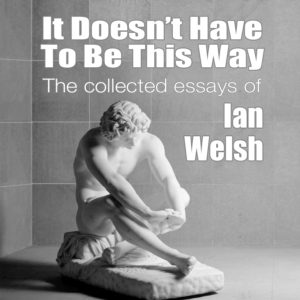
“It Doesn’t Have to Be This Way” Redux

So last year, I published a collection of essays (free for now) with commentary. They’re clustered around why are world is, in many ways, shit, and what a better world would look like.

I haven’t pushed it much at all, but there are a lot of new readers, and if you enjoy my writing, well, I’ve been writing online for 17 years or so, and these are my picks for some of the most important essays. There are also two essays never published anywhere else, one of which concerns how to evaluate your risk from climate change and the collapse of neoliberalism. (Said collapse having sped up since the book was published.)

Get “It Doesn’t Have To Be This Way” here.


Everything I write here is free, but rent isn’t, so if you value my writing, please DONATE or SUBSCRIBE.


Page 253 of 532

Powered by WordPress & Theme by Anders Norén