Use to discuss topics unrelated to recent posts.
No surprise, leaked opinion was accurate. There’s a decent map here of what it will mean on the ground:
Roe is overturned, looks like Alito’s leaked opinion in Dobbs is unchanged. This map can help you figure out what happens where you are. The guide in this link has a state by state breakdown (some states outlaw immediately some have waiting periods) https://t.co/WpPqwQEr5Y pic.twitter.com/dx3Pnd4kDV
— Molly Shah (@MollyOShah) June 24, 2022
Republicans have spent generations stacking courts, doing whatever they could to put ideologues there. They understood what appointments meant.
If you think Democrats are going to do anything meaningful about this, you are delusional. Democratic leadership does not care, though they’ll fundraise on the issue:
Thinking about how Pelosi and Clyburn just went out of their way to help an anti-abortion, pro-gun incumbent beat a young progressive woman by 289 votes. pic.twitter.com/MOhRSknfZD
— onagapnotsew (@westonpagano) June 24, 2022
The next time Republicans have the Senate, House, and Presidency they’ll pass a nationwide abortion ban.
Meanwhile, restrictions on guns will be increasingly struck down. Cops no longer have to read people their Miranda rights. Republicans want gay marriage gone. I think they’ll continue to allow cross-race marriages, at least as long as Thomas is on the court, and maybe longer, as they’ll need Hispanic votes. Free public schooling is also likely to go in many states. Contraceptives will be made illegal in many places.
America, fuck’yeah.
Bertrand Russel once called Plato the original intellectual fascist (in “A History of Western Philosophy,” which is well worth reading.)
In The Republic, Plato tries to come up with the ideal form of government and decides on a caste system, where children are educated, and then, based on their character and aptitude are divided into workers, enforcers, and rulers. The rulers are to be those who are philosophers by nature and training — those who love wisdom and are uninterested in wealth.
It’s easy to sneer at Plato, but there’s a reason why Whitehead’s line that “All of Western philosophy is but a footnote to Plato” has a lot of truth to it.
And one has to remember the context: Athenian democracy, the most famous in the Grecian world (and the most famous in Western history) had failed and been defeated by Sparta, after a reign of abuses which turned its allies against it. Entire cities were destroyed, with men killed and women and children sold into slavery. The most glorious city in their world, conquered and occupied.
Plato was never a democrat, and he hated Athenian democracy for killing his teacher Socrates, but he was looking at a real problem: those who became leaders in democracy were very often unsuited to rule. Pericles was great, aye, but he led Athens into a war it lost.
There are really two problems: the selection of leaders, and how they are treated. Lord Acton said that “power tends to corrupt; absolute power corrupts absolutely.” Tends is important; it doesn’t happen to everyone, but it happens to most. When you’re powerful, you don’t have to care about other people without power, and over time, most people tend not to.
Further, powerful people spend time with other powerful people as equals or near equals and, in time, they become their own faction, and look after their own interests and not those of people without power.
The story of “crusading politician goes to the capital and gets corrupted” is ancient. A cliche. It’s a cliche because it happens most of the time; there are exceptions, but they are exceptions.
So, for any and all societies, the question is: How should we select leaders?
As I’ve said before, there can be no question that all societies on Earth have failed the leadership selection test (with the possible honorable exception of tiny, powerless Bhutan). We have failed because we knew of climate change and ecological collapse and we did nothing; indeed, we put our collective foot, hard, on the accelerator.
There’s an argument that this is just how humans are. There have been multiple collapses in history, including ecological, and we never seem to do anything to stop them.
But there’s another argument that we can find a better way.
Leadership and followership are related. I had this first brought home to me when I was in elementary school. From the third grade to halfway through sixth grade, I was in a class where the boys had two leaders. They were best friends, and they were friendly, inclusive of everyone, and tolerated no bullying. It wasn’t that they stopped it, though on a couple occasions did I see them step in, it was that their example was so much the opposite that it just didn’t happen.
Then, halfway through sixth grade, I went to another school and the leader of the boys was himself a bully, and bullying was rife.
Throughout my life, I’ve seen how groups and organizations become like the people who run them. Leadership is incredibly powerful, just by example, even before any “power” is used.
So the most important question in improving human society and groups is improving how we select and treat leaders, and by this measure, representative democracy has rather obviously failed.
This is noted often by conservative neo-reactionaries, but such folks are misguided at best. The eras of nobles or aristocrats (two different things), or of kings, were not better — they were often awful. The rise of agricultural kingships lead to cruelty of a type and scale hard for us now to imagine, and that continued throughout their history. One common punishment in Tudor England was opening someone’s stomach, pulling out their intestines and burning them while the person was alive; crowds would gather, treat this as entertainment and have a party while it was going on.
The answer to democracy’s failures isn’t some foolish nostalgia for a time which was worse; we need to find something genuinely new, or we will keep stumbling from catastrophe to catastrophe, and at some point said catastrophe will wipe us out.
So I suggest to readers to consider the question, which Plato tried to answer, of how to select, train, and treat rulers — and I would add that they should act in the best interests of all, especially including those they don’t know, both who are alive at the same time the leaders are, and those who will be alive after they are dead.
This is the human problem. If we can’t solve it, we can’t have good societies — save by chance and for brief periods.
As you may have heard, Lithuania has cut off much of the land supply to Kalingrad, a former German city held by Russia, but which has no land connection to Russia.
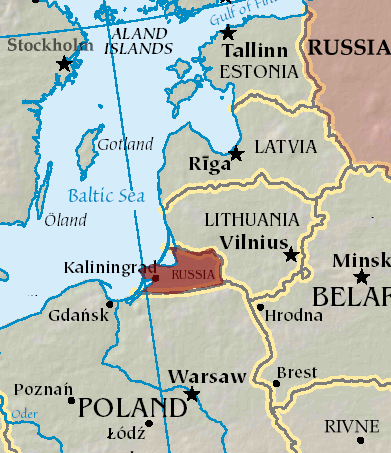
Lithuania has applied EU sanctions to the transit of goods to Kaliningrad. Russia says this is a blockade and in violation of an agreement from 2002 to allow transit between the Russian mainland and Kaliningrad. Sanctions apparently amount to about 50 percent of shipments, and Lithuania has also closed its airspace to Russia. Because the Baltic freezes during the winter, resupplying Kaliningrad will become particularly difficult in a few months.
The Russian official response has been fairly measured — they consider it a violation and are studying how to retaliate.
The simplest retaliations are not easy; while the EU as a whole relies in Russian energy, Lithuania itself is relatively energy self-sufficient.
I would suggest that the solution, as Lithuania says it is just implementing EU sanctions, is to simply shut off energy to the EU as a whole for a while and see what happens.
But there’s something else here that needs comment: Lithuania is part of NATO.
I believed, when Lithuania joined NATO, that it shouldn’t have been let in. Lithuania has an army of about 20K. It’s not Ukraine, with Europe’s largest army (and still losing), it could be overrun in days. Lithuania feels free to provoke Russia because of NATO Article 5.
But let’s look at exactly what Article 5 says:
The Parties agree that an armed attack against one or more of them . . . shall be considered an attack against them all and consequently they agree that, if such an armed attack occurs, each of them, in exercise of the right of individual or collective self-defence recognised by Article 51 of the Charter of the United Nations, will assist the Party or Parties so attacked by taking . . . such action as it deems necessary, including the use of armed force, to restore and maintain the security of the North Atlantic area.
You’ll notice that this isn’t actually an automatic declaration of war. Each country in NATO will decide what to do.
As I’ve said in the past, if Russia attacks Lithuania, I feel we should go to war.
But the analogy right now is that someone who is too weak to fight is poking someone dangerous because they have friends who can fight.
Are we really willing to risk WWIII and nuclear armageddon so that Lithuania or the EU can provoke Russia?
Lithuanian politicians seem to think that Article 5 is automatic: It isn’t, and they need to remember that. The same is true of the EU as a whole, whose military cannot defeat Russia without aid from the US and Turkey.
How sure are they that the US will answer the call?
Should the US answer the call? Are you personally willing to die so that Lithuania and the EU can poke Russia? (A Russian ex-general recently noted that, if war breaks out, the UK will cease to exist, so this question isn’t really just for Americans.)
I suggest that EU and Lithuanian politicians and citizens should think this over carefully. Turkey, I virtually guarantee, will not join such a war, and those who depend on the US have often found out that it cannot be trusted when the stakes are high.
I doubt this situation will lead to war, but each provocation and escalation, from either side, increases the odds, and we’re playing a very high stakes game here — given how many nuclear weapons both sides have.
Perhaps we should think carefully about for whom we are actually willing to die, about who we’re willing to defend if the cost is that almost everyone we know, including our family and friends, stands a good chance of dying.
Because if WWIII happens, whichever side starts losing, will use nuclear weapons.
You can’t automatically bow down to threats and never be willing to fight, or those who are willing to use violence can make you do anything they want, but there’s a difference between standing up for yourself and provoking a fight.
The EU, NATO and the Baltic states need to think very carefully about this difference.
by Tony Wikrent
Strategic Political Economy
From 2010: The Unvarnished Truth About the US
Ian Welsh, June 15, 2022
Twelve years ago I wrote this post. I don’t see anything since then has made it wrong and I think it’s worth reading still, especially for those who weren’t with me 12 years ago:
I’ve been meaning to write this post for some time and in light of yesterday’s Supreme Court decision allowing unlimited corporate money into the political system, I think it’s time.
Yesterday’s decision makes the US a soft fascist state. Roosevelt’s definition of fascism was control of government by corporate interests. Unlimited money means that private interests can dump billions into elections if they choose. Given that the government can, will, and has rewarded them with trillions, as in the bailouts, or is thinking about doing so in HCR, by forcing millions of Americans to buy their products the return on investment is so good that I would argue that corporations have a fiduciary duty to their shareholders to buy out government – after all if you pay a million to get a billion, or a billion to get a trillion, that’s far far better returns than are avaiable anywhere else….
Add to this the US’s complete inability to manage its economic affairs, and its refusal to fix its profound structural problems, whether in the financial system, the education system, the military, concrete infrastructure, technology or anything else and I cannot see a likely scenario where the US turns things around. The US’s problems in almost every area amount to “monied interests are making a killing on business as usual, and ologopolistic markets and will do anything they can to make sure the problem isn’t fixed”.
Even before they had the ability to dump unlimited money into the political system, they virtually controlled Washington. This will put their influence on steroids. Any congressperson who goes against their interests can be threatened by what amounts to unlimited money. And any one who does their bidding can be rewarded with so much money their reelection is virtually secure.
[Twitter, via Naked Capitalism 6-15-2022]
Remember when everyone who warned this exact thing would happen was called a Putin apologist https://t.co/Ni6nj0f54S
— Paul Gottinger (@PaulGottinger) June 15, 2022
.
Ryan Morgan [American Military News, via Mike Norman Economics 6-15-2022]
The West Doesn’t Want The World To Know That Russia Just Saved Brazil’s Crop This Year
Andrew Korybko [One World, via Mike Norman Economics 6-14-2022]
The epidemic
WTO Fails to Promote COVID Vaccines
Robert Kuttner, June 17, 2022 [The American Prospect]
… the U.S., despite Biden’s commitment to a waiver of drug company patent rights, sides with Pharma.
A new study claims Medicare-for-all could have saved more than 200,000 lives during the pandemic
[Vox, via Naked Capitalism 6-17-2022]
Use comments to discuss topics unrelated to recent posts.
And that’s what Ukraine is willing to admit to.
Up to 1,000 Ukrainian soldiers are being killed or wounded each day in the Donbas region of eastern Ukraine, with 200 to 500 killed on average and many more wounded, a top Ukrainian official said on Wednesday.
In the initial attack, Russia took heavy casualties. They didn’t expect the Ukrainians to really fight, don’t seem to have taken into account the amount of fortifications built in the East since 2014 and were very sparing with artillery and air power. Since then, however, they have engaged in grinding attrition warfare. They have air superiority, more missiles, and far more artillery. They also have far more reserves, and their supply lines aren’t interdicted by hostile air forces, so they easily rotate units in and out of the front.
The result of this is that Ukraine is now taking much higher casualties than Russia and will have a higher killed/injured ratio as well. If they’re willing to admit up to 1K a day, I’m betting it’s at least double that.
Russia is advancing slowly, but they are taking ground, and they seem in no rush. Once they conquer Donbas and Luhansk, the question is whether their primary pivot is to Odessa or to Kharkiv. (I’d say taking Odessa does more harm to Ukraine, as Russia could then easily close off Ukraine’s entire coast, but Russia may want Kharkiv more.)
The other thing to bear in mind is that once Donbas and Luhansk are conquered, most of the rest of Ukraine is not nearly as heavily fortified, except in the sense that all cities are natural fortifications, and that Ukraine is essentially a flat open plain. Advances may speed up a fair bit, though the post Cold-war Russian army (as with most armies) isn’t really suited to breakthroughs and blitzkrieg warfare, as like other modern armies it is organized around brigades which don’t really have the mass and men necessary.
As I have long noted, barring an economic/logistical collapse which seems extremely unlikely, there was never any way that Russia was going to lose the conventional stage of any war with Ukraine. They have a far larger military, and it’s not, actually, crap.
The decision of when to stop the Ukraine war is Putin’s. If he is seen to lose the war, he will lose power and almost certainly wind up dead along with his family, so he won’t end the war until he has a victory, and, as he controls the more powerful military force, he can choose to win.
The longer Ukraine puts off making peace, the worse the terms are likely to be.
As for a guerilla war, my guess is that Russia will take parts that are primarily Russian, and anyone who is pro-Ukraine will be encouraged or forced to leave. Nasty ethnic cleansing, but it is one of the ways you break insurgencies. (They may not even have to do very much, though, considering how many have fled the war. Just don’t let them come back if they aren’t pro-Russian.)
The longer-term consequences are harder to forsee beyond the obvious stuff like Russia now being a junior Chinese ally and Europe now being a much firmer US satrapy. There’ll be a famine, there’s going to be a recession (caused as much by the political and central bank response as the war and sanctions), and so on. Europe won’t recognize whatever Russia takes, and there’ll be a festering sore, probably for decades.
But, bottom line, Russia is winning and will keep winning. The only thing that could change that would be direct entry by NATO, and that would probably lead to nuclear war.
Twelve years ago, I wrote this post. I don’t see anything since then has changed to make it wrong, and I think it’s worth reading still — especially for those who weren’t with me 12 years ago.
I’ve been meaning to write this post for some time, and in light of yesterday’s Supreme Court decision allowing unlimited corporate money into the political system, I think it’s time.
Yesterday’s decision makes the US a soft fascist state. Roosevelt’s definition of fascism was control of government by corporate interests. Unlimited money means that private interests can dump billions into elections if they choose. Given that the government can, will, and has rewarded them with trillions, as in the bailouts, or is thinking about doing so in HCR, by forcing millions of Americans to buy their products, the return on investment is so good that I would argue that corporations have a fiduciary duty to their shareholders to buy out government – after all, if you pay a million to get a billion, or a billion to get a trillion, that’s far far better returns than are available anywhere else.
And no politician, no political party, can reasonably expect to win when billions of dollars are arrayed against it.
The one faint hope is that politicians in the Senate will panic, know they have ten months to do something, and ram something through. Of course, that will only be a stopgap measure, until the Supremes overthrow it, but in the meantime, maybe Dems will get serious about the Supreme Court and stop rubber-stamping radical right-wingers like Alito and Roberts.
That is, however, a faint hope.
Given the US’s complete inability to manage its economic affairs, and its refusal to fix its profound structural problems, whether in the financial system, the education system, the military, concrete infrastructure, technology, or anything else, I cannot see a likely scenario where the US turns things around. The US’s problems in almost every area amount to “monied interests are making a killing on business as usual, and ologopolistic markets and will do anything they can to make sure the problem isn’t fixed.”
Even before they had the ability to dump unlimited money into the political system, they virtually controlled Washington. This will put their influence on steroids. Any congressperson who goes against their interests can be threatened by what amounts to unlimited money. And any one who does their bidding can be rewarded with so much money their reelection is virtually secure.
This decision makes the US’s recovery from its decline even more unlikely than before — and before it was still very unlikely. Absolute catastrophe will have to occur before people are angry enough and corporations weak enough for there to even be a chance.
So, my advice to my readers is this.
If you can leave the US, do. Most of the world is going to suffer over the next decades, but there are places which will suffer less than the US: places that have not settled for soft fascism and are refusing to fix their economic problems. Fighting to the very end is romantic, and all, but when you’re outnumbered, outgunned, and your odds of winning are miniscule, sometimes the smartest thing to do is book out. Those who immigrated to the US understood this; they left countries which were less free or had less economic hope than the US, and they came to a place where freedom and opportunity reigned.
That place, that time, is coming to an end. For your own sake, and especially for the sake of your children, I tell you now — it is time to get out.
I am not the only person thinking this. Even before the decisions, two of my savviest American friends, people with impeccable records at predicting the US meltdown, told me that within the next few years they would be leaving.
There’s always hope, and those who choose to stay might stop this terminal decline.
But you need to ask yourself, seriously, if you are willing to pay the price of failure, if you are willing to have your children pay the price of failure. Because it will be very, very steep.