Ian Welsh

The horizon is not so far as we can see, but as far as we can imagine

And He Said To Me “We’re all going to die, and heaven knows we deserve to”

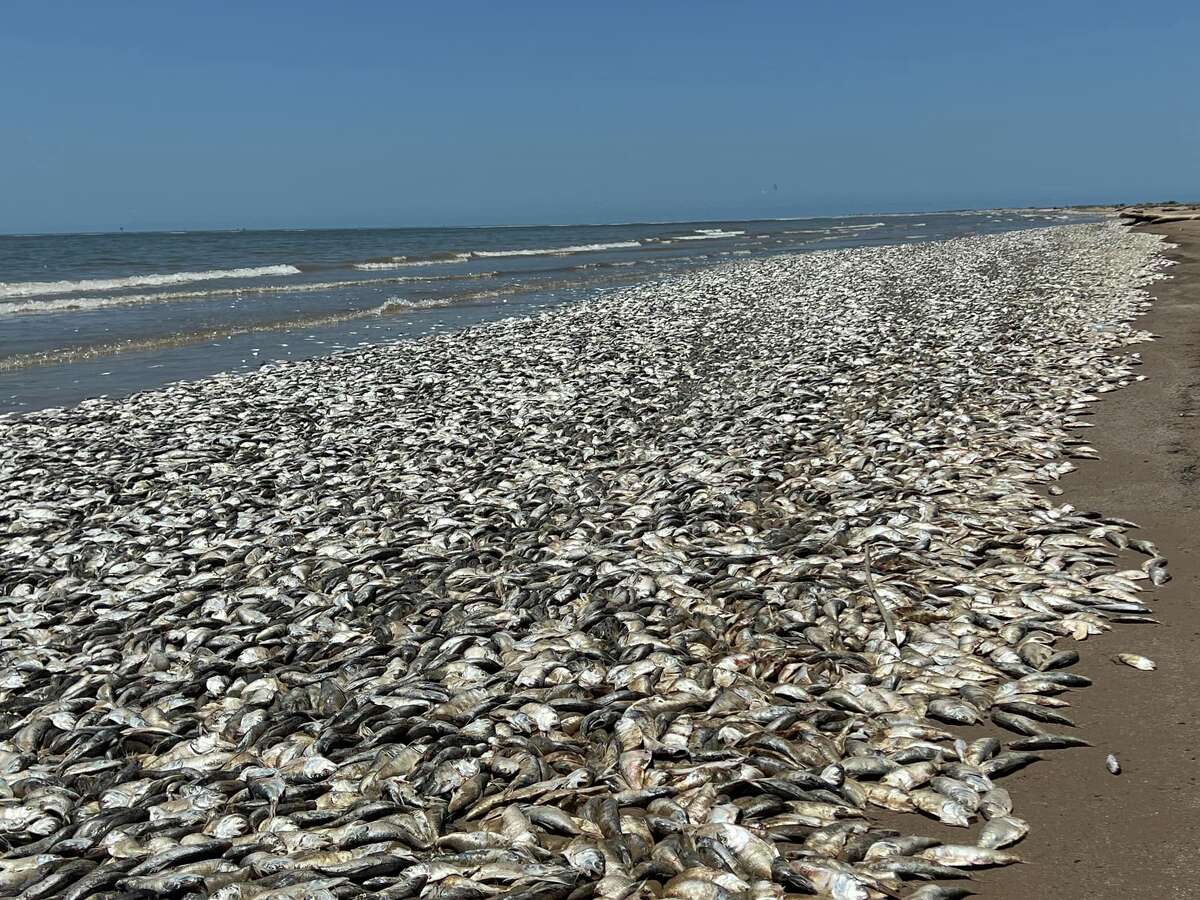
That’s what a friend wrote to me when he sent me the story attached to that picture.

“A cleanup is underway as an unquantifiable amount of dead fish washed ashore on several Texas beaches today due to low oxygen levels in the water, according to a Quintana Beach County Park Official.”

Yeah. Now this isn’t just a climate change thing, nor is this the first time it’s happened, but warm water holds less oxygen and also reduces the number of oxygen producing phytoplankton. Red Tides (algal blooms which deplete oxygen) are also made more common by climate change.

So, there are two things to say about this.

First: the probability that all humans will die is low. Not zero or effectively zero though I know some smart people who think that’s true. They argue “the Earth has had this much carbon/heat before and there was life, it’ll suck, but whatever.” Well, yeah, but not while humans were around.

What it really is is about is an assumption that the next equilibrium point (from the one we’ve inhabited for about 10K years) is a livable one, and that we won’t blow thru it and others and settle at one which is not livable, or more accurately, which we cannot adapt to in time to avoid an extinction spiral.

It is also true that the problem is NOT just carbon, it is ecological collapse. Human are apex predators. If we take out the web beneath us, we are the ones most vulnerable.

This is probably true. It is not certainly true.

Second: Just Because Human Life Will Probably Go On, Doesn’t Mean Yours Will. Or, y’know, the life of anybody you care about. Always true, but more true in mass death scenarios. Nor does it mean your life will not really, really, suck.

Well, there’s your Monday cheer for you!


This is a donor supported site, so if you value the writing, please DONATE or SUBSCRIBE.

Week-end Wrap – Political Economy – June 11, 2023

by Tony Wikrent


Strategic Political Economy

What Happens When Corporations are Taxed at 50% – Like Before the Reagan Revolution?

Thom Hartmann, June 5, 2023 [DailyKos]

The main benefit of raising the top personal income tax bracket back up to nosebleed levels is that it causes CEOs and business owners (people who can essentially determine their own pay) to restrain themselves from draining the corporate coffers just to buy a new super-yacht, jet, private island, or a fourth 70-room mansion in the Swiss Alps.

Back in the 1933-1981 era, instead of behaving like spendthrift wastrels, CEOs and business owners would take income up to the edge of the top tax bracket and then stop (with the most prosperous CEOs maxing out at around 30 times average worker income), leaving the rest of the money in the company….

The second, though, is really the most important: taxes are used to incentivize behaviors that are good for the nation and discourage behaviors that are destructive to the nation.

What Happens When You Tax Billionaires at 90 Percent?

Thom Hartmann, June 3, 2023 [DailyKos]

[TW: Ian explained the damage tax cuts inflict on real investment in a January 2008 post on FireDogLake, which is now longer even archived. It was entitled, “Why Financial Crises Will Keep Happening” and I saved this excerpt of it:

At this point to wring the excesses out of the system and to stop the systemic incentives to keep blowing bubbles is going to require doing something to make it so it doesn’t pay. There are two parts to any solution. The first and simplest way is to put a very progressive tax on all income no matter how or where earned that probably comes in at over 95% of all income over, say, $500,000 or a million at the most. Suddenly, needing to actually keep the companies sound, and knowing that in 7 years when the loans go bad, they’ll still be there taking the heat for it, will tend to concentrate the mind not on “can I make enough money to be in a yacht in 3 years” but into “does this deal make sense over the longrun”.

-TW ]

The economic consequences of major tax cuts for the rich (PDF)

[LSE Research Online, via Naked Capitalism 6-8-2023]

The Abstract: “This paper uses data from 18 OECD countries over the last five decades to estimate the causal effect of major tax cuts for the rich on income inequality, economic growth, and unemployment. First, we use a new encompassing measure of taxes on the rich to identify instances of major reduction in tax progressivity. Then, we look at the causal effect of these episodes on economic outcomes by applying a nonparametric generalization of the difference-in-differences indicator that implements Mahalanobis matching in panel data analysis. We find that major reforms reducings taxes on the rich lead to higher income inequality as measured by the top 1% share of pre-tax national income. The effect remains stable in the medium term. In contrast, such reforms do not have any significant effect on economic growth and unemployment.”

(anti)Republican Party debt charade

The Fix Was In With Biden’s Debt Ceiling Deal (podcast)

June 8, 2023 [The Lever]

On this week’s Lever Time, Sirota and David Dayen of The American Prospect unravel the “meager thinking” behind the debt ceiling deal.

The Coming Storm of Fiscal Policy

Dylan Gyauch-Lewis, June, 2023 [The American Prospect]

How Democrats created a worse debt ceiling situation in 2025…. A default was sidestepped, but only for now. Depending on decisions made by voters just a year and a half from today, we could well see a replay of exactly the same type of hostage-taking from congressional Republicans—only then, President Biden would have even less leverage than he had this time around. Indeed, 2025 will feature a Kilimanjaro-sized fiscal cliff, giving the 2024 elections even higher policy stakes. Provisions of the Affordable Care Act and most provisions of Donald Trump’s tax cuts are both set to expire in 2025, and at the same time the debt ceiling will unfreeze, and the spending caps instituted under the Fiscal Responsibility Act will expire….

The Biden administration has been at its best when using the administrative state to take on rapacious corporations and protect the public. This deal impedes that work. The next deal might see it grind to a halt. Looking at who the president trusted with negotiations doesn’t exactly cause a swell of optimism, either. One of the top negotiators Biden appointed was Steve Ricchetti, a former head of lobbying for pharmaceutical companies (among other industries). Ricchetti has a documented history of opposing labor interests and overt elitism and nepotism. Also heavily involved was White House Chief of Staff Jeff Zients, who has long been a key pathway for getting corporate preferences into policy. On top of that, Zients himself exemplifies the type of corporate tycoon that the full weight of regulatory power should be coming down on. Trusting either with the fate of regulatory agencies is letting the fox negotiate the strength of the henhouse.

In short, this round of negotiations was fought to a draw, but the White House backed itself into a corner before the next one even started. The White House may have won a reprieve from fiscal policy fights, but there’s a fiscal policy hurricane brewing.

Open Thread

Use to discuss topics unrelated to recent posts.

Quick Takes 2: The End Of Wild Fish Approaches, Decline Of The Dollar, And More

So, let’s do another quick takes. I’m feeling slightly compulsive about clearing out some of my backlog of stuff I should write about but never get to.

***

One of the signs of Boeing’s decline (other than massive price over-runs and planes falling out of the sky), was when they decided to get rid of their wind tunnel and use computer modeling, and it’s something I noted at the time. So it’s interesting to me that the Chinese have just completed the world’s largest wind tunnel, specifically meant for testing hypersonic plane and missile models.

Computer models can be useful, but they aren’t the real world and relying on them when you can do direct observation is—stupid, and the sort of cost-cutting that leads to huge errors and costs down the road.

***

State Farm has decided to no longer insure new customers homes in California! Why? Because of forest fires. Having worked for an insurance company home office, I can assure you that this is a cold mathematical decision. It will spread beyond California and if the government wants home insurance in a lot of places, it’s going to have to subsidize it or just do it themselves. (Government insurance is almost always cheaper than private but insuring stuff that truly is at very high risk is basically stupid.)

This is a half climate change, half capitalism issue. PG&E, the California electricity company has not been clearly brush around its poles and lines or replacing old poles, lines and equipment. They have, however, been paying huge dividends. Power supply is also something that government does best, though there’s some room for private (heavily regulated) generation.

The easiest way to make outsize profits is to push your costs onto other people. Walmart and Amazon telling their employees to get food stamps is another example, but neglecting maintainence that leads to thousands of houses being burnt down is another.

***

Another of those “it’s happening faster than we expected” stories about climate change, in this case, ocean circulation slowing more quickly than expected. This leads to the oceans being a worse sink for carbon, leading to faster overall climate change, so it’s a compounding thing and it leads to less nutrients and oxygen for ocean life. If you’re young or maybe even middle aged, you will see the full collapse of fish stocks.

***

In the “end of the dollar” news, ten Asean countries have agreed to cooperate in creating a currency for trade among themselves.

They are “Brunei, Cambodia, Indonesia, Laos, Malaysia, Myanmar, Philippines, Singapore, Thailand, and Vietnam.”

The end of the US dollar as international trade currency isn’t here yet, but it’s getting closer. The BRICS are acting on this (and multiple countries want to join BRICS) and oil deals are being cut in non-dollar terms.

A great deal of US privilege and US standard of living comes from having the global trade and reserve currency, and so does much of America’s ability to sanction other countries. It is, indeed, other countries desire to not be subject to US currency/bank based sanctions that is driving much of this, and the seizing of Russia’s reserves was the wake up call, whether one thinks it was justified or not.

***

Back in the 70s one of my uncles was friends with a marine biologist in British Columbia, Canada. He stated that he expected to see the end of the BC salmon run in his lifetime. I suspect he was wrong, he probably died in the 2010s, but he wasn’t far wrong. It looks like the Alaska (and therefore BC) salmon run has collapsed, and it’s unlikely to come back. If it does, it will be brief.

The end of wild seafood is on the horizon.

***

And that’s it for today’s quick takes.


This is a donor supported site, so if you value the writing, please DONATE or SUBSCRIBE
Quick Takes: American Can’t Build Ships; Plants Feel Pain & More

As long as I’ve been blogging, I’ve made notes of articles I wanted to write about at some point, and then, mostly, I haven’t written about them, generally because they don’t support a full article.

When I was the managing editor at the Agonist I’d put up a quick takes post fairly often, and use those links. The difference from Tony’s excellent roundups, is that every link gets some commentary.

I’m going to start doing “Quick Takes” here, and if people like them I’ll continue.


One of the signs of America’s decline is that it can’t make warships anymore. The Chinese produce better ships at one-third the price and are producing more than the Americans. American allies in Japan and South Korea produce slightly better ships than the Chinese at reasonable prices and have the ability to churn them out in numbers, so the suggested solution is to get them to build the ships.

This is similar to the F-35, which came in way over budget, is ludicrously expensive and while it might be the best jet in the world, certainly isn’t worth the price.

Everything in the US is too expensive. America is a rentier society: the idea is to make money without really doing anything; without making anything. That means high costs for things like housing, food, medicine and so on, which means high wages and high costs for most things made American. To bring production back to America means ending that, and it also means breaking up monopolies and oligopolies. When Clinton forced defense contractors to merge in the name of efficiency he destroyed their actual engineering cultures.

Late Imperial corruption, degeneration and decline.


Most people never really come to grips with the metaphysical horror of life on earth. We now know that trees are likely conscious and it turns out that most plants probably are conscious and can feel pain. So going vegan isn’t a solution to the problem of causing suffering just by eating to stay alive. Just as there are ethical concerns about how we produce meat, there should be ethical concerns about how we treat plants and all the trees we chop down. One issue, other than the whole pain thing, is that modern monocrops lose the ability to communicate with each other, which they normally do to say things like “hey, insects are eating me, better manufacture some poisons to keep them away.”

That means needing more insecticides (terrible for us), but hey, we could also be subjecting plants to the equivalent of solitary confinement.

Lovely.


China had planned to build a bunch of floating nuclear reactors in the South China Sea, but has decided not to. Why? Well, a few reasons but the primary one seems to be someone (the US) blowing up the Nord Stream pipelines. That got the Chinese thinking what Americans would do to their offshore nuclear reactors, not even necessarily in the case of war, but in the case of not-quite-war. (After all, at least in theory, the US and Russia are not at war.)

Offshore reactors make a lot of sense, because there’s plenty of water to keep them cooled, and they are part of a solution to climate change, but hey, America has the right to blow anything up, anywhere.


One key thing to remember about the 1920s is that the US was the world’s most important economy, and among major economies, the best performing. The Great Depression started in the US because it was the world’s lynchpin economy: it was the driver keeping consumer prices down, the primary manufacturing economy and so on. When it ditched, no one else could pick up the slack.

Which is why I keep a wary eye on China, whose economy now serves the same purpose. Yes, I know Americans like to pretend that America is world’s most important economy, but it isn’t and hasn’t been for at least a decade. It’s China that kept inflation under control for decades (with a solid wage crushing assist from Western central banks) and it’s China that is (as regular readers are tired of me saying) the primary manufacturing center. It’s even China who produces the most patents, and it isn’t close.

So China’s the one to watch, and that’s why I keep a weather eye on stories like China’s manufacturing activity contracting May. One month doesn’t matter, but people who get all happy when China stumbles don’t seem to get that it’s the one everyone else has their arm slung around so they can walk.

***

That will do for now. Quick takes will return.


Donors and subscribers make it possible for me to write, so if you value my writing, please DONATE or SUBSCRIBE

Wagner Mercenary Company Chief Prigozhin Has Gone Over The Line

So, Prigozhin captured a Russian Colonel (after what appears to be a real firefight), and interrogated him and made him “admit” that Russia troops had fired on Wagner mercenaries.

He has also accused the Ministry of Defense (MoD) of not supplying enough ammunition and of setting explosives along the route that Wagner used to leave Bakhmut, among other things. What Prigozhin is saying, repeatedly, is “the bureaucrats are stabbing us in the back, that’s why the war isn’t going well.”

Soto Voce, of course, this is an attack on Putin, whom the hard right blames for not going full war economy, not retaliating against the West’s supply of Ukraine and keeping the gloves on (which he has, if he hadn’t, there wouldn’t be power on anywhere in Ukraine.)

Almost anyone but Prigozhin saying such things would have been in prison now, and I think Putin is making a mistake if he doesn’t make an example of Prigozhin: the kidnapping of a Colonel was over the line. Since Wagner has withdrawn from combat anyway (just in time to avoid the counter-attack, so that if Ukraine has a good counter-attack they can say “we took it, the MoD lost it), well, it’s time.

Wagner was useful because it was a prison-to-frontline piprline. It took heavy casualties of people whose deaths don’t matter to Russia. Prisoners are also ideal in that a normal person is often taken from a job. A prisoner was just an expense: if he gets dead, almost no one cares.

This is, of course, the truth behind Putin’s war: he keeps trying to fight it on the cheap: the right isn’t wrong about that. He doesn’t want to go “all-in”. Money isn’t expensive to Putin, it’s cheap. Actually doing another mobilization or moving to a war economy or putting in extended curfews to help avoid Ukrainian attacks, those are expensive, because at the end of the day, Putin does require popular support to stay in power.

Putin is popular, he has always been popular and he wants to stay popular.

But there are also attacks which can’t be allowed. When you rule, in part, by fear, as Putin does, you cannot allow someone to get away with really challenging you. That’s what Prigozhin is doing, and Putin needs to put him down and probably dismantle Wagner.

Mercenaries are always a bad idea anyway, for a variety of reasons. Putin may not need full mobilization, but he needs more than he’s done, and he should calculate the costs of a slow drag war vs. mobilizing and getting the war done by making real gains that force the Ukrainians to the table.

But leave Prigozhin to keep spewing his attacks and Putin will be seen as weak, and once seen as weak, some dog pack or another will tear him down.

(Oh, and if I were in the Russian army officer corp, I’d kidnap Prigozhin and “interrogate” him.)


Donors and subscribers make it possible for me to write, so if you value this writing, please DONATE or SUBSCRIBE

Week-end Wrap – Political Economy – June 4, 2023

by Tony Wikrent


Why elites are misanthropic

Billionaires and the Evolution of Overconfidence

[The Garden of Forking Paths, via The Big Picture 5-31-2023]

To understand billionaires, you need to understand horizontal inequality, illusory control, self-selection bias, quantified self-worth, and the evolution of overconfidence.

What would you do if you suddenly had a billion dollars?

The way you answer that question will tell you something about how likely you are to become a billionaire in the first place.

For most of us—myself included—the answer to that question gets split into two parts: logistics and philanthropy. First, for logistics, you might consider: what would you change about your life once I never have to worry about money ever again? This is the “would you quit your job?” or “would you move somewhere else?” part of the question. Second, if you’re a decent person, you’d probably consider who you’d help and how you’d allocate a substantial portion of your obscene, newfound wealth to people who need support. To us, money is for something, it’s not a goal in itself.

That means we probably won’t become billionaires.

When billionaires first become billionaires, they have a different answer to the question of what they’d do if they reached a billion dollars: “I’d figure out how to make two billion.” This is a trait that pretty much every billionaire has….

I’ve spent much of my career studying powerful people, interviewing more than 500 leaders all over the world, from America to Zambia, Belarus to Thailand, Madagascar to Tunisia. As part of my research, I’ve met many billionaires. And the most important lesson I learned in those interactions was that these people were not normal. I don’t mean that in a nasty way (though often they deserved it). I mean it in a statistical way — they were abnormal outliers….

Now, consider other social systems such as power and wealth. If you want to become powerful, you usually have to want power. We have a word for that: “power-hungry,” and it’s not a compliment. It quite literally means someone who seeks power — and rarely do you get power without seeking it. The most powerful people in our societies are therefore those who, by self-selection bias, seek power — and then have managed to get power and stay in power.

But now, unlike the spelling bee, there’s a bit of conceptual leakage. What we want is someone who is good at wielding power for the benefit of us all. But what we’re actually selecting for in our political systems is someone who wants power, is good at getting it, and then never letting go. Our systems select for the wrong thing. It’s as though you were to hold a spelling bee but then choose then winners based on who is best at convincing you that they can spell, rather than who can actually spell.

The same is true for wealth. In an ideal world, the people most rewarded financially in our social systems would be those who generate the most shared wealth and prosperity, or those who innovate and help humanity the most; or those who are the wisest and most selfless and could therefore use their wealth for its maximal impact.

But that’s not what our modern economies select for at all. Many of the smartest people on the planet are not driven by money, so they’re not even in the running to become a billionaire — just as many of the people who would make the best politicians are those who least want political power. They’re not in the game, so they can’t win. Many theoretical physicists are geniuses; none of them are billionaires.

By contrast, few billionaires are geniuses, but all of them think they are…. when someone becomes a billionaire, it’s the ultimate validation of their overconfidence….

This leads to a dangerous delusion known as illusory control, in which a person mistakenly thinks they can shape outcomes to their liking even when they can’t. This occurs frequently when someone who has been successful in one domain chalks that success up purely to talent rather than to a more accurate assessment of their abilities and knowledge. They then assume that everything they touch will turn to gold and are surprised when it doesn’t….

The problem is worsened by a phenomenon known as horizontal inequality. We measure ourselves not against society as a whole, but relative to those closest to us. Billionaires often live near other billionaires and socialize with them (this is why yacht clubs exist), so their benchmarks shift. They compete with each other, so assessments of their wealth are transferred within the 0.000033 percent of the population, rather than relative to the 99.999967 percent of the population they’re above…. because of their obsession with horizontal inequality, a billion dollars is never enough for a billionaire. They just keep angling for that next billion, in a Quixotic quest to entrench their status and outcompete their peers….

Rather, these lessons are a call to action. The billionaire class is the visible manifestation of a broken system, which attracts and promotes the wrong kind of people into wealth and rewards them in a way that is very unlike a meritocratic spelling bee. The good news is that, like all systems, these systems can be changed, to create stronger overlap between who we hope to reward—those who help society and improve our world—and who we actually reward too often: greedy overconfident narcissists who can never get enough of their grotesque wealth.

The Man Who Knows What the World’s Richest People Want (and How To Get It)

[Vice, via The Big Picture 6-3-2023]

Rey Flemings has become one of the premiere fixers for the global elite. More than that, though, he gives the rich a place to admit what they can’t say publicly: that they need help finding happiness.

Open Thread

Use to discuss topics unrelated to recent posts.

Page 150 of 532

Powered by WordPress & Theme by Anders Norén