Now let’s be clear, I don’t expect a famine in America, though I do expect a lot more people to die from hunger because food prices are going to be a lot higher.
Fertilizer in America:
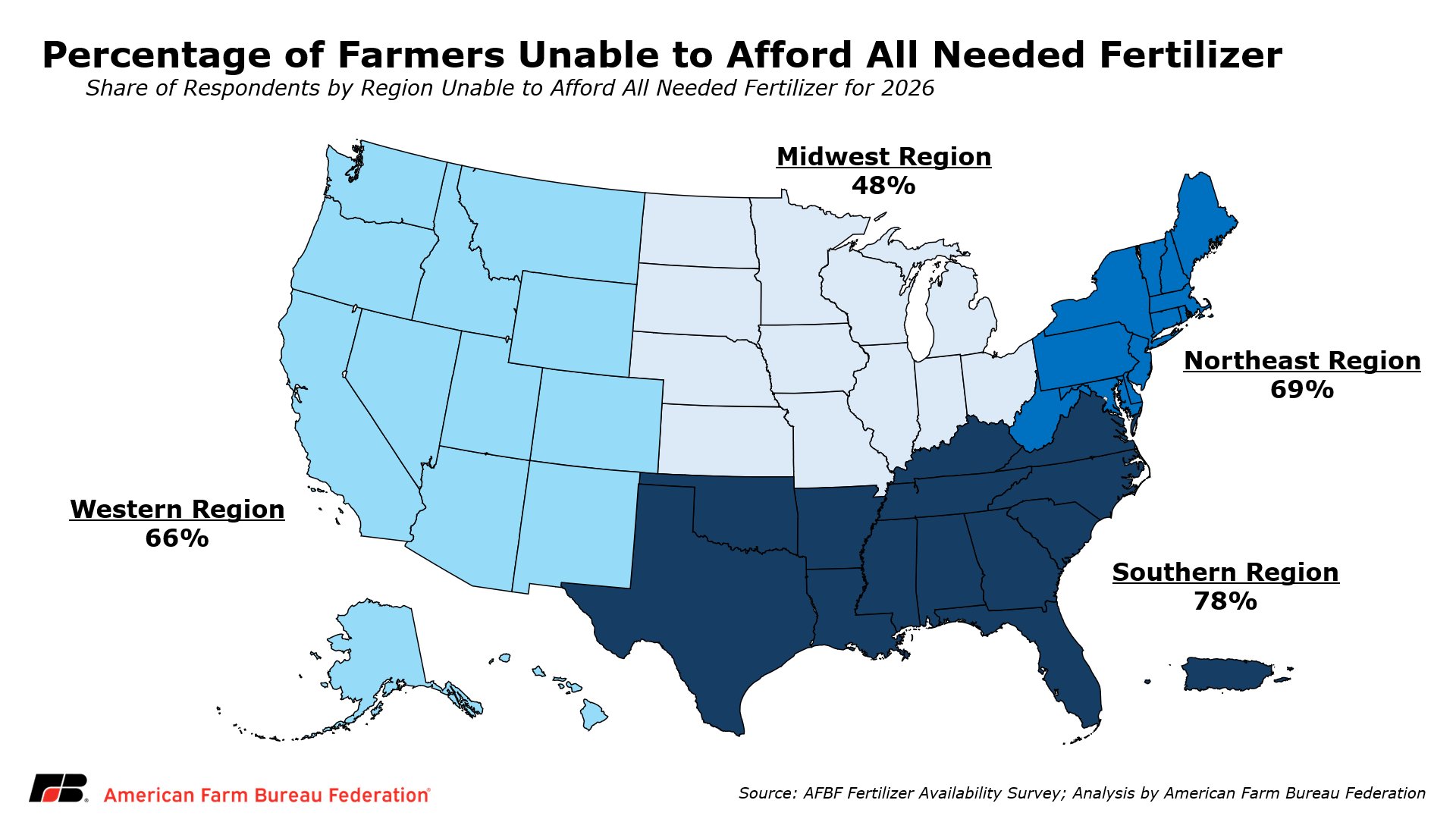
Note that in addition to the war, this is a policy failure at the domestic level. Farmers should be subsidized and prices should be limited to whatever is actually reasonable based on increased non-domestic costs. The first thing you do is make sure your farmers can grow food, because without food, you’ve got nothing, and as Lenin said, every country is three missed meals away from revolution. (It’s actually more than that, but the rhetorical point remains.)
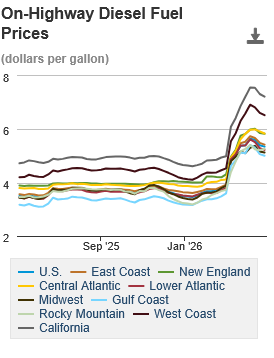 Most farmers use tractors. Most tractors use diesel, and those prices are rising too. They will continue to rise because the oil which is being restricted is the best oil for creating distillates like diesel, bunker fuel (ships) and jet fuel.
In Pakistan we have the following:
Growers have expressed serious concern over the worsening condition of the agriculture sector, stating that it is already on the brink of collapse due to low returns on crops, while continuous increases in diesel and fertilizer prices are delivering a severe blow.
They pointed out that despite urea being locally produced, its prices are rising every other day, which they termed beyond understanding. The growers criticized the government for increasing levies on petroleum products, particularly diesel, allegedly to cover tax shortfalls due to inefficiencies of the Federal Board of Revenue (FBR).
India continues to impress, not only do they have increasing diesel prices, but they’ve increased taxes on diesel to make the problem worse. (This sort of thing is why, no, India is not the next China. China has massive reserves, controls prices when necessary and disallows export when needed.)
Of course, if your country is already in trouble, you’re going to get in the neck:
The new report, From Hormuz to the Frontlines of Hunger, traces how disruption to the Strait of Hormuz and uncertainty around commercial shipping are affecting six crisis-affected countries: Sudan, Somalia, Ethiopia, Pakistan, Myanmar, and Lebanon…
Key findings include:
- Global urea prices, a key fertilizer benchmark, rose 85% between December 2025 and March 2026.
- In Somalia, fuel prices more than doubled, adding pressure on food, transport and water costs.
- In Myanmar, diesel prices rose 160% since the start of the war, affecting irrigation, milling and transport.
- In Sudan, gasoline costs in Khartoum rose 66% in a single week in early April, making moving food delivery to market commercially unviable.
Pakistan is almost certain to have a famine as well. Australian farmers are completely screwed as the country only has two refineries (down from eight 20 years ago because it was cheaper to buy from China, y’know. Too bad China won’t sell to Australia when they’re shortages, which a five year old could have predicted, but hey, max profit is all we are allowed to take into account.)
So far what we’ve seen is mostly higher prices for fuel and fertilizer, though some countries already have shortages. This is the logistics overhang — tankers already full and on route, storage facilities already full, etc, etc… But that’s coming to an end right about NOW. And what will start happening is actual shortages. (Jet fuel is supposedly down to 14 days in the US, though that’s not important for agriculture.)
Rich countries will outbid poor countries, but high prices mean farmer simply can’t afford all the diesel and fertilizer they need. They can’t ship their animals to slaughterhouses, etc, etc.
I’m paying close to $300 a tank to run my truck. And that’s not including gas for farm activity. I have a farm. I can’t haul any livestock ANYWHERE. Neither can my neighbors who have cattle. One of them sold all his cattle and he’s out of the business. I know many farmers who… https://t.co/YTKhP5qqzV
— Jane Says (@CitizenJaneSays) May 2, 2026
The next year is going to be ugly. Even if the war ended today, which can only happen if the US declares victory and lets Iran, in fact, win, it’d be ugly. But if the closure of the Strait continues, multiple countries will have famines and almost everyone is going to have significantly increased food prices, which means a lot of poor people will go hungry and some will die. It’s great Congress has cut food stamps every few years for the past 30 odd years.
If the war does go kinetic again, Iran will destroy vast amounts of oil infrastructure, and the crisis will go on for years.
The only sane response is to end the war, but that would mean de-facto acknowledging Iran is a great power and the US is no longer a global hegemonic power. Oh, and Israel might be more restricted in its ability to mass murder civilians, with their extra special emphasis on children, doctors, nurses, paramedics and firefighters.
What good is life if Israel and America can’t commit war crimes with complete immunity? This would be a complete violation of American and Israeli values, and Trump and Congress just cannot abide the idea that they don’t get to rape, murder and/or torture anyone they want. (Which is why Trump keeps shoving Cuba around. If you can’t bully the big kid, find a small kid to beat the shit out of.)
Anyway, on a personal level, if you can, stock up on shelf-stable staples. Today is the cheapest they’re going to be for at least a couple years.
Everyone reads these article for free, but the site and Ian take money to run. If you value the writing here and can, please subscribe or donate.
cc
Meanwhile Carney foolishly continues to go out of his way to invoke the word “terrorism” for Hezbollah and Iran at every single opportunity he can, but he never once applies the word to Israeli-sponsored settler terrorism: “Settler violence” is the Anglo-Zionist media’s euphemism to white-wash, cover for, and enable Zionist terrorism that has as its political goal the ethnic-cleansing of the indigenous Palestinians.
Meanwhile the US stock market keeps on hitting all-time highs, the US is set to celebrate its 250th anniversary of Independence in eight weeks on the Fourth of July, the White House oligarchs are getting richer, and billion-dollar IPOs are planned for Anthropic and Sam Altman’s OpenAI.
Charles P. Steadman
Jet fuel not important for agriculture?
Crop dusters would like a word. They are almost exclusively turboprop powered these days.
Charles P. Steadman
Let me add this is a well written and thoughtful, if not frightening commentary.
Thank you Mr. Welsh
Bob
Your penultimate paragraph is spot on.
What really is going on, though, that not a single state aside from Iran is in open resistance?
Ian Welsh
Charles,
I didn’t think of crop dusters. I worked on a couple farms as a kid, but they weren’t big enough for that sort of fanciness.
Egoculexegonos
If we add a likely super El Niño in the 2026-27 cycle to the salad we’ll have a nice lunch.
Lately I cannot help thinking on the likes of Nick Land and his variegated crowd of sidekick acolytes.
It’s becoming easier and easier for a bunch of parasites to conveniently kill some millions without consequences.
TacJack
Don’t sugarcoat it Ian, there is a very high probability famine will be visited upon the US.
The question is who will get what from whom?
Carborundum
For the US, fertilizer is more an issue of pricing rather than absolute scarcity. About 90% of their phosphate is produced domestically, along with 80% of their nitrogen. The only one of the big three they don’t mostly produce in-house is potassium and that is overwhelmingly Canadian-supplied. Contextually, the cost/affordability story is probably as much about the fact that input costs generally have remained significantly elevated post-pandemic as it is the acute impact of OP Raging Toddler or whatever they’ve named this strategic clusterfuck.
Statistically, it’s important to note that the measurement unit is farmers – not crop acres. Small farms look to be more affected by this than larger ones; the bigger guys who account for the bulk of the acres, particularly in the midwest where the bulk of the staples action is, are much more likely to have already locked their fertilizer prices in prior to the run up. (Parenthetically, it is weird to me to see that so few American farmers outside the mid-west contract their fertilizer substantially prior to the planting season. We *always* got that locked down early unless there was a good market dynamics reason.) Speciality crops, sourced from areas outside the midwest look substantially more exposed.
I am not optimistic about any of this actually exerting any substantial near-term direct pressure on the US towards ending the conflict. Again, this is one of those situations where everyone else pays the overwhelming majority of the cost while being told what a bunch of free riders we are.
Dan
Ian said “Farmers should be subsidized and prices should be limited.”
But Ian, in the U.S., farmers are already heavily subsidized, and have been for the past 90 years. Further, most U.S. farmers are millionaires — are you sure you want to subsidize millionaires?
Even millionaires have debts and expenses and can go broke, but I see your point that food is vital to a nation’s well being and thus justifies some kind of government intervention. The same could be said for electricity, transportation, schools, water, sewer, health care, libraries, fire departments, and other vital things, and thus we do have various forms of government intervention or ownership of those things with various degrees of success. If you ask me, the type of intervention that works best — take public fire departments, for example — is government ownership and operation. The neolibs hate government ownership and prefer to privatize, hand out vouchers, subsidize insurance, or various other financial incentives, but neoliberal privatization has a crappy track record while many public institutions, while not perfect, work pretty darned well. So why not nationalize farms and food?
The government could own the land and lease it to private farmers. The government could own the fertilizer plants and sell fertilizer to the private farmers at controlled prices. The government could own the seed compaines and sell seed to private farmers at controlled prices. The government could own the meat packing plants, and so on. In general, government ownership and control of things that are monopolistic (land is not exactly a monopoly but they aren’t making any more of it and ownership of farm land is mostly a hereditary aristocracy).
Instead, we have neoliberal subsidies of things like corn for ethanol, and dairies (milk is not vital and not particularly healthy), and destructive subsidized grazing on public lands because millionaire corn farmers and millionaire dairy farmers and millionaire ranchers have a lot of political clout.
Agree with the rest of your essay.
Mark Level
Can anyone in his shambolic mal-administration talk Trump down off a ledge? It seems not. As you note, they are all using the Crisis they created for stock market manipulations and personal plunder. Where are the Dimmiecraps? MIA, twiddling their thumbs, waiting to take power after November (still a long 5 months away!!) assuming Mafia Don won’t cancel elections and declare his Royalist Reich.
Will anything change? We know it won’t, just a different “team” looting, and making sure you don’t get affordable healthcare, the Zionists continue to dominate the slavish goyim in this country and around the world. Here’s a brilliant Gavin Newsom joint when he’s asked about AIPAC: https://www.youtube.com/shorts/OXT9B6ifKxc
I don’t recommend taking a shot of whisky every time he says the word “interesting” as a deflection, you will be shit-faced in under 5 minutes.
I’m going to be a contrarian ‘coz it’s Tuesday, and Mars likes a good argument on his day. I think Ian’s post is overly optimistic, think many will be starving before this year is over, and not just in Africa, Asia and the Global South, either. Australia, perhaps Japan, though they can always try to exterminate the local Whale population, even without diesel, they can do it the 19th century way if insufficient petrol.
The Globalists, not just Bill Gates, have been talking about culling the human herd of the Lessers/ Poors for some time, never skip an opportunity for “creative destruction.” There are many people I have loved and do love, BUT the Nightmare that is history is pushing me to be more like Ambrose “Bitter Bierce” daily. We slightly evolved apes (very slightly) are a disease on the planet. About 1.5 years ago, Ian did a good post on the declines in bird, insect, and many mammal species, frogs, bats, nearly every breed of fauna and lots of flora as well due to pestiforous apes. I say, bring it on, we richly deserve it!! Gotta grow up and face facts as a species at some point, this is drawing nigh. “Walkin’ Spanish Down the Hall,” as Tom Waits sang. We all will in time.
Trump kicked his rural CHUD constituents in the teeth, just as Biden did to “progressive” (few of these in that party, some dumb voter drones though) followers, by dropping the actual Build Back Better false premise with the help of his pals Joe Mansion and Kristin Enema, all the Dimmies including AOC rolled over and went along, that’s the “system.”
Now let’s contradict and look at the positive side: Who will do well? The “evil” Socialist countries generally will do much better, hellscapes like fat lunatic Millei’s Argentina will see mass death and unbelievable misery. The first paragraph with Lenin’s quote, 3 missed meals away from Revolution, does apply though. (Possibly not in US? I simply don’t know.)
Glad I got outta Minnesota. Cold parts of the world will face freezing winters, inadequate pricey heat. cc’s nota bene on Carney is spot on, he’s a Globalist wacko, on par with the Nazi-nostalgic goons Merz and Von Der Leyen (aristo name from hubby.)
This is Capitalism’s biggest crash since 1848 or 1929. Some societies will adapt, slowly, many others will not be allowed to by their Ruling Class. Hit or Miss, a lottery for survival as in Shirley Jackson’s “The Lottery.”
Like mago frequently reminds us, enjoy the beauty, the ups and downs of consciousness while we all still can. In that spirit, here is a link to the Brazilian classic Aguas de Marco, “The Waters of March,” Marco, con c duro, is actually my real name, Hispanicized my name last year, sick of having an ugly Deutsche last name.
https://www.youtube.com/watch?v=E1tOV7y94DY&list=RDE1tOV7y94DY&start_radio=1
Feral Finster
“Jet fuel is supposedly down to 14 days in the US, though that’s not important for agriculture.”
Jet fuel is basically glorified diesel. You can run jet fuel in a diesel engine, and, while diesel is not an ideal jet fuel, you can run it in a jet engine if it is clean.
Feral Finster
Thing is, as long as they continue to feast on steak, bedeck themselves with gold gewgaws and fly their private jets, nobody in the ruling class could give a shit if the poors starve.
marku
Canned food (esp protein like chicken and tuna), beans and rice (complete protein) stored in 5 gallon buckets (with oxygen suppressors in there too )
If I don’t use it, it goes to the food bank before it ages out….
Bought 2 oil changes for the truck (base lube feedstock comes from the gulf)
Also new tires where needed. They will not get cheaper
spud
Dan:
bill clinton practically destroyed small family farms, and left the big corporate ones survive. and if you were small, he told them to get big. why? cash crops for free trade and the deregulation of commodities. that’s what wall street wanted.
i was around and very active at that time. i remember well the demonization of the food surpluses we had at that time. which i knew kept prices stable, and was there in case of need for what ever reason.
once clinton gutted agriculture and deregulated commodities, i watched a wall street parasite announce the end of abundance, and the era of scarcity was upon us.
—–
During Bill Clinton’s presidency, the U.S. experienced a federal budget surplus from fiscal years 1998 to 2001, which was partly attributed to economic growth and increased revenue from various sectors, including agriculture. However, his administration’s agricultural policies, such as cutting support for farmers, were controversial and had significant impacts on rural communities.
Wikipedia National Archives
Agricultural Surplus During Clinton’s Presidency
Economic Context
During Bill Clinton’s presidency, the United States experienced a federal budget surplus from fiscal years 1998 to 2001. This surplus was largely attributed to strong economic growth, which averaged around 4% annually, and increased revenue from various sectors, including agriculture.
Agricultural Policies and Their Impact
Clinton’s administration implemented several agricultural policies that were controversial:
Cuts in Support for Farmers: The administration reduced support for farmers, which was a significant shift from previous policies aimed at protecting rural communities.
Trade Policies: Clinton’s trade agreements aimed to open markets but often led to challenges for domestic farmers. For instance, the reduction of tariffs on imported goods affected local agricultural production.
Controversial Agricultural Policies Policies included cuts in farmer support and trade agreements impacting local agriculture.
While the surplus was a notable achievement, the agricultural policies during Clinton’s presidency had lasting effects on rural communities and farmers, leading to ongoing debates about their effectiveness and consequences.
Wikipedia National Archives
Bill Clinton’s agricultural support cuts led to a significant shift towards a free market system, reducing government intervention in farming decisions. This change aimed to increase efficiency and lower food prices, but it also created challenges for farmers facing market volatility and financial instability.
National Archives Kenyon College
——–
then of course bill clintons so called welfare reform, is why so many are hungry and homeless now. he created a whole generation of women who became prostitutes and meth dealers.
————-
FDR clearly knew it was free trade which caused the depression: FDR imposed protective tariffs immediately to favor agro-industrial recovery on all fronts ending years of rapacious free trade.
https://matthewehret.substack.com/p/how-to-crush-a-bankers-dictatorship
How to Crush a Bankers’ Dictatorship: How the Great Reset of 1933 Was Thwarted by FDR
…
if you want to know why we are in this mess today, it was not carter nor reagan, although those two dimwits started it. its almost all bill clintons disastrous policies. he took us back to the robber baron era.
mago
Crop dusters? Please. I don’t know how much those arial toxin dispensers are still used, but if the lot of them are grounded and the artichoke fields they spray (for example) go fallow everybody wins except the owners thereof.
Let water gobbling almond orchards go thirsty as well. If big ag goes tits up (unlikely) that’s another win in the long run. And oh, yeah, cattle ranching. There’s a cruel and toxic industry that the world is better off without. (I grew up around it and am still surrounded by it, so I have first hand experience.) Maybe it’s going to take global disaster to affect a paradigm shift in food cultivation and distribution.
In the past when fuel costs spiked food distributors put a fuel surcharge on the bill. That wasn’t a cost I could pass on to restaurant customers, but retailers did. As an aside if fine dining establishments bite it and their clientele are reduced to a rice and bean diet, there’s another win.
I try to buy bulk, but one of the problems with a hand to mouth existence is you can’t get a leg up. I do have a stash of grains and oils and some herbs and supplements, but I’m going to be hurting if access to fresh produce and items like miso become scarce or unavailable. And the staples that I do have aren’t going to last long. I’m used to living with scarcity, but something tells me I and countless others are going to be seriously tested by the prevailing insanity. Exponential suffering heading our way. Maybe, just maybe, some positive changes will happen on the other side. In the meantime. . .
I have much more to say about this, but I’ve got to prep for a somewhat elaborate dinner and am running behind. Not enough hours in the day.
Oakchair
The only sane response is to end the war,
—–
Well if your moral ideology is that the poor are useless eaters, wealth is a sign of gods blessing, and population reduction is necessary then the only “sane” response would be to continue the war.
In fact if you were in say a secret ruling class group that discussed how to “get rid of poor people as a whole” this is how you’d do it. Additional marks for being able to scapegoat the entire blame on the Jews and one of your 79 year old members who plays a clown on TV.
spud
Mark Level:
cheap air conditioning made the south and west habitable, that’s going away now as we speak.
whats great about living up north is that the weather helps to make us very creative and innovative. so creative that the midwest was one of the main drivers of GDP growth in america, till bill clinton made us fly over country, and gutted our ability to contribute. he chose wall street instead.
just look at canada, it was ontario and Quebec the main drivers, both quite cold.
Indo-Canadian
I was surprised to read that the Indian government raised taxes on diesel because it earlier lowered the domestic fuel tax and the state-run oil companies have been selling at a loss.
Also, the name “Federal Board of Revenue” sounded odd because India refers to itself as a Union instead of a federation. Indeed, looking it up, India doesn’t have a “Federal Board of Revenue,” but it looks like Pakistan does. The link is also to a Pakistan site. The tax rise sounds like something Pakistan might have done under IMF pressure.
Ian Welsh
Indo-Canadian: thank you. I’m embarassed to have made that mistake and appreciate you catching it. I’ve corrected it.