
Use to discuss topics unrelated to recent posts.
Author: Ian Welsh Page 26 of 448
is ironic in a number of ways.
https://t.co/qJssreVR98 pic.twitter.com/rAxGPLZXqp
— Deeda Weeda aka DMAN 🇵🇸 (@DeemTheDreem) November 27, 2025
As Sun Tzu pointed out about two and a half millenia ago, you should always treat traitors well. Never really trust them, but treat them well, because if people know you don’t, they won’t betray. (And be clear, this man was a traitor to his own country.)
To cap it off it turns out that he was a highly trained murderer. Highly trained murderers with shitty morals (most of them) need to be treated very carefully. Either take care of them well or kill them. At the very least, don’t bring them into your country and then abandon them to a shitty racist society without any support. (Aka. give them a job. There are tons of meaningless well paid government jobs. Give people like this one, plus a nice health care plan.)
Fortunately (or is that unfortunately?) he was in a rage and killed two national guardsmen, who while obviously willing to kill for Empire (like him, but probably less so) had no real power or responsibility for what happened to him. If he’d been thinking straight he would have gone after a politician or admin official. Even easier, a lot of the people responsible for how he was mishandled are no longer elected officials or high admin officers and thus have no real protection.
Seems a bit silly to kill a couple of peons. The people responsible won’t give a damn, they’re just talking points. But if it was one of them?
Not, of course, that I would ever condone extra-judicial murder of people who are responsible for a stupid, hopeless war and thus all the deaths, murders, rapes, torture, starvation and homelessness a stupid, hopeless war entails.
Anyway, treat traitors well, but never trust them. Sun Tzu knew. If I were a member of the elite, I’d be wondering if the next pissed off veteran, foreign born or not, will connect the dots and decide to go after actual responsible parties. Perhaps jobs should be found for them, and health care, just out of self-interest?
Oh, and do note that he did not kill civilians. That makes this act, in at least one way, morally superior to 95% of the decisions made to use violence by elected members of Congress and every administration official of my lifetime.
This site is only viable due to reader donations. If you value it and can, please subscribe or donate.
The misunderstandings packed into this little bit of writing are stupendous:
Over the past few years, China has been in deflation, while the US has been in inflation. Yet despite this stark divergence, the CNH has still depreciated more than 10% against the US dollar. This combination — falling relative prices in China and a weaker currency — has made Chinese goods and services extraordinarily cheap in global terms. A vivid example: a night at the Four Seasons Beijing costs roughly $250, compared with more than $1,160 in New York
First, a 10% drop does not make a hotel room cost one quarter as much in Beijing as in New York. That’s ridiculous on the face. Almost everything costs less in China than in America. America has an economy optimized to drive prices high to extract maximum profit. China has economy with actual competitive markets: if you raise prices someone else will come in underneath you. Almost all of America is operating in or as if it is in an oligopoly. There is little actual price competition because even when there are competitors they figure that competing on price is stupid: it hurts both of them. Why not both raise prices to usurious heights? Win/Win.
This doesn’t happen in China because it has competitive markets and it has competitive markets in large part because China will throw executives in prison or execute them if they engage in this sort of price collusion, whereas in the US, though ostensibly illegal based on the laws on the book, such collusion has been made legal by decades of court decisions and prosecutorial decisions. (Prosecutors mostly don’t, and when they do courts almost always refuse to convict.)
China also has lots and lots of firms and genuine low barriers to entry. If you try to collude, someone from outside your industry will enter and undercut you, and often this will be someone with deep enough pockets that you can’t win a price war with them.
Second, currency values outside of hyperinflation are driven primarily by demand for currency. That isn’t primarily about trade, it’s about investors and financial carry trade. China unquestionably has a more dynamic and larger economy than any Western nation, but it isn’t financialized: Chinese companies don’t produce the sort of returns that American companies have over the last 50 years. This is deliberate policy: if they did, then China’s economy would suck for ordinary people, like Western economies suck for ordinary people because prices would be much higher. (See that Hilton room, though it cascades thru the entire economy, with rent and food at the low end much cheaper in China too.)
It is also pretty hard to invest in China as a foreigner, while the US is set up for foreign investors. Even if you want “China exposure” it’s hard to get.
So the Yuan isn’t in massive demand, because there aren’t bullshit over-sized returns like the AI bubble. The central bank doesn’t run its policies based on “the stock market must always go up.” America has spent 50 years burning down its real economy to produce outsize “profits” due to asset pumping. China keeps asset prices under control, and when a bubble does occur, as it did in real-estate, they deliberately deflate it, bearing the cost.
None of this is particularly unique, by the way. It’s basically the way the US economy was mostly run from the 30s thru the mid 70s or so. The policy details, the ways things are done are different, but American policies were meant to encourage real economic growth and if you look at a stock market graph you’ll see it traded sideways. No 50 year bull market. Asset bubbles were discouraged. You can’t have a good economy with high real-estate prices, just can’t be done and the stock market is a secondary market, not a primary one. Emphasizing it is sheerest insanity.
There is very little that China has done which is genuinely unique, despite jingoistic assertions otherwise. The playbook they have run is the same one almost every successful industrializing nation after Britain used, and very similar to the Japanese model. What is different are two things. First, the scale, when 1.4 billion people industrialize and modernize, it shakes the world. Second, a genuine desire to help the poor, which is extremely rare during industrialization, though not unheard of. (The Gilded Age did not care about the poor. Britain’s industrialization period was driven by hurting the poor as much, or more, than they could bear. They were far better off as peasants than in factories.)
Anyway, countries can be real rich (lots of genuine productive capacity with low prices and dynamic markets) or they can be fake-rich, with financialized markets that squeeze the last penny out of consumers and immiserate workers, leading to non-competitive markets and oligarchy. China is rich. America is fake-rich.
This site is only viable due to reader donations. If you value it and can, please subscribe or donate.
The simplest measure of a government’s legitimacy is whether or not it works for the benefit of the people. Democrats also believe the government should be selected by the people.
America does not meet either criterion at this time. Yes, there are elections, but the duopoly means that voters tend to choose from a small slate, pre-selected by others. The most visible occasion of this was when Obama had every Democratic presidential nominee candidate drop out so that Biden could defeat Bernie Sanders. Year in, year out, most of the candidates put up for election are those chosen by party insiders.
This is not always true, of course. It is less true on the Republican side, where primarying incumbents often works and where a vocal but grassroots minority does have significant power in choosing candidates. On the Democratic side it’s mostly true, but some candidates do slip thru: Mamdani for New York City mayor being the most recent example.
Still, overall, it’s questionable that Americans really choose their own government, and that’s true in most Western countries. In Romania, for example, the unacceptable candidate who was going to win was simply arrested and banned from running and there is a movement to make Germany’s AfD illegal. In Canada the party leaders simply refuse to allow pro-Palestine candidates, even those who are selected as candidate by their riding, to run.
The more accurate view is that political parties in most ostensibly democratic countries are political oligarchies. How much this is true varies. First past the post system tend to have very strong oligopolies, while proportional representation countries allow more flexibility.
Perhaps worse when outsider candidates do break thru and win they usually don’t wind up voting for and doing what they ran on. You can see this (though it’s a bit of a stretch to call him an outsider) with Trump. It’s visible with AOC, the darling of the left who has voted for almost all Israeli aid packages and who has clearly decided to become an insider.
So first there’s a huge barrier to electing people who support outsider views, then most of them are co-opted. If there’s a real threat of an outsider taking the top seat, the establishment works hard against them. We saw that with Corbyn, where one academic study found that about 80% of all news stories lied about his policies.
It’s fair to say that most Western countries don’t really have “government by the people.” The mechanisms still, partially, exist. The form is there, but the reality isn’t. They’re political oligarchies. (The EU is worse than the US.)
And we all know that most Western governments aren’t “for the people.” For fifty years they’ve been immiserating their own people, becoming rich themselves and forcing money upwards, creating a financial oligopoly on top of the political oligopoly. I often say that for most Westerners their most dangerous enemies are their own politicians. Putin isn’t a danger to you as a EU member or America. But Macron or Von Der Leyen are. They’re the ones destroying your standard of living and piecemeal destroying social supports. This is even more the case in Britain, where there hasn’t been a Prime Minister whose primary legacy wasn’t hurting most Britons since the 70s. (Well, maybe Tony Blair had that as his secondary goal, his primary goal being hurting Iraqis to toady to America.)
Great systems are judged by their great opponents. For much of the 20th century that was the USSR and it is not entirely a coincidence that when the USSR was strong, Western governments treated their people well. Of course that isn’t all there is to it, there were the oil shocks, Vietnam, etc… But the West was ideologically scared of communism and when it seemed to work, they felt they had to make capitalism work.
These days the great opponent is China, and the one party communist state running a hybrid capitalist/socialist economy. And the problem for the West is that China’s government, while not “by the people” is definitely “for the people”. They’ve brought more people out of poverty than anyone else ever has. They keep rent and housing and health care prices low, as deliberate policy. Incomes are lower than in the West, but costs are much lower. You can buy enough food to feed someone for a week for $50 in most of China, with ease.
They also create the future: high speed trains, for example. They build real public infrastructure. I was very impressed when they built rest and relaxation places for delivery workers: they cared that such workers were miserable and exploited. And they build things like this:
In the US, rich people enjoy beautiful infrastructure.
In China, amazing things are open to everyone, even the poorest of the society.
That’s capitalism versus socialism.
A park in Chengdu. pic.twitter.com/D4NkHKqcLC
— S.L. Kanthan (@Kanthan2030) October 31, 2025
Now it’s fair to say that this isn’t precisely “socialism” vs. “capitalism”. There was a time when the West built lots of public parks and so on. It’s the difference between a real rich society and a financialized society. One has plenty of excess capacity, the other has plenty of money but very little actual ability to build and create and no desire to do so if someone can’t make an unfair profit from it.
The problem for the West is simple: China is better governed than almost any (perhaps actually any) Western country. And that governance shows plenty of signs of being in the interests of the vast majority of Chinese, whose lives it has vastly improved. Democracy itself is in danger. If it doesn’t produce better results for ordinary people, and if it’s basically fake anyway, why keep it?
The risk here is that the anti-democratic forces in the West aren’t the CPC, they’re billionaires who think the problem with the current government is that it still does some things for ordinary people which aren’t primarily about benefiting billionaires. They’re fascists, at best.
Democracy, if it wants to survive as a major force in the world, needs real reform (all so-called reforms in the West over the past 50 years have been about hurting ordinary people to benefit rich people). If it isn’t re-aligned to work for the majority, its day as a major force in the world faces a bloody sunset.
This site is only viable due to reader donations. If you value it and can, please subscribe or donate.
One of the predictions I made many years ago was that Long Covid would slowly cripple workforces. Covid still exists, and that we deliberately don’t try to count cases any more doesn’t change that.
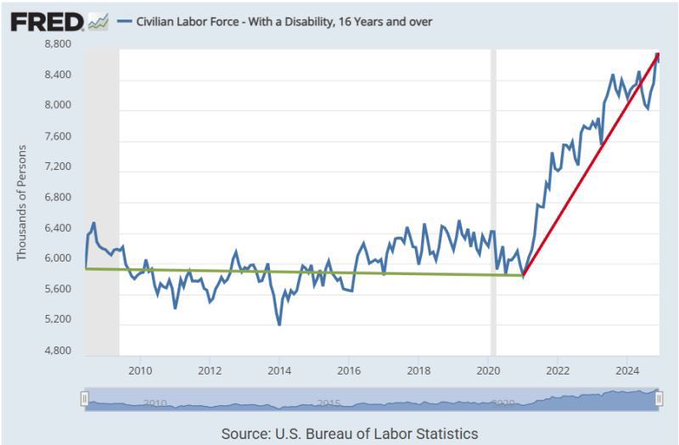 This is typical of our handling of all problems. We just pretend they don’t exist and won’t have serious consequences if we ignore them. While China is somewhat better, with their hard push on clean tech, their willingness to deflate housing prices and their policies reducing the number of billionaires, they too have ignored Covid.
Ironically this is because the Chinese government IS quite sensitive to public opinion. Zero Covid was the right policy, but it was done stupidly and as a result huge demonstrations occurred and the CPC backed down.
Shutdowns made sense in the early days of Covid. This is public health 101 during a pandemic. But as with everyone else the Chinese did them too late and too long.
The actual solution is the one we used for water borne diseases. We cleaned up the water, and we have to clean up the air. All public buildings and all apartment buildings and condos need filters and UV to clean the air. It’s a huge project, to be sure, but it’s more than doable, for less than we are spending on the insane AI data center push. The result would be a lot less Covid, less disabling and at the same time less flu, colds and other airborne diseases.
It’s simple. We have the technology, and we aren’t doing it. Insanity. Not even in most hospitals. Emergency protocols like masks and isolation make sense, but they are emergency protocols and not for long term use. Find out the vector and find a long term solution to the vector.
This solution was understood as early as 2021. Many voices were raised. Nothing was done.
Our predecessors did what they could. If you remember the old steam and hot water heating systems, you know they usually ran too hot so that people had to open windows to cool down, even in the middle of winter. This was deliberate, the designers wanted those windows open to increase ventilation, because they knew the great post-World War I flu pandemic had been airborne.
We have better tech, and better solutions and we’re just sitting on our thumbs and rotating.
Pathetic.
This site is only viable due to reader donations. If you value it and can, please subscribe or donate.
Normally I ignore the style of government rhetoric and concentrate on the substance. But the Trump administration is so pathetically juvenile it beggars belief:
Womp womp, cry all you want. These criminal illegal aliens aren’t getting released.
Like clockwork, violent rioters have arrived at the Broadview ICE facility to demand the release of some of the worst human beings on planet earth.
Get a job you imbecilic morons. pic.twitter.com/k4HdE5IqNu
— Homeland Security (@DHSgov) November 14, 2025
I mean, what? This sounds like something from a schoolyard. Womp, womp? Imbecilic morons?
Of course, the fish rots from the head:
“If there’s nothing incriminating in the files, sir, why not—” Lucey began to say as the president took questions aboard Air Force One.
Before she could finish, however, Trump pointed his finger at her and barked, “Quiet! Quiet, piggy.”
…
“This reporter behaved in an inappropriate and unprofessional way toward her colleagues on the plane. If you’re going to give it, you have to be able to take,” a White House official told the Daily Beast.
There was, of course, nothing inappropriate or unprofessional about Lucey’s question.
America is ruled by stupid, foolish children. Almost everything Trump has done has backfired, harming America’s economy and position in the world. And he’s scared, as he should be, because he was Epstein’s best friend for years, and there’s no way he didn’t know what was going on. Nor is the man who leered at Teen USA contestants and grabbed women by the pussy (his words) likely to have not partaken in Epstein’s wares.
Trump was always, obviously, a sexual predator, a rapist and scum. Unlike other scum he’s barely even tried to conceal it. People voted for him because he didn’t sound like a normal politician (which is good) but were fools, because what he sounded like was a profoundly stupid, greedy and selfish man without an iota of concern for other people who enjoyed belittling and hurting them.
It is both profoundly sad and amusing to watch him hurt those who voted for him, like farmers, the most. And costs keep soaring:
Stop voting for obvious frauds, politicians suffering from dementia, and those who get off on hurting other people. “Different” isn’t enough, it has to be different in the sense of “actually wants to help people.” I have sympathy, but complete disdain for anyone who thought Trump would be good for ordinary Americans “like them.” He has governed exactly like one would expect: vastly corrupt, cruel and almost entirely to the benefit of other billionaires.
Democracy works when, at the least, ordinary people vote their own interests. Americans, and most Westerners, seem entirely incapable of doing so. (And yes, there were other options. Stop whining about how third parties can’t win, and stop voting for the duopoly. For the slow of wit, Biden was also human garbage.)
Pathetic
This site is only viable due to reader donations. If you value it and can, please subscribe or donate.
 For a long time after the Industrial Revolution, many thinkers believed that automation would lead to us living lives of leisure. Twenty hour work weeks, or even less, and many people wouldn’t need to work at all, but would still live good lives.
It never happened.
Economists will tell you this is because there’s always more work to be done, but economists are the priesthood of capitalism, not scientists, not even social scientists.
Most of us are well aware that many jobs are, in David Graeber’s memorable phrase, bullshit jobs. They either don’t really need to be done or are actively harmful. Everyone working in private equity. All the engineers optimizing ads. Almost everyone who works on Wall Street or in shadow banking. Most bankers, for that matter. The jobs which are actually necessary, “essential workers”, are badly paid and treated, but if they don’t show up, as we find out in a garbage, nurse, transit or teamster strike, disaster ensues.
If the janitors don’t show up, everyone’s in shit. If the CEO doesn’t show up, life continues and most people don’t care. Indeed, without CEOs most companies would run better than they do, and you’d be in a lot less danger of losing your job.
We could easily work 20 hour weeks already, if that was a priority.
But the structure of capitalism makes this impossible. We create goods which are designed to wear out quickly and be replaced. “Planned Obsolesence.” We need people to have jobs to get money to buy these shoddy goods. We buy fast food crap because we’re too busy, rather than cooking good food, and most people spend their lives doing work they’d never do if they didn’t need money to survive.
So we find more bullshit jobs, and more harmful jobs for people, and the machine churns on, destroying the environment, making people sick and unhappy and forcing us into wage slavery. Most people spend most of their waking hours doing what they’re told. Or else. Then when you’re old, you might be allowed to retire, and enjoy your declining health. Might.
We have more houses than we need, far more than the number of homeless. America throws out one-third of its food, yet people go hungry. There’s more than enough, literally more than enough food for everyone in the world to have a full and healthy diet.
Perhaps they will, I hope so. To do so, however, they will have to move away from capitalism towards true communism, where everyone shares in the benefits of automation, and not just a few.
There is no reason why this isn’t possible. It could have been done any time in the last century or so, had we wished to.
Remember this: you work like a dog, obey some manager’s orders and don’t do what you really want to do because our system, and our leaders require it when it isn’t actually necessary.
Capitalism might (or might not) have been necessary for industrialization. But it is a set of leg irons weighing all of us down now, and threatening to destroy the very conditions required for life to continue on Earth.
But it doesn’t have to be that way, and the task of the next generation of leadership is to figure out how to run modern societies without it, without wasteful over-consumption and without destroying the environment, while making sure everyone has what they need and can live fulfilling lives: lives they choose, where most of their time is their own to do with as they would, not as some boss desires.
May it be so. The other options are far, far worse, likely catastrophically so.
This site is only viable due to reader donations. If you value it and can, please subscribe or donate.