The horizon is not so far as we can see, but as far as we can imagine

Category: Miscellaney Page 1 of 14

Starfleet Academy’s Gay Klingon Could’ve Been Epic

~by Sean Paul Kelley

Forewarned: this is culture war stuff. So, if you trigger easily: don’t read this. Then again, you’ll be missing out on some excellent counterintuitive culture war rabble-rousing.

I guess I ought to declare right here and now before I get trounced for being an out of touch GenXer neobigot. So, say it with me, loud and clear: I’m for every human on this planet being treated with the innate dignity they possess and deserve and that they not be denied the rights their ancestors fought so hard for. Rights are not entitlements, they are earned. And much of humanity has, in the past, earned them and passed them down. They should not be denied to anyone.

Now that my virtue signaling is out of the way I can move on to some cultural war criticism.

First, why must a gay man be portrayed as simpering and overly sensitive? Why does this portrayal as queens persist in pretty much all visual media? And FFS, folks, don’t get all sensitive, I’m going somewhere awesome with this.

Why not portray a gay man very much in touch with his masculinity? Need a few historical examples of powerful, masculine gay men that changed the world?

Easy-peasy. First, Alexander the Great and his lover Hephastion. If you disagree, because Iskander has to be a man’s man, well, fuck off. It’s historically inaccurate to believe otherwise. Seriously, the Greeks buggered each other left and right and all were married. Then there is the Prussian King, Frederick the Great, who out maneuvered the armies of Maria “Always Weeping, always Annexing” Theresa of Austria at almost every turn? Both men were as gay as Freddy Mercury, and both were indomitable warriors and strategic geniuses par excellence.

So, when Starfleet Academy wrote in a gay Klingon, I confess, my interest was piqued. The Kurtzman era franchise had a chance to change in a new powerfully positive way. But, the show-runners took the easier, softer way.

For real, they just turned down the wrong alleyway.

See, fiction has rules. You create species or characters and portray them a certain ways; they have to obey their own rules of internal logic. That way the reader or viewer knows what to expect. When a character or species acts contrary to canon, the reader and the viewer are not only confused but lose interest. So, what happened with the gay Klingon?

Let’s discuss Klingons in general first, okay?

Klingons, in case you don’t know, are fierce warriors, poets, singers and deeply, deeply romantic. Klingons are the antithesis of brooding self-actualized pansies, looking for closure or healing. They love killing almost as much as they love dying. “It is a good day to die,” is their constant refrain. And bloodwine? They make the Russians look like pikers when it comes to imbibing alcohol. So, would it not make sense that a gay Klingon ought to have been written in character? To write a gay Klingon any other way than as an awesome bad-ass killing, drinking and fucking machine is to fundamentally misunderstand Klingons and their crucial role in the Star Trek canon.

Let’s take Worf, from TNG and Deep Space 9, as an example. If Worf wanted to fuck another male Klingon, Worf’s idea of foreplay would have been sparring with bat’leths, followed by bending his paramour over a barrel of blood wine, blowing his load, screaming a blood-curdling Klingon scream and then a blood-wine toast, ending with a little spooning and a love poem.

You know I am right.

A gay Klingon could have been immortal. A gay Klingon had the potential to be Star Trek’s equivalent of a honey badger: he don’t give a fuck. A gay Klingon Dahar master? Dip me in a vat of melted cellophane!

Kurtzman and crew had the chance to create an immortal, utterly amazing Klingon in the mold of Alexander the Great or Frederick of Prussia. Instead they opted to tick off the wokester checklist with an absolutely pathetic, weepy, whingy, sniveling crybaby of a Klingon

What a waste.

The Kurtzman iteration of Star Trek has been nothing but failure after failure to understand what Star Trek was. It was never, ever true to Gene Roddenberry’s vision.

The franchise needs a fifteen year rest.

I’ll be ready for a do over in my late sixties. Get it fucking right next time.

What Constitutes A Successful Life?

I never fully bought into the consensus ideas of what constitutes a successful life. Money, power, 2.3 kids, a house in the burbs.

I was an only child and I spent a lot of time around adults as a kid, especially before my teens. Most of them were spending their lives doing things they wouldn’t have done if they didn’t need money, and most of them didn’t seem happy—in some cases happy about their work, in other cases happy about their lives.

I grew up, went to work because I had to eat and keep a roof over my head and heat on in Canadian winters, and I didn’t find much to recommend itself in most jobs. Half the time the work didn’t need to be done, the rest of the time it did need to be done, but we were stopped from doing it properly due to management wanting to increase profits, and often what they did would only increase profits in the short run and hurt them in the long run while alienating customers and employees.

I could have respected my job in life insurance if we’d actually been looking out for those we insured more. There were a few old school underwriters left who did, and I could see my employer had once been run honorably, but by the time I got there all that remained were a few guttering embers. A lot of people got rich under the new regime, but long term profitability went down. (Doing good isn’t always stupid even in terms of greed.)

But the bottom line really was “would I do this if I didn’t need the money?” The only jobs I ever had where that was somewhat true were being the managing editor at FireDogLake and the Agonist, and writing this blog, though even in those three cases I’d have done less if I didn’t need the money.

“I worked all my life and most of it I would never have done if I didn’t want or need more money” doesn’t seem like success to me. (I’m talking only for myself. If it does to you, great. There’s certainly honor in providing for one’s family even in a job one hates, for example.)

There’s a lot of chatter about falling fertility rates and lots of pro-family propaganda these days. I’m not anti-family or pro-family, both stances seem absurd to me. I’m pro-good families and anti-bad families and I’ve sure seen plenty of people have children who fucked their kids up beyond belief and none of them seemed happy in their family life. “I produced 2.3 fucked up kids and was miserable almost all the time” doesn’t smell like success to me. Again, talking only for myself. If it does for you, awesome.

Then there’s power. It seems, in the West, that almost everyone who has power does more evil than good. Corporate or political, this is true. I’m hard pressed to think that “I became President of the US and bombed five countries and killed a million people and made another 5 million homeless in an unnecessary war justified by lies” is success. Or it’s not any success I want and if it’s a success you want, you’re human filth.

Of course, the power is a Western issue (and Africa and a lot of other places, but especially the West in this time period). I have issues with Xi, but I think he can legitimately claim that he uses his power more for good, especially for the Chinese, than evil. FDR could have said something similar. But right now power in the West is poison. Even people like Bernie Sanders and AOC have voted to send Israel weapons while they commit genocide.

I do think that getting power and then doing more good with it than harm is admirable and a life worth living. So I guess there’s that.

But in the end we all share the same fate: death. All the money, all the power, all the wealth, even our families will be lost. I’ve been close to death more than once, a whisper away, and I live my life in the knowledge that everything I have here, in this life, I will one day lose. Perhaps my knowledge is an exception, perhaps I will be reunited with people I love at some point. Perhaps. But for sure the money and power and possessions are all lost.

I don’t have any real answers. I’ve tried, personally, to live a life where I spend as much of my time doing what I want to do as possible, and not what someone else wants me to do. I’ve tried, not always successfully, not to hurt people except to protect others from them and to be kind, because life is often shit and I don’t like it when others make life worse for me and do like it when people are kind to me. I’ve tried to speak the truth as best I can, hoping that the truth is something good. Obviously I’ve failed at times, truth being a slippery thing.

I don’t view myself as successful or as a failure (though I certainly thought of myself as a failure for years). Just as someone stumbling around, trying to live a life I like more than I hate and to not do more harm than good. If I die and can look back and think “yeah, I more or less enjoyed a lot of that and helped more people than I hurt” then I’ll consider my life a success no matter the scale or the stage.

But thank God I never bought fully into what society considers success. The idea of being Obama or Trump or Musk or Zuckerberg or most executives I’ve ever met is nauseating.

We just spent a couple thousand getting the site and email subscriptions working properly. If you value this site and can, please subscribe or donate.

Apologies For The Non-Existent Posting

By Sean Paul Kelley

Folks I’m sorry I haven’t posted in a while. Not that I need to explain, but I value the community here and wanted to offer up what’s been happening with me.

For several months now I have been battling a severely low resting heart rate (low 30s to mid 40s) and there is some light at the end of the tunnel,  so says my cardiologist; we are exploring options. The good news is I have been an athlete most of my life. Ran a few marathons, for twenty years I ran close to 30 miles a week. So, my normal resting heart rate at age 55–gods aging does sucketh–is usually in the mid-60s to low 70s. As we all know you only get so many heartbeats in life. So, the fewer the better. That’s the good news.

But, a resting heart rate in the low 30s can cause fainting spells when one makes to fast a move. As an heretofore active person–I mean I walk at almost twice the speed of everyone else, naturally, I have to be careful.

As you all know I dislocated my shoulder a few weeks ago. The reason behind the fall was I was acting like a teenager bouncing down the stairs. Fortunately I began to faint when I only had four or five steps left to go, so instead of falling down the whole rack and breaking my neck, well, we all know what happened. Tangentially, when those guys in the movies who dislocate a shoulder then smash it back into place against a wall and then go on back to their kicking ass spree is pure horseshit.

Anyway, the upshot is this: when my heart rate is very low I am very tired and inactive. Today it’s in the 60s. But y’all will just have to bear with me for the time being. I have no way of knowing when this will go away.

On that note: please, please, support this site, subscribe or donate. We’re about $1,800 from our goal of $12,500. 

A Brief Taxonomy Of Corruption

I was discussing Indian corruption with Sean-Paul the other day, and we had to really break down what we meant by corruption. That lead to a simple classification system, so I’m sharing it with it.

Everyday vs. Elite Corruption

Do you bribe the policeman or the minor bureaucrat to get a permit. Do you grease everyone with even a tiny bit of to get what you want, and it is it expected? Is it essentially required, in the sense that if you don’t consequences are nasty: arrest or or dential, Or at best, whatever you needed done taking forever and being shoddily done.

This is everyday corruption. India is rife with it. America, mostly, doesn’t have it. Russia used to have it, but I’m told by Sean-Paul, that at least in Moscow, it’s now gone.

Elite corruption is when the elites are self-greasing. Whenever anything is done, it is done in a way where somebody rich can take a cut. Contracting to build new infrastructure is where the contracts are inflated is the standard, but there are tons of variations. Most Western nations have this. The US or the UK is probably the worst among major countries. But it exists in Russia and (though much less than before) in China.

Honest vs. Dishonest Corruption

In honest corruption you get what you pay for. In everyday corruption your visa gets stamped, your parking ticket disappears, you get the permit you needed, or city workers show up and connect your new place to power, water and sewage. At the elite level, if if a bridge, or hospital or park or space program was promised, it is delivered on time and on budget. It’s just that the budget includes 10% grease. Some other games may be played. If you know where new facilities will be built you could, say, buy up property that will soon increase in price, then sell once it does.

But bottom line, what is delivered at the end is delivered on time or with minor delays and it works. It’s not shoddy. China during most of the Deng period had a lot of honest elite corruption. Everyone was taking a cut. But they bloody well had to deliver and if they didn’t, they lost their place at the elite table and might even end up in prison or executed. American in the late 19th and early 290th century mostly had honest corruption. Tammany Hall was corrupt, but they also kept their promises. The great railroads and bridges and parks got built, and were generally built well and on time.

Dishonest Corruption Is when you whoever is corrupt doesn’t have to deliver. You pay off the cop and he throws you in jail anyway. You bribe the bureaucrat and he still drags his feet getting you approval, if you get it at all. The first payment is never the last payment, the idea is to drain you of as much as possible.

At the elite level dishonest corruption is that the street or building was promised and funded but somehow either never gets finished or takes twice as long and three times as much and then, once done, it usually turns out to be shoddily built. A new program for veterans/homeless/cancer/whatever is promised, but somehow it’s slow and ineffective and doesn’t do much, but a few people make a lot of money off of it. Promises mean nothing, nothing is delivered on time and what little is delivered is of crap quality. Meanwhile insider trading is everywhere, taxes always go down on the rich and up on the poor and middle class and programs which used to work are slowly degraded into uselessness so that someone can make more money.

This is the US or the UK and Canada and indeed all neoliberal countries. It’s actually more or less the definition of neoliberalism. Effectiveness is nothing and efficiency is really only about how efficient something is at funneling money to the rich. It is also India, which is why India is, despite some progress, still screwed. It’s run by criminals from top to bottom. Ironically, in my experience (which is out of date, I’m happy to be corrected) low level Indian corruption is “honest’ in that you get what you pay for. High level Indian corruption is dishonest as hell. No big project ever works properly, comes in on time and is effective. (This is why I’m still negative on India.)

There’s also a middle corruption, slice for everyone. This is where everyone involved in the project gets some. So the workers get some, the managers get some, and the contractors gets some. Everyone is being greased. This doesn’t mean just having a job, it means being paid better and treated better than at a non corrupt job.

The honest and dishonest versions are as normal. Honest “slice for everyone” corruption still delivers what was promised at reasonable quality. Dishonest “slice fore everyone” doesn’t deliver or delivers absolute crap.

Obviously no corruption is best, but equally obviously honest corruption is better. If you have to have any corruption, then honest elite corruption or honest slice for everyone corruption is best. Low level corruption is always bad, since it means “if you don’t have money, you’re never treated fairly and you can’t break out of the bottom” but if you must have it honest is better than dishonest.

Growing up a lot in what was then called the third world, then observing politics for years all of this has been well known by me, but I never really broke it down properly, it was pretty much “implicit knowledge” as much that we learn young is.

For your reading displeasure.

***

If you’ve read this far, and you read a lot of this site’s articles, you might wish to Subscribe or donate. The site has over over 3,500 posts, and the site, and Ian, take money to run.

I Mean, It Is Theoretically Possible That Epstein Committed Suicide

Wired:

Footage tied to Jeffrey Epstein’s death in federal custody appears to have been altered before it was shared with the public—despite being presented as unedited surveillance video—according to a joint investigation by WIRED and multiple independent video forensics experts.

Here’s what the analysis uncovered:

Hidden metadata embedded in the video file revealed that the footage wasn’t a direct export from the prison’s internal surveillance system. Instead, the file had been processed—apparently using Adobe Premiere Pro, a professional-grade video editing program. Evidence suggests it was stitched together from at least two separate clips, saved multiple times, and exported before being posted on the Department of Justice’s website as if it were “raw” footage.

But you’d have to be really stupid to think it’s the most likely possibility.

So, there are no Epstein files, Ghislaine was not involved in pimping underaged girls and it’s all just a big nothing. Good to know.

The Horror of School

Back during the pandemic, two things happened with students. Overall, they committed more suicides, BUT when schools were closed, suicide rates went down. (I predicted the latter at the time.)

Then there’s this lovely chart:

Well, well, well. Seems forcing people to do what they don’t want to do, in what is usually a socially oppressive environment, is bad for them.

There are, of course, those who thrive in school, and love it — usually the socially dominant kids. But for a lot of kids, school is Hell.

I think this has a lot to do with alignment of goals. I wrote recently about the epidemic of AI cheating and how to avoid it, but I think the smartest commentary I’ve seen on AI cheating, and cheating in general, is this one:

Has anyone stopped to ask WHY students cheat? Would a buddhist monk “cheat” at meditation? Would an artist “cheat” at painting? No. When process and outcomes are aligned, there’s no incentive to cheat. So what’s happening differently at colleges?

Back in the stone age, I took an introductory sociology class. The professor asked the students who were intending to be teachers to put up their hands. A forest. She told them to keep their hands up, and asked everyone who was planning on social work to put up their hands.

Out of a class of about a hundred and fifty, only three people’s hands weren’t up.

147 students weren’t taking sociology because they were interested in it, but because it was a way-station on the way to a goal.

The problem with “higher” education is that good jobs are locked by the requirement for degrees. The vast majority of students aren’t in university because they want to learn, they’re there because they need the credential. They don’t see the applicability of what they’re learning to their future jobs, in most cases correctly, so they just want to get through the courses with the least effort possible while getting the necessary grades.

Of course, they cheat. They’re being forced to waste three or four years and huge amounts of money on a chance of getting past the gatekeepers.

I used to amuse myself by talking to graduates. I’d ask them what their major was, then discuss it with them. Nine times out of ten, I knew more about the subject than they did, even though I’d never taken a single course in the topic at hand. They’d memorized enough to pass the tests, then immediately forgot it, because it had no relevance to their goals or their life.

The only case for requiring a bachelors degree, in a job that doesn’t use the knowledge taught by that course, is that it screens out people who won’t put up with bullshit and who won’t do what their told when it doesn’t align with their goals. A B.A. certifies to potential employers that, “this person will do what they’re told and put up with your bullshit. They barely need to be coerced, they do what is expected of them.”

Problems is, it also certifies that, “they will put in as little effort in the job as they can, unless it serves them to do otherwise.”

If it were up to me, I’d make it illegal to require unrelated educational credentials. Want to hire an engineer (an actual engineer, not a programmer)? Fine, ask for a degree. But if it’s just some unrelated job, no.

But I’d go even further, I’d mandate exams to test for job knowledge. (In person, supervised) similar to how a lot of companies test programmers. “Can you actually make a small program?”

Testing for jobs used to be pretty standard. Almost all civil service jobs were gated behind exams and so were a lot of private sector ones.

Then see how they perform for a few months.

Forcing people to do what they don’t want to do is sometimes necessary, to be sure. But it has to make sense. There’s plenty of evidence that good home-schooling teaches students skills faster than classroom teaching (and no, not all  home schooling is right wing nutjobs, where I grew up it was hippies.) As for socialization, there are other ways to socialize children, most of which are probably more pleasant and less harmful than the often hellish social circumstances in schools, especially high schools.

As for spending time with adults, well, that’s what children did for most of history. They weren’t stuck just with kids for most of the day, then just their parents. After all, you’re a kid for a lot less longer than you’re an adult, and it’s the adult world you need to know how to navigate.

I’m not saying mass schooling has or had no benefits. It obviously does and did. But can we find a better way to teach children?

This blog has always been free to read, but it isn’t free to produce. If you’d like to support my writing, I’d appreciate it. You can donate or subscribe by clicking on this link.

Well That Was Hell: 2024 In Review

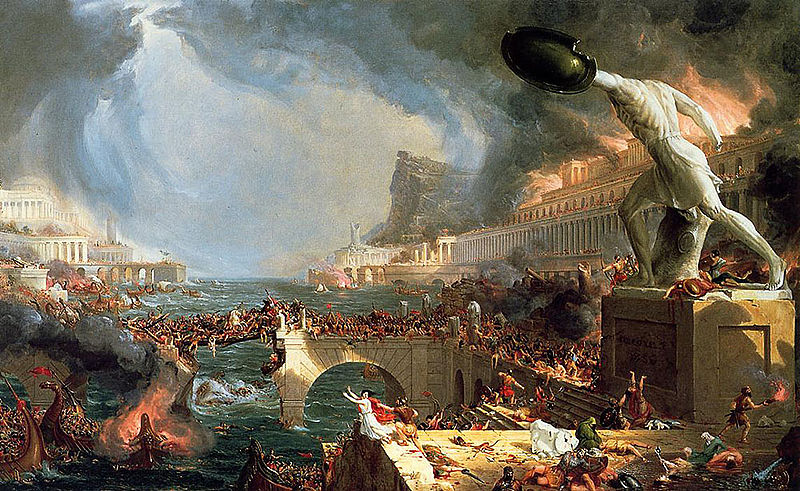
The Course of Empire by Thomas Cole

The Course of Empire by Thomas Cole

Not the best of all years. Annus Horriblus.

Gaza: Genocide continues and seems likely to be successful. I’d guess the actual casualties are somewhere north of 700K at this point, they sure aren’t anywhere close to the official numbers.  Never again meant nothing.

Hezbollah: Held the Israelis off on the ground, but were devastated by Mossad assassinations and terrorism (the cell phone attack) plus a bombing campaign against civilians they were unwilling to endure. Some signs the war may start up again after the 60 day ceasefire, but without air defense, I don’t think they have it in them to tough it out. Could be wrong.

Syria: I don’t know anyone who expected the Syrian army to collapse the way it did. Israel’s occupied an area about 4X that of Gaza and destroyed most of the Syrian army’s stockpiles, plane and air defenses. Syria’s pretty much defenseless. Some signs of a guerilla war starting against the new “government”. Meanwhile Turkey and its proxies are hammering the Kurds.

Iran: the leadership has proved extremely cautious, though the youngs in the Revolutionary Guard are not and when Khamenei dies, there may be a change in policy. Proved that Israel can’t stop their missile attacks, but unwilling to use them except under extreme provocation and pressure from the youngs. Lost their Syrian ally and Hezbollah has taken hard hits, while the population has lost faith in the system. Not a good year for them.

Russia: continues to grind forward in Ukraine. Economy is doing very well, thanks and they’re now arguably the 4th largest economy in the world, having overtaken Germany. Solid alliance with China. Pretty good year, actually.

Ukraine War: Russia’s winning and all signs are that the Ukrainian army is running out of manpower. Assuming Putin doesn’t accept a peace deal (he shouldn’t, unless Trump offers a better deal than Trump’s likely to offer) I expect the Ukrainian army to collapse in 2025 and the war to go big arrow. Most likely the war will end in a humiliating surrender, perhaps even an unconditional one.

Europe: Industrial collapse, especially in Germany. Germany and France are now ungovernable by either the center-right or left. France is being kicked out of Africa. China is buying fewer and fewer German cars and European goods. America is cannibalizing European industry thanks to lower energy costs. Without a massive turnaround in policy Europe is headed for a massive decline. Wouldn’t expect EU collapse in 2025, but 2026 is possible.

America: Continues its slow decline. Cannibalizing its allies industry to try to sustain itself. Largely unable to create new tech outside of the information sector. Costs are insane, the rabble are getting uppity and Trump is likely to pursue policies better for oligarchs than ordinary people. Loss in Ukraine will be a huge hit to American prestige and power.

Massive eighteen percent increase in homelessness, even as billionaires have doubled their wealth since 2020.

Yemen: The only truly moral nation in the world, as the only one going all out to try and stop a genocide. I don’t like their ideology much, but when they’re the only people standing up, so what?

Anglosphere (Canada, Britain, Australia): experimented with massive immigration and its skyrocked housing and rent and caused massive political instability. Labour and the Canadian Liberals will lose their next elections, but the people who will replace them are Trump-style tards and decline will continue even as looting of the public sector intensifies.

China: Slowing growth but still doing fine, thanks. Massive investment in industry, has taken the lead in about 80% of tech fields, including electric vehicles and drones. Pumping out naval vessels like there’s no tomorrow and has over a 1,000 ICBMs now. Moving up the semiconductor chain far faster than almost anyone (except me) predicted. Eating America and Europe’s lunch in the developing world, since they offer cheaper goods, development and loans without the hypocritcal lectures about human rights.

Generally speaking the decline of the American empire, the rise of a new cold war, the end of neoliberal globalization and the age of revolution and war are all on track as I predicted years ago. Climate change is accelerating, we’re ignoring it and morons are worried about population decline while humanity is in vast population overshoot. This isn’t the worst year of your life, it’s the best year of the rest of your life in geopolitical, economic and ecological terms.

Annus Horribulus will return next year.

SUBSCRIBE OR DONATE

Bikes, Cars, Pedestrians and Local Business

Alright, enough of the doom and gloom. Stumbled across a study on the impact of changing a four lane road in a retail area down to two lanes plus bike lanes. This sort of change is usually resisted by local businesses, who are scared of losing customers, but someone did a study:

I would have liked to see a study showing what happened to businesses nearby for comparison, but this study is still suggestive. And it’s not just that business was up, it’s that people who walk and cycle spend more:


(I’m running my annual fundraiser. If you value my writing and want more of it, please consider donating. Your donations really do keep this place running.)


Which is to say, if you want to make more business you want more non-drivers and less drivers.

Besides, to point out the obvious, most drivers are going somewhere else. Most people who are walking or cycling live nearby, and people taking public transit have chosen to come to your area specifically.

Cities built for cars are inefficient, ugly and increase pollution massively. Cities built for pedestrians, cyclists and rapid transit are far, far more pleasant, as well as healthier and better for the environment. Part of the problem is the same as trains v.s. roads. When you add in all the costs, trains are cheaper and more efficient, but railroads are expected to pay all their own costs, while road users aren’t.

The other problem is that there are powerful pro-road and car lobbies. It’s well documented that the old streetcar systems in America were dismantled largely because GM engaged in a massive political influence campaign to have them dismantled.

In any case, mass use of cars is something else that will be going away over the next fifty years as civilization collapse and climate change hit, and hit hard. We aren’t going to be able to afford such nonsense. There will still be cars, for sure, but the idea that every family should have one will end.

And like many of the things that are going to go away, this will be good for us, it’s just that like any bad-for-you addiction the ideal is to slowly titrate off, not cold-turkey.

Those cities and states which get ahead of this and make changes now and over the next decade or two will be far better off than those who pretend it will never happen.

Page 1 of 14

Powered by WordPress & Theme by Anders Norén