
So, India and Indian chuds are doing a victory round because supposedly Indian poverty has massively dropped to 2.6%. Supposedly 496 million Indians were lifted out of poverty.
What’s the poverty threshold? Making over $3/day. You are still poor, even in India, at $3 a day. As Cateleya says:
Poverty depends on where you draw the line At the $3 threshold, only 2.6% are poor. At the $4.20 threshold, 16.1% are poor.
And, for the record, at $4.20 a day you’re still in poverty.
Yeah.
Folks, it’s my annual fundraiser. This fundraiser keeps the lights on. Everything here is free, there’s no ads, I don’t take sponsored posts and I don’t write pro-Israeli propaganda, even though I’ve been offered money (which I could really use) to sell my soul and betray my readers. If you can give, if it won’t cause you hardship, & you value this site and the writing here, please Subscribe or Donate. So far we’ve raised $8,780 from 68 people, meaning we’re a bit over half way to our goal.
Anyway, this is why I don’t trust stats I don’t investigate. There are stats that are somewhat accurate, for sure, but if you eyeball and number and you think it’s off, it probably is. CPI is bullshit in almost every country. Poverty and extreme poverty stats are almost all bullshit as well, except from China, which actually has lifted people out.
As for India, it’s a wreck. Modi’s policies have been terrible, starting with demonetization, when he took all large bills out of circulation to defeat corruption and hit the grey and black markets. Seemed like a good idea, but it empowers middlemen to take an electronic cut, and those markets were huge in India.
And, surprise, it didn’t make any real difference to corruption.
Further, AI is hitting offshoring hard, since companies are keen to replace employees, even cheap Indian speaking employees, with it. This is hurting all those Indian customer service centers, but also a lot of offshored programmers and so on. India went hard into being an outsourcing center, and unlike China mostly hasn’t used it to uplift their population as a whole, create a domestic market or build its own domestic industry meant for consumption in India. It’s a financialized, extremely corrupt state, with government full of criminals, authoritarian and ineffective.
I still see no reason to believe that India will be “the next China”. Yes, they have a lot of young people, but they don’t have much else going for them. Even without onrushing climate change I don’t think they’d make it, with global warming and onrushing water and rainfall issues, I see no hope. While India won’t be the first country hit hard by climate change (various Island states, Bangladesh, etc…) it’s going to be the first major country to be hit hard unless the Atlantic current flips sooner than expected (in which case Europe is beyond screwed._ I fully expect mass famines withing twenty years, and hundreds of millions dead.
I hope I’m wrong, but I see few signs that suggest otherwise.
Feral Finster
I am far from a Modi fan, but I question whether AI would hit the cheapest programmers first or would it hit them last?
That is an honest question. On the one hand, cheap programmers are presumably doing tasks that are easier to replace with a bot. On the other hand, AI is many things, but it ain’t cheap, while cheap programmers, are, well, cheap.
Dan Kelly
Does China itself desire to maintain its status as ‘the next China’?
‘China will step up the use of monetary policy tools to support its capital market, strengthen market resilience and boost investor confidence, its central bank announced Monday.
The People’s Bank of China (PBOC) said that it will conduct the third operation of the Securities, Funds and Insurance companies Swap Facility (SFISF) on Tuesday, aiming to help financial institutions secure funding and boost their capacity to buy stocks.
The operation will have a swap term of one year, with the possibility of extension depending on circumstances, according to the PBOC.
A total of 31 securities and fund companies have submitted applications for the facility, with the amount requested exceeding 100 billion yuan (about 14.89 billion U.S. dollars), the announcement said.
Introduced in October 2024, the SFISF allows eligible securities, fund and insurance companies to use assets, including bonds, stock exchange-traded funds and shares in companies on the CSI 300 Index, as collateral in exchange for highly liquid assets, such as treasury bonds and central bank bills.
The facility is designed to improve participating institutions’ access to funding and enhance their capacity to increase stock holdings.’
https://archive.ph/Yhm5I
Xi is said to have stated ‘no welfarism’ and there was debate at the time surrounding what may or may not have been lost in translation and what he really meant.
That particular incident aside, Xi has more than hinted again and again and again that he is against really any sort of social safety nets.
We love to unearth basic structural realities here at Ian’s place.
The fact is that China has an aging population and a shrinking workforce and whatever sex they have isn’t producing kids.
China raised the official retirement age!
They are raising the minimum amount of time to earn a pension from 15 to 20 years.
Please don’t chime in and say this is all better than the west. We know that but China is heading in the same direction and at an accelerated pace.
China’s meteoric rise in seemingly no time – as impressive as it was/is from a macro-level planning and engineering and political and all the things that had to ‘happen’ for it to proceed and come to fruition….it seems like it may all be for naught if China keeps following a more ‘western capitalist’ approach which it absolutely is doing.
Xi’s China is practicing a Reagan-like supply-side economics whereby their state-owned social security funds are relying on better stock market returns to sustain themselves.
They are quite fond of ‘individual retirement accounts’ – IRAs – and they continue to roll them out in lieu of fortifying and expanding the public sector.
elkern
I grew up (1960’s-70’s) admiring India for its role in starting the Nonaligned Movement, and imagined that the Congress Party really might actually fix the Caste system. But then I started to see that India was still stuck with its core problems.
India is saddled with the world’s oldest Oligarchy, enforced by a religion which is particularly good at convincing people to accept their position in society, with the promise of a better life next time if they just obey the rules in this one.
Even before Modi took over, it became obvious that Congress and other Indian political parties were all run by traditionally rich and powerful families. BJP has just made everything even worse, as Fundamentalist religious political parties always do (see: Taliban, US GOP, Israel, KSA, etc).
Mark Level
I appreciate this Blog so much for oftent demystifying and shooting down Bullshit. Yes, it sounds like “the Indians are suddenly doing great due to Elite activity” is complete bullshit, Modi’s main raison d’etre in office has been discrimination against Muslims, sometimes culminating in mass riots and pogroms of the type we see in Palestine, Gaza, the West Bank, etc. as well as bulking up the Caste system and the oppression of women in India. Due to sexual discrimination, forced marriages and rape, Indian women have experienced a life-span an av’g. of 8 years shorter than men, though biologically women tend to live longer in societies that aren’t massively misogynist. (I used the “have experienced” past tense carefully, as around 2 decades ago The Nation did a massive story on this; I assume it has changed little, would be happy if I were wrong.)
As to Finster’s point, there is a Knowledge Class in the “3rd World”, speaking loosely of English speakers in remote human service of magazine subscriptions, Adult video content, Warranties, tech support, hotel bookings, etc. that I think does better than many though I would still assume they are not highly paid but at least are not in the lower precariat.
I’ve mostly stopped using crap like that now that I live in Mexico, though while I still lived in the US before August, I always paid attention to which group I would get; many Spanish speakers (I practiced with their consent before moving), many Indians, some Filipinos, etc.
I thank Dan Kelly for the post, I usually don’t pay attention to stuff like this, I think even in functional societies (economically speaking) there will always be tendencies to cheat, financialize, or introduce Rentier mechanisms. Were I a thoroughgoing Cynic I could write this off as “human nature,” but I suppose it has more to do with what the local Elites will permit, or not.
Just read an interesting article here about the differences, generation-based, between when AMLO ruled here and the new Technocratic regime she formed after taking over for him as President. She suddenly announced a move to force further use of “tarjetas”, cards, to track money and payments, I suppose raising taxes is the main motivation.
The underground (or semi-so) economy here is huge, about 85% of Mexicans survive that way according the article I read critical of Sheinbaum. This is certainly true in rural work, farming, and in Service work here too. (I live in a tourist town, restaurants, transport and service work generally as well as tipping are important here.)
The Sheinbaum initiative would attempt to impose electronic means on economic exchange, a major barrier being areas where people don’t use phones or computers for banking. That is major areas and sectors in Mexico, according to the article. I’m sure this will meet a lot of passive resistance and workarounds.
Before leaving, while praising Blogs that cut through bullshit, I have to say I’ve been enjoying and learning a lot recently from a site called UnHerd + Iconoclasts, by economists Yannis Varoufakis and a German named Wolfgang Munchau. Here is a link if interested–
https://www.youtube.com/watch?v=AdqCUnfe7qE
Varoufakis covers the Hispanic flight away from Trump halfway thru his current term and predicts (with the consensus view) that he’s going to take a beating after today’s Midterm voting. Did he think ICE would be popular with folks in Texas who experience the racism directly or thru family members or friends?
Munchau covers the current Youth uprisings in Europe, and how unlikely he thinks it is that they will have some Change effect (even if temporary and minor) on governments; Varoufakis adds that the lack of an organized Communist party like those that existed in the West in the 60s and 70s to a lesser extent; add Anarchists, I think, when I was young that was widely offered but like much else genuinely Left seems to have died off in USA.
They also covered in passing earlier in the segments how the DSA atttracts mainly Intellectual types, college students, and not the actually Precariat masses. No surprise, I guess.
It seems like a pre-Revolutionary time in many areas of the world; I truly doubt it will be so even as things get far worse than they already are in the US, but to repeat myself, hope to be proven wrong, even from afar.
Purple Library Guy
China does have one advantage–if the government decides some strategy isn’t working to get the results they want, they will change it.
different clue
. . . .” it seems like it may all be for naught if China keeps following a more ‘western capitalist’ approach which it absolutely is doing. ”
And also, if they collapse all the rest of the world’s economies to zero with their Mercantilonialist export aggression, and they haven’t yet done all the things they need to do to have a sealed-off steady-state survival economy when all the Outer Barbarian economies shrink to zero – hence shrinking their ability to buy anything from China to zero as well — then whatever part of the not-sealed-off-yet Chinese economy which relies on selling to the captive Mercantilonial markets will also collapse to zero as well.
StewartM
Interesting take, Dan Kelly. I posted a Youtube on poverty in Vietnam (where I currently am, for a few more weeks). There’s some conventional wisdom that “Vietnam will be the next China” which has merit, both good and bad. I posted a Youtube on poverty in Ho Chi Minh City (District 4 and District 7), with a heart-breaking scene of an old woman living under a bridge (the police had put up fences around her living area to protect her from bullies and such, which is more than you can say that the police do for US homeless people, though). This old woman was homeless because the state had seized and destroyed her house in District 7 in order to make room for more development, which is the same crappy route that “urban renewal” in the US follows (i.e., “poor people, go somewhere else…”)
That being said, having been to Vietnam quite a number of times since 2017, I am seeing rapid development and improvements. I just rode the HCMC metro line the other night, patterned after metro lines in Taipei and Japan, and it’s quite good; I’d say better than the Washington DC metro (though not yet its scope)–for 19,000 VND (about 75 US cents). A full-scale cheap metro line will vastly simplify Vietnam’s famous “chaotic” traffic and ease road use and congestion.
And is obvious that there is a rising Vietnamese middle-class. I see it at the apartment complex I’m staying. VinFast (Vietnamese cars with an emphasis on electric vehicles) are being marketed, as well as electric bikes and buses (I see the VinFast buses at the local bus station). VinFar is also marketed electric vehicles in California and is building a plant in North Carolina! I can’t speak for their quality, but if they improve to Chinese standards, they could make inroads. (Same old story, other countries create, while our elites creatively shuffle paper while squashing the plebs).
I will also mention two other things:
One, “no welfare” (for those able to work) is not a problem if we also say “no unemployed”. That’s actually a very socialist point to make. Don’t get people small stipends that are barely enough to live on, give them jobs! Of course, what happens in the West our elites want “neither welfare nor jobs” so that they can depress wages and increase profits the lazy way, by not having to do any real hard work themselves.
Two, an oft-overlooked point in China’s economy is the “Hukou”:
https://en.wikipedia.org/wiki/Hukou
https://english.elpais.com/international/2026-07-29/hukou-the-invisible-border-that-follows-chinas-internal-migrants.html
Until very recently, the Chinese government strictly limited internal migration within China so that migrants seeking “good jobs” in the rapidly developing cities wouldn’t overload those cities infrastructure. Of course, this resulted in what some have described as a caste-like system between urban rich and rural poor. However, there are indications that the Chinese government is going to ease up on this:
https://global.chinadaily.com.cn/a/202312/05/WS656e7f76a31090682a5f1754.html
However, as Ian has correctly noted, some rural residents don’t want to give up their rural lifestyles (and there are some advantages in land ownership and use to rural residents).
spud
Xi listened to milton freidman i am afraid. you can see chinas export economy faltering already. the world simply will not become what america has become since 1993, a dumping ground hopelessly in debt and grinding poverty, hardly making a thing.
china can only get away with this for so long, then they better really understand cradle to grave.
now the phony stats, remember when bill clinton touted the one dollar a day scam to fool the gullible into thinking free trade is working?
——-
The $1-a-day poverty line has been criticized for being too low, as it fails to account for many people who are still poor despite earning above this threshold. This measure has shaped global poverty understanding and policy, but new research suggests a higher poverty line of $21.50 a day to better reflect the true scale of poverty worldwide.
voxdev.org Apple
Critique of the $1-a-Day Poverty Line
The $1-a-day poverty line has been widely criticized for being an inadequate measure of poverty. This benchmark, established by the World Bank in 1990, is considered too low and fails to capture the true extent of poverty. Many individuals who earn above this threshold still live in conditions that can be classified as poor.
Issues with the $1-a-Day Measure
Underestimation of Poverty: The $1-a-day line does not account for the millions of people who, while above this threshold, still struggle to meet basic needs.
Political Convenience: This low benchmark allows wealthier nations to overlook broader poverty issues, focusing only on those below the line and ignoring the near-poor.
Misleading Statistics: The reliance on this measure has led to a misunderstanding of global poverty trends, with many believing that poverty has not improved significantly.
Proposal for a Higher Poverty Line
Recent research advocates for a new upper-bound poverty line of $21.50 a day. This figure aims to provide a more realistic assessment of poverty by considering the actual costs of living and basic needs in various countries.
Benefits of a Higher Poverty Line
Broader Inclusion: A higher threshold would include more individuals who are struggling but are not classified as extremely poor under the $1-a-day measure.
Policy Shift: It encourages a focus on comprehensive economic growth and development strategies that address the needs of the near-poor.
Improved Understanding: This new measure would help reshape global poverty discussions and aid strategies, leading to more effective interventions.
————
China’s poverty reduction success is widely recognized, but it was achieved through a mix of state-led strategies and market reforms rather than free trade alone. China lifted more than 800 million people out of extreme poverty since the late 1970s, largely due to deliberate policies, rapid economic growth, and targeted interventions rather than relying solely on free trade.
borgenproject.org Wikipedia
——-
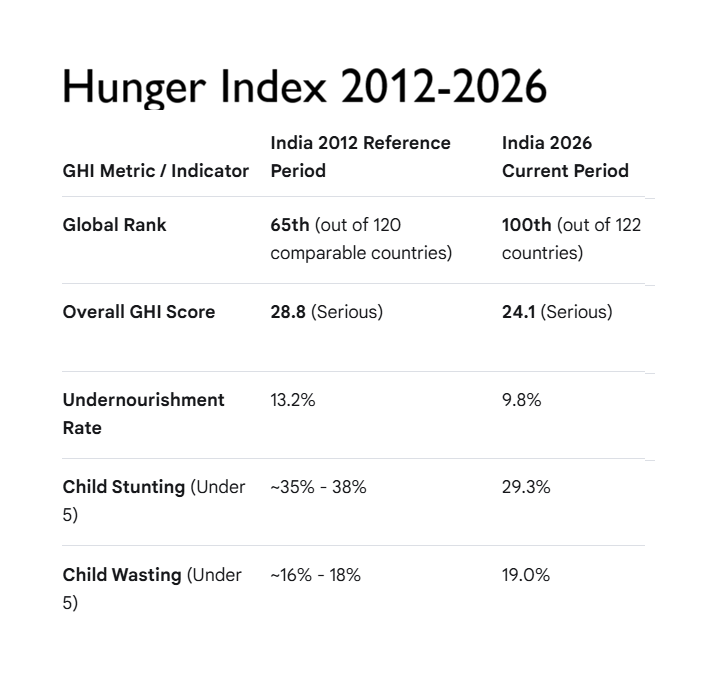
India struggles with food distribution and hunger issues, despite claims of being self-sufficient in food production. The country has a significant number of hungry people, indicating that it cannot adequately meet its domestic food needs.
Down To Earth
India is currently facing a balance of payments deficit, which means that its outflows of foreign currency exceed its inflows. This situation is exacerbated by high import costs, particularly for crude oil, and ongoing economic challenges.
Indiatimes Wikipedia
———–
you always have to look at how phony are the stats as Ian has. if india says it can be self sufficient in food, why do they have a severe import problem, and balance of payments problem, and rely on thing like cash crops to help offset trade deficits.
in fact, they really has been no poverty reduction as explained by others here, and most likely poverty is getting worse.
————–
Cash crops for export in India can exacerbate hunger issues by diverting resources away from food production, leading to reduced availability of essential food crops for the local population. This focus on cash crops often results in food insecurity, as many farmers prioritize lucrative exports over growing food for domestic consumption.
globalhungerindex.org papers.ssrn.com
India’s trade deficit has been persistent and increasing, primarily due to high imports of oil and non-oil goods, which have outpaced export growth. This reliance on remittances and services to finance the deficit raises concerns about economic fragility and sustainability.
UMass Amherst Trading Economics
India has been experiencing a persistent trade deficit, which has been increasing over the years. This situation is primarily driven by high imports of both oil and non-oil goods, which consistently outpace the growth of exports.
High Import Levels: India imports significant quantities of mineral fuels, oils, and various goods, leading to a substantial trade gap.
Weak Export Growth: Although exports have seen some increases, they have not kept pace with the rising import costs.
Reliance on Remittances and Services: India depends on remittances and service exports to finance its trade deficit, which raises concerns about economic stability.
Recent Trade Deficit Data
The trade deficit figures illustrate the ongoing challenges:
Month Trade Deficit (USD Billion) Exports (USD Billion) Imports (USD Billion)
September 2026 30.21 44.4 74.61
August 2026 26.86 38.81 65.67
July 2026 31.98 38.2 70.18
The increasing trade deficit poses risks to India’s economic health. The reliance on external financing through remittances and capital inflows can lead to financial fragility, especially if global economic conditions worsen. This situation necessitates policy measures aimed at enhancing the competitiveness of Indian exports to mitigate the trade deficit’s impact.
UMass Amherst Trading Economics
———
the globalists simply cannot help themselves, they keep doing the same losing schemes over and over again, expecting a different result.