
The traditional revolutionary change requirements are:
- An inability to pay military, police and functionaries.
- A split in the elite.
- Popular revolt.
As a rule, all three are necessary.
In the Russian revolution, the military was noticeably absent, or in the case of the Navy, actually revolted. Near the end, with the old government in the Winter Palace and protestors outside, the cadets being used as guards refused to fight, the Cossacks which the government expected to come rescue them never showed up, and navy sailors helped organize the crowds outside and storm the Palace.
There’s a lot of confusion around this issue, and a fair bit of comes from the idea that money doesn’t matter, because you can always print more.
Sure.
How’d that work for the Weimar Republic?
The bottom line is that money is only good for buying what exists or what is close to existing.
What we’ve been seeing for about 60 years now is:
- price increases higher than wage increases.
- Deindustrialization.
This means the West is making less of what its own populations need, and the populations can afford less of what does exist. Internal capacity is collapsing. (Ignore CPI, it’s not just a lie, it’s a damned lie. Expenses have risen far faster than it suggests.)
The solution to this, such as it was, was to trade: buy what is needed from other countries. The West was almost the sole supplier of goods that other countries wanted: planes, cars, advanced electronics, weapons and so on. For a while the USSR was an alternative, but as time went by that alternative became less and less viable, until the collapse of the USSR, at which point the West was pretty much the only game in town.
But Western elites were drinking their own kool-aid. They wanted reduced wages and environmental protection costs, so they decided to move production overseas, especially to China. Now China can make almost everything that any country might want: they don’t have to buy from America, and as the technical ability to avoid the dollar payment system increases, that means they don’t need the West.
Recently, what we’ve seen is a reduction in Western coercive ability. Not a complete loss of it (yet), as Venezuela and Cuba and Greenland show, but a serious loss in power. In fact the pivot to coercing weak nearby states and vassals is due to the weakness: the US can’t win far from its territory, but it’s still scary to Latin America and Europe.
This isn’t just about the US though, France had its own sphere of African interests, with military bases throughout multiple ex-colonies. It essentially ran multiple countries. Almost all of them have now run the French out. The French nuclear system, for example, used heavily discounted uranium from African vassals.
Trump seized Venezuela’s oil and has locked down Greenland’s resources, but he’s lost the Middle East. (Yes the war continue. Yes the US has lost and the American Middle Eastern Raj is dying and will not be saved.) Africa would far rather do business with China.
So would Latin America, but American military might, “NGOs”, diplomats and intelligence services have so far mostly been able to keep Latin America in the American sphere. So far. As the ability to use naval forces to project forces declines (and it is and will) this will end, though the process may take a couple decades and a lot of pain.
All of this is a roundabout way of saying that the US is becoming much more poor and will continue to do so. Its coercive abilities are low, it has lost Africa and is losing the Middle East. Even Asian countries which have disputes with China (Vietnam, for example) are integrating with China’s economy.
Can’t make it. Can’t force as many countries to sell to the US for cheap. Has much less to sell to the world that it wants at a reasonable price, since China sells all the same things for less.
At this point the system’s only remaining pillar is dollar privilege. Everything is bought and sold in dollars, the US can print dollars, and the US can thus keep buying what it needs.
Except when it can’t, as with rare earths, industrial magnets, and other resources and goods China has decided to stop selling to America, which it can’t make itself and for which there is no adequate alternative supply. These goods, by the way, are necessary for American weapons, and without them the US military will keep becoming weaker and unable to rebuild its arsenal. (On the other hand, Russia and Iran and North Korea all get as much of these goods from China as they need.)
And dollar privilege is ending. Oh it goes back and forth, the US is fighting tooth and nail to keep it going, but the trend is clear. Abuse of sanctions, in particular, has made it clear to everyone outside the West, and even to some inside the West, that being in the dollar system: settling trades in dollars, is a huge vulnerability.
I assume the picture is clear: America can’t make as much, can’t force other countries to sell for cheap, has less to trade that can’t be bought for less somewhere else, and soon won’t just be able to print dollars and buy it anyway.
This brings us back to the enforcer class. Police in America are paid VERY well.
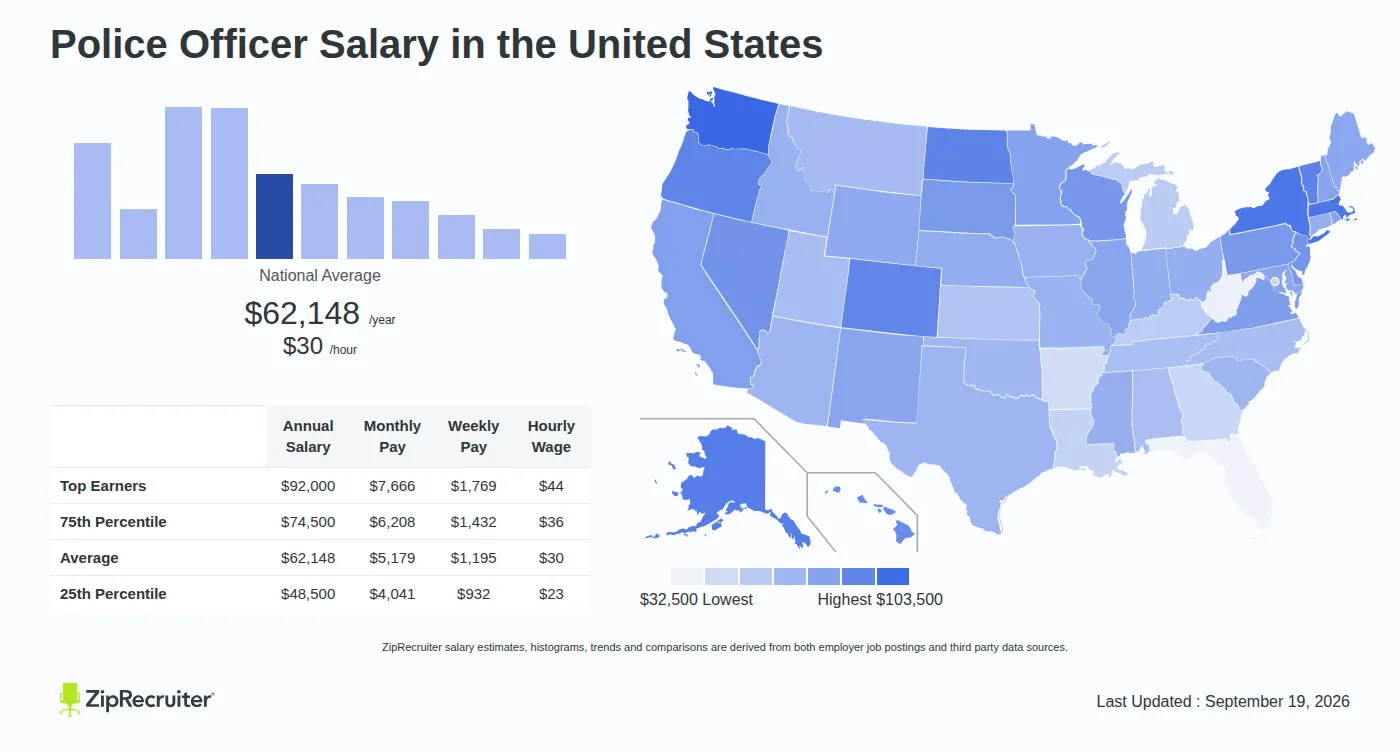
With overtime it’s not unusual for police salaries to hit the mid hundred thousands.
Cops are, generally, pretty well paid.
The military is less so, with salaries in the mid 30K range being common for non-NCO enlisted members.
Cops are well paid because they enforce the laws.
“Duh,” you say, but the point I’m making is that they break strikes, intimidate protesters, enforce property laws and steal more money from people than burglars do–but not from elites. Laws are set up to favor elites and cops are how laws that are unfair are enforced.
They’re frontline against the possibility of change. During the American revolution, those unhappy with officials would gather in large groups and go “have a talk” with their representatives. That sort of thing is basically impossible now.
It should be obvious why it’s necessary for the enforcer class: military and cops, to break from the elites for a revolution to succeed. They don’t all have to, but either you need some on the side of the new order, or you need them to refuse to do their jobs: as was the case with the Cossacks in the Russian Revolution.
A lot of people think that the first requirement of revolution: being unable to pay cops, military and functionaries (someone does need to keep things running) is impossible now in the US.
They’re right.
Now
But as the US becomes poorer and as prices continue to rise faster than wages, even police wages, and especially as actual shortages occur (sorry, we just don’t have any) that will change. You could pay them 10 billion dollars, but if it won’t buy the food, medicine, housing, internet and so on that they need or want, it amounts to “not being able to pay”.
And that’s where the US is in danger of heading. Can’t make a lot of stuff. Can force fewer and fewer countries to sell or “give” resources to them, can’t earn an honest buck in trade because China’s good are cheaper, and soon can’t just print dollars.
(I also expect that a lot of US copyright laws may be overthrown in other countries in about a decade to two decades. No reason to pay that ransom if you aren’t buying from the US, and it’s better to have domestic industry or your own internet companies.)
Every great nation thinks “it can’t happen here” till it does. For the US the endgame grows closer.
What I write here is for the benefit of everyone, but alas, I live in capitalism and I, and the site, take money to keep running. If you value the writing here and can, please subscribe or donate.
Leave a Reply