The neoliberal era, which is dying but not yet dead, has been extremely tiresome for anyone with an IQ higher than a tomato, and even a scintilla of intellectual honesty.
Witness the current German chancellor, Merz, intent on doubling down on the same policies which have failed to work for generations:
“With 450 million consumers, we are already larger than the United States. We must break free from what is holding us back. We are being slowed down by labor costs, energy prices, taxes, and social contributions. We must push through reforms, and overcome resistance.”
My bolding, of course.
So, let’s demolish this. We’ll start with productivity versus corporate tax rates:
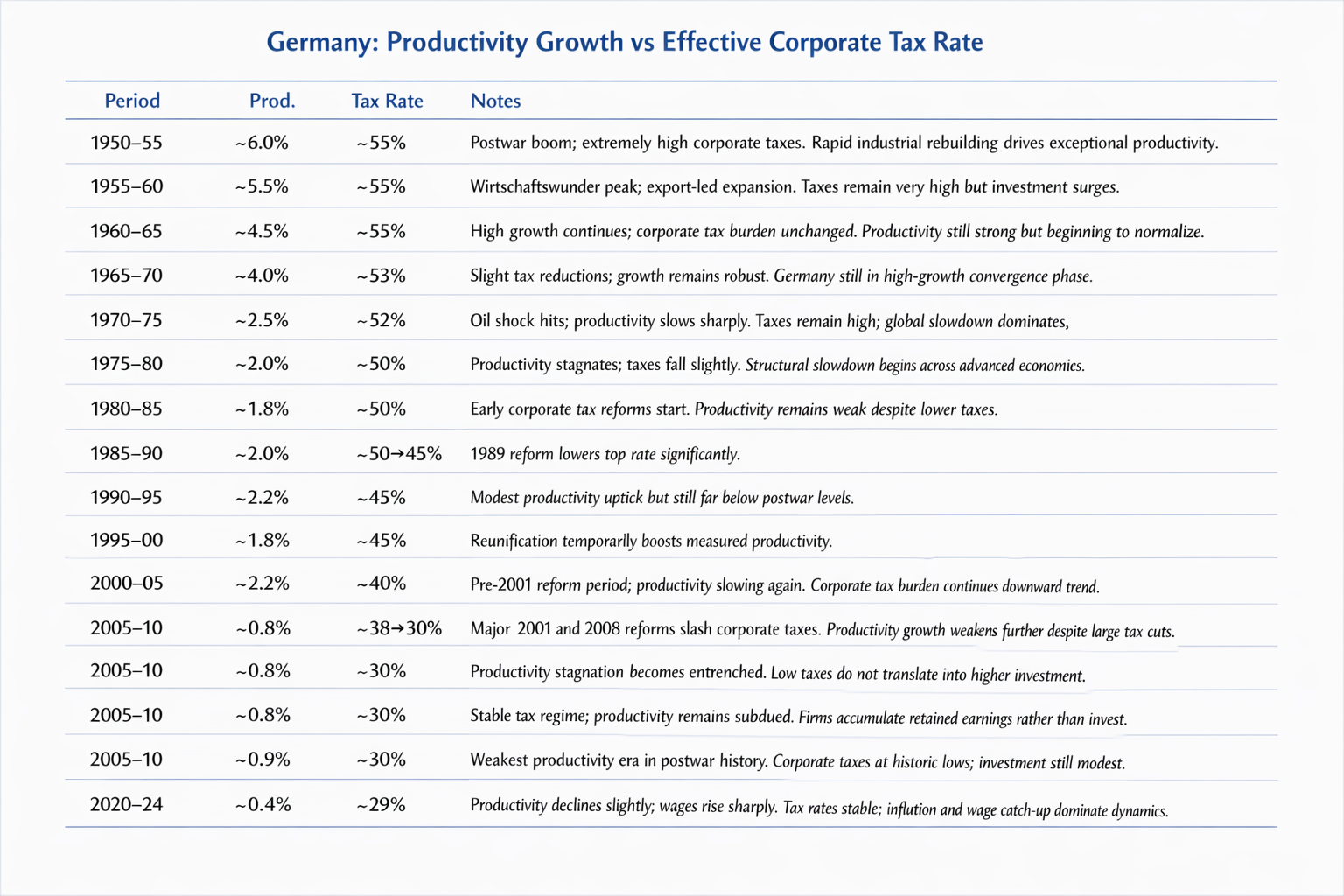
So, the lower the tax rate, the lower the productivity increase (and thus competitiveness.) This is correlation, not causation, but it does clearly indicate that lowering corporate tax rates doesn’t automatically increase productivity. Looking that this table, you’d assume the opposite.
What actually matters is how much of profits are kept inside the company and used for investment in the business. High tax rates on non retained earnings, combined with high tax rates on dividends and executive income encourage firms to reinvest rather than disburse. The neoliberal story is exactly wrong: high tax rates on corporations and high progressive taxes on income and wealth encourage growth. You want ordinary people to pay to lower taxes, so they buy products, and you want high income people to pay high taxes so they don’t take wealth out of the companies they own and run, but rather insist those companies re-invest.
Now let’s look at wages:
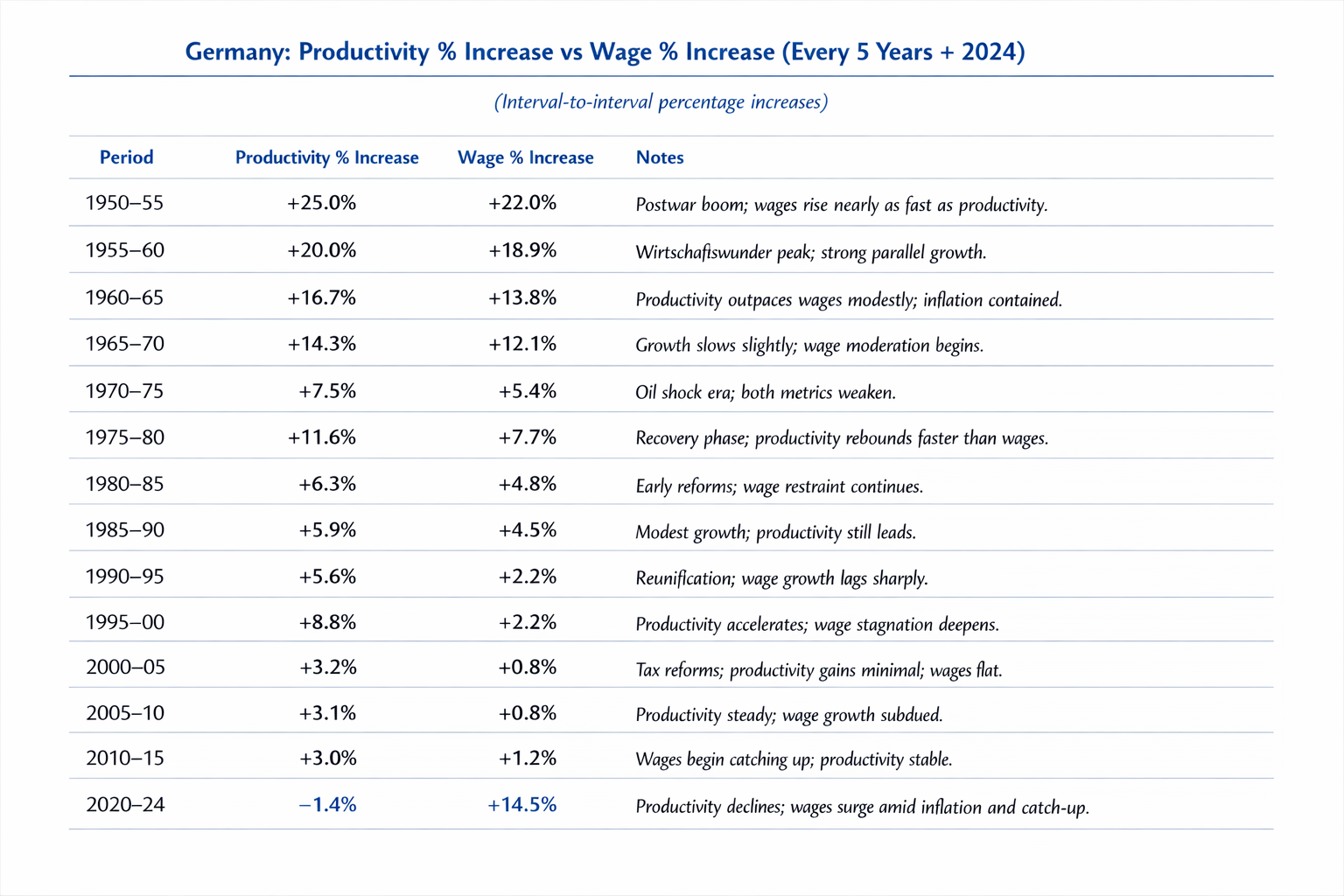 There are some ups and downs, but generally speaking during the earlier periods wages increase at a higher percentage of productivity.
Now there are two important recent breakpoints. First is the tax changes of 2000: you’ll notice that wage increases and productivity increases from 2000 to 2020 are abysmal. Corporate tax rates were dropped from 40% to 25%: if neoliberalism worked, then reduced taxes should have led to more investment, instead it lead to more stock buybacks and more executive compensation, in part, because at the same tiem they changed tax laws in ways that made stock buybacks and stock options for executives far less taxed.
So the freed up money, instead of going to reinvestment, went to shareholders and executives.
They also made it so that investments in other countries, not Germany, were taxed less than investment in Germany.
I want to say that the sheer stupid is breathtaking, but of course, this wasn’t done to improve Germany productivity and ordinary people’s wages, it was done to make the rich in Germany even richer.
The actual strategy which works, if anyone cares, is high corporate taxation, with tax relief if money is spent inside Germany to improve a company’s productivity: if it’s actually reinvested.
So the tax changes of 2000 hurt productivity and hurt wages and made Germany’s rich even richer. Quelle surprise.
Now let’s take a look at what happened post 2020 – a radical change. This is German de-industrialization. There’s a massive inflation shock, both from increased energy prices due the Ukraine war and pipeline destruction, plus inflation from Covid and corporate price gouging. Wages rise because they have to: after years of slowing wage increases, Germans need enough money to pay for housing and food. Corporations have to pay more or people won’t work.
Productivity actually DROPS. This is the energy shock that has caused so much German industry to relocate out of the country or to shut down entirely. It’s not just that China has advantages, it’s that Germany shot itself itself in the foot going along with anti-Russian energy sanctions and not fixing the pipelines.
Merz is in a panic. His actual constituents, Germany’s rich (he doesn’t give a damn about ordinary people) are in trouble. So his idea is to reduce taxes and force down wages.
Never improved Germany’s economy in the past, of course, quite the opposite.
So what will happen if he reduces corporate taxes? They’ll move industry out of the country faster because he hasn’t dealt with energy prices. (He mentions them, but he has no plan.) Reducing individual taxes might allow for decreased wages, or at least decreased wage increases, but if German companies aren’t competitive with Chinese companies, any extra consumer spending from reduced taxes will flood out of the country, and in the long term reduced wages means less potential domestic income.
Again:
Germany companies won’t invest more in Germany, they’ll invest more outside of Germany, including in China, if taxes are reduced without any legal changes to force reinvestment in Germany.
The actual solution is to force reinvestment in Germany thru tax changes that make foreign investment less profitable, and targeted tariffs, subsidies and industrial policy to make German goods more competitive.
Oh, and to end the Ukraine war, fix the pipelines and get energy costs down, though that may no longer be possible, as Putin has indicated Russia is no longer interested in long term energy deals with a Europe who hates Russia.
There is no cheap source of hydrocarbons any more and that situation is just going to get worse, even leaving aside the shock from the Iranian war. So Germany’s ultra-double-fucked. They need to figure out how to build nuclear fast and cheap and double down on renewables, primarily solar and perhaps tidal (the exact opposite of what right wing fools want.)
There’s no easy way out. Reducing taxes without restructuring taxes to force domestic investment will accelerate de-industrialization. Lower taxes on individuals might help lower wages somewhat, but will damage the German state’s fiscal ability at a time when massive public investment in energy is required.
Neoliberalism failed to do anything but make the rich, richer. If Merz happened to want to actually rescue Germany from de-industrialization he’d have to raise corporate taxes and change taxation and compensation rules to force reinvestment in Germany, while massively increasing public spending on energy. Any corporation which won’t reinvest needs to be taxed into the ground, and that money should be used for the energy build-out.
Taxes on the rich, including a wealth tax, should be increased. (No, they aren’t leaving the country in large numbers. Where would they go? China won’t take them if they can’t bring their money with them, and maybe not even then. America is no longer attractive, and the rest of Europe is doing badly too.)
In general, laws need to force Germany corporations and rich to invest in Germany, and make it so they can’t move their resources out of Germany. (Or perhaps not out of Europe.) None of this is ideologically, and thus politically, possible.
Merz won’t fix anything. Instead he’ll make everything worse. If the German hard right gets in power they might cut a deal with Russia, and that would help somewhat, but they won’t fix anything fundamental either.
A complete revision in economic ideology, of the same magnitude as the New Deal is required, and Merz and the opposition parties are incapable of that.
Germany, and Europe, will continue an inexorable decline.
Everyone reads these article for free, but the site and Ian take money to run. If you value the writing here and can, please subscribe or donate.
Feral Finster
Merz, like the rest of the european political class, has no priority other than The War On Russia, namely, in keeping it going long enough to get Americans to fight Russia for them.
Since Merz personally will not suffer (and the AfD is effectively neutered by its perceived association with Trump), why should he care if germans suffer?
Feral Finster
“The neoliberal era…has been extremely tiresome for anyone with… even a scintilla of intellectual honesty.”
Well, there’s your problem right there.
For blessed are the cynical, for only they have what it takes to get ahead.
Mark Level
“In other news, water is wet.”
Now I’m not ridiculing Ian for being Captain Obvious, sometimes we all have to be. But yes, Merz is just saying what Annalina Baerbock said earlier about what Germans wanted a few years back, not to deindustrialize further and to reopen the still operational Nordstream pipeline, basically “I don’t care what the German people want. It doesn’t matter. I’ll do what I think is right” which of course is any and all things to “destroy Russia.”
Isn’t that bitch the head of the UN now?; I believe so, which helps explain how the Security Council denounced the victim of a 2nd Surprise Attack illegal under International Law after Feb. 28. The brown people and Muslims are always Untermenschen, unworthy victims, to be demonized and have their children slaughtered.
Yeah, Merz couldn’t give a flying fuck about the German economy or people. He does what his fellow Reptiloids at Blackrock want. The upside?
As you document, as the stats show, Late Toxic Neoliberalism hollows out then completely destroys both the economy and the society wherever it is implemented.
For the sake of humanity and the future, just waiting this shit out means it will collapse. It takes time and patience, however.
In a related note, pics of the “food” on the US Warships “serving” Empire and Death are foul, it’s like what conscripted British Sailors were forced to eat (see also famously the SS Potemkin before the Revolution), how long until our little tin soldiers revolt and start another “laundry room fire?” (Sic– most evidence suggests that’s just cover and the Gerald Ford (Gerald Fraud) got hit by a missile. (Thanks to Max Blumenthal on Nima’s show for this final digression.)
elkern
I understand how legal/structural problems in the USA (Plurality-Wins elections, Citizens United, etc) made it easy for the Zillionaires to take control of our Government(s). Britain shares many of these structural problems, so it makes sense that they are in the same hole we’re in.
But most (continental) European countries don’t have these same problems. They were all (?) rebuilt after WWII, with rules and norms that seem designed to avoid the US/British problems (money buys politics).
They (all?) have truly multi-party Parliamentary systems (so people aren’t stuck voting for the lesser-of-two-evils). Most have (legally mandated) short election seasons, so campaigns are cheaper. I *thought* that they have far more rigorous controls on campaign money, and that they (mostly) actually enforced such laws (unlike USA).
What happened there?
Sean Paul Kelley
Scratch a German, find a Nazi.
Failed Scholar
Good!
joey_n
What do you make of this then?
https://ria.ru/20260416/mid-2087332867.html
And even before hand, and I don’t know if it’s true or what’s changed since it was posted on 25 March:
https://x.com/SprinterPress/status/2037096219600712023
mago
@ Mark Level
At least the sailors of yore got their daily pint of grog even as the captain was screwing the cabin boy.
No end to the good times, eh?
Sail on sailor. . .
spud
look at the years where neo-liberalism took over, one name stands out, the bill clinton of germany.
Gerhard Schröder
https://en.wikipedia.org/wiki/Gerhard_Schr%C3%B6der
Domestic policies
In his first term, Schröder’s government decided to phase out nuclear power, fund renewable energies,[32] institute civil unions for same-sex partners, and liberalise the naturalization law.[33][34] During Schröder’s time in office, economic growth slowed to only 0.2% in 2002 and Gross Domestic Product shrank in 2003, while German unemployment was over the 10% mark.[35]
Most voters soon associated Schröder with the Agenda 2010 reform program, which included cuts in the social welfare system (national health insurance, unemployment payments, pensions), lower taxes, and reformed regulations on employment and payment.
He also eliminated capital gains tax on the sale of corporate stocks in an attempt to make the country more attractive to foreign investors.[36] After the 2002 election, the SPD steadily lost support in opinion polls. Many increasingly perceived Schröder’s Third Way program to be a dismantling of the German welfare state.
Moreover, Germany’s high unemployment rate remained a serious problem for the government.[37][38][39] Schröder’s tax policies were also unpopular; when the satirical radio show The Gerd Show released The Tax Song (Der Steuersong), featuring Schröder’s voice (by impressionist Elmar Brandt) lampooning Germany’s indirect taxation, it became Germany’s 2002 Christmas #1 hit and sold over a million copies.[40][41]
The fact that Schröder served on the Volkswagen board (a position that came with his position as minister-president of Lower Saxony) and tended to prefer pro-car policies led to him being nicknamed the car chancellor (Auto-Kanzler).[42]
Carborundum
I don’t know how we’d ever decompose it, but I would bet that a large fraction of the above patterning is ultimately attributable to a combination of post-war recovery demand and demographics.
Digby
Doesn’t sound fair to the former East Germans who lived under a more anti-Nazi environment than West Germany and/or didn’t vote for Merz, assuming that makes a difference anymore.
Sean Paul Kelley
@Digby: you’re right. If you run into an asshole in the morning, you ran into an asshole. If you run into assholes all day, you’re the asshole. That was me today: the asshole. Mea culpa. My apologies.
Like & Subscribe
Doesn’t sound fair to the former East Germans who lived under a more anti-Nazi environment than West Germany and/or didn’t vote for Merz, assuming that makes a difference anymore.
How about, scratch a German, find an authoritarian? Yeah, East Germany was emphatically anti-Nazi except of course when collaborating with Neo-Nazis in West Germany to destabilize its governance.
Putin was stationed in East Germany during the collapse of the Soviet Union. He worked hand in glove with the Stasi which was as cruel as the Gestapo in its own right.
Like & Subscribe
That was me today: the asshole. Mea culpa. My apologies.
You need to learn how to have compassion, grasshopper. Authoritarians, the Stasi, MAGA, the Nazis, they, all of them to the last person, are humans afterall, therefore, we must remain humane and treat them as fellow human beings with love and respect and compassion and understanding and tolerance. If we expect them to be bad, they will be bad. If they’re bad, it’s because of us because that was our expectation of them. If we transform that expectation and instead expect them to be good and decent and moral and fun-loving and carefree, they will be that. It all depends on us and our attitude and approach. Easy peasy.
Thank you for your attention in this matter.
Oakchair
has no priority other than The War On Russia,
—–
The Western ruling class has 1 and only 1 priority. Their own power.
The “war on Russia” may simply be a means to increase surveillance, censorship, remove rights, rig democracy and centralize power amongst themselves. All of which have happened with “Russia” being the marketing reason for doing all those things.
Feral Finster
@joey_n
Russia clearly does not want to fight the West. They want to be allowed to join it.
Naive scrotes.
Of course, the West sees Russian dithering and indecision as contemptible weakness, and the West will be satisfied with nothing less than Russian blood.
@Oakchair:
“The Western ruling class has 1 and only 1 priority. Their own power.
The “war on Russia” may simply be a means to increase surveillance, censorship, remove rights, rig democracy and centralize power amongst themselves. All of which have happened with “Russia” being the marketing reason for doing all those things.”
There is some truth to that.
mago
When I was hanging out in Germany in the late 80’s and early nineties it seemed like a reasonable enough place, except dealing with the sclerotic bureaucracy was maddening. I actually secured a work permit from the state.
On the other hand the fetish for rules and order didn’t set well. Always had a problem with that authority thing. Anyway, the place is a basket case now as is most of the continent. Spain seems to be showing some balls, however.
Alas, I lack the time and patience that Mark Level mentions. This crumbling neoliberal order is going to get worse before my time is up.
In parting I just want to observe that cheap sarcasm is undignified. Thank you for your attention to this matter.
Ian Welsh
I don’t know a lot about Germany, honestly. But my impression is that they embraced the worst of neoliberalism in 2000 and before then had more reasonable policies. Adoption was staggered. Britain first, then the US, Canada was late 80s. Europe ex-Britain always had the rules fetish but they weren’t neoliberal in 1980 and conversion seems to have been staggered.
spud
Ian Welsh:
that policy of wage suppression and gutting of the social safety net was done to attain a trade surplus over the rest of the E.U., it worked for a while, but no capitalist or free trader understands that the gutting of wages and safety net, plus a lack of government and private sector investment(with government its austerity, with the private sector its increased profits)its simply eating its seed corn, and will implode into poverty and dependence on other nations to try to stay afloat.
its a age old problem that’s playing out in india right now. and it ain’t pretty.
so far china has kept at bay their milton freidman trained economists, but for how long? their trade surplus is a huge target that the rich all over the world are drooling over.
Marc
Ian Welsh: “I don’t know a lot about Germany, honestly.”
It shows.
Whats with all you international progressives/lefties bitching about that we phased-out nuclear power? Here in Germany only the “center” right (CDU/CSU, FDP) and far right (AFD) still hallucinate about nuclear power. For the SPD, the Greens, the Linke and a majority of the citizens nuclear power is done. For good!
1. IIRC the three (3!) nuclear power plants that where left and were shut down for good, only produced about 6% of total electric energy production in Germany.
2. the same year we shut down these three aging nuclear plants, solar and wind power production grew by 12% and reduction of electric power consumption accounted for an other -3%, or so. Hence, phasing-out nuclear power never even made a dent.
3. all these three nuclear power plants needed new certification anyway AND our stock of nuclear fuel was depleted (IIRC current nuclear fuel producers are Russia and Niger…). New certification would have taken 1-2 years, IF no repairs or updates were needed (that would have taken some more years).
4. nuclear power is neither cost effective, nor are build in time. The currently build nuclear power plants (GB, Finnland and France?) are several years over schedule and cost 3-5x more than proposed
5. neither the electric power producers (RWE, EON, etc, etc) nor the banks are interested in building nuclear power plants. ROI just doesn’t add-up! (it never did)
6. heard of climate change and shrinking glaciers lately? In summer we and France(!) regularly have to shut down nuclear and coal plants, because rivers are too shallow and warm to cool these power plants
7. WE NEED MORE BATTERIES! Currently there are 500GWh worth of industrial scale batteries waiting construction approval. Sure, a good chunk of these 500GWh come from companies who filed approval papers “just in case”, but it feels like like every other week an other big multiple MW battery goes online, or construction started.
8. small balcony solar power plants are a BIG thing here and up to 800W, need no state approval. You just plug them in any free power socket. Actually by law, even the landlords HAVE to allow balcony solar power plants in their buildings! We currently have 1.3 mio of these things installed, that produce 1.34GW electrical power combined. In the last 4 years, balcony solar power plant installation grew TENFOLD (from 48MW in 2020 to 540MW in 2025). More and more of them have their own battery as well.
9. regenerative electrical power production in Germany usually exceeds 50% of all electric power production for much of the year for a few years now. There’s usually only 1-2 weeks in the dead of winter when the sky is too clouded and the wind doesn’t blow enough.
So for the love of God guys, stop hallucinating about nuclear power plants in Germany! We don’t need it, we don’t want it, it doesn’t help with our ongoing transition to regenerative energy production at all, we would have to shut them down in peak summer anyways (rivers too low and too hot) and it’s too fucking expensive!
Ian Welsh
Nuclear doesn’t add up because you do it wrong. It works in China and they get it built on time for a fraction of the cost in Germany or the West in general. Why doesn’t it work in Germany? (Molten salt or air cooled nuclear is the answer if you have little water.)
If your energy policy is so brilliant, why is your industry fleeing Germany because of high energy costs?
Nuclear is baseline. Solar is only with enough batteries, which you’ll eventually have but don’t have now. If you’re going to transition, plan for the transition so that you don’t lose your industry to high energy costs: you won’t get it back once you lose it, because you won’t be remotely competitive with China.
I’m no expert on German post-war history, but I can read energy statistics and I know how economies work. Merz’s policies will drive your economy into the ground like a piledriver. You have nothing the world wants if you don’t have industry and you aren’t self-sufficient, nor can you be.
Carborundum
For context, net German electricity generation is down 22% or about 130 TWh from peak in 2017. Generating *capacity* is very strongly up, but not actual generation. I don’t know how one runs a modern industrial society on a contracting power base. Per capita energy utilization is a very significant long-run predictor of prosperity. That said, how one uses it is obviously pretty key – as an example, Canada has about 2.5 times the per capita power utilization and not all of that is accounted for by population dispersal and an environment that tries to kill you…
I would personally love to have one of those balcony units – they are a really smart idea, but a 500MW delta is a small component of the overall increase in solar over the period, which I make to be a smidge over 100GW. Multiple sources indicate that Germany currently has less than 30GWh in installed battery capacity, which suggests to me that this is going to take a while, even given the advantages of a robust and highly skilled industrial base.
different clue
Free Trade isn’t fair and Fair Trade isn’t free. It has to be defended in the teeth of the International Free Trade Conspiracy.
Protectionism is part of the defense of Fair Trade.
spud
here is another towering intellectual mental midget try to replicate the big three’s feat, of attaining a trade surplus like shroeder, or as in the clinton/blair types, getting that trade surplus through china for there wealthy parasites and leeches of the street, or wall street.
none of it worked out as the three thought it would. because as this video says, they are really idiots.
https://www.youtube.com/watch?v=jfGLNQbanVQ
The Fall of Modi’s Narrative: Wall Street’s Brutal Harvest of India.
spud
different clue:
correct, and here it is all spelled out in simple to understand terms.
http://americanusconstitution.com/article1section8.html
Article 1, Section 8
Clause 1: The Congress shall have Power To lay and collect Taxes, Duties, Imposts and Excises, to pay the Debts and provide for the common Defence and general Welfare of the United States; but all Duties, Imposts and Excises shall be uniform throughout the United States;
Clause 2: To borrow Money on the credit of the United States;
Clause 3: To regulate Commerce with foreign Nations, and among the several States, and with the Indian Tribes;
Clause 4: To establish an uniform Rule of Naturalization, and uniform Laws on the subject of Bankruptcies throughout the United States;
Clause 5: To coin Money, regulate the Value thereof, and of foreign Coin, and fix the Standard of Weights and Measures;
Clause 6: To provide for the Punishment of counterfeiting the Securities and current Coin of the United States;
Clause 7: To establish Post Offices and post Roads;
Clause 8: To promote the Progress of Science and useful Arts, by securing for limited Times to Authors and Inventors the exclusive Right to their respective Writings and Discoveries;
Clause 9: To constitute Tribunals inferior to the supreme Court;
Clause 10: To define and punish Piracies and Felonies committed on the high Seas, and Offences against the Law of Nations
Clause 11: To declare War, grant Letters of Marque and Reprisal, and make Rules concerning Captures on Land and Water;
Clause 12: To raise and support Armies, but no Appropriation of Money to that Use shall be for a longer Term than two Years;
Clause 13: To provide and maintain a Navy;
Clause 14: To make Rules for the Government and Regulation of the land and naval Forces;
Clause 15: To provide for calling forth the Militia to execute the Laws of the Union, suppress Insurrections and repel Invasions;
Clause 16: To provide for organizing, arming, and disciplining, the Militia, and for governing such Part of them as may be employed in the Service of the United States, reserving to the States respectively, the Appointment of the Officers, and the Authority of training the Militia according to the discipline prescribed by Congress;
Clause 17: To exercise exclusive Legislation in all Cases whatsoever, over such District (not exceeding ten Miles square) as may, byCession of particular States, and the Acceptance of Congress, become the Seat of the Government of the United States, and to exercise like Authority over all Places purchased by the Consent of the Legislature of the State in which the Same shall be, for the Erection of Forts, Magazines, Arsenals, dock-Yards, and other needful Buildings;–And
Clause 18: To make all Laws which shall be necessary and proper for carrying into Execution the foregoing Powers, and all other Powers vested by this Constitution in the Government of the United States, or in any Department or Officer thereof.
Marc
Ian,
I didn’t argue about Merz (and the CDU-led governments before him) driving our industry into the ground. CDU led governments sabotages solar and wind power production at every step of the way in the past.
My argument was, that nuclear is too expensive, too slow to implement (5-10 years out) and bad ROI already prevent power companies and banks to consider it. Also, we (Habeck/Greens) extended the running time of the last nuclear plants till our remaining nuclear fuel ran out. They where shut down when the nuclear fuel was depleted AND 1-2 years(?) after their certificates already expired to create a buffer for loosing Russian gas and oil. (who said: “Keep your friends close, but your enemies closer”? SunTsu?)
Basically, cheap solar and wind power makes anything except gas peakers (we need a few more of those for the interim) too expensive. Since the power plants with the highest production costs dictate the price of electric energy in Germany (yeah, we are real capitalists!) the relatively high prices of electricity strangulate our industry. Industry prices are less than half of the price for the general public, btw. (I pay 40 cents/kW and use 2kW/day).
“Nuclear is baseline. Solar is only with enough batteries, which you’ll eventually have but don’t have now.”
Germany is in the fortunate situation that wind speed at the North See coast (pretty stormy by comparison) usually picks-up considerably at night and when solar generation declines due to cloud cover. Hence, we got a pretty consistent regenerative energy generation throughout the year and import regenerative energy when prices are lower than the energy production costs of our gas peakers.
IIRC wind turbines are designed to last about 20 years, pay their construction costs in the first 8-10 years and produce revenue for 10-12 years. At the North See coast however, wind turbines usually generate revenue after about four years already. The problem are the power lines to transport that energy to the southern states where some of the industrial production is located. Former CDU/CSU governments torpedoed power line construction from north to south for decades.
“If you’re going to transition, plan for the transition so that you don’t lose your industry to high energy costs: you won’t get it back once you lose it, because you won’t be remotely competitive with China.”
Yeah, tell that the CDU/CSU who all but destroyed our booming solar industry 20 years ago and went half way into shutting down our wind power industry a few years back. We lost 100,000 of 120,000 solar industry jobs at the time, to extend the life of our coal industry and save 35,000 coal jobs for a few more years.
Jan Wiklund
The whole EU practice the kind of idiotic anorexia called “austerity”. Not only Germany. It has only made them poorer and weaker. But they still cling to it.
Actually it is written into their constitution. The euro is not about anything else (see for example Bernhard Moss [ed]: Monetary union in crisis, 2005).
The reason is of course that the banks earn from it. People have to take a loan when they have no money. And it’s the banks (and other financial institutions) that call the tune in a neo-liberal state.
France had to yield for a year or two to the Yellow Vests, but that is long ago.
Marc
Ian,
just last Sunday we had negative electric prices between 9am and 5pm due to an excess of solar and wind power, btw.
This German company did a very smart approach in designing their new production facility by combining solar, heat pumps, heat and ice storage and didn’t even connect to the gas infrastructure for heating. According to the owner, the heating system payed for itself after 3.5 years by saving gas costs.
https://www.youtube.com/watch?v=RIlsuqnhw10