Ian Welsh

The horizon is not so far as we can see, but as far as we can imagine

The Senders stumble into the Terror Dome

Soundtrack for this post.

William S. Burroughs postulated four political parties in his 1959 novel Naked Lunch: Liquefactionists, Senders, Divisionists, and Factualists.

Per Wiki:

The city is contested by four rival political parties: Liquefactionists, who want to merge everyone into one protoplasmic entity; Senders, who want to control everyone else through telepathy; Divisionists, who subdivide into replicas of themselves; and Factualists, who oppose the other three.

The Senders are a metaphor for mass media propaganda as practiced by Edward Bernays, Leon Trotsky, Joseph Goebbels, and American political consultants.

The Democrats and their allied Never Trumper Republicans are the heirs to this legacy.

The rise of the Internet, then the World Wide Web, and finally social media initially threw them for a loop and played a role in Trump taking over the G.O.P.

Their reaction was to impose a surveillance and censorship regime using the tech monopolies as bottlenecks:

Essentially the Biden administration’s communications policy has been to relentlessly and flagrantly spin, distort, lie

Unfortunately, combining surveillance and censorship with slick media campaigns using the power of celebrity to encourage supporters to form parasocial bonds with politicians is way too much power for anyone to handle.

Because there’s no way not to get high on your own supply.

As YouTuber History Legends said of the Ukrainian war effort:

The propaganda was too strong and too effective.

We have an entire army of NAFO trolls (on) Reddit and Twitter. People that believed 100% everything that was being said by Ukraine.

The Ukrainians will only show their successes to their population as if the Ukrainians are constantly winning.

At the same time we have a million Ukrainian men abroad. We have countless Ukrainian soldiers and enlisted personnel that are not at the front.

We have people in Kiev partying as if there’s no war happening.

The problem for Ukraine is that they haven’t managed to create (a) national feeling of it’s now or never. They always try to portray the war as ‘oh we’re winning. It’s fine.’

So everybody kind of kept their life going because everything is going well at the front but it’s not true and now it’s too late.

The disorientation goes to the top, as US Secretary of State Antony Blinken’s new piece for Foreign Policy illustrates.

The Biden administration’s strategy has put the United States in a much stronger geopolitical position today than it was four years ago. [Really??] But our work is unfinished. The United States must sustain its fortitude across administrations to shake the revisionists’ assumptions. It must be prepared for the revisionist states to deepen cooperation with one another to try to make up the difference. It must maintain its commitments to and the trust of its friends. And it must continue to earn the American people’s confidence in the power, purpose, and value of disciplined American leadership in the world.

Meanwhile, air alerts over Israel:

All of Israel is covered by air alerts

Eyeless in Gaza, indeed.

Ryan Grim tweets:

This is either a complete and total failure to contain the conflict by the Biden administration -- or this is what the White House wanted and it's the most egregious lie told to the public since WMD. Either incompetence or duplicity--no 3rd option. Malevolent in either case.

Incompetence or duplicity? What do we think?

Bikes, Cars, Pedestrians and Local Business

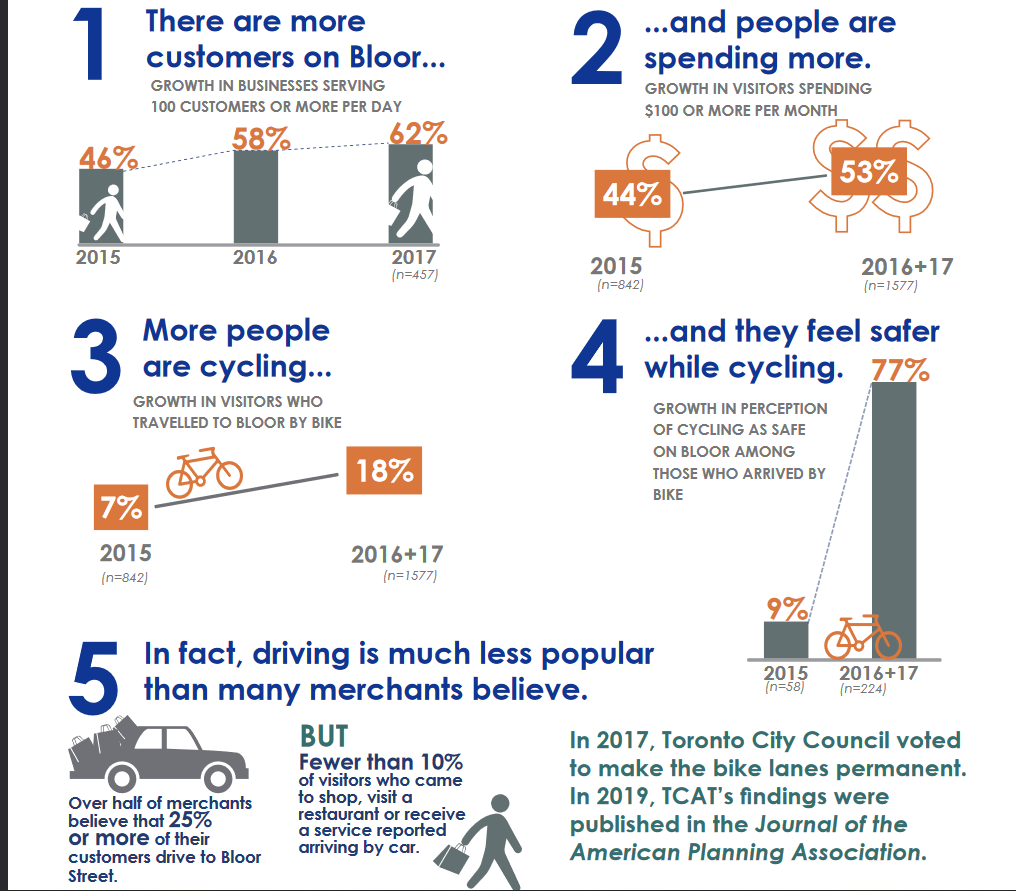
Alright, enough of the doom and gloom. Stumbled across a study on the impact of changing a four lane road in a retail area down to two lanes plus bike lanes. This sort of change is usually resisted by local businesses, who are scared of losing customers, but someone did a study:

I would have liked to see a study showing what happened to businesses nearby for comparison, but this study is still suggestive. And it’s not just that business was up, it’s that people who walk and cycle spend more:


(I’m running my annual fundraiser. If you value my writing and want more of it, please consider donating. Your donations really do keep this place running.)


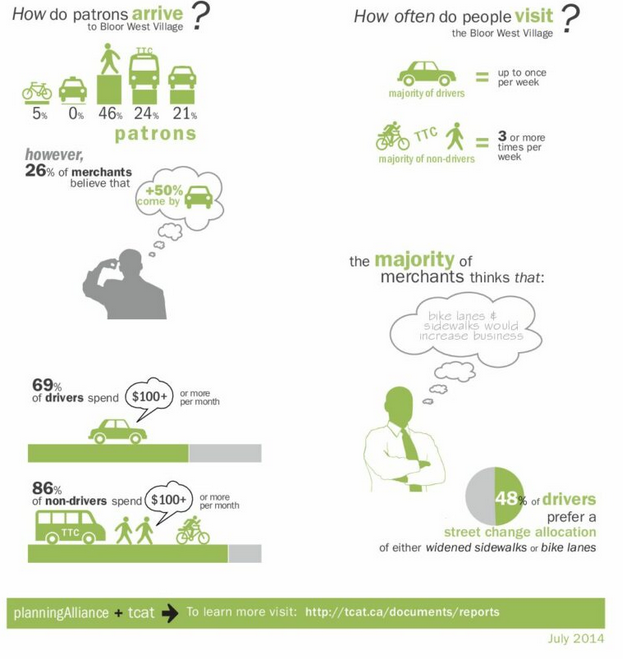
Which is to say, if you want to make more business you want more non-drivers and less drivers.

Besides, to point out the obvious, most drivers are going somewhere else. Most people who are walking or cycling live nearby, and people taking public transit have chosen to come to your area specifically.

Cities built for cars are inefficient, ugly and increase pollution massively. Cities built for pedestrians, cyclists and rapid transit are far, far more pleasant, as well as healthier and better for the environment. Part of the problem is the same as trains v.s. roads. When you add in all the costs, trains are cheaper and more efficient, but railroads are expected to pay all their own costs, while road users aren’t.

The other problem is that there are powerful pro-road and car lobbies. It’s well documented that the old streetcar systems in America were dismantled largely because GM engaged in a massive political influence campaign to have them dismantled.

In any case, mass use of cars is something else that will be going away over the next fifty years as civilization collapse and climate change hit, and hit hard. We aren’t going to be able to afford such nonsense. There will still be cars, for sure, but the idea that every family should have one will end.

And like many of the things that are going to go away, this will be good for us, it’s just that like any bad-for-you addiction the ideal is to slowly titrate off, not cold-turkey.

Those cities and states which get ahead of this and make changes now and over the next decade or two will be far better off than those who pretend it will never happen.

Week-end Wrap – Political Economy – September 29 2024

by Tony Wikrent


Strategic Political Economy

The Quiet Coup: Neoliberalism and the Looting of America — EXCERPTS

Mehrsa Baradaran (New York, W.W. Norton, 2024)

Introduction

Ideologies that have developed memelike qualities, like race and religion, have been some of the most potent forces shaping human history, especially when they have fused with the law. Racial hierarchy began as ideology to justify plunder and slaughter—those who murdered unjustly, like the Spanish conquistadors or British slave traders, blamed their crimes on their victims’ “inherent” inferiority and a meme was born in the world. Before the wholesale theft of indigenous land, the law justified it. In the early nineteenth century, Chief Justice John Marshall deemed that the indigenous tribes in America could not own or sell their land on account of their inherent “savagery.” The law thereafter demarcated property rights as the exclusive domain of white men, paving the way for manifest destiny, the seizure of 1.5 billion acres of land for private ownership, and the genocide of millions of indigenous people. Marshall built his legal opinion on precedent and theory provided by the British philosopher John Locke, whose theory of property law was popular in Great Britain in the late 1600s at the height of the British slave trade. It was “natural” and just, noted Locke, that “the creator” had endowed only “the industrious and rational” white men with the right to own land and people. It was also expedient. Ideologies persist through replication exactly because they evade detection, and through the process of replication, they evolve. For example, the ideology of patriarchy once reinforced itself through property laws like coverture and primogeniture that prohibited women from owning property. Once an ideology is embedded in legal code, its silent perpetuation is guaranteed.

Patently immoral practices like colonial subjugation, slavery, land theft, Jim Crow, segregation, and forced labor lasted so long that the theories that once justified them—like divine decree—no longer did the job. Instead of addressing the injustices that racist ideologies had created, often, those with the most to lose went looking for new ideologies Ito justify their unfair position at the top: first, Christianity; then Darwinian science; then the pseudo-scientific babble of “human IQ” testing; then, as was the case at the end of the 1960s, economics.

xxx
As John Adams once wrote to Thomas Jefferson (20 June 1815), ‘Power always sincerely, conscientiously… believes itself Right. Power always thinks it has a great Soul, and vast Views, beyond the Comprehension of the Weak; and that it is doing God’s Service, when it is violating all his laws.” 19 Such was the object of the neoliberal revolution in legal theory: to infuse raw power with a soul—and snuff out the discretion that is law’s dynamic living heart.

The law is the most powerful engine through which ideologies can become self-replicating engines. John Locke’s theory of property as the endowed right of white men to use and to produce worked like witchcraft—the natural world, which had sustained societies for thousands of years, could suddenly be taken by force, enclosed, and tilled for the sole profit of one man, with trespassers punished. The conversion of land into one person’s permanent property was not permissible under the indigenous populations who had long occupied it, nor was such a thing permissible anywhere in the world except Europe—and even there, only after the enclosure movements of the 1600s. The brilliant and prolific philosopher Locke happened to be under the patronage of Anthony Ashley Cooper, one of the richest men in England (who later became the First Earl of Shaftesbury); he was first hired as Cooper’s personal doctor, but as the earl entered politics to advocate for more property rights, Locke’s star rose alongside his. And property laws were passed in legislatures and handed down over time, carrying memes from men long dead with ideas long denounced.

Law codified land into assets and has been extending the market into new frontiers ever since—from corporate shares and derivatives to NFTs—transforming abstract ideas into tradable assets. A similar alchemy transformed gold into money by smelting an image onto a coin, then transformed gold coins into bank notes emblazoned with the image of a king, queen, or president. Initially, it was gold’s malleability that made it ideal for coinage. But with the rise of empire and Great Britain’s dominance of the global trade in gold, the gold standard became yet another ideology to preserve power. Locke’s theories about gold being the highest source of value on account of its scarcity have been as impossible to dislodge from monetary theories as his ideas about race have been from property laws. But Locke was wrong—gold was not valuable. Then, as now, money’s value derived from the image on the coin. Money is a symbol of people’s trust in the government that issued it. Gold’s scarcity was not the source of its value, but it was one of the causes of hundreds of years of wars in Europe over the scarce metal. While empire based on the gold standard and justified by white supremacy fell to the global horror of World War II, the underlying logic of both lingered. Unaddressed and unexamined, these bad ideas continue to breed distrust in our societies and scarcity in our economies. The greatest villains of our modern times are rarely human beings but the zombie ideas of dead men that continue to shape our societies.

FAR FROM BEING a battle between capitalism and communism, as so many historians have painted the era’s conflict, the global revolutions of the 1960s were the only world wars that involved the entire world. Truly, the world had turned upside down as a globe dominated by a handful of empires became a world with over a hundred independent nations—each demanding equal sovereignty on the world stage. The possibilities were breathtaking and the 1960s saw the first worldwide conversation between and among peoples speaking to one another. Neoliberalism was the successor ideology of empire. Gone were the gunboats, colonial governments, and talk of civilizing savages. Instead, development loans, sovereign debt markets, and transnational corporations became the face of power in the Global South. The guns did not disappear of course, but were traded on global markets from distributors to trade-friendly governments.

After decades of relentless activism by Black Americans across every legal domain, the American South’s chokehold on the law finally broke and the Constitution’s promise of equality was secured for all Americans. The last stages of the civil rights movement forced the quiet oppression of southern law to show its teeth and claws

[TW: I am greatly encouraged that Baradaran identifies John Locke as one of the major causes of bad political economy. As I have noted a number of times, it was Locke’s ideas of private property that made liberalism so insidiously destructive of the founding philosophy of civic republicanism, leading us to our present megacrises.

[Baradaran’s book is an excellent accompaniment to The Lever’s epic and important series on The Master Plan (see below). She discusses some people who The Lever series has not mentioned yet, such as Ayn Rand acolyte and neoliberal enforcer Alan Greenspan, who played a central role in Richard Nixon’s 1968 campaign, and the development of conservative economics as a cloak for outright racism.]


The Secret Plot To Buy American Democracy (podcast)

[The Lever, September 20, 2024]

In 1971, Lewis Powell, a tobacco industry lawyer and future Supreme Court justice, penned a memo calling on conservatives and business interests to make the nation’s legal system far more friendly to corporate power. A few years later, a lawyer named Michael Horowitz penned a follow-up memo calling for conservatives to indoctrinate generations of lawyers as the right’s foot soldiers on the ground.

Today on Lever Time, senior podcast producer Arjun Singh talks to David Sirota and Jared Jacang Maher about their deep-dive investigation into this 50-year plan in the hit new Lever podcast Master Plan. Then, Arjun sits down with journalist David Daley to discuss his latest book, Antidemocratic: Inside the Far Right’s 50-Year Plot to Control American Elections.

Daley’s book centers on Chief Justice John Roberts, whose ascent to the high court — and the conservative rulings he’s handed down — were the culmination of decades of work that began with Powell and Horowitz’s memos.


Master Plan, Ep 5: How Corporations Became People (podcast)

Corporations Are People, My Friend (YouTube video)

[The Lever, September 10, 2024]

In Master Plan’s fifth episode, we explore how an unlikely catalyst — Robert Kennedy’s 1968 assassination — created an opportunity for his Senate replacement to manufacture the first and perhaps most important blow against America’s new campaign finance laws: Buckley v. Valeo. With a supporting cast including James Buckley, John Bolton, Charles Koch, and Robert Bork, this U.S. Supreme Court case was the first to frame the fight against campaign finance regulations as a crusade for free speech and third-party rights.

MASTER PLAN, Ep 6: The Maverick Vs. The Corruption Machine (podcast)

[The Lever, September 17, 2024]

In the 1980s, the U.S. government was anything but clean. After the landmark Supreme Court cases we told you about in Episode 5 turned money into “speech” in the 1970s, cash began flowing into elections unchecked. Big donors also expected big favors.

It wasn’t such a surprise, then, when five U.S. senators got caught in 1989 for allegedly trying to pressure a federal bank regulator to go easy on savings and loan magnate Charles Keating. But what no one expected was that one of the so-called “Keating Five,” a relative newcomer named John McCain, would do far more than apologize for his mistakes; he’d transform into the staunchest campaign finance reformer since Watergate.

McCain would need his unpredictable “maverick” energy for the fights ahead. Because once he set his sights on wrangling the dark money out of politics, he’d find himself butting heads with two powerful members of his own party — a senator who’d been called the “Darth Vader of campaign finance reform,” and a governor-turned-president backed by big donors.

Jared Kushner declares victory

Sharing Kushner’s tweet in full because it has to be seen in toto to be believed and it’s important to remember he will no doubt once again be the architect of Trump’s ME policy should Trump retake office.

And also because of this observation from Mohammad Alsaafin of AJ+:

It’s darkly funny that every stupid thing Kushner is saying here reflects the actual strategy and position of the Biden administration.

Ok, here’s Kushner’s victory lap:

September 27th is the most important day in the Middle East since the Abraham Accords breakthrough.
I have spent countless hours studying Hezbollah and there is not an expert on earth who thought that what Israel has done to decapitate and degrade them was possible.
This is significant because Iran is now fully exposed. The reason why their nuclear facilities have not been destroyed, despite weak air defense systems, is because Hezbollah has been a loaded gun pointed at Israel.
Iran spent the last forty years building this capability as its deterrent. President Trump would often say, “Iran has never won a war but never lost a negotiation.”
The Islamic Republic’s regime is much tougher when risking Hamas, Hezbollah, Syrian and Houthi lives than when risking their own. Their foolish efforts to assassinate President Trump and hack his campaign reek of desperation and are hardening a large coalition against them.
Iranian leadership is stuck in the old Middle East, while their neighbors in the GCC are sprinting toward the future by investing in their populations and infrastructure. They are becoming dynamic magnets for talent and investment while Iran falls further behind.
As the Iranian proxies and threats dissipate, regional security and prosperity will rise for Christians, Muslims and Jews alike. Israel now finds itself with the threat from Gaza mostly neutralized and the opportunity to neutralize Hezbollah in the north.
It’s unfortunate how we got here but maybe there can be a silver lining in the end.
Anyone who has been calling for a ceasefire in the North is wrong.
There is no going back for Israel.
They cannot afford now to not finish the job and completely dismantle the arsenal that has been aimed at them. They will never get another chance. After the brilliant, rapid-fire tactical successes of the pagers, radios, and targeting of leadership, Hezbollah’s massive weapon cache is unguarded and unmanned.
Most of Hezbollah fighters are hiding in their tunnels. Anyone still around was not important enough to carry a pager or be invited to a leadership meeting. Iran is reeling, as well, insecure and unsure how deeply its own intelligence has been penetrated.
Failing to take full advantage of this opportunity to neutralize the threat is irresponsible.
I have been hearing some amazing stories about how Israel has been collecting intelligence over the past 10 months with some brilliant technology and crowdsourcing initiatives.
But today, with the confirmed killing of Nasrallah and at least 16 top commanders eliminated in just nine days, was the first day I started thinking about a Middle East without Iran’s fully loaded arsenal aimed at Israel. So many more positive outcomes are possible.
This is a moment to stand behind the peace-seeking nation of Israel and the large portion of the Lebanese who have been plagued by Hezbollah and who want to return to the times when their country was thriving, and Beirut a cosmopolitan city.
The main issue between Lebanon and Israel is Iran; otherwise there is a lot of benefit for the people of both countries from working together. The right move now for America would be to tell Israel to finish the job.
It’s long overdue. And it’s not only Israel’s fight. More than 40 years ago, Hezbollah killed 241 US military personnel, including 220 Marines. That remains the single deadliest day for the U.S. Marine Corps since the Battle of Iwo Jima.
Later that same day, Hezbollah killed 58 French paratroopers. And now, over the past six weeks or so, Israel has eliminated as many terrorists on the US list of wanted terrorists as the US has done in the last 20 years. Including Ibrahim Aqil, the leader of Hezbollah’s Islamic Jihad Organization who masterminded the 1983 killing of those Marines.
There’s nothing less reassuring than bipartisan neocon war mongers declaring victory in the immediate aftermath of their latest atrocity.

The Future Of Hezbollah and Israel’s Conflict

Nasrallah is dead, assassinated by the Israelis. There have been significant bombings in Beiruit, and escalation between Hezbollah and Israel are clear.

First, let’s state the obvious. Israel’s intelligence has seriously comprised Hezbollah, much more than they ever did to Hamas. I suspect this is a result of not taking Hamas particularly seriously and the differing nature of Lebanon and Gaza. Gaza, by all accounts, was a fairly tight knit community, united in their opposition to Israel. Lebanon is not, it’s a sectarian state with a great deal of internal divisions.

There was a lot of anger in Iran and Hezbollah that Hamas did not forewarn them of October 7th, but it’s clear they were right not to. If they had, Israel would very likely have found out, and this is especially true if Hezbollah had been told.

As for the assassination, it’s much less important than people make out: decapitation strategies don’t significantly degrade strong ideological organizations like Hezbollah. The real question is how much knowledge Israel has of the actual military infrastructure. Nasrallah was a well loved leader, but he was a very cautious man and much less interested in fighting Israel than many make out. The new leadership, and given Israel’s success at assassination, it is almost all new, will be far more willing to fight.

Intelligence, airpower and its alliances with American and other Western nations are Israel’s strengths, and they are not small matters.


(I’m running my annual fundraiser. If you value my writing and want more of it, please consider donating. Your donations really do keep this place running.)


That said, those who are panicking, often hysterically, are premature. Hezbollah defeated Israel militarily in 2006, and before that when it won a guerilla war against Israel’s occupation and forced them out. They are much stronger now than they were then. They have more missiles, more men, who are well seasoned fighters, and they have dug in to a far greater degree than Hamas ever could.

Israeli intelligence and the airforce are impressive, but the actual ground forces Israel have are weak: not in equipment, but in morale and competence. To accomplish Israel’s goal of pushing Hezbollah out of southern Lebanon they will have to go in on the ground, and when they do I very much doubt their ability to win.

Unlike Hamas, Hezbollah’s supply lines cannot be cut: the posturing about Beiruit’s airport is ludicrous, the supplies come in by land and there is no possibility of interdicting most of them.

If Hezbollah does need reinforcements, they will have them, from Iraq’s militias and from Iranian “volunteers.” Manpower will not be an issue, though Hezbollah is unlikely to ask for many men at first, since they are not trained to operate in the Hezbollah manner.

Nasrallah was a cautious man, and Hezbollah has been holding back. Their missile force can output far more and better missiles than they have been using in the past, and the end of the old leadership almost certainly means the gloves will come off.

Further, Hezbollah has done great damage to Israel already. The reason Israel is turning to Lebanon is that Hezbollah has displaced hundreds of thousand of settlers, causing an internal refugee problem, and combined with Yemen’s naval blockade, has massively damaged the Israeli economy. And this is with them holding back, because they did not want a general war.

But the only way to truly defeat Israel is to defeat their military, and the best way to do that is for them to attack into Lebanon. Hezbollah, hopefully, will ramp up its attacks to force Israel to do just that, if it isn’t intending to already (which they almost certainly are), and if it is already intending to, to make it happen sooner.

The war, then, is still in its early stages. Do not fall to doom and gloom (if you support the resistance), nor optimism (if you’re pro-genocide). Wait, and see. The real battles, which will determine the outcome of the war, have not yet happened.

Open Thread

Use to discuss topics unrelated to recent posts.

Culture Creation

In my article on the rise and fall of credential systems and the Medieval University System, I mentioned that universities create culture. Standardized culture, as a rule. There was a fair bit of confusion around what culture creation is, so let’s talk about that.

To start, note that what you’re reading right now is culture creation: ideas about how the world works, or should work. I’m amplifying, as it happens, an academic, Randall Collins, though a lot of my work isn’t primarily based on academic literature, this is.  But if I’m writing about Israel, say, and the Gaza genocide, that’s culture production: that’s me amplifying and on rare occasions expanding on all those in the past who have said “genocide is bad” or “Zionism is based on ethnic cleansing, terrorism and apartheid.”

When I write about the ideology, or about surveillance is bad or climate change, it’s all culture production. It’s intended to explain how the world is or ought to be.

Schools and the especially the first parts of higher education, like BAs and Bachelors of science or engineering produce pretty standardized culture: there aren’t that many different standard textbooks for each field and virtually all academic disciplines have a consensus worldview of how things are and how they should be, and that’s what they teach. At higher levels, some disciplines let some doubt in, but at lower levels what you’re getting is pretty much the same as everyone else.


(I’m running my annual fundraiser. If you value my writing and want more of it, please consider donating. Your donations really do keep this place running.)


Over time that consensus changes, of course, but it is a matter of “over time” and major paradigm breaks aren’t all that common.

It may seem weird to include science and engineering, but they also have consensus ways of thinking and organizing the world and those ways, too, change over time.

The Medieval Universities produced lawyers, doctors, theologians and administators. People who had a common view of the world. Of course there were some disputes, but they were much more similar to each other than to, say, the humanists who later replaced them.

The great ideologues produce new cultural projects: new understandings. Confucius produced administrators: he knew that’s what he was doing, that was his intention. He wanted to change China, and the way he chose was to try and make the best ministers. He built on top of a view of society as family. The Legalists, his main opposition, did much the same but with the idea of a ruthless state and complete obedience to the ruler, and the Mohists, though more revolutionary in mind, also trained administrators, but wanted far more equality

Islam is famed for its legalism, and what is law but “how things should be?”

The Philosophes were, likewise, engaged in a project of creating an understanding of “what should be.”

So was Jesus, so was Marx and so was Adam Smith.

But those are the high points, for every great ideologue there are millions of small ones. And yeah, a lot of podcasts fall under the rubric of culture creation, including some of the biggest ones. Joe Rogan qualifies, for sure. Talk radio usually qualifies, and Rush Limbaugh was one of the most important ideologues of the past forty years.

Technology (which is part of culture); natural constraints like geography, climate and biology; and ideology in the sense, again of “what we believe is and should be” are the most important parts of what creates human reality. Culture creation matters and it’s dirt common. Without all the little creators taking up their work, the big ones wouldn’t be big.

2024 Annual Fundraiser

As blogs go this one has been around for a long time. It started a political/economic/financial blog back in 2009, but over the years I’ve written less and less about finance and politics and turned to topics I consider more important. As the amount of “red meat” has gone down, the readership hasn’t, and I’m grateful.

When I hear from readers, they usually give one of two reasons for liking the blog:

  1. It makes them feel less alone. Less like the crazy one. The Mississippi sized torrent of BS pouring thru most media will have you believing right is wrong, black is white, Covid is non airborne, Israel is humane and Russia is losing. The centrists are reasonable, the right is misguided, but the left is the true evil. Finding a place where the information stream isn’t full of shit and there are others who who seek the truth is a relief.
  2. They learn from it. Quite a few people have written to express their gratitude in having their world views and their expectations of what’s going to happen in the future change to something more realistic, and hopefully more humane.

As for myself, I try to write articles that interest me and which are at least one of interesting to readers, important for understanding the world, or useful to my readership.

Every year (except once when I forgot because I was in the hospital), I do an annual fundraiser. The money raised supports me so I can keep writing. You can subscribe or donate. If you value my writing and want to see more of it, I hope you will.

This year we’ve got four goals. Each unlocks a writing project. Subscriptions count as three times their nominal value.

At $4,000 I’ll do three book reviews. Barring serious illness, one in November, December and January. The first will  be “India is Broken”, because no, Virginia, India is not going to be the next China. The second will be “The Invention of Capitalism,” about primitive accumulation: or how people were forced into factories, had their land stolen and so on. The third will be “Wealth and Democracy” by Kevin Phillips, one of the most important books I ever read.

At $7,000 I’ll do three more book reviews based on what I’m interested in at the time, again one a month. If you have nominees you’d like to see reviewed, feel free to suggest in comments.

At $10,000 I’ll write an article on the fundamental process which keeps society together, how it fails and renews and under what conditions it fails to renew.

At $13,000 I’ll write an article on the weaknesses of North American style police, and how a determined and ruthless opponent could take advantage of those weaknesses to rip them a new one.

Every dollar you give helps me. If you like my writing and you can afford to give (please don’t if you’re short yourself) I’d appreciate if you did.

SUBSCRIBE OR DONATE TO OUR 2023 FUNDRAISER

Page 81 of 512

Powered by WordPress & Theme by Anders Norén