Much as I like Elizabeth Warren, I’m not going along with this:
“Even so,” the panel concluded, “there is broad consensus that the TARP was an important part of a broader government strategy that stabilized the U.S. financial system by renewing the flow of credit and averting a more acute crisis.”
It added, “Although the government’s response to the crisis was at first haphazard and uncertain, it eventually proved decisive enough to stop the panic and restore market confidence.”
Why? Well, because…
The panel’s 134-page report noted that after 14 months of the program, problems remain. Banks resist making loans, toxic mortgage-related assets still clog big banks’ balance sheets and smaller banks are vulnerable to troubles in the commercial real estate sector.
Here’s what happened, not just with TARP but with the overall bailout, of which TARP was only one part.
Because banks were not forced to recognize bad loans and assets, but have been allowed to keep them on the books it did not restart lending. Instead the money given, loaned and guaranteed has been used to allow banks to not take their losses, and they have used that money in addition to increase leveraged financial plays and for buyouts of other financial firms which are even more distressed.
We’re going to hear a lot of triumphalism over the next year, because the economy is probably going to “recover” more strongly than many expect, not primarily because of the stimulus, but because of increased military spending. Military Keynesianism is the only type of Keynesianism both parties agree with, and it should be no surprise that Obama escalating in Afghanistan, because that’s spending he can get through Congress and it directly creates jobs. It’s not the best possible stimulus, not even close, but it’s far better than tax cuts, or tax cuts in drag, which is what much of the stimulus spending actually was, since it allowed States to avoid raising taxes on the rich. (And yes, Virginia, I’m here to tell you that right now raising taxes on the rich and spending it to create broad based demand and jobs would be very stimulative.)
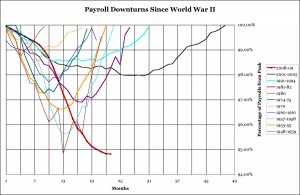
Japanification has occurred. To be specific, Japanification is when a society’s banks are unable to lend adequately because they have huge numbers of bad loans on the books which have not been recognized, and which they have to pay down over many years. The IMF forecast last year, which did not include a stimulus bill, assumed that the economy would have about the level of unemployment it has now. The IMF is one of the few organizations which saw the crisis coming and which was screaming warnings from the rooftop, so they are not Pollyanas.
The US economy has shifted down a step. The new “normal” is going to be higher unemployment and lower relative wages than was considered acceptable even under Bush, let alone under Clinton.
Meanwhile, the “decoupling” fools were talking about happening last year, is happening this year. Most Asian economies are recovering much much more strongly than Europe and the US. Why? Because they are creditor nations with surpluses. Their businesses and consumers can get credit, and their governments can run stimuluses much more effectively than the US can. They are also production societies which actually still concentrate on making real things, not on leveraged financial plays and suburban expansion of worthless communities without a real economic base to support them.
Meanwhile the US is trying to get the financial economy and the housing bubble going again. As long as the US is willing to keep shipping real productive capacity and the remaining few areas where the US has a technological advantage to Asia, and particularly to China, those nations will let the US try its financialization game again, but don’t expect them to be enthusiastic about it.
And once they’ve got what they need, it’ll be time to cut the US off. When the US makes nothing anyone else wants, why should the rest of the world play?
Can you say dollar/Yuan parity? Sure you can. Within 20 years.
Enjoy the next year, it’s going to be better than you expect, though unemployment will not recover all that much. But don’t expect the OK times to last, because they won’t. Nations which make less and less the rest of the world wants, don’t do well in the long run. The game of liquidating America’s advantages has been going on for over 30 years now, and the long run is now the medium run.
Soon it will be the short run.
When even the smart, competent people aren’t willing to face the reality of what’s happening in their own country, that country has nowhere to go but down. This will be a one step forward, to steps back decline, and triumphalists will scream about how wonderful each step forward is, but the trend is clear and there is no reason to expect it to change anytime in the next 10 to 15 years.