
Ian Welsh

The horizon is not so far as we can see, but as far as we can imagine

The Hidden Army: Hezbollah Teaches the World How to Fight

Surveillance State notes something very, very important:

Hezbollah and Israel have been at war for some time. In an effort to stop Hezbollah’s guerrilla fighters from communicating, Israel has in the past jammed the cell phone towers in the Hezbollah-controlled areas in southern Lebanon. Eager to make sure that didn’t happen again, Hezbollah has covertly built out a fiber-optic network throughout the areas it controls.

He then goes on to note that the last crisis between Lebanon’s government and Hezbollah was over the government trying to shut down that fiber-optic network. Hezbollah regarded that as an act of war:

(Hezbollah’s leader, Hassan Nasrallah) said the government’s decision to shut down Hezbollah’s fiber-optic communications network was tantamount to a declaration of war. For the (central) government, the network represented an intolerable example of Hezbollah’s efforts to set up an Iranian- and Syrian-backed state within Lebanon. Hezbollah justifies the network, which carried its communications during a 2006 war with Israel, as a vital security asset.

The interesting thing is that during the 2006 war, Hezbollah won the information war. Their communications remained secure, but Israeli soldiers carrying cell phones made calls which Hezbollah tracked. Even if they couldn’t listen in, being able to triangulate where some Israeli soldier is making a call from gives some very interesting, and useful, information.

Americans, Israelis and the West in general are used to assuming they’ll win the surveillance, electronic and information war. But Hezbollah defeated or drew Israel in all three. A network of tunnels, pre-prepared camouflage positions for missile launchers and the use of civilian clothes when troops were traveling made aerial surveillance and satellites virtually useless. The Israelis were never able to shut down the majority of Hezbollah’s missile launchers, any more than they’ve been able to find those of the Palestinians.

Hezbollah’s army is a secret one. It’s like an old fashioned spy agency.

It doesn’t exist.

If you’re enrolled in it, you don’t tell anyone. The war was rife with stories of soldiers being killed, and their families finding out for the first time that they were even in Hezbollah’s army. This, of course, is to make it impossible to use assassination, mostly aerial assassination, to take out key leaders.

Hezbollah is an almost perfect Darwinian organization. Israel uses informants and assassination? Great – we’ll keep even our membership secret. Israel uses air power? We’ll dig tunnels and set up aeriel blinds for our missile launchers. Israel doesn’t like taking heavy infantry casualties – fine then, we’ll set up overlapping bunkers which simply cannot be cleared without taking losses.

Hezbollah has created the new model army, and a new model state. Call it the Hidden Army. An army that blends in with the population, that moves only when it cannot be seen, that sets up in the expectation of surveillance. An army that knows all the high tech games, and spent the time to figure out how to nullify them. It sounds like a guerilla army, and it is, but it’s also much more: it’s an army capable of engaging in strategic warfare and an army capable of engaging in full on attrition defense warfare against Israeli main battle forces. It’s hard to overstate how impressive this is.

It’s an unrecognized State with a hidden army. Oh, the UN says there’s a Lebanese government with authority over Hezbollah. But everyone knows that the real government in southern Lebanon is Hezbollah. They pick up the garbage, they give out the pensions, heck, they have their own phone network. Crazy. When the Lebanese “government” picks a fight with Hezbollah, Hezbollah wins.

We are going to see many more of these unrecognized governments, with their hidden armies. Why? Because they work, and they work very well, both at providing government services to a population, and at frustrating much larger, more powerful and expensive conventional armies. As official governments fail, less recognized ones will pick up the pieces. And they will look to Lebanon to see how to do it, survive, and even win.

(Kicking this one to the front again – Feb 25, 2013 – originally reposted in 2009.)

(Another reprint.  This one got some hostile reaction from people who missed the point.  Hezbollah might be the most interesting and successful neo-state in the world.  Anyone who isn’t studying it is a fool. )
On Economic Justice

Who should get how much?

Who deserves how much money?

How do we decide?

It is, I believe, nonsense to say that we deserve whatever we happen to earn.  The value of our money is not something which is reliant on us as individuals, but is based instead on the productive capacity of our society, something which individuals have almost nothing to do with.  Being born in America or Belgium is worth much more than being born in Nigeria or Bangladesh.  You didn’t choose your parents, you didn’t choose your upraising, you can’t be said to “deserve” much if anything as a result.

People whose parents are poor don’t get into university as much as those whose parents are wealthier, nor do they graduate as often.  Being lower on the socio-economic stratum reduces performance independent of ability, as the Spirit Level documents.  As the joke about George Bush ran, he was born on 3rd base and thought he hit a triple.  But the concept applies to so many of us.

Deserve is a very slippery word.

Perhaps we deserve more if we contribute more to society?  If this is the case then we can only look at, say, the bankers and brokers of Wall Street, Bay Street and Fleet Street and say “they don’t deserve their money”, because they damaged the world economic system, damage which caused many people to lose their homes, caused food inflation and hunger, and certainly led to many deaths and much suffering which would not have occured otherwise.  Financialization of the economy gave them great rewards at great cost to many of their fellow citizens.  And it required trillions of dollars to bail them out, and even after they were bailed out, the damage they did was not undone.

Only by the most debased principles can, say, bankers, be said to deserve their money, the same principle that lead Thucydides to write that the strong do as they will, and the weak suffer what they must.  The same principles that say anything someone can steal or take, they deserve.

Is that justice?  Does that create a society we want to live in?  As we have, more and more, come to believe that people deserve to keep whatever they make, however they make it (as evinced by the erosion of progressive taxation), has it made our societies better places to live?

And, to go back to the initial point about the value of money being social and not individual, does it make sense to say an individual “deserves” their money when most of what their money is worth is created by other people?

As I’ve said before, too many jobs today do harm, do evil, rather than good.  The health insurance industry in the US makes its money essentially by denying care.  Hydrocarbon companies actively stand in the way of stopping climate change.  Many food companies produce food which they know leads to diabetes, obesity and chronic disease.

These jobs, these industries, actively decrease the well-being of individuals and of society.  They decrease the real value of money, because money which cannot buy well-being is worse than worthless, it is actively harmful.

Who does more harm to society, someone on welfare, or a banker who contributed to the biggest financial crisis since the Great Depression?  Who deserves more?  I find it hard to say that the banker deserves more than the person on welfare, for he or she has done vastly more harm.  Perhaps the banker works harder, but is working harder to do harm so praiseworthy?  Is it worthy of reward?

No compassionate society can base distribution of money or goods entirely on contribution to society.  If we say that those who don’t contribute deserve nothing, we move quickly into dystopic territory, because someone who receives no goods, dies.  If we take the harm principle too seriously, we could easily move into a scenario where we would find the arguments for killing those who do harm overwhelmingly strong.  And make no mistake, those in power, private or powerful, can do more harm than almost any garden-variety criminal can.  Even a serial killer doesn’t kill as many people as a bad policy can.

Justice recognizes that so much of what we are, so much of what we do, is based on circumstances.  Humans are malleable, most people, under the wrong circumstances, will do the wrong thing.  Most people, under the right circumstances, will do the right thing, too. That does not mean that we can tolerate too much of the wrong thing, it does not mean we say “oh, they couldn’t help themselves”, it simply means that we put the emphasis on correction, not vengeance; it simply means that we are compassionate, as we would hope others would be compassionate to us.

So we give a good living to those who contribute little, we correct those who do harm, if necessary through criminal sanctions, but better by finding work for them where their talents can do good, not harm.  We do not allow major industries which do more harm than good.  We recognize that people do change, and someone who is not contributing as much as we might want right now may contribute more in the future.

Knowing that most of the value of money is not individual, that even the most rewarded are rewarded because of the society and times he lives in, we put a cap on rewards.

(Note: There is much more to say about economic justice.)

Bootstrapping

Out of most crises comes opportunity.  Unemployment in the developed world, especially amongst the highly skilled, is opportunity for those countries willing to seize it.

Does your country not have the medicine it needs?  There are plenty of people capable of making and even inventing those medicines who are out of work.

Need roads and ports?  Plenty of those who can build them are out of work.

Need telecom infrastrucure?  The same.

A lot of highly skilled workers are out of work.  More want work that matters, they want to make medicines which will get to people at prices which will save lives, or build buildings which create energy and are good for those who live in them, or invent knew ways of farming.  They want to create energy sources which don’t dump carbon into the atmosphere and they want to build spaceships and get off the rock.

These people exist, and they are hungry for meaningful work, for good work.  Those who are out of work simply want a decent living, those who are working but hate their jobs will work for less if they are taken care of.

They are a way past the foreign currency bottleneck, they are a way past unfair patents and copyright.  Combined with pacts between countries to share key resources, they are a way to bootstrap up developing countries, or for wise developed countries to throw off the shackles of austerity and go back on a high growth path.  They can be used to bypass the old industries, to create the future in countries who didn’t win the last few technological and economic cycles.

They are lying on the ground, waiting only for those wise enough to offer them work that matters.

The Logic of Surveillance

Surveillance is part of the system of control.  “The more surveillance, the more control” is the majority belief amongst the ruling elites.  Automated surveillance requires fewer “watchers”, and since the watchers cannot watch all the surveillance, long term storage increases the ability to find some “crime” anyone is guilty of.  When you add in recognition systems based on face, gait or other criteria, you have the theoretical ability to track people from the moment they leave their homes till they return.  Other measures make it possible to see what people are doing inside their own homes (IR heat maps, for example).  A world in which everyone is tracked all the time is very possible.

Quis custodiet ipsos custodes

This is one of the biggest problems the current elites face: they want the smallest enforcer class possible, so as to spend surplus on other things.  The enforcer class is also insular, primarily concerned with itself (see Dorner) and is paid in large part by practical immunity to many laws and a license to abuse ordinary people.  Not being driven primarily by justice or a desire to serve the public and with a code of honor which appears to largely center around self-protection and fraternity within the enforcer class, the enforcers’ reliability is in question: they are blunt tools and their fear for themselves makes them remarkably inefficient.

Surveillance expands the reach of the enforcer class and thus of the elites.  Every camera, drone and so on reduces the number of eyes needed on the ground.  The Stasi had millions of informers; surveillance reduces that requirement and the cost of the enforcer class.

The reliance on surveillance is however a weakness, one of many.  One of the simplest ways to reduce the power and reach of the oligarchy is to destroy surveillance equipment, much of which is very easy to reach.  I have frequently said that we will know that people are becoming more serious when they start destroying surveillance equipment, when it becomes an ethical imperative to do so; ideally when people believe that blanket surveillance is an ethical wrong.

I, am, thus interested to see that the Barefoot Bandit Brigade destroying surveillance cameras.  In the US, those who oppose current elites directly seem strongest around Oakland and in the Pacific Northwest.

It is best that the surveillance system be challenged and dismantled before it becomes comprehensive; once every person is tracked all the time it will be far harder to do so, especially as audio surveillance also expands.  Once everyone is both tracked and listened to, it will be virtually impossible to organize resistance.

The comprehensive surveillance state, combined with measures to deal with the loyalty of the enforcer class, is the end game: it is where current trends lead.  It will be justified to the public as a measure to decrease crime and protect innocents (especially children), but it will lead to a more advanced Stasi state.

Note: minor edits made.

A reminder

“If you’re in trouble, or hurt or need – go to the poor people. They’re the only ones that’ll help – the only ones.”
― John Steinbeck, The Grapes of Wrath

Only when we understand, deep in our bones, that life and the world are profoundly, vastly unfair, do we approach compassion.

The coming catastrophes and the Rawlsian veil of ignorance

A just society, according to Rawls, is a society whose structure, whose rewards and punishments, are set up before we know what position we will hold in it.  The Rawlsian veil of ignorance cuts deeper than most people realize.  Take for example old-fashioned meritocracy: grades, schooling, intelligence.  Should intelligence be highly rewarded?  Would you set up society to reward the smart heavily if you didn’t know you’d be smart?  Most of smart is your parents, in terms of nutrition, education and genetics.  You don’t choose your parents, you can’t know that you’ll be smart before you’re born.  Smart is mostly not a choice, neither is healthy, nor a type A personality, and so on.

The great problem we have today in improving our society, in fixing our economy, is that so many people don’t want to give up what they have.  If you work in the health insurance industry in the US, an evil industry whose job is to deny care in exchange for money, for example, your job needs to go away. It is a job which does more harm than good.  If you work in peteroleum extraction, well, most of those jobs need to go away.  If you work in a large bank or brokerage, well, your job needs to change in a way that will deprive you of your high bonuses, and which will leave many bankers and traders unemployed, because banking done in a way that build society rather than tears it down probably doesn’t need your skill set.  We need a lot less accountants, a lot less administrators at universities, a lot less soldiers, a ton less spies, far fewer people working in the military-industrial complex, and on and on.

But what the past 40 years have proven is this: if you lose your job, you’re on your own.  If you’re in your 40s and 50s and you lose a good job, you’ll probably never, ever, have a good job ever again.  People who are displaced by economic change, good or bad, aren’t taken care of.  We have reduced retraining, made welfare and unemployment insurance harder to get, increased university tuition, not made efforts to find or create new, good jobs.  We hire foreigners to take over the job of older techies, since they cost too much.

People know, they know and they are right, that economic change, in our society, could cost them everything.  Their job and any prospect of a good job.  Their house.  Their marriage.  Their health care and even their life.

So they grasp tightly to what they have, and everyone fights to make sure that nothing really changes.  Each person, with their little or big piece of the pie, fights viciously to keep it whether it’s good for society or not.  They are right to do so.

This is why we can only have change after catastrophe: after war and famine and revolution, because only in extremis, only when, as in WWII, people realize that everyone is in it together, will they be willing to take care of each other.  And only in time of catastrophe, when so many have lost everything, will they be willing to change society.  Catastrophe forms a Rawlsian veil on the future: you don’t know, after the age of catastrophe, what your position in society will be. Not knowing that, it behooves you to make that society as equitable as possible.

This is the argument for catastrophe: that we will not, cannot, make the changes required to avoid catastrophe until we have lost or truly, existentially, fear the loss of everything.  We will not be fair and kind to each other till we have no choice, we will not be fair and kind to others till we know we need that for ourselves.

This is sad, pathetic even, an indictment of humanity.  Does it have to be so?  I hope not, but I fear it does.

It is such issues I will discuss in my coming book.  Are we bound to the wheel of causality even in our own societies, or can we take control of our own destinies?

Iraq wouldn’t have happened if it weren’t for oil, and Aaron Swartz died for oil too

Stirling Newberry has up an important piece on how protected works are used to pay for imports. You should read it.  There’s a reason the laws against “piracy” are more punitive than those against, say, negligent murder.

Justice is not Law, Law is Not Justice

A law is deserving of respect to the extent, and only to the extent, it is just.  A law which is not just deserves only the level of obedience one gives to any group or individual who says “do this, or I’ll hurt you.”  That is, to the extent that you believe their threat is credible, you may choose to obey to avoid the adverse effects of being caught disobeying.

The recent imbroglio over Aaron Swartz has seen a lot of people using the word “proportionality”. It does not matter if someone is guilty of a crime if the punishment is disproportionate.  In England the penalty for stealing a chicken, at one point, was death or being sent to a penal colony (Australia).  Juries started refusing to convict people even in the face of incontrovertible evidence of the accused’s guilt.  The sentencing had to be changed: stealing was not made legal, rather the penalty was reduced.

In the US at the current time, going to jail, for many people, means being raped.  Often repeatedly.  So I, personally, am not willing to send anyone but the worst criminals to jail, because I do not believe in judicial rape.  The punishment does not fit the crime.  Likewise it has come to be that if you are a felon you will never have a good job ever again.  Everyone does a background check.  Again, this is disproportionate to most crimes. It is also stupid, since people who cannot get a good job, or any job, are much more likely to turn to crime.

The US system provides for people having timely trials.  In most cases this is no longer true: you do not have a right to a timely trial.  People’s lives are destroyed in the pre-trial period, which can go on for years. This happens for the same reason that most cases never get to trial, but are plead out: the system could not afford to give a trial to everyone because there are too many people being shoved through the system.

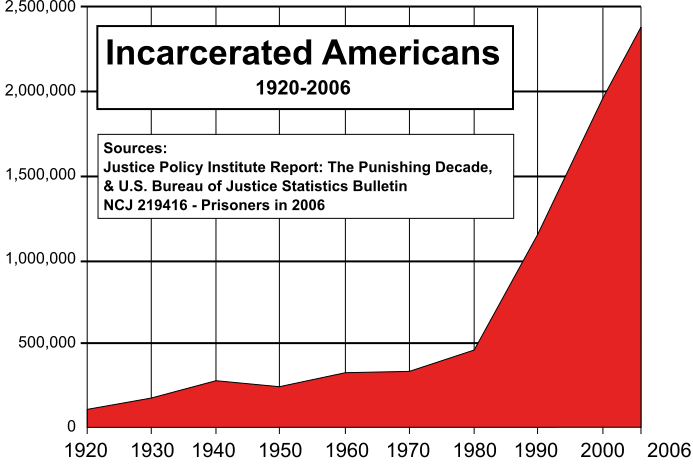
Graph of incarceration in the US over time

From Wikipedia

The graph at the right tells that story well enough.

This is a social choice.  Americans chose to lock  up a lot more people by criminalizing drug possession, by removing judicial discretion, and by increased mandated sentences.  Laws such as “three strike” laws are the paradigm.

This happens, notice, exactly at the election of Reagan.  Something changed in America.

Pleading out is not fair.  It is not fair to society or to the felon.  Both deserve a trial, to find out the truth.  If society has laws which mandate X years, then those laws should be followed.  If they cannot be followed in a just way, with little pleading and speedy trials, if following them would take more resources than a country will commit, then the laws must be changed.  This is especially the case in a country where it is no longer always possible for the accused to face their accusers or to see the evidence against them, or even to know what the law is, since America now has secret laws and secret interpretations of laws.  (A secret law is, ipso facto, unjust.  If you do not understand that, I cannot explain it to you.)

Full trials, and the full protection of the law, such as it remains, now belongs only to those who are very wealthy, and sometimes not even to them.  Defending a trial can take hundreds of thousand or millions of dollars.  An ordinary person cannot afford it.  Public defenders are overworked, underfunded, and generally plead out.  This is on top of the fact that most rich criminals, such as the bankers who committed widespread fraud, are never charged with crimes, and if they are charged are allowed to settle with a token payment which immunizes them from further charges for their criminal acts, acts which demonstrably cost hundreds of thousands of people their houses, lost people their jobs, and even their lives.  Law which is enforced only against some classes of people, and not against others, is unjust.

And then there is civil forfeiture, in which people who have been convicted of nothing, have their assets taken away.  Even if you’re rich, you may find yourself using a public defender.

A social system only works if there are people willing to carry it out. The USSR collapsed when the people running it were unwilling to call out the army.  That same class of people, in the Prague Spring, did call the army out.  It collapsed because the factory workers weren’t working, the farmers weren’t farming, and so on.

The US legal system (it does not deserve to be called a justice system) works because people carry out its dictates.  The people who run the prisons put up with, or even encourage the rapes.  Private companies make money from prisoners, so need more prisons. The police make huge amounts of money by seizing the assets of “criminals” before they are even convicted.  The judges put up with the 3 strikes laws and mandated sentencing.  They allow trials to be put back and back rather than throwing them out due to lack of a speedy trial.  Everyone is onside with plea bargaining.  The rich are good with this because they either get a real trial, or they don’t get charged at all.  The middle class think that if they’re “good” they’ll be ok, till they find out otherwise, and the poor put up with it because of a boot in the face and much more.

The principles of fixing the system (never use the word reform, it means making things better for the rich and worse for everyone else) are simple enough.  No secret evidence.  No secret laws.  No secret interpretations of law. No tolerance of rape in prison.  Nobody gets plead out if the plead involves doing jail time or becoming a felon.  No criminal record checks for jobs which don’t really really need them, so that prisoners can  reintegrate into society.  End civil forfeiture.  Allow no private defense attorneys, everyone uses a public defender including the rich, and the defenders are drawn by lot (they will be very well funded very quickly, and they will be the best lawyers in the country.)   All this will make enforcing current laws impossible with the current budgets Fine. Give judges back discretion, remove three strike laws and overly harsh sentencing, repeal virtually all prohibition laws for most classes of drugs.  Stop sending people to jail for IP offenses, and create an economy which gives poor people real jobs.

Or spend the money necessary to keep laws as they are now, but also have them be enforced justly, even if they still aren’t just.  That will mean a LOT more money, but if it’s important to Americans to lock up people for non-violent drug crimes, they should put their money where their “values” are.

Otherwise, everyone who supports the current system, is part of a system which is unjust.  More crudely, if you don’t at least support fixing the prisons so people arent’ predictably raped, you are complicit in rape.  And by support I mean you are either willing to pay to imprison the current number of prisoners humanely, or you are willing to send less people to prison so the current amount of money will do the job.

There is no justice without proportionality, no justice in a land with secret laws, no justice in a country where the rich skate and the poor plead out.  There is only law, the same law the Stasi proclaimed: do what we say or else.

Page 448 of 532

Powered by WordPress & Theme by Anders Norén