Ian Welsh

The horizon is not so far as we can see, but as far as we can imagine

Why the Climate Change Numbers Say “Nuclear”

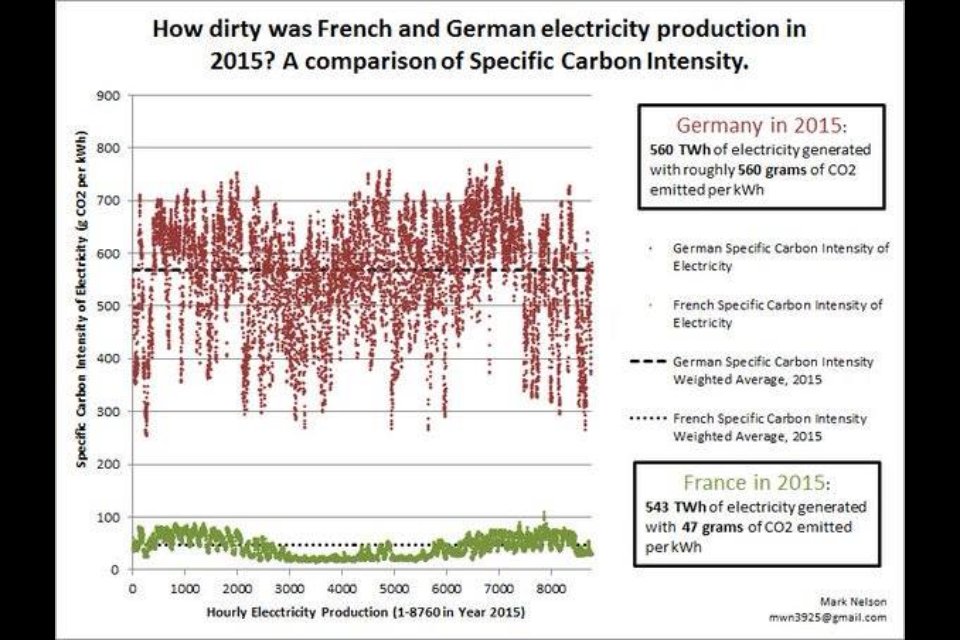
Lot of people won’t like this post, but some of the smartest people I know have been saying for decades that a solution to climate change means nuclear energy. The numbers cannot, and will not, work without it.

The below info-graphic shows why:

French v German carbon production

The problem with nuclear energy is the problem with everything in our society.

Running it requires competent, risk-adverse individuals who takes its dangers seriously. It’s not that these dangers can’t be managed, it is certainly not that we can’t design better and safer reactors than we have now, it is that our elites do not care about the future. They are rational, utility-maximizers in the short run, who believe that investing to prevent disaster or catastrophe is foolish. Any catastrophe can be managed or survived. Katrina happened, life went on. Indeed, Katrina was a brilliant opportunity to introduce charter schools to New Orleans.

The financial disaster happened, and the people who caused it came out richer and more powerful, as a group. Fukushima happened, and, well, we’re all alive, thanks.

The long lesson our elites have learned over the past 40 years is that nothing can go so wrong it can’t be recovered from and that most catastrophes and crises are just opportunities to make even more money. There is no reason to invest in preventing crises when higher returns await elsewhere and when catastrophes are beneficial to our leaders.

As such, we cannot, overall, be expected to run something like nuclear energy properly.

Or financial markets.

But, if we really wanted to mitigate climate change, what we would really need to do is figure out how to run nuclear energy safely–including handling shutting down plants, dealing with waste, and running them safely. That would mean a significant framework/infrastructure redesign.

But it would also mean a change in our culture and society, a change to a society capable of managing risk, and we would have to be given some reason to believe that change would be relatively long-lasting: At least as long as the life-cycle of the nuclear plants.

Nuclear energy would be used as a transition energy source, needed for a generation or two, as we move to better sources. But generational cycles, and our own recent history, indicate that expecting our social structure to stay sane for as long as the life-cycle of nuclear plants isn’t a safe bet.

As usual, technical problems are subordinate to cultural and social issues.


If you enjoyed this article, and want me to write more, please DONATE or SUBSCRIBE.

How Terrible People Normalize Injustice

There is a proposal to raise jail times for web piracy from two to ten years in the UK.

The key phrase in the above piece is “…other serious offenses, including rape and rioting.”

So, the writer, Matt Burgess, is saying web piracy is a serious offense, akin to rape.

Do not pretend a professional writer (and his editor) don’t know what they’re doing. It leaped out at me immediately. It appears to condemn, but the language normalizes.

Though this line is buried in the text, it is the pull quote used on twitter.

Our media is, overall, a detriment to society. I mean this quite seriously.


If you enjoyed this article, and want me to write more, please DONATE or SUBSCRIBE.

What the Infotech/Telecom Revolution Has Actually Done

Globe on FireThere’s a great deal of talk about how wonderful modern technology is. The internet, cell phones, and computers are the stars of this firmament. I believe such talk is somewhat overblown; the latest tech revolution is not as significant as many that have come before.

At least not in terms of doing good.

Let us examine what all this infotech really has changed.

Control. Massive control. Surveillance.

Just in time inventory. Not possible 50 years ago.

Second to second tracking of workers without having to have a supervisor physically watching them. Amazon warehouse workers carry devices which allow their workflow to be tracked to the second. And if they aren’t making their seconds, the supervisor is right on them. This wasn’t possible 30 years ago. If you wanted to have that sort of control, you had to have a supervisor physically watching them, and the cost was prohibitive.

This sort of tracking is used for clerical workers as well.

Outsourcing work that had to be kept domestic before. The massive call centers in Delhi and Ireland were not possible even 30 years ago. The cost was simply prohibitive.

Offshoring work, like manufacturing, was difficult to offshore before. Without real-time, high-density communications, cutting edge manufacturing overseas was very difficult in the past. You could offshore some things, certainly, but those industries tended to be mature industries: shipbuilding, textiles, and so on. Cutting edge industries, no, they had to be located close to the boffins or they were offshored to another, essentially First World country–as when Britain offshored much of their production to the United States in the late 19th century.

Commercial surveillance. Everything you buy is cross referenced. When you buy something at a major retailers, the store takes a picture of you and matches it with your information. All online purchase information is stored and centralized in databases. This information is shared. This includes, but goes far beyond, internet surveillance; witness Google or Facebook serving you ads based on what you’ve read or searched. Add this data to credit reports, bank accounts, and so on, and it provides a remarkably complete picture of your life, because everything you buy with anything but cash (and even some of that) is tracked. Where you are when you buy it is also tracked.

Government surveillance. Millions of cameras in London and most other First World cities. Millions of cameras in Chinese cities. Some transit systems now have audio surveillance. Because the government can seize any private surveillance as well, you can assume you’re being tracked all day in most First World cities. Add this to the commercial surveillance system described above and the picture of your life is startlingly accurate.

As biometric recognition system comes online (face, gait, infrared, and more) this work will be done automatically.

What the telecom and infotech revolution has done is enable wide scale CONTROL and SURVEILLANCE.

These are two sides of the same coin, you can’t control people if you don’t what they’re doing.

This control is most dictatorial, amusingly, in the private sector. The worse a job is, the more this sort of control has been used for super-Taylorization, making humans into little more than remotely controlled flesh robots.

It has made control of international conglomerates far easier; control from the top to the periphery far easier. This is true in the government and the military as well, where central commanders often control details like when bombs drop, rather than leaving it to a plane’s crew.

This is a world where only a few people have practical power. It is a world, not of radical decentralization, but of radical centralization.

This is a vast experiment. In the past, there have been surveillance and control societies. But the math on them has always been suspect. Sometimes they work, and work brilliantly–like in Tokugawa Japan, certain periods of Confucian Chinese bureaucratic control, or ancient Egypt.

But often they have been defeated, and fairly easily, by societies which allowed more freedom; less control, less spying, and supervision. Societies which assumed people knew what to do on their own; or just societies that understood that the cost of close supervision and surveillance was too high to support.

The old East German Stasi model, with one-third of the population spying on the other two-thirds was the ludicrous extension of this.

What the telecom and infotech revolutions have actually enabled is a vast experiment in de-skilling, surveillance, and control–beyond the dreams even of the late 19th century Taylorist movement, with their stopwatches and assembly lines.  Nothing people do, from what they eat, to what entertainment they consume, to when and how well they sleep; let alone everything they do during their working day, is beyond reach.

This is not to say there are no good results from infotech and computers—there are plenty. But contrary to the idea that these technologies would increase freedom, they appear, on a daily basis, to have decreased freedom and privacy and promise to radically reduce them even more.

The second set of questions about any technology are how it can be used for violence, how it can be used for control, and how it can be used for ideological production.

(The first question, of course, is what is required to use it. More on that another time.)

Infotech may enable totalitarian societies which make those of the past look like kindergarten. We are already far past the technology used in the novel 1984 (Big Brother could not record, for example). That much of this surveillance is done by private actors as opposed to the government, does not reduce the loss of freedom, autonomy, and privacy.

Combined with making humans obsolete, infotech and the telecom revolution are as vastly important as their boosters say.

But, so far, not in a beneficial way. Yes, they could be used to make human lives better, it seems the real traction of the telecom and infotech revolutions remarkably began/coincided with neo-liberal policies which have hurt vast numbers of people in both the First and Third Worlds–precisely because they helped make those neo-liberal policies work.

Technologies are never neutral and there is no guarantee that “progress” will actually improve people’s lives. Even if a technology has the potential to improve people’s lives, potential is theoretical; i.e., not the same as practice.

Infotech and telecom tech are primarily control technologies, the same as writing was. They vastly increase the ability to centralize and to control a population’s behaviour.

(Read also: The Late Internet Revolution is Not So Big A Deal)


If you enjoyed this article, and want me to write more, please DONATE or SUBSCRIBE.

Most Russians Would Like the USSR Back

This is what happens when you mess up the transition from Communism:

When researchers asked the public if they would like the Soviet Union to be restored, 58 percent replied in the affirmative, with 14 percent saying they considered such project quite realistic at the moment. Forty-four percent view the restoration of the USSR as unfeasible, even though preferable. Thirty-one percent said they would not be happy if events took such a turn, while 10 percent could not give a simple answer to the question.

Of course, much of it is nostalgia by people who have no memory of the USSR, but I still find it interesting that, in some of the countries that were Communist, people would like to go back.  The number in East Germany was 57 percent recently.

I wonder what the number would be in China. The interesting metric is this: Those who stay in their ancestral villagers are happier than those who leave. Pollution is terrible in the new mega-cities and safety is way down. I know many people familiar with China in the 80s who say you could leave your possessions in public, come back hours later and be certain they would be thre.

History never ends. Neither capitalism, nor democracy, nor the current capitalist philosophy of neo-liberalism will be eternal.


If you enjoyed this article, and want me to write more, please DONATE or SUBSCRIBE.


Open Thread (Primaries)

Feel free to use this thread as an open one. In particular, any discussion of the US primaries should go here.

Single Payer Healthcare: Bernie Sanders vs. The Wonks

comparative-health-care-costs_html_m36226ab1

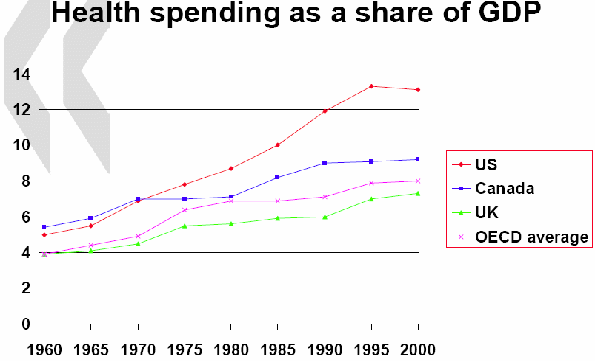
“Liberal wonks” have been sniping at Sanders healthcare plan: Single payer. In a single payer system, the government acts as the sole insurer for all basic medical needs. Think Medicare, except for everyone.

Single payer costs less than the American system–about one-third less. Take a look at the chart above and find the Canadian line. Notice what happens after Canada goes from a private to a single payer system—costs drop by about one third compared to the United States.

One can cavil about how Sanders will pay for single payer, but the fact is that it will cost Americans less than the current system.

A lot less.

The question then becomes: “Who will pay?” It makes no difference to a company’s balance sheet, or a person’s bank account whom they end up paying—private insurers, or the government. It only matters how much they pay.

Paying one-third less will be a win for everyone, except insurance companies, drug companies, and various health-care providers who price gouge, so long as it is intended that everyone win.

As for your coalition to get single-payer through, it is everyone not involved in the healthcare industry, and many people (like doctors who hate the current system) within the healthcare system.

Yes, insurance and drug companies, appliance manufacturers, private hospitals, and so on will spend an immense amount of money to campaign against single payer, but they are still a minority of the population and of businesses. There is a case to be made to every single non-healthcare company which currently offers insurance (these tend to be the large, more powerful businesses) to come out for single payer to save themselves money.

Single payer is a superior system. It costs less and produces better results on most metrics. Anyone who tells you otherwise is either lying, or has no idea what they are talking about.

“Wonks” who pretend otherwise through tedious arguments, are deceptive at best, making their bones within the system at worst. Or not actually competent “wonks.”


If you enjoyed this article, and want me to write more, please DONATE or SUBSCRIBE.

What Should Wages, Prices, and Taxes Be?

The principle is simple.

Wages and taxes must cover the cost of maintainence and replacement of capital plus any negative externalities.

Maintainence of capital, as horrible as the phrase sounds, includes workers. They must have a wage sufficient to eat well, live in a healthy place, buy entertainment, and have children. That is maintainence of “human capital.”

Taxes must be at a level sufficient to replace society’s capital base. That includes running schools, roads, courts, and all of that.

Businesses which put particular wear on specific portions of capital should be charged extra taxes. Are you degrading “natural capital” by polluting or drawing down water or timber reserves? You need to pay the replacement cost. Are you putting more stress on roads than normal businesses? You pay for that as well.

Prices should run on the same principle. Charging less than the cost of operating plus the replacement cost of capital and the price of any externalities mean the company is underpricing its goods.

“But it’s a free market.”

Free markets work when, and only when, full costs are priced in. If you charge less than the full price, you undercut those business that are charging full cost, driving them out of business. Because they were actually paying the freight for their business and you aren’t, you are free-loading, a parasite.

Competitive markets require more than the above to exist, but these are some of the requirements. One can deliberately choose, as a society, to subsidize an important sector (perhaps renewables, perhaps education), but the actual costs still need to be known and covered by society.

If you see a business or government which isn’t covering the cost of replacing its capital, whether human, natural, or otherwise, you see a business or government which is parasitical on the past, on people, or on the environment.

You will virtually always wind up paying the price anyway. But paying on the back end is far more expensive.

Corporations and people usually get rich by offloading their capital costs…by not paying them. For an example of this, look into the history and practices of Walmart, which did not, and does not, even pay its employees enough to feed themselves, and whose business practices wiped out the downtowns of most of small-town America.

The Waltons are rich precisely because they downloaded their costs onto other people and pocketed the difference.

A good society does not allow this to be done without democratic determination, and makes it as transparent as possible. If something is being subsidized, it should be known, and those who are receiving the subsidy should not be allowed to get rich off it. Want to get rich?  Great, do it in an unsubsidized business. You’re welcome to “do well” in a subsidized one, but not to become a billionaire.

This stuff is fundamental. It was well understood by the New Deal Liberals who ran World War II (no war rich!), and the post-war economy. They didn’t always live up to it, but they did know it. We seem to have forgotten.


If you enjoyed this article, and want me to write more, please DONATE or SUBSCRIBE.

The Market Fairy Will Not Solve the Problems of Uber and Lyft

Image by Admit One

Image by Admit One

Here is the thing about Uber and Lyft (and much of the “sharing economy”).

They don’t pay the cost of their capital.

The wages they pay to their drivers are less than the depreciation of the cars and the expense of keeping the drivers fed, housed, and healthy. They pay less than minimum wage in most markets, and, in most markets, that is not enough to pay the costs of a car plus a human.

These business models are ways of draining capital from the economy and putting them into the hands of a few investors and executives. They prey on desperate people who need money now, even if the money is insufficient to pay their total costs. Drivers are draining their own reserves to get cash now, but, hey, they gotta eat and pay the bills.

This sharing economy shit works in a shitty economy. In a good economy, where people have what they need, it doesn’t work.

The cab company model, with medallions and so on, was exploitative. It wound up charging customers too much, but it did cover its own costs–mostly. Uber and Lyft charge too little and siphon too much of what they charge back to themselves.

The model which made sense was the model of car-sharing, where company-owned cars could be used by those who had bought memberships in the company. This meant that the actual cost of the cars had to be covered. It was far cheaper than cabs, but not as cheap as Uber or Lyft (and you had to drive yourself). Something like that, but with drivers, could have worked.

For that matter, Uber- and Lyft-style apps could work with regulated wages sufficient to pay costs in particular markets.

The market will not miraculously produce a capital-replacing living wage. If it should do so in any particular market, that is happenstance; luck, not social physics.

This is a social action problem; a race to the bottom issue. It makes sense, individually, to race to the bottom.  Company execs and investors get rich, consumers get cheaper rides and drivers get money they need. But this isn’t win, win, win. It’s a long con. And not a very long one, either.

The cheaper wages paid to drivers, and thus the cheaper rides, also drive business with capital structures which make social sense out of business. They can’t compete with, “Drive your car into the ground, make less than minimum wage.”

Because it is a social action problem, what needs to be done is to take a game which leads to some people winning while destroying capital and people and move it to a game where everyone wins and capital and people are not destroyed. This can only be dealt with socially, by government.

“Thou shalt pay at least the capital replacement cost + a living wage for the market and shall take only an additional X percent for providing your app. If thou dost not we shall toss thine ass into prison.”

That is the social solution. It is not “The Market Fairy of supply and demand will make sure that fair, sustainable solutions always occur. All praise the Market Fairy.”

Until we stop pretending the Market Fairy is going to solve social action problems, we won’t actually solve those problems.


If you enjoyed this article, and want me to write more, please DONATE or SUBSCRIBE.

Page 381 of 532

Powered by WordPress & Theme by Anders Norén