On September 11, 2001, I was at work. As the reports came in, the company set up a TV in a large room and work ground to a halt as people watched.
I turned to a friend and said, “I hope America doesn’t attack the wrong country in retaliation.”
He scoffed.
Assuming that Osama bin Laden was behind 9/11, it was a master stroke. Osama was the first great man of the 21st century, the man who changed the course of history in precisely the way he planned. (Remember, “great” and “good” are not synonyms. Plenty of great men and women have been monsters.)
Osama was a smart man and had spent a lot of time considering the Muslim world’s situation.
He believed that the regimes he wanted to overthrow, like Egypt, survived due to the support of an enemy much further away: the US. His thesis was that US support propped up enemy societies.
The usual rule in Islam is to fight the local tyrant, but OBL argued that the US must be fought first: Only once it was defeated, or at least severely weakened, could Islam win the more local battles. He also wanted to prove that US soldiers could be defeated.
What he wanted to do was to draw US soldiers into a killing field. He figured it would be Afghanistan, and America did oblige and attack, but Afghanistan wasn’t much of a quagmire in those first years.
Then, the US decided to attack Iraq, one of OBL’s enemies, as Iraq was run by a secular regime. And Iraq turned out to be a complete mess.
The US walked all over the conventional army of Iraq, then was fought to a bloody loss by irregulars (and it was a loss–US troops had to pay bribes in order to leave the country without being fired upon).
And Islamic groups and revolution spread, and if the US wasn’t defeated, well, all the money, men, and attention spent on Iraq did contribute to the great financial crisis, and Muslims learned that they could beat the US if they were willing to take enough pain doing it.
Osama won. He got much of what he wanted. He must have praised Allah mightily for making his enemies attack Iraq.
As for the US, the “state of emergency” declared after 9/11 is still in effect. The Patriot Act is still in effect. The Authorization to Use Military Force (AUMF) is still in effect. These are the Enabling Acts of Bush’s republic–and of Obama’s.
US citizens did, in fact, lose many of their freedoms and a great deal of their prosperity as a result of 9/11.
9/11 was a milder form of the Reichstag Fire. No, Bush wasn’t Hitler, but he did change the nature of the US significantly–enough so that it is a recognizably different country than it was before.
Americans ratified those changes by re-electing Bush in 2004, knowing fully that he was torturing and so on. Then came Obama.
Obama is Bush’s heir. Anything one party does can be undone by the next, but Obama chose to roll back very little of Bush’s republic, and in fact, he extended many of Bush’s policies. He is worse on whistleblowers than Bush (far, far worse). He has performed far more drone assassinations. He has deported far more immigrants. And he has kept all the enabling acts in place.
I make no claim that the US before 9/11 was “good,” but it was better than the US after 9/11, to the great harm of very many people all around the world–including Americans themselves.
But 9/11? 9/11 was a success. It got the man who planned it about three-quarters of what he wanted.
A very great success. Too bad the US handed that success to Osama. He couldn’t have made you do anything, he had to to take a gamble on you.
Osama understood the US well enough to get the US to do what he wanted. The US did not understand Osama well enough to avoid walking straight into his trap…or they had so much hubris they figured they could walk through it unharmed.
So many dead. So many maimed. So many refugees. So many economically destroyed. So many better roads not taken.
But Osama, Osama at least was happy with 9/11.
That was Bush, and the US’s greatest gift to Osama, which outweighs his death a 1000/1. Men like Osama are not scared of death.
So much stupid, so much evil. But Osama was just evil, not stupid.
If you enjoyed this article, and want me to write more, please DONATE or SUBSCRIBE.
In his first event at the G20 leaders’ summit, Justin Trudeau urged his peers Saturday to drive away the anti-globalization and protectionist attitudes that have been fuelling “divisive, fearful rhetoric” in different parts of the world.
This is why Trudeau will join the TTP and TTIP if he can. Trudeau is a neoliberal. He believes that “trade” deals which are primarily about reducing wages, increasing intellectual property, and removing corporations from government oversight are good things. He likes Canada losing sovereignty; he thinks it’s a good thing.
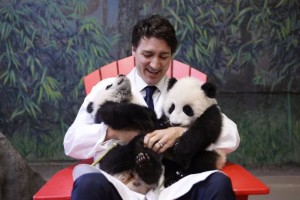
Justin Trudeau has abs. He is, well, beautiful. He has a great smile. He’s a neoliberal authoritarian who helped pass Bill-C51, a terrible bill which, among other things, makes large classes of speech criminal and allows national security to illegalize environmental protests–should the government desire it.
It’s not that Trudeau isn’t better than Canada’s previous PM Harper, it’s that that is a very low bar. Yes, he believes in multiculturalism, and in taking in refugees, and I’m glad he does, but that doesn’t offset the other ways in which he is terrible.
Trudeau’s just a prettier, slightly kinder face on standard neoliberal policies.
But, he’s pretty. And he says warm things about refugees. And he marches with gays. And he has amazing abs, and shows them off.
He parses as a really nice guy. The NDP leader, Mulcair, is fat, bearded, and can come across as intimidating. He’s more of a centrist than I like, but when Bill C51 was suggested, he immediately opposed it–even when the polls were in its favor. When there was a row about Niqabs in Quebec durign the election, Mulcair immediately supported the right to wear them. He spoke out against the effects of oil dependence on Canada’s economy when the price of oil was still high.
I won’t say Trudeau isn’t a man of principle, but I will say that his principles are neoliberal principles combined with cosmopolitanism.
But Mulcair, the fat man with the beard, has principles which include liberty and which he holds to even when they are unpopular.
More Canadians, of course, voted for Trudeau. The break point in the election, despite all the whining from lefties, was not Trudeau’s declared willingness to run deficits vs. Mulcair’s saying he wouldn’t. No, it was Niqabs. Quebec is a secular province, similar to France, in that secularism is its ideology, its religion.
Standing up for the right to wear Niqabs caused the NDP’s vote in Quebec to collapse. When it collapsed, national polls dropped the NDP below the Liberals and since soft-stupid left wingers were in “anyone but the Conservatives” mode they ran to the Liberal party.
And yeah, Trudeau is better than Harper, but he isn’t actually good on really important economic and liberty issues. Except when it comes to cosmopolitan issues like refugees and not being a dick about things like the census, his policies are not noticeably different from Harper’s. He does 80 percent of what Harper would have done, 80 percent of the harm, but without the added 20 percent of the gratuitous cruelty and stupidity.
Canadian left-wingers got suckered again. They could have had a flawed man who was genuinely anti-authoritarian, and whose economic policies, while flawed, would have included, oh, tax raises.
Instead they got Mr. Neoliberal Pretty Abs.
I’m not entirely upset by this. I think Mulcair triangulated too much on economic policy, or possibly genuinely believed in stuff like “no deficits.” Him running “center” and losing might not be the worst thing if people realize that as why he lost.
But it wasn’t his weaknesses that pushed Canadians over the edge, it was his integrity. And the love of Trudeau, even during the election, was based mostly on his status as son of a beloved past-leader and his prettiness and charisma.
Trudeau’s record was of supporting most of the worst things perpetrated by the Conservative party–the things people wanted to replace. Mulcair had a record of opposing those things.
This is similar to American leftists running to “the woman” as if Thatcher wasn’t a woman, or to “the black” as if Obama hadn’t been on his knees all election worshiping at the shrine of Reagan. Or, locally, of Liberals voting for a lesbian in Ontario, because, hey, lesbian, and waking up to find out that, on economic policy, she’s more right-wing than the last Conservative premier was. The left-wing white male candidates, like the guy who ran a food bank, well, fuck, they were straight. They couldn’t be as left-wing as a lesbian.
This inability to think, to judge actions over acting and rhetoric, and group identity markets is killing us. I mean that quite seriously. Policies are engaged in whose objective effect is to increase poverty and fuel the rise of the authoritarian right.
Our inability to overcome programming meant for living in bands of 60 people or so is killing us in a hundred ways, of which this is just one. Trudeau may be the guy you’d want to have at your house-warming party, like George W Bush was the guy you’d want a drink with, but both are bad leaders in ways that matter and that will harm many of the people who voted for them.
Democracy is swiftly moving from “the worst type of government other than all the others which have been tried” (Churchill) to “the government under which we made most of the decisions which destroyed half the world.”
Do not think those who pay the price for our failures will say, “Gee, the primary government form of the most important nations had nothing to do with it.” If you love Democracy, figuring out how to work it so it results in better decisions is mandatory, and that means figuring out how to elect better leaders.
Pretty or not.
If you enjoyed this article, and want me to write more, please DONATE or SUBSCRIBE.
As regular readers of my blog know, I’ve been meditating for some time, with some useful results.
A lot of modern meditation teaching and writing emphasizes meditation for benefits: be calmer, more loving, happier, be more effective. Heck, even “make money.” That’s all very nice, and I’ve certainly noticed benefits, but the original impetus for a lot of techniques was to learn something specific: What you really are.
A lot of what I do is “choiceless sitting.” I just sit there, and do nothing. Impulses come, thoughts come, feelings come, and I just let it all pass.
About a month ago, I woke up one morning with extraordinary clarity. I could feel each impulse to do something very clearly. Get up. Roll over. Scratch. Go check my email. Use the toilet.
Each one came very slowly and I watched it, and it subsided. And another, and another.
They were all, very clearly, external to me. I was watching them, and they were not me. The sensation was unpleasant; as though they were impositions, some outside force trying to make me do things.
This wasn’t a unique experience, but it was far clearer than during normal mediation, where the impulses felt much closer.
A Sense of Freedom
The Hindus sometimes say there are two paths: “not this, not that” and “this and that.”
On the first path, the one I’m on, you peel away everything that isn’t you until you realize that you are the witness, and everything you thought was you, like your body, your thoughts, your personality and so on, isn’t you.
This aligns very well with modern neuroscience, by the way, which finds that by the time the conscious mind is aware it has made a decision, the decision has already been made. You think you have free will, you think you make choices, but you don’t. You just rationalize choices your body has already made.
Ramakrishna put it, theistically, “You do nothing, God does everything.”
The result of this is a sense of freedom: Because you don’t actually make choices, you can stop worrying about them. You aren’t in control, it’s not your responsibility, so chill.
This idea is intensely alienated from the common understanding of the human condition, with all its emphasis on free will, and choice, and responsibility, and doing this, and doing that.
That Which Never Changes
Meditation can also produce a very profound feeling that what you are never changes. Indeed, it can’t. This core “Ian” was the same when I was five years old, 25, and today. My body and personality have changed quite a bit from age five to 25, or even two years ago, but that core is the same.
More than that, that core is the same as everyone else’s core. My self has no features different from your self.
Again, this is very alienated from the common understanding that we’re all unique flowers, slightly different from each other.
We are, but only in the non-essentials, the stuff that isn’t the self, like personality, or body, or personal history. The self, that never changes, seems to be the same for everyone.
(For the Buddhists who follow the canon that there is no self, I’ll note that I understand why Buddhists believe this. You look at everything you can sense and realize “I’m not that” and are left with nothing. I simply follow the Hindus, that nothing is something, at least, that’s my sense of it. Some Buddhists, for example many Chan Buddhists, agree.)
Because the self can’t change, it also can’t be hurt. If you identify as the self (or the nothing), there is a sense that you are impervious: Yes you can feel pain (and it sucks), and your body can be hurt, but that which is actually you remains as it always was.
Happiness for No Reason
This allows for a great relaxation: You don’t have to be scared and worry all the time. That relaxation has physical benefits; you wind up in parasympathetic mode far more often. You suffer far less stress, and you’re far happier and healthier as a result. The default “not doing anything” mode for humans is to think about the past and the future, but you start doing that far far less, which is good, because worrying and dwelling on the past makes people unhappy and imaginary threats make you stressed.
This also allows a great deal of happiness to arise. It’s not the “uncaused happiness” which comes later on the path (and which I have experienced only rarely), instead it is happiness that takes almost nothing.
“My goodness this food is wonderful. Isn’t that a beautiful bird? Isn’t it wonderful that we can make buildings which soar?”
My favorite experience was about five months ago. I was walking down the street and heard the distinctive sound of air brakes and the squeal of a bus and felt happy. Isn’t it wonderful that I don’t have to walk everywhere, and I also don’t have to own a car? (Not that cars aren’t wonderful.) I felt absurd that this made me happy. But hey, happiness.
The small things that are great (ahhhhh, this mattress is soft) you notice far more often and you receive far more pleasure from. A lot of people miss all of this: They walk in a world of wonders, and they gain no pleasure from it.
A New Relationship with Fear and Anger
In the summer of 2015, readers may remember the Greek financial crisis: Syriza had been elected and was trying to avoid the worst of the terrible austerity the Troika had forced on them.
I was pretty chill about that until Syriza betrayed the Greeks by accepting a terrible deal. I was furious. I wrote an angry denunciation and went for a walk. An hour later, I was still angry, and I wasn’t enjoying being angry. It’s not a pleasant feeling when it drags on and on.
I thought, “This is ridiculous. Being angry doesn’t help the people on whose behalf I’m angry, and it hurts me.”
If you’re like I was, or most people are, you’ve had many such thoughts: “Don’t worry, be happy,” “Just relax,” “Dwelling on your mistakes doesn’t help.” They’re all versions of, “Being unhappy doesn’t help the situation.” You think the thought, and whatever emotion you’re stuck in, or problem your dwelling on, doesn’t go away.
But this time it did. Just disappeared. And I was happy.
A couple hours later, at home, I started dwelling on my personal financial situation. Not good. I was poor and if I didn’t get some money, I might even wind up on the street. I reviewed my plans, and what I was willing to do to avoid such a fate, and then I thought, “Dwelling on this further won’t help. I’ve made my plans, I’m doing what I’m willing to do, so there’s no point in making myself unhappy by dwelling on it.”
Again, I’m sure most people have such thoughts, and most of the time they don’t work. Maybe we stop for a few minutes, through willpower, but soon we’re back to it.
This time, however, I stopped, and I was happy and I didn’t go back to it. No point. When new facts come up about my finances, I revisit, decide what I’m willing to do and pack it away.
Not Giving a Shit
Life is often a shit show, but as Twain once wrote, “I am an old man and have known a great many troubles, but most of them never happened.”
I didn’t change any of what I had planned to do about money, I didn’t worry, and so far (at least), I haven’t wound up on the street. Even if I had, I might as well enjoy the day. And for the day I have food, internet, books, and a place to sleep that is air conditioned and rather comfortable. Why should I be unhappy?
None of this means that bad stuff doesn’t happen or it doesn’t suck when it does. Many years ago I talked to someone who was probably enlightened and asked about enlightenment and suffering. They said, “There is no suffering when you’re enlightened, but it’s still better to have less pain.”
I didn’t understand that then, but I do now, even though I’m not enlightened. What you learn to do is not add anything to whatever pain you’re experiencing, to not care that you’re in pain. That reduces the effect of the pain significantly, but it doesn’t mean that pain doesn’t still suck. Enough pain and you’ll still be screaming with the worst of them. Still, you know it doesn’t harm that which is truly you and you know that it will end.
It’s funny that I started this article by saying meditation is about finding out what you are, not about benefits, then turned to the benefits. But like a lot of things in life, if your primary concern is the benefits of the action, those benefits are often slower in coming. Most of the benefits of meditation come from not caring.
I often joke: “The whole of the path is not giving a fuck.”
It’s a joke. It’s also true. The first time I listened to this “guided meditation” I laughed myself sick, because it’s exactly right.
Happiness is not giving a shit. It is not worrying, not dwelling and moving on. It isn’t not planning or not trying to fix things, it’s not mindless. You do what you can, you make your plans, but you don’t dwell. Someone insults you, say, you may get angry, but you aren’t thinking about it three hours later. You experience pain, you don’t start down the self pity road and once it’s done, it’s done.
You don’t add.
Let the Happiness Pass
I’m not perfect at this, oh no. I make no claims at enlightenment. But I am far far better than I was two or three years ago.
Everything passes and most of the suffering of life comes from what you add to what actually happened.
And strangely, not caring, not clinging, leads to a lot more happiness. Ordinary people think that if you’re happy you should grab on to it hard, but that kills the happiness. Be happy, let it pass, and something else will happen to make you happy.
These, then, are some of the fruits of meditation. Eat, and enjoy.
If you enjoyed this article, and want me to write more, please DONATE or SUBSCRIBE.
So, the author of the Harry Potter books has come out hard against Jeremy Corbyn, and for Blairism. She has defended the Blairite legacy, and she has some good points: There were more nurses and teaching assistants, for example.
One could note that Blairism, as with all neo-liberalism before the crash of 07/8, was unsustainable. It was based on bubbles. Though it is true that Blairites did distribute more money than Conservatives have past the bubble: Insane austerity was not yet the guiding principle of the day.
Unsustainable means “helped cause the crash.” It’s true that Blairites would be less cruel than Conservatives, and it is also true that almost every MP who opposed Corbyn also abstained from voting against Welfare cuts, for example.
I don’t want to get too down on Rowling. As very rich people go, she’s a pretty good one. She doesn’t dodge taxes, she supports social welfare spending, and so on. “High” UK taxes are why she’s no longer quite a billionaire. (Quite; you needn’t worry she’ll be on the rolls again.)
But I think to understand Rowling’s love of Blairism one should understanding three things. First, she got welfare and doesn’t seem, again, to have noticed that the Blairites she loves are now anti-welfare.
Here are the other two things which might be important to understand Rowling’s love of neoLiberalism:
1)
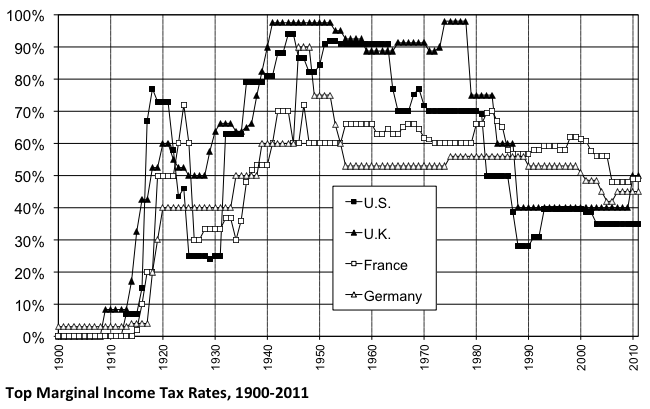
Top Tax Rates
Whatever else is true of Corbyn, if he becomes Prime Minister, he will raise taxes on the rich.
2)
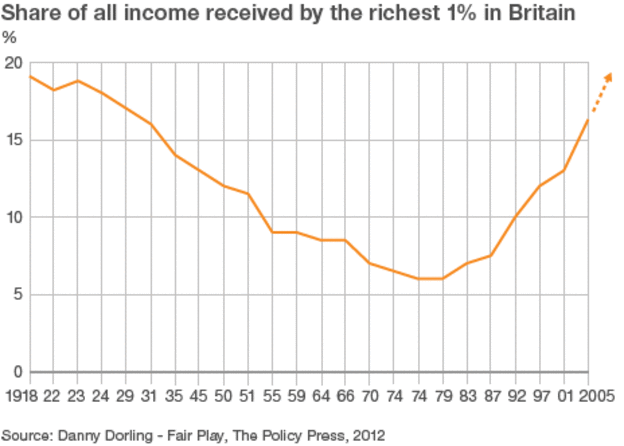
UK one percent share of income to 2005
Blairism is kinder-gentler Thatcherism. It is neoliberalism, and rich people have done very well under neoliberalism. Though this chart doesn’t show it, the top .1 percent do even better, the top .01 percent even better, and so on.
I don’t doubt Rowling’s good will, or her concern for those who have less money than she does. She’s put up by paying taxes she could have dodged. But that doesn’t alter the fact that neoliberalism has been very good to her, and she’d have been a ton less rich if the policies Corbyn favors, as epitomized by tax rates after WWII, plus far less generous copyright protection, had been in force.
Blairite neoliberalism, like Clintonianism, is the policy regime that lets rich and upper class people feel good about themselves. They get most of the benefits of neoliberalism without having to watch a boot stomping a face over and over again, as under Cameron.
That doesn’t alter the fact that neoliberalism is a cruel, unsustainable policy regime based on exporting British manufacturing, favoring “the City” and the financial industry over all others, and on pushing income and ownership of assets towards a small number of people. Nor did that change under Blairite Labour.
Rowling, of course, also thinks that Corbyn can’t win. Maybe he can, maybe he can’t. It’s certainly true that Labour infighting has seen the polls move heavily against Labour. It’s not clear, however, that this is Corbyn’s fault, or that it will be true come election time, or that a Blairite leader could win election either. Labour has been losing, and its collapse in Scotland did not happen while Corbyn was leader, nor probably would have, as it was driven in part by anger at austerity policies which Labour refused to oppose.
All this, however, is neither there nor that. The bottom line is that being a Blairite, Clintonian, or other third-way type, allows the rich and well-off to have their wealth and their tax cuts, and feel good about themselves. Rowling may be 100 percent motivated by the milk of human kindness, but she is still supporting a regime that has done very, very well for her against the possibility of a change which would damage her financial position significantly.
If you enjoyed this article, and want me to write more, please DONATE or SUBSCRIBE.
Rousseff has been impeached and removed, supposedly for corruption, though there’s little evidence she personally benefited from corruption, while many of those who impeached her are very corrupt. Brazil was a “miracle economy” for much of the past decade and a half while the “left” ran things, but much of that was due to forces beyond local control, like the price of oil and the strength of the world and Chinese economies.
President Michel Temer said on Wednesday that fixing Brazil’s economy would not be easy, but his priority was to pass a spending cap this year, attract foreign investment, reduce unemployment, and begin pension system reform.
A.K.A., neoliberal austerity. Unions will be crushed, pensions will be cut, spending will be cut, and outsiders will be allowed to buy up Brazilian companies and resources for relatively cheap, so long as Brazilian elites get a cut.
Rousseff wasn’t the greatest prize, having run neoliberal-light policies in many areas, but she wasn’t personally corrupt and she engaged in far less austerity than Temer will.
Parties of the left are being crushed in much of South America for the simple reason that they ran the countries during the resource boom of the 2000s and have not been able to manage the drop in resource prices, first from oil, then generally as China stopped buying so many resources. I’ve discussed the perils of basing a left-wing government on resources before.
There are a variety of issues around private companies producing pharmaceuticals. They basically come down to: (1) It’s expensive; (2) There are huge regulatory barriers to entry, and; (3) People who need medicine will often pay almost any price for it.
Worse, companies that sell medicine don’t want cures, they want palliatives–drugs you have to take for the rest of your life which don’t actually heal what’s wrong with you.
The simple, obvious solution is as follows:
The government takes over all manufacturing of cures and the distribution system. Even if this is “inefficient” the government’s “inefficiency” will not result in the price gouging in which these private actors engage.
The government offers bounties for new medicines. Very large bounties in the billions.
Yes, there are plenty of details to be worked out, but this outline works because government, when not captured by private actors, is incentivized to want cheap medicines and cured people; sick people don’t pay as much tax and government pays so much of the health-care bills. This is true even in the US. Between Medicare, Medicaid, and huge subsidies, the US government pays as much per capita as most universal health care countries, without actually getting universal health care.
Bounties will change the focus from palliatives (though some are good) to cures, simply by offering huge bounties for cures.
Yes, some research funds are necessary, but the bounty must be large enough that people won’t want to keep doing research to get those funds, but will want the big payoff at the end.
This isn’t my idea, many economists have suggested bounties.
But it’s a good, obvious, idea.
There are other ways to do this. In particular, you could just move all research to the public sector (which funds most of it anyway) and have an agency which is responsible for getting new medicines through the approval process, which is most of what Pharma does. Make sure scientists will get a modest bonus for a cure and know they’ll be moved to another problem rather than let go, and voila, they’ll want to create cures.
Add in a patent fix of mandatory licensing and shorter patent periods, and you’re pretty much done. (EpiPen and insulin prices are not patent issues, but patents are the cause of much elevated price-related suffering elsewhere.)
Fixing Pharma is like fixing most other problems. It’s only difficult because we refuse to do the obvious, and we refuse to do that because the people who are making a killing at it have bought the government.
If you enjoyed this article, and want me to write more, please DONATE or SUBSCRIBE.
All those involved should go to jail, maximum security, where the nasty people are, and pharma production should simply be taken over by the government, while all patents are moved to a mandatory licensing system with durations slashed to the bone (that’s right, neither insulin and EpiPen are in patent protection, which shows just how broken the US system is).
“This borders on the unbelievable,” Davidson said, citing an extremely concentrated insulin which “in 2001 had the wholesale price of $45. By last year, the cost had skyrocketed to $1,447” for the same monthly supply.
….
From 2011 to 2013, the wholesale price of insulin went up by as much as 62 percent. From 2013 to 2015, the price jumped again, from a low of 33 percent to as much as 107 percent
There is simply no question that this will kill people. Those involved should be charged with negligent homicide.
But, hey! Rich people are fine, so it isn’t actually a crisis.
If you enjoyed this article, and want me to write more, please DONATE or SUBSCRIBE.

 On September 11, 2001, I was at work. As the reports came in, the company set up a TV in a large room and work ground to a halt as people watched.
 One of those amusing scientific studies runs as follows: Someone in a supermarket knocks over a large display of canned goods. They either: