Ian Welsh

The horizon is not so far as we can see, but as far as we can imagine

Saudi Arabian Collapse Continues

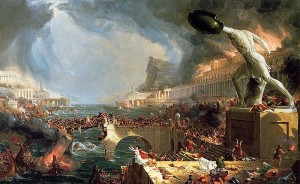
The Course of Empire by Thomas Cole

The Course of Empire by Thomas Cole

Saudi Arabia is engaging in, in the words of the Guardian, a privatization so comprehensive it dwarfs Thatcher or even the great post-Communist Russian fire sale.

That’s…large.

It is also a consequence of the price of oil. Saudi Arabia isn’t making enough money from oil to support its government expenses.

They could directly tax or charge their population for the difference, of course, but privatization allows them to sluff off the blame. Sell assets that can charge more and cost more than they make right now, let private actors do the charging.

This kicks the problem down the line a bit, and distances the Saudi Royal family from some of the blame, but it doesn’t make much difference in the long run.

Saudi Arabia needs much more from the outside world than Saudi Arabia now produces. That’s what has to be changed, and the situation is only going to get worse. (When electric cars become the norm, Saudi is cooked, as I have noted before).

The assets the Saudis are selling are also that which make them legitimate to their population. The House of Saud bought a lot of peace from their subjects by spending a lot of money on their subjects.

When they aren’t able to do any more, their legitimacy will take a huge hit. If they aren’t doing anything for people, why keep them around?

I stand by my prediction of revolution in Saudi Arabia. Timing is always hard to predict, but 10 to 20 years seems likely.

This is exacerbated by incompetence at the top. The war in Yemen was supposed to be over in months, and isn’t; it’s a fiasco. The blockade of Qatar was supposed to bring them to heel, and hasn’t, but has pushed them into the orbit of Iran and Turkey.

The current generation of Saudi rulers are spectacularly incompetent. This isn’t surprising, it happens to all wealthy or powerful families in time when their scions are protected from the real world, which the Sauds always have been.

Buying Saudia assets located in Saudi Arabia may work out very well for some people. But it will be a political and possibly military game as much as a financial game. As such, it is only for sharks. A lot of people got hurt trying to make money after the USSR fell, and while some won big, they were a minority.

The prelude to the Age of War and Revolution chugs on.


The results of the work I do, like this article, are free, but food isn’t, so if you value my work, please DONATE or SUBSCRIBE.

Korea Claims to Test a Hydrogen Bomb

Meant for ICBMs. AKA: Metropolis killers capable of reaching the US.

North Korea is a nuclear armed state now, and must be dealt with as such.

Note that this mess is George W. Bush’s fault. There was a deal in place, under Clinton, which gave North Korea what it wanted in exchange for not further developing nukes, and Bush cancelled it. It wasn’t the greatest deal, but it was better than this.

Right, so there are two choices here. Go to war with North Korea in a sneak attack. To reliably take out their nukes, the US would have to use nukes itself. China has said that it would defend North Korea if the US attacks it, however, and if they do, we’re talking WWIII. The US would probably “win,” but it’s quite likely it would be a nuclear war.

AKA: No winners. And even if China doesn’t get involved, much of Seoul goes up in flames and if the North Koreans do get off a nuke, well, Tokyo, the world’s largest metropolis, could get hit.

Alternatively, perhaps it is time to sign a peace treaty with North Korea and integrate it into the world economy, in exchange for no further development of nukes. I mean, strictly speaking, North Korea is still at war with the US and other nations, because no peace treaty was ever signed.

They might be, well, nervous about that. Totally crazy, I know, since the US never attacks other countries that… uhh, wait, where was I?

Yeah, so, negotiate a real peace treaty, or go to war, or… ummm, just let them keep getting more and more weapons till they really can destroy the US and pretty much anyone else.

In a sane world, only one of those three options would look good.


The results of the work I do, like this article, are free, but food isn’t, so if you value my work, please DONATE or SUBSCRIBE.

On Wells Fargo

So, the latest revelation is in:

The scope of Wells Fargo’s fake accounts scandal grew significantly on Thursday, with the bank now saying that 3.5 million accounts were potentially opened without customers’ permission between 2009 and 2016.

That’s up from 2.1 million accounts that the bank had cited in September 2016, when it acknowledged that employees under pressure to meet aggressive sales targets had opened accounts that customers might not have even been aware existed.

Yeah.

I once worked for a mid-sized multinational financial corporation.

Everyone who was anyone, and everyone working in the departments in question, knew.

You can’t have numbers like these and not have everyone involved know. It cannot be done.

Everyone is either compromised or was incompetent. There will be a few exceptions, in technical corners away from executive suites and the front lines, but they will be few.

My old employer never did anything this bad (of which I was aware), they engaged in aggressive corner cutting, but tried to stay, well, legal. But when they did something dubious, it was known, even at the floor level.

And it was always driven by high-level executive demands for targets that simply could not be met by staying in the straight and narrow. Always. Low-level employees do much of the dirty work, but they do it because it is demanded, and because if they don’t, they will be let go or fired.

Numbers which can only be made by cheating, will be made by cheating. It is that simple.


The results of the work I do, like this article, are free, but food isn’t, so if you value my work, please DONATE or SUBSCRIBE.

Review: The SPQR Series by John Maddox Roberts

Amidst all the non-fiction, I thought it would be nice to review some fiction.
This is a series of detective novels set in the late Republic. It starts just before the Cataline conspiracy and runs, as of now, until somewhat after Caesar’s assassination.

The detective is Decius Caecillius Metellus, who starts out as a young man whose family is a powerful force in the Senate.

I’ve loved this series since the 90s, when I stumbled across it. Decius feels Roman, while still being sympathetic to moderns. He loves gladiatorial games and chariot races–he’s very relaxed about violence, but he lacks cruelty and is pushed forward by a sense of obligation to his fellow Romans without spite to non-Romans.

And he’s funny. The stories of SPQR are lovely mysteries, not the greatest, but what really makes the series shine is Decius’s first person narrative and its absolute lack of reverence to the subjects.

Because Decius is of the Plebian nobility, and from an important family, he can call on all the major figures anyone familiar with the period knows: Caesar and Cato and Crassus and Pomey and Milo and many many more. Decius sees these people as his social equals, without the gloss of history. Caesar in the years before his rise to power is described as someone who is known mainly for his debts, the marvel of all Rome, and for almost certainly having been buggered by the King of Bythnia.

Cato is treated as an honorable boor, cruel besides, who is the butt of jokes. Cicero is treated with more respect, but his weaknesses are clearly outlined.

And Deciu’s best friend is Milo, one of the gang leaders fighting for control of Rome, and protected by Cicero.

I’ve never read a series of books that makes a time and place come quite as alive as SPQR does, and SPQR moreover is fun, and often irreverent, without glossing on the cruelties of Rome, but without dwelling.

To Decius this is how things are, and he may disapprove of some of it, but he accepts it as we accept our world. He lives in it, and he takes us with him, and he’s no prude: He wades in, enjoying the food, the fleshpots, and the violence with an honest glee that allows us to see the world with him.

For years, I used to carry two or three of these novels with me whenever I traveled, and I’ve read the first half dozen of them over 15 times each.

For some reason, they’re quite popular in Germany. They’re not so popular in the US, but you may find in them something you enjoy as much as I do.

I hope so.

(The earlier ones are generally better, and while you don’t have to read the series in order, I think it is best enjoyed thus.)


The results of the work I do, like this article, are free, but food isn’t, so if you value my work, please DONATE or SUBSCRIBE.

The Further Tragedy of Hurricane Harvey

All right, this is bad, and yes, climate change is almost certainly a factor because hotter temperatures allow air to hold more water and increase the likelihood of higher winds, but I want to talk about what will happen afterwards.

When Sandy hit New York and New Jersey, it sucked, but the real damage happened afterwards. Poor people couldn’t afford to fix their homes and were forced out. In New Jersey, beach front properties owned by poor people, which had been in their families for generations, wound up on the market to be bought up by rich people.

Aid was systematically diverted from poor people to their “betters” and the poor parts of town were allowed to rot.

Every disaster like this is an opportunity. When New Orleans was hit, the aftermath was used to destroy public education and bring in charter schools, for another example.

When disaster strikes, the vultures are ready. Harvey will be used to buy up poor people’s property for cents on the dollar and force them out.

That, in America, is what disasters are for.

It is nice to see everyone getting together to help, but the real co-operative action we’ll needed when the government fails (as it will) will be that of people helping each other survive and keep their homes against the efforts of those who want to take advantage of their misery.

And, American civil society being as weakened as it is, except for some efforts on crowd-funding sites and a few overwhelmed community orgs, that cooperative action will not occur on nearly a wide enough scale.

And the rich will get richer, and the poor, poorer.

This is a long-term dynamic. It has been de-facto government and social policy since Reagan.

And it will only change when neoliberalism falls, and only IF it is replaced by something better.


The results of the work I do, like this article, are free, but food isn’t, so if you value my work, please DONATE or SUBSCRIBE.

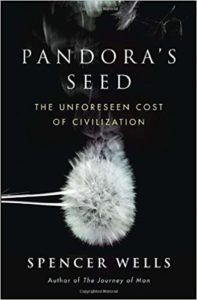
Book Review: Pandora’s Seed by Spencer Wells

There have been a number of technological revolutions during humanity’s existence. Perhaps the most important was the stone age tool revolution, really, but that’s not one we tend to focus on, it being so far in the past. Instead, we focus on the agricultural revolution and the industrial revolution.
Pandora’s Seed is about the agricultural revolution. As the title suggests, Wells thinks the agricultural revolution was something of a disaster.

This isn’t a novel argument any more, most people have heard it made, and certainly any long time reader of this blog knows I think it is essentially true.

The argument is simple enough: When we look at hunter-gatherers from before the agricultural revolution, they’re healthier and they live longer. After the agricultural revolution, and especially later, after the hydraulic revolution, we are sicker and die sooner. We have a lot more disease. We have gum disease and tooth decay. We are shorter. Women’s hips are narrower, meaning childbirth is harder and the women are less healthy (hip size correlating quite nicely with overall health in women).

Most of these metrics don’t recover for thousands of years. It is not until Hellenic civilization that most of them are exceeded, and when Hellenic civilization collapses, the growth in those metrics ends.

Women’s hip width has STILL not recovered.

And remember that average age statistics include childhood deaths. Take them out, and the average lifespans of many ancient societies look a lot better. It’s a misunderstanding of the general consensus that the natural lifespan was 35 years. The life span was actually about 70, and people who didn’t get to that age didn’t get there due to privation, disease, violence or death in childbirth.

We evolved as hunter-gatherers. It is that simple. We are adapted for that sort of lifestyle. We have made some genetic adaptations to the agricultural lifestyle, without question, but we are not fully adapted to it. The use of cultural change instead of genetic change has led us to be ill-adapted for the way we live.

This becomes, in certain respects, even more extreme post-industrial revolution. It is unquestionable, for example, that we have far more mental illness than our forbears. Humans handle living in industrial society even worse than they do in agricultural societies. We have rampant obesity, because humans are not meant to have easy access to this much sugar and empty carbohydrates all while sitting on their asses all day.

When we do perform labour, whether agricultural labor or industrial, it is generally bad for us. The human body is made for hunting and gathering, not for rote, unnatural repetitive movements, over and over and again.

So in agricultural or industrial societies we eat in ways to which we aren’t adapted, and we work in ways to which we aren’t adapted. And it makes us sick and unhappy.

That is not deny to the obvious benefits of industrialization in particular, simply to note its underside.

As for agriculture, it prevailed because those who took it up (or herding) tended to win wars. Hunter-gatherers were happier, healthier, and lived longer, but they lost wars, and because they didn’t shit nearly as much where they ate, they didn’t have the disease resistance of sedentary agriculturalists. Just going near agricultural settlements would have often been a death sentence.

The core point here is simple: Social and technological advancement are not the same things as increases in human welfare. Mistaking one for another is vastly stupid. Social or technological advancements win if they out-compete other models, and that competition is not based on “is nicer,” it is based, ultimately, on violence. (Most of the world, having been conquered by Europeans after the industrial revolution, is real, real clear on this.)

The agricultural revolution didn’t run humanity off a cliff. But the industrial revolution and our advancements in military technology (aka. nukes) offer us the ability to “win” ourselves to extinction, while making ourselves vastly unhappy doing so.

Perhaps it is time to learn how to take to conscious control of our technology and society, before our unconsciousness causes catastrophes we cannot handle.

This is an important book, to nail into our heads the facts about how advancements work, in a time period long enough ago that we can hopefully look at it with the faintest shred of objectivity.


The results of the work I do, like this article, are free, but food isn’t, so if you value my work, please DONATE or SUBSCRIBE.


The World Is Going to Hell Because

Globe on FireYou get the behaviour you reward.

Politicians in the US, with the Iraq war and the vote to have it, committed the exact same war crime most Nazis were hung for: aggressive war.

They, including the most responsible politician, George W. Bush, were not punished for it. Indeed, Bush was re-elected and so were most of the others.

In 2008, there was a vast financial crisis, caused by bankers and Wall Street brokers and so on–financial executives. It included a widespread amount of fraud, aided and abetted by ratings agencies, financial regulators, and central banks.

No one was held responsible and sent to jail. Instead, they were bailed out and allowed to keep their illicit profits, and the same games that caused the crisis were reinstituted alongside aggressive money printing targeted at the class of people who caused the crisis.

In other words, the people who caused the financial crisis, as a class, were rewarded for that their behavior.

We have an ongoing problem, due to turn into a worldwide catastrophe causing over a billion human deaths and so many non-human deaths it will show up clearly in the geological record. It is called climate change.

Oil companies knew that climate change was real, based on their own research, back in the 80s. Not only did they not make that research public, they spent large amounts of money to fund propaganda saying that what they knew was true wasn’t.

Put more simply, for their own personal and financial gain, major corporate executives did their best to make sure that information known to be true, which might have helped stop a billion or more deaths, was not acted upon.

They have not been punished for that, but they have, indeed, retired wealthy and happy.

If people who knowingly do very very bad things (like causing the death and suffering of millions of people in wars, economic downturns, and forseeable environmental catastrophes) are not only not punished but rewarded, then more of the same behaviour will occur.

During his term in office, Obama increased drone murders significantly and destroyed Libya, in a war of aggression (the same war crime that for which Nazis were hung, and Obama also should be in a war crimes dock along with every other Western leader involved in Libya). He was then re-elected.

None of this stuff should be hard to understand. If leaders who do monstrous things are rewarded, as opposed to punished, for doing those things, more leaders will do even more monstrous things. They have been shown that is what is rewarded.

Welcome to a world tottering towards hell, because that is what too many people want–as measured by what they reward.


The results of the work I do, like this article, are free, but food isn’t, so if you value my work, please DONATE or SUBSCRIBE.

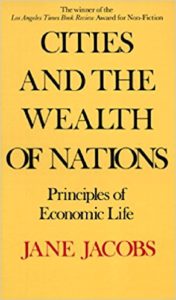
Review: Cities and the Wealth of Nations by Jane Jacobs

Jane Jacobs came to prominence with the publication of The Death and Life of Great American Cities, which examined what made cities succeed and fail in extremely minute detail–such as how pedestrians walk on sidewalks and what makes parks safe. It’s a brilliant book, and reshaped urban planning, but I’ve always found her economic duology, The Economy of Cities and this book more useful to my interests.

Cities and the Wealth of Nations was published in 1984, and starts with the observation, and case, that the economy of much of the world seemed to have gone off track in a semi-permanent fashion: Something had changed from the post-WWII economy, something which downshifted the economy.

When I first read this book, around 1990, I didn’t think much of that position, but I now know it’s true: Between 1968 and 1980 a vast variety of economic and social metrics all shifted to new tracks; bad tracks. From inequality to wage growth to productivity to growth in the third world, it all went bad.

Jacobs thinks that the way we analyze economies is wrong from the bottom up. Nations, to Jacobs, make no sense as economic units. Canada and Singapore and Britain have almost nothing in common except the fact that they are sovereign units.

To Jacobs, as one would expect, cities are the fundamental economic unit. It is in cities that new work, new industries, are created. It is cities which generate economic forces, forces which affect non-city regions unevenly.

When you lump cities together with non city regions, economics gets ugly. Part of this is feedback: Because cities are the fundamental economic units, when they grow, they should receive the feedback of imported items growing cheaper; and when they are stagnant or shrinking, imported items should become more expensive.

Put simply, cities should have their own currencies, but don’t. They are lumped together with other cities and with non-city regions, and the import/export effects of those regions swamp what each city needs.

In sovereign areas, with multiple economically active cities, this tends to crush all cities but one: You can see this most clearly in England, which used to have many economically active cities and which, as of Jacobs’ writing, was down to two: Birmingham and London.

London, basically, drove the value of the pound. This was inappropriate to the needs of other cities and strangled them, turning them economically inert: They were cities only in the sense of their populations, they were not economically viable cities where large amounts of new work was still generated.

Large hinterland regions do the same thing: If you have a lot of agriculture or a lot of mineral resources or anything else from your hinterlands, the exchange rate will tend to be propped higher than the city(s) need, again strangling growth.

Workarounds for this are always inefficient. You can do what the US did in the 19th century and have tariffs, but that hurts agricultural and resource regions–they simply aren’t receiving what they should from their labour, and is doesn’t eliminate the multiple cities problem.

So, ideally, cities should have their own currencies, and so should non-city regions, so that everyone is getting the feedback they require (steps must also be taken to ensure that currency rates are driven almost entirely by export/import, and not by speculation or by central bank/government manipulation).

This is hard to do in the real world, for obvious reasons, but I agree with Jacobs we should find a way to do it.

Jacobs also spends a lot of time detailing how cities influence non-city regions; almost always in ways that deform the non-city regions and often harmfully.

The first of these influences are supply regions, which produce something cities want. In the modern era, the foremost of these might be Saudi Arabia: It’s rich, because it has oil, but with almost nothing else it is doomed to poverty once oil is no longer important. Economically productive cities want the oil and want nothing else Saudi Arabia produces. When those cities stop wanting that oil (or enough of it), doom will fall. (Jacob uses the example of Uruguay, which was once very prosperous, but never had economically active cities.)

The second influence is regions workers abandon–a place where everyone leaves to go to cities, because there is no work in the region. Examples are distressingly common, and all the screams in the US about immigrants are essentially about such regions in Mexico and further south–places where people can’t make a living, and have to leave.

A variation on this is clearances. New technology displaces workers out of regions. The classic case was peasants forced off their land in Britain, so landowners could enclose the land and grow crops or tend sheep for more money. But this happens all the time in the third world, where subsistence workers are forced off the land for plantations, and is a regular occurance today in China, where people are cleared out of a place so that suburbs or mines or whatnot can be built.

The next type is capital for regions without cities. Jacobs uses the example of the Volta dam in Ghana. It has a huge hydroelectric power supply, but there’s no real value to it, because there is no industry to take advantage of it. All the while, the dam itself destroys local agriculture, hunting, and fishing. Large amounts of money also often go into picturesque regions used for vacations, driving out most of the people who were there before the money arrived, distorting their economy.

Then there are places that were once cities; economically productive, which lose their productivity. Jacobs gives ancient Egypt as an example: the heart of a technologically sophisticated civilization, eventually reduced to mostly subsistence agriculture and no longer one of the beating hearts of the ancient world. A better example, I think, is Europe in the Dark Ages. When the Arabs cut off trade, Europe swiftly became a backwater hole, losing almost all of its advanced cities and spending centuries sinking into poverty before it started growing and advancing again the Middle Ages.

Economically active cities, in short, are powerful, and they often do nasty things to regions that are not cities. Even when what they do seems good, as with demand for oil, or Uruguay’s produce and minerals, it is a boon that can disappear at any time.

Jacobs points out one other thing of note: Backwards cities are best off trading with each other, rather than with the more advanced cities. This was, by the way, a more prevalent pattern in the post-war period before neoliberalism, and in that period growth was faster. The argument is simple enough: Advanced cities often don’t need the goods produced by backwards cities, but other backwards cities do.

Overall, this is an important book. One of the most important I’ve ever read. The point about broken feedback and economic units not making sense is absolutely fundamental and explains a simple fact: City states which can manage to survive the political-military environment, almost always do very well. The ideal economic circumstance is a world of city states, but we don’t have that due to military political reasons (they can’t defend themselves).

That doesn’t mean we shouldn’t figure out a way to get the results of city states while allowing for defense.

To me, then, it’s a must-read book, and perhaps Jacobs’ most important.


The results of the work I do, like this article, are free, but food isn’t, so if you value my work, please DONATE or SUBSCRIBE.

Page 345 of 532

Powered by WordPress & Theme by Anders Norén