
Ian Welsh

The horizon is not so far as we can see, but as far as we can imagine

The Mueller Report: Who Cares?

I’m running a little late on this one as I found out Friday night that I had to be out of my place Tuesday. My landlord was not up to fire code, and the city was (is) going to shut the place down on Tuesday. So, a scramble to find a new place, though in the end I found something nicer in a better location.

Right then, Mueller. I haven’t written much about “RussiaGate.” There are other people who have done a better job, taken a closer look.

The Barr letter (pdf) summarizes the finding. Mueller found that the Trump campaign was not engaged in a conspiracy with Russia to steal the election, although the Russians did try to effect the election. He punted on whether Trump was guilty of obstruction of justice, and Barr, as one would expect, decided that obstruction had not occurred.

I’m not going to go into the weeds on this. Trump is clearly corrupt and clearly meets the emoluments bar for impeachment.

I never liked RussiaGate, for a number of reasons:

The DNC Hack Information Was Correct

I think that for ordinary people the fact that the DNC was trying to fix the primary for Clinton over Sanders is actually more important that the fact that the scuzzy behavior was discovered by hacking.

Mueller Is a Republican

I really don’t understand this fetish for thinking Daddy Republicans will take down other Republicans. I’m not saying Mueller is corrupt or looked the other way, but why keep expecting Republicans to do your job for you?

It Distracted from Real Problems

Clinton just ran a bad campaign. She didn’t campaign in the key post-industrial battleground states which cost her the election and she ceded the populist economic argument to Trump, among a number of errors. She just isn’t a good campaigner. She lost a Primary to Obama which was hers to win, she lost against Trump, the Presidential candidate with the highest negatives of any candidate since polling. She was just a bad candidate.

But more to the point, acting as if Trump was more important than bad campaigning, gerrymandering and voter suppression puts attention away from issues that Democrats could actually learn from and do something about onto a spooky “evil” foreigner. The demonic Putin, who despite leading a state which is much smaller than the US, the EU, or China in terms of population and GDP, is apparently the Dark Lord reborn and from whom all bad things follow.

If Russian interference made the difference it made the difference because the election was so close that everything made the difference, and because there were real American problems (and wrongdoing at the DNC) to exploit.

Russiaphobia Is Baaadddd

Russia may be a declining great power, but it is still a great power with a LOT of nuclear weapons and one into whose sphere of influence the US has been aggressively pushing. A lot of Russians genuinely think America wants war with them. They’re scared.

And, yeah, a scared declining great power with a lot of nukes is… baaaaddddd.

Concluding Remarks

Trump is corrupt and has engaged in illegal activity. Mueller was never needed to prove that, because he does much of it openly. He never did get rid of the Magnitsky sanctions, which is mostly what Russia wants (and which I think should be gotten rid of), and when you look at substantive actions has done little that is good for Russia. I actually would like better relations between the US and Russia, to avoid war and possibly nuclear war and so on, so I think this is bad, but it’s all a sideshow.

If Democrats want to impeach Trump, you can do it now. Can’t convict in the Senate, but he’s clearly guilty and they can drag him through the mud any time they want: He’s corrupt and rotten to the core. (In ways that are more obvious than Obama’s terrible corruption, because Obama waited to be paid off until after he was out of office, just like Bill Clinton.)

Russiagate, whatever validity it has, was always bad politics and a way of avoiding real problems. Democrats need to stop expecting Daddy Republicans and the FBI to save them and take steps to win and defeat Trump themselves.


The results of the work I do, like this article, are free, but food isn’t, so if you value my work, please DONATE or SUBSCRIBE.

Week-end Wrap – Political Economy – March 24, 2019

**This post is by Tony Wikrent**

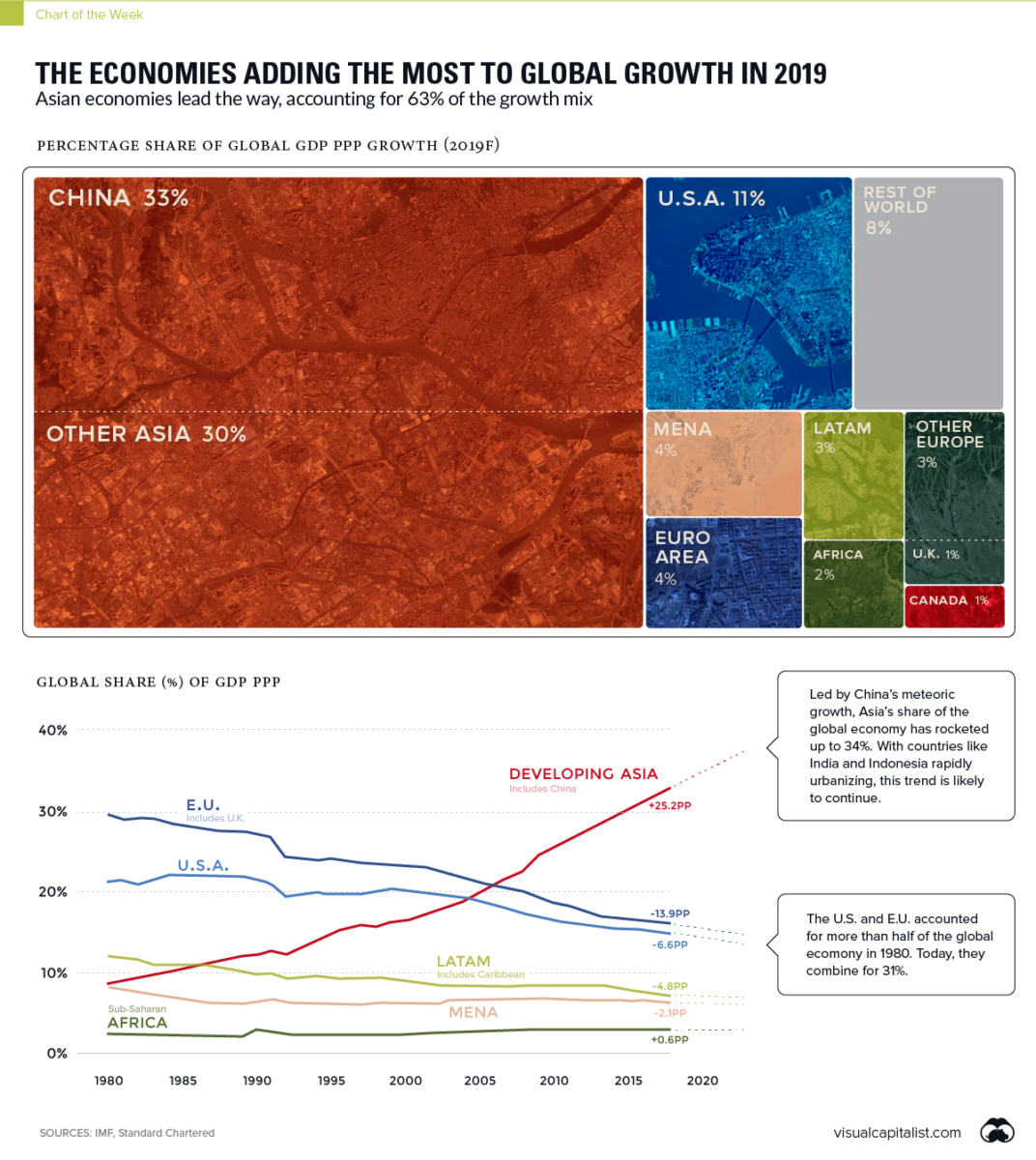
Economies Adding the Most to Global Growth in 2019
Barry Ritholtz [The Big Picture  3-19-19]

‘Full-Time Freelance’ Is Just the Industry Standard

[Splinter News 3-14-19]

On Monday, David Tamarkin, the site editor at Epicurious, a Condé Nast food publication, tweeted out a job posting for an editorial assistant. The position, Tamarkin wrote, was “full-time freelance,” meaning the person filling the job would work 40 hours a week and perform the duties of a full-time employee. After two days of online outrage and backlash, including users virtuously snitch-tagging the New York State Department of Labor, Tamarkin tweeted on Wednesday that the position would indeed be eligible for benefits.

Wage growth for low-wage workers has been strongest in states with minimum wage increases

[Economic Policy Institute 3-18-19]

Low-wage workers in states that increased the minimum wage between 2013 and 2018 experienced wage growth at a rate 50 percent faster than those in states with no minimum wage increases. Check out EPI’s new interactive map to see the count of workers in each congressional district that would receive wage increases if Congress passes the Raise the Wage Act of 2019.

Record U.S. trade deficit in 2018 reflects failure of Trump’s trade policies
By Robert E. Scott [Economic Policy Institute 3-18-19]
California Jury Finds Roundup Caused Man’s Cancer
[NPR 3-19-19]

A San Francisco federal jury unanimously agreed on Tuesday that Roundup caused a man’s cancer — a potentially massive blow to the company that produces the glyphosate-based herbicide currently facing hundreds of similar lawsuits…. The verdict is the second in the U.S. to find a connection between the herbicide’s key ingredient, glyphosate, and the disease. In August, another San Francisco jury determined Roundup had caused cancer in a former groundskeeper. It also decided Monsanto, the company that developed the popular weed killer, deliberately failed to warn consumers or regulators about the product’s risks.


Monsanto’s Weed Killer is “Substantial Factor” in Cancer, Says Jury

[Spinter News 3-22-19]

Monsanto is about to face 11,200 more trials over the potential carcinogen in Roundup, which has prompted legislation to limit the chemical’s use

Executives in custody as China chemical plant explosion death toll reaches 47, with 640 injured

[South China Morning Post, via Naked Capitalism 3-22-19]
Lambert Strether notes: “Oddly, or not, there seems to be no talk of arresting the executives responsible for the petrochemical fire in Houston.”

Disrupting mainstream economics

Is There Hope For Mitigating Climate Change?

I’ve always felt that the last thing which came out of Pandora’s box, hope, was the worst thing to come out. People wouldn’t put up with the evils of the world so readily if they didn’t feel hope.
Most recently, in America, Obama ran on “hope” and did, well, very little to help most people who voted for him. (And rather a lot to hurt them.)

So, what hope is there for dealing with climate change?

What, I think, there clearly isn’t, is hope that we avoid serious and catastrophic consequences. The methane in permafrost will be released and we are going to get hit hard.

People will die, it will be bad. For some people very bad.

Combined with ecological collapse there is an outside, but still real, chance that we will destroy our civilization or wipe ourselves out.

That’s the bad news.

The good news is that the generational cohort is changing. The Boomers are giving way to the Millenials (Xers, of whom I am one, never counted for much politically.)

As Stirling Newberry explained, old people don’t much care about climate change because they’re going to be dead before the worst of it hits.

Young people do.

And the Overton window is shifting: even if Pelosi (old) sneered at the Green New Deal, Alexandria Ocasio-Cortez got it talked about and taken seriously. Multiple Presidential candidates are for some version of it.

What is possible; what is acceptable, is changing.

The Green New Deal is no different from what many people have suggested in the past: refit the entire economy to be as carbon renewable as possible. Make every building as close to energy neutral as possible, use renewable energy, etc..

We had the technology in the 90s, heck we had much of it before then. AOC’s plan is, in broad strokes, identical to what I used to propose Democrats run on back in the 2000s, when no one took it seriously.

So, yes, there is hope.

The other piece of hope is that things get really bad; catastrophically bad, as soon as possible. We need to lose millions of people to climate change and ecological collapse in an obvious and terrible way, so everyone else wakes up.

That’s not nice, but this is a boiling frog situation: we need something to happen that makes people panic and realize that they can’t take their time fixing this.

As long as it seems like a slow change, we will tend to put off the very radical change that is needed.

Fortunately, I’m almost certain climate change will be discontinuous and that bad things will happen off schedule and before we expect them to. In one sense that’s bad, especially if whatever happens is so bad we can’t recover, but if it doesn’t, it’ll be exactly what we need.

Grim, but that’s where we are.

Hope? Yeah, there is some. But only if we seize the chances we will be given.


The results of the work I do, like this article, are free, but food isn’t, so if you value my work, please DONATE or SUBSCRIBE.


Climate Change and Game Theory

**This Article Is By Stirling Newberry**
It is certainly true that if you want to know the economic outcome of a situation, it is best to study Game Theory. But it is also true, that if everyone else is bad at game theory you’re even better off. Which is why the New Yorker has a writer whose job is mis-represent game theory.


I suppose that I should talk about Brexit, and I will in due time. But there is a larger game afoot: climate change.


Money is crated in the past, but paid for in the future. Loans are paid off by future earnings. Normally money is created about the same in the future as in the past, so the fact that it’s actually created in the future doesn’t matter. Because this is mostly true, economists usually don’t pay much attention to the fact, even though they know it. As a result, they don’t think about the times when the future will be a lot different than the past.


But 1st people are going to use the false game theory to make a bundle of cash, and then die. Because after all, dying is a way to keep the money and choose who it goes to. But more on that later.


One of the main ways that the future changes from the past is when we change how we get our supply of energy. Think back 300 years, only the most vital industries could use coal, almost all of the rest used either wood, wind, or muscle power. Coal started extremely expensive, but once transportation was run by coal became cheaper. That means that 100 years ago, everybody who could use coal did so.


But on the boundaries there was a new kind of energy: oil. Oil had several advantages over coal, mainly because it was liquid and flowed from place to place rather than solid which meant it had to be shoveled. And do not think the people shoveling did not how hard that was. Coal was mainly for industry, and next for naval (which is the 1st place when Churchill appeared on the scene, he was one who decided that oil was the right way to power ships, rather than coal).


What this has to do with Game Theory? Very occasionally the past is loaded with people who made money from an economy based on one specific power, but the future needs another source. This is why today we are stuck between the people who made money in oil, but whose future is not oil. The problem is that it is not just oil, it is the entire apparatus for distributing power: cars, for example, are actually oil on wheels. So the people who made money in the past want to keep going because they are going to die before the bill comes due. Meanwhile, people who live in the future, that is to say, young people, realize that oil is bad for them. One can draw supply-demand diagrams if one really needs to. All people with oil are rich, and the vast majority of young people are poor and they do not spend as much of their lives on oil-based things and activities.


That means that old people, who run the economy and politics, keep voting for oil ( and to some extent coal.) The problem is that it is not just people, but climate which has a say. Almost everybody reading this will not be alive by 2200, but our children might just make it, and their children almost certainly will. This is a problem with Game Theory if you think about it: the people who have the money are going to die before the bill comes due. If John Maynard Keynes was alive he would propose government as the solution, but the government is now run by same old people. So don’t hold your breath.


 This is why action is coming from below: young people know that they are going to pay the actual bill for the oil based economy, while old people are going to get the money. There are various other problems, such as nuclear power being safe, except because of the people who run it. This is actually also part of game theory: nuclear power requires smart people run it, but the probability says that there are more profitable things than running a nuclear plant, so people with talent go into those rather than supplying nuclear power. Which is a problem because nuclear power is dangerous, and stupid people who run it make mistakes (Three Mile Island, Chernobyl, Fukushima Daiichi.) Once every 15 years does not do the job, it has to be 0 tolerance, and that means getting brighter people, but the economics does not allow for that. Thank you for playing have a nice day.


But the general problem of money from the past dictating the future can be solved: because borrowing occurs regularly, and most of the borrowing is rolled over. That means that the currency markets could, by general government agreement, make borrowing for the oil based economy more expensive and make it cheaper for renewables and nuclear power. Proceeds will be split between the 2 currencies, and while there will be graft ( you cannot help that, but you can limit it.) slowly the world’s energy supply will be made cleaner. Gradually as more people become aware of the cost to themselves, the fee will be enlarged to cover the cost.


Thus the result is an N by N matrix with each player determining what is the best use of there time. This means that the government sector, will determine the cost, and the market will determine what should be done.

If you enjoyed this article, and want more, please DONATE or SUBSCRIBE.

Rules of Thumb

Just for amusement I’m going to throw out some of my rules of thumb: these are the rules of judgement and research that I use to cut through the BS.

This is one of the oldest posts I wrote which I still have access too. There’s a couple things I’d amend, fourteen years later, but I think the basic still stand – Ian

Don’t trust liars Now someone isn’t a liar because they once got something wrong, or made an honest mistake. But people who regularly bend facts to make their point shouldn’t be trusted. Seems obvious, eh? Well then, why were so many people giving the Bush administration the benefit of the doubt in the run up to the Iraq war? Not only were they known liars who had lied repeatedly on taxation and economic issues during the 2000 campaign, they were caught out on lie after lie during the actual selling of the Iraq war. If they had a case, they would have made it honestly – they didn’t and it was obvious. People who bought it bought it because they wanted to believe.

Accept the Obvious The number of people who can’t accept the obvious always astounds me. Obviously people are not rational – why have we built an entire branch of economics around this BS? Obviously the Nasdaq was overvalued in 1999. Obviously Dow 36,000 was a pack of bullshit. Obviously options are an expense and if anyone tries to tell you they aren’t, tell them that since they cost nothing you’d love to have a few million of them. Obviously people who are willing to die for their beliefs cannot be usefully classified as cowards.

Read the shortest book on a subject Want to learn about a subject? Find the shortest book on the subject. Do not find the longest. The shortest will have to distill the topic down to a framework which you can appropriate and use to hang new facts and theories off of. You may well discard that theory in time but in order to remember things you have to be able to connect them to something – the framework will let you do that. Also, shorter generally forces the writer to think more sharply. That’s good. After you’ve read a few short books on myth you can read The Golden Bough. Not before.

Being Smart Means Never Having to Admit You’re Wrong Don’t fall into this trap. If you’re smart, you can work any set of inconvenient facts to support your beliefs. You can be /clever/. Don’t be clever. Don’t trust people who are. If someone has to bend logic into a pretzel to support a thesis they’re almost certainly wrong.

Human Nature Doesn’t Change Never has. Never will. Don’t believe any argument which supposes implicitly that it has.

Real discontinuities are rare Everything doesn’t change all that often. In fact, entire lifetimes go by in which almost nothing changes in entire areas of human experience. Computers did not repeal basic laws of economic gravity, they just reduced certain transaction costs and made certain types of automation easier or possible. The 90’s telecommunications “revolution” didn’t “revolutionize” it the way the telegraph did – it just continued an ongoing trend. Whenever someone tells you “things are different now” ask, “how exactly?” You’ll usually find everything is different in degree – not kind.

TANSTAAFL Nothing’s free. If someone tells you something is, they’re scamming you. If you don’t know who’s paying – it’s probably you.

There is no crisis Well sometimes there is. But usually there isn’t. And every bill that is a “reform”, isn’t. When people use words of like “reform” and “crisis” be very wary – 90% of the time they’re trying to get something changed because they have a “solution” which benefits someone . There is no Social Security “Crisis”, to use the most contemporary example. There is budget “crisis”, but it isn’t getting a lot of play.

Follow the Incentives Always ask what behaviour is rewarded or punished in any system, proposed system or legislation. Because that’s the behaviour you’re going to get.

You can’t make a man understand something if his job depends on him not understanding it.
Enough said.

Easy is not a synonym for simple. Hard is not a synonym for complicated Despite what people would have you believe, there are very few complicated problems in public life. There are, however, many hard problems in public life. Think of it this way – it’s simple to lose weight, just eat less and exercise more. It is, however, hard to lose weight. It is not complicated to balance the budget – just spend about the same as you bring in. It can be hard however, since you have either cut spending or raise taxes and doing either hurts someone.

Efficient and effective are not synonyms and efficient is not always good. That’s right – reduced transaction costs aren’t always a good thing. In fact, almost nothing is good in all circumstances. Anyone who tells you freer trade is “always” better is an ideologue. Same thing with someone who tells you that there can never be any restrictions on speech. Same thing with people who tell you there should never be any restrictions on what you can spend your money on. Well, they’re either an ideologue or they’re trying to sell you something.

You can’t look it up Knowledge you have not internalized cannot be used to think with. You cannot form connections between it and other things you know. You also can’t look something up you don’t know exists. There is no substitute for actually knowing something yourself – the internet only makes it easier to look things up, not to know you need to look it up.

If you can’t explain it, you don’t know it. ‘Nuff said.

If you don’t know it from the basic building blocks, you’re a monkey. A related rule is “do it right, then do it fast”, because if you do it fast first you’ll never do it right. If you only know the later parts of a discipline, but not the reasoning behind them, you won’t know when the rule doesn’t apply. An example is in my Ricardo’s Caveat – where generations after Ricardo forgot that comparative advantage didn’t apply to nations with free capital flows – they skip past the necessary conditions to the conclusions and take it as a universal law rather than a conditional one.

Imagination is the mother of empathy If you can’t put yourself in another person’s shoes and see the world as they see it then you’ll always be a cripple when it comes to prediction, understanding or effective action. Empathy isn’t just for symps – it’s the foundation of strategy and tactics. If you can’t think like your enemy you’re at a severe disadvantage and if you judge before understanding you’re a moral cripple.

Know Yourself Not just because you need to know your own prejudces in order to adjust for them, but because knowing your own beliefs allows you to refine your thinking. Thinking comes from emotion primarily, not from logic, and that’s fine – as long as you know what principles are driving your emotions.

Ideas are tools. Want to examine the relation of classes to the means of production? Marxism works great. NeoClassical economics doesn’t. Want to understand how positive and negative associations build up in a person?  Behaviouralism. Want to understand how people organize models of the world? Don’t use behaviouralism. Want to know how interest groups form? Conflict sociology. And so on – what works for one thing, may not work for another and the “intellectual” who is just a Marxist or just Freudian or just a Feminist – is just a fool.

Concluding Thoughts on IQ and Smarts I don’t want to get into the IQ debate, but let’s admit that some people have more processing power than other people. There are tons of people who are smarter than I am but most of them don’t know how to think – they use their brains to support their predetermined beliefs and they waste huge amounts of cycles on trivia or on cleverness that leads nowhere useful. The metaphor I like to use is this. Say you’ve got a really powerful motorbike (good brains) with a mediocre driver (bad thinker). Opposing them you’ve got a bike with a weak engine with great driver (good thinker). Now if there in a race – what’s going to happen? Well, if the race is on a straightaway the good bike is going to win. If the question is a technical one which can be stated in value neutral language and solved though pure application of logical rules – the smarter person will get there first and do a better job. But if the road is a twisty hilly one the better rider will win hands down (ask any good motorcycle rider) and indeed if the bad rider tries to keep up he’ll probably crash. And when it comes to tricky real world problems that’s what happens. The smart but rigid thinker goes where his ideology tells him to – right through hills if necessary. The smart guy who doesn’t understand the fundamentals doesn’t realize that the rules of his discipline change in certain circumstances. The guy who is paid to come up with certain results or gets fired – comes up with those results and convinces himself they’re right.

Thinking well, beyond a certain point, isn’t about how bright you are – its about judgement. It is a talent which can be refined as a skill. And it mostly isn’t taught in University or college or high school – it’s learned the hard way. An expert is just someone who knows a lot – not necessarily someone who thinks well and a professional is just someone who is paid to do something and may well be paid to do it and come up with expected results. Anyone can learn to think better if they work at it – and if they remember than while there are heuristics and rules of thumb, there are, in the end, no shortcuts.

(Reposted from BOP, 2005.  Only thing I’d note is to emphasize that sometimes it is a crisis, and you have to know when…)

Water Wars And the Great Indian Die-Off

Humans can go without food for weeks. Water, a few days:

The core fact of climate change and human mismanagement of resources that a lot of people don’t seem to understand is that the worst of it is going to be about water.

Consider the Indian subcontinent. It is under three main water threats:

  • As glaciers go away, glacier fed streams and rivers dry up.
  • There has been vast depletion of aquifers, and within twenty to thirty years this will reach a crisis that devastates agriculture. There is no water to replace this aquifer water.
  • Climate change will change wind and rainfall patterns. Much of Indian agriculture is based on the monsoon cycle. If it fails even a few times in a row, agriculture will be devastated.

These items often feed into each other: for example, depleting groundwater is one of the culprits in drying up the Ganges, and if the Ganges goes dry, India dies.

Meanwhile, how do you think Pakistan is going to react, when, as things get worse, they realize that their agriculture, or people, are dying because India has decided to take upstream water they need?

India isn’t the only nation that will be hit hard by all this, but it’s going to be one of the worst. I am almost entirely positive we will see a famine in India which kills literally hundreds of millions of people.

Perhaps it won’t include a war between Pakistan and India; nuclear armed states, over water.

We are now in the triage period of an oncoming catastrophe. A lot of people are going to die, more will be immiserated, and the question now is who, and to a lesser extent how many.

This isn’t to say that nothing can be done to decrease the death count slightly, and to reduce the odds of human extinction, but we are past the point of no return on Climate Change. It will happen, the large stores of methane in permafrost (and probably in the arctic) will be released and climate, including rainfall patterns, will change. Large numbers of rivers and streams will dry up, and sea-levels will rise.

This will not happen on an even schedule of +X every 10 years, when it goes bad, it will go ballistic, and events like ice melts and changes to ocean and wind currents will happen quickly. Some of them may happen like switches flipping. It will go from “sucky” to “catastrophic” fast, with little warning.

So, I know that many people are stuck. No money, no health, no youth and too many obligations.

But be aware of this and plan for it if you can.

And if you live in India or any of the nations around the Indian subcontinent, please be particularly careful as there is even less possibility of India avoiding the worst case scenario than there is for most countries.


The results of the work I do, like this article, are free, but food isn’t, so if you value my work, please DONATE or SUBSCRIBE.

Circles of Identity, Circles of Violence

Globe on FireThe worst humanitarian disaster in the world today is almost certainly Yemen, which is under siege and bombed every day. There is a famine, people are dying every day, and there is no let-up in sight.

For years, there were terror attacks in Iraq virtually every day; bombs going off in markets, and so on. Then someone would, say, attack the London Underground and the West would go into paroxysms of grief.

We care about violence in direct proportion to how much we identify with the victims. We identify with fellow Westerners far more than we do with non-Westerners. Let there be an attack in Western Europe (not Eastern Europe) or an English-speaking nation and we cry and talk about racism and fascism and intolerance and go on and on and on.

And meanwhile Yemenis die. Iraqis die. Afghans die.

One might say “all deaths matter” but we don’t act that way. Some deaths definitely matter more than others, some violence definitely matters more than other violence. When Saudi Arabia, aided by the United States, bombs the hell out of Yemen, well, that doesn’t much matter.

When some right-wing fascist shoots up a mosque, we go into paroxysms for days.

All lives, and all deaths, are not equal, they never have been.

Which is, I guess, like saying, “The sun is hot.” Everyone knows this, we just, too often, pretend otherwise. We pretend we care about people who aren’t like us, who aren’t members of our societies or societies we identify with.

And maybe we do. A little bit. A very, little bit.

Identification is in the running for the first evil; the first sin.

Oh, it’s entirely understandable: humans are tribal. For much of history, the most dangerous animal to a human was another human, and we compete for the same resources. Our near-competitor is other humans (with insects coming a close second, ever since the agricultural revolution).

It is human to identify: We put ourselves first (my body!), our families second, our friends third, our tribe fourth, and everyone else a distance thousandth.

But much of what is human is evil or self-destructive. Much of what is human is especially evil or self-destructive when it scales to billions of people.

In a world where humans are a few million or even a few hundred million people, what we do doesn’t much matter. Oh we can and did cause ecological collapses. We can and did cause genocides. We can and did wipe out entire species (including, basically, all megafauna). We’ve always been cannibalistic locusts on two legs.

But when there are billions of us, when we live in each others pockets, and when what happens in the Amazon, the Congo, or the Arctic bounces back to effect us almost immediately, when what happens when a country like Iraq, Afghanistan, or Yemen becomes a failed state, or when a country like Saudi Arabia becomes a fantastically rich, fundamentalist state exporting its particular ideology all over the world, well, our identities are ramped up into weapons far more deadly– more so than they were when our ancestors wiped out the European aborigines, or most of the Native Americans.

Identity tells us not just who to care about, it tells us who to kill.

And we are very good at killing.

The irony is that identities are very close to arbitrary. You didn’t choose where you were born, or who your parents are, so you didn’t choose your culture or your nationality. As for religion, most people worship the religion of their parents.

We kill each other fighting over characteristics we didn’t create (you didn’t create Christianity, or Islam, or Hinduism, or, America, or Russia) and which almost none of us chose.

This is bug-fuck insane. If you change your religion, you are still you. If you change your nationality, you are still you. We are killing ourselves or identities which are, well, crazy to identify with. (This will strike most people as radical, but no, your religion or nationality is not fundamental and if you think it is, you are nuts.)

Or we divide ourselves up over frankly absurd biological characteristics: the color of our skin, or our sexual characteristics.

None of this makes any sense.

And the consequences are severe: Because we do not take care of everyone, because we are scared of each other, we treat each other badly.

The simplest and surest rule of human nature is this: People who are abused tend to become abusers. People who are treated well tend to treat other people well. Oh, this isn’t a 100 percent rule–there are always exceptions, those people who were abused and turn into saints, those who are treated well and are still bad…but overall it’s a rule that works.

Evil redounds. It doesn’t always, or even often, redound directly on those who do evil (the world would be a better and simpler place if it did), but it does hit other people.

Evil leads to more evil.

Good leads to more good.

But because someone has a different culture, or religion, or nationality, or skin color, or genitals, we think it’s ok to do them more evil, and less good. We think it’s ok to care more about the evil done to people we identify with, and care less about people we identify less with.

And in a world with billions of people, that doesn’t work. The evil we do thousands of miles away comes back to us.

Further, our identification with humans above all other life is also a problem.

If we cared about what was happening to other species, to other animals, we could have avoided the worst of climate change and environmental collapse. Because, we, humans are not yet taking it in the neck, we don’t much care; we have done, effectively, nothing.

But there is already an apocalypse among animals, with species dying every day, in the fast mass extinction in Earth’s history.

This was a warning sign.

But they’re only animals, we don’t identify with them, so, well, whatever.

In a world with billions of people, we will only have a good world, a world worth living in, and maybe even a world we even can live in, if we either identify with no one or everyone. Either we recognize that humans, and life, are a web supporting each all of us, and that our good lives require all of us, or we will create hell.

Or rather, given that climate change and ecological collapse are now irreversible to some extent, we have already created hell, it just hasn’t been completely delivered by nature yet.

Preferential identity, for us as a species, is an evil. Most religions and nationalities and ideologies, putting some people above everyone else, are evil. Perhaps they have done some good in the past. Perhaps they do some good in present. But overall they lead to evil, and cannot but lead to evil. (As most recently, nationalism did.)

No one wants to believe this, but most people identify with nationalities or religions or cultures or skin color or whatever. They identify with crap that either clearly is not them, or which is meaningless (who cares how much melanin you have?)

Until we fix this, every fix for our problems as a species will be temporary: a band-aid on a gusher.

So it has ever been.

Does it have to ever be?


The results of the work I do, like this article, are free, but food isn’t, so if you value my work, please DONATE or SUBSCRIBE.

Week-end Wrap – Political Economy – March 17, 2019

**This Post Is By Tony Wikrent**

Strategic Political Economy

How Swedes and Norwegians Broke the Power of the ‘One Percent’

[Films for Action, via Naked Capitalism 3-14-19]

By 1935, Norway was on the brink. The Conservative-led government was losing legitimacy daily; the 1 percent became increasingly desperate as militancy grew among workers and farmers. A complete overthrow might be just a couple years away, radical workers thought. However, the misery of the poor became more urgent daily, and the Labor Party felt increasing pressure from its members to alleviate their suffering, which it could do only if it took charge of the government in a compromise agreement with the other side.

This it did. In a compromise that allowed owners to retain the right to own and manage their firms, Labor in 1935 took the reins of government in coalition with the Agrarian Party. They expanded the economy and started public works projects to head toward a policy of full employment that became the keystone of Norwegian economic policy. Labor’s success and the continued militancy of workers enabled steady inroads against the privileges of the one percent, to the point that majority ownership of all large firms was taken by the public interest. (There is an entry on this case as well at the Global Nonviolent Action Database.)

The one percent thereby lost its historic power to dominate the economy and society. Not until three decades later could the Conservatives return to a governing coalition, having by then accepted the new rules of the game, including a high degree of public ownership of the means of production, extremely progressive taxation, strong business regulation for the public good and the virtual abolition of poverty. When Conservatives eventually tried a fling with neoliberal policies, the economy generated a bubble and headed for disaster. (Sound familiar?)

Labor stepped in, seized the three largest banks, fired the top management, left the stockholders without a dime and refused to bail out any of the smaller banks. The well-purged Norwegian financial sector was not one of those that lurched into crisis in 2008; carefully regulated and much of it publicly owned, the sector was solid.

The Birth of Predatory Capitalism: How the Free World Took Four Giant Leaps to Self-Destruction
[Medium, via Mike Norman Economics 2-10-19]

Economics in the real world

“Lawmakers who supported the ban said cashless stores were unintentionally discriminating against people in the community who don’t have debit or credit cards, since they would be unable to make purchases. Cash is also an appealing choice for people who want to keep their purchasing history private from retailers, credit card companies, or perhaps even spouses. It also negates any potential risks, in the event a company is breached and customer information is leaked to hackers. While cash and coins are legal tender, there is no federal law that requires businesses to accept them, according to the Federal Reserve’s website.”

Why not make this a Federal law?

Why the Amazon River Can’t Be Crossed By Bridge

[Conde Nast Traveller, via Naked Capitalism 3-13-19]

“[T]he Amazon is the world’s longest river not crossed by any bridges… For most of its length, the Amazon isn’t anywhere close to too wide to bridge—in the dry season. But during the rainy season, the river rises thirty feet, and crossings that were once three miles wide can balloon to thirty miles in a matter of weeks. The soft sediment that makes up the river bank is constantly eroding, and the river is often full of debris, including floating vegetation islands called matupás, which can measure up to 10 square acres. It’s a civil engineer’s worst nightmare. But the real reason for the lack of bridges is simply this: the Amazon Basin has very few roads for bridges to connect.”

‘They Never Stopped, Ever’: Here Are Some of Your Student Loan Horror Stories

[Splinter News 3-16-19]

Earlier this week, in the aftermath of the college admissions scandal, I wrote about my own experience with college and student loans. After that post, many of you emailed me and relayed your own heartbreaking and ridiculous stories about student loans, and the shit you’ve put yourself through to pay…

What the Hell Actually Happens to Money You Put in A Flexible Spending Account? 

Page 313 of 532

Powered by WordPress & Theme by Anders Norén