
Ian Welsh

The horizon is not so far as we can see, but as far as we can imagine

Putin Looks to Win Both the War & the Peace

So, saw this yesterday:

“Biden said he’s seeking to shield Americans from higher energy costs by exempting energy payments from sanctions…The sanctions didn’t appear targeted at Russian energy, aluminum, and wheat industries…”

… Former Bush official McNally called it: “I expect stringent sanctions, but nothing on energy — bankers, ships, and oligarchs. They don’t want to add upward pressure on oil prices — they are absolutely terrified.”

Putin will win the war. He will leave Ukraine, except in the newly recognized republics. Whatever regime is in control of the rest of the Ukraine will now understand the consequences of even thinking of joining NATO. The West egged Ukraine on and then did nothing while Russia invaded it.

The sanctions which are about to hit Russia are serious, but if they don’t include wheat, aluminum, energy, or maritime shipping or hit oligarchs by kicking them out of London and other European capitals, they aren’t really going to matter.

Putin has made fools of the Western elite class again. Yes, the intelligence was right, but it didn’t matter. He’s figured exactly out what the West will and won’t do. He calculated right, they calculated wrong.

Because people are all worked up, I will state, again: This is not a moral judgment. Putin, like every recent US President, is a war criminal who should be hung. But he’s competent, and Western elites are fools.

Putin calculated correctly because, indeed, if Russian oil is cut off from the West, the economic consequences will be huge. He can withstand the loss of customers better than the customers can withstand the loss of oil and natural gas.

I don’t really get it. (I mean, I do; they’re idiots.) If they weren’t going to actually hit Russia with real sanctions & they believed Russia would invade, they should have actually negotiated to avoid the invasion. What here is better than saying “Okay, Ukraine won’t join NATO”?

However, I think there’s still a slight chance Putin has miscalculated. Congress may pass a ban — even if Biden doesn’t want it. But, it looks to me like Putin is fine with his BATNA; he thinks an oil cutoff will hurt the West more than it hurts Russia.

(A BATNA is your best alternative to a negotiated agreement. Putin wanted things from the West, they wouldn’t give those things to him, and his BATNA was “Okay, I’ll invade, you’ll hit me with sanctions, and I can live with those sanctions.)

At the end of the day, neglecting to negotiate over whether Ukraine will ever join NATO or is a neutral country will result in Ukraine never joining NATO and a lot of people dying. (I know some people think he would have invaded anyway, but we’ll never know. We didn’t negotiate.)

Negotiation is not based on the notion that “None of the things you want are a starter. We will talk, but nothing you want will happen.” That was the Western stance. Well then, Putin had a BATNA he was willing to use. What was the West’s?

No matter how much I take the sheer incompetence of Western elites into account, I can never keep up. They are always more stupid, more foolish, and more greedy than I can imagine.

Anyway, Putin will win his war. He will probably win his peace; the sanctions are not going to be so large he can’t handle them. Indeed, the way that the West has ratcheted up sanctions over the years has been a favor to him. Do remember that Russia has said that if they are cut out out from SWIFT, they will consider it an act of war, and then ask yourself, “Is Putin bluffing?” Then ask yourself how the assumption that Putin is bluffing and calling his bluffs has worked out for people over the years.

Putin will not let the West choke him out like they did Iran and Venezuela. And it doesn’t look like the West is even going to try.

Meanwhile, China has been crystal clear that they are not going to cut Russia off. China’s foreign ministry statement:

When the US drove five waves of NATO expansion eastward all the way to Russia’s doorstep and deployed advanced offensive strategicweapons in breach of its assurances to Russia, did it ever think about the consequences of pushing a big country to the wall?… Did the US respect the sovereignty and territorial integrity of the Federal Republic of Yugoslavia when US-led NATO bombed Belgrade?

Did the US respect the sovereignty and territorial integrity of Iraq when it launched military strikes on Baghdad on unwarranted charges? Did the US respect the sovereignty and territorial integrity of Afghanistan when US drones wantonly killed innocent people in Kabul and other places? Did the US respect the sovereignty and territorial integrity of other countries when it instigated color revolutions and meddled in their internal affairs all around the world?

It is hoped that the US takes these questions seriously and abandons double standards.

Yeah.

Let’s be clear, China will never let the West choke out Russia because China knows that the US (and increasingly the EU) considers China the real enemy — once Russia is taken out, China’s next. If Russia goes down, China no longer has a secure back, or a secure source of oil, minerals, or food. With Russia, China has a good chance of winning the oncoming Cold War. Without it, China loses that war.

The West appears unwilling to put in real sanctions because they would hurt the West more than they would hurt Russia. (Note that England’s economy would collapse if they really froze out oligarchs, starting with the London real-estate market. I bet half the richest people in Britain would be bankrupt in six months. Even the central bank might not be able to save them by printing money because, without Russians propping up the City, the pound would collapse.)

We’ll see how this plays out. But I think Putin comes out of this with a win. That’s not a moral judgment, it’s a pragmatic one.
 

Calm and Perspective About Ukraine

Obviously, the war in Ukraine is bad. Innocents will suffer, people who needn’t have been will die and be crippled, and hurt.

However, I’m seeing a great deal of hysteria or near-hysteria over this, and it mostly isn’t justified. It is unlikely that more people will die in this situation than died due to Iraq — or Libya. Some years back, the Congo had a war in which six million people died, and most Westerners don’t even know it happened. Right now, people are starving to death in Afghanistan and Yemen, and Yemen is constantly being bombed. Etc.

So, on humanitarian grounds, this is no worse than many other wars, and while we don’t know the final butcher bill (and can’t guess very well yet, as we don’t know exactly what Putin intends to do), it’s unlikely to be as many deaths as in the Congo or as resulted from Iraq (as all ISIS deaths must be counted in the tally, etc.).

What makes Ukraine different, emotionally, to Westerners, is that they are white Europeans.

The next question is geopolitical. Ukraine feels more important because it seems like the end of a particular political order. It is not that Russia is recognizing new states and carving up an old state; Israel took the Golan Heights, and Kosovo was created by NATO military intervention and would not exist without it. For that matter, Russia has run this playbook before, in Ossetia (Georgia) and Crimea.

So this is not NEW. It is not something completely verboten or anything, as many claim.

It feels new because Russia defied the US, the EU, and NATO, invading a European state, and did so in the face of huge sanction threats.

But, in geopolitical terms, all that is happening is that Russia is saying, “We are a ‘Great Power’ and we will take the same rights as the US has taken to invade and annex.”

This is not a greater war crime than Iraq, or Libya, or the Israeli invasion and occupation of Lebanon. What it is, is the moment at which the West realizes that the US is no longer the sole “Great Power.”

There is, of course, a small but very real risk here because Russia is a great power, with a real military, and a lot of nuclear weapons. I have seen a fair number of people calling for NATO to intervene militarily, and I don’t think Americans understand what they’re calling for. Since the Civil War, the US hasn’t had a war with an enemy that could hurt them in the continental US. If Russia gets bombed, the continental US will get hit as well. Russia is not Iraq, Korea, Vietnam, Afghanistan, or Libya. It has a real military and can strike back, even without using nukes.

The rage, the impotent rage and fear, is, I think, because of this. At last, the US has come up against an enemy it can’t just shove around. That hasn’t been the case since the USSR collapsed.

Fortunately, saner heads — including Biden — recognize this, which is why they’re reaching for further sanctions and not intending to bomb, bomb, bomb.

I will point out that I wrote that Russia would go to war if it wasn’t given a guarantee that Ukraine would not join NATO. Put aside, “But they should be able to do whatever they want,” and look at the situation pragmatically. Drop the emotions.

What is the end result of not signing a piece of paper saying Ukraine will not join NATO?

Ukraine won’t join NATO. Even after the war (assuming they aren’t occupied), they won’t because Russia has made it clear that if they even gesture in that direction, they’ll be invaded again. So the end result is dead people, recognition of breakaway regions, and Ukraine not joining NATO anyway.

Russia will be sanctioned, but it is ready for that. They have stated that if they are cut off from SWIFT, they will consider that a declaration of war. They don’t intend to be slowly choked out like Venezuela, Iran, and Iraq in the 90s. Nor will China allow them to be choked out, because if Russia’s choked out, China knows they’re next. The consensus in DC that China must be humbled and forced into a subservient position in the “rules-based international order” is absolutely iron-clad and bipartisan.

So, for a few years now, I’ve been writing about the next cold war. This is the start of it. It doesn’t include China yet, but they won’t cooperate with sanctions on Russia, so it may not be long before it does. I also have an entire section called “The Age of War and Revolution,” and a discussion of this is the start of it — along with the “The Twilight of Revolution,” a sub-category. Neoliberalism no longer rules Russia, in large part because of the sanctions. In time, it won’t rule China either, and in some ways it never has (they are neoliberal for export purposes, but not internally, and their internal market is huge).

The foolish “End of History” nonsense is now obviously dead. It was always the most stupid intellectual movement of the past 50 years, and only poltroons ever believed it.

History is back.

But in the meantime, while war is awful and always will be (and for the record I’m happy to see war crimes tribunals for Putin so long as the last five US presidents are also in the dock, and I’d even volunteer as the executioner), this isn’t likely to be as bad a war as many other recent ones. So except for the remote possibility of nuclear war, there’s no need to be more upset than you were about Iraq or the six million dead Congolese.

Take deep breaths and carry on. Nothing that is happening is unexpected in the broad strokes.

DONATE OR SUBSCRIBE

Putin Is Running the Georgian and Kosovo Playbook in Ukraine

As I noted last week, the playbook for Russia in Ukraine is based on what happened with Kosovo.

Putin recognized the breakaway regions, moved troops in, and is now attacking and bombing Ukraine — just as both Serbia and Georgie were attacked. I didn’t expect the general invasion, but I should have, especially since I wrote:

It’s ironic revenge for Kosovo and Serbia. Say there are atrocities/genocide, recognize a break-away, bomb and use troops to enforce your will.

I will be surprised (and wrong) if there is a general occupation of Ukraine, but it is possible because of the NordStream cancellation. What will most likely happen is the Ukrainian military will be defeated in the field, as were the Georgian and Serbian militaries, to make the point that they can’t resist, they have to let Russia do what it wants, and, as Putin himself has said, to demilitarize it. (“We destroyed your military, and you will not build one up or let foreign troops in, or we will do it again.”)

If Putin does occupy Ukraine, it will be because he considers it (like Taiwan) nothing more than a breakaway province, considers Western sanctions inevitable (he said so in his most recent speech), and figures, “Fuck it, might as well take the pain now as later.”

It was wise of NATO nations to remove diplomats, as that means it won’t matter if there’s an “accidental” embassy bombing, which is what happened to the Chinese embassy during the Serbian war.

With the announcement that NordStream will not happen, Russia has very little reason to play by Western rules (we can do it, you can’t), and they won’t.

Welcome to the world I have been predicting for a few years. Russia will be increasingly cut off, China is next on the list (they will not cooperate with US and European sanctions on Russia), and the world will split into two economic areas at cold war, though it won’t be immediate unless things spiral completely out of control.

Europe will be hurt badly by this, as they need far more from China and Russia than they do from the US, as this excellent article by Michael Hudson points out.

Welcome to interesting times.

Update: If NATO responds militarily, there is a good chance the war goes nuclear. And if it does, China will use the opportunity to reconquer Taiwan.

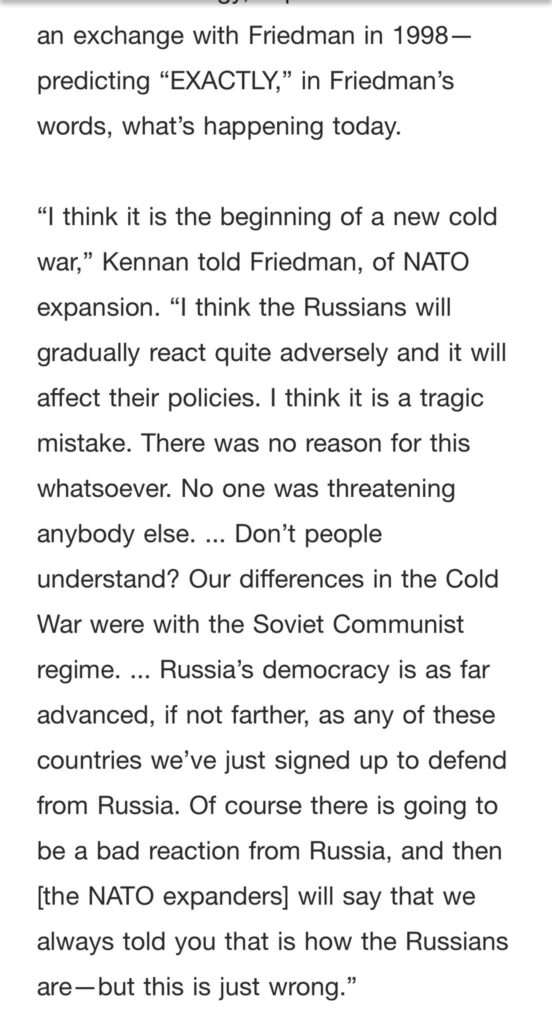
Update 2: What George Kennan, the architect of USSR containment, said back in the 90s.


DONATE OR SUBSCRIBE

Why Are UK Sanctions on Ruissia So Small?

So, before the Russian recognition of the two breakaway Republics and their sending troops, PM Johnson was talking big about sanctions, but in the end, they were fairly minor.

The irony is that Britain could really hurt Russia, because a lot of Russian money is stored there, invested in real-estate, and many important Russians have homes in Britain, especially in London.

Various people have noticed this, for example:

But thing to understand about the UK is that it has almost nothing left that the world wants. It offers:

1) The City for money laundering and access to world financial markets.

2) London itself, still a world class city.

3) UK law, for disputes — people trust UK law more than they trust their own law (or US law, the other common third-party option).

The UK doesn’t have a significant manufacturing sector any more. It has a few high-tech companies, but is not a leader in tech. It has some North Sea oil (being depleted), and it has some very pretty real-estate and that’s, well, that’s it.

Britain mishandled the post-war period and did not upgrade its manufacturing sector. Then Thatcher decided, quite deliberately, to liquidate it and concentrate on financial services and real-estate. That’s what both Labour and Conservative governments have done for the last 43 years.

There’s basically nothing left now but the “City” and real-estate games which are based on air. Without more money coming in from outside and from financial games, there’s no reason to be in London or Britain — except that London’s already a great world city with a big financial center. But there’s nothing else; no real industry, no high tech, and the great universities are being systematically defunded along with everything else.

So Britain can’t impose real sanctions because Britain’s one real product is, “Bring your money and yourself here and your money and your self will be safe and you’ll even make more money.” That’s now the central column of the entire economy; nothing else can replace it.

“Your money is safe here unless you do something nasty we don’t like,” isn’t safety. It means political whims can destroy rich people’s lives, and that’s the exact opposite of what they’re paying for when they take their money to the City and Britain. They can get that elsewhere; if they want to be “safe except for sanctions” then hell, go to the US, Canada, or Germany.

Or, if they want to be “safe from sanctions but our rulers can fuck you up any time they want on a whim and will,” then there’s Abu Dhabi.

London, the City, and Britain offer safety to all but the very very worst rich people in the world. Without that, what is left of Britain collapses. Maybe even past middle-income status (where they’re already headed).

There was a last “out” offered. His name was Jeremy Corbyn. UK Elites colluded and lied (at a rate of about 80 percent) to make sure he wouldn’t take power, because he would have redistributed some money away from them.

So now the course of the UK’s decline is set, and if the comfortable classes want a chance of living out their lives comfortably while the rest of society decays around them, the foreign, corrupt cash must flow.

DONATE OR SUBSCRIBE

The Emergency Act in Canada

I suppose I should note that I consider the use of the act unjustified.

The truth is that Canada already had all the necessary powers to deal with the protesters. All that was required were simple police actions: The protesters have been breaking a variety of laws, so the police just needed to do their jobs.

If the police have gone so rogue they won’t do their jobs, then that’s the real problem — and it needs to be stated as such. In that case, what we need to hear is: “We’re using the Act and we’re also going to fix the police.”

Yet, in the end, the Ottawa police did clear the streets of Ottawa. Despite their claims, in no way did they need to invoke the Emergency Act for this.

So why did they use it?

I have a variety of guesses, but I don’t actually know, and it worries me.

DONATE OR SUBSCRIBE

How to Understand Russia’s Playbook in the Ukraine

It’s ironic revenge for Kosovo and Serbia. Say there are atrocities/genocide, recognize a break-away, then bomb and use troops to enforce your will.

Westerners have never understood how angry the whole Serbian intervention made Russia, who saw Serbia as a core ally. It’s one of the main turning points in Western/Russian relations.

To Russia, this is their “humanitarian intervention.” I’m quite sure Putin finds it very, very funny.


Is Trudeau an Authoritarian for Using POGG Powers Against the Truckers?

Well? Yes and no. Trudeau has always been an authoritarian. He’s been willing to use harsh force against the left — especially anyone interfering with the petroleum industry and other resource extraction industries.

But Trudeau did nothing about the “truckers” until they blocked trade between the US and Canada.

He did not use authoritarian measures (seizing bank accounts and shutting down insurance, in the case of the “truckers”) when the blockaders were making Ottawa citizens’ (but not its politicians) lives miserable, because Trudeau doesn’t care about them or that.

In every order, there are sacred objects, and there are the ruling class’s core interests. It is when you move against them that you are taken out.

Covid, as I have discussed at length in the past, has been good to the ruling class. It has at least doubled the wealth of the world’s billionaires and vastly increased the wealth of the top .1 percent. To them, Covid is good, not bad. This is a fundamental truth that most people refuse to understand, because they can’t, psychologically, face the fact that their leaders kill them whenever it’s to their leaders benefit (and often enough when it isn’t).

The general class of powers Trudeau used to take out the “truckers” come under the Canadian constitution’s POGG (Peace, Order, and Good Government) clause. Using the powers of that clause, Trudeau could have easily created a law to allow him to take federal control of Covid policy. In Canada, there are ten provinces, and the Maritime provinces did a good job against Covid, while everyone else did a bad job. So it was clear, even without international comparisons, that a lot of people were dying and getting sick who could have been saved under a decent national policy (and many more will later be disabled or die due to Long Covid or t-cell depletion and so on.)

The “truckers” are, and were, in a minority; most people in Canada support mandates, masks, and so on, but major provinces are removing restrictions, just like in the US. (“We’ve half-assed this, and now we’re not even going to try.”)

If Trudeau had wanted to, he could have used the authoritarian powers outlines in the Constitution to save thousands of lives. Maybe even 20K or so, perhaps more, if he was the competent sort who could actually run a Zero-Covid policy properly (he’s not, but we can imagine a Prime Minister who was).

He didn’t. He never even contemplated it. But the second the “truckers” impacted trade with the US? BOOM. (This is also because the US, who is Canada’s overlord, made it clear they were upset.)

Trade with the US matters. Covid deaths are not a problem, but rather, are a good thing when they are making the rich, richer. Ottawa residents’ discomfort during weeks of occupation is basically irrelevant.

Trudeau’s authoritarian, all right — if you go after what matters to Canada’s rich, who are his supporters. Otherwise, no. Die all you want, that’s not his problem. (Certain Canadian resource elites support the Covid protestors, but not the manufacturing elite, as a rule.)

DONATE OR SUBSCRIBE

Week-end Wrap – Political Economy – February 20, 2022

by Tony Wikrent

Strategic Political Economy

“‘We conclude’ or ‘I believe?’ Study finds rationality declined decades ago”

[Phys.org, via Naked Capitalism Water Cooler 2-17-2022]

“Analyzing language from millions of books, the researchers found that words associated with reasoning, such as ‘determine’ and ‘conclusion,’ rose systematically beginning in 1850, while words related to human experience such as ‘feel’ and ‘believe’ declined. This pattern has reversed over the past 40 years, paralleled by a shift from a collectivistic to an individualistic focus as reflected by the ratio of singular to plural pronouns such as ‘I’/’we.’ ‘Interpreting this synchronous sea-change in book language remains challenging,’ says co-author Johan Bollen of Indiana University. ‘However, as we show, the nature of this reversal occurs in fiction as well as non-fiction. Moreover, we observe the same pattern of change between sentiment and rationality flag words in New York Times articles, suggesting that it is not an artifact of the book corpora we analyzed.’ ‘Inferring the drivers of long-term patterns seen from 1850 until 1980 necessarily remains speculative,’ says lead author Marten Scheffer of WUR. ‘One possibility when it comes to the trends from 1850 to 1980 is that the rapid developments in science and technology and their socio-economic benefits drove a rise in status of the scientific approach, which gradually permeated culture, society, and its institutions ranging from the education to politics. As argued early on by Max Weber, this may have led to a process of ‘disenchantment’ as the role of spiritualism dwindled in modernized, bureaucratic, and secularized societies.” What precisely caused the observed reversal of the long-term trend around 1980 remains perhaps even more difficult to pinpoint. However, according to the authors there could be a connection to tensions arising from changes in economic policies since the early 1980s, which may have been defended on rational arguments but the benefits of which were not equally distributed.”

See chart here. TW: 1980 was the Reagan “revolution.”

Rhodes Center Podcast: ‘How Efficiency Replaced Equality in US Policy”  Mark Blythe interview of Elizabeth Popp Berman

[Watson Institute for International and Public Affairs, via YouTube 2-13-2022]

On this episode Mark talks with Elizabeth Popp Berman, Professor of Sociology at the University of Michigan, and author of Thinking Like an Economist: How Efficiency Replaced Equality in US Public Policy. In it, she explains how in the middle of the 20th century a new kind of economic thinking took hold among policymakers at all levels of government. It replaced bold visions of justice and equality with a more technocratic style, one whose goals could be summed up in one word: efficiency. Over the last half century this quest for efficiency has guided policies in everything from public education to defense to environmental management. It’s dominance is also reflected in the wild proliferation of MPA programs that exist in American universities today that have cost-benefit analysis at their heart. Elizabeth and Mark discuss where this thinking came from, and why it appealed (and continues to appeal) to so many policymakers. They also talk about what’s lost in this focus on efficiency, and why it isn’t the panacea its advocates claim.

The cost / benefit analysis of Robert McNamara’s Vietnam War Defense Department is an overlooked but important root of today’s neoliberal / conservative political economy. Being forced to find numerical measures of performance and efficiency especially had brutal effects on education and welfar and medical care. 

The Constitution Was Meant to Guard Against Oligarchy

Chris Lehmann, February 10, 2022 [The New Republic]

A new book aims to recover the Constitution’s pivotal role in shaping claims of justice and equality….

But it’s the broader asymmetry here—which has an energetic, dogmatic conservative legal establishment continually seizing ground from an enervated liberal opposition—that’s the real sign of moral and imaginative decay in the America’s politics, in the courts and beyond them. Instead of ritually stigmatizing its extremist flank, the American right perennially finds new ways to empower its ardent apostles and advance its policy-cum-legal agenda; for all its plaints about the administrative state’s undemocratic excesses, it’s aggressively backloaded the judicial talent pool with hard-right nominees groomed by the Federalist Society. And meanwhile, instead of responding in kind with bold proposals to reimagine our core commitments to freedom, equality, and opportunity in an age of spiraling inequality, rampaging privatization, and depleted social goods, the proceduralist center conducts rearguard actions to preserve the appearance of comity, compromise, and bipartisan decorum….

Page 196 of 532

Powered by WordPress & Theme by Anders Norén