
Use to discuss topics unrelated to recent posts.
I want you to ask yourself this question: what makes someone your enemy? Really think about it for a bit before continuing. Have an answer.
An enemy is someone who is doing you you harm, or intends to do you harm. If they have the ability to do you harm, they will act on it.
Note what this definition does not include. It says nothing about hate or anger or emotional state. It does not matter why someone is or wants or intends to harm you, all that matters is that they do.
It does also not matter if you are collateral damage: if they don’t even know you personally exist. If they’re willing to harm you to get what they want, without caring one way or another about you, they’re your enemy.
If a political leader passes a law or regulation which takes away your health care or your house or your food or your life, it doesn’t matter that they weren’t thinking about you, specifically, when they made that decision. They deliberately harmed you, and they were OK with it. They certainly knew, if they thought about it all, that it would harm some people, and that wasn’t a problem for them.
When healthcare execs raise the prices of medicines like insulin or care, they know that means some people who need that medicine or care will do without, and they know some people will die. If they don’t need to make the decision “If we don’t do this, we’ll go bankrupt and no one will get care” then they’re good with a bunch of people suffering or dying. They are, therefore, those people’s enemies, and they are a potential enemy for anyone who might one day not be able to afford care.
Your greatest enemies, that is the people who are most likely to make decisions which harm you, are almost always your politicians and corporate leaders. These are also the people who could be your greatest allies, if they chose, as FDR did for most Americans (though he was an enemy of the rich, and both he and they understood that.)
If you are thinking about politics this is the most fundamental concept you need to understand and emotionally internalize. People with power are your greatest enemies or your greatest allies, and your job is to make them your allies. If they are your enemies, and almost all of them in the current world are, then you must treat them as an enemy, and never think of them as a friend or ally.
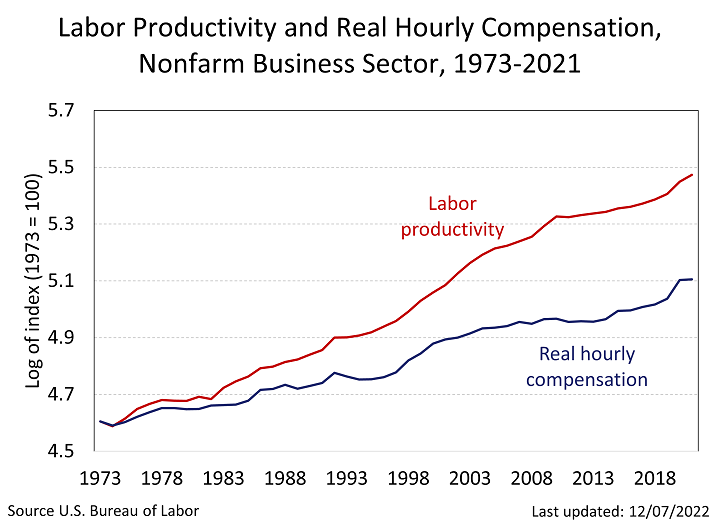
For about 50 years, politicians and private wealthy individuals have deliberately pursued policies which have impoverished you. If your income had increased at the same rate as productivity, you’d have about twice as much income. Think about that. The reason you don’t is they took all of that (and more) and made sure it went to people who were already rich.
People who intend to or do harm you are your enemies.
This means, by the way, that unless you are a Ukrainian, Putin is not much of an enemy to you. Your own politicians and rich people are almost always the greatest threat to you if you live in a developed country, and if you live in an undeveloped country it’s sometimes leaders of foreign nations, the IMF, foreign corporations and so on.
It isn’t any more complicated than that. At the World Economic Forum at Davos, everyone gets a Covid test and all rooms have HEPA filters and UV light to destroy viruses. That’s how they treat themselves. Our societies could afford to do that for everyone, but our leaders, and the media they control pretend that Covid is “over”, while protecting themselves.
Your enemies. (Well unless you’re reading this and in the charmed circle, in which case they’re your allies. Just remember, in 50 years your class will be reviled and hated more than we revile and hate Hitler today.)
The results of the work I do, like this article, are free, but food isn’t, so if you value my work, please DONATE or SUBSCRIBE.
So, as many readers know, I got cancer. (I’m fine. It’s treated, I won’t die of it (3% chance some years out), though I’m on hormone blockers (moderately nasty as an adult) for as much as another year.)
Anyway, I got cancer while Covid was on, so a lot of my visits were virtual, or just phone calls, unless they really required my physical presence. Three month followups: usually by phone. Faster for the doctor; faster for me, all good. But the last time I went in the waiting room was packed. I waited for hours, and the nurse apologized “the government won’t let us do followups by phone (or virtually) any more.”
Oh. Weird. Made no sense to me, but governments do stupid things all the time, and despite how I make my living I didn’t think about it much. (Doctor’s visits tend to focus my mind elsewhere.)
Ontario’s been in a deepening health care crisis for a couple decades at least. In a lot of cities, if you don’t have a family doctor, it’s essentially impossible to find one. If your current doc retires, too bad. Toronto, the largest city, is the worst. So lots of clinics sprung up, and you’d go to one of them when you got sick. They started offering virtual visits even before the pandemic.
A spokesperson for the Deputy Premier and Minister of Health, Sylvia Jones, told CTV News Toronto, “It is against the law to charge for OHIP-covered services. If the ministry finds that a person has paid for an insured service or some component of an insured service, there is a mechanism in place for the ministry to ensure that the full amount of the payment is returned to that person. Ontarians who believe they have been charged for an insured service should contact the ministry by e-mail at protectpublichealthcare@ontario.ca or by phone (toll-free) at 1-888-662-6613.”
On Wednesday, Ontario Premier Doug Ford said he doesn’t want patients paying out of pocket for medical expenses.
“We also need to be clear, Ontarians will always access the healthcare they need with their OHIP card, never their credit card,” said Ford.
Sounds great, eh? The principle is that if it’s covered under the government plan physicians who take any money from the plan at all can’t charge: you’re either fully private or in the system. This is supposed to be true across Canada, and for a long time it almost always was. (Except in Quebec, where they use ethnic pride to allow extra lots of corruption. See “Brexit” for a recent high profile Anglo version of this.)
But about the same time I was sitting on my ass needlessly the Ford government in Ontario also changed another regulation: OHIP would no longer pay for virtual visits to clinics (or in a clinic with a telepresence doctor) if there hadn’t been a physical examination by that clinic or doctor in the last year.
THUD. People go to clinics because they don’t have a relationship with a family doctor. If they had a physical exam every year there’d be a relationship: that’s what family doctors do. Those “regular checkups”.
Have you seen the kicker?
If OHIP doesn’t cover it, then you can charge for it. Since virtual visits with doctors and clinics who haven’t phsycally examined you are not covered, they can be charged for.
Meanwhile, Galen Weston, probably the most influential and powerful Billionaire in Ontario, who owns both the most supermarkets (where he has clinics) and the biggest drug store chain (Shopper’s Drug Store, which he was allowed to buy a few years ago), had rolled out a virtual visit service. Don’t know how well it was doing, but I do know that the public health care line you call to be told what to do is now referring people to services like it.
It’s called Maple. Here’s the current pricing.
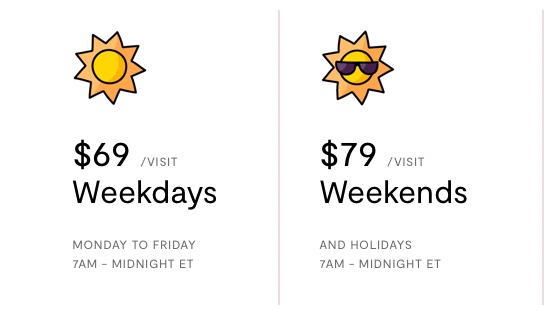
In my entire life I have literally never paid for a doctor’s visit. Not once. Not ever. Not even a virtual visit with an online clinic last year before this new regulation so I could renew some meds.
But this isn’t covered any more, so it’s legal.
And that’s one of the mechanics of stealth-privatizing healthcare.
Note that while it’s hard to get a family doctor, it’s a growing problem and most people still have them, so this is a boiling frog issue: a majority of people won’t be affected. Yet. And most people can afford $80. But this is how you do it, step by step.
And in a certain way, it’s a BIG step, because as I say, I’ve never paid. Neither have most Canadians. If I need healthcare I may have to wait sometimes (though usually not more than a couple hours), but it’s free.
This is a strike against that. You get people used to paying for some services and slowly expand which ones and pretty soon you’re paying for a lot more. Another similar step was to allow pharmacists to renew most prescriptions: but it isn’t a covered service and they can charge for it. Only $15, but I’ve never paid for a prescription in my life either. And phone renewals of prescriptions with doctors aren’t covered either, so most of them are now charging for them, though that’s been true for a while.
Step, by step. Meanwhile, under-fund the system, overwork doctors and nurses and technicians and make the quality of care worse and worse. Over decades don’t train enough doctors or nurses to start with, then use Covid to decrease supply even more and push doctors and nurses out of the public system into the private system where they don’t have to work 12 hour+ shifts over and over and aren’t expected to get Covid over and over. (In one previous visit three of the four radiation oncologists were out with Covid, another longer wait, because we refuse to ventilate, HEPA filter, use UV light and mandate N95 masks rather than cloth ones.)
I have quipped before that I’m very glad I got cancer now, because in 10 years I’m not sure I’d be able to get care. The system now is creaking, but it still more or less works if you’re really sick. But the real money in privatization is market pricing for the truly desperate, like people who have cancer.
One final point: these people make their fortunes, literally, by making you sick and making it more likely you die. That’s what they do. They are your enemies, wherever they are because anyone who is taking active steps which make it more likely for you to die, to not get healthcare you need or to become impoverished or homeless is your enemy if anyone is. We just pretend they aren’t our enemies, mortal enemies, in fact, because they operate through the system by the rules; rules they made.
More on that later.
The results of the work I do, like this article, are free, but food isn’t, so if you value my work, please DONATE or SUBSCRIBE.
Back in the early 2000s I remember reading an interview with Ted Turner, who founded CNN and later sold it. He wasn’t happy with how it was being run so the reporter asked him why he didn’t buy it back.
He explained that he had only a few billion dollars, which meant he wasn’t “in the game” anymore. People mocked him for it, since to a normal person that’s more money than they could ever use, but he was right. He had sold, and now he couldn’t re-buy; prices for key assets like CNN had gone up.
This the basic issue the real players, the mega-rich and the CEOs who run the big companies face. The amount of money that was enough last year isn’t enough this year, let alone in five years. Fall behind and soon you’re out of the game. This doesn’t have to be personal money, just money you control, so if you have effective management control of a company you don’t have ownership control of, you’re in the game, though such people generally reward themselves massively, so they at least aren’t embarassed in front of their peers.
Different oligarchs are competing against each other and so are different groups: tech, finance, manufacturing, military-industrial, etc… If one gets enough of an advantage, then they buy out the others, and even if you’re still filthy rich, you’re out of the game and nowhere near as powerful as those still in the game.
As everyone knows now, the rich have been taking more and more of pie. The most famous chart is the labor productivity vs. wages one:
Furthermore, the real players have been narrowing: there are fewer and fewer people who are really in the game. Vast waves of consolidation in almost every industry have created oligopolies and monopolies, because those sorts of businesses can squeeze customers. Some games are easier to squeeze than others: healthcare is a famous example as people will pay almost anything to live. There’s a reason Bill Gates is buying up all the farmland he can get, too, with environmental disaster onrushing, he knows that those who control food will (with enough political cover) also clean up.
But at the end of the day, everyone is taking from the same pool: any increase in wealth that doesn’t come from productivity increases has to come from someone else. The rich do take from each other, though they play by the rule that unless you’ve betrayed other elites you get to stay wealthy, but most of what they take still has to come from the masses.
Unfortunately they’ve been squeezing the masses for 40 to 50 years, maybe a little more. So they have to keep finding new places to squeeze. This is why power has been privatized and de-regulated; why water and sewage is privatized in the UK (and sewage is in the rivers again), and so on.
But in those countries with public health systems (aka. not the US) like Canada and the UK, well, that’s a place where the full squeeze hasn’t been put on. Prices can easily be raised, by moving to the profit maximizing price (insulin at $800, like in the US, and so on), though it means a lot of people will suffer and die.
There’s one last big public heifer to be taken down and consumed, in other words. And if you don’t get in on it, well, your rivals will and they’ll be richer than you, and you stand a good chance of being forced out of the game.
So, with a few exceptions (manufacturing used to be one of them), the elite consensus is to privatize health care. It’s a big cow, sitting there waiting to be chopped up, and if you get a big enough chunk you may be able to buy out some rivals or at least stay in the game.
And in some cases it’s pretty much the last one. In the UK, it’s the only thing of worth the government owns which it hasn’t privatized. So, as everyone understands by now, you deliberately underfund and sabotage it, then call in the private sector because it isn’t working well. The same thing is happening in multiple Canadian provinces, including where I live in Ontario.
And the real players will become fewer and fewer, and if it means that you die or suffer, well, that’s a price the players are willing to pay so they can stay in the game.
As the game narrows, the players will also turn even more on each other. This has already happened with the TransAtlantic elite, who used to more or less cooperate: the US is now feasting on Europe. But then the Germans had been feeding on much of the rest of Europe already. And it’s obvious that Chinese and US elites are moving to a confrontation, and this is driven in great part by the refusal of the CCP to allow anything important in their economy to be controlled by foreigners.
Sadly, there is a real economy, and it is being fantastically mismanaged, not least by allowing the real carrying capacity of the world to collapse. Elites had such a huge pie (to change metaphors) that it usually made more sense to fight over it than to cooperate to grow it more. So we’re at the beginning stages of collapse. There will come a time when the pie starts to shrink in ways no one can deny.
The silver lining, such as it is, is that so much will have been privatized and screwed up that when we finally do get serious about change, assuming we avoid a Dark Age (not a sure thing) we will be able to do things differently, since there will be so little legacy left.
It’s not much of a silver lining, but destruction does make change possible.
The results of the work I do, like this article, are free, but food isn’t, so if you value my work, please DONATE or SUBSCRIBE.
by Tony Wikrent
Strategic Political Economy
How Much Income Do You Need to Be Rich?
[Of Dollars And Data, The Big Picture 1-19-2023]
Based on the 2019 Survey of Consumer Finances, what are the top 10%, top 5%, and top 1% of household incomes in the U.S.? We take a high level overview of how much income the highest earning households make so that you can determine for yourself what it means to be rich…
- Top 10% = $191,406
- Top 5% = $290,164
- Top 1% = $867,436
Thomas Frank On Why Democrats Suck
Katie Halper [YouTube, January 3, 2023]
10:49 If you go back and look at the sociological literature in … the mid-1960s, it was triumphant … about … the middle class achievement; that the gap between rich and poor had shrunk; that we had solved the problem [of inequality]; that we were the “affluent society…” there’s a a book that came out in 1966 … by an economic [with] a whole chapter establishing that white collar and blue collar people basically had the almost exactly the same standard of living….
..the richest man in the world in 1965 … was J Paul Getty, an … American Oil Baron he was living in London by that time and his net worth in 1965 was one billion dollars and this is the richest man in the world … he wrote an article for one of the popular magazines … complaining … that it wasn’t really awesome he was the richest man in the world a… because even the middleclass man could afford all the things that he had….
…look at what has happened to us since… billionaires shooting themselves sinto space … billionaires making billion dollars in a single year…
Is the Reason Some Wealthy People Oppose Democracy Deeper Than We Think?
Thom Hartmann, January 18, 2023 [DailyKos]
Why are America’s plutocrats funding efforts to weaken our democracy and replace it with plutocracy and oligarchy? …. An extraordinary investigative report from documented.net tells how morbidly rich families, their companies, and their personal foundations are funding efforts to limit or restrict democracy across the United States…. Most Americans — and lots of editorial writers — are convinced it’s simply because rich folks want to influence legislation to benefit themselves and keep their regulations and taxes down….
But history does suggest that many are trying to “stabilize” America rather than just pillage her.
They are worried that America is suffering from too much democracy.
The modern-day backstory to this starts in the early 1950s when conservative thinker Russell Kirk proposed a startling hypothesis that would fundamentally change our nation and the world….
Kirk and colleagues like William F. Buckley postulated that if the middle-class and minorities became too wealthy, they’d feel the safety and freedom to throw themselves actively into our political processes, as rich people had historically done.
That expansion of democracy, they believed, would produce an absolute collapse of our nation’s social order — producing chaos, riots, and possibly even the end of the republic.
The first chapter of Kirk’s 1951 book, The Conservative Mind, is devoted to Edmund Burke, the British conservative who Thomas Paine visited for two weeks in 1793 on his way to get arrested in the French revolution. Paine was so outraged by Burke’s arguments that he wrote an entire book rebutting them titled The Rights of Man. It’s still in print (as is Burke).
Burke was defending, among other things, Britain’s restrictions on democracy, including limits on who could vote or run for office, and the British maximum wage.
Burke and his contemporaries in the late 1700s believed that if working-class people made too much money, they’d have enough spare time to use democratic processes to challenge the social order and collapse the British kingdom.
Too much democracy, Burke believed, was a dangerous thing: deadly to nations and a violation of evolution and nature itself.
Summarizing his debate with Paine about the French Revolution, Burke wrote:
“The occupation of a hair-dresser, or of a working tallow-chandler [candle maker], cannot be a matter of honour to any person—to say nothing of a number of other more servile employments. Such descriptions of men ought not to suffer oppression from the state; but the state suffers oppression, if such as they, either individually or collectively are permitted to rule [by voting]. In this you think you are combating prejudice, but you are at war with nature.”
That was why Parliament passed a law making it illegal for employers to pay people over a certain amount, so as to keep wage-earners right at the edge of poverty throughout their lives….
The Republican/Conservative “solution” to the “national crisis” these movements represented was put into place with the election of 1980: the project of the Reagan Revolution was to dial back democracy while taking the middle class down a peg, and thus end the protests and social instability.
Their goal was, at its core, to save America from itself.
While it looks from the outside like the singular mission of the Reagan Revolution was simply to help rich people and giant corporations get richer and more powerful (and that’s certainly been the effect), the ideologues driving the movement also thought they were restoring stability to the United States, both socially, economically, and — most important — politically….
Throughout the 1970s and 1980s, wealthy people associated with Kirk’s and Reagan’s Republicans built a massive infrastructure of think tanks and media outlets to promote and amplify this message about the dangers of too much democracy. (Emphasis in original)
[TW: For nine decades now, we have allowed the reactionary rich to develop and fund the conservative and libertarian movements, and allowed those movements to “feed red meat to the base” to motivate their voters.
Fundraising wound up about $200 short, but I’ll probably write the final article on reasons to hope anyway, as it was so close and the past few years have been hard for so many. My very sincere thanks to everyone who gave.
Feel free to use this thread to discuss topics unrelated to recent posts.
Most people don’t really get just how extensive European conquest of the world was.
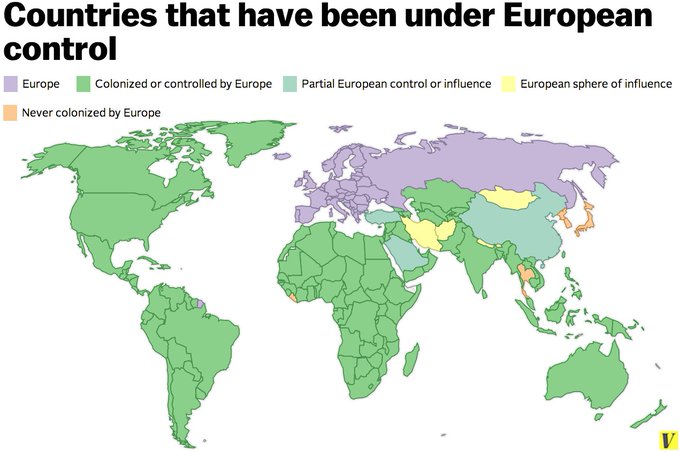
The map’s a bit inaccurate over in Russia: most of Russia is “not Europe” and was conquered — most of it should be green, like North America. Likewise, Japan was conquered by the US, which is a European colony. Leaving aside their brutal war crimes, they were stupid to pick a fight with an industrialized continental power: there was never any chance of winning against the US, as Admiral Yamamoto told them.
But the point is fairly simple: Europeans made the modern world. Wiped out almost all the natives in North America; conqured all of Africa and South America, and almost all of Asia. We went around and imposed our form of capitalism. We destroyed local industry, as in India (which was at least as industrialized as England before the conquests) and forced the natives to trade with us on negative terms, the most famous example being the two Opium wars to make China allow the Opium trade, since England had almost nothing else the Chinese wanted to buy.
World War I and II were a competition between the European powers (which include the US, who had by then essentially completely wiped out the natives) and the US and USSR, the peripheral continental powers won the war, divided Europe between them, “de-colonized” and then ruled the world between them till the USSR collapsed, at which point the US got to tell almost everyone what to do and how to do it for a good twenty-plus years.
A few nations managed to sort of resist: Cuba, Venezuela, Iran and North Korea, but they were made to suffer vastly for their defiance.
The era ended, I would argue, when Russia sent troops to Syria. They defied the US directly, and fought, and the US backed down. One could argue for Georgia, but it was on Russia’s border. Syria was an assertion that the US could not overthrow any government it wanted and that it didn’t control the Middle East minus Iran.
But Russia, important as it is, is now a junior ally to China. They have the nukes, but they don’t have the economy to stand up to the West and NATO without China’s support, and they know it. The competition is not really between Russia and NATO or Russia and the Ukraine, but China and the US, even though neither side has anything more than observers on the ground.
The Russians have chosen their side: chosen not to be Europeans but to be Asians. They say this frequently, it’s a deliberate choice. If this century is to be the Asian one, Russia will be Asian. This change from looking to Europe and being essentially European is massive, and it’s what makes it possible for China to win. Losing Russia, with its vast resources and land ties to China makes it nearly impossible to use American sea-power to “choke out” China thru trade interdiction.
The coming cold war, and possible hot war (or a series of proxy wars) with China is about whether a non-European power will be allowed to remake the world Europe made. Everyone recognized that the US was Britain’s heir, ruling indirectly, but ruling nonetheless. It is about a different, non-EuroAmerican elite being powerful: people who don’t believe in exactly the same things as the trans-Atlantic rulers.
It is an existential threat to European rule, and it is being treated as such. The “yellow peril” has arrived.
In 30 years, will Mandarin be the the new English? The new lingua-Franca? The language everyone has to know and that you can, if clumsily, get by on almost everywhere?
Absent a major war, likely nuclear, or civilization collapse, I find it hard to see a scenario where China doesn’t become the most important global power. Oh, they have problems–but so does everyone. Cries of how they can’t do it because of culture seem weak to me: China was the civilization leader for most of the last 2,000 years, the idea that Chinese culture can’t produce science, music, arts and all the other flowers of civilization is absurd and they’ve certainly been able to adopt our innovations, just as we previously adopted gunpowder and the printing press from them.
Everything ends. We Europeans had our day in the sun (though my Irish ancestors missed most of it) and now the sun sets, as it always does.
There’s a lot of talk about friend-shoring and bringing industry back to the US and its allies, but the reality is quite different.
China's trade surplus reached US$877.6 billion for 2022, an increase of 30% of the already record high year of 2021. This is the biggest trade surplus ever achieved by one country in human history. Trade surplus with the US accounted for almost half at US$ 404 billion. pic.twitter.com/P37rbLGczI
— America-China Watcher (@PandemicTruther) January 14, 2023
The bottom line, right now, is that if the US went to war with China, the American (and Western) economies would virtually collapse.
The US is making serious preparations for war: they are fortifying allied countries in Asia in a similar fashion to how they did Ukraine after 2014, although obviously with less of an eye to ground invasion. Japan has doubled its military budget and stated that it will no longer obey the “peace” constitution but will participate in offensive operations with America. US bases are popping up around China wherever they are allowed.
But to fight a non-nuclear war with China, the West has to genuinely re-shore its critical industries, and it isn’t doing that beyond a few steps with regards to semiconductors. A vast swathe of basic industrial goods are made by China, and not by the West, or not in sufficient quantities.
However, to seriously repatriate industry requires reducing the cost-structure: and that means reducing housing costs, and in the US, health-care and tuition costs, so that Western industry is cost-competitive. Right now the US is grabbing a swathe of energy price sensitive industry from Europe, and especially Germany, but that doesn’t help much in an general war: they’re taking from their allies, not their enemies.
Genuine oligarchic plutocracies, which is what most of the West is, including the US, are generally very bad at industry and war, though there are exceptions (Venice, at various points. But being merchants concentrated their minds on naval power.)
The steps required for America and the West to rise to the challenge of China require Western elites to make painful choices they so far are avoiding: they simply have to give a better deal to their populations, and not concentrate on keeping wage increases under inflation increases (which is what has happened in the US.)
America’s elites can be absurdly filthy rich or they can just filthy rich and have a chance of retaining their global pre-eminence. It’s unlikely they can do both, though I suppose they could bet on ruling a post-nuclear wasteland, if they’ve gone fully insane.