Ian Welsh

The horizon is not so far as we can see, but as far as we can imagine

The Distributed Nature Of Collapse

When the western world sanctioned Russia they expected Russia to collapse. It didn’t. The first reason is that most of the non-western world didn’t cooperate with the sanctions, but the second is simple: Russia has a food and fuel and mineral surplus.

The world as it stands now is every inter-dependent. The supply networks are dizzyingly complex and a final item like a car is made up of materials and parts extracted, made and assembled in dozens of locations.

The world isn’t always this way: it was like this in the late 19th, but after WWI that changed and the era of free trade ended, collapsing in particular during the Great Depression. The world did not become as “free trade” as it was before WWI again till the early 21st century.

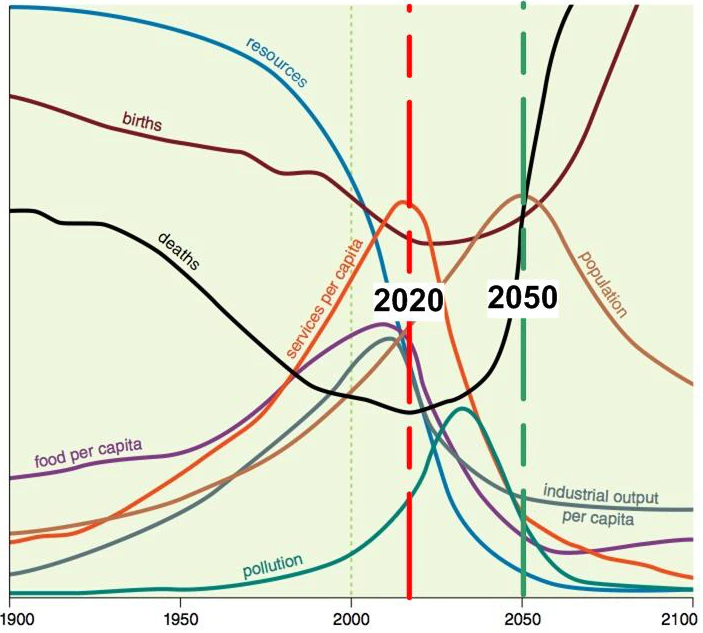
But we are in a period of collapse. The peak, I would guess, will be seen to have been 2020, though different parts of the world economy will peak at different points (peak conventional oil was 2005, fracking and shale oil is not as good.) There will be water peaks, food peaks, peaks for various minerals like copper and so on. There will be a population peak, which will occur after a lot of other peaks. One model, which has been pretty accurate in general terms, is the Limits of Growth model, which regular readers will be familiar with:

Now the thing to understand is that as resources become genuinely scarce rather than simply distributionally scarce (we have more than enough food and have for a long time but people still go hungry) countries will stop trading away what they need and will move to more restricted trade. “We have excess food, you have excess minerals, we will trade with you for this, but we are not selling food generally on the world market to just anyone.”

In periods of genuine shortages, countries stop trading indiscriminately. Food riots are one of the main causes of government collapse and elites losing their lives. Running out of heating or cooling fuel or fuel to run the distribution network (diesel is probably near peak) can lead to fast internal collapse, and so on.

So when there isn’t enough, you stop playing around. You don’t trade unless you’re getting something concrete you need. If you need something, don’t have enough of it and either can’t or would rather not trade for it and still can run your military, you send your military to go get it. (This will become harder and harder though, as modern militaries are resource hogs.)

We’ve had a world economy for a long time now: most of the world since 45, virtually all of the world since the collapse of the USSR (and even before that the USSR, which had food shortages and petroleum to sell, was in the world market.)

Increasingly we will not. Some of this is driven, right now, by competition between the West (which includes S. Korea, Japan and Taiwan) and China, but even much of that is, I suspect, shortages in drag. Soon it will just be “there isn’t enough, who is going to get it?”

Take a good hard look at where you live and what it can make and grow and dig up itself, and how well it can be defended. Because that is going to matter even more in the not-so-far future.


This is a donor supported site, so if you value the writing, please DONATE or SUBSCRIBE.

How To Reduce Inflation And Create A Good Economy

Right now we have central banks attempting to control inflation by crushing wages. But wage-push demand isn’t the primary driver of inflation, it is corporate profit taking (increasing prices much faster than their costs) and some genuine supply bottlenecks.

This cannot be fixed by central banks except by smashing ordinary people flat, and in certain senses not even then, since it will lead to long term maldistribution of resources which will lead to real economic problems in the future: problems not based on distribution or finance, but on lack of physical ability to create what we need.

If we want to fix this we have to make it so that those who control economic decision making can only do well if the population as a whole does well. That means politicians who want to help the population (not 90% of European or American pols) and corporate leaders who need the population to do well.

We’ll concentrate on the corporate/private side.

Take public all natural monopolies. Monopolies and oligpolies can charge more because people have to buy what they have. Private enterprise is only better than government at providing differentiated goods. If everything is the same (and a joule is a joule and a liter of safe water is a liter of safe water and a cheap, fast train trip is a cheap, fast train trip) then government can do it cheaper and better than private enterprise, since it doesn’t have to make a profit.

Excess Profits Tax or Max Profits Tax. You can only make 5% profit + inflation. Anything more is taxed away. Money invested, is not taxed, however.

No Stock Buybacks, No Stock Options. If a company has excess money, it can only increase profits and stock prices by producing more or better.

Executive and Board Salaries Linked to General Welfare. All compensation is treated as wages. Wages above 10x median are taxed at 95%. They are only allowed to increase by the average of the median individual income, and the median income of the bottom 5%.

No Capital Flows To Other Except For Resource Extraction: Comparative advantage does not work with free capital flows. This was noted by Ricardo when he created the comparative advantage. Companies need to reinvest at home. They also need to not be able to run away with capital because they don’t like being only 10X as rich as the rest of the population.

No Free Central Bank Money: The central bank doesn’t get to just give people money, like it has been since 2008. That’s a legislative decision and one which the legislature should not be allowed to give away to other bodies except in relatively small amounts (perhaps a max of 1% of GDP.)

Break Up the Banks and Regulate Them Properly: Banks decide who gets to do what. If you want the advantages of a free market you need lots of them: easy enough, create them by breaking up the big banks. As for regulation, go back to an equivalent of Glass-Steagall.

Break up Monopolies and Oligopolies in General: either it’s a natural monopoly, in which case the government should run it, or it isn’t, in which case it’s broken up. Go back to prices rising in unison being enough evidence by itself of an oligopoly.

Retailers Either Sell Only Their Own Stuff Or Only Other People’s. No store brands, no Amazon basics, none of that. It’s vastly anti-competitive. Nor can retailers mandate that they must get the lowest price or any other such thing.

***

The general principles here are just to move the market back towards a free market and to “align” incentives so that rich people can’t get richer without everyone prospering.

There’s much more required, of course: these policies require politicians to want to implement them, and for them to last for any length of time, changes need to be made to politics to also make sure politicians self-interest is aligned with the general population. (The other method, which might better is to remove self-interest from these decisions entirely. You don’t always need skin in the game in a material sense—doctors with no financial stake make better decisions for patients than those with and endless measurement aligned with incentives warps measurements.)

None of this is really complicated in the broad strokes. We know what creates good economies and societies, we just rarely do it and those with the most power, whether people or countries, try to keep other countries or people down.


This is a donor supported site, so if you value the writing, please DONATE or SUBSCRIBE.

Week-end Wrap – Political Economy – July 23, 2023

by Tony Wikrent


COVID

First major survey of doctors with Long Covid reveals debilitating impact on health, life and work

[BMA, via Naked Capitalism Water Cooler 7-21-2023]

“Around 60% of doctors told the BMA that post-acute Covid ill health has impacted on their ability to carry out day-to-day activities on a regular basis; Almost one in five respondents (18%) reported that they were now unable to work due to their post-acute Covid ill-health; Less than one in three (31%) doctors said they were working full-time, compared to more than half (57%) before the onset of their illness; Nearly half (48%) said they have experienced some form of loss of earnings as a result of post-acute Covid.”


Covid Origins Scientist Denounces Reporting On His Messages As A “Conspiracy Theory”

[Public, via Naked Capitalism 7-21-2023]


War

‘An Act of War’: Inside America’s Silicon Blockade Against China 

[NYT, via Naked Capitalism 7-16-2023]

Though delivered in the unassuming form of updated export rules, the Oct. 7 controls essentially seek to eradicate, root and branch, China’s entire ecosystem of advanced technology. “The new policy embodied in Oct. 7 is: Not only are we not going to allow China to progress any further technologically, we are going to actively reverse their current state of the art,” Allen says. C.J. Muse, a senior semiconductor analyst at Evercore ISI, put it this way: “If you’d told me about these rules five years ago, I would’ve told you that’s an act of war — we’d have to be at war.”

If the controls are successful, they could handicap China for a generation; if they fail, they may backfire spectacularly, hastening the very future the United States is trying desperately to avoid.

The Looming War Against China

Michael Hudson [On Finance, Real Estate And The Powers Of Neoliberalism, via Mike Norman Economics, July 22, 2023]

Open Thread

Use to discuss topics unrelated to recent posts.

How Religions Go Wrong (Fire From The Gods 3)

Back in February I started a series on how the great solutions like Christianity, Buddhism, Capitalism, Marxism and many more have tried to fix the problems created by our ability to invent creations, like agriculture, industrialization and, indeed, the internet, which wind up doing us vast harm.

Start by reading:

Fire From The Gods: the Original Sins of Agriculture and Industrialism And Hope For The Future

Then read the first post, about Buddha’s quixotic quest to end suffering.

“Fuck Suffering”, The Buddhist Solution (Part One)

Then I wrote the third article on how Buddhism goes wrong and realized that most of what I was writing about what actually applicable to most religions and I stalled out: perhaps I had been wrong or perhaps I didn’t understand the situation as well as I thought (not quite the same thing.)

So I’m going to continue this series now with the ways that religions, in general, go wrong, before returning to how specific ideologies (remember, religions are just a subset of ideology) go wrong. Since I’ve already started, I’ll make Buddhism the primary example religion.

I was caught on the horns of another dilemma before even the first attempt.. If one is going to talk honestly about mysticism, not just religion, and great religions are born from mysticism even if they often lose it over time, one can’t adopt a secular materialistic worldview. And when it comes to this I have a particular problem: I’ve done a lot of work and had experiences that standard materialism, as a metaphysics, can’t explain and that “skeptics” would consider bullshit.

The problem with religion in actual practice is that “weird shit” happens. I can’t think of any advanced practitioner who I’m friends enough with to allow honesty (because talking about this is a bad idea) who hasn’t dealt with world-view shattering weirdness.

To write this article without talking about that at least a bit would be dishonest. At the end of the day, I have only one rule of blogging, I tell the truth as I know it. I may be wrong; I might be full of shit, but I don’t write what I don’t believe to be true.

So let’s get to it. Since I know that most people won’t have clicked thru to the articles I linked, I’m going to quote a chunk of the Buddhist piece, on what the Buddha was trying to do.

…the essence of the Buddha’s question is heroic to the point of being quixotic. Siddhartha saw suffering and instead of saying “well, it’s inevitable, I just have to accept it” instead determined:

Fuck suffering. I refuse to accept it is inevitable and I will dedicate my life to finding a way to end suffering.

Now that’s heroic to the extent of imbecility, except that he seems to have succeeded.

This is the core of all great ideologies, of which religions are a subset. The are based on a heroic ideal: a heroic conception of what it is possible for humans to achieve. Something extremely idealistic, often to the point of near insanity.

Now the first thing to note is that Buddhism, as preached by the Buddha, is based on genuine belief in reincarnation. The Buddha famously refused to discuss almost all metaphysics, but rebirth was baked into Buddhism at the start. You’ve been born before and you’re going to be born again. This was horrifying to Indians of the time, and rightfully so. I’ve never understood why people who believe in only one life think reincarnation is a cop-out mechanism: nothing says you’re coming back to nothing but good lives or that horrible things won’t happen. And each time, you start over from near scratch.

This belief in reincarnation is important, it is part of the social contract between Buddhist monks, who often did not have monasteries, but wandered around like medieval European friars, begging for food and owning nothing they couldn’t carry, and the lay people who supported them, kept them alive and if they did have monasteries, were often the ones who built them.

I remember reading about how when a forest monk was found to have left the forest near a Thai village, the villagers decided that he was enlightened and holy and built a monastery for him. They built it because they felt they received something from having a monastery with an enlightened master in charge.

In the same book, the author, who was trying out to see if he wanted to become a monk, and thus following some of the rules, when begging for food said “thank you”. The woman who gave him the food was so offended she went to the Abbot (no longer the original master) and told him she and her family would never give food to the monastery’s monks ever again.

She wasn’t giving food to the monks out of charity. It was a bargain: I give you food, and your lineage owes me. Thank you was considered an attempt to make her act into charity.

This is based on the idea that monks who make actual progress get powers. They owe the people who supported them while they were working, and their lineage owes those people as well. In exchange they use their powers to help those people, perhaps in this life and perhaps in future lives, including helping them have future better lives and, when they are read, to become enlightened themselves.

Christian monks had the same deal going in many cases: huge amounts of money, land, treasure and people were given to monasteries because they prayed for the souls of the dead and their prayers were held to help those alive.

Now to a materialist, this is obviously a crock of shit, and intended to defraud the lay people into supporting monks who can then just laze around. And often enough it is.

But, again, if you do enough spiritual work, weird shit starts to happen or you see weird shit. I knew a guru who could pluck specific words and phrases out of my mind, even over the phone. He wasn’t cold reading me, the knowledge was exact and precise, not just “you’re thinking about X”, but the precise words in my head. I’ve seen other things.

Weird shit is real, and people who do a lot of spiritual work often develop what might as well be called powers. This isn’t D&D or movie magic, they don’t throw fireballs, but it’s stuff that the materialist paradigm doesn’t explain.

So the social deal in a lot of communities is “we support the monks, and they help us.” Some of that is absolutely basic stuff like giving good advice, teaching the lay members and so on, but some of it is “we help you, you use your magic powers to help us and even if we don’t get enlightened in this life, you’ll help us get enlightened in a future life.” This was especially true in the past, but it is still true in some of the most Buddhist countries in the world, like Thailand and Burma.

This goes wrong in a lot of ways. The simplest is that many monasteries and monks are not sincerely working to get enlightened. Thai monasteries are famous for fat, lazy and greedy monks; for entire monasteries full of people just looking for an easy life. This has been a problem all thru Buddhist history.

In Christian monasteries, drunk monks were common, corruption was common, in some particularly egregious cases nuns were prostitutes, though in general, as time went on, the nuns had a better reputation than the monks.

The second is something that Buddhist literature brings up again and again: magic isn’t enlightenment. Having powers does not mean you are enlightened in the sense of “not suffering.” It sure as  hell does not mean you are compassionate or good.

People do a bit of spiritual work and they get powers, some of which are not magic, but simply applied psychology based on remarkable feats of control over consciousness, and people who are suffering go to them for help. But as they aren’t good people or enlightened, what they do may be better for them than for the people looking for that help, or it may be well- meaning but ineffective.

This is especially a problem in Buddhism because Buddhism isn’t about getting “powers”, it is about ending suffering. In Christianity this is dealt with as the dichotomy of those who get their powers from God and those who get them from Satan.

As is always the case, there are a lot of people who are unhappy and suffering and looking for a savior or saviors. It’s hard to make any big gains, to radically change your life for the better in a way that doesn’t fall pray to falling back to your “normal” level of happiness. When that does happen, people tend to get fixated on whatever or whoever they feel was responsible.

It’s easy to leverage “spiritual” attainments into worldly power and wealth. In the modern world this is greatly on display with the Indian “God Men”, who are some of the richest and most powerful people in India and whose support is one of the main factors in the current Prime Minister’s rise to power, which he has used to embrace xenophobic and fascist policies and to oppress Muslims and other non Hindu inhabitants of India, of whom there are hundreds of millions.

Tibet was a feudal theocratic, complete with horribly mistreated serfs and nasty dungeons. “We have special knowledge and/or powers and/or virtues you must serve us” is a way that all major religions go bad and Buddhism is not an exception.

But most of what we’re talking about here applies to all religions, not just Buddhism. The monastic abuses happened in Christianity as in Buddhism: it’s an issue with the form. Christian monks were absolutely trading divine blessings for secular support, and if those blessings were often of a different form than Buddhist ones, the problems were essentially the same: monks without attainments, fat and lazy; or monks who were not holy but had some accomplishments abusing those accomplishments.

In all these cases, however, the central goal is forgotten or perverted. Buddhism’s goal is to end suffering and when it’s not possible (yet) to end it, to reduce it. Thus the Buddhist Indian emperor Asoka instituted laws against abuse of animals, for example, and in Tibet excavation for buildings would include carefully removing the dirt then sorting thru it to remove all the insects and worms so as to not harm them. Vegetarianism is often associated with sincere Buddhism in places where it’s possible (it’s not in Tibet) and for the same reason: to reduce suffering of animals.

In Christianity the goal includes certain moral attainments, including certain actions. If you get powers and you aren’t a good person, well, you’ve missed the boat. In Buddhism, the goal is to end suffering, and if you haven’t done that for yourself  or you aren’t at least reducing suffering in others and yourself, you’re off the boat.

Implicit in Buddhism, and a problem it shares with other religions which seek enlightenment, is the idea that enlightenment is the “best thing”, better than anything else you can ever have. As with Spanish conquistadors and priests burning pagans to death because they believed that would allow them to avoid Hell and the torment is nothing compared to an eternity in Hell, Buddhism is prone to abuses in the name of getting people enlightened.

The doctrine of “expedient means”, which is not something the Buddha ever said himself, allows one to lie to and mislead people. The metaphor is that if children are in a burning building and lying to them is necessary to get them out of the building, you do it. Enlightenment is the best thing, lying is justified.

This is different from the more standard Buddhist test for what to say, “is it both true and helpful.”

In Christianity, we have the crusades and the inquisition, and it is hard to see how one can justify that from a religion worshipping a man-god who said “love they enemies” and “turn the other cheek.”

Likewise, while a lot of guru abuse is because of Gurus looking out for themselves, some of it is because the Guru genuinely thinks that the abuse will help the student become enlightened.  (Gurus are particularly a thing in Hinduism and Tibetan Buddhism, but Zen Buddhism has often had a real problem with masters beating students. A rap with a stick and a beating are quite different.)

Any religion or ideology which believes in a redeemed state will lead to otherwise evil or immoral acts being considered acceptable in the name of the cause. Of course this is true of every major ideology: capitalism, Marxism, and democracy, among others.

The “best thing” problem exists in all great ideologies I can think of: there is a type of life; type of person, or both, who is best and that person is idealized and allowed to do things no one else is. In our modern world it might be the “job creators” in the European Middle Ages it was rulers (chosen by God), knights and monks/priests/hermits. The best life was either the life of glory and honor, or a life dedicated to God.

Some of these best people will always abuse their power and privilege and the percentage of them who do so is a good indicator of how corrupt a society is and how far an ideology has fallen.

Likewise the best life sucks energy and resources away from other lifestyles and hurts the people who are not in the best life. Tibetan serfs were treated abominably, as were European ones. Low caste and casteless Hindus are treated worse than cows. In our modern world those who don’t make much or any money are generally treated terribly, and since the suburbs was (and still is, to many) the ideal life, other types of life were sacrificed to create those houses with white picket fences.

At the base of any ideology; an religion, is a heroic view of the world. A great dream. But by prioritizing towards that great dream, classes of good people are created. Classes of good lives are created. Creating those good lives denigrates other lives. This isn’t automatically bad, but it’s very easy for it to go bad. “Good” people are entitled, we feel, to more power and resources. Bad people to less. It is the nature of the process, you can’t create the good without creating the bad. (This includes fairly simple things like being peaceful is good therefore being violent is bad, so don’t believe that creating the bad is always, well, bad.)

We’ve talked about religions here, but we’ll return to show, even more, how the common failure points of religions have their failure points in ideologies. (One that some readers may have picked up on is the similarity between monastries and corporations.)


This is a donor supported site, so if you value the writing, please DONATE or SUBSCRIBE.

The Elements Of Persuasion

Many posts I write aren’t intended to be persuasive if you don’t already agree with me on some axes. Take, for example, the post “some acts are always evil.” I chose rape as my example: it is not possible to have a justified rape. If you agree with this, you’ll agree that some acts are always evil. If you don’t think rape is never justified, then my argument won’t work with you, and indeed it didn’t work with all the commenters for just that reason.

There are three primary elements of persuasion.

The first might be called beneficence or trust or sometimes even disinterest. If you’re trying to persuade me to do or believe something, I want to know that you have my best interests at heart: that you aren’t trying to persuade me because it’s good for you that I agree, but not good for me. This is the entire thesis of the book “How To Make Friends And Influence People.” It’s the basis of all win/win negotiating methods. It makes a huge difference.

Disinterest is the intellectual version of this, meant more for changing minds than making deals. It is a “I just follow the logic or facts wherever they go and accept the conclusions.” If you’re obviously arguing “from interest” people will tend not to believe what you say about issues unless they share the same interest as you.

The second might be called competence or wisdom or knowledge. This is the “do you know what you’re talking about” check. Perhaps you’re arguing win/win that we should attack that tiger and take its lunch, but if I don’t think you know how to beat that tiger, it sure ain’t looking like a win/win to me. Professionals trade on this sort of thing, “I have training”. The guy or gal trying to tell you how to do well on dates or get a romantic partner needs to have a happy relationship or be constantly seen with beautiful women or handsome men. The person preaching how to get rich has to be rich, and so on.

I used to think this really, really mattered and in my early years of blogging I would write posts tallying up my predictions and how well they had done, with what a friend once called “Stalinist self-criticism.” I thought that if I proved I was usually right about certain subjects, people would trust me on those subjects.

Worked with some people, but not with most. It took me about five years to realize this intellectually, and another 6 years or so to understand it emotionally.

So this factor matters, but it’s only one factor and I would say that in most circumstances it isn’t most important factor.

The third factor of persuasion is what might be called mode. This how you persuade people: perhaps you make that appeal to authority. Perhaps you are friendly. Perhaps you simply make your statements confidently as if no one could doubt you. Perhaps show that what you say follows logically if people accept your premises (this is what I did in the “some acts are always evil post”, using rape as being always evil.) Perhaps you reason inductively “we can find hundreds of samples of this situation an in every or almost all case it went the way I say.”

There are socially dominant modes in different periods, societies and social groups. Scientists, at least in principle, should be convinced by evidence supporting hypotheses. Scholastic academics of the middle ages wanted one to use a combination of Aristotlean logic and biblical revelation. In most societies which have ever existed “this is how we’ve always done it’ was a killer argument. In others “I’ve got a big sword and lots of muscular friends” more or less worked, especially when willing to kill enough people.

In spiritual groups, showing that you appear to have attainments like calm and dispassion or universal love or the ability to concentrate for hours engenders trust in some people. In older societies performing miracles engendered trust (and whatever you think about it they genuinely believed in miracles and appear to have experienced them.) In established religions and with believers showing that the religious texts support what you say is an important mode.

Beneficience, competence and mode. It’s hard to get all three moving at the same time simply because different groups have different ideas of what qualifies one as competent. They shade easily into each other: the mode of arguing from scripture also suggests that the people who are qualified (competent) are priests or monks or theologians, for example. People who believe in the scientific mode of reasoning will tend to trust scientists, giving them more benefit of the doubt than non-scientists even if the non scientists are using the scientific method.

A simply summation of what works best might be “one of us and one of our leaders.” That combines an assumption of beneficience (group members want what is good for group members), competence (has risen to leadership) and mode, because a leading group member will almost always use the mode appropriate to the group.

All of these factors of persuasion can be hacked. Do Biden or Trump or Clinton or Bush care about average Americans? Of course not. There is no beneficience in most senior politicians for the masses. Are they competent? Well, maybe at making the rich richer and at campaigning, but at making everyone better off and safer? Of course not. As for mode, well, they’re usually good at adopting appropriate modes, but the recent example of Trump shows that what modes can work is a lot different from what modes are normal.

I tend to think that the most effective factor is beneficience. People are more tribal than anything else, and if you can get them thinking you’re one of them (even if you aren’t, which is usually the case with politicians) and acting in their best interests, enough of them will believe almost anything to get you what you want.

If you don’t want to be persuaded by con men and psychopaths, don’t believe “one of us” from anyone who either doesn’t have the same interests as you or whose interests, at least, aren’t actively engaged: whose well-being isn’t effected if you believe them or don’t.


This is a donor supported site, so if you value the writing, please DONATE or SUBSCRIBE.
Week-end Wrap – Political Economy – July 16, 2023

by Tony Wikrent


Global power shift

Has the West lost control of oil? 

[Unherd, via Naked Capitalism 7-10-2023]

Led by the odd pairing of the Saudi Crown Prince, Mohammad Bin Salman (MBS), and Vladimir Putin, the Opec Plus oil producers’ cartel exists to maintain a price floor for its fractious members in an energy environment where oil prices have crashed three times over the past two decades. But its importance in a geopolitical world defined by Sino-American competition is beginning to extend well beyond the gyrations of oil markets. Opec Plus has remained resilient even as the Beijing-Moscow-Tehran axis has hardened since Russia’s invasion of Ukraine, as well as the recent Chinese-brokered rapprochement between Saudi Arabia and Iran. This raises questions about whether Saudi Arabia is now defecting into the anti-Washington camp….

Forging an association between Opec and Moscow was an act of Saudi desperation. For the previous two years, Riyadh had sought to bankrupt the American shale sector by allowing prices to slump, but largely succeeded only in emptying its own foreign exchange reserves. When they finally reversed course in September 2016, the Saudis found that, having alienated most other Opec members with their recklessness, they could no longer control prices. Two months later, Russia and 10 other states agreed to support a second Opec oil output cut, and Opec Plus was born….

Undoubtedly, some broader geopolitical convergence between Riyadh and Moscow against Washington followed over the next three years. When King Salman visited Putin in October 2017 — the first ever state visit of a Saudi monarch to Moscow — the two leaders discussed military co-operation and the possibility of the Saudis purchasing Russian arms….

When, in September 2019, Iran — either alone or acting with its Houthi allies in Yemen — destroyed the large Saudi oil processing facility at Abqaiq with drones and cruise missiles, that chasm was laid bare. While the Saudis were crushed by the failure of their Patriot missile defence system, bought at great expense from the Americans, Putin appeared with the Iranian president and mock-solemnly pronounced that Moscow could sell Riyadh protection that would actually work….

The Trump administration’s Abraham Accords, which saw the UAE and Bahrain normalise relations with Israel in September 2020, compounded the cartel’s lack of internal coherence on Middle Eastern matters. In oil terms, the Accords also appeared strategic: the UAE is the only member of Opec Plus other than Saudi Arabia with clear spare capacity, and Bahrain has been sitting on a known large offshore shale oil formation since 2018.

But for the past three years, events have conspired decidedly to strengthen Opec Plus. With the new Democratic administration in Washington unable to bring Iran into another nuclear deal in 2021, and post-pandemic growth in the shale sector nearly entirely concentrated in the Permian Basin, Biden, just eight months into office, had to ask Opec Plus to increase production. His trip to Riyadh the following summer for the same purpose yielded little. Indeed, in the months after Biden’s visit, Opec Plus appeared to toy with the American president, announcing a major production cut just weeks before the mid-term elections. Unable at any time during his presidency to influence the cartel, Biden has had to release so much reserve US oil that in March 2023 the Strategic Petroleum Reserve contained only 58% of what it did three years previously.

The World China Is Building 

[NOEMA, via Naked Capitalism 7-14-2023]

…The International Monetary Fund expects Asian countries to account for 70% of growth globally this year. China must “shape a new international system that is conducive to hedging against the negative impacts of the West’s decoupling,” the scholar and former People’s Liberation Army theorist Cheng Yawen wrote recently….

The world China is reorienting itself to is a world that, in many respects, looks like China did a generation ago. On offer are the basics of development — education, health care, clean drinking water, housing. But also more than that — technology, communication and transportation.

Back in April, on the eve of a trip to China, Brazilian President Luiz Inacio Lula da Silva sat down for an interview with Reuters. “I am going to invite Xi Jinping to come to Brazil,” he said, “to get to know Brazil, to show him the projects that we have of interest for Chinese investment. … What we want is for the Chinese to make investments to generate new jobs and generate new productive assets in Brazil.” After Lula and Xi had met, the Brazilian finance minister proclaimed that “President Lula wants a policy of reindustrialization. This visit starts a new challenge for Brazil: bringing direct investments from China.” Three months later, the battery and electric vehicle giant BYD announced a $624 million investment to build a factory in Brazil, its first outside Asia….

Across the Global South, fast-growing countries from Bangladesh to Brazil can send raw materials to China and get technological devices in exchange. The idea is that what China is today, they could be tomorrow….

The majority of human beings alive today live in a world of not enough: not enough food; not enough security; not enough housing, education, health care; not enough rights for women; not enough potable water. They are desperate to get out of there, as China has. They might or might not like Chinese government policies or the transactional attitudes of Chinese entrepreneurs, but such concerns are usually of little importance to countries struggling to bootstrap their way out of poverty.

The first world tends to see the third as a rebuke and a threat. Most Southeast Asian countries have historically borne abuse in relationship to these American fears. Most American companies don’t tend to see Pakistan or Bangladesh or Sumatra as places they’d like invest money in. But opportunity beckons for Chinese companies seeking markets outside their nation’s borders and finding countries with rapidly growing populations and GDPs. Imagine a Huawei engineer in a rural Bangladeshi village, eating a bad lunch with the mayor, surrounded by rice paddies — he might remember the Hunan of his childhood.

How China Came to Dominate the World’s Largest Nickel Source for Electric Cars

[Wall Street Journal, via The Big Picture 7-9-2023]
Across the Indonesian archipelago, new industrial plants are going up to process chunks of nickel ore for use in electric-car batteries. Five years ago, there were none. What changed? Chinese companies had a breakthrough.
They tamed a refining process that was once unwieldy, unlocking Indonesia’s expansive deposits for the nickel-hungry EV industry. In doing so, they established Chinese dominance over what has grown into the world’s largest source of the commodity.  That gives China a leg up in the global race to secure minerals that are critical to the energy transition and is a blow to U.S. efforts to lessen American companies’ dependency on China.

China beats rivals to successfully launch first methane-liquid rocket 

[Reuters, via Naked Capitalism 7-13-2023]

The Poles are rearming at a breathtaking rate and are now Europe’s rising power. Let’s embrace Warsaw – over Paris and Berlin

[Daily Mail, via Naked Capitalism 7-9-2023]

The Battle for Colombia 

[New Left Review, via Naked Capitalism 7-15-2023]


Capitalism = democracy. Not.

The terrifying rise of ‘debanking’ 

[Spiked, via Naked Capitalism 7-10-2023]

Last week, former Brexit Party leader Nigel Farage announced that his Coutts bank account of over 40 years had been closed against his will and without any real explanation. The motive might have been political, he speculated. Perhaps Coutts, the prestigious private bank for the wealthy, had taken exception to his support for Brexit. Farage went on to claim that nine other banks have refused his custom, too. This seemed like a potential case of what has become known as ‘debanking’ – that is, the practice of withholding banking services to individuals, because of the views they hold….

As it stands, we do not know exactly why Farage’s account was closed. But we do know that he is not the only one claiming to have been ‘debanked’. In fact, over the past week or so, numerous cases have emerged of people being denied access to financial services, seemingly on the basis of their political views. This has included activists, parents groups and even people with no political background at all.

Unpopularity Behind Elite Demands For Spying And Censorship 

[Public, via Naked Capitalism 7-12-2023]

Open Thread

Use to discuss topics unrelated to recent posts.

Page 146 of 532

Powered by WordPress & Theme by Anders Norén