Ian Welsh

The horizon is not so far as we can see, but as far as we can imagine

The End Of The Post-War & Post-Soviet Eras

So…

The BRICS group of nations has decided to invite six countries – Argentina, Egypt, Iran, Ethiopia, Saudi Arabia and the United Arab Emirates

BRICS already included Brazil, Russia, India, China and South Africa.

The era isn’t over yet, but when you consider that US/European sanctions against Russia failed to gain much support from India, China, and almost all of Africa and South America, it’s clear that US/West is down to its core again: the EU, Canada, Australia, New Zealand, Japan, Taiwan and South Korea. These are all either core West states or their key “uplifts” — the nations they let into the club and industrialized.

This leads to the new cold war, which everyone has noticed now, and has the world’s greatest industrial power, China, on the other side. Ironically the most important nations on the West’s side, other than the US, are South Korea and Japan, which remain technological powerhouses, while Europe is coasting on legacy technology and failing to advance compared to China, the US, Japan and South Korea (more or less in that order.)

The majority of trade, about 90%, still uses the dollar, but dollar reserves are at their lowest since the fall of the USSR, and will continue to fall, as the freezing of Russia’s dollar reserves (which will probably be seized in the end) and the massive sanctions have made it clear that dollars are only useful if you don’t cross America, and many nations, including China, know that’s only a matter of time.

Bilateral trade using local currencies will continue to increase, as will trade using the Yuan.

All Empires end, as do all eras. Neoliberalism is dying, the US world order is dying and the unipolar era is dead. A new multipolar era is upon us.

These are all good things, more than bad, for most of the world’s population as the post-Soviet order was used to crush countries the US disapproved of under horrid neoliberal austerity policies. That doesn’t mean the new era will feel good, or even be good: that’s not possible with our environmental problems, and the onrushing civilization collapse, but at least countries will increasingly be able to do what they feel is good for them and their citizens without the IMF and US/EU sanctions crushing them.


Folks, it’s your donations and subscriptions which make it possible for me to keep writing (since I need to eat and pay rent and the cost of both have skyrocketed) so please (if you aren’t struggling) DONATE or SUBSCRIBE.

Wagner Chief Prigozhin Dies

His private jet “crashed.” I must say it’s a nice change from falling out of a window, though still a standard (those who have reason to believe powerful people want them dead should not fly in private planes.)

There were other people in the plane and they may not have “had it coming” (I don’t know) but Prigozhin was a piece of human garbage whose prison sentence was, for among things, choking awoman so he could rob her.

I won a bet with a friend on this, who thought that Prigozhin couldn’t be taken out without causing a clash with his troops.

This is classic: what Putin did was separate Prigozhin from his loyal troops so he wouldn’t have to fight them all, then take him out. The delay was to let those Wagner members who were still loyal to Prigozhin realize the loss. (The remains of Wagner will now mostly be integrated into the military.)

Prigozhin had to killed or put in prison. Putin could not allow him to be seen to prosper after he launched a coup attempt, however abortive that attempt was. Others might get the idea they could take a run at the king and if they failed, no big deal.

Remember that Prigozhin received no support from the Russian establishment: not one governor or senior official; no military support (hardly surprising after he alienated them by attacking a senior officer and constantly denigrating them.)

Prigozhin was a fool, he thought he was bigger and more popular than he was, and he paid the price.

Putin’s “weakness”, such as it is, comes from the simple fact that he is old and everyone knows nature will force him to leave at some point. He doesn’t have another twenty years at the top, and he has no obvious designated successor, so people are starting to jockey to replace him and for those who aren’t in the running, to pick sides, as you often can’t remain neutral. That said, his polling remains good, the military is loyal enough, and while there are some economic issues, they aren’t (yet, or perhaps ever) such as to cause him concern.

Remember the rebellion trifecta: an elite faction, the enforcer class unwilling to intervene, and a popular faction. Prigozhin tried to neutralize the enforcers by attacking while most of the pointy part of the military was at war, but he didn’t get any of it.

A palace coup remains possible, but at least for now, anything else is very unlikely.

“You come for the king, you best not miss.”


Folks, it’s your donations and subscriptions which make it possible for me to keep writing (since I need to eat and pay rent and the cost of both have skyrocketed) so please (if you aren’t struggling) DONATE or SUBSCRIBE.

Declining Population Thru Lower Birth Rates Is GOOD, Mmmmkay?

Alright, let’s cover this again, with a bit more explication, since the idiots are really doubling down on “oh no, decreasing population.”

If you want to see it on a map, here goes:
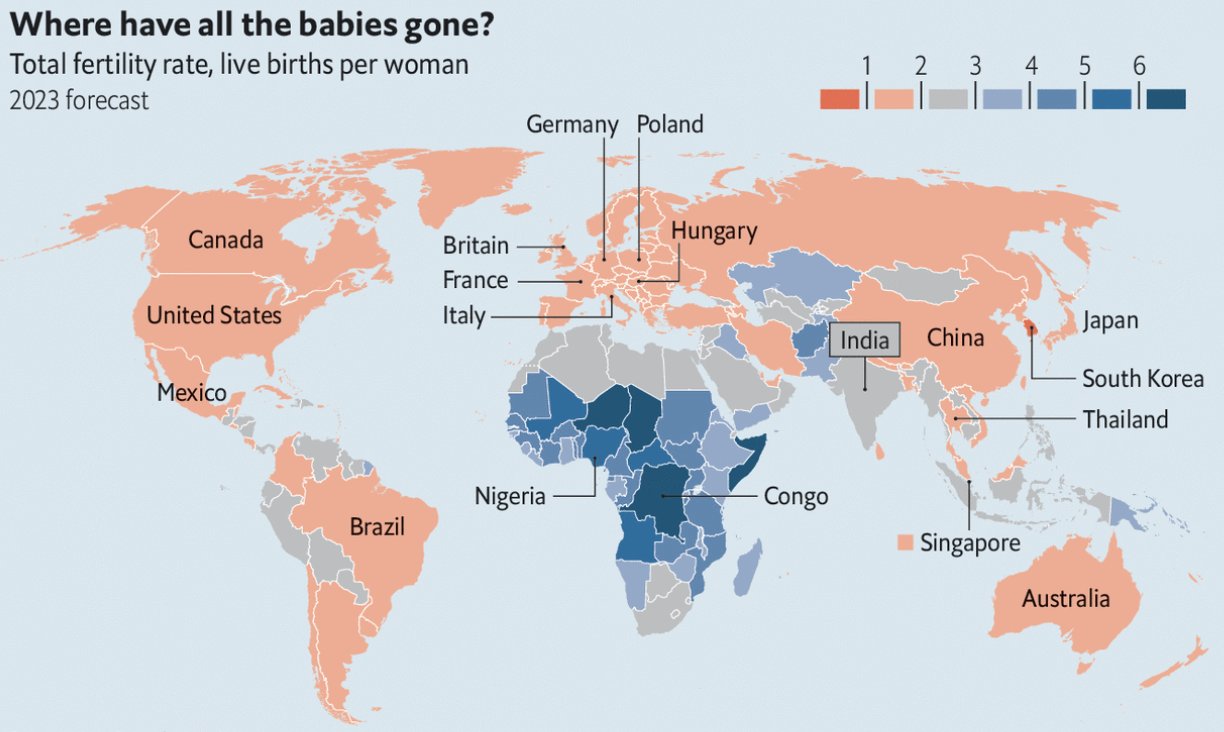
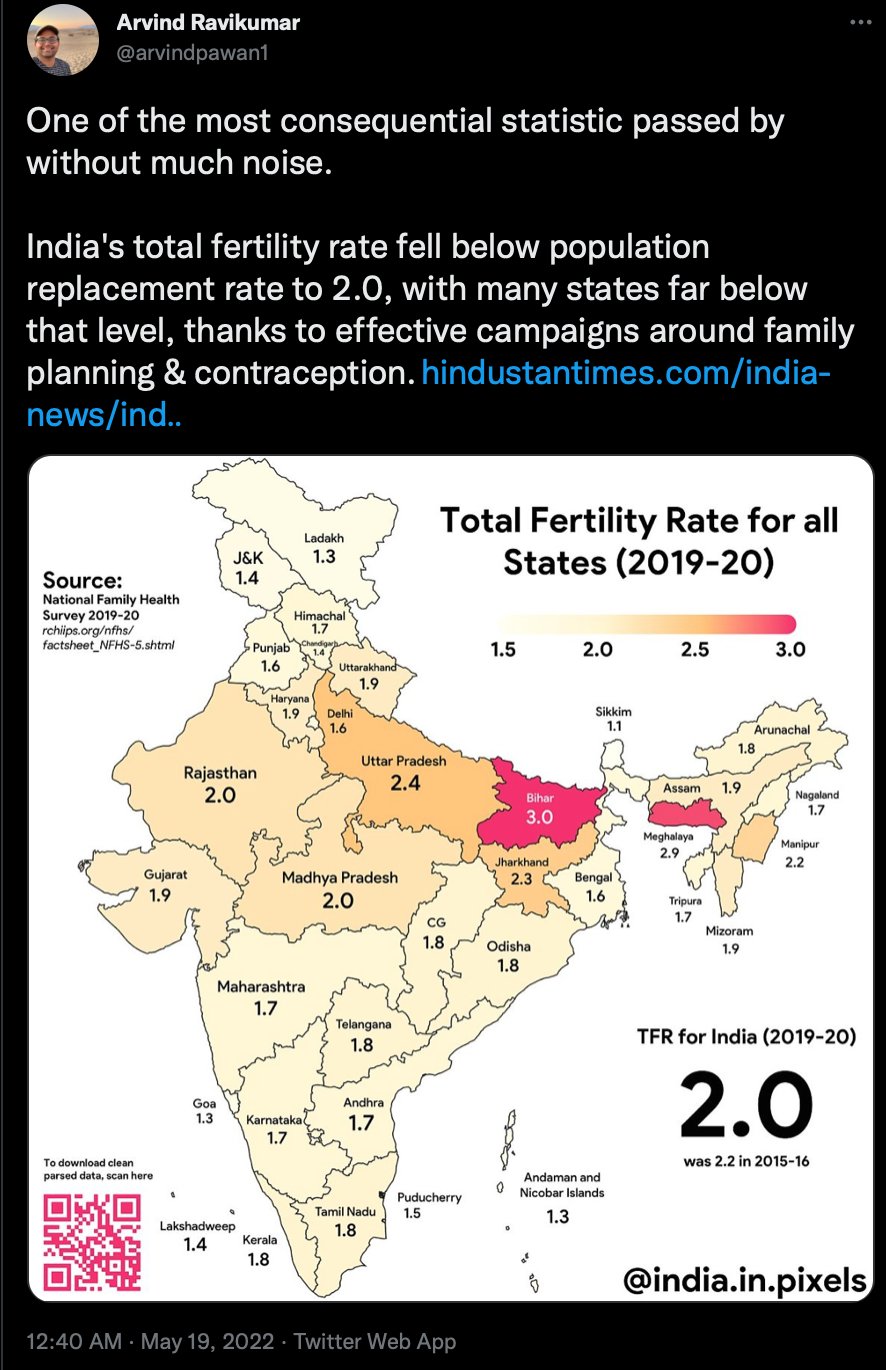
Even India has dropped to about replacement rate.
Now, let’s deal with this.

First, to the extent the plummet in birth rates is because of decreased biological fertility, like reduced sperm counts, it’s bad.

Second, despite this, we are well over the world’s carrying capacity and you are seeing it in the collapse of other life forms (ecological collapse) and climate change.

Third: the world’s carrying capacity is variable in a sense: what matters is number of people times the average per capita carrying cost of each person.

Fourth: the more population we want to have, the lower our per capita carrying costs have to be.

Fifth: a lot of people whine about this and to a certain extent rightly so. It is associated with austerity.

Sixth: imagine a world in which you bought a phone and used it for 20 years with modular upgrades; a car and used it for 50 (with modular upgrades); a washer and dryer and used it for 75 years, and where all of those things, when they finally ended their lives, were carefully recycled as much as possible.

Imagine a world in which almost nothing was made out of plastic. (In the 70s almost all bottles were glass and we used paper bags and grocery items were not individually wrapped in plastic and fuck “germs!” Covid has proven we don’t really care about that.)

Imagine a world in which we work half as much, create stuff that lasts for decades or even half a century or more.

Seventh: “but how can we afford this?” We can afford anything we can actually physically do. Each individual item would be more expensive, but last far longer and be cheaper overall. Yes, we would have to change how we distribute permission to have things, but we need to do that already.

Eighth: even in capitalist terms the “oh, without population gain how can we have economic growth” stuff is incoherent. Capitalism is supposed to increase productivity massively, so you should still be able to have growth, certainly per-capita growth. If you can’t, you’re a bad capitalist.

Ninth: that particular issue is related to oligarchs wanting to funnel all the money upwards and instead of relying on customers, rely on government, including central bank, subsidies. (Neither Tesla nor SpaceX would have made it without massive government subsidies.) In actual capitalism capitalists want high wages, because “everyone else’s employees are my customers.” The cost of high wages is more than made up for by people being able to afford their goods. This is why the economy of the post-war era was so good: high wages and lots of consumptiong.

Tenth: of course this sort of capitalism has to go away, we can’t afford a planned obsolesence economy in a world over carrying capacity and with limited stocks of key resources (the way we’re burning thru lithium should be literally criminal). But even in capitalist terms “oh no, population decrease” is an admission of failure.

Eleven: the dependency ratio is how many working people are supporting non-working (old, young, disabled and not allowed to work) people. Yes, a lower ratio makes things harder, but again, productivity is what matters and capitalism keeps claiming it’s good at raising productivity. Plus the actual percentage of people working for wages in high prosperity periods has often actually been lower than in high prosperity periods.

Twelve: oh, and worker compensation is likely to go up as population decreases and as the carry ratio decreases (or at least, be higher than it would have been otherwise, civilization collapse is also in the mix.) After the black death, welfare increased massively. We’re already seeing some of this effect due to the pandemic (one of the only good things to come out of it.)

***

We need less population. The world’s population has over doubled just in my lifetime (I’m 55). That’s ridiculous. And minus the internet and a few good medical improvements, I’ll tell you that life wasn’t worse then. (Even Africa had higher growth rates in the 50s and 60s and the dire poverty numbers are bullshit, because subsistence farming was far more common, but that’s another article.)

We have no problems we can’t adapt to, minus a few scenarios like the Venus runaway, a full ecological collapse which eliminates the apex species (that’s us) or polluting the world so much we can’t survive (which includes nuclear war.)  We can, in theory and even in practice, if our politics wasn’t so screwed up, even make most people better off at the same time. But it will take time, and the most important problems are made simpler by population reductions.

What is going to make everything harder, actually, is our refusal to deal with Covid and our “New Emperor’s Clothes” insistence on pretending it’s over, while it continues as a mass disabling event. Yeah, we can handle a lower dependency ratio, but crippling hundreds of millions of people and making hundreds of millions more sicker is an unnecessary self-inflicted wound.

As before, as so far always in this crisis, the most important thing we have to do is replace our leadership class: political and private, en-masse, so that the correct decisions can be made. And yes, capitalism as we understand it is going to have to go away.

But this weird idea that population reduction right now is bad is breathtakingly stupid, and people who believe it have been fooled, or are fools


Folks, it’s your donations and subscriptions which make it possible for me to keep writing (since I need to eat and pay rent and the cost of both have skyrocked) so please (if you aren’t struggling) DONATE or SUBSCRIBE.

Week-end Wrap – Political Economy – August 20, 2023

by Tony Wikrent

Climate and environmental crises

‘This Is Huge’: Judge Sides With Montana Youths in Historic Climate Ruling 

[Common Dreams, via Naked Capitalism 8-15-2023]

Climate Jurisprudence Gets a New Blueprint 

Gabrielle Gurley, August 17, 2023 [The American Prospect]

A Montana judge delivers a stunning, historic decision on the Mountain West state’s culpability for surging climate dangers that hit young people hard.

Montana Climate Lawsuit: Youths Win Landmark Case 

[Rolling Stone, via Naked Capitalism 8-15-2023]

Biden DOJ: “No Constitutional Right To A Stable Climate”

David Sirota, August 16, 2023 [The Lever]

As a heatwave scorched America with record-breaking temperatures this June, the Biden administration attempted to block a landmark climate lawsuit by declaring that “there is no constitutional right to a stable climate system,” according to court records reviewed by The Lever.

The assertion in Juliana v. United States — which echoed both the Trump and Obama administrations’ legal claims in the same long-running case — was part of the Justice Department’s latest attempt to halt the suit brought by children who assert that the Constitution requires the federal government to maintain a climate that supports human life.

That suit’s momentum could be bolstered by a separate legal victory in Montana this week, but neither the victory nor the intensifying climate disaster appear to have stopped the Biden administration’s crusade to kill the federal case. Indeed, Biden’s Justice Department filed its most recent motion to dismiss the case in the same week that large swaths of the country were under extreme heat warnings.

That filing came as President Joe Biden has refused repeated calls to declare a climate emergency, and as his administration backed a court case designed to accelerate the construction of a massive fossil gas pipeline, despite scientists’ climate warnings. Biden’s administration has also declared that the Intergovernmental Panel on Climate Change’s scientific report about climate change “does not present sufficient cause” to halt a massive expansion of fossil fuel drilling.

The world’s infrastructure was built for a climate no longer existing

Bill Haskell [Angry Bear, via Mike Norman Economics, August 15, 2023]


Global power shift

[Twitter-X, via Naked Capitalism 8-15-2023]

Open Thread

Use to discuss topics unrelated to recent posts.

Quick Takes: Covid, China, Environment & More

Another “quick takes” in which I make brief comments on pieces I think are worthy of note, but am not going to write a full article on.

One of the policies I’ve promoted is criminal charges for environmental crimes, rather than just fines, which are simply treated as a cost of business and don’t take money from the executives responsible. Seems at least one country is doing so.

Violating China’s environmental policies can lead to real punishment. In March 2021, four major steel mills in Hebei were caught falsifying records to evade carbon emission limits; the next year, dozens of executives responsible were sentenced to prison.

It’s worth remembering just how good the media is at making people hate and fear the enemy of the day. They did it to Iraq, to Russia and to China.

There’s been a fair bit of bad economic news out of China recently (which I intend do a fuller post on), but one piece cuts both ways. A huge decrease in exports means that China’s customers (the West, to a significant degree) are buying less and it’s not just because of sanctions. China is now the world linchpin economy, much as the US was in 1920s–the industrial power exporting to other countries. We all know how the 20s ended.

China’s exports in July were down 14.5% year on year, far worse than expected, to $282 billion, although it is worth noting that in July 2022, China recorded its highest monthly levels of exports in history.

Meanwhile, the Covid pandemic is not over. Our elites know this: they want us back in offices, but protect themselves.

“Anybody who meets with the president does indeed get tested. I do, we all do”

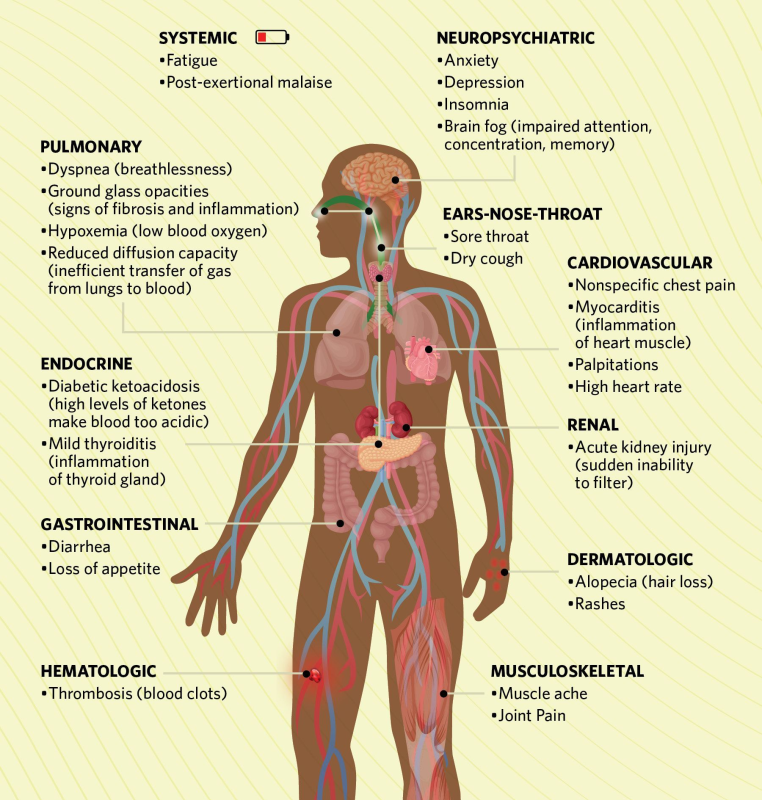
The problem with Covid isn’t so much the deaths, though that’s bad, it’s the damage it does to people, even to people who don’t appear to have Long Covid. This picture and article summarizes some of Covid’s sequelae.

Fun stuff.

Extra fun is that some school districts have a financial incentive to keep sick kids in school.

The superintendent also noted a financial impact. If the current 90% daily attendance rate rose to 95% — which it was pre-pandemic — the result, he said, would be $300 million more in state funding, which is largely based on attendance.

Carvalho spoke on a day when he took part in two home visits in North Hollywood with students who had poor attendance last year, including an eighth-grader who missed 40 days of school. Her mother, Marissa Garcia, said both of her daughters had trouble keeping up with studies during the pandemic and also adjusting once school resumed. But the single mother said she and her daughters would redouble efforts to get the most out of school.


Back early in the pandemic, when they wanted to send children back to school, I wrote multiple articles saying this would be a disaster, because children are illness sponges. Not only are they not immune to Covid damage, they spread disease, as all parents and teachers know.

In totally predictable news, we now have proof of the obvious. “More than 70% of US household COVID spread started with a child, study suggests.”

A fun article is the one claiming no one knows why working age people are dying more from “non Covid.” Perhaps you can figure it out.

No one knows precisely what is driving the phenomenon, but there is an inexplicable lack of urgency to find out. A concerted investigation is in order.

Deaths among young Americans documented in employee life insurance claims should alone set off alarms. Among working people 35 to 44 years old, a stunning 34% more died than expected in the last quarter of 2022, with above-average rates in other working-age groups, too.

Covid has all sorts of weird side effects. More car accidents, for example, which when you look at that Sequelae graphic, rather makes sense. A lot of damaged people are driving and driving badly.

The cost of auto insurance soared 16.9% from a year ago Car insurers lost on average 12 cents for every dollar of premium written in 2022, the worst performance in more than 20 years, according This is partially due to an increase in accidents

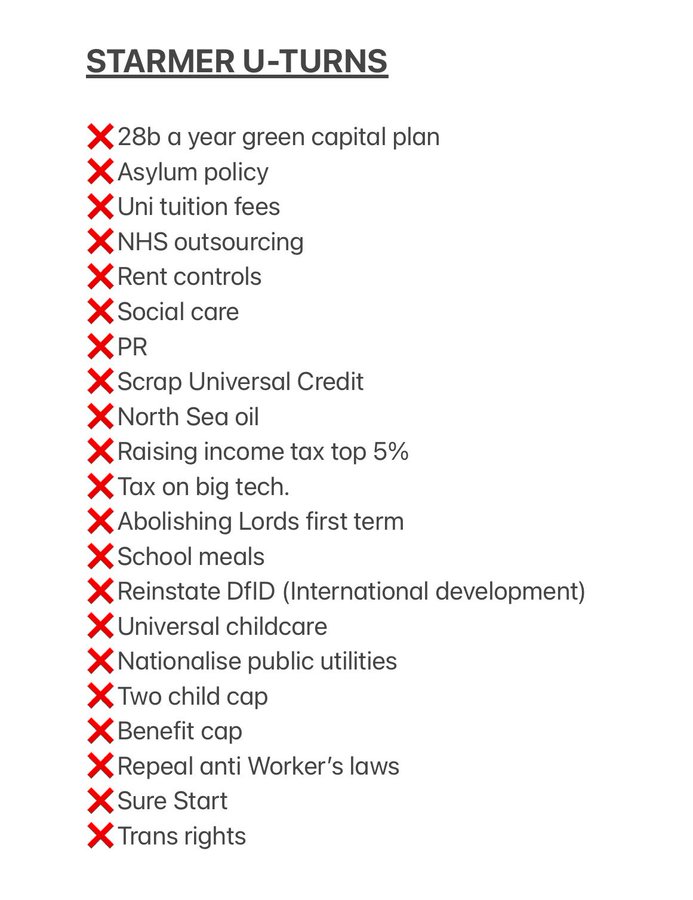
Enough Covid fun. Off in Britain, the UK continues its slide to 3rd world status. Start with this lovely list of Labour leader Keir Starmers continued retreat from his promises when elected leader of the party.

And “progressives” continue to slurp it up, ensuring Britain’s decline and the left’s irrelevance.

And that’s our week’s quicktakes. Mostly bad, but at least China is jailing some climate criminals. Remember, most importantly, that Covid is not over and that you don’t want to get it, and if you’ve had it, you don’t want to get it again.

This is a donor supported site, so if you value the writing, please DONATE or SUBSCRIBE.

Why Human Judgment Must Be Primary Over Metrics (Academic Edition)

So, you’re all probably aware of the replication and fraud crisis in the scientific community. Psychology’s been hit hardest, and the social sciences, but the physical sciences have not been immune.

Retractions have risen sharply in recent years for two main reasons: first, sleuthing, largely by volunteers who comb academic literature for anomalies, and, second, major publishers’ (belated) recognition that their business models have made them susceptible to paper mills – scientific chop shops that sell everything from authorships to entire manuscripts to researchers who need to publish lest they perish.

These researchers are required – sometimes in stark terms – to publish papers in order to earn and keep jobs or to be promoted. The governments of some countries have even offered cash bonuses for publishing in certain journals. Any surprise, then, that some scientists cheat? (my emphasis)

And these are not merely academic matters. Particularly when it comes to medical research, fakery hurts real people. Take the example of Joachim Boldt – the German anesthesiologist who, with 186 retractions, now sits atop the Retraction Watch leader board of scientists with the most pulled papers.

The key paragraph is : academics are judged on how many papers they have, and how many citations those papers receive. Getting hired and getting tenure are based on them. Since it’s hard to get a full time real academic job these days, let alone get tenure, there’s a LOT at stake for academics. Publish or perish.

This isn’t how such decisions were always made, however. At one point, human judgment was given a much bigger sway. Hiring committees read the research, looked at teaching, and talked to the academic. Some academics published only a few papers, but they were good papers, and others were considered to have potential.

Such a system was subject to standard human abuse: hiring people who were liked, in effect, so an independent measure of academic excellent was sought, and what was come up with citations: if your research was important, presumably other academics would refer to it.

But any metric which is used to make monetary decisions is quickly gamed. If you must have those citations, many people will cut corners to get them. After spending 10 years to earn a Ph.D. the idea of being part of the large majority who either get no job or become associate profs, badly paid and treated, isn’t palatable.

For a long time this went on and cutting corners worked: the people inside the system were those who had benefited from it, after all. Everyone knew it was occurring but the incentives to prove it were lacking. Then some outsiders started looking, people funded with outside money, and they found a ton of fraud and sloppiness.

We keep doing this: we keep seeking metrics to cut out human judgment, but it can’t be done. It’s not that metrics aren’t useful, but, again, as soon as everyone knows what the metrics are, they game them. (Note how similar this is to Google’s early metric: how many links a webpage received. Remember how good early Google was before everyone started search engine optimization and Google decided to maximize monetization.)

The solution isn’t to find new metrics, and to get back on the treadmill, it is to go back to judgment, and to review the results over time with groups of outsiders and insiders.

You can’t outsource human decisions on who gets power to algorithms. It never works and it never will, as we’re finding out with “AI”.

Just bit the bullet and take responsibility.


This is a donor supported site, so if you value the writing, please DONATE or SUBSCRIBE.

The “It Can’t Be Done Because It’s Never Been Done” Problem

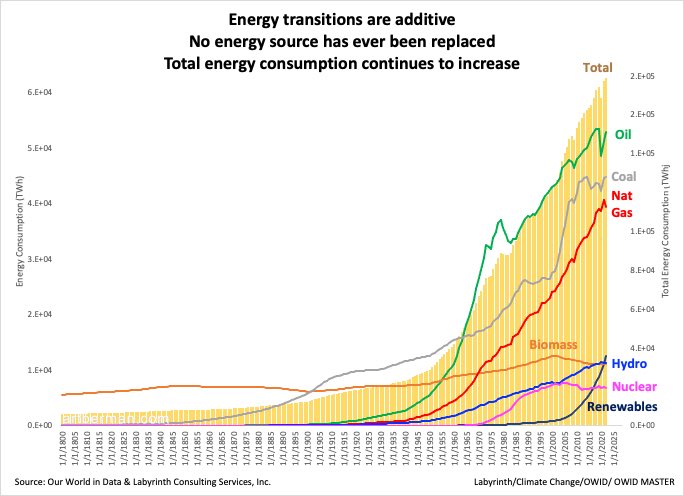
This chart is going around:

This is a useful chart, in that it shows that we aren’t reducing absolute use of energy sources which increase global warming: the gains you constantly hear about, at a global level (there are country exceptions, such as Germany) are relative, not absolute and it’s absolute that matters.

But it’s a dangerous chart in the sense that it suggests that because we’ve never done something, we can’t. In the specific case it is misleading: we’ve never had any particular reason to not keeping old forms of energy, and energy revolutions are uneven: in Europe and America and Canada, biomass is used a lot less than it was in the past, but as population expands, especially in less developed countries, well, of course biomass keeps being used, especially for cooking, and as long as global population keeps increasing, even reduced per-capita energy use could easily lead to higher numbers.

But the larger issue is the “we can’t do what we’ve never done” before idea. It’s obviously untrue technologically.  Back in the 19th century many leading scientists believed powered flight was impossible, to give just one of thousands of example. But it’s also true socially: we never had universal sufferage states, for example. Older Democracies had very sharp limits on the franchise. Modern corporations are a new form of social organization though they have some similarities to older forms (primarily religious: temples and, in particular, monasteries). Double entry book-keeping had massive social effects, so did various religious innovations and so on.

“We’ve never done it so we can’t do it”, with standard excuses of “it’s just human nature” (as if human nature isn’t very plastic) is the true doomerism.

We have changed how we live, socially, culturally and technologically, over and over again and we can do it again.

If we can’t, if we are nothing but larger versions of bacteria multiplying in a petri dish, only pretending to sentient, then we are doomed and in a certain sense, deserve to be doomed.

Only if we can change and take conscious control of how we change, recognizing that most (but definitely not all) of the constraints we have put on our ability to change are cultural and created by us, can we have an expectation of a good future ahead of us.

I’m betting we can do things we’ve never done before because any other bet leads places we really don’t want to go.


This is a donor supported site, so if you value the writing, please DONATE or SUBSCRIBE.

Page 143 of 532

Powered by WordPress & Theme by Anders Norén