The horizon is not so far as we can see, but as far as we can imagine

Category: health care Page 28 of 35

When Medicare is destroyed is only a matter of when

Folks, this won’t pass this year, but a version of it will pass:

That plan would transform Medicare from a government insurance program to one in which seniors would chose from private, federally subsidized coverage. Americans 55 and older would stay in the current system.

Remember, Obama’s health care reform was essentially the Republican plan from the 90s.  The Republicans, whom everyone was sneering at for running crazies, have put in place a team of hard right ideologues, who have moved DC significantly to the right even of where it was.  At some point they will pass this, because they want it badly, and the Democrats have no alternative vision other than “right wing, but not as right wing”, which goes nowhere.

I’ve said this before: get out.  If you can’t get out, get your kids out.  This is not going to end well.  Obama has institutionalized Bush rather than rolling him back, and in some areas, such as civil liberties and unilateral Presidential war powers, has actually moved further to the right than Bush was.  It is not impossible that this will get better in the next couple decades (as 5 year old Ian once argued, almost nothing is impossible), but it is unlikely.  Americans spent the last 35 years spending their retirement, their children’s retirement and running infrastructure and capital into the ground, and they were good with that.  Every effort to repeal Prop 13, for example, failed miserably.  America is the culture of the free lunch, what Americans don’t realize is that they’re the free lunch.

That doesn’t mean the US couldn’t fix its problems, in theory, but the point is that socially and politically, the US does not want to fix its problems.  It wants to continue to make them worse.  Yes, a majority of Americans may prefer different policies on some issues, but they aren’t willing to MAKE it happen or to actually pay for it (see Prop 13 above).  They aren’t willing to die for it, and at this point, that’s what it would take because your elites see no reason not take everything you have and turn you into slaves in all but name.  You will be debt slaves, who own almost nothing, not your house, not your phone, not your car, not your books.  Anything which can be rented to you, rather than than sold, will be.

Welcome to the Repo culture.  Everything you have, everything you are, can be taken away from you, and you are nothing but a series of revenue streams to your lords and masters.  Fail to pay, and you won’t even be allowed to be a debt and wage slave, you’ll be in a cardboard box or a debtor’s prison.

Modern Americans are mostly descended from people who didn’t say “this pisshole country is worth fighting for”, they’re descended from people who said “screw this, I’m outta here”.  Emulate them and leave, if you can’t leave do the other thing they were willing to do: prepare for a revolution and be willing to die in it.

Or accept your fate as slaves.

Your choice.

Washington State May Cut Medicaid Drug Benefits

I notice that of the solutions suggested, raising taxes on the rich isn’t one of them. Truly, such a thing is unthinkable: far more unthinkable than poor people dying because they don’t have medication.

Interesting set of priorities.

I also strongly suspect that the savings will be less than the government thinks, since without medication many folks will wind up in the hospital.

Just sayin’.

Tai Chi better for Fibromyalgia than drugs

Imagine that.

What’s remarkable, actually, is how often some form of exercise is better for a variety of conditions than pharmaceuticals.  From depression to osteoperosis to preventing the effects of Alzheimer, getting active generally works as well or better than drugs.

In terms of societal health, doing everything we can so that people eat healthily and get exercise would probably do more than anything else.

Instead we subsidize corn syrup and build suburbs without sidewalks.

Social Security Trustees Report: No Social Security Crisis

Social Security Trustees report that social security will be able to make full payments until 2037(pdf).  Tax receipts will dip below outlays before then, but this is precisely why the Social Security program has taken in more money than it needed, so that it could handle baby boomer retirement and increased life spans.

Any projection which goes out 27  years is so incredibly reliant on the embedded assumptions about growth, employment and lifespans that it amounts to a fiction.  It is, at best, a guess.

Increase growth by just a little bit and the entire “problem” goes away.  Get rid of the taxation cap so the rich are not capped in what they pay and the entire problem goes away.  Assume higher employment, and the entire problem goes away.  Assume a reduction in inequality, and the problem goes away.

The US has a number of problems which are at or near crisis, such as employment, inequality and healthcare costs, to name just a few.  Social Security is not one of them. It isn’t even close, and politicians and billionaires like Pete Peterson who are trying to gin up a crisis should be ashamed of themselves.

If they want the US budget more in order they should look at health care, where single payer could cut costs by at least a third, and at the military, where real spending has doubled since the end of the Clinton administration.

Or they should work on increasing employment and increasing wages for ordinary people. That’s a crisis.

Instead of dealing with real problems, instead of tackling the medical industry or the military-industrial complex, instead of fixing the job situation, they want to steal money from old people.

Massive Small Business Insurance Rate Hikes In California

Twelve to twenty three percent increases are common, with increases as high as 76%. Needless to say, these increases are unsupportable by many businesses, who will drop coverage as a result.

Ok, excuse me, but is anyone surprised?  Democrats had a chance to do real  health care reform, and they balked, kludging together a mess which was guaranteed not to work.

Those of us with an actual track record of, y’know, getting policy consequences right, warned that Health Care Reform was an ineffective mess which wouldn’t control costs, but too many people wanted to be fooled, wanted to “hope”.

Hope’s all very nice, but it’s not a bloody plan, or a bloody policy, nor does it constitute good analysis.

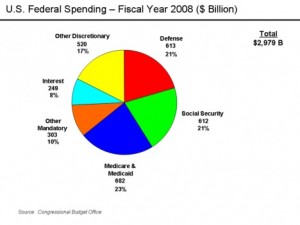
Fiscal Sustainability Facts and Solutions

2008 Budget

2008 Budget

1) Social Security, at current rates, is not expected to run short of money before 2037.

2)The simplest way to “fix” Social Security, if you’re worried about a “problem” 27 years in the future, is simply to remove the contribution limit.  End of problem.  Period.  Social Security is not in crisis.

3) The reason politicians want to “fix” Social Security is to increase the SS surplus, so they can use it for other things.

4) Medicare has more serious issues.  However the simplest way to fix healthcare in the US is to move single payer, which would reduce healthcare per person by one-third.  It has worked for every other country in the history of the world that has done it.  It will work for the US.  Since we’ve admitted now that everyone deserves health care, and since it’s cheaper, and better, why not use the next round of healthcare to fix Medicare by fixing health care?

Global Military Spending 2008

Global Military Spending 2008

The unspoken entitlement is the US military.  The US spends about half the entire world’s military budget.  There is, actually, no one in the world who can invade or seriously threaten the US in any fashion. (Is Canada going to invade?  Mexico?) You can easily slash the military budget in half and still be so far ahead of any possible combination of enemies that it isn’t even close.

And yes, taxes are going to need to go up.  Here’s a simple fix—tax all income over 5 million at 90%.  It won’t hurt the economy (the best economy in America’s history was back when marginal tax rates were this high in the 50’s and 60’s).  It will mean that the rich, who got almost the entire bailout and whose irresponsibility threw the US into its worst economic crisis since the Great Depression will pay for it.

Oh, and change the estate tax to tax 80% of all inheritances over 5 million, too.  Remember, dead people don’t need money and 5 million tax free for choosing your parents right is enough of a head start.

There are plenty of other ways to raise money and cut costs.  For example, you can put  a tax on buying and selling derivatives or you can slap on a carbon tax or you can reform corporate taxes so corporations making billions don’t pay no taxes.

Finally, the bottom line is this.  The US owes its money in dollars.  The US can print money.  The US is not going to run out of money(pdf).  There may be some inflation but anyone who tries to tell you that the US won’t have enough money to pay SS or Medicare is simply lying to you.

Anti-depressants and ADHD meds worse than no medication for most patients

Seriously.  I’ve suspected this for years, here’s the hardcore evidence.

Honestly, if you’re depressed the best treatment for everything short of the most severe depression is exercise.  If you don’t want to exercise, get a puppy.  Having someone who is always happy to see you and who needs you is what most people need.

And with luck, going on walks with the puppy will get you started on exercise.  Double win.

Americans in particular, and westerners in general are horrendously overmedicated.   In part I suspect this is simply because American lives, for all the material splendor, suck.  Working 9-5+ overtime + 2 hour commute, always knowing that if you lose your job you’ll lose everything, eating (too much) manufactured food denatured of proper nutrients while not getting enough exercise puts people under constant stress.  Added to that is the strong pressure to act “normal” and to never be seen to be sad or anxious or moody.  Act in unexpected and socially unacceptable ways and pretty soon that job you need, no matter how good you are at it, starts becoming insecure.

So people medicate.  Heavily.  It’s the only way they can get through their lives.  Anti-depressants are more addictive than opiates.  More addictive that cocaine.

But hey, that’s a good business to be in.  For pharma.  Get people hooked on your legal drugs, make the cheap natural stuff (pot and opiates and coca leaves rather than cocaine) illegal, and clean up.

(Some quotes after the jump)

Recissions and Denial of Care Under Obamacare

I had to go through this language for another purpose, so let’s see how HCR affects recissions and denial of care. (A recission is cancelling the policy, denial of care means denying a specific treatment.)

Here’s the recission language.

‘‘SEC. 2712. PROHIBITION ON RESCISSIONS.
‘‘A group health plan and a health insurance issuer offering group or individual health insurance coverage shall not rescind such plan or coverage with respect to an enrollee once the enrollee is covered under such plan or coverage involved, except that this section shall not apply to a covered individual who has performed an act or practice that constitutes fraud or makes an intentional misrepresentation of material fact as prohibited by the terms of the plan or coverage. Such plan or coverage may not be cancelled except with prior notice to the enrollee,

The denial of care and appeals language is as follows.

‘‘SEC. 2719. APPEALS PROCESS.

‘‘A group health plan and a health insurance issuer offering group or individual health insurance coverage shall implement an effective appeals process for appeals of coverage determinations and claims, under which the plan or issuer shall, at a minimum—

‘‘(1) have in effect an internal claims appeal process;

‘‘(2) provide notice to enrollees, in a culturally and linguistically appropriate manner, of available internal and external appeals processes, and the availability of any applicable office of health insurance consumer assistance or ombudsman established under section 2793 to assist such enrollees with the appeals processes;

‘‘(3) allow an enrollee to review their file, to present evidence and testimony as part of the appeals process, and to receive continued coverage pending the outcome of the appeals process; and

‘‘(4) provide an external review process for such plans and issuers that, at a minimum, includes the consumer protections set forth in the Uniform External Review Model Act promulgated
by the National Association of Insurance Commissioners and is binding on such plans.’’.

I’ve taken a look at the NAIC model reg referenced.  As I read it:

If company A denies care or rescinds:

a) the client must appeal to the company itself.

b) if that fails, the client may appeal to an external arbiter.  However, either the company has to agree to this or the insurance commissioner has to override the company’s decision.  (The criteria are pretty straightforward and making a false negative would be hard to do absent just lying.)

If care is urgent and the doctor agrees the client may skip the internal appeals process and go straight to external appeal, with the same caveat that the insurer must agree or the insurance company must override the decision of the insurer.

Actually, this is pretty decent.  The obvious ways to try and game it are:

1) to force as many non-urgent appeals to take the maximum time in the internal review (30 days), then kick them to external (between everything, 3 to 4 months).
2) Snow the external review organizations under by denying as much as possible, and forcing times up.  This won’t do squat on recissions, but on denial of care a certain # of people will die (or get better) and that will save some money.  You do pay for external reviews, but it’s unlikely to be more than the cost of really sick people’s care.
3) Game the insurance commissioner.  The insurance commissioner decides who does the external review.  Some reviewers will find for the companies/plaintiffs more than others.

Like any compliance based activity this bill requires the compliance agencies to do their jobs, but actually, this is written fairly tightly.  I think, from a strict bottom line perspective, it’ll probably turn out to be worth still trying to deny care to really sick people who aren’t mortally ill, to buy yourself 3 or 4 months worth of surcease from bills.  Also, the harder you make it to get care, the more likely they are to drop your company and find a new one, so hassling them into the ground might be good business practice.

In terms of recissions, it really is a matter of the definition of fraud.  If forgetting to put anything on the application form or getting something wrong on the form (say getting dates slightly wrong about some illness from 2 decades ago) is fraud, they can still get a lot of people rescinded.  If not, and if you can’t deny care due to prior conditions, then why would they be, then in fact it will be damn hard to rescind policies.

Another question is simply of  penalties.  If I, as a company, simply say “no, I don’t care what the law is I’m not going to obey it”, what is the penalty?  As with coal mining companies who simply accept fines as a cost of doing business, it may be worth breaking the law.

The final point is that much of this seems (if I’m reading this correctly) to be handled by the State Insurance commissioners.  Some of them are really good (New York, for example).  Some of them are captured by the industry or have very few resources.

Bottom Line: Recissions as such are probably a thing of the past once the bill goes into full effect, unless regulators completely fall down on the job.  Denial of care will probably still continue, though you’ll eventually be able to force them to give it to you, they can and probably will deny as often as they can to drive down costs and try and drive you to another company, if you’re an expensive (ie. very sick) customer.

Page 28 of 35

Powered by WordPress & Theme by Anders Norén