The horizon is not so far as we can see, but as far as we can imagine

Category: Age of War and Revolution Page 5 of 28

Chinese Companies Compete For Market Share & That’s Why Starbucks Is Toast

Starbucks sells expensive sugared drinks, and some of them have coffee in them. It’s been very profitable and despite some declines, remains so. The CEO was paid about $96 million last year. He was brought in to “turn Starbucks around”, and his main moves have been towards returning Starbucks to its roots as a “third place”, which is to say, somewhere other than work or home where people spend time.

That’s a good idea, actually, because if all Starbucks sells is expensive drinks, which most people pick up, then it’s a lousy value proposition for consumers, especially for the mass of consumers who are seeing a lot of inflation and effectively decreasing wages. The average drink at Starbucks probably comes in around $5 and it’s easy to spend $7, and that’s just on the drink.

Now here’s the issue: American companies are most interested in profits. They want to make large net profits and pay their executives well, which they do by giving them stock options and in most cases juicing share prices by spending massive amounts on stock buybacks.
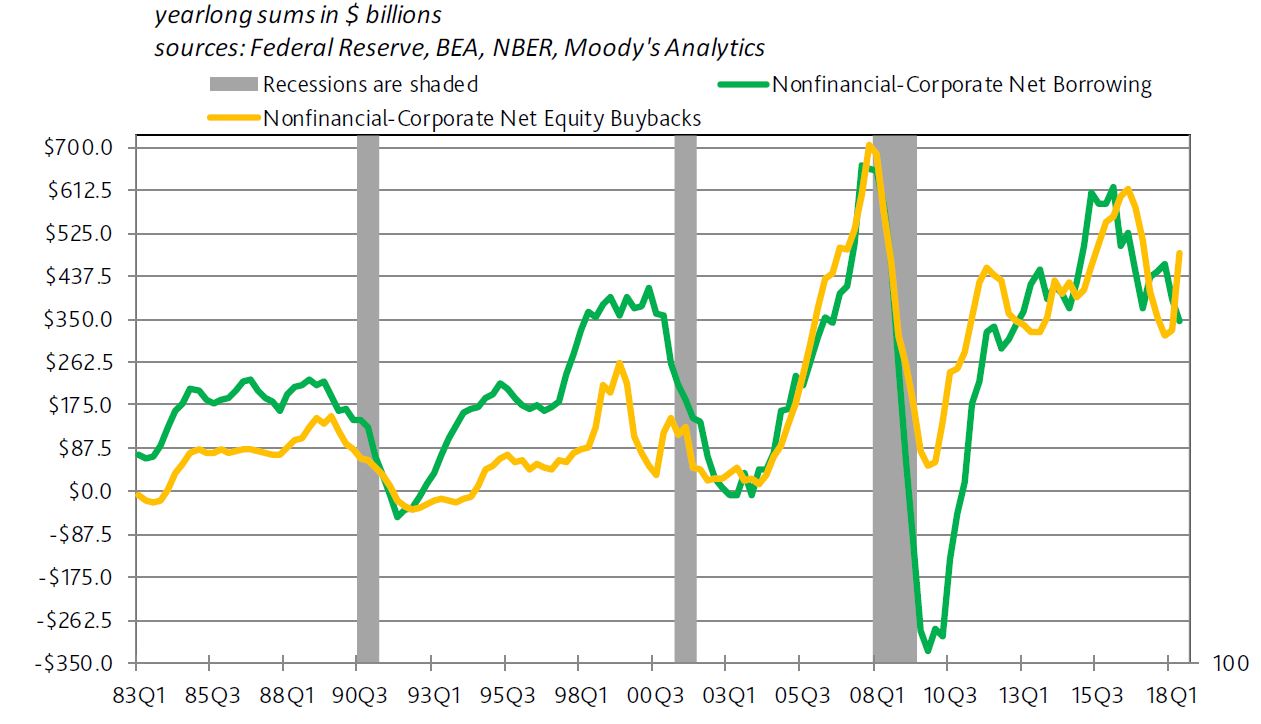


American companies are in the business of making whoever controls them rich. Sometimes they’re willing to make a long play and compete for market share, but generally ONLY if they think there’s a possibility of achieving a monopoly or oligopoly position. So there was tons of money for Uber & Lyft, because investors knew that in the end, they’d be able to reap monopoly profits, which they now are.

But in markets where there doesn’t seem to be that possibility, corporations are much less willing to compete aggressively for market share by beating the competitor on price. They prefer to compete in other ways: the third place, for example, or a product that is perceived as better and effectively “price clump”. If an upstart tries to break into an established industry they may briefly drop prices to keep them out, but that’s as far as they’ll go.

Now here’s the problem, Chinese companies compete aggressively for market share based on price. Starbucks used to be the player in the Chinese coffee house market. Then they had their coffee drunk by an upstart named Luckin. Luckin is opening about 10x as many stores as Starbucks. It has 16,000 stores to Starbucks 7,000, and its drinks, which include fancy ones, are about 30% cheaper. Starbucks definitely makes more per store, but Luckin makes more gross. There’s no “third place” about Luckin, they’re kiosks, you order your drink, usually thru your phone (which offers constant discounts) and pick it up.

Because they have massive scale, their unit costs are low, and they benefit from the usual “no one can beat the Chinese at scale” advantage. (Though Starbucks could have done the same, they just wanted to be a more luxury brand and get the extra profits.)
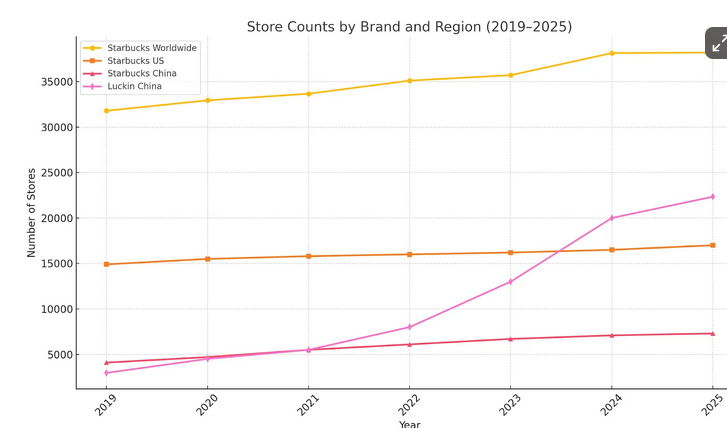
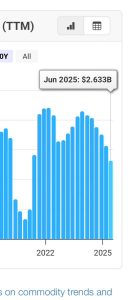
Gadallion goes into this in detail, if you want the nitty gritty, but this chart shows the speed of Luckin’s growth.


Now Luckin has come to America. The drinks are cheaper and Starbucks does a lot of pick up business. If you’re just going to pick up a drink, why not go to the cheaper alternative, assuming the drinks are about as good? And unlike China, American consumers are squeezed big time. (China’s 2nd and 3rd tier city consumers are doing well, Beijing and Shanghai consumers are currently under pressure from the housing bubble being smashed, but should recover in the next year or two.)

For now Starbucks has more stores worldwide than Luckin. But their unit costs are higher even now. If Luckin keeps expanding, and especially expanding in the US and S.E. Asia, Luckin’s unit costs are likely to keep decreasing.

It’s hard to see how this doesn’t end badly for Starbucks, unless they get Congress or Trump to intervene. There’s momentum with Starbucks: people are used to going there and keep doing so. But if there’s something cheaper, that’s about as good?

If they compete on price, they lose a lot of their profit margins and investors are already squealing about the minor drops they’ve recently experienced. If they don’t compete on price, Americans who are price sensitive and don’t need “the third place” move to them, and they lose massive amounts of volume. There’s certainly a niche and a fairly large one for “buy a drink and stay at the coffee shop to enjoy it”, and I suspect it’s pretty profitable, but it’s smaller than what Starbucks is right now, and what’s to stop Luckin, after it wins the price sensitive customers from opening “Luckin Luxury Cafes” or somesuch, offering actual premium drinks and comfy chairs and tables and laptop charging, and using their unit cost advantage to out compete the “third place” Starbucks?

This is a specific case of a general rule: Chinese companies want scale and compete on price. They’re like American businesses in the 50s and 60s. They offer value and they aren’t trying to maximize profits by maximizing prices, because they’re used to an economy which has actual price competition.

I used to spend a lot of time in Starbucks, because they had stores in book shops, and I’d buy a coffee and read books for a few hours every day. I’d still be interested in that sort of thing and I have some emotional fondness for Starbucks because of what are, for me, good memories.

But it’s hard to be sanguine about their future. The third place stuff is fine, but if they want to survive, they’d better start competing on price while they still have a size advantage.

Most US companies are in a far worse situation: they’re already smaller than their Chinese equivalents. They can’t compete on price, it’s not possible, because they don’t have scale economies and can’t get them. As China catches up in quality and in many industries surpasses, they’re toast unless protected from Chinese competition, usually by law, geography or trade barriers. Businesses which aren’t, however, are about to experience what other countries experiences when Coke and McDonalds, in the 80s and 90s, came to town, or manufacturers experienced in the 50s and 60s before the rise of Japan.

Developing countries, with lower costs, have an ironic advantage when it comes to survival of many businesses. But high profit, high cost countries like America and most European ones?

Toast.

***

I appreciate everyone who donates or subscribes to keep this site (and Ian) running. Readership is up over 40% this year, and I’m very grateful. If you want to help the blog, please share the articles you like and if you can afford it, and like the content, please Subscribe or donate.
London & New York Are Toast

Stumbled across this recently: 

  • China aims to become custodian of foreign sovereign gold reserves to strengthen its standing in the global bullion market, according to people familiar with the matter.
  • The People’s Bank of China is using the Shanghai Gold Exchange to court central banks in friendly countries to buy bullion and store it within the country’s borders.
  • The move would enhance Beijing’s role in the global financial system, furthering its goal of establishing a world that’s less dependent on the dollar and Western centers.

Remember when the US stole Venezuela’s gold? Remember when the West “froze” Russia’s reserves, including gold?

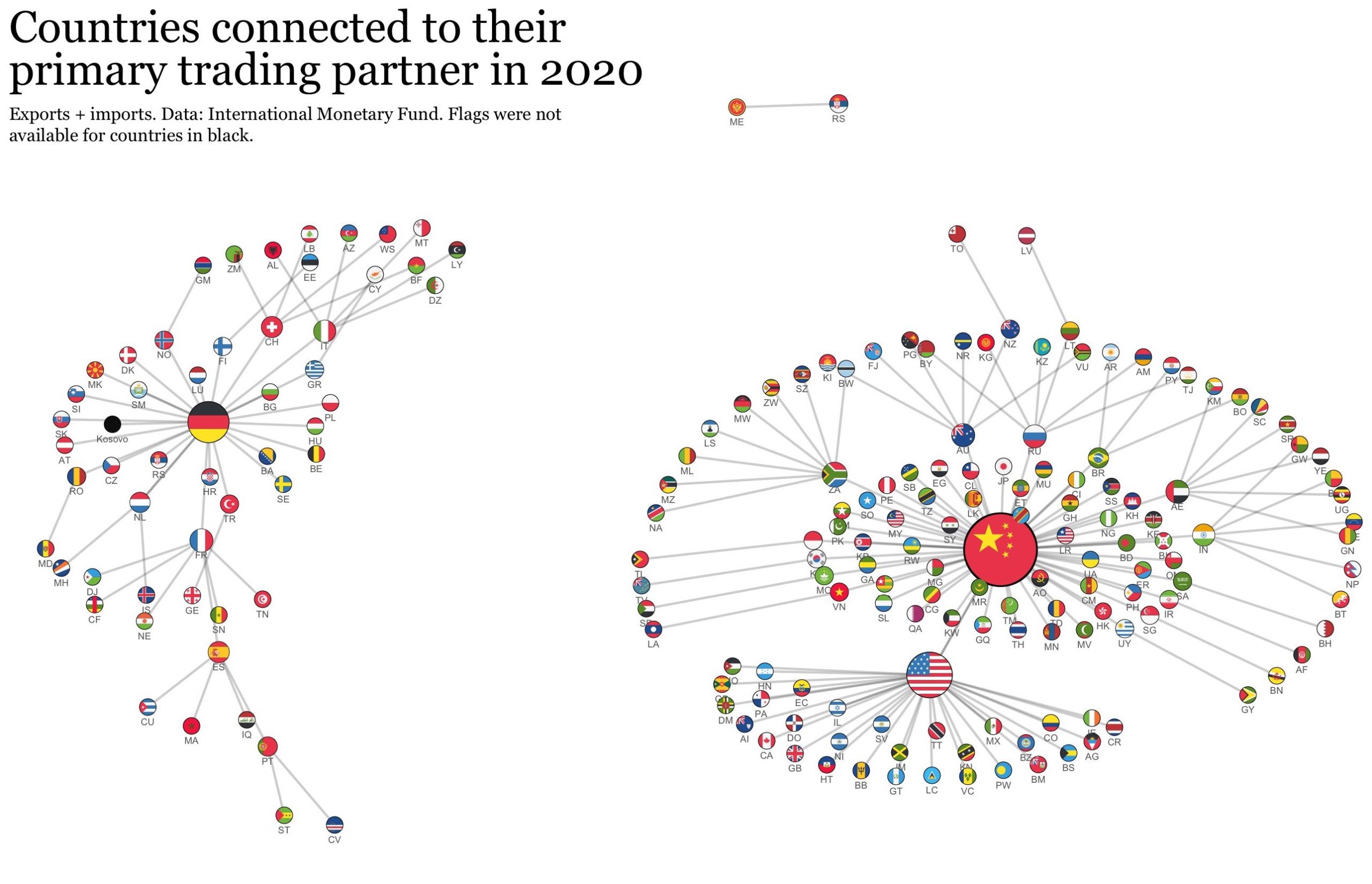
Actions have consequences. Since most countries do more trade with China than with the US, let alone the laughable UK, and since China appears a lot less likely to steal one’s reserves, this rather makes sense.

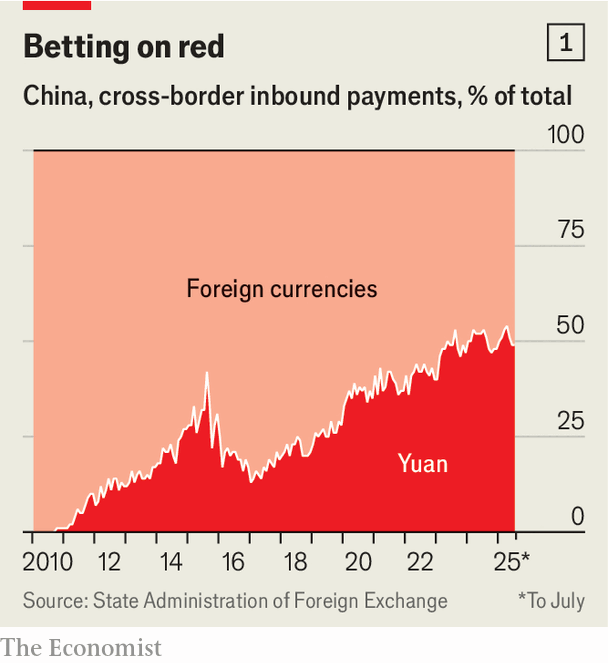
China does almost half of its trade now in Yuan, and the the remaining is often in local currencies. (The Russians pay in rubles, for example.)

When  you add in the trade flows, and bear in mind this is 5 years old and today China has overtaken in more countries…

Well, why exactly would you use US dollars for trade, or use New York or London as your primary foreign banking center? You’d be a fool if you did so, if you’re outside of the West+allies (Japan, South Korea, Taiwan.)’

The US stock market is also VASTLY over-valued. There hasn’t been a proper market correction which was allowed to stick in generations. The idea that US public companies are worth more than China’s public companies is ludicrous. As the actual world economy is now centered on China, not America, this will become unsustainable, because the US dollar is going to copy what happened to the UK pound over the 20th century, and the US will no longer have currency seignorage: if other countries don’t want it, the US can’t just print it without massive and crippling inflation.

This means the eternal rising market created by Greenspan and treated as sacred by every President and Federal Reserve Chairman is in its last gasp. No matter how much they will wish to prop it up, they won’t be able to without crippling side-effects beyond what can be papered over by printing more money and giving it to rich people. (All of this before the fact the stock market is currently an AI circle jerk, with companies buying NVidia chips for AI and NVidia then investing in those companies. When AI turns out to be an ordinary tech, useful for some things but not revolutionary, BOOM.)

Meanwhile:

This is a big deal. This is what GE and Siemens sell. Now there are Japanese and Korean and Chinese suppliers, but this a key technology. And Iran can make it now. GE has the largest installed base, followed by Siemens (German), but why court sanctions risk and repair parts being cut off?

When the Ukraine war started, Siemens withdrew from Russia, and refused to maintain already sold turbines.

Woops.

Again, core tech that used to be controlled by the “North” is spreading across the world. Hell, the Houthis are making their own farm combines!

And it’s China where the future is happening, including the Jetsons future:


The US isn’t even on this technology, let alone moving to scale. Let me remind you of the rule of Industrial dominance:

When there is a dominant industrial power (Britain to 1860, America from 1920 to 1965) you have to be ahead in tech to compete, because the dominant power can always scale cheaper than you.

This is an industry where the US and Europe aren’t even on the playfield. Worse (or better), it’s the sort of industry that, in wartime, can easily be converted to military production.

We’ll end with one more chart:

It’s over. It’s all over. The West is sinking into industrial and technological second place and it’s a second place that is long way behind first place. Further, massive US research cuts and a monomaniacal obsession with one tech (so called “AI”) indicate that the US isn’t serious about catching up, but has accepted its decline, whatever the political rhetoric may be.

This leads to the end of the American Empire, to vassals pulling away, and to a massive and sustained loss of standard of living, just as it did in the UK. Combined with ecological issues, I expect the American experiences of decline to be faster and worse.

***

I appreciate everyone who donates or subscribes to keep this site (and Ian) running. Readership is up over 40% this year, and I’m very grateful. If you want to help the blog, please share the articles you like and if you can afford it, and like the content, please Subscribe or donate.
American Billionaires Are Competing To Be King Shit of Turd Island

You may have heard that Tesla’s board has proposed giving Elon Musk a one trillion dollar payday. Tesla is falling apart, and the ostensible theory is that only Musk can save it, as if he’s not the guy who ran it into the ground with his bad decision making.

Elon, of course, is currently “the world’s richest man” but his fortune is probably under 500 billion. So he wants to triple it.

This, as you may have figured out already, is not about saving Tesla, but looting it before it crashes out completely, which is what’s going to happen. Only 100% anti-china EV tariffs are keeping Tesla alive right now, but the problem is that non-Chinese companies are now producing cheaper, better cars and no, Tesla isn’t going to regain its lead.

Elon is just a rat trying to leave a sinking ship with a huge wheel of gold embossed brie, and the board (his cronies) are helping him.

Meanwhile:

(Every person who told you that the end of dollar hegemony was impossible was either an idiot or lying to you.)

Oh, and meanwhile China has banned all its tech companies from buying NVidia AI chips. Seems they figure their homegrown chips are now as good as the lobotomized versions NVidia is allowed to sell to Chinese companies.

In about three years, China’s chips will be as good as NVidia’s. In about six years they’ll be as good and a lot cheaper. Then every country outside the West will switch.

Meanwhile, as I’ve discussed before, every non-Western country will use Chinese Open Source AI, because using American or European AI is way too risky (if you don’t understand why, you’ve been a coma for the past 40 years.)

NVidia is driving something like 40% of American stock valuations and AI is the huge bet America is making. America can’t even make magnets.

So what happens when China can produce essentially everything the West can, at equal or better quality, and it costs less? Passenger jets, military tech, chips, AI, robots, drones, cars, consumer goods. Everything. (or a reasonable facsimile, well north of 90% within five to ten years, and it’s already north of 80%.)

Well, the oligarchs who have been competing to be the richest guy in America are going to find they have a whole bunch of US dollars that the most important economy in the world, China, won’t accept for anything meaningful. You won’t be able to buy Chinese companies with it. You won’t be able to buy Chinese tech secrets with it. Chinese scientists won’t want to work in the shithole that the US is turning into, especially given all the racism against Chinese.

American oligarchs will, as my father put it, find out that they were competing to be “King Shit of Turd Island.” Like being the world’s richest Indian in 1950. You’ll live a nice life, but you don’t matter.

Serious elites have three jobs, in order of importance.

  1. Keep their country powerful and advanced and important;
  2. Keep control of their country
  3. Compete among themselves.

American elites reversed the order of these tasks for generations. They’ll be lucky to avoid a civil war, is how badly they’ve fucked up. And the tech-bro “masters of the universe” are about to watch China roar past them and gain the tech lead in everything that matters. They can own America’s Tik-tok, but who cares, because America is a has-been nation, coasting on legacy fumes, and it’s only going to fall further and further behind.

Thiel and Musk and so on are just crabs in a bucket, competing for power in country going to Hell. May the best most ruthless crab be crowed King Shit of Turd Island.

***

If you’ve read this far, and you’ve read some of my articles and most if not all of Ian’s, then you might wish to Subscribe or donate. Ian has written over 3,500 posts, and the site, and Ian, need the money to keep the shop running. So please, consider it.

Follow Up and And Reply On My “How to Lose Allies” Post

First, I want to follow up on this: “I am due to have a conversation with a friend that lives in Denmark tomorrow and I’m going to ask him about energy prices.”

His reply, and I paraphrase as I did not record it or take notes: “if we still had to make our house payment, we would be totally screwed. The amount of money that we pay for energy now is about equal to what our house payment used to be. It’s about five times higher than it normally is, but what’s even worse is the high cost of energy filters out into everything in the Danish economy. A simple item like bread is three times higher than it used to be. Specialty items are three or four times higher than they used to be. Fish from fisherman that we go to the docks to buy from because we live on an island is four times more expensive because they’re paying four times more for the energy they’re using to go out and fish. It’s brutal and it’s all because the United States or somebody allied with it blew up the Nord stream pipeline. I try to keep my mouth shut about this because most people have drank the Kool-Aid, but I really hope Russia wins because I’m sick of all this global elite bullshit.”

These words were spoken by a well educated American married to a Dane with two teen-aged Danish children. If the Danish economy is suffering like this Germany must be fucked.

Where does Europe get its energy now? From the US, now exporting LNG (liquid natural gas) to Europe for 4x the price of Russian and Turkmen natural gas. Here is my question as a Texan: why haven’t natural gas prices risen in tandem with the export of the commodity? People I have asked who recieve natural gas royalties are pissed because there is no price increase pass through. So, owners of the wells are getting screwed and so are the buyers of the product. Welcome to Oligarchical America.

Next I want to address a handful of commenters in my post, best reprersented by Mark Level. He writes, in a very gracious and polite comment that he takes issue with my outline of American Grand Strategy. He notes, “This insane hobby-horse (or idee fixe, choose your metaphor) dates back far more than 120 years, probably 3x that long, and originates in British Colonial phobias about Russia and “the East” generally. Halford John Mackinder developed this lunacy & published it almost exactly 120 years ago, but it had a long pre-natal development among arrogant Imperial gits in Asia. (Gits and twits, upper-class British twits, like the Monty Python sketch.) See here, and the delightful childish fantasy of being Alexander Magnus from this Mackinder thought bubble . . . .

Please note, first and foremost, I used the word hostile power or hostile coalition. Hostile being the primary variable.

I’ve read Mackinder’s works. Anyone who has traveled across the Silk Road pretty much has to read them. His idea is not necessarily original. It’s more a fusion of ideas that came out of the late 18th century and 19th century Western European dominance of the world that began, as I previously mentioned, with the defeat of Venice in 1509,  Portugal’s conquest of a Spice Empire, and its desrtuction of the Ottoman Navy in the Indian Ocean, thus having no rivals, and of course Spain’s rapacious theft of New World gold and silver.

During the 17th and 18th century, a new idea developed with the growth of the British Navy, who outstripped the Dutch and pretty much took over their empire. New York City was, after all, New Amsterdam. What these developments presaged was an idea that centered around the ascendancy of the Littoral powers over the Continental Empires that had ruled Eurasia for millenia. Gunpowder, boats, better firearms, better steel and in the New World, devastating disease leading to genocide in many cases up and down North and South America. The Littoral is defined by strategistsas those land areas (and their adjacent areas and associated air space) that are susceptible to engagement and influence from the sea.” Thus the emphasis on a strong navy by Alfred Thayer Mahan who proved just how dominant Littoral Powers could be. For a time, that is, only for a time, as I see it.

Add to this ascendancy the wars of the Western European powers of the United Kingdom, Spain, France, and the Holy Roman Empire primarily fought during the 18th century for two strategic reasons, primarily by two very different nations with very different vital national interests at stake.

One, was the United Kingdom’s insistence that no power could dominate the Low Lands of the Netherlands and later Belgium because if they could, it would threaten an invasion of the British Isles, plus their massive exports of wool textiles, fueling the nascent industrial revolution. Smart, if ruthless policy.

Second, we must understand France‘s main goal during the wars of this time (and for several centruies prior) was to ensure a divided Germany. So long as the German states were littered into 100 different little principalities France had nothing to worry about. Thus France could go on dominating the continent. The first seismic change to this was the War of the Sixth Coalition which saw for the first time Russia flex its true potential when Russian troops occupied Paris. France’s cataclysm occured not in 1941 but in 1870 with her defeat in the Franco-Prussian war. The result of which was Prussia unifying all of Germany into one empire, adding insult to injury by having the Kaiser crowned in Versailles and taking Alsace Lorraine away as its prize.

Fuse those two strategies together and it is not too far an intellectual leap, considering the Great Game going on at the time between the UK and the Russian Empire, for Mackinder to conjure up his ideas. Were his ideas taken up by the United Kingdom? You bet, but by 1917 when it was clear that the United Kingdom could no longer maintain the balance of power in Europe and the United States had to intervene, (everyone should read AJP Taylor’s magnum opus, The Struggle For Mastery in Europe, to understand the balance of power and its collapse in 1917) US foreign policy intellectuals adopted it. And rightly so.

I think it’s the correct idea. But my reasons for thinking it’s the correct idea are not gonna make many of you happy. You might have to face some hard truths. Oh yeah, I did tell you I was a Realist in the old school manner of the word? In fact there have been a few times when Ian has chastened me pretty seriously for my realism. With that admisssion I will make another one: I don’t mind the criticism from Ian or from others. Ian is probably the smartest person I’ve ever met in my life and I listen to what he has to say. And when I say listen to him, I mean, I consider his words deeply. A man who cannot change his mind will never change anything. Nevertheless, I digress.

Here are my reasons for why I believe the prevention of a single hostile power or coalition of hostile powers from dominating the Eurasian landmass is smart policy. Please, if you take anything away from this sentence, take the meaning hostile. 

Number one: the Monroe Doctrine. Oh, I hear you screaming already. But the fact is that if this were not “our” hemisphere, not a one of us would have the standard of living we do today. Our hegemony of the Western Hemisphere is the primary foundation of our wealth and our power. You might not like it. I grimace frequently at the crimes we comitt to protect it. But, the Westphalian System is not built on justice. It is built on the acceptance of international anarchy. Each nation to its own. There is no single sovereign power governing planet Earth. Thus, violence is the supreme authority from which all other authority is derived. Is this a grim Hobbesian outlook? Yes. I don’t like it and I’m pretty sure you don’t either. But as a realist, I take the world as it is, not as I desire it to be. A hostile power or coalition of hostile powers that dominate Eurasia can take that hegemony away. You might not like it but trust me when I say you don’t want that to happen.

Second, a hostile power or coalition of hostile powers that dominate Eurasia can take more than our hegemony away, it/they can invade us. We don’t want that either. Thus we have a powerful navy that projects power to keep Eurasia divided–for the time being, because I think if we get into a war with China, their indirect way of war–read your Sun Tzu–will probably outwit us on the high seas. I’ve spent a great deal of time in China and have a healthy fear of their capabilities. However, my greatest fear is that in our arrogance we will engender the very hostility we must prevent and by our own devices bring about the doom we should seek to avoid. We have lost our edge, our generosity of spirit and our understanding of power. We have become a mean spirited, two-bit, cheap and vulgar people. And sadly, because so many of us are beaten down economically by rich elites who are delusional, we’re going to lose a big war in a painful way. A war that could be avoided, but probably won’t be. I hope I’m wrong, but don’t think I am.

That said, these very wise words, written by Robert D. Kaplan recently, convey the gravity of our present predicament, “There is no prediction. It is only through coming to terms with the past and vividly, realizing the present that we can have premonitions about the future.” Moreover, as a wise woman wrote about history, “the more I study history, the more I learn the art of prophecy.” Deeply contradictory statements, yet both true in their essence.

Are we any more perceptive now about what awaits our planet than were the Russians of 1917, or all of Europe in 1914, and, for that matter, the Germans of the 1920s and the early 30s?

Do we honestly think we know better than they did? With all of our gadgets and our technological triumphalism I bet you there are a handful of you out there that think we do know better than they did. I hate to disappoint you, but we don’t. History is the story of contingency and human agency, not inevtiablity.

So, there it is. Rip me to shreds if you wish. I’ve suffered enough Shakespearean arrows of outrageous fortune in my 54 years to handle it. In fact, I welcome your ideas and if you got this far I’m grateful for your time.

If you’ve read this far, and you’ve read some of my articles and most if not all of Ian’s, then you might wish to Subscribe or donate. Ian has written over 3,500 posts, and the site, and Ian, need the money to keep the shop running. So please, consider it.

The West Is In A Far Worse Position than the Warsaw Pact Was At The Start Of the Cold War

Chinese and American flags flying together

One of my long term predictions, coming true before our eyes, was that the world would fall into a new cold war, forming two trade blocs. I hoped it wouldn’t happen, I suggested ways to avoid it (including Europe forming the nucleus of a third bloc), but so far it appears correct.

Khrushchev  famously said “we will bury you!” Looking back and knowing that the USSR and Warsaw Pact collapsed, we laugh.

But he had reason to believe it. Soviet style Communism had some issues, but in the 50s, it looked like the superior system. It had avoided the Great Depression, it had been the most powerful state in the coalition defeating the Nazis, it had by far and away a larger military than NATO and its economy was growing faster.

This last bit really worried the West. The miracle of compound growth, and all that. The Soviets weren’t just growing faster than the West, they had been doing so for a couple decades.

The West had strengths, including a larger population, a corner strategic position, a larger economy (even if growing slower) and the technological and scientific lead.

When the Soviets put a man into space first that scared the hell out of the West.

Now, of course, in the end they did “lose.”

Now take a look at the “Golden Billion”, NATO plus Japan and South Korea. Lower population. Weaker military (yes, it is.) Behind in 80% of techs. Slower economic growth. Smaller real economy (industrial/resources.) They still might be considered to have a corner position (though not once the Chinese unambiguously have the stronger navy, which they will), but it’s the only advantage they have.

The original Cold war started off with NATO leading in tech/population/economy/position, and behind it economic growth/military size.

This cold war starts with the “Golden Billion” ahead only in strategic position. (Continental US, Europe as a corner position.) Arguably even this isn’t true, given that South Korea and Japan are now key parts of the coalition and extremely vulnerable. As we speak, the US is slashing spending on research and tech, with only a few exceptions (like AI.)

No one, and I mean no one with least bit of historical understand or common sense would bet on the “Golden Billion”. If you are doing so  you are stupid. Yes, there’s a small chance, but it is tiny.

The only sane and statesmanlike response from those in charge of American vassal states is to figure out how to switch sides, without the US wrecking them, and how to get a good deal. If you can’t, the question is how to avoid the US looting you during its decline. As Sean-Paul Kelley wrote on Sunday:

The chaos of rising energy prices is devastating European industry. In the last year alone Germany has lost 196,000 businesses. I repeat 196,000 businesses in Germany closed in one year. That’s devastating to any economy, but Germany long the economic engine of Europe and the EU is deindustrializing for one simple reason: the destruction of the Nord Stream pipeline, which has been an absolute catastrophe for Europe. The United States is responsible for it.

Russia and China just signed a new pipeline deal. The energy that went to Europe (the cheap energy) is now going to go to China. Chances of Europe avoid de-industrialization have gone from slim to damn near none.

The Soviets pumped resources to their allies. The Americans are cannibalizing them. The Soviets made a mistake, but this strategy won’t work either, because a fundamentally financialized economy cannot produce the type of real growth which is required to win a great power competition.

The world is dividing into two great blocs. One of them is so much weaker than the other, with so much worse future technological and economic growth prospects that it is almost certain to lose.

Our side.

The best way to win a war is to ally with the stronger side. That isn’t America or NATO or the Golden Billion.

***

If you’ve read this far, and you read a lot of this site’s articles, you might wish to Subscribe or donate. The site has over over 3,500 posts, and the site, and Ian, take money to run.

If You Understand Only One Thing About Chinese Government

It should be that almost always they do what they promise, and they meet their goals. An American-Chinese silicon valley type spent some time in China recently (I don’t agree wit the whole article, but you should read it), and among the bits that stood out to me was this:

In the US, when politicians make campaign promises, I never actually expect them to follow through. But Chinese leaders do—for better and for worse. The 2025 plans to build 1,350 Shenzhen parks or reduce China’s energy dependence aren’t mere propaganda. (Neither, tragically, was the one-child policy.) Accountability is built into China’s bureaucratic system through KPIs, and you can see the results firsthand.

This echoes what Naomi Wu noted: that the Communist party attains their goals, and that many of them are the smartest most capable people she knows. (I think the one child policy wasn’t a mistake, as it happens, though it probably continued too long.)

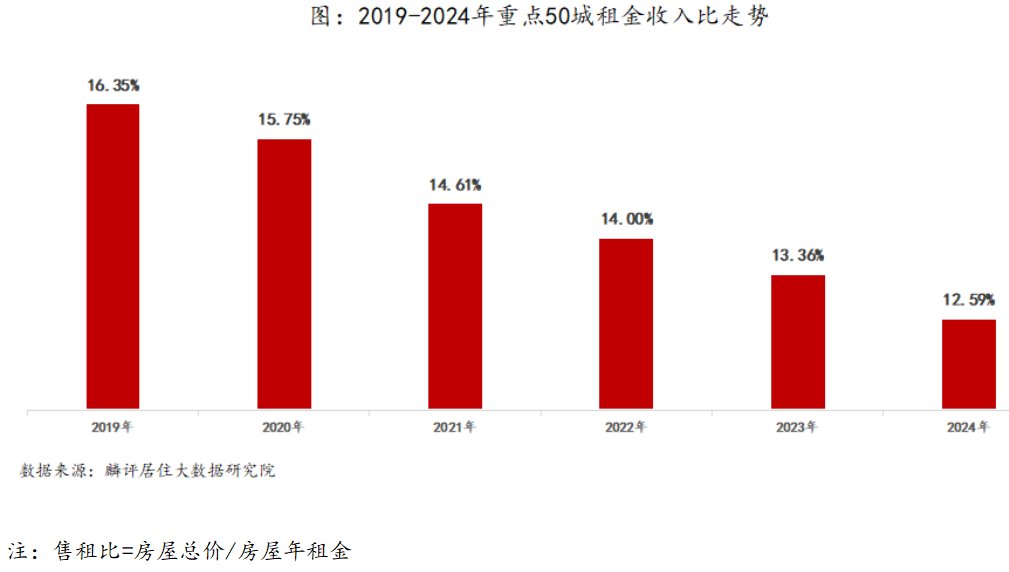
This chart is of average rent as a percentage of income.

As a westerner this is mind boggling. My entire life rent prices have just increased and increased and increased. So have housing prices. One of my big criticisms of China for years was that they had overly-relied on housing bubbles to fund their growth and that it was causing significant discontent. Every young Chinese person mentioned it as a problem.

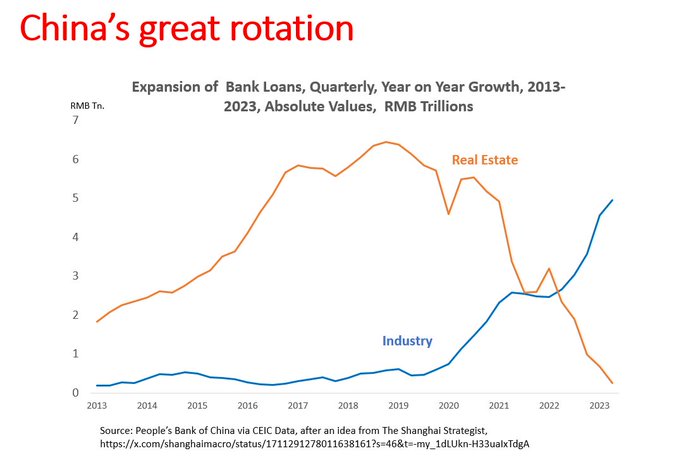
So then they just… went and fixed it? And yes, it’s been painful, and led to some softness in the economy, but when it’s done, the economy will be much stronger. (See, “China is Transitioning, and So far successfully“).

China faced a challenge during Trump’s first term: he slapped export controls on chips. They didn’t have a significant domestic industry. So they built one. They knew that if America had done this with one industry, they could do it with all, so they set a national goal to become self sufficient industrially: to be able to make everything they needed. As this was happening, they realized housing was too expensive, so they made that part of the solution, they rotated investment out of real estate into industry.

To a Westerner who has lived their entire adult life under neo-liberalism, this is mind-boggling. Wait, the government can “just do things?” And when it decides to do things, it succeeds? It isn’t just bullshit?

I mean do things other than de-regulate and say “well there isn’t anything we can really do, this is just how the world is.” Do things other than just make the rich even richer? Do things other than constantly de-funding science and engineering and the humanities? Do things other than making medicine fantastically expensive? Do something other than blowing another asset bubble?

I’m 57, and I remember the world before neoliberalism, but I remember it as a child. In my entire adult life I have not seen a Western government capable of doing what China does: set an important goal which benefits the population as a whole and crush it.

China is winning because China deserves to win, because it is better run. I’m not going to whitewash it: there are a lot of things I don’t like about how China is run. But bottom line, it’s run more for the benefit of ordinary citizens than most Western countries, and those countries which seem to be run for the benefit of the population as a whole are running on legacy systems: the entire EU it seems, is considering gutting their social welfare systems to spend more money on American weapons. For my entire life things have been getting slowly worse in France and Germany, and quickly worse in the UK. In China, on the other hand, life keeps getting better for the majority of the population.

Are you worried about Democracy? You should be. But one simple threat is this: China isn’t a democracy and its actions clearly benefit the majority of its people more than the actions of American or British or EU governments benefit their people.

Democracy isn’t just a something word you wave around. If it doesn’t produce better results, people will stop believing in it.

China’s winning because the CCP gets results and the results it chooses to get are, much more often than in the West, good for the majority of its people. That means it deserves to win, and we deserve to lose.

***

If you’ve read this far, and you read a lot of this site’s articles, you might wish to Subscribe or donate. The site has over over 3,500 posts, and the site, and Ian, take money to run.

Trump Is Running the Standard Purge and Control Playbook To Install Decline

Some years ago I wrote an article about how to run a real left wing government.

Seven Rules for running a real left-wing government

Of course, it was really a guide for how to change the ruling ideology of a society. Because, yes, elites, apparatchniks and what as might be called a deep state state exist. These aren’t all the same thing. There is plenty of private support for whatever the status quo is, especially at the highest levels, since whatever the ideology is, it put them in charge and benefited them. There are also a lot of mid level enforcers, bureaucrats (both private and public) and professionals who benefit from the status quo.

Anyway, two of the seven rules were specific to the problem of running a left wing government in a neoliberal world (it was 2016.) But here are the other five

  • Your First Act Must Be a Media Law
  • Take Control of the Banking Sector
  • Who Is Your Administrative Class?
  • Take Control of Distribution and Utilities
  • Reduce Your Vulnerability to the World Trade System

Control the Media: Now the wording isn’t always the best, but Trump has been on a constant attack against the media. He’s changed who is allowed to be part of the White House press pool and he’s made the media pay blackmail money. He’s now talking about removing NBC and ABC’s licenses. He may, he may not, but the threat makes them change.

Take Control of the Banking Sector: for the first time in its history, a Federal Reserve governor has been fired the President has always had this authority in theory (except over the Chair), but has never used it in practice. Ironically I once advised Obama to use this power to stop the Fed bailouts in 2009. Control over the banking sector is really control over the permission system: whoever is given money or the ability to create money can do things. Once you have your hands on the money-artery, nothing significant can happen without your permission.

Who is Your Administrative class: All systems have a class of people which run the bureaucracies. We have come to know ours as the PMC. Trump is replacing them, firing them in huge piles, and replacing them with right wing, often religious, fanatics. These are people who will give him his military parade (denied in his first term), who will extradite his enemies, who will break laws for him knowing that the Supreme Court (carefully packed during decades of preparation for this moment) will make what they do legal, and that in any case, the enforcer class is under Trump’s control.

Indeed, Trump has been purging the enforcer class and replacing them with people who would not have been considered qualified by the previous system. This is true of the military, the FBI and indeed of all the three letter agencies. Since ICE are his loyal brownshirts, needing no purging, they are being massively enlarged and given far greater powers.

Reduce vulnerability to the World Trade System: Let’s state this simply: the US had been losing the trade game badly for about fifteen years. China was coming on hard, Africa is lost, South America is almost lost, Russia is no longer complacent and America has lost the lead in over 80% of technologies. It can’t build ships, its planes fall out of the sky, most electronics are made elsewhere, it can’t even make magnets. It’s a joke.

So Trump is creating a two bloc system, there’s the US and its vassals (calling them allies amounts to lying) Europe, Japan, Australia, Canada, New Zealand, and South Korea. On the other side China, Russia, Iran, and their friends, which includes most of Africa and Asia and a good chunk of South America.

The US has slapped 100% tariffs on Chinese EVs, and tariffs on almost everyone else. Why? Well, simply enough, the US can’t compete. If there is free trade, or anything approximating it, the US’s economy will be further cannibalized. Since they can’t sell overseas, except for chips, food and a few other goods, it’s time to stop competing. The US can’t win, so it’s not going to play.

The problem, of course, is that unless the US takes this time behind trade barriers to become competitive, it’ll just keep falling behind, and there’s only so much it can cannibalize its vassals. Given the massive slashing of research and universities, with no sign of a new system to replace them, it’s clear that the US has chosen semi-permanent decline.

Trump is Changing the US ruling ideology to Controlled un-development

It’s still about making the rich richer, but Trump’s choice is controlled decline. The US and the West will fall further and further behind, living conditions will get worse and worse, but the rich will become relatively richer in relation to everyone else in society. Think India in the post-war period. Fantastically wealthy elites, everyone else is a peon. Oh, there’s lots of ruin in countries, but this is the direction of the arrow and it only changes if a different ideology takes over.

Competition in the US between all groups will become far more savage, because there is no net. You get you hands on a position which commands resources or you become homeless or techno-peasant.

The vassals, who mostly have social welfare systems, will be forced to liquidate them, buy US military goods (which are useless against the US, given the software driven nature of them) and sell off all their public goods to continue the enrichment of elites. Any who try to avoid this fate will be coerced as necessary, first by their own internal elites.

This is the future in America and its allies. The only way to avoid it is to figure out how to defect.

***

If you’ve read this far, and you read a lot of this site’s articles, you might wish to Subscribe or donate. The site has over over 3,500 posts, and the site, and Ian, take money to run.

Trump Takes Share Of US Company Profits & Pentagon Guarantees Rare Earth Prices

The US government is to take a 15% cut of Nvidia and AMD chip sale profits to China. There are also discussion of taking a 10% stock share in Intel.

Meanwhile the Pentagon has taken a hundred million dollar stake in a rare earth miner, and guaranteed minimum prices.

As Albert Pinto notes, this isn’t neoliberalism. Neoliberalism is dying, if not dead, in the US, though the Euros are clinging to it. Everyone’s noticed that China’s hybrid model absolutely trounced the West, and, hey, it’s a chance to get even richer. Pinto thinks that Trump is trying to change the nature of the oligarchy:

8/ Winters’ model of oligarchy:

1 Warring: armed oligarchs defend property claims separately

2 Ruling: oligarchs institutionalise defence

3 Sultanistic: 1 oligarch monopolises armed wealth and defence

4 Civil: state defends property regime Trump: US from 4->3?

Now I don’t think America’s oligarchy going to go Sultanistic, in the sense of one ruling oligarch. The only way that happens is if Trump manages to turn the Presidency into a Trump family matter, and that seems unlikely. But a rotating sultantic Presidency until, perhaps, someone manages to make it permanent: that’s possible.

But the days of laissez-faire are clearly over. Now this isn’t entirely stupid, I’ve been calling for what Trump did for rare earths for twenty years. It’s the obvious thing to do. Likewise, ensuring stable domestic production of necessary resources is sane and necessary and if one has to pay a little bit more, so be it.

Owning shares in US companies isn’t necessarily a bad thing. The truth is that every fundamental innovation which made the internet and smart phones possible was government funded. Tesla doesn’t exist without a massive government loan back when it was nothing. But the government doesn’t share in the upside nearly as much as it should, because large corporations pay almost no taxes. The government takes the risks (Solyndra was given about the same amount of money as Tesla at the same time, and went bankrupt) but doesn’t share in the upside. Tesla just paid back the loan, but if the US had an equity share, it’d have made out very well.

Golden shares, a 10% ownership in large or important firms used to be quite common. It’s not a new policy, but it used to be associated with the left wing. What’s going on now is a right wing version of the same thing.

The President is the strong man who runs the government. Everything private companies do they do because he allows it, therefore government has a right to a share of the profits and to exercise control when it chooses to. The President picks winners and losers, determines the effect of court decisions, and so on.

It’s the logical extension of the tendency to Imperial Presidency. Every other power in society is weakened, the President is above all. An elected dictator, as it were. (Similar to parliamentary democracies in that sense, but very un-American and without the protections of Westminister government, where new parties are possible and governments can fall easily.)

Right now the scramble is to see which faction will control the Presidency after Trump. The best bet is probably the tech-bro faction, since Vance is Peter Thiel, the Palantir surveillance state magnate’s creature. (Though puppets have a tendency to cut their strings when they attain supreme power.)

All of this entails a vast misunderstanding of how the Chinese public/private system works, by the way. For one, China probably has the most competitive (free) markets in the world in those sectors which are private. For another, the system is not run to maximize profit, but to produce certain social and policy outcomes, including a good life for the majority of the population. China has both deliberately reduced housing and rent prices, crashing the housing market and costing owners a huge amount of money, and it has been deliberately reducing the number of billionaires.

These aren’t incidental matters, and just saying “well, we’ll move to a mixed model” misses what makes China’s economy work so well.

But no society run by a financial oligarchy is capable of understanding that “more profit” isn’t the way to win economically, so America will continue to learn the wrong lessons from China. As for Europe, they aren’t even learning the wrong lessons, they’re just doubling down on austerity and increasing military spending in a way which will make some Americans rich and hardly help them at all. Not even in the game.

More on all this later.

***

If you’ve read this far, and you read a lot of this site’s articles, you might wish to Subscribe or donate. The site has over over 3,500 posts, and the site, and Ian, take money to run.


Page 5 of 28

Powered by WordPress & Theme by Anders Norén