
Week-end Wrap – Political Economy – August 23, 2026
by Tony Wikrent
Denmark deploys first conscripts to Greenland
[Euractiv, via Naked Capitalism 08-22-2026]
War on voting
Time to Raise Hell: Trump Taking GOP Voter Suppression Efforts to Heights Never Seen
Thom Hartmann, Aug 21, 2026 [Common Dreams]
Joyce Vance just pointed out that Howard Lutnick, Trump’s morbidly rich crony Commerce Secretary, claimed this week that they’d found over 24,000 noncitizens who’d illegally voted in the 2020 election.
It’s a lie, of course, and a pretty naked one at that, but this will be the foundation for Republicans establishing even more draconian rules to prevent married women, racial minorities, city dwellers, and low-income people from voting this fall and in 2028.
Also this week, the Center for American Progress released an extraordinarily disturbing fact sheet summarizing an investigation they published that documents fifteen separate, interlocking tactics the Trump administration, Republican governors, and GOP members of Congress are engaging in right now to rig this fall’s election….
THE BACKDOOR OPTION THAT COULD KEEP THE GOP IN CONTROL OF CONGRESS
[[Seymour Hersh, via Lambert Strether’s Water Cooler 2026-08-19]
From Joel McCleary, a former aide on security issues to President Jimmy Carter:
McCleary’s notion is that many of the secret military and intelligence powers initially aimed at warning about a nuclear attack or other extraordinary national security threats are now being turned on political issues: namely the prospect that the Republican Party might lose control of both chambers of Congress, as polls are saying may happen in November’s election. “Note who works the switch,” McCleary said. “Formally, the secretary of homeland security is the president’s lead agent for continuity. In practice, the homeland security apparatus now runs through Stephen Miller, the deputy chief of staff for policy in the White House who now sits atop an elevated office far above its old standing.
“The working hypothesis,” McCleary added, “is that Miller is the de facto head of the continuity machinery, which means that the on-off switch for the Constitution that COGCON entrusts to the president is, day to day, in the hands of an unconfirmed White House aide.
“The problem is that no legal framework distinguishes between a nuclear attack and a border dispute, between a civilization-ending pandemic and a political protest, between a genuine cyberattack on national infrastructure and a manufactured pretext for invoking extraordinary authority. The president alone defines the emergency. The president alone activates the response. The president alone signs the pre-draft orders. And no institution—not Congress, not the courts, not the military chain of command—has been given the legal tools to determine, in real time, whether the emergency is genuine and whether the response is proportionate.
“This is not a partisan observation,” McCleary said. “It is a structural deficiency that endangers the republic regardless of which party holds the White House.
Experts raise alarms over Census Bureau report Trump is touting on noncitizen voting
[NPR, via The Big Picture, August 20, 2026]
A highly unusual Census Bureau report that President Trump is using to reup dubious claims of widespread illegal voting by non-U.S. citizens has ties to a Trump-aligned think tank, NPR has learned. Work on the analysis was not conducted by career civil servants at the Census Bureau, and the team behind it included individuals affiliated with the America First Policy Institute, a think tank started by officials from Trump’s first administration, according to a Census Bureau employee who NPR has agreed not to name because they fear retaliation at work. NPR finds the highly unusual Census Bureau report behind the president’s claims has ties to a Trump-aligned think tank.
Christopher Armitage, Aug 15, 2026 [The Existentialist Republic]
… Governors have declared states of emergency for far less than any single one of these. Together they represent the largest sustained assault on constitutional governance in American history.
None of these are separate crises. The Epstein files are the web we’re caught in. Many of the people starting these wars and funding the authoritarian takeover are in those files. That’s the key. The DOJ takeover, the firing of FBI agents, the smearing of survivors, the consolidation of power, the war: all of it traces back to people protecting themselves from what those files contain, while aiming to make permanent a world where a Jeffrey Epstein type would become President for life rather than appear before a jury.
The federal investigation into Epstein’s co-conspirators is dead, and the Trump administration has spent over a year actively covering it up. SDNY had an active investigation. DOJ headquarters ordered the files transferred out of SDNY, and the investigation stopped. The FBI closed it in July 2025 with a two-page memo claiming no evidence existed. Director Kash Patel, went before Congress and attacked the credibility of the survivors. When Congress “forced” a release of the files under the Epstein Files Transparency Act, the DOJ produced roughly half of what it had collected, included the survivors’ personal information and intimate details of their abuse, and protected the names of the abusers.
Pam Bondi indicted zero co-conspirators in the fourteen months she ran the Justice Department. Trump fired her on April 2. Todd Blanche, his former personal defense lawyer and the man who personally conducted the Ghislaine Maxwell interview, took over as acting attorney general and was confirmed to the job on August 8 by a vote of 50 to 49….
… Do we hope that elections clear all this up on their own? Do we give this admin 2.5 years to continue building a MAGA army, purging the military and federal government of non-loyalists, attacking elections, and covering up criminal activities?
…. [The powers various states give their governors in emergencies.] Read that list again with the economy in mind instead of a hurricane. A governor operating under those authorities can put people on a payroll immediately, start public works without waiting out the ordinary bidding calendar, and move money, staff, and functions between agencies to wherever they are needed. Franklin Roosevelt did that nationally in the Great Depression. The emergency statutes already on the books give a governor a state-sized version of it, available the day the declaration is signed.
The founders built the country this way because they knew this exact thing could happen. The answer they left us is not in Washington, where every federal check has already failed. It is in fifty state capitals, each with a governor who can act immediately and a criminal code no federal pardon can reach. That is why a captured federal government does not have to mean a captured country, even with a transnational criminal organization calling itself the Republican Party and its oligarch owners running the executive branch.
One state has already started without an emergency declaration, and what happened there tells you both that this works and why the emergency power matters.
New Mexico’s House of Representatives voted unanimously in February to create an investigative subcommittee into Epstein’s operation at Zorro Ranch in Santa Fe County. Attorney General Raúl Torrez reopened the state’s criminal investigation the same month. The subcommittee issued twenty subpoenas to state agencies, local law enforcement, federal agencies, and banks including J.P. Morgan Chase and Deutsche Bank….
What we get out of this is a democracy with a functioning justice system. That’s way better than saying “the pedophile in charge of the country just started a war, we better get out the vote in 3 months and hope they haven’t rigged the game too much!” ….
War
Iran’s Secret Plan to Escalate the War
[Wall Street Journal, via The Big Picture, August 18, 2026]
Intercepted communications and other intelligence suggest a strategic shift by hard-line leaders to raise the costs for the U.S. and its regional allies
Iran’s Weapons Production Doubled in Past Year Despite US, Israeli Strikes
[Sputnik, via Naked Capitalism 08-22-2026]
SCOOP: Trump’s Iran War Has Burned Through Well Over 90% of Key Long-Range Missiles
Asawin Suebsaeng, Aug 17, 2026 [Zeteo]
Sources tell Zeteo the percentage of critical long-range missiles that the Trump administration has depleted in its failing war is in ‘at least the high nineties.’
Why the World’s Most Powerful Navy is Losing the Logistics War
Sal Mercogliano, YouTube
The Tail That Couldn’t Keep Up: How the US Navy Ran Its Own Sailors Short on Food and Soap
Larry Johnson [via Naked Capitalism 08-16-2026]
Trump not violating any law
‘He who saves his Country does not violate any Law’
Joe DePaolo, May 4th, 2025
The Sex Criminals and Child Abusers of ICE and CBP
Spencer Ackerman, 18 Aug 2026 [forever-wars.com]
… A new report by the Ohio Immigrant Alliance, released today, pulls back the curtain on a stunning level of sexual criminal behavior within ICE and CBP. Out of 152 cases of identified immigration officials or contractors accused or convicted of criminal behavior, 131 of them, or 86.2 percent, were charged with sex offenses. Seventy-eight of them—51 percent of the entire cohort—”committed sex offenses against children—the single largest category on the list,” the report states. Cases involving a CBP officer, the report finds, “are more likely to involve underage victims” than those of an ICE officer. Yet fully half of ICE officers accused or convicted of sex offenses (12 of 24) had a minor as their victim….
A County Attorney Makes a Stand Against ICE in Montana
Gabriel Furshong, August 18, 2026 [The New Republic]
In April, Audrey Cromwell, the top cop in Gallatin County, a rugged and fast-growing part of Montana made famous by Paramount’s hit Yellowstone TV series, received a surprising phone call. It was a local reporter wondering what Cromwell thought about a press release from Austin Knudsen, the state’s hard-line Republican attorney general, accusing Cromwell of “stealthily” enacting a sanctuary city policy and demanding she rescind the policy within five days.
But Cromwell, a Democrat who ousted a 26-year Republican incumbent in a razor-thin race for county attorney in 2022, had never established such a policy. Nor had she received any direct communication from Knudsen.
The ostensible subject of the press release was a mundane question of bureaucratic procedure. In October, the Enforcement and Removal Operations division of Immigration and Customs Enforcement had requested confidential criminal justice information, or CCJI, on a Gallatin County resident. Because the request pertained to a deportation proceeding, which is a civil rather than criminal matter under federal law, the records department asked Cromwell’s office for guidance on whether to comply with the request. In response, a civil legal assistant in Cromwell’s office advised that a court order would be required to release the information….
Malcolm Ferguson, August 21, 2026 [The New Republic]
President Trump is trying to take away the American Bar Association’s ability to accredit law schools due to its being too woke.
The ABA is the leading accreditor for almost 200 law schools in the United States. Without its accreditation, a school’s graduates may not qualify to take the bar exam, and the school itself may not qualify for federal funding—two massive implications. Now the Education Department has published a 500-page report recommending the removal of that long-standing power because it believes the ABA is trying to “inject their own political preferences, their own ideologies into the work that they do.” ….
Private Prison Giant Gave Trump-aligned Super PAC $1.4 Million After Landing Mega ICE Contracts
Freddy Brewster, Luke Goldstein, August 20, 2026 [The Lever]
The buck stops somewhere else: A look at Trump’s tendency to avoid blame when things go awry
[AP, via Naked Capitalism 08-16-2026]
Report: Trump Wants to Move Ford-Class Carrier’s Island for Appearance
[Maritime Executive, via Lambert Strether’s Water Cooler 2026-08-20]
“In addition to the remarkable decision to remove the electromagnetic launch system and weapons elevators from future ships in the Ford-class carrier program, the White House has reportedly asked the Navy to relocate the entire superstructure to place it amidships.” More: “The intended practical advantages to this layout notwithstanding, the Navy is now studying a revamp of the design to put the island amidships, the way it was on older generations of pre-nuclear, conventionally-powered hulls. The motive is in part to make the ships more aesthetically pleasing for the president, according to new reporting by The Hill and the Washington Post. The Navy’s engineers have “begun moving out on options to meet the President’s intent,” a spokesperson confirmed to The Hill.” And: “The Washington Post reports that the cost of the redesign would be in the range of several billion dollars, on top of the $13 billion base price per unit. This extra cost would add to previously-announced multi-billion dollar change orders to remove the ships’ electromagnetic catapults and weapons elevators, two systems that the Navy has had significant difficulty in bringing to maturity.”
Strategic Political Economy
Years of US tariffs on China have largely failed to reduce dependence on Chinese suppliers
[Peterson Institute for International Economics, via Naked Capitalism 08-17-2026]
Global power shift
[Military Watch Magazine Editorial Staff, August-17th-2026]
Russia’s India Route, China’s BRI and Pakistan’s Dilemma: A New Battle for Eurasian Connectivity
[India Narrative, via Naked Capitalism 08-18-2026]
Numbers travel further than rhetoric here. Russian crude supplied roughly 2 percent of India’s imports before 2022; by July 2026 the figure had reached 55.5 percent, a new high struck even as the Gulf burned (Discovery Alert 2026; see Figure 1). That is not diplomatic friendship. It is structural dependence, running in both directions, since Moscow now needs this buyer nearly as much as Delhi wants the discount, and Farrell and Newman’s (2019) network logic applies squarely: asymmetric position, not sentiment, is what generates leverage.
How China destroyed US sanctions against Iran, Russia, and North Korea
[YouTube, via Naked Capitalism 08-22-2026]
Why China’s Grip on Iron Ore Is a Warning for the US Navy
[The National Interest, via Naked Capitalism 08-16-2026]
China Is Moving Fast on AI. It’s Also Keeping It in Line.
[Barron’s, via Naked Capitalism 08-16-2026]
China’s green revolution and what it means for the world
[The Week, via Naked Capitalism 08-16-2026]
China Exports 1 Million Automobiles in a Month … Twice
[Clean Technica, via Naked Capitalism 08-16-2026]
Oligarchy
[Public Citizen, August 17, 2026, via Lever News]
… Among Public Citizen’s key findings:[5]
- President Trump has hired at least 57 individuals with assets of ‘as much as’ $100 million or more to run the government’s public agencies or to act as U.S. ambassadors overseas;[6]
- The combined declared assets of those 57 individuals range from $13.9 billion to more than $34.8 billion;
- At least 31 of these individuals have declared assets of $100 million or more;[7]
- Eight of the individuals are worth as much as $1 billion or more;
- Nearly 34% of Trump’s cabinet are worth as much as $100 million or more;
- Seventeen of these 57 ultra-millionaires are U.S ambassadors, the remaining 40 individuals have senior positions within a wide range of federal agencies;
- The appointment of some individuals to senior government positions indicates a striking correlation to multimillion dollar donations to Trump’s presidential political campaign, associated political action committees, or his 2025 Presidential Inaugural Committee;
- In total, 30 of the 57 individuals listed in the table below provided more than $65 million in campaign contributions to Trump associated political committees during the 2024 Presidential election cycle.
Monopoly Round-Up: What Happens When Oligarchs Stop Being Polite
Matt Stoller, Aug 16, 2026 [BIG]
Before getting to the full round-up, I want to go over something that is a pretty common tool used to push back against populist policy – the capital strike. That is when an employer or financier uses their ability to withhold capital to threaten a political entity in order to secure desired policy changes. In the 1920s, then-Treasury Secretary Andrew Mellon explained the basics: “Just as labor cannot be forced to work against its will, so it can be taken for granted that capital will not work unless the return is worth while.”
We are seeing this situation play out right now, as Paramount CEO David Ellison has told executives at his company that he will move the studio out of California if the Attorney General, Rob Bonta, does not allow his merger with Warner Discovery. He is also threatening to move CBS out of New York City to punish New York Attorney General Leticia James….
But in addition to being interest in and of itself, the Ellison threat is a useful lens to understand what will happen as the populist wave crashes into an entrenched class of oligarchs. After all, right now, there are virtually no examples of challenging billionaires directly, the Paramount-Warner example stands alone. But that will soon change, and we can expect similar reactions from Ellison’s cohort as they face real democratic pushback.
What could this rolling set of conflicts look like?
Let’s go back to Andrew Mellon, who was Treasury Secretary but also the owner of the aluminum monopoly, Alcoa. In 1930, when Democrats in Congress tried to lower the protective tariff on aluminum imports from five to two cents a pound, New York Senator Royal Copeland got a threat which caused him to change his position. If that tariff change happened, Alcoa would offshore its production to Canada. Copeland said the “people of this country are at the mercy of this monster monopoly, no matter what we do.” It was on “account of fear of the power of this corporation to bring distress, poverty, and unemployment to the American toiling masses” that he reversed himself, and maintained the tariff, and Alcoa’s profit margins, at a high level.
Ultimately, New Dealers did break the power of Alcoa, but it took until the 1940s to do that, with a ground-breaking antitrust case, explicit government investment in new aluminum companies, and bauxite and power resources from public lands. The capital strike in 1930 did block the reduction in tariffs, because Mellon had the capital, and the government didn’t develop an alternative means of delivering aluminum for years….
Get ready for a lot more of this dynamic, because we now live in a society where a small number of firms and individuals command trillions of dollars in capital, with tight control of intellectual property and infrastructure. Of course, it’s conceptually easy to destroy these threats of capital strikes, the government could simply supply capital when the superrich balk. That’s why what Mamdani is doing with grocery stores is so infuriating to the rich. You’d also need to break monopolies, weaken copyright and patents, and generally impose public utility rules on vital infrastructure.
The answer, in other words, is democracy. But if you go to Hollywood right now, you’ll find some workers who now want the Paramount-Warner merger to go through, because they believe it’ll keep jobs in California. Threats work, at least until we stand up to them and win.
Aurelien [via Naked Capitalism 08-20-2026]
… we have arrived at a situation where you can exercise power and authority, and have influence and demand respect, without the need to have any knowledge of things you are responsible for, to tell the truth about what you do know, or even to regard the search for truth itself as a justifiable and important pursuit.
But the origins of this problem lie, I think, not with Foucault or Derrida (though I’ll touch on them briefly) but with something very different: theories developed by right-wing economists in the 1960s and 1970s.
For years, economists on the fringes had been trying to persuade governments that inflation could be controlled by changes in interest rates. Putting rates up, they claimed, would (theoretically) reduce the demand for money, so that inflation would go down, at least for some values of “inflation,” and some types of interest rates. Inflation was a huge problem in the 1970s as a result of the 1973 oil price shock, and, whilst it was falling substantially by the end of the decade, the Tory government that came to power in 1979 was obsessed with inflation as a threat, and brought these ideas blinking out of the shadows and applied them. Now in practice, the result was a disaster: high interest rates pushed the Pound up and made exports un-competitive, companies went out of business, unemployment doubled, and, ironically, inflation shot up again as high interest rates increased costs. Whoops. But what’s important here is that this is the first known sighting of the idea that knowledge and truth were something to be imposed by fiat, not sought. There was no supporting evidence whatever for the hypothesis linking inflation and interest rates, but those involved didn’t care. The theory was by definition right because it was intellectually persuasive to them, and indeed it continues to have an influence even today.
As economies became more and more virtual, as production of practically everything was outsourced to China, and everything became financialised, statistics became steadily more ethereal. Once, the economic news would be about the balance of payments, the strength of sterling or the rate of unemployment and changes in industrial production. These were all real things that you could in principle measure, and had real effects on peoples’ lives. But now the powers that be have decided that they don’t care about such things and the practical effects on peoples’ lives. Indeed, they don’t care about the real world at all, the world in which we live. This became clear to many people for the first time in the 2008 economic crash, where an astonished public discovered that most of the wealth that was supposed to exist actually didn’t, and that for years clever bankers had been selling sliced-up underperforming mortgages to each other, which were actually worth nothing. Yet if anything, the problem has become worse, with the financialisation of financialisation itself, where the ruling class simply doesn’t care about the real world, but works itself into lathers about futures prices of barrels of oil, and how low they can get them so they can sell them at a profit later. No matter how often they are told that you can’t buy and sell things that don’t exist, they don’t understand and anyway they don’t care….
… knowledge today is derived from norms, and norms are enforced by power, just like the deconstructionists said, although probably not in the way they expected. Truths are normative truths, not pragmatic ones. Thus, Immigration is a Good Thing, costs and practical difficulties do not exist, and anyone who draws attention to them is a fascist. Thus also, entire institutions, in some weird Idealistic sense, are declared inherently “racist” or “sexist.” This is not a judgement about actions of individuals or even groups, but a judgement about the Idealist essence of vaguely defined entities which in fact are changing an evolving all the time. Since the essence of such institutions is decided in advance and can be taken for granted, any search for actual knowledge abut how they operate is unnecessary: critics just don’t care….
This Palantir Billionaire’s Passion Project is Criminalizing Homelessness
Sophie Hurwitz, Aug 22, 2026 [Mother Jones]
Joe Lonsdale, co-founder of the weapons-tech company Palantir, is also a major force behind the Trump administration’s policy of pushing unhoused people toward incarceration.
Lonsdale, a longtime critic of “housing first” policy—which proposes that homelessness be solved by supplying those in need of housing with somewhere to live—argues that fining and arresting people for sleeping in public will push them into mental health treatment….
The Cicero Institute, a lobbying group he founded eight years ago, has been instrumental in passing laws criminalizing camping or sleeping in public in 16 states, according to the New York Times. In total, the think tank has worked to pass 241 pieces of legislation in the past 5 years, on issues ranging from education to healthcare. Its c4 arm, Cicero Action, has engaged in lobbying related to military spending and defense contracts, according to the National Homelessness Law Institute. But time and again, Lonsdale and Cicero return to their push to eliminate unhoused people from public life….
Felonomics
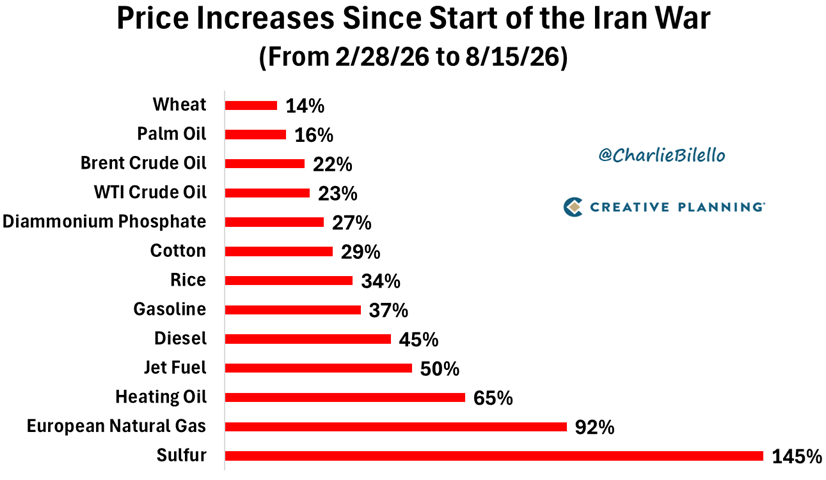
GRAPH: Price increases since the start of the Iran War 2/28/26
[@charliebilello via The Big Picture, August 17, 2026]
Economists Blame $40 Trillion Debt Milestone on Two Things: GOP Ineptitude and Tax Cuts for the Rich
Jake Johnson, August 20, 2026 [CommonDreams]
Elon Musk Broke the FAA — Palantir Is Picking Up the Pieces
[The Verge, via The Big Picture, August 20, 2026]
On August 6 the Minneapolis air route control center lost radar and communications for two hours, disrupting more than 1,100 flights across a 330,000-square-mile, nine-state sector. Musk’s DOGE was supposed to rebuild the nation’s air traffic control system, but it ended up paving the way for Peter Thiel’s company to take over.
Bad Food: It’s not hard to follow the money
Joyce Vance, Aug 22, 2026 [Civil Discourse ]
Trump Is Blocking Billions of Dollars of Grants That Would Fix the Grid
[Canary Media, via The Big Picture, August 16, 2026]
Jeff St. John on the Department of Energy canceling or stalling funding for thousands of projects meant to shore up a stressed grid — and not only in blue states.
The carnage of mainstream neoliberal economics
The Enshittification of Big Food: Why the food on your shelf keeps getting worse
[The Future Market), via The Big Picture, August 19, 2026]
Mike Lee traces the 1990 swap of beef tallow for partially hydrogenated vegetable oil in McDonald’s fryers. The trans fats proved more dangerous than the saturated fat they replaced, and by the late 1990s were blamed for roughly 50,000 premature American deaths a year.
Copper squeeze builds with spreads surging and price near record
[Mining.com, via Naked Capitalism 08-18-2026]
How an Alleged Wage-Fixing Scheme Is Fueling Historic Labor Uprisings
[Sentient, via Naked Capitalism 08-20-2026]
Oil Majors Reap $93 Billion Windfall From the Iran War
[Oil Price, via Naked Capitalism 08-17-2026]
Rising US life expectancy isn’t what it seems
[Salon, via Naked Capitalism 08-16-2026]
Health care crisis
Universal Health Coverage Could Save $1 Trillion and 114,000 Lives Every Year, Yale Study Projects
Matt Kristoffersen, August 13, 2026 [Yale School of Public Health]
A single-payer universal health care system could cover every American, save more than 100,000 lives a year, and still cost $1 trillion less than the system it would replace, according to a new preprint study led by researchers at the Yale School of Public Health.
For the study, which has not yet been peer reviewed, the researchers modeled what would happen if the United States adopted a national public insurance program like the one proposed in the Medicare for All Act. Using 2024 spending, insurance coverage, and mortality data, they estimate that the universal coverage would reduce annual health expenditures by $1.04 trillion, or nearly 20% — even after accounting for the additional care that uninsured and underinsured people would receive.
Hospital Prepayment Rules Add New Wrinkle to Patients’ Financial Responsibility
[MedPage Today, via Naked Capitalism 08-22-2026]
Her Brain Was Broken. It Was Fixed With Sound—Not a Scalpel
[Wired, via The Big Picture, August 19, 2026]
One woman’s meth addiction was so bad, the only option left might have been brain surgery. Then a single session of noninvasive, focused ultrasound seemed to do what years of treatment could not. Emily Mullin on Erin McNulty, missing for weeks and years into methamphetamine use, and the focused-ultrasound procedure that reached her without surgery.
The U.S. Healthcare System is Already Mostly Socialized
Paul Krugman [via The Big Picture, August 18, 2026]
Krugman examines the framing fight in Michigan’s Senate race, and why “socialized medicine” is an odd attack line against a system that already is. And there’s nothing radical about wanting to end insurance company parasitism
Restoring balance to the economy
Are Insurers Overcharging in Your State?
Brian Shearer and Vanderbilt Policy Accelerator, Aug 17, 2026
In April, I published two papers describing how property insurance is too expensive, and More Perfect Union just posted a great video explaining it. Today, we’re also releasing a new data tool that lets you see exactly how much insurers may be overcharging in your state, drawing on 25 years of insurance regulator data across every state and five major insurance lines.
Everything from auto and homeowners’ insurance to workers comp and liability insurance has become more expensive than necessary. Property insurance is one of the few markets where the government has veto-power over the prices and yet state insurance regulators have allowed the costs to creep up to $1.1 trillion per year. That’s twice what people pay for all utilities combined, so this is a major part of the overall affordability crisis. And it’s not just consumers who pay – businesses across the country are being price gouged too. Insurance is one of the biggest costs for restaurants and small businesses, and a major cost for developers building affordable housing.
The reason prices are so high is simple. Insurers are charging more than they need to cover losses from actual claims, generating extra revenue to pay for wasteful spending on dividends, stock buybacks, excessive advertising budgets and high agent commissions, private jets, and other expenses….
Information age dystopia / surveillance state
The Flock Uprising Is Just the Beginning
[Salon, via The Big Picture, August 16, 2026]
The public rebellion against Flock’s AI-powered surveillance cameras — sold to local governments as mere “license plate readers” — has turned into a national cat-and-mouse game between vandals and cops.
Flock Cameras Are Going to Get Drivers Killed
[Jalopnik, via The Big Picture, August 16, 2026]
Justin Hughes on how often the readers get it wrong, and what happens when police act on a bad hit.
Technology and Constitutional Rot
[Yale Law School, via Naked Capitalism 08-18-2026]
Technological change affects the Constitution not only by creating new problems of constitutional interpretation, but also by changing the distribution of economic and political power. New technologies alter what governments and private actors can know, control, predict, and accomplish. When constitutional institutions fail to adapt, large shifts in power and control can lead to constitutional rot: the process by which a democratic republic becomes less democratic and less republican over time. The United States has suffered from increasing constitutional rot over the past four decades; rapid technological change has made the rot worse.
Our Second Gilded Age has many similarities to the technological and economic upheavals of the First Gilded Age, which was also a period of constitutional decay. We now live in the Algorithmic Society, where public and private decision making increasingly depend on algorithms, artificial intelligence, platforms, large-scale data collection and digital surveillance. The Algorithmic Society produces an Algorithmic State, including a National Surveillance State organized around prediction and prevention. These changes disproportionately strengthen the executive branch, weaken Congress, limit practical judicial oversight, and increase government’s dependence on powerful private firms and privately-owned technological infrastructure.
Large global technology companies increasingly exercise governing power over communications, commerce, national security, access to information, and public debate. As a result, government and technology firms engage in repeated attempts at mutual co-optation, blurring traditional distinctions between public and private power. Digital platforms reshape the public sphere through an attention economy that weakens knowledge, intensifies political polarization, and erodes trust. These changes exacerbate four central features of constitutional rot: growing wealth inequality, political polarization, loss of trust, and policy disasters.
Despite these dire circumstances, the United States has recovered from periods of constitutional rot before. The First Gilded Age gave way to the reforms of the Progressive Era and the New Deal. Today constitutional renewal involves a different set of reforms: new digital privacy laws and new antitrust, civil-rights, and due-process protections. Renewal means reconstructing and improving the knowledge institutions that underwrite our democracy. It requires structural changes that better allow Congress to check and oversee the executive branch. And it requires reforms that secure and strengthen our system of democratic representation.
Meta faces a $1.4 trillion reckoning in latest trial over social media addiction
[Engadget, via Naked Capitalism 08-18-2026]
Facebook Is Drowning In Islamophobic AI Slop Calling for Violence Against Muslim Americans
[Futurism, via Naked Capitalism 08-18-2026]
Climate and environmental crises
The Strait of Hormuz Isn’t the Only Major Shipping Route in Crisis
Kate Aronoff, August 21, 2026 [The New Republic]
Two other vital maritime waterways are snarled—due not to war, but the climate. This is the new normal….
Water levels in Germany’s Rhine River—one of Europe’s busiest shipping routes—have been at record lows amid weeks of drought, forcing cargo carriers to cut shipments to as little as one-fifth of normal capacity. Those problems didn’t start this summer, either. Rising temperatures caused by climate change have meant less snow in the Alps during the winter, and so less meltwater draining into the Rhine in warmer months. ING, the Dutch banking giant, estimates that the halt of traffic on the Rhine will lower Germany’s gross domestic product by 0.3 percentage points this year, which is especially bad news considering the country was on track to grow by just 0.8 percentage points all year. German insurer Allianz likewise estimates that the brutal two-week heat wave in June will cut all of Europe’s GDP by 0.3 percentage points. In May, Allianz analysts had already projected that the countries most exposed to extreme heat—France, Japan, Italy, Germany, and Spain—will see economic output that’s 5 to 7 percent lower than it would have been otherwise by 2030.
It’s not just Europe. The cost of shipping goods through the busiest lanes in the Panama Canal have jumped to record highs amid falling water levels and increased traffic from vessels redirected from routes disrupted by the Iran war. The Financial Times reports that transit slots on the canal’s most commonly used locks are being auctioned off for 16 times the average price for the same period last year. The ongoing El Niño—on track to be the strongest such event in 76 years—has seen wet season rainfalls slip below previous levels. Climate change has already made rainfall there much less predictable, meaning extreme droughts and floods both threaten to “push canal infrastructure past its operational limits,” The New York Times reported….
Low Rivers, High Stakes: Europe’s Nuclear Cooling Crisis
Felicity Bradstock – Aug 21, 2026 [oilprice.com]
Democrats’ political malpractice
Hakeem Jeffries’ Betrayal Shows Why Democratic Voters Are So Enraged
David Sirota, August 17, 2026 [The Lever]
House Democratic Leader Hakeem Jeffries (N.Y.) announced his opposition to Medicare for All on the same day a CBS News poll found 90 percent of Democratic voters support the idea — and 72 hours after a Yale University study showed the program would save 114,000 American lives and $1 trillion every single year.
Here’s some important context: Jeffries has raked in hundreds of thousands of dollars of campaign cash from healthcare PACs in the 2026 election cycle and didn’t face any primary challenge holding him accountable to Democratic voters’ desires, despite him representing a deep New York City blue district….
Thomas Frank [Harper’s, via Naked Capitalism 08-22-2026]
… Despite its text-inflected architecture and its staggering price tag, the Obama Center is, in fact, not a presidential library at all: it houses no official presidential records for researchers to dig through. Those are stored in a National Archives facility somewhere in suburban Maryland. With this magnificent granite chunk, in other words, the vanity side of postpresidential structures has finally and totally eclipsed the research side. Instead of archives, the Obama Center features beautiful landscaping, a restaurant and bar, an athletic center, and up in the tower an Obama museum that trumpets what is flattering to its subject and omits what is not….
I intend no insult when I use the word “elite”; it is the only word that accurately represents the dazzling list of names one finds on the Obama Center’s donor wall. In the fifty-million-dollars-and-up category we find Jeff Bezos, of Amazon and the Washington Post; Connie Ballmer, the wife of a former Microsoft CEO; Brian Chesky, the CEO of Airbnb; TWG Global, an AI-focused holding company; a foundation associated with the private-equity billionaire Glenn H. Hutchins; and a mystery donor identified as Anonymous.These patterns persist in the more densely populated donor categories: tech and private equity, multibillionaires and dynastic wealth; great foundations and the biggest of big corporations. Eric Schmidt and Sean Parker are there, as are Microsoft and the Gates Foundation. Ken Griffin, a financier who supports conservative causes, shows up in the 1-to-9.9-million-dollar category, along with the personal foundation of the Walmart heiress Alice Walton and the Walmart Foundation itself….Fifteen years ago, conservatives used this sort of anodyne sentiment—then as now one of Obama’s favorite modes—to spin nightmares about our “radical” president and how he intended to “socialize” America. Others, like me, brushed it off because we came to see Obama as a moderate’s moderate, a would-be Blue Dog Democrat, a man who honored norms, precedent, and incrementalism to a self-sabotaging degree. This man was no progressive, we would realize: he was a fan of the New York Times columnist Thomas Friedman; chose Larry Summers as his principal economic adviser; and longed to strike a “grand bargain” with the Republicans in Congress. (Cuts to Social Security and Medicare in exchange for tax increases, for those who don’t remember.)To judge by the Obama Center, however, one might wonder whether those right-wingers were on to something after all. Summers and the pursuit of a “grand bargain” are not mentioned in the museum; they have been removed from the official account. But Rules for Radicals is sold in the gift shop. And the museum does describe—at length and in some detail—the history of left-wing protest in America. Exhibit after exhibit carries visitors to the unavoidable conclusion that Barack Obama was somehow the bearer of the sacred flame of reform, the heir of the Progressives, the women’s-suffrage movement, the New Deal, the civil-rights movement, the various upheavals of the Sixties, the Eighties Chicago mayor Harold Washington, and pretty much any other left-wing insurgency you can think of. He was, the museum suggests, the most progressive president anyone could possibly hope for.Powerful institutions cloaking themselves in the trappings of radicalism has been a familiar phenomenon ever since the nation’s corporations, foundations, electric utilities, and intelligence agencies decided a while back that they needed to depict themselves as intersectional warriors against colonialism and white supremacy. But here the stratagem indicates something more meaningful….
Resistance
Christopher Armitage, Aug 16, 2026 [The Existentialist Republic]
America Has the Parts to Build What the EU Built: A Toolkit for Beating Autocrats.
Christopher Armitage, Aug 18, 2026 [The Existentialist Republic]
Just a few months ago, Hungary held an election with roughly 80 percent turnout and threw Viktor Orbán out of power after sixteen years. Péter Magyar’s Tisza Party, which ran on naming the Orbán government’s corruption openly and promising specific measures to dismantle it, won 53.18 percent of the vote and 138 of the 199 seats in parliament, a two-thirds supermajority, while Orbán’s Fidesz took 55 seats. Magyar’s 3.3 million votes were the most any party has ever received in democratic Hungary. The textbook case of a seemingly successfully captured regime ended at a ballot box the regime itself had spent over a decade engineering to be unloseable.
Orbán lost because several conditions converged, and one of them was that the European Union spent years successfully deploying a working soft-power apparatus that starved his patronage system of the money it ran on. Over the course of the Orbán government’s standoff with Brussels, the EU froze tens of billions of euros earmarked for Hungary on rule-of-law grounds, with around 18 billion still frozen at the time of the election and over a billion permanently forfeited when the first tranche of suspended funds expired at the end of 2024. That money had been the lifeblood of the Fidesz network, much of it historically funneled to Orbán-connected oligarchs who in turn kept the regime’s coalition loyal. Cut off the money and the coalition gets fragile. When Tisza ran a credible challenge, the coalition broke. The collapse was policy doing exactly what it was designed to do….
The (anti)Federalist Society assault on the Constitution
Deploying To SCOTUS: Big Oil’s Dark Money Army
Freddy Brewster, August 20, 2026 [The Lever]
Dark-money conservative groups and Big Oil interests have quietly mobilized behind a landmark Supreme Court case that could restrict when and how states and municipalities can seek climate damages from fossil fuel companies. At the center of the case is an oil and gas company linked to a major Trump donor and personal ally of Justice Samuel Alito.
Suncor Energy Inc. v. Board of County Commissioners of Boulder County will decide whether states and local municipalities can sue oil and gas companies that knew fossil fuels contributed to worsening natural disasters and hid it from the public. Suncor is partially owned by Elliott Investment Management — a private equity firm led by Trump donor Paul Singer, who has vacationed with Alito — and has attracted the attention of the dark money network associated with Leo Leonard, the billionaire-backed architect of the far-right Supreme Court….
Consumer Watchdog found that at least 16 of the groups that filed amicus briefs supporting the oil and gas companies are funded by the Koch Network, a petrochemical-fueled conservative coalition, and nine of the groups received funding from Leo’s dark money machine. Ten of the groups were partially bankrolled by the Sarah Scaife Foundation, a conservative nonprofit that helped fund the Heritage Foundation as it wrote the Project 2025 blueprint to remake the federal government under the second Trump administration.
How the Supreme Court Kicked Off America’s Sports Betting Addiction Crisis
Madiba K. Dennie, 08.18.26 [Talking Points Memo]
In 2017, Americans legally wagered $4.9 billion on sporting events. Last year, they bet over $165 billion. And the true costs of their bets were even higher: One-quarter of sports bettors, surveyed by U.S. News last summer, worried that they couldn’t control their gambling. Over 30,000 people reach out to the National Problem Gambling Helpline every month.
“Problem gambling,” a term referring to an inability to control gambling behavior that results in personal or financial harm, is at least twice as common among sports bettors as among gamblers in general. It’s unsurprising, then, that Congress enacted a law decades ago that prohibited sports gambling throughout much of the country. But in 2018, the Supreme Court struck that law down, freeing states to partner with the gambling industry to profit off their vulnerable residents. A growing body of research shows Americans are now paying the price.
Before the Court’s decision in Murphy v. National Collegiate Athletic Association, only four states authorized some form of sports betting. One year after Murphy, 19 states and the District of Columbia authorized sports betting. Today, 39 states and Washington, D.C., have laws authorizing sports betting. Most allow people to place mobile bets, which means that millions of Americans now carry an addictive bankrupting device in their pockets.
The consequences have been predictably grim. A June 2026 study of patient records showed that in states that legalized sports betting, diagnoses of gambling disorder increased by more than 60 percent since the Court’s ruling. A March 2026 study found statistically significant increases in people falling 90 or more days behind on their car loan and student loan payments—both in states that legalized sports betting and in counties within 15 miles of a legal state….
[TW: I have written a number of times that one of the key principles of civic republicanism is a civic duty to “do good.” Such abhorrent Supreme Court decisions can be easily struck down by simply defining these principles of civic republicanism if we somehow manage to revive the philosophy. ]
Civic republicanism
How 10,000 American Cities Got Their Names
[Wall Street Journal, via The Big Picture, August 18, 2026]
Carl Churchill mines a century-old federal report in which geographer Henry Gannett of the United States Geological Survey catalogued the origins of some 10,000 town and city names. Good semiquincentennial reading. The federal government used to catalog the origins of town names nationwide. A 334-page report reveals the influences that shaped American communities as they spread across the country.
[TW: Conservatives like to stoke the cultural war issue of “patriotism.” And liberals and the left have stupidly allowed conservatives to dominate the discussion of public virtue, and “patriotism.” What could be more patriotic than understanding the historical background of where you live? The national government in the 1920s funding a United States Geological Survey project to identify and record the origins of town names is a great example of promoting the General Welfare – in no small part because there is no immediately obvious link to the General Welfare. Contrast this to Margaret Thatcher’s notorious principle of conservative economics / neoliberalism, “There is no such thing as society.” As conservatives like to argue, USA is a republic, not a democracy. But they have no idea what the actual governing principles of a republic should be. In fact, they are hostile to those principles, because they point to imposing strict and severe limitations on capitalism and “free enterprise” and a fundamental hostility to concentrations of economic power.]
The Hidden Debt That Apple Owes to the CIA
[WSJ, via Naked Capitalism 08-20-2026]
Without CIA funding that helped keep NeXT afloat in the ’80s, Steve Jobs might not have made a triumphant return to Apple—and the iPhone might not have its foundational operating code.
[TW: Just one example of Alexander Hamilton’s policies and how USA was actually built (see the links at the end): government promotion of science and technology.”]
.