The horizon is not so far as we can see, but as far as we can imagine

Author: Ian Welsh Page 30 of 439

Why Does The CCP Accomplish Goals Meant To Better China’s People?

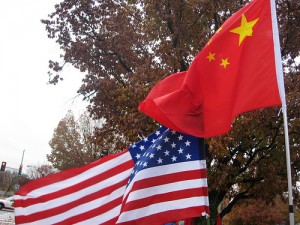
Chinese and American flags flying together

When I originally formulated this article it was just “Why does the CCP accomplish its goals?”

But that’s a stupid article. Certainly there are governments which fail to accomplish their goals, in countries which lacks state capacity or are in constrained positions. But for most of my life most Western governments haven’t been all that constrained, they just acted as if they were.

The truth is that Western governments have mostly accomplished their goals over the last 45 years: it’s just that their ur-goal was to make the rich richer. If that meant burning everything else down, they were OK with that. There are a number of reasons for this, but basically political elites were bought: do what the rich want and even if you lose office you’ll be very well taken care of. Instead of viewing government as “theirs” and their countries as “belonging to them” they viewed political office as a way to get rich. Instead of viewing the rich as their competitors for power, to be kept under control, they viewed them as their benefactors and as the ones who could put them into office. Or, put another way, most elected representatives saw themselves as de-facto employees, or contractors, of the rich and corporations.

This view has explanatory power: politicians do what you’d expect them to do if it were true. Take a look at Trump: his budget has 4 trillion in tax cuts for the rich, and to partially pay for those cuts, it is getting rid of 800 billion in Medicare funding. The idea that he’s some sort of economic populist is laughable. He’s making the rich get richer, just like every other President since Carter (though Reagan was the real inflection point.)

This wasn’t always the case. From 33 till around 68 or so, the primary policy goal in America was the growth and prosperity of the middle class, and most politicians, while they’d take the money of corporations and rich to some extent, saw them as the enemy, to be kept under control.

So, let’s turn to the CCP. They have lifted more people out of poverty than every other country combined. The one-child policy, whether you agree with it or not, did get China’s population growth under control. They are ahead in 80% of techs, when 20 years ago that number belonged to the US. They have the largest industrial economy in the world. They are reducing housing prices, which was their goal. They are reducing inequality and smashing the number of billionaires. They are installing more renewable energy than the rest of the world combined. They are building industrial stacks so that nothing they actually need comes from the rest of the world—they’re not quite there yet but they will be. (Don’t invest in TMSC long term, their near monopoly position is almost over and they will soon be overtaken by the Chinese. Three to five years at most is my guess.)

The CCP accomplishes its goals. Its primary goal is:

The Preservation of its own power. There are two branches to this: avoidance of foreign military conquest or regime change, and avoidance of domestic collapse or revolt.

To be powerful, and thus not be at the mercy of foreigners (one of Mao’s main goals) requires an educated, prosperous population and an industrial economy, because military power post-industrial revolution is primarily a result of technology plus industry. If another country can defeat you militarily, you won’t stay in power if they don’t want you to.

Domestically if the population loves you (and all polling shows vast support for the CCP) you will keep power. If they despise you, you will eventually lose power. The Soviets, with all their tanks and soldiers, fell in part because neither the people nor the elites believed in rule by the Party any more. So making the people prosperous is job one for protecting the CCP’s rule. Prosperous people don’t revolt. The Chinese believe this more than any other civilization. The entire “Mandate of Heaven” is based on this, and for over two thousand years the Chinese have regarded the government as responsible for prosperity. When it can no longer provide it, not only is overthrowing it justified, it is even virtuous. On the other hand, to overthrow a government which takes care of the people is vile, and understood as such.

Likewise, if one doesn’t want a change in which elites control the country, one can’t allow domestic power centers other than the party to spring up. This is why the CCP has been crushing billionaires. This is why the CCP banned the Falun Gong (who had widespread membership, including members in the CCP.) Bilionaires were particularly pernicious, because they corrupted party members, and those members goals changed from keeping the CCP in power by making China stronger and people more prosperous, to making a small number of people rich at the cost of general prosperity.

Xi was absolutely correct to make going after corruption his first and most important goal, because the CCP had split into factions and those factions were putting their own prosperity and strength above those of the party and the country. Left unchecked China would have fallen into a corruption spiral, inequality would have spiralled out of control and even if the CCP existed in form, it would no longer be its own power center, but controlled by others.

Now it should be understood that the CCP’s basic ideology isn’t “stay in power at all costs”. Like all ideologies it justifies it otherwise. It would say, and many party members, probably including Xi, would say that the party wants to stay in power because it can make China powerful and prosperous.

Given China’s progress since the party took over (and there was plenty of progress under Mao, don’t let anyone tell you otherwise — education and lifespand went way up), the CCP feels entirely justified in this belief.

Of course all things pass, and at some point the CCP will fail and be replaced, either in form (abolished) or by takeover. The Democratic party still exists in America, after all, but FDR or even LBJ would not recognize it, nor have any respect for it. Even Carter, the original neoliberal, by the end of his life, found it abominable. (I suspect young President Carter didn’t fully understand the consequences of what he helped birth.)

But for now, the CCP stands in its glory, having accomplished much of what it originally set out to do. It kicked out foreign occupiers. It made China strong enough that it could no longer be pushed around or occupied. It made the Chinese people prosperous. It gained the technological and industrial lead over the West.

It did so because it regards China as belonging to it, and believes that it has a responsibility to the people of China and that it deserves and will keep its power only if it delivers for the people of China: not for a minority, but for the masses.

None of this is to say the CCP is perfect, just that it’s an effective government which actually wants a prosperous population.

Our governments are effective, but what they want is richer rich people. As a result they will become ineffective and at some point they will either fall and change form and rise again, or they will devolve into full-on failed states.

If you’ve read this far, and you read a lot of my articles, you might wish to Subscribe or donate. I’ve written over 3,500 posts, and the site, and Ian, take money to run.


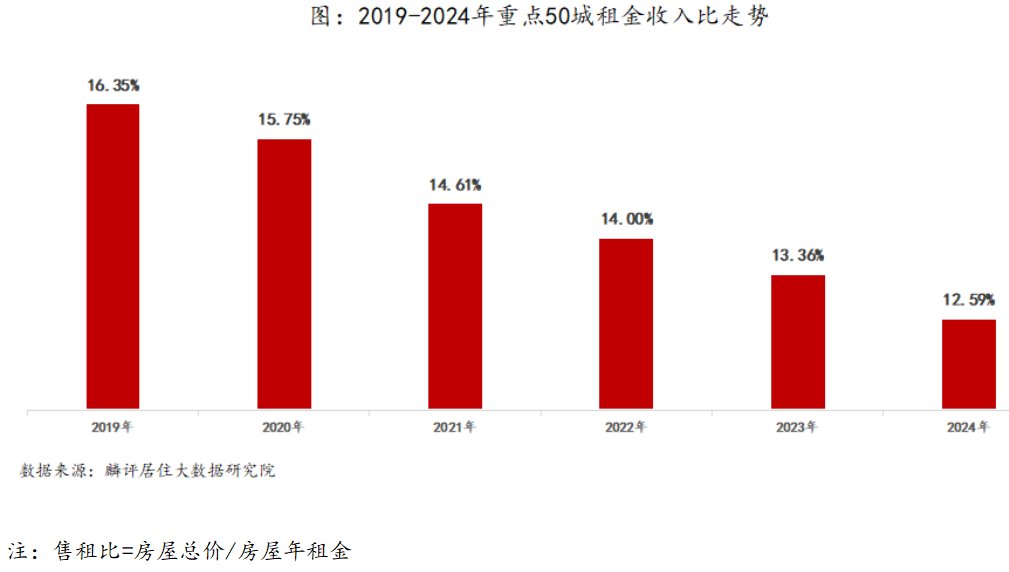
Prices of Both Housing And Rent Are Decreasing In China

In 2016, Xi said that houses were for living in, not for speculating. The Chinese government took steps to reduce prices, those steps took time to bear fruit.


Likewise, rent prices have been dropping recently:

And yes, this is a result of government policy:

While, according to the PBOC, in the pre-pandemic decade, the annual rental inflation in China exceeded 1.2%, it slowed significantly in recent years and has been in the negative in the last twelve months. In March 2025, the rent of the rental housing component of the consumer price index (CPI) showed a 0.1% year-on-year decline, trending upwards, however, from -0.4% and -0.3% annual change rates previously registered in September 2024 and December 2024, respectively.

“In recent years, rents have declined due to lower income expectations and the increase in government-subsidized housing supply. This has provided tenants with more options and increased bargaining power, making lease renewals a key challenge for leasing companies,” noted Savills in their 2025 Chinese Real Estate Market Outlook.

Now you might think “this means the Chinese economy or citizen is in trouble!” No.

In stark contrast to the slowdown across housing and industry, however, Chinese consumers appear motivated to open their wallets and spend on goods. Retail sales grew 6.4% in May, topping expectations and sharply accelerating from April’s 5.1% rise.

Now, standard Western economists think that the real-estate market slumping is bad, and retail trade going up is good, but they’re both good and they’re both a result of government policy. China wants relatively cheap real-estate and to increase the size of its domestic consumer market so its industry is less reliant on exports. (Trump has kindly demonstrated the problem with over-reliance on trade partners.)

The thing is that if real-estate had kept going up in price the way it did in the past, the CCP would be in danger: their legitimacy rests on the idea that people’s lives keep betting better. For many years I kept reading young people in China saying they couldn’t afford to own a home. That was (and still is, to some extent) a problem. Xi acted on it.

Further high real-estate prices increase the costs of every single business, since they increase the costs of employees. China wants to stay an industrial power, not become worthless rentiers and financiers, and as such real-estate can’t be allowed to increase too much.

Now for a long time real-estate is how city government financed themselves. It was an engine which allowed growth. But when it started becoming a financial game, with people owning multiple condos or houses; prices increasing faster than wages and people locked out of ownership Beijing acted.

You can’t be an industrial power if rentiers: people who expect to make money thru time arbitrage and managed scarcity, are in charge of your society.

It is also true that if you aren’t a major manufacturing power you can’t become or remain a major military power. (Britain says “Hi!” America says, “uhhhhh….”)

Anyway, China needs to keep housing and rental prices down. At the very least they need to increase less than wage increases and for many years.

All signs are, that as is most often the case, the CCP is succeeding at the policy goals it set out for itself.

If you’ve read this far, and you read a lot of my articles, you might wish to Subscribe or donate. I’ve written over 3,500 posts, and the site, and Ian, take money to run.

Doomed Tesla (RoboTaxi Edition)

I’ll keep this one short and sweet.

Tesla was contacted by the National Highway Traffic Safety Administration on Monday after videos posted on social media showed the company’s robotaxis driving in a chaotic manner on public roads in Austin, Texas.

Elon Musk’s electric vehicle maker debuted autonomous trips in Austin on Sunday, opening the service to a limited number of riders by invitation only.

In the videos shared widely online, one Tesla robotaxi was spotted traveling the wrong way down a road, and another was shown braking hard in the middle of traffic, responding to “stationary police vehicles outside its driving path,” among several other examples.

Elon Musk is not that smart. He chose to use cameras only, and not Lidar, against the advice of his own engineers.

China has robotaxis already. They work fine. They have Lidar.

Tesla is doomed. Their cars are worse than those of their competitors and more expensive. Robotaxis aren’t going to work. The only thing saving Tesla right now is 100% tariffs on Chinese autos, but even non Chinese electric cars are better and often cheaper.

Meanwhile Musk is in a feud with Trump, Trump has threatened to remove subsidies for Musk enterprises and Musk (again, an idiot) has said Trump should go ahead. And yes, he does need those subsidies.

The majority of Musk’s wealth is tied up in Tesla, and it’s days are numbered. Meanwhile Starship keeps exploding, the last time during fueling, not even after launch. There are a lot of competitors to SpaceX, and w/o NASA contracts SpaceX doesn’t look so hot either. Right now NASA is stuck with Musk, but that’s not going to last.

Musk isn’t going to be the world’s richest man much longer.

If you’ve read this far, and you read a lot of my articles, you might wish to Subscribe or donate. I’ve written over 3,500 posts, and the site, and Ian, take money to run.

Sean-Paul Kelley

Just a quick word that my friend and ex-boss Sean-Paul Kelley is posting fairly often now. Sean-Paul founded the (now defunct) Agonist blog back in the day, which was very important during the Iraq War. He also gave me my first salaried blogging job as the managing editor of the Agonist. (I received some money for writing at BOPNews, but only some.)

I’m pleased to have him here. Do take the time to read the author byline above posts so you know if it’s him or me. Because almost all writing here has been mine and the blog is titled “Ian Welsh” people often assume all posts are from me. Sean-Paul’s more of an old school blogger than I am. Remember that guest posters are invited in part to give different takes than I would and I don’t pre-approve their posts, unless they’re very infrequent or new.

(Those who remember Mandos will get this. Out of a hundred Mandos posts, I might have agreed with one.) That said, Sean-Paul and I agree about most things.

Open Thread

Use to discuss topics unrelated to recent posts. No vax/anti-vax this week.

Reducing Suffering

As a Canadian, the issue of people removing snow from the sidewalk is a big deal. Some years ago, I lived near a house where they never removed the snow. It piled up until it was almost four feet high, and some partial thaws meant that underneath all that snow was ice. Every time I had to walk in that direction I cursed the owners (there was an SUV that came and went, so I knew it wasn’t uninhabited). One time, I did slip, and I was furious, even though the pain of the fall was minor.

Thing is, I don’t enjoy being furious or upset. Oh, a little anger is sometimes nice enough, but overall it’s an unpleasant feeling unless you’ve been having even worse emotions like fear, despair, powerlessness, or self-pity.

This is what Buddha called the second arrow. If you’ve been shot by an arrow, you’re in pain. If you’re upset that you’ve been shot by an arrow, you’re adding additional suffering.

Let’s run through three scenarios. Imagine each of them briefly, as if they happened to you:

1) You turn a corner and trip over a fallen branch, falling. You’re a little hurt (abraded hands), but basically okay. How upset are you?

2) You slip on some ice someone was supposed to clean up and fall. You’re a little hurt, but basically okay. How upset are you?

3) You’re walking down the street, and someone sticks out their leg and trips you, then laughs at you. You fall, but catch yourself. While a little hurt, you’re basically okay. How upset are you?

If you’re a normal person either (negligence) or (active malevolence) upsets you more. Probably, it’s the asshole who tripped you. (You might also get upset at the branch and kick it, swear at it, or enjoy breaking it, but hopefully not.)

The point here is that being upset makes your suffering worse. It also doesn’t deal with whatever caused the problem. Picking up the branch you tripped over, getting the city to fine the person not shoveling their snow, and either calling the cops or in times and places where it’s allowed, beating the hell out of the guy who tripped you might make sure there are no repeats.

You can do any of those things without being upset, through cold, clear calculation. If you don’t remove the branch, you or someone else could trip over it again. If you don’t convince the homeowner to shovel the snow, same thing. If you don’t make the tripper decide tripping people is a bad idea, he’ll do it again.

Much of why we get upset is that we have expectations about how other people should behave or even how the world should be. (How dare that branch trip you up!) Then, we think that if someone hurts us, we should get upset.

But, again, being upset doesn’t hurt the other person (though a display of anger might make a difference if you can make them scared of you) and doesn’t get them to change their behaviour. Indeed, in the case of the tripper, they want you to be upset. Your anger is part of their reward, just like how online trolls are trying to make you angry.

Being upset does hurt you, though. It makes your suffering worse.

But if you believe you should be upset, you will be.

So the first step is to ask yourself: What benefit there is to being upset? Do this all the time when something makes you upset, just ask yourself, “Does this help? Do I like feeling this?” Maybe you do (usually in the case of anger), but most of the time, the honest answer is gong to be no.

Over time, if you keep doing this, you’ll be upset less and less. You’ll change the reflex.

We add suffering to almost everything. If you get a bad headache and are upset because it “isn’t fair,” that adds suffering to the headache. If you get upset at yourself for doing something stupid, that adds suffering. I used to be like that; I stopped when I realized that, after decades of being harsh with myself, my behaviour hadn’t changed. In other words, being upset when I made a mistake wasn’t reducing the number of mistakes, it was just making me unhappy. (When I did stop being too self-critical, mistakes decreased somewhat, ironically.)

Buddha’s Second Arrow is the low-lying fruit, the easiest way to reduce your suffering — suffering which doesn’t help you deal with whatever issues you face. When you’re cool and calm, you’re more likely to fix whatever the problem is — if it can be fixed — faster and more competently than you are upset.

Pull out the second arrow.

If you’ve read this far, and you read a lot of my articles, you might wish to Subscribe or donate. I’ve written over 3,500 posts, and the site, and Ian, take money to run.

Does Zohran Mamdani Matter?

So, Democratic Socialist (ie. has politics a 70s liberal would have agreed with, but is less racist) Zohran Mamdani has won the nomination as the Democratic candidate for New York City Mayor.

The best analysis I’ve read of this is definitely from Matt Stoller. He says this win helps define this as a “system-defining election,” that is, an attempt to not just to change who runs a system, but how that system is run. Read the article.

I’ll point out here that there have been a few such attempts. Stoller writes about Lamont’s challenge to Lieberman, in which Lamont won the primary, then Lieberman won the election. It’s similar to what will be tried here: The oligarchical part of the Democratic party will align behind another candidate, possibly even the Republican one. Those who don’t will try to co-opt Mamdani, and turn him into a centrist left-winger.

Mamdani is more radical than Sanders; he isn’t a Zionist, for example. But he’s basically suggesting policies than no Democrat during the 50s, 60s, and even into the 70s would have found extraordinary.

What Stoller calls system-defining elections, I call sub-ideological revolutions. FDR changed the form of capitalism practiced in the US, so did Carter and Reagan. Mamdani, for all the screams from rich operatives like Larry Summers and various oligarchs, isn’t a radical — any more than FDR was. He doesn’t want to switch to economic Communism (i.e., worker ownership of the means of production or Soviet-style central control), say, or a single-party state. He wants real changes in how capitalism is practiced, and some changes to who has power in Democracy.

Sanders’ runs in 2016 and 2020 were an attempt at a sub-ideological revolution, or, system-defining elections. This is why Obama intervened and lined everyone up behind Biden, a nearly unprecedented step.

Likewise, Corbyn represented such an attempt, except Corybn got further, winning the Labour leadership. It’s not an accident that (and we have receipts, so don’t argue) Labour operatives actually sabotaged him in two elections to ensure a Conservative win. They wanted the old ideology/system to keep running more than they wanted their party to win. And once Corbyn was removed, his successor, Starmer, purged the party of the democratic socialist left. Once in power, Starmer doubled down on austerity and politics no different in substance, but actually more punitive, than those followed by the Conservative party.

The Reform Party in the UK is now coming on hard.

Be clear that sub-ideological transitions/system changes can be bad. Neoliberalism was a bad change. In the UK, if Reform sets the new system/ideological norm, it will be awful.

This is one reason why I said that Corbyn was the UK’s last chance: If the left failed, the right would then get its shot, and what the right wants to do is beyond awful.

It’s why Germany is beyond hosed: Doubling down on military Keynesianism (which won’t work in a corrupt, neoliberal system), while cutting social welfare will simply lead to the new-right getting into power. Their policies will make most people worse off, not better.

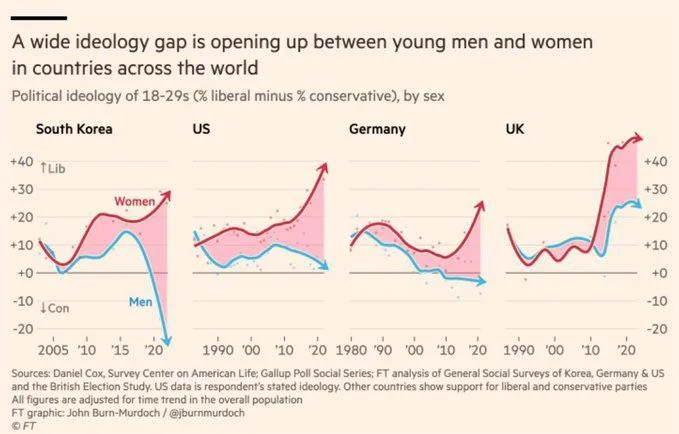
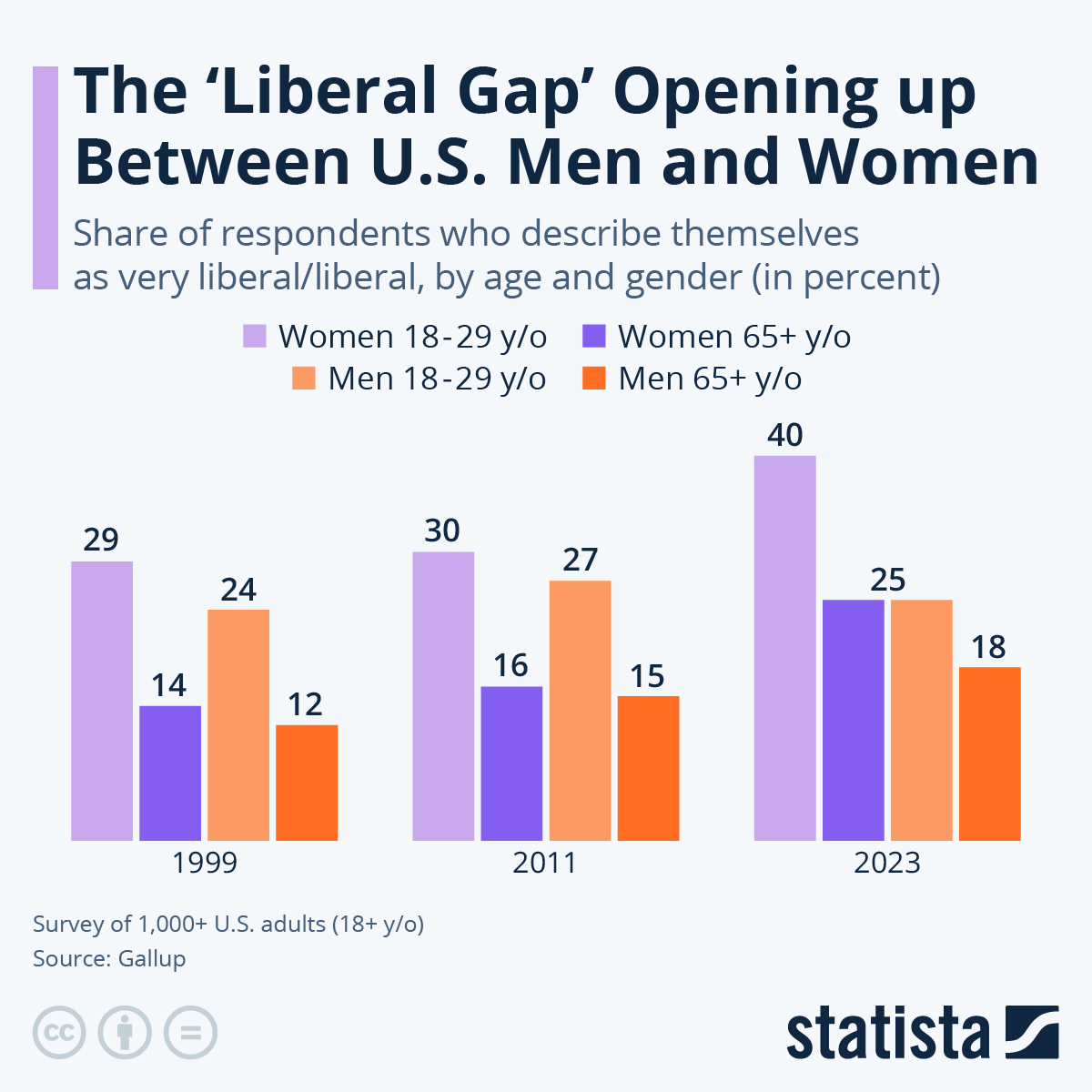
As for Mamdani, he’s a good sign. The fact that men, as well as the youngs, went for him is also excellent, because it shows that men and youngsters aren’t really “right-wing” in any way that matters. Yet. What they want is change. If they are offered good change, they’ll take it. However, they’re so desperate that if all that’s on the menu is shitty change, or the status quo, they’ll take shitty change.

This was obviously going to happen. I wrote years ago that we wouldn’t see real change until the mid-2020s, at the earliest, because it required generational change as well.

Mamdani tells us that what sort of change will finally win in the US is not yet decided. It doesn’t have to be MAGA stupidity and meanness.

So if you want something better in the US, if you want a chance at a New New Deal, get behind Mamdani and people like him — hard.

There still remains a question of whether Mamdani can deliver, even if he is elected. Will he be be co-opted? Will he run into opposition from enemies so powerful he either can’t overcome them? Or will he use them as a rallying call? Is he competent enough to create and run a new system like the one he’s suggesting?

This is a chance because, if Mamdani wins and then improves New Yorker’s lives, he’ll be copied. And if you’re in a position to do something to improve the chance of this happening and then working, I suggest you do so.

If you’ve read this far, and you read a lot of my articles, you might wish to Subscribe or donate. I’ve written over 3,500 posts, and the site, and Ian, take money to run.

The Middle East Is Hastening Ukraine’s Fall & The End of the European Era

The Course of Empire by Thomas Cole

The Course of Empire by Thomas Cole

Rarely spoken of is the effects of the Middle Eastern wars on Ukraine. For a long time, Ukraine got everything it wanted, but since Oct 7th, it has been , or worse, on America’s priority list. Mossad has a great deal of influence in America, just short of control, almost certainly due to a sickening collection of videos and pictures, and Israel has received the first cut off everything it needed: most especially of interceptor missiles.

Even so, the reason that Israel and the US called for a ceasefire and Iran did not (though it accepted one) is that Israel was less than a week from running out of air defense missiles, and as best I can tell, the US could only have supplied about another 7-10 days worth.

What this means for Ukraine is simple enough, they’re being absolutely hammered by Russian missiles and bombs. They don’t have enough air defense, they don’t have enough missiles for the air defense, and there is no reasonable prospect of re-stocking. The West’s larder is empty.

The tempo of Russia advances continues to increase. It’s still slow, but it’s at least eight times as fast as it was a year ago, and as Ukraine runs out of men, weapons and ammunition (Western shortages go far beyond air defense), plus as morale continues to plummet in Ukrainian armed forces, the prospect of “big arrow” warfare grows closer.

As I’ve said before I expect that period will arrive next year. The fighting age male population is decimated, those willing to fight are or will be mostly dead, and Russia will win the war decisively, taking whatever they want to. The only danger of this not happening is Putin accepting a peace offer before that: like Khameini, he is very cautious, doesn’t like war and wants it over. If Zelensky ever gets his head on straight, or is replaced, he’s likely to accept a peace deal much short of what can be accomplished by arms and an unconditional surrender.

This will be a HUGE loss for the West. The first war they have decisively lost on the battlefield in generations. There will be no concealing it, and the inability to ramp up production of weapon systems and munitions will leave the collective West so weak that no one will be able to believe they could win a conventional war against China, or even Russia.

It will, psychologically, be the end of Western hegemony. For almost 400 years the West has been dominant, and since Industrial Revolution, overwhelmingly dominant.

That era is almost over. The economic aftershocks will be huge: the end of American dollar hegemony is likely within five years, ten at the most and the entire world except, perhaps, Canada, the US and Europe, will re-orient to China. The US will even lose South Korea and Japan as reliable allies, indeed, it arguably already has (more on that another time.)

This is a literal epochal period. The “nothing ever happens” fools are missing that this is the end of a literal era: the era of European supremacy (the US is just a European settler state and Britain’s successor.)

The new era will be multipolar only if China wants it to be. They are approaching “America after WWII” levels of industrial and technological power. However, for at time, they will probably allow a multipolar world, as they are smart enough not to want to be a superpower or “world cop.”

Normally this would cycle to a superpower period, but environmental issues are likely to short-circuit normal macro-geopolitical cycles. Everyone will wind up in survival mode, and the question will be who manages this best. Whoever does will lead the next cycle, which will occur long after most or all of us are dead.

So, as best you can, you may as well be interested. You are living in truly interesting times, which come around only every half millenia or so.

If you’ve read this far, and you read a lot of my articles, you might wish to donate or subscribe. I’ve written over 3,500 posts, and the site, and Ian, take money to run.

Page 30 of 439

Powered by WordPress & Theme by Anders Norén