
Near the start of the war I noted that the real issue with petroleum shortages wasn’t gasoline, it was diesel, bunker fuel (ships) and jet fuel.
Diesel is, despite what many say, feasible to get off of: even some of the massive machines used for mining are already being switched over, and China is moving hard on electric freight trucking.
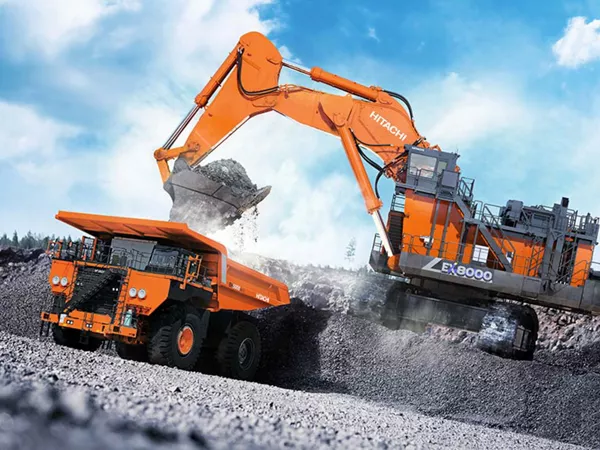
Hitachi Electric Excavator
But large freighters and super tankers are a lot harder. Electric can work for coastal freighters, but it doesn’t work for long haul shipping because you need constant recharging.
Enter Green Ammonia. This is part of China’s push on hydrogen tech. It’s currently more expensive than bunker fuel, but projections show it might hit parity by 2030, at least for the Chinese, since they’re scaling it hard. It’s made from hydrogen extracted from water, and nitrogen extracted from air, and it has zero emissions (though that’s not what this about.)
What’s important here is that if your shipping fleet uses Green Ammonia, it doesn’t matter if the supply of hydrocarbons is cut. It can still move. China’s been buying up ports all over the world, refueling can occur at them, and it works almost as well as bunker fuel, so you can make long trips across the Atlantic or Pacific if needed. (Indeed, if it’ll reach price parity by 2030, we can assume it will be cheaper by 2035, given the Chinese record on scaling.)
That means the only major vulnerability left is jet fuel, and I’m aware of no real substitues that can scale in the immediate term, though there are efforts underway. Fundamentally, however, air shipping is far less important than ocean shipping, and air travel is a luxury good. Nice to have, but not necessary to have. Jet fuel is important, strategically, for the military.
The point here is that China thinks ahead. They look at strategic vulnerabilities and they do something. This is, in part, about de-carbonization, of course, but strategically it’s a movement towards more self-reliance and less vulnerability. It also emphasizes that hydrocarbons are a wasting asset. You cannot, long term, base your economy on them. You must find a replacement if they’re your main source of foreign exchange.
The world’s changing, and in part it is changing because China is changing it. The great tech revolution of the last 40 years was telecom/chip based, but the fundamental blocks of our society remained hydrocarbon engine based. It’s China, more than anyone else, who is moving as fast as it can to an electrified economy that is not reliant on hydrocarbons, a change in the economic engine which has run our societies since the 40s or so. (The switchover from a coal/steam based economy started much earlier but took a long time.)
China makes the future, the rest of us fight over the bones of the past.
Everyone reads these article for free, but the site and Ian take money to run. If you value the writing here and can, please subscribe or donate.
Nat Wilson Turner
Good piece. I hadn’t heard of Green Ammonia before. Muy interesantte.
Like & Subscribe
And to think, if not for the loathsome opportunistic Clintons, it may never have been. Evil as the Clintons are, China must be grateful to them. If Perot had won, an impossibility for sure, we wouldn’t be having this discussion. I voted for Perot, fyi. I agreed with Perot about that great big sucking sound. I knew it, he knew it, but unfortunately, most American people didn’t know it and unwittingly voted instead to make the 21st Century the Chinese Century.
bruce wilder
There’s a strange trope in the neoliberal West in that the economy is narrated like the weather: something slightly mysterious in that it seems to just happen, responding to random, largely unseen forces of nature.
ProNewerDeal
Note that Chinese is able to do this without an 2B2F Investment Bankster sector. Another reason the USA shoulda done like Iceland and let the 2B2Fs banks go bankrupt in 2008.
spud
Like & Subscribe:
i agree. i bet the chinese government officials gets up every morning to a picture of bill clinton on their side tables, and get a huge belly laugh to start the day out.
Feral Finster
Petroleum has a lot of uses besides energy.
Like & Subscribe
Here’s an article discussing the pros and cons of green ammonia. It’s not all it’s cracked up to be as is the case with most if not all “green” alternatives. If China wants to earn my respect, it will champion the world’s first planned economy based on radical contraction versus perpetual, mandatory growth.
https://www.cleanegroup.org/wp-content/uploads/Green-Ammonia-Fact-Sheet.pdf
TacJack
Hydrogen has always been the end game for energy. It is renewable and requires almost no embodied energy to produce, minuscule when compared to what is required to turn fossil fuels into propulsion.
Excellent article.
Last thought: China is ALWAYS ahead of fruitcakes quoting anything from the bible.
NGG
Trump is an idiot – the global tendency is to solar/ nuclear/ wind to reduce energy costs. China is leading in this endeavor. Trump vision is rooted in the1950’s. His vision – if you can all it that- is to bring us all back to 1950. His vision is ignorant and detrimental to the future of the USA.
S.
LY
High speed rail is the substitute for continental jet travel. Guess who has deployed a massive system in the last decade?
Another Duncan
TacJack: But are they ahead of fruitcakes quoting Quentin Tarantino?
Carborundum
I think this is one of those things where one has to realize that there’s no such thing as a free lunch (cheaper, sure, but not free).
Heavy machinery is going to continue to be a significant challenge – consulting the sales materials on the excavator and the associated electric power plant, the reality appears to be that excavator will work on electric — as long as it can be plugged in to triple phase AC power (which is why they also offer it with a range of conventional engines). Certainly useful in edge cases, but probably not more broadly. For me, the key heavy machinery related scenario, which I very seldom see people talk about, is heavy traction for large scale farming (which is where the bulk of the food comes from). Decarbonizing that is where the big yield is, but I just can’t see guys dragging a cord around a half mile long field.
Similarly, ammonia is a challenging, challenging fuel cycle. Not fun to work with (understatement), energy intensive to produce, and less energy dense than conventional fuels. The literature seems to indicate that you’re likely still net ahead, but the range of how far one is ahead is very broad and I would bet that no one is doing a full cost accounting of the expense of increasing net power generation required for a changeover. Particularly significant when demands for additional generation look to be about to go through the roof. Personally, I’m a lot more interested in the process as it relates to fertilizer production – again, that strikes me as the big potential win.
KT Chong
China actually has lots of shale oil/gas reserves, ~32 billion barrels (~1,100 trillion cubic feet) of *proven* *recoverable* deposits, 90-95% are in inland in Sichuan Basin, Xinjiang Jimsar and Daqing Gulong, and the remaining 5-10% offshore in Bohai Bay / Jiyang plays. China is ranked 3rd globally in shale gas and — surprise, surprise — 1st in shale gas.
However, China’s proven + recoverable shale reserves are difficult and expensive to frack and pump. The breakeven full-cycle cost for China to frack and pump its own shales, depending on location, geology and oil/gas quality, is between $45-$90 per barrel, which usually works out to be ~$80.
When Brent crude hovered in the $60-$68 range before the Iran War, China was paying the market price minus a “US-sanction” discount of $5-$6 = $54-63 per barrel from Russia, minus $10-11 = $49-58 from Iran, and minus $14-$15 = $45-54 from Venezuela. Roughly. There was no point for China to frack and pump its own shales at $80 when it could buy and import at ~$50. At those discounted prices, China was buying cheap oil/gas not to use but to stockpile in strategic reserves all over the country.
At ~$100 or more per barrel, the math changes. A shale oil/gas rush has just started in China, but it has gone mostly unnoticed and unreported outside China especially in the West.
KT Chong
P.S. Shale oil and gas usually come out of the same hole via fracking, so I use them interchangeably.
KT Chong
More P.S. Chinese engineers and scientists in PetroChina, Sinopec, etc., have developed “Extreme Fracking” (5,000m+ depths / 175 MPa pressures). Actually, the technology had been in “experimental” stages since early-to-mid 2010s but recently graduated to being “commercial” and “economical” in… just last year! 2023-2025. Perfect timing.
KT Chong
Even more P.S. The US is entering its “peak shale” (or its 2nd “peak oil”) plateau right now. The US hit peak crude out at 13.6 million barrels per day (bpd) in 2025, which is projected to drop for the first time to 13.5 bpd in 2026.
Just as China is surging, but China ain’t sharing (i.e., selling or exporting.) China is still buying, importing, and hoarding.
That is why Trump wants to grab any and every other countries that have oil + gas and can’t defend themselves. Canada better gets nuke soon because they have lots of oil + gas, and they can’t lock down any strategic chokepoint to force the US into submission.
Bob
There is no “green” ammonia. Come on man. Get on board with Bright Green Lies (although 2/3rds of the writers of that book are genocide supporters).
There isn’t an ecologically sympathetic way to keep the industrial system going. To produce ammonia is required hydrogen that’s already a very high energy using process. The electricity can come from windmills and solar which are byproducts of fossil fuel industry. Petrol is basically a byproduct of deisel and kerosene manufacturing. The minerals are mined by little African children who work at the wrong end of a gun barrel. There is no “green” anything here. Except we are helping to turn the word green into a synonym for death.
As L&S says, only plans for reducing dependence on industrial civilisation can be considered at all helpful for future generations of living beings including humans.
No enormous ships carrying goods from China to Europe and so on. We have to think this sort of madness out of existence.
KT Chong
On jet fuel:
Coal-to-liquids (CTL) technology has existed for decades, and it can turn coal into jet fuel. It’s originally developed by Germany and scaled by South Africa’s Sasol, but it is still expensive. But in recent years, China has made breakthroughs and pioneered its specific use for high-performance jet and rocket fuel:
• Rocket Fuel (2023): In a global first, Space Pioneer (aka Beijing Tianbing Technology, a Chinese aerospace company) successfully launched its Tianlong-2 rocket — using aviation kerosene derived entirely from coal. This proved that coal-based fuel could meet the extreme performance and stability standards of high-thrust engines.
https://www.scmp.com/news/china/science/article/3221787/chinese-space-start-launches-worlds-first-rocket-powered-coal
• Industrial Scaling (2025–2026): Sinopec, the Shenhua Group, etc., have recently started to scale massive CTL facilities in regions like Ningxia. These plants use an indirect liquefaction process—gasifying coal into “syngas” and then chemically reassembling it into jet fuel, diesel, and naphtha.
https://www.omrglobal.com/blogs/china-e-fuel-market-growth
• Some new Chinese startup called Carbonology (co-founded by a former Tesla VP) claimed that they can now capture carbon dioxide from the atmosphere and combine it with hydrogen from water to create “unlimited” synthetic petroleum (i.e., jet fuel.) Their current goal is to scale this to a 100,000-ton facility by 2027.
https://www.scmp.com/economy/china-economy/article/3346892/unlimited-gas-chinese-firm-claims-it-can-produce-petroleum-air-and-water
This happened in March 2025. Again, perfect timing.
The problem: it is an expensive process to produce synthetic/jet fuel. However, IMO if they can package and sell this technology as a fuel source *and* sucking CO₂ out of the atmosphere to clean up Earth (which has its own price tags,) then it could work. i.e., price in carbon cleanup + energy security + future scale.
Typically governments (i.e., the U.S. especially Trump) are not willing to pay for decarbonization, but they should sell the decarbonization of the technology to Xi Jinping, who is (or was) a big environmentalist, i.e., Xi’s whole thing before he became the General Secretary was he had written many books and papers on and on about the “ecological civilization”, “sustainable development”, and “harmony between economy and environment”.
KT Chong
Correction:
“This happened in March 2025. Again, perfect timing.”
2026, not 2025. Happened in March 2026, just last month.
different clue
. . . ” At ~$100 or more per barrel, the math changes. A shale oil/gas rush has just started in China, but it has gone mostly unnoticed and unreported outside China especially in the West. ” . . .
Really? Well . . . isn’t that special.
https://www.youtube.com/watch?v=RmwqnqL3Hbg
Let’s hope China can build itself a Great Seawall of China. Because with all the carbon skydumping China plans to do with its ” shale oil/ gas rush”, China is going to need a Great Seawall of China.
Unless the ChinaGov plans to mitigate all its planned carbon skydumping with a whole bunch of freelance wildcat geoengineering all on its own. Without having to ask anyone’s permission of course , because who would dare to tell China “no”?
Jefferson Hamilton
“Hydrogen has always been the end game for energy.”
If by that you mean that the game ends when you try to base your system on hydrogen, I agree. It’s a shitty battery, nothing more. I remember when everyone was harping on hydrogen fuels cells as the “way of the future, the way of the future.” Where’d that go? Oh yeah, nowhere.
KT Chong
Another correction, to my first post in this section:
“China is ranked 3rd globally in shale gas and — surprise, surprise — 1st in shale gas.”
I said gas twice.
It’s actually: China is ranked 3rd globally in shale OIL and 1st in shale gas, (i.e., recoverable reserves.)
Mark+Oglesby
To any and all, for the good of humankind and all life on planet BLUE, please read Julian Cribb’s (Cribb is an Australian science reporter and writer) ‘FOOD or WAR’ which categorially states that we can no longer keeping mining planet earth as the ecological devastation will accelerate our environmental decline, and in the end, devastate our world which will end horribly for all life. What to do? We must STOP using our present economic system and completely change our thinking concerning (1) what is work/employment (basically, why do we need ‘FULL’ employment, we don’t you know) (2) we must produce locally! Grow our own food, create our own energy, maintain a system wherein all have a part to play in the future and betterment of their communities (and yes, I am a Communist as I see clearly what it actually means), and that being said, we need to stop doing those things (production) just for the sake of employment and a paycheck (which is kind of stupid when you think about it) because we must create what we need to sustain life in our communities (go into any shopping-mall and carefully look at all those things produced which really don’t help keep us alive, healthy, and most certainly happy- again those things produced are being produced just to keep people employed, and on and on and on- again, STUPID!) (3) What money actually is, and is not? and I’ll refer you to MMT (Modern Monetary Theory) Money means nothing, place a 1 and zeros to infinity and beyond, and please get the point as money is created endlessly, but natural resources? well, they are and remain limited, and this’ where our economics must be maintained. What can we do with the resources we have? And what must be done (locally) to achieve this maintaining of life for everyone in the community (again, and yes, I am a Communist as I see clearly what it actually means). Therefore, we need not waste so many resources just to maintain our present economic system, to ship SASS (Stupid Ass Scratching Stuff) all over the world. And yes, trade remains important (as many committees haven’t the life sustaining things needed to maintain life, but really now, again, go to any shopping centers and ask yourself, is the (SASS) really that important for our community, will it keep us healthy, happy, and wise? I doubt it. And finally (but certainly not complete), stop and think about all the energy that’s wasted just in a single day’s commute to and from work (and yes, it’s devastating our beautiful BLUE planet), pure INSANITY!
spud
Mark+Oglesby:
MMT works in favor of socialism.
different clue
@ Mark+Oglesby,
Are you an Orthodox Church of Marx-Engels Communist?
Or are you some kind of breakaway SchismatiCommunist? The kind which the Orthodox Church of Marx-Engels Communism would persecute if it could, through its Office of the Proletarian’s Vanguard Inquisition, if it had one?
By the way, as I read K T Chong’s proud recounting of all of China’s extreme, total and amazing advances in fracking, super-fracking, ultra-fracking, etc.; I am led to believe that the ChinaGov is committed to burning all the gas and oil in existence which it can find and reach.
Good to the very last drop.
Condition Venus here we come!
spud
https://www.youtube.com/watch?v=99dZSTieydk
Socialist Chinamaxxing: BEN NORTON
14,696 views Apr 15, 2026
On April 12, 2026, Ben Norton (Editor, Geopolitical Economy Report)
participated in a webinar entitled “Socialist Chinamaxxing: How China’s achievements are a product of its socialist system.
spud
different clue:
austerity is the opposite of MMT. austerity never works, it also destroys capitalism. so if you want to destroy oligarchy, MMT will let your country get out from underneath those that own the gold, write the rules.
of course Lincoln proved this by beating the souths conservative monetary policies with the green back program.
its why Lincoln was knocked off, and we returned to conservative monetary policies, and went right into the long depression.
FDR seriously weakened conservative monetary policies, and set america up as the envy of the world, and really set up the eventual separation from the conservative gold standard.