The horizon is not so far as we can see, but as far as we can imagine

Category: Russo-Ukraine War Page 1 of 2

Are Multiple Russian Breakthroughs Imminent?

In my Nov. 7 analysis of the Russo-Ukrainian War I missed two serious developments on the line of contact that I simply didn’t have the bandwidth to notice. After paying closer attention I came away with a big picture question: has Russia pierced the line of contact in three places or are my sources exaggerating? For the last two weeks there has been talk and rumors, some of which I have been guilty of passing along, that Russia achieved such a goal. But where?

Most observers are in rough agreement that the following five Kupyansk, Siversk, Lyman, Huliapole, and Constantinovka are under dire threat. Pokrovsk and Myrnograd are done. Finis.

But these three are the standouts.

The first, and most obvious, is in the immediate environs of Pokrovsk. As I noted November 7, west of Pokrovsk—is all open steppe land with little to no defensive terrain—all the way to Pavlograd. Will the Russians move forward? Doubtful. I stand by what I wrote two weeks ago: “Russia will consolidate its gains in and around Pokrovsk, after the Ukrainian soldiers in the pocket are killed or surrender. For some time after I foresee Russia utilization of tactical defense within an offensive framework.” But the Russians, when they are ready, will move across the steppe towards Pavlograd, en masse.

The second and most unlikely involves troops now taking Lyman, who afterwards will move south, in tandem with troops north of Pokrovsk, to encircle both Slovyansk and Kramatorsk, two large towns serving as the final obstacles on the road to Poltava. This encirclement, if attempted, would make the Pokrovsk-Myrnograd cauldron look likes child’s play. It is doable, however, and an encirclement of Slovyansk and Kramatorsk might be just the right bait for the last of the Ukraines reserves; with only enough reserves to fight in one place, this is where they’d stand. Russia can afford to tease the Ukraine as it retains the strategic initiative. It can feint, sucker punch and attack pretty much with impunity at this point in the war. Yes, Ukrainian forces can mount local counter-offensives, but the days of counter-offensives across the entire line of contact are long past.

The third—which is the most serious for the Ukraine—is in the south, where an imminent encirclement of Hulyiapole, will wrap up the flank of Ukrainian forces in the south elimanating all resistance to Zaporozhye. This operations seems well on its way to success. The Ukrainians have no answer to the Russians here.

As I mentioned above there are other places the Russians are pressuring: Kupyansk, Siversk and Constantinovka. In all three places Ukrainian defenses crumble, Russia hammers supply lines, drops FAB-500 on mustering points, lobs Iskanders on ammo dumps and bridges, and hurls thermobaric bombs at makeshift barracks and more. The Russians are doing this as near to the line of contact as possible. Everything to a purpose: shattering the will of the Ukrainian soldier to continue the fight.

Meanwhile, Russia’s strategic bombing and drone campaign against the whole of the nation escalates sans mercy.

Of the three points I mentioned above, I see the Russians grinding away deliberately and slowly; advancing at speeds of their choice around the Pokrovsk environs, and in and around Lyman. In other words, more attrition. Maybe a feint at encirclement will draw in the last of the Ukraine’s strategic reserves, which would then be attrited away as the Russians have been doing so since 2023.

Poor US TV generals, still have no big flashy red arrows or armored movements to get their war porn on.

Only in the south might we see a real breakout; a breakout that posisbly rolls up of the entire Ukrainian flank to Zaporozhye. The Russians might be at the gates in two weeks. Maybe less, maybe more. Maybe we’ll see an operational pause and then a deliberate resumption of the churn.

One fact is beyond obvious at this point: the Ukraine has lost. The question now is: how much more will they lose.

Pokrovsk Has Fallen, Now What?

~by Sean Paul Kelley

With the encirclement of the Pokrovsk-Myrnohrad pocket by Russia now complete, it is only days, a week or two at most, until mopping up operations are complete. This is an indisputable Russian victory, but don’t expect the war to change much. Russia’s strategy of attrition is about incremental gains that create unsustainable enemy losses, not the acquisition of territory. A fact that Western, especially retired American generals consistently get wrong. They expect the Russians to fight like Americans. That’s a terrible assumption to make.

On June 30 of this year I wrote that Russia was beginning its advance on Pokrovsk in earnest.  Now, a lot of Western commentators, like Gen. Keane, have made the claim in the legacy media, along with other retired US generals, that the Russian’s have been bogged down in and around the Pokrovsk area for a year and only have 30-something kilometers to show for their efforts. This is why I cite the above link about the start of Russia’s encirclement of Pokrovsk. American generals obsesses about big red arrows on maps, rapid armor advances taking territory, breakthroughs while Russia’s attrition of Ukrainian soldiers massively degrades the Ukraine’s ability to prosecute the war. US generals, however, display staggering amounts of hypocrisy in discussions about Russia’s massive and successful strategic bombing campaign. Those selfsame generals who cheered American Shock and Awe war porn that dominated the news coming out of places like Iraq, Afghanistan, and Libya. Funny how they now label the same strategy, employed now by evil Russia, as war crimes and focus on Russia’s killing of civilians, which the Russians are studiously trying to avoid and largely succeeding. But I digress.

American generals, think tankers and media personalities are ignorant, be it vincible ignorance or supererogatory, of what a strategy of attrition really is and what it looks like. Here’s the best definition I’ve got for you: using military power to gradually degrade an opponents military resources, i.e. killing as many of your adversary’s soldiers and wrecking as much of his kit as possible and/or breaking his will to fight. Nowhere in the generally accepted definition of attritional warfare does it say a word about occupying as much land as possible. That comes later. Much later.

With Pokrovsk surrounded what should we expect from the Russians? The landscape west of Pokrovsk is mostly open fields for many, many kilometers, with few tree lines, villages or ravines for Russian forces to utilize for an effective defense against the Ukraine’s drones; hardly an ideal landscape for attritional warfare. In fact, with the Ukraine’s ability to manufacture drones still intact it would be a killing field, littered with Russian armor, APCs, infantrymen and anything else the Russians might send into the open.

Make no mistake, the Russians are going to have to march across the landscape west of Pokrovsk at some point, but I posit the following near-term moves by the Russians. I’ll follow up with some developments I expect later in 2026.

First, Russia will continue encircling other salients, or cauldrons as the Russians prefer to call them, they appear to be enveloping, like the Kupyansk-Senkove salient or the potential envelopment of Konstantinivka. These areas offer excellent defensive positions and landscapes for Russia’s small-teams based attritional style of attack along the line of contact. It begins with artillery and/or missile bombardment, small teams then attack and destroy Ukrainian positions, kill or capture soldiers, retreat, then let the Ukrainians return. Rinse and repeat with drone coverage dominating overhead and you’ve got a style of war that chews up time like Andre the Giant hoovered up food at all you can eat buffets. It’s efficacy is not in doubt so long as you understand Russian strategy. If you’re ignorant of it, well, then you are expecting a big armored break-out after Pokrovsk, which won’t happen, because that’s not how Russia is conducting this war.

Second, Russia will consolidate its gains in and around Pokrovsk, after the Ukrainian soldiers in the pocket are killed or surrender. For some time after I foresee Russia utilization of tactical defense within an offensive framework, much like what American generals called the strategic defensive during our Civil War. In essence, at first they’ll capture positions, then dare the Ukrainians to take them back by appearing weak, digging in, rotating out tired soldiers, and firming up logistics. Subsequent Ukrainian attacks lead to mounting casualties. Then do it again.

In the context of capturing Pokrovsk, Russia will continue targeting the Ukraine’s industrial base, especially drone manufacturing sites. And it will hammer the nearby cities of Kramatorsk and Slovyansk with drones, missiles and FAB glide bombs, but it will be some time until Russian ground forces are within reach of mounting an attack on either city. Much will also depend on how well the Ukraine’s armed forces perform.

In war your opponent gets a vote on whether you succeed or not. Will the Ukraine’s armed forces hold up or might we see a general collapse in 2026? The Ukraine is now engaged in the widespread press ganging of men to fight on the front, reports this story at Responsible Statecraft. Some of the men press-ganged into service have reportedly died from blunt-force trauma, after beatings with iron bars and one young man died from injuries sustained attempting to jump out of the vehicle he’d been forced into. Most of the ‘busificaiton’ as it is euphemistically called has taken place in 2025 and thousands of such videos can be found here, proof that the Ukraine’s manpower shortages are growing to crisis levels. Such activities by Ukrainian recruiters also bodes ill for the armed forces, and adjacently indicative of the efficacy of Russia’s strategy of attritional warfare. Although press-ganging is not something Russia directly influences, it’s a clear symptom of the unsustainably large amounts of casualties the Ukraine has and continues to sustain.

In the near-term expect the war on the ground to continue as it has since 2023. Russia will grind it out, slowly and patiently. I always find it laughable when commentators claim that hardliners in the Kremlin are chomping at the bit for Putin to launch a massive offensive. This is stupid, Western group-think. Why is it so hard to understand that Russians are naturally endowed with a deep well of patience to draw upon? Especially Putin. That is not to say there will be no fireworks in the near future. But they will be arriving from a different direction than Russian soldiers will. They will come from above.

A near-term imperative for Russian forces is a way to achieve drone dominance along the line of contact. Russia has, by and large, achieved a hybrid-kind of air superiority. This has largely been achieved by its manufacturing prowess, producing, according to some sources, nearly a thousand Geran-2 drones a month. One report dated this September describes a new jet-powered version, the Geran-3, that is operational, largely resistant to electronic warfare and can be fitted with a 90 kilo thermobaric warhead, making them extremely lethal, inexpensive and plentiful. Russia also manufactures and utilizes on a daily basis hundreds of Gerbera decoy drones. By using the Geran-2 and 3s in conjunction with Gerbera decoys and higher value missiles like the Iskander and the hypersonic Kinzhal the Ukraine’s ability to mount anything approaching an effective air defense is nullified.

Achieving drone superiority over the line of contact is another matter altogether. The Ukraine can still manufacture enough FPV drones to give the Russians pause, forcing their continued use of small-teams to attack, destroy and then retreat. But, the Russian’s are innovating. For example, there are recent reports of the deployment of a mother-ship drone with two FPV drones attached with fiber optic cables. The mother ship drone flies at altitudes above the FPV’s alleged EW bubble and by connecting its two FPV drones via fiber optic cables achieves complete EW avoidance. While not a game changer, widespread deployment of such drones would make the war that much more difficult for the Ukraine to prosecute effectively.

Pokrovsk is a major victory for Russia, a significant morale booster for the troops and those on the home front and proves the efficacy of Russia’s strategy of attrition. But don’t expect much to change after Pokrovsk. It’s a loss for the Ukraine. The question, how big of a loss? How many troops died or will be captured once the pocket is completely mopped up remains the most important variable of the battle; how badly will it effect the Ukrainian armed forces morale is what bears watching, by Putin and Zelensky alike.


The Tiny Dictate to the Large

After reading this article at @RStatecraft by @connor_echols I am more convinced than ever that admitting the Baltic States into NATO was the biggest mistake NATO ever made: three miniscule states with three tiny militaries dominate policy yet contribute nothing but acrimony and accusations towards Russia. 

Just read the stridency of their claims towards Russia. Former Latvian PM: “Putin acts the way he acts, and the only options for the West are either to submit or to resist.” Or the present Estonia FM: “Russia’s war against Ukraine is driven by one thing and one thing only: its refusal to accept the Soviet Union’s collapse and its unrelenting imperialist ambitions.”

It’s our annual fundraiser. We’ve raised a little over $7,620 from 65 people in the last twelve days, out of our goal of $12,500. If you’re a regular reader and can afford to support our writing, please subscribe or donate. Over 10,000 people read every day, but without those who give the site would not survive.

Look, I get the Baltics are paranoid about chimerical Russian irredentism towards the three republics. NATO can’t and shouldn’t allow alliance policy to be dictated by its three smallest members, who are tiny, paranoid and are lead by some critically undereducated fools, like Kaja Kallas, who said, “Chinese are very good at technology but they are not that good in social sciences . . . . The Russians… are not good at technology at all, but super good in social sciences.”

I’ll let that one go without comment. The bottom line is tiny states are dictating the policy of huge institutions and nations, just take a look at how the Israeli tail wags the American dog.

We’re supposed to make peace with enemies, folks, not friends.

Dialogue is essential more than ever. Not paranoia.

It’s Our Annual Fundraiser. If you read us a lot, please Subscribe or Donate.

Russo-Ukraine War Update

~by Sean Paul Kelley

I’m going to relay a conversation I had on X today with everyone here. It’s just easier this way, as I dislocated my shoulder yesterday and sprained my wrist falling down the stairs. Let me add, that crap that movie star tough guys do when they have a dislocated should is utter balderdash. Having my shoulder relocated was excruciating. So a ton of typing is out. Copy and paste is in. But I digress.

I replied to a Tweet, an X, WTF do we call those things now? Well, I’m sticking with Tweet. This one from the US Ambassador to NATO.

The US Ambassador to NATO tweeted the following;

Russia is losing hundreds of soldiers a day without making any significant gains in Ukraine. Russia must recognize that it’s time for peace and come to the negotiating table.” 

I replied to the Ambassador with a series of tweets:

The @USAmbNATO clearly does not comprehend what a strategy of attrition means. Capturing territory and manuever warfare are secondary to degrading the Ukraine’s ability to fight. This Russia is succeeding at quite well. 

I would add that US Generals, who excel in tactics and the operational art of war–which includes logistics–love to quote Bradley’s axiom “amateurs talk strategy and professionals talk logistics.”

I loathe this quote for a number of reasons. Most of all because US generals and their partisans use this argument from authority to dismiss often very valid criticism. I’ll give you one example: Tommy “Catastrophic Success” Franks. He, Stanley McCrystal and Petraeus are prime examples of US generals with a signal lack of imagination, relying on the strength of their logisctical prowess, e.g. The Surge in Iraq. 

This was my third tweet to the Ambassador:

[The generals] insistence on this adage has lead to consequential misunderstandings of strategy and why so many continue to conflate Russia’s lack of forward movement with failure (i.e. General Kellog, ~spk). A strategy of attrition is all about the gradual erosion of the enemy’s ability to fight.”

It’s hard for me to comprehend that these men cannot understand Russia’s strategy in the Ukraine. Then an X user asked me a rather intelligent and sincere question:

For how long would you say Russia has been succeeding quite well at degrading Ukraine’s abiity to fight? For the full 3.5 years or a shorter time span? Follow up: how long will this success take to yield major changes on the battlefield? 

Let me first say how pleasant it was to get a sincere question on X. Usually it’s agreement or derision, and second I thank my cultured interlocotur for a few hours of intellectual stimulation.

My reply was fivefold, and many of you have read portions of it here in the past:

All modern Russian wars–starting with the Great Northern War in 1700–begin badly for Russia. All of them. The SMO is a perfect example. The Russians were uprepared, had an ill-thought out strategy and got pushed back badly. They got whooped. But the Russian’s learn quickly.

So, they did what they normally do in such situations, traded space for time. By mid-2023 their industry was on a total war setting, minting more artillery shells than all of the US and NATO combined. They’d called up fuck-tons of troops . . . 

. . . and because necessity is the mother of all innovation quickly outstripped the Ukraine in drone warfare. Plus, with their thermobaric weapons and Iskander missiles in high production they devestated fortified positions. Then they attacked supply routes. (They also innovated an EW unjammable fiber-optic drone that was devastasting ~spk added later.) Then 3-5 man teams . . . 

. . . cleared the trenches. The Kursk invasion was a catastrophe for the Ukraine and by 2024 it was clear the Ukrainian army was in trouble, [seeing as] recruiting meant kidnapping, and the Ukraine began shifting divisions will nilly against attacks initiated by the Russians.

Russia [now owns] the initiative & numbers & air superiority over all the Ukraine & drone superiority over the front lines. It looks very bad for the Ukraine now. Russia grinds away, caring not about territory yet. That comes next year in 2026 when they take Odessa. Does this [clarify]?

It’s Ian’s annual fundraiser. This allows us to cover the changeover of hegemony from America to China, environmental collapse, internal US fascism, what a better society would look like, Gaza, AI, the coming stock market crash and various other issues. You can Subscribe or Donate here or contact Ian at ian-at-fdl-at-gmail-dot-com if you need another way to donate (mail, usually. A lot of cash apps don’t work in Canada.)

Intelligent and incisive he asked the following: 

If they don’t take Odessa in 2026 would you adjust your analysis? Also, Russia hasn’t won all its modern wars. Crimean, Russo-Japanese & Afghanistan come to mind. Chechnya is a bit messy in terms of winners/losers. So while Russia can take heavy casualties sometimes it’s too many.

My reply was threefold: 

First, I didn’t say Russia has won all its modern wars. I said they all begin badly. Second, if they don’t take Odessa, I would be surprised. But it would not mean ultimate failure. Russian sabotage teams are already in Odessa. Chechnya actually became a total success.

It took more than a decade, much like the Murid War, but Chechens are now some of the most fanatically loyal soldiers in the Russian Federation. Crimea was a shit-show as was Russ-Jap and WWI and Afghan. Russian’s aren’t perfect, but they will win the war against the Ukraine.

The present military leadership knows exactly what they are doing. One action might change their strategy: an attemped decapitation strike that actually hit the Kremlin. Oreshniks would rain down on Kiev, brutal and devastating and foreign operaties (US/UK) would be targeted.

He then asks, 

When you say they will win the war against Ukraine, what does victory entail? Full territorial acquisition? I predict more stalemate – for multiple years to come if both sides stick to the military approach at resolving the conflict. I’ve been right on that for ~4 yrs thus far.

My final reply was this: 

Victory will be dictated on the battlefield. The Russians are not interested in full territorial acquisition. They are interested in landlocking the rump state. Zelensky will be killed or exiled. A pro-Russian regime will be installed. The Ukraine will be neutral . . . 

. . . along the lines of the Austrian Treaty at the end of WWII. It will not be a frozen conflict. Putin’s main goal is to create a peace that endures for at least a generation after he dies or steps down. That’s what I see are Russia’s goals. I doubt the war continues past 2026.

My main beef here remains the lack, be it from wilful ignorance or delusion, of US policymakers, generals and think tank denizens, of understanding Russian strategy in the Ukraine. Understanding attrition is not difficult. Just google it and read the wikipedia entry. How difficult is that? Do they not teach boolean operators at the US Army War College?

It’s Our Annual Fundraiser. If you read us a lot, please Subscribe or Donate.

Bad Faith and Criminality

~by Sean Paul Kelley

In the aftermath of the 1905 Russo-Japanese War, US president Teddy Roosevelt brought together negotiators from Russia and Japan to hammer out a peace. This was the first time the US was ever seen as an ‘honest broker’ in international relations. In 1919 President Wilson sailed to Paris with his 14 Points doing his level best to get the Europeans to negotiate an honorable peace. The wily Europeans outfoxed the rigid and moralizing Southerner in just about all the negotiations. Nevertheless, the US retained the aura of ‘honest broker’ until this century. I can’t say exactly when we lost it—probably when Colin Powell lied to the UN in testimony before the Second Iraqi War—but lost it we did. Somewhere in there we lost the aura of exceptional power we possessed by pissing away a metric shit-ton (yes, an American who can do metric!) of blood and treasure in the sands of Iraq and mountains of Afghanistan—and with that loss, we shot whatever credibility we retained right in the foot. But those, shall I say, are different discussions for a different day.

Lost auras being the one thing—at least we still got a chakra, right? (Ugly and poisoned though it may be.) It’s the second thing that grates the teeth at night: an everlasting chronicle of bullshit deeply eroding any sense of diplomatic norms that’s transfigured us into OG rogue nation. So, grab some popcorn, rewind the Wayback Machine and head back to 2014 cause I got a whopper to tell you.

It’s late summer of 2014 and a brushfire war is simmering between Russia and the Ukraine. The US and its European allies are eager to see the Ukraine join NATO. They bring Russia and the Ukraine together and pretty much force feed them the Minsk Accords. Then, over the course of the next eight years the NATO allies string the Russians along encouraging the Ukraine in its ever persistent demands to renegotiate the Minsk Accords.

Nota bene: yes, I write it as the Ukraine. I know the Ukrainians desire their benighted lot to be call Ukraine.

Do I care?

Not one iota.

It was always called the Ukraine—I mean, the Russians use the partitive genitive (don’t ask) when describing the Ukraine as a nation—and it will ever thus be called the Ukraine.

Now, it took the Russians—rarely gullible—a long time to figure out our stunning acts of “bad faith.” But “bad faith” it was. The US and its European allies had no intention of ever compelling the Ukraine to live up to its international agreements with Russia. They were only ever playing for time, waiting for the day they could present Ukrainian membership in NATO as a fait accompli, hoping for a démarche, a dénouement. Damned if we got war in its place.

But the forever-war nation ain’t gonna let a little war-war stop it, no, no, no! Once America sets a precedent it’s game on, bitches! So, in late May-early June 2025 the US negotiated directly with Iranian diplomats signaling that no military action was imminent. While negotiations were held, the US and Israel agreed on America logistical support for an Israeli attack on Iran. A week after Israel launched its first strikes against Iranian nuclear sites, the United States followed suit. Not only is this acting in “bad faith” it’s outright deceit, a line no nation should ever cross in the conduct of negotiations. It’s one thing to bring two sets of instructions to negotiations, one always needs a fall-back position. But deceit? WTF?

Twice then, the US has acted in “bad faith.” It’s at number three when the wise recognize a pattern, three also being proof of outright illegality in the conduct of international affairs, at least according to international and domestic law. So, there is that, you know?

Domestic law, you ask? How so?

“Young grasshopper,” says Master Po, “sit and I will tell you.” (Anyone who gets the reference wins a cookie.)

Treaties signed by the United States and ratified by the Senate are, in accordance with the 1920 Supreme Court ruling Missouri v Holland, the supreme law of the land.

Skeptical-like, you query, “what treaty did we violate, Sean Paul?”

Easy, the 1961 Vienna Convention on Diplomatic Relations. This treaty enshrined, in international and domestic law, a norm of diplomacy dating back 575 years to the city-state of Milan and its then ruler Francesco Sforza—a norm, or custom only violated three or four times in the last century it’s so sacred. So basic, so important is the principle of the personal sanctity of the negotiator, aka the diplomat, that it is respected by every nation on the goddamned planet.

It is the singular, fundamental law of diplomacy from which spring all the other elements of reciprocity evident in the conduct of international relations. And in typical American fashion, just days ago, we nuked that norm into oblivion when we in concert with Qatar and Israel arranged for an attack on credentialed Hamas negotiators.

I don’t have anything else to add except a few questions. Why would any nation enter into negotiations with us ever again? Who would be that stupid and reckless? And what, if anything, can ever be done to regain international trust? What I’ve detailed are fundamentally outrageous betrayals of diplomatic norms, norms developed over 500 years ago and used for centuries.

It’s not rocket sceince. Hell, it ain’t even algebra. Christ, it’s more basic than fractions. It should be easy to comprehend. And the behavior is so fucking counter-productive I would expect even the stupid to fathom.

I would be wrong.

P.S. And consequences,those things be bad, like ju-ju bee tree bad shit. Didnae take long, aye?

P.P.S. Oh, and by the way, this leads directly to the massive diversification away from petrodollar settlements, which gets us a fuckton closer to the end of the dollar as global reserve currency. That’s going to be one serious painful adjustment for Americans to make, domestic production notwithstanding.

If you’ve read this far, and you’ve read some of my articles and most if not all of Ian’s, then you might wish to Subscribe or donate. Ian has written over 3,500 posts, and the site, and Ian, need the money to keep the shop running. So please, consider it.

Euro Proposal For A No Fly Zone in the Ukraine: the Consequences

In the aftermath of several errant Russia drones crashing into Poland, said nation’s foreign minister, Radoslaw Sikorski, invoked Article 4 of NATO, and whilst giving an interview to a German paper, called for  “a limited, NATO/EU-run no-fly buffer for drones nearing alliance airspace.

Dmitri Medvedev, the former president of the Russiann Federation while speaking at a Russian Security Council meeting on Moday said that “Russia would consider NATO forces protecting Ukrainian airspace as a declaration of war. . . .

Russia, it should be added, asserted that “that “no targets on the territory of Poland were planned for destruction,” and that the drones it used in Ukraine have a flight range of no more than 700 kilometers (435 miles).” I would add the Russian first deputy Permanent Representative  to the UN made a very good point in an interview this morning. He asked simply, “cui bono?”

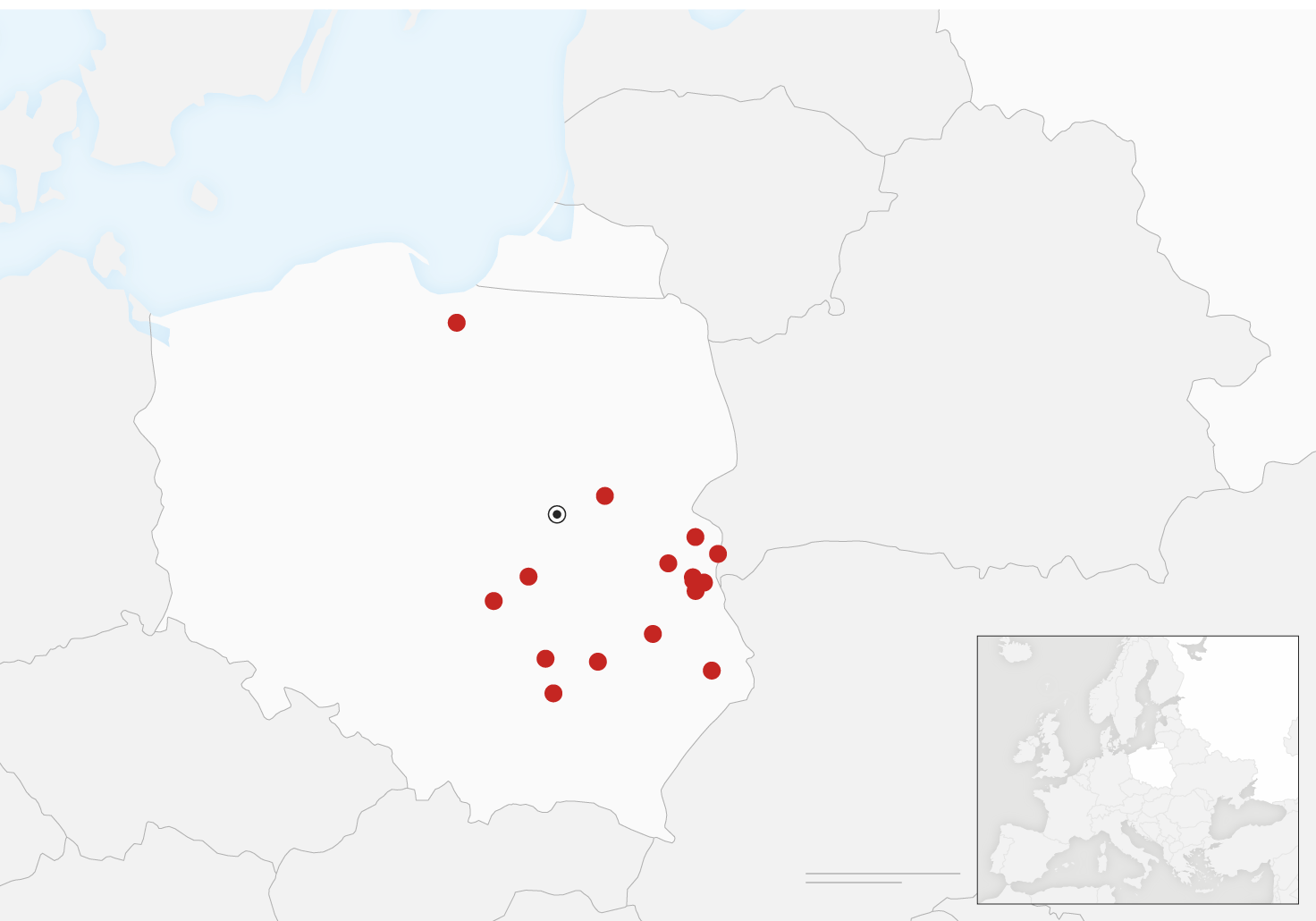
Cui bono notwithstanding, a lot remains open for interpreation, especially without the evidence being reported on seriously and assiduously. (Which won’t happen in the West.) That said, the number of drones that landed or were shot down in Poland is troubling. Look at this map for a better idea of what worries me. I’ve heard several explanations, from Ukrainian spoofing and EW warfare, to a false flag operation. Spoofing, EW warfare, cui bono or false flag–any others?–really doesn’t matter. It is simply bad ju-ju for all parties concerned.

Regardless of what really happened, are we absolutely insane?

Have our diplomats and leaders lost all touch with reality? If we declare and attempt to enforce a No-Fly Zone over the Ukraine we are declaring war on the Russian Federation. Declaring war on a nuclear power that could absorb a full force first strike by the USA much better than we could absorb their very robust response is as stupid as someone with brains for dynamite who cannot blow the wax out of their ears if their brains exploded.

Thank heavens for the brothers Lieven, one, Dominic, is an historian of empire, the other, whom I will quote below, is foreign policy analyst that writes frequently for the site Responsible Statecraft. Anatol is an adult in a childish firmament of foreign policy know-nothings, like Kaja Kallas. As one Russian observer said about her: she is critically undereducated. But back to Anatol, as he writes on the drones falling in Poland: “We should remember that during the Cold War, there were a number of far more serious violations of air space by both sides, some of them leading to NATO planes being shot down and American and British airmen killed. These incidents led not to threats of war, but careful attempts to de-escalate tensions and develop ways to avoid such clashes.” What a mature idea. I wish we had more adults in the room, so to speak.

The whole Ukraine debacle has only unravelled our power faster than if adults were running our foreign policy. And a No Fly Zone over the Ukraine is the height of childish, bat-shit crazy ideas. But then, we have not had an adult running our foreign policy since George Schultz left foggy bottom on January 20, 1989. I take that back, the last adult to manage our foreign policy was James A. Baker, who left foggy bottom on August 23, 1992. It has been unipolar willy nilly serially destroying nation after nation ever since.

It has got to stop. I just fear how it ultimately will stop.

If you’ve read this far, and you’ve read some of my articles and most if not all of Ian’s, then you might wish to Subscribe or donate. Ian has written over 3,500 posts, and the site, and Ian, need the money to keep the shop running. So please, consider it.
Follow Up and And Reply On My “How to Lose Allies” Post

First, I want to follow up on this: “I am due to have a conversation with a friend that lives in Denmark tomorrow and I’m going to ask him about energy prices.”

His reply, and I paraphrase as I did not record it or take notes: “if we still had to make our house payment, we would be totally screwed. The amount of money that we pay for energy now is about equal to what our house payment used to be. It’s about five times higher than it normally is, but what’s even worse is the high cost of energy filters out into everything in the Danish economy. A simple item like bread is three times higher than it used to be. Specialty items are three or four times higher than they used to be. Fish from fisherman that we go to the docks to buy from because we live on an island is four times more expensive because they’re paying four times more for the energy they’re using to go out and fish. It’s brutal and it’s all because the United States or somebody allied with it blew up the Nord stream pipeline. I try to keep my mouth shut about this because most people have drank the Kool-Aid, but I really hope Russia wins because I’m sick of all this global elite bullshit.”

These words were spoken by a well educated American married to a Dane with two teen-aged Danish children. If the Danish economy is suffering like this Germany must be fucked.

Where does Europe get its energy now? From the US, now exporting LNG (liquid natural gas) to Europe for 4x the price of Russian and Turkmen natural gas. Here is my question as a Texan: why haven’t natural gas prices risen in tandem with the export of the commodity? People I have asked who recieve natural gas royalties are pissed because there is no price increase pass through. So, owners of the wells are getting screwed and so are the buyers of the product. Welcome to Oligarchical America.

Next I want to address a handful of commenters in my post, best reprersented by Mark Level. He writes, in a very gracious and polite comment that he takes issue with my outline of American Grand Strategy. He notes, “This insane hobby-horse (or idee fixe, choose your metaphor) dates back far more than 120 years, probably 3x that long, and originates in British Colonial phobias about Russia and “the East” generally. Halford John Mackinder developed this lunacy & published it almost exactly 120 years ago, but it had a long pre-natal development among arrogant Imperial gits in Asia. (Gits and twits, upper-class British twits, like the Monty Python sketch.) See here, and the delightful childish fantasy of being Alexander Magnus from this Mackinder thought bubble . . . .

Please note, first and foremost, I used the word hostile power or hostile coalition. Hostile being the primary variable.

I’ve read Mackinder’s works. Anyone who has traveled across the Silk Road pretty much has to read them. His idea is not necessarily original. It’s more a fusion of ideas that came out of the late 18th century and 19th century Western European dominance of the world that began, as I previously mentioned, with the defeat of Venice in 1509,  Portugal’s conquest of a Spice Empire, and its desrtuction of the Ottoman Navy in the Indian Ocean, thus having no rivals, and of course Spain’s rapacious theft of New World gold and silver.

During the 17th and 18th century, a new idea developed with the growth of the British Navy, who outstripped the Dutch and pretty much took over their empire. New York City was, after all, New Amsterdam. What these developments presaged was an idea that centered around the ascendancy of the Littoral powers over the Continental Empires that had ruled Eurasia for millenia. Gunpowder, boats, better firearms, better steel and in the New World, devastating disease leading to genocide in many cases up and down North and South America. The Littoral is defined by strategistsas those land areas (and their adjacent areas and associated air space) that are susceptible to engagement and influence from the sea.” Thus the emphasis on a strong navy by Alfred Thayer Mahan who proved just how dominant Littoral Powers could be. For a time, that is, only for a time, as I see it.

Add to this ascendancy the wars of the Western European powers of the United Kingdom, Spain, France, and the Holy Roman Empire primarily fought during the 18th century for two strategic reasons, primarily by two very different nations with very different vital national interests at stake.

One, was the United Kingdom’s insistence that no power could dominate the Low Lands of the Netherlands and later Belgium because if they could, it would threaten an invasion of the British Isles, plus their massive exports of wool textiles, fueling the nascent industrial revolution. Smart, if ruthless policy.

Second, we must understand France‘s main goal during the wars of this time (and for several centruies prior) was to ensure a divided Germany. So long as the German states were littered into 100 different little principalities France had nothing to worry about. Thus France could go on dominating the continent. The first seismic change to this was the War of the Sixth Coalition which saw for the first time Russia flex its true potential when Russian troops occupied Paris. France’s cataclysm occured not in 1941 but in 1870 with her defeat in the Franco-Prussian war. The result of which was Prussia unifying all of Germany into one empire, adding insult to injury by having the Kaiser crowned in Versailles and taking Alsace Lorraine away as its prize.

Fuse those two strategies together and it is not too far an intellectual leap, considering the Great Game going on at the time between the UK and the Russian Empire, for Mackinder to conjure up his ideas. Were his ideas taken up by the United Kingdom? You bet, but by 1917 when it was clear that the United Kingdom could no longer maintain the balance of power in Europe and the United States had to intervene, (everyone should read AJP Taylor’s magnum opus, The Struggle For Mastery in Europe, to understand the balance of power and its collapse in 1917) US foreign policy intellectuals adopted it. And rightly so.

I think it’s the correct idea. But my reasons for thinking it’s the correct idea are not gonna make many of you happy. You might have to face some hard truths. Oh yeah, I did tell you I was a Realist in the old school manner of the word? In fact there have been a few times when Ian has chastened me pretty seriously for my realism. With that admisssion I will make another one: I don’t mind the criticism from Ian or from others. Ian is probably the smartest person I’ve ever met in my life and I listen to what he has to say. And when I say listen to him, I mean, I consider his words deeply. A man who cannot change his mind will never change anything. Nevertheless, I digress.

Here are my reasons for why I believe the prevention of a single hostile power or coalition of hostile powers from dominating the Eurasian landmass is smart policy. Please, if you take anything away from this sentence, take the meaning hostile. 

Number one: the Monroe Doctrine. Oh, I hear you screaming already. But the fact is that if this were not “our” hemisphere, not a one of us would have the standard of living we do today. Our hegemony of the Western Hemisphere is the primary foundation of our wealth and our power. You might not like it. I grimace frequently at the crimes we comitt to protect it. But, the Westphalian System is not built on justice. It is built on the acceptance of international anarchy. Each nation to its own. There is no single sovereign power governing planet Earth. Thus, violence is the supreme authority from which all other authority is derived. Is this a grim Hobbesian outlook? Yes. I don’t like it and I’m pretty sure you don’t either. But as a realist, I take the world as it is, not as I desire it to be. A hostile power or coalition of hostile powers that dominate Eurasia can take that hegemony away. You might not like it but trust me when I say you don’t want that to happen.

Second, a hostile power or coalition of hostile powers that dominate Eurasia can take more than our hegemony away, it/they can invade us. We don’t want that either. Thus we have a powerful navy that projects power to keep Eurasia divided–for the time being, because I think if we get into a war with China, their indirect way of war–read your Sun Tzu–will probably outwit us on the high seas. I’ve spent a great deal of time in China and have a healthy fear of their capabilities. However, my greatest fear is that in our arrogance we will engender the very hostility we must prevent and by our own devices bring about the doom we should seek to avoid. We have lost our edge, our generosity of spirit and our understanding of power. We have become a mean spirited, two-bit, cheap and vulgar people. And sadly, because so many of us are beaten down economically by rich elites who are delusional, we’re going to lose a big war in a painful way. A war that could be avoided, but probably won’t be. I hope I’m wrong, but don’t think I am.

That said, these very wise words, written by Robert D. Kaplan recently, convey the gravity of our present predicament, “There is no prediction. It is only through coming to terms with the past and vividly, realizing the present that we can have premonitions about the future.” Moreover, as a wise woman wrote about history, “the more I study history, the more I learn the art of prophecy.” Deeply contradictory statements, yet both true in their essence.

Are we any more perceptive now about what awaits our planet than were the Russians of 1917, or all of Europe in 1914, and, for that matter, the Germans of the 1920s and the early 30s?

Do we honestly think we know better than they did? With all of our gadgets and our technological triumphalism I bet you there are a handful of you out there that think we do know better than they did. I hate to disappoint you, but we don’t. History is the story of contingency and human agency, not inevtiablity.

So, there it is. Rip me to shreds if you wish. I’ve suffered enough Shakespearean arrows of outrageous fortune in my 54 years to handle it. In fact, I welcome your ideas and if you got this far I’m grateful for your time.

If you’ve read this far, and you’ve read some of my articles and most if not all of Ian’s, then you might wish to Subscribe or donate. Ian has written over 3,500 posts, and the site, and Ian, need the money to keep the shop running. So please, consider it.
Russo-Ukraine War Update June 30, 2025

Before we get into the most recent developments of the war between Russia and the Ukraine, I want to focus a little bit about how Russia is outstripping the West technology-wise. We all know necessity is the mother of all invention. And war is the mother of all necessity. The Russians haven’t missed a beat innovating. One of the most terrifying weapon systems in Russia’s developing arsenal are its multifarious thermobaric weapon systems. They now have at least three operating platforms to deliver these utterly destructive weapons. Thermobaric weapons are not illegal under the rules of war. They are accepted as valid and while the Ukrainians might complain, no one is listening.

If you recall the MOAB–so called Mother of all Bombs, was a thermobaric weapon. Thermobaric weapons explode and aerosolize fuel in the air before they ignite. They are designed to destroy bunkers, and killl everyone in them. The United States has not developed them futher, resting on their laurels as they have no need to do so, so they think.

Not so Russia. Here is a primer on thermobaric weapons. Here is a primer in a more Russo-Ukraine conflict context. So far the US has only developed a thermobaric grenade, the MOAB, the Hellfire missile and one for a minor Marine rocket launcher. That is the limit of US innovation.

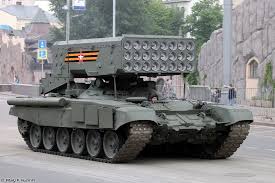
TOS-1A on a T-72 tank chassis.

The Russians on the other hand have taken things a lot further. First, the MOAB destructive power is 9.8 tonnes. The Russian version, dubbed the FOAB (father), is the equivalent of 44.4 tonnes. But the Russian version of the bomb is overkill and the Russians know it, using it only sparingly. Instead they developed a launch system of 24 thermobaric rockts placed on top of a T-72 tank chassis with a maximum range of about 6 kilometers, called the TOS-1A. Many of the TOS-1A were destroyed early in the war. The TOS-1A could be spotted and destroyed by some of the more advanced counter-artillery weapons systems the West gave the Ukrainians. So, the Russians, as trench, fortified and urban warfare became more prevalent, reboubled their efforts.

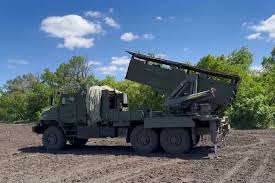
TOS-2, mounted on a six wheeled Ural.

The Russians soon upgraded the TOS-1A with the TOS-2. The TOS-2 is based on a wheeled vehicle for better shoot and scoot capability to avoid being blown up by counter battery attacks. The rockets are more lethal–having flecks of magnesium and aluminum to make them hotter (tests are ongoing with nanofuels) and have a range of almost 15 kilometers. It is also equipped with modern sights and target navigation systems, I beleive based on Russia’s GLONASS, their version of GPS satellite targeting. TOS-2 vehicles can self reload, and come equipped with electronic warfare jamming systems. Here is the first of two videos, made within the last two months showing the devastation the TOS-2 system, which recently underwent an upgrade, can do to Ukrainian lines. Here is the second. Warning to the viewer: these are real scenes of war. Viewer discretion advised.

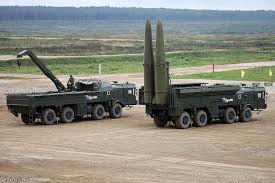
Iskander Misiles topped with thermobaric warheads.

Moreover, even the much vaunted Iskander ballistic missile can be mounted with a 700 kg thermobaric warhead. The list of Russian thermobaric weapons is simply to long to itemize and discuss. The important fact here is that the United States has no answer to weapons like this. The Russians have officially incorporated these fearsome weapons into their artillery doctrine and are now using them all across the front lines to destroy bunkers, trenches and near the front hardened command centers. The results, per the CIA (arguably not the most trustworthy source, but it’s what I got) describe horrifying results:

the effect of a [thermobaric] explosion within confined spaces is immense. Those near the ignition point are [incenerated]. Those at the fringe are likely to suffer many internal, invisible injuries, including burst eardrums and crushed inner ear organs, severe concussions, ruptured lungs and internal organs, and possibly blindness.

Not to mention the harderned structures they are sheltering in collapse on top of them. It has been frequently reported that many Ukrainian soldiers who experience such explosions and survive surrender immediately, the psychological effect is that crippling. The pressure on the front and the Ukrainian infantryman gets greater and greater every day.

Five quick links. This first one is worth everyone’s time because it actually destroys a BBC article based on Russia’s neglect of Mariopol, a town it took early in the war and supposedly has left to rot, per the BBC. The video proves the exact opposite. Watch it here.

Second, brutal attacks on Kremenchuk, and third Russia prepares to storm Pokhrovsk.

Third, a brief summary of Russian advances along the line of contact and a Ukrainian counter-attack.Worth the 3.34 minutes of the video.

Lastly, a pretty respectful and wide ranging conversation between an American interviewer and the Russian ambassador to the UN. Longish but all in English and worth watching. It’s a rare example of no-bullshit in my opinion.

More as it develops.

Page 1 of 2

Powered by WordPress & Theme by Anders Norén