The horizon is not so far as we can see, but as far as we can imagine

Category: History Page 4 of 5

Nazis Are Not Socialists

Th above idea, because they were called National Socialists, tends not to die.

The Nazis reduced wages and shattered unions. Being a socialist got you sent to a camp.

Under the Nazis, corporate profits and the percentage of national income going to high income people increased.

And the Nazis also privatized a great deal, in fact their privatization regime was very similiar to how neoliberals have run the economy.

Nazis were right-wingers, who believed in poor workers and rich capitalists and that the state should mostly be involved in military and police. They were not socialists, by any definition of the word socialist of which I am aware.


The results of the work I do, like this article, are free, but food isn’t, so if you value my work, please DONATE or SUBSCRIBE.

Syria and the Cult of the Tough Decision

(POST BY MANDOS!!!)

The chances were always high that regardless of who was elected, Trump or Clinton, there would be some kind of American attack in Syria.  However, the chances were always higher with Trump than Clinton. Yes, you read that right: It was always a lot more likely that Trump would attack Syria than Clinton would. The reason for this is that Clinton took a more hawkish position on Syria before the election. Trump took a right-populist position of focusing on domestic politics and telegraphed a Russia-friendlier course. This more or less convinced me that he was going to attack Syria at some point. Likely, Clinton would have too — but with Trump it was basically inevitable.

Running a complex industrial and military power requires a highly technical bureaucracy. That bureaucracy therefore has an ultimate veto on what is possible to accomplish that is necessarily beyond democracy. That bureaucracy has made it clear that it won’t implement policies by people it doesn’t consider to be “serious.”  The hallmark of seriousness is the ability to make the Tough Decision.

(DID I MENTION THAT THIS WAS A POST BY MANDOS? BEFORE YOU COMMENT…)

The complaint by the technocratic class against what it denigrates as “populism” is — among other things — that populism is ultimately the rejection of the Tough Decision. Left-wing populism holds that there are a lot of win-win situations where the benefits to (most) stakeholders far outweigh the costs of participation. Right-wing populism does not believe in win-win propositions, but rather that in a win-lose situation it is effortless to identify who should be on the losing side of the equation and to practically shove the loss onto them. Either way, left- and right-wing populism deny the centrality of the Tough Decision in leadership.

Clinton ran as the anti-populist candidate, presenting herself as the one who would preserve an already-great America through her ability to make Tough Decisions that distributed costs in a way that her supporters wouldn’t always like. Trump ran as a right-wing populist, explicitly riding on the feeling that there were designated “winners” who weren’t winning and designated “losers” who weren’t losing, and proposing solutions whereby this state of affairs could be effortlessly corrected. Insofar as he has attempted to make good on this aspect of this program in a public way, the system has acted against him, because all of the other entities, and that includes the House “Freedom” Caucus, believes in the Tough Decision.

Foreign policy is always the domain in which the right-wing populist can most easily exercise the Tough Decision and win back some loyalty from the managerial class. That is because, in the short run, breaking a promise on a foreign policy or military point is often the one that is lowest-cost to his principal support base. By attacking Syria, Trump proves that he can make a Tough Decision and that he can be “brought to reason” by the policy elite. Clinton would not have had to do this so soon, at least, and would thus have had the confidence of the policy elite that she would “push the button” but would merely be holding off until a strategically more optimal moment. The policy elite seems to have been afraid that Trump would never push the button. That concern has been proven unjust.

The cult of the Tough Decision is killing the world. It is not merely a fetish of a generation of technocrats but deeply engrained into the psychological structure of our society. It stems from a couple of inoffensive common-sense pillars:

  1. There Ain’t No Such Thing as a Free Lunch
  2. You Can’t Have Your Cake and Eat It Too

Both of these are narrowly true. Every “free” lunch requires at least some effort to go and obtain it. (1) is merely a recognition that all things have an up-front energy cost. (2) is merely a recognition that once you’ve made a choice, the world changes such that the very same choice is not available a second time in its exact original form. In present-day psychology, we exaggerate these to mean that not merely is there an up-front cost to everything, but it is highly likely that most up-front costs outweigh the benefits — and that there are no win-win situations, because the up-front cost of most choices must result in a major stakeholder losing out.

This exaggeration of common-sense wisdom has come in its most exaggerated form of the fetishization of abstract intellectual exercises from economics and game theory. These exercises are concentrated in the political and managerial elite, but they are constantly reflected in popular discourse and media culture. It is propagated by often very well-intentioned people who would like to make the world better.

Its results are particularly damaging to left-wing populism, because left-wing populism is founded on the existence of low-cost, self-replenishing free lunches — repeated win-win situations. (As opposed to, as I said, right-wing populism, which rejects either the low-cost or the self-replenishing part.) The existence of these free lunches probably sounds like an absurdity even to readers here. Admittedly, they seem to be vanishing quickly, but they are not all gone. Single-payer universal health care in a developed country is one of these free lunches, where the principal payers of the monopsony cost (medical services providers of various sorts, including large organizations) can afford the cost without true suffering.

In a twist of fate, Trump was one of the popular purveyors of the Cult of the Tough Decision in his reality show career. Reality TV, of the “voting off the island” genre, is all about making someone cry in public as a designated loser, and then self-back-patting that it was a responsible or necessary or realistic choice. It is a genre that is emblematic of our era. So it should surprise no one that Trump returns to the ontology of public action that worked out so well for him.

The Basic Psychological Structure of Our Society Does Not Work

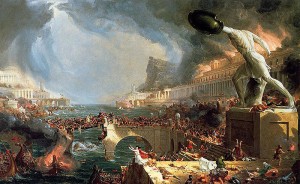
The Course of Empire by Thomas Cole

The Course of Empire by Thomas Cole

Here’s the thing. Our society only works after generational crises which don’t destroy it. After the Napoleonic Wars, the survivors made Europe more or less work. They got a good long run out of it–a surprisingly long one–but it began going south starting around 1870, and it blew up with WWII.

It went south in ways that are recognizable, by the way. For example, the British Empire pushed laissez-faire trade policies which made the rich richer, but gutted the British manufacturing base over time, moving much of it, ironically, to America.

The system went into crisis from 1914 to 1945, and the Americans took it over and ran it basically well up until the early 70s, about 25 years. Then it went into decline. It’s hard to tell exactly when the end-game crisis start(ed) until we can look back, but if we aren’t in it right now, we’re close.

1945 to 2008 is 63 years. If you count up through to today, it’s 71 years. If the crisis isn’t seen to have started for another ten years, it will be 81.

But the core point here is that it’s very hard to create people who can run a system.

A common refrain is that prosperity destroys character. But that’s not quite right: The people who created the good post-war economy were the FDR types, mostly. People who were adults in the 20s and 30s, who saw what went wrong.

People have a hard time learning from other people’s experiences. They have to see it themselves. So, in the early 70s there is an attempt to get rid of the short-sale uptick rule (you can only short a stock on an uptick of the stock) and it dies in the face of massive backlash. A couple decades later, those people are dead, and even more wholesale revisions to the rules are put in place to prevent another Depression. Finally, Clinton kills Glass-Steagall, the main spar, wholesale, something entirely unthinkable in 1960 when the population had lived through and remembered the reasons Glass-Steagall existed in the first place.

But the rot goes deeper than just, “It’s hard to learn what you didn’t experience.” It goes to the core of how we raise ourselves and our children.

School, as we do it, is a terrible way to raise people. What it actually teaches us is to, “Do what you’re told, when you’re told. Wait to be told how to do things, don’t figure out things for yourself, and give the approved answer, not one you came up  with  yourself.”

It trains drones. It trains people who are meant to spend their adult lives under supervision, doing what they are told, when they are told, and giving their bosses the answers their bosses want.

Those people make fine wage slaves, yes, but they don’t make good citizens. They have been failed to be taught how to think for themselves. Even worse, they have been taught that if a thought of their own should come up, they should keep it to themselves.

Meanwhile, school interactions with peers are terrible. When we call something “high school” we mean horrible peer pressure bullshit. A few people remember high school fondly, but most people remember it as one of the worst times of their lives.

Wage slavery, and I use the term slavery very deliberately, is a terrible system if you want a democracy or a Republic. Mass production consumer societies, in which we choose from menus rather than creating anything ourselves, are terrible for democracies or Republics.

The ways we school people, the jobs most people work at, and the methods through which we distribute goods to people (through money gained by sitting down, shutting up, and doing what you are told) are antithetical to free, egalitarian societies. Only a crisis which forces people to think for themselves and where they have to be trusted for a while can briefly create people suited to political freedom.

But we can’t have world wars and depressions all the time, for what I assume are obvious reasons. So we stagger along, brief good periods sliding into shit periods, regularly.

Of course there is more to it than this, such as cycles of destruction of capital and labor and so on, but much of that is manageable–in theory. It isn’t manageable in practice, not because it couldn’t be done, but because our society–we, ourselves–don’t create the people who can do it.

Freedom, democracy, equality: these things are not compatible with how we order our economic affairs, how we raise our children, or how we condition our adults.

We will not reverse course, this cycle; that doesn’t happen and it won’t. It’s too late. But there is always another cycle. If we don’t want the next cycle to be as disastrous as this one, we must figure out a better way to run our economy, to educate our children, and to live as adults. A way suited to people fit to be free.

This doesn’t mean “work or starve” as many libertarian morons would think; it means allowing real choices to be made, which requires an absence of existential fear while still including consequences. It means teaching children to to be something other than “good workers.” It means jobs that aren’t “you’re a kneepad for the boss or you lose everything.” It means a power structure that does not concentrate wealth and power in the hands of a few and create a gate around access to the good life, which fosters outside of it a subservience born of the desperate knowledge that the good life comes from good jobs, which are in scarce supply.

All of this is do-able. In some sense, most of it isn’t even all that complicated. But that doesn’t mean any of it is easy, and it is hardest because we have been trained to exist in a poverty of imagination, an inability to imagine worlds that are much better than the one in which we live.

We have the technology. What we don’t have is the people. We aren’t the people who can run a good society (this is obvious, as we haven’t).

But as people, we can re-create ourselves and our descendants. Biology is only half destiny, the rest is in our hands.

So far, we’ve been acting like bacteria in a petri dish, rushing to destroy our environment through unchecked, stupid growth.

Let us hope we can prove ourselves wiser than that. Or, instead of us instructing ourselves, Nature will instruct, and her lessons will be harsh.


The results of the work I do, like this article, are free, but food isn’t, so if you value my work, please DONATE or SUBSCRIBE.

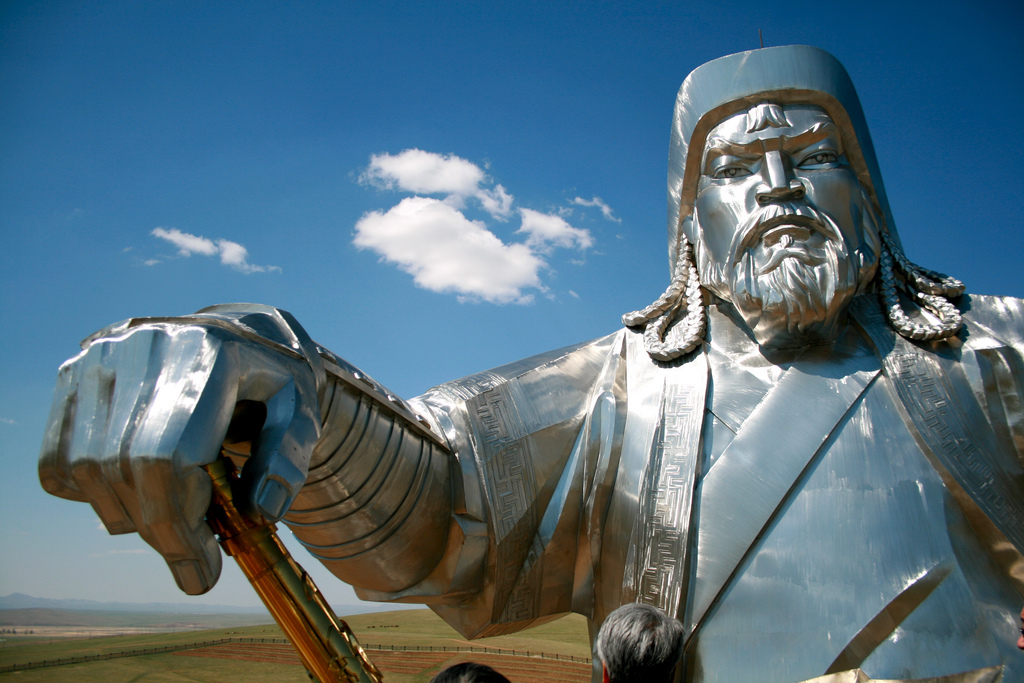
Genghis Khan, Photo by Francois Phillipe

The Genius of Genghis Khan

So, he comes out of nowhere, and he and his heirs create the largest land empire in history.

It was not inevitable; horse nomads didn’t always win, they usually lost. At one point Temujin (his name, Genghis Khan is a title) chose not to attack the Chinese capital because he just didn’t have the forces.

Temujin was exceptional in many ways, and his life, especially his early life, reads like an adventure novel: He was exiled from his original tribe when his father died, killed his own older brother (ostensibly for hoarding food when the family was hungry), was captured by his enemies and escaped, rescued his kidnapped wife and refused to disavow the child she bore that may not have been his, and rather more. It’s worth reading.

Genghis Khan turned the Mongols into probably the most dominant military in history. They basically didn’t lose battles or wars during his life, and they weren’t defeated straight up until the Mamluks in Egypt, long after his death. The Mamluks did it by copying the Mongols, but it wouldn’t have worked against Temujin’s Mongols (I’ll explain why below).

The Nazis developed blitzkrieg, in part, by examining Mongol campaigns and strategy. The Mongols, in an era with no communication faster than a messenger, were able to coordinate multiple armies advancing hundreds of miles apart, so that they would meet at an agreed place on the same day. Temujin and his generals coordinated armies in a way contemporaries couldn’t. They were also startlingly fast: Mongol armies performed marches in the Russian winter which moved faster than WWII panzer armies over the same terrain.

The Mongols treated war and mass hunts the same: They couldn’t give a damn about glory or honor; they were there to defeat the enemy with the least losses possible, so they would regularly feint, withdraw before attacks while punishing them with bow fire, and so on. They gutted Eastern Europe’s chivalry just this way, and those who think that Europe could have stood up against the Mongols if they hadn’t withdrawn due the Great Khan’s death are simply fooling themselves. They defeated far more unified and dangerous opponents over as bad or worse terrain multiple times; the only terrain that ever stopped the Mongols was the Ocean (although it took them some time to conquer southern China due to terrain.)

Genghis Khan was ruthless. Because the Mongols were few in number, he would either recruit enemies into his ranks, or slaughter them outright. In cities that resisted, all men of fighting age would be rounded up, taken to the next city assault and forced to attack the walls. This is pitiless, to be sure, but the Mongols could not afford to leave populations capable and willing to rise up behind their lines.

When attacking a city, the Mongols generally offered quite generous terms–if the city didn’t resist. If it did, they would often destroy the city entirely. Part of this is because, especially at the beginning, they had almost no siege capability. Sieges took years the Mongols couldn’t afford, so they made surrender very tempting and the cost of resistance terrible.

Resistance in Afghanistan basically ended the Hellenic culture there. (But then, the Afghans killed Temujin’s emissaries when he asked for peaceful trade. Whoops.)

Khan was particularly good at espionage. He protected merchants, made friends with them, and used them as spies. When the Mongols invaded they would know their enemy’s weaknesses, including any vassals who were willing to rebel, any conquered and resentful minorities, and so on, and they used that information, often inspiring uprisings at the same time as their attacks.

All of this is very nice, and important, but the greatest aids to Temujin’s success were two things most people don’t concentrate on amidst all the slaughter, glory and rapine.

Genghis Khan was absolutely brilliant at sizing people up, and he was brilliant at inspiring loyalty.

Khan regularly took people who had been his enemies and made them his most important generals and administrators. None of them betrayed him.

One of the main causes of the Mongols’ later defeats is that after Khan and those who he had directly picked to administer and lead died, the genius was gone. The last truly great general, for example, was Subotai, who (as best I recall) never lost a battle (Subotai lead the attack on Europe).

Khan had genius subordinates, as competent as him or moreso at warfare and far better than him at administrating non-nomads. And they were loyal.

Khan certainly favored his family, but he didn’t do so to the extent of freezing out the truly talented. Competence and success were rewarded, in anyone, including, in notable occasions, in women. Relatedly, Khan, quite unusually for the time, enforced religious equality in his empire.

Once a population was conquered, they were taxed lightly, and the rule of law was enforced. One may quip the Mongols made a desert and called it peace, as with Augustus, but the Pax Mongolica was very real, and allowed travel from Europe all the way to China. The line is that, on Mongol patrolled routes, a virgin with a pot of gold was completely safe–including from the Mongols. You certainly couldn’t say the same virtually anywhere in Europe at the time (probably anywhere, but perhaps there were some small areas which were exceptions).

I bring all this up because Khan, of course, also killed millions and wiped entire cities from the map. The Mongols broke the flower of Muslim civilization, ending their Golden Age. (Anecdote: Upon conquering,  I believe, Baghdad, the Mongols, who had a taboo on spilling royal blood, locked the Caliph in his treasury with his gold to starve, commenting that he should have spent it on armies and defenses. They were not without a rough sense of humor.)

The historians I have read on the period often note that Mongol atrocities weren’t worse than most of the people they fought. Instead, the Mongols were just far more successful (but that doesn’t change the sheer scale of them).

So, why do I bring all this up?

Because Genghis Khan is far removed from our time. We have very few real emotional feelings about him (unless you’re Mongol, and some Chinese are still angry).

Genghis Khan was a great man. I don’t think there’s any reasonable definition of great that doesn’t conflate great with good, a criteria which he does not meet. He was extraordinarily competent, one of the most competent figures we know of in history. He was honorable, keeping his deals. He loved his wife greatly, there is no question of it; the romance and love of Borte and Temujin is one of the great historical romances. He was religiously tolerant in an age of violent religious bigotry.

He also killed millions. Effectively destroyed civilizations. He was evil by any useful definition of evil. He was a great man, an evil man, an honorable man, a man who inspired great dedication and loyalty. He committed fratricide, something his own mother never forgave him for.

Bad man. Competent man. Honorable man. Great leader. Great general (though not the best Mongol general; note that Genghis Khan could secure the loyalty of men who were more competent than him).

I’m going to return to this theme at least one more time. In the meantime, Genghis Khan, great man, world’s greatest conqueror (you can quibble about Alexander, but I give it to Temujin), evil, genocidal bastard. Romantic.

All at the same time.

In the meantime, reading up on the Mongols and Khan is fascinating, can teach you a great deal due to distance, and can be disturbing as well.


If you enjoyed this article, and want me to write more, please DONATE or SUBSCRIBE.

Do Great Men and Women Change the World?

Most of us, when we were young, were taught history as a series of events, with the names of important men and women attached. In effect, we were taught the “Great Man” theory of history, that history is the result of the actions of great individuals.

Do the great matter? Do they make a difference?

Sometimes, I think.

In some cases, a person we call great fills a role someone else would have filled, and does it no better than anyone else would have. Sometimes they fill a role someone else would have filled and perform it so well it makes a huge difference.  And sometimes they wrench history about, in a role someone else would not have filled.

Let us start with a man who filled a role someone else would have, but did it brilliantly, and it mattered.

Napoleon.

The Revolution almost inevitably ended with a dictator. I don’t think, given the sort of revolution France had, that could have been avoided.

That it was Napoleon, one of the greatest generals in history, mattered. He didn’t have to be a great general to get the job, he had to be in the right place at the right time. A competent general could have gotten the job.

Napoleon almost never lost a battle. Other French generals lost often. That mattered. Napoleon, wherever he went, changed everything: from ending the Holy Roman Empire, to shattering various other bonds of feudalism, Napoleon changed Europe far, far beyond France. A man who lost even a few more battles than Napoleon did, wouldn’t have.

Let us take two modern great men who, I think, changed little. Start with Mark Zuckerberg, CEO of Facebook. Someone was going to win the “social friends” space. For a while it looked like it would be MySpace, and there were contenders before Facebook. Indeed, Facebook is not dominant in every country in this space.

All Zuckerberg did was win a space someone would have won. The details are different, sure, but not enough to really matter to anyone. Having won it he has done nothing particularly different anyone else would have done in that space.

Though still worshipped as a genius, I think Bill Gates is in the same category. MS DOS (in which I was an expert) was little different from any other OS that IBM could have chosen at the time. Windows (like the Macintosh) is just Xerox Park tech, which if Gates had not been around, would have been stolen/co-opted by someone else (aka. Jobs).

Gates was very good at creating a near-monopoly for a couple decades, but other businessmen in the same situation might well have done the same thing.   Perhaps they wouldn’t have, and he made a difference. If so, that difference was negative, it seems to me.

If something is inevitable, someone will do it. The specific individual Who does it only matters if they are extraordinary. If they are just very good at what they do, well, someone else very good could have stepped up and the difference would have been minor.

I suspect this applies to a lot of earlier “Lords of Industry.” Ford, for example.

In the “inevitable” but it mattered who it was category I’d slot, say, Genghis Khan. He wasn’t the only one trying to unify the Mongols, but his degree of success rested on his own particular genius, which, oddly, was mainly that he was an extraordinary judge of ability and character in other men and women. Temujin’s generals and administrators were extraordinary, and he made loyal followers out of people he had been enemies with. Similar to Shaka (but much more succesfully since he didn’t have to face 19th century weapons), he was also able to turn his society into an extraordinarily efficient war machine.

So who came out of nowhere and changed the world? Who forged a position which wouldn’t have existed otherwise, then did something extraordinary with it?

I find it hard to think of anyone. In the intellectual sphere, Socrates, Plato and Aristotle, for example, came out of a specific time and place where philosophers and teachers were very highly valued because they taught people how to argue.  (Read Plato’s dialogues and tell me, for all his sneering at “sophists” he is not an amazing debater.)

Perhaps one can make a case for Newton, but Leibniz created calculus almost at the same time. Were the rest of his discoveries made much sooner than they otherwise would have been?

Or perhaps the great religious figures? Buddha, Christ, Confucius. Does a Buddha have to happen? Certainly the circumstances are there for one in the newly urbanized cities of northern India with their loss of faith in the old Vedic religion. Indeed, modern Hinduism really comes out of that period as well, for all they claim the Vedas they have little in common with that religion.

Someone would have done what Buddha did, but I think a strong argument exists that how well he did it, and how he did it matters.

So, what do my readers think? Who would you nominate as coming out of nowhere and changing the world? Who is the great one who did not fill a slot someone would have filled?


If you enjoyed this article, and want me to write more, please DONATE or SUBSCRIBE.

Did the Industrial Revolution Require Land Clearances, Slavery, Genocide, and Empire?

The Leninist argument is that imperialism, industrialization, and capitalism were intertwined. It did not make sense to discuss capitalism or industrialization without discussing Empire, and all its crimes. It is also the common argument that land clearances, in which commons rights were taken away from peasants and serfs, often by law and force, were required to create the industrial workforce.

This is because the early industrial workforce was a terrible place to work and live–and the phenomenon is not temporary, by most measures. It was true for between a hundred and a hundred and fifty years. Maybe longer. You worked longer (six and a half days a week, 12 hours a day was common in certain periods), you lived in urban filth, ate less, were sick more, grew to lower height if born into this, and died younger.

So, clearance was bad for the people who were cleared. I trust I don’t have to explain why European Imperialism was bad for most everyone else. Granted, European Imperialism predates the Industrial Revolution (but not the commercial, wind, and water revolutions), but it goes into overdrive during the Industrial period, and the gains of previous periods are definitely used to support the Industrial Revolution.

There are two questions to answer with regards to the clearance issue. First, whether or not clearances were necessary for the agricultural revolution to occur. With no agricultural revolution, there’s not enough food for expanding city populations.


(I am fundraising to determine how much I’ll write this year. If you value my writing, and want more of it, please consider donating.)


The orthodox answer to this question is, “No.” But recently, a scholar, Robert C. Allan, went through the agricultural records and compared enclosed field to non-enclosed field production. Common fields were usually somewhat less productive than enclosed fields, but their gains increased almost as fast as enclosed fields did, and were even higher for certain crops (for instance, as with nitrogen fixers, like clover).

In other words, no, the agricultural revolution was not predicated on field enclosure–it just would have happened slightly slower in a non-field-enclosure scenario.

The second question concerns wages for workers, and is trickier. Allan argues that the Industrial Revolution happened in England for a simple reason: The coal was right there and could easily be shipped to factories. Shipping coal was hellishly expensive, and early steam engines were massively inefficient. Industrialization didn’t start in, say, Paris, because it lacked the resources. In Paris, it was cheaper to use more labor rather than to use coal.

Field enclosures made labor cheap in England. Without them, there are a lot less desperate workers, and a lot less desperate workers means higher wages and better treatment of workers (no one’s leaving the peasant village to go work 78 hour work weeks). Higher wages could make steam-driven factories unprofitable. No profit = no revolution.

This is an empirical question, and I don’t see the data to indicate the answer one way or the other. The theoretical point of view is this: Land clearances forced the cost of labor down. The higher wages are, the more you want to use capital (like equipment), not workers. In such a case, again, the Industrial Revolution happens, but it happens closer to Newcastle to keep the cost of coal down, and it is slow to gain traction due to profitability concerns. Once stabilized, however, the incentives for increasing machine efficiency of the machines faster could quite possibly have accelerated the Industrial Revolution faster than how it actually played out. Hard to say, but the argument is sound.

Now, for Empire.

With a very few exceptions, the main one being the USSR, every country which has industrialized, including Britain and the US, has done so with mercantalist policies, that is, behind trade barriers of some sort or another. They become free traders when their industry is well-established, not before.

Mercantalism does not require imperialism, but imperialism can augment mercantilism. When the British invaded India, India had more factories than England. Soon, they didn’t. India was a vast market for British manufacturing and provided raw materials.

The South in the US provided much of the cotton, through slave labor, as did Egypt and various other places which were conquered or absorbed through imperialism. (While the US South was, no, not under British control during this period, the Native Americans were cleared from it by European imperialism and disease and the slaves were brought over on European ships.)

Imperialism provides two things: Markets and cheap supplies for the factories. Even the Chinese opium/tea trade is related. Tea reduces appetites and enables people to work longer, and the British, even with the agricultural revolution, are somewhat underfed. Minus six half-day weeks, of course, they would not need so much food, but they do. (Ever done hard, manual labor all day? I have. I ate A LOT.)

There is clearly a benefit from Imperialism for industrialization under capitalism.

Could industrialization have happened without forcing open these barriers to British exports and without cheaper commodities like cotton, acquired through slave labor, plantations (which require shoving small farmers off the land), and so on?

What would have happened if we didn’t conquer, pillage, and enslave so many people? What would have happened if we didn’t deliberately retard their economic development? If we didn’t kill so many of them?

Perhaps they would have been more prosperous. Granted, many tribal societies have little use for money, but as the Hudson’s Bay experience shows, if you provide goods they really want, they’ll go out of their way to get what you want in return. And India, despite vast numbers of peasants, had vast mercantile cities and trade long before the British, Portuguese, and so on, arrived.

The commodities wouldn’t be so cheap, and Britain may not have gained so near a monopoly in early industrial manufacturing, but other societies would have also been richer–which means more purchasing power. Richer people can pay more.

The British still would have had that huge advantage: Coal near the manufacturing areas and near the coast. It’s an island. You can get what you manufacture to the sea easily, and you can use coal because the coal is near the sea too (everything is near the sea in England, from the Continental point of view).

This scenario suggests that England would have still industrialized first, and the Industrial Revolution still happens in Britain. Is it’s pace slower? Faster? I suspect slower at first, faster later. But it is more humane, and it leads to a better world.

If China and India had industrialized at a faster, more organic pace than they did; if they had been dragged along closer behind, standards of living would have risen faster. But standard of living is negatively correlated to the number of children.

A world in which all (or at least most) boats rise together, with England in the lead, but not excessively so, is one with a lot less of a population problem and a lot less of a poverty problem.

It may just be that being complete bastards to virtually everyone was not required for industrialization. It may be that we would have lived in a vastly better world.

It may not, of course, but I think the argument for “Being Assholes Wasn’t Actually Necessary” is pretty strong.

And I think it’s fairly important, because it’s at the heart of the whole “Is other people’s suffering required for some people to live the good life?” question.

(This is part 3 of a semi-series.  Read part one on “The Death of Capitalism” part 2 on “What Capitalism is and part 4 on  “How The Rational Irrationality of Capitalism Is Destroying the World”.)


If you enjoyed this article, and want me to write more, please DONATE or SUBSCRIBE.

When Does Technological Advancement Actually Lead to Prosperity?

When is a society prosperous? The general understanding seems to be it’s when everyone has an abundance of goods. But is this a useful definition? Are you prosperous if you have an abundance of goods, but no time to enjoy them? Are you prosperous if you have an abundance of goods, but you’re sick? Are you prosperous if you have an abundance of goods, but you live in an oppressive society? Are you prosperous if you have an abundance of goods but are desperately unhappy and feel you’ve wasted your life?

You can argue to keep it simple: Prosperity means everyone has access to a lot of goods and services. But I think this falls flat; we can all understand that more goods don’t necessarily make us better off, nor more services. More foods that make us sick aren’t better. More health care doesn’t mean we’re healthier, it often means we’re sicker. More prisons mean our society is producing more criminals and more crime.

Just increasing economic activity doesn’t make people better off, doesn’t increase prosperity.

The prototypical example of this is the move to agriculture. It would seem self-evident that learning how to grow more food has made us better off. More food is better, right? In fact, however, the move from hunting and gathering to agriculture led to lives which were worse, for the vast majority of the population. People were shorter in most agricultural societies, which indicates worse nutrition. There was far more disease and far more chronic health conditions. People also generally had less free time and they lived fewer years than the hunter-gatherers who preceded them.

Nor was this a short term decline, it lasted for thousands of years. Height is a good measure of nutrition, and we are still not as tall as our hunter-gatherer ancestors. Pelvic depth, which measures how easily women give birth has also never recovered. Median lifespan was not higher for around 6,000 years. And it declined for hundreds of years during that period in certain areas of the world. Members of the Hellenic world, from 300 BC to 120 AD, had longer lives than westerners before the 20th century.(1) Our lives can get worse, and stay worse, for hundreds or thousands of years, despite having more ability to create goods.

Are societies with more food and goods better if the people are sicker, live shorter lives, and have more difficulty reproducing? If that’s prosperity, do we want it?

Instead of more goods, more “stuff,” we should want the right goods and/or the right stuff. Stuff that makes us healthier, happier, smarter, more able to do great works, and to live well. Instead of more work, we should want right work, enough work to make the right stuff, but not so much work we have no time for our loved ones, friends, and doing the activities we love, whatever those might be. And, as much as possible we should want health instead of medicine and low crime rather than prisons.

All other things being equal, yes, more productive capacity is better. The more stuff we can make, in theory, the better off we’ll be. But in practice, it doesn’t always work that way.

Again, part of this is about the right stuff, or the wrong stuff. In our own society we are seeing an epidemic of obesity and diabetes due to our diet, for example. Part of that problem lay with modern hierarchies and inequality. Inequality is undeniably bad for us, as a whole. The more unequal your society is, the lower the median lifespan. The more unequal the society, the sicker, in general. More heart attacks, much more stress. The more unequal, the more crime. These links are robust.

The links run two ways. On the one hand, humans find inequality stressful. The human body, if subject to long term stress, becomes unhealthy and far more likely to be sick. People who feel unequal act less capable than those who feel equal. This is true for the rich and powerful in unequal societies and the poor. Everyone suffers. Though the poor and weak do suffer more, even the rich and powerful would be healthier and live longer in equal societies, most likely simply due to the stress effect.(2)

The second part is distribution, or rather, the question of who gets to control distribution. The more unequal a society, the less stuff the poor and middle class have, comparatively. Some technologies tend to lead to more inequality, some tend to lead to more equality. In most hunter-gatherer societies, there isn’t enough surplus to support a class of rich, powerful people and their servitors–in particular their servitors who enforce the status quo through ideology or violence. With little surplus, there is equality. This doesn’t mean hunter-gatherers live badly, most of them seem to have spent a lot less time producing what they needed than we do, they certainly didn’t work 40 hour weeks, or 60 hour weeks, closer to 20. (3) The rest of the time they could dance, create art, make love, socialize, make music, or whatever else they enjoyed.

Agriculture didn’t lead immediately to inequality, the original agricultural societies appear to have been quite equal, probably even more so than the late hunter-gatherer societies that preceded them. But increasing surpluses and the need for coordination which arose, especially in hydraulic civiliations (civilizations based around irrigation which is labor intensive and requires specialists) led to the rise of inequality. The pharoahs created great monuments, but their subjects did not live nearly as well as hunter-gatherers.

The organization of violence, and the technology behind it, is also a factor. It is not an accident that classical Greece had democracy in many cities, nor that it extended only to males who could fight and not women or non-fighting males. It is not an accident that Rome had citizenship classes based on what equipment soldiers could afford: the Equestrian class was named that because they could take a horse to war. It is not accident that the Swiss Cantons, where men fought in pike formation, were democratic for their time. Nor is it an accident that universal sufferage arose in the age of mass conscription and that women gained the vote as societies moved to mass mobilization.

When Rome moved away from citizen conscription to a professional army it soon lost its liberty. As we move away from mass armies it is notable that, while we haven’t lost the vote formally, the vote seems to matter less and less as politicians increasingly just do what they want, no matter what the electorate might have indicated.

Power matters for prosperity. The more evenly power is spread, the more likely a society is to be prosperous, for no small factions can engage in policies which are helpful to them, but broadly harmful to everyone else. Likewise, widespread demand, absent supply bottlenecks, leads to widespread prosperity as well.

In the current era, we have seen a massive increase in CEO and executive pay. This is due to the fact that they have taken power over the primary productive organizations in our society: Corporations. The owners of most corporations, if they are not also the managers, are largely powerless against the management. It is not that management is more competent than it was 40 years ago, at least at their ostensible job of enriching shareholders, it is that they are more powerful than they were 40 years ago, compared to shareholders and compared to government.

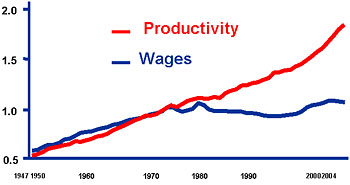
Because increases in the amount we can create do not automatically translate into either creating what is good for us, or into relatively even distribution of what we create, increases in the amount we can create do not always lead to prosperity. Likewise, it certainly does not naturally lead to widespread affluence. Productivity in America rose 80.4 percent from 1973 to 2011, but median real wages rose only 10.2 percent and median male wages rose 0.1 percent. (4) This was not the case from 1948 to 1973, when wages rose as fast as productivity did.

Increases in productivity, in our ability to make more stuff, only lead to prosperity and affluence if we are making the right stuff, and we are actually distributing that stuff widely. If a small group of individuals are able to skim off most of the surplus, prosperity does not result and if a society which is prosperous allows an oligarchy, nobility, or aristocracy to form, even if such an aristocracy (like our own) pretends it does not exist, society will find its prosperity fading.

Creating goods that hurt people is not prosperity either. Currently, about 40 percent of all deaths are caused by pollution or malnutrition.(5) If someone you love has died, there is a good chance they died because we make stuff in ways that pollute the environment, or because the stuff we make, like most of our food, is very bad for us. Being fat is not healthy, and we are in the midst of an obesity epidemic. Even when we do not immediately die, we suffer from chronic diseases at a rate that would astonish our ancestors. As of the year 2000, for example, approximately 45 percent of the US population suffered from a chronic disease. 21 percent had multiple conditions.(6) Some of this is just due to living longer, but much of it is due to the food we eat, the stress our jobs inflict upon us, and the pollution we spew into the air, land, and water.

We should always remember this. Increases in productive capacity and technological advancement do not always lead to welfare and when they do, they do not automatically do so immediately. The industrial revolution certainly did lead to increased human welfare, but if you were of the generations thrown off the land and made to work in the early factories, often 6 1/2 days a week, in horrible conditions, you would not have thought so. You were, in virtually every way, worse off than you were before by being thrown off the land, and so were your children. A few industrialists and the people around them certainly did very well, but that is not prosperity, nor is it affluence.

And a gain of affluence which lasts less than two centuries and ends in ecological disaster which kills billions, well, our descendents may not call that a success, or nor may they think it was worth it.

Prosperity, in the end, is as much about power and politics as it is about technology and productive ability. The ability to make more things does not ensure we are making the right things, or that the people who need them, get them. Productive capacity which is not shared is not prosperity.

  1. pg 23, Spencer Wells, Pandora’s seed
  2. Inequality book
  3. going from memory on this one
  4. http://www.epi.org/publication/ib330-productivity-vs-compensation/
  5. http://dieoff.org/page165.htm
  6. Anderson G, Horvath J The growing burden of chronic disease in America. Public Health Rep. 2004;119:263-70.

If you enjoyed this article, and want me to write more, please DONATE or SUBSCRIBE.

The Decline and Fall of Post-war Liberalism and the Rise of the Right

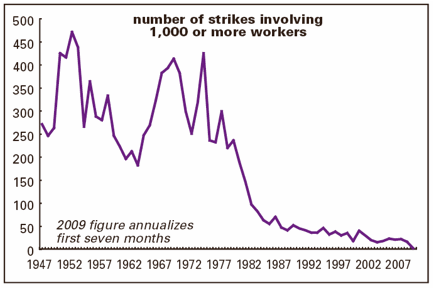
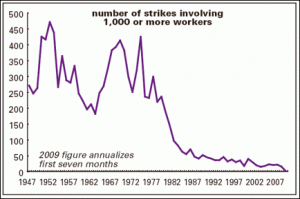
strikes-involving-more-than-1k-workersIn the Anglo-US world, post-war liberalism has been on the defensive since the 1970s. This is normally shown through various wage or wealth graphs, but I’m going to show two graphs of a different nature. The first, to the right, is the number of strikes involving more than 1K workers. Fascinating, eh?

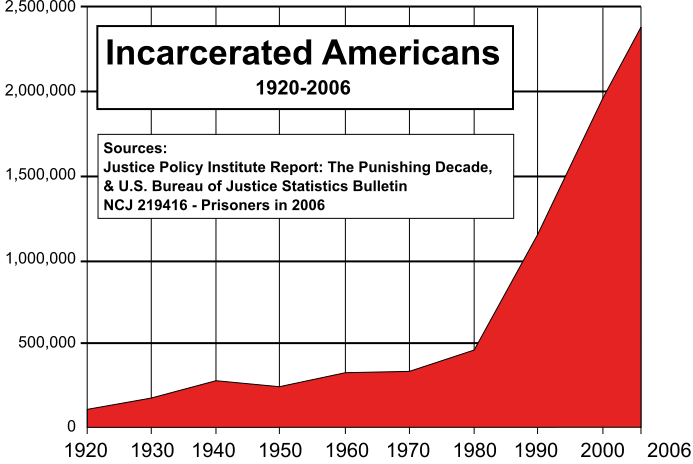
The second, below and to your left, is the incarceration rate. It isn’t adjusted for population increases, but even if it was, the picture wouldn’t change significantly.

This is the change caused by the Reagan revolution in the US, which, as is the case with most revolutions, started before its flagship personality.
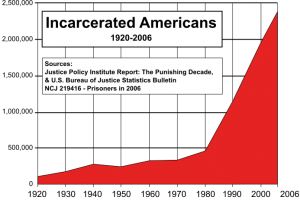
Graph of incarceration in the US over time

From Wikipedia


I was born in 1968. I remember the 70s, albeit from a child’s perspective. They were very different from today. My overwhelming impression is that people were more relaxed and having a lot more fun. They were also far more open. The omnipresent security personnel, the constant ID checks, and so forth, did not exist. Those came in to force, in Canada, in the early 1990s. As a bike courier in Ottawa, I would regularly walk around government offices to deliver packages. A few, like the Department of National Defense and Foreign Affairs, would make us call up or make us deliver to the mail room, but in most cases I’d just go up to the recipient’s office. Virtually all corporate offices were open, gated only by a receptionist. Even the higher security places were freer. I used to walk through Defense headquarters virtually every day, as they connected two bridges with a heated pedestrian walkway. That walkway closed in the Gulf War and has never, so far as I know, re-opened.

I also walked freely through Parliament Hill, un-escorted, with no ID check to get in.

This may seem like a sideline, but it isn’t. The post-war liberal state was fundamentally different from the one we have today. It was open. The bureaucrats and the politicians and even the important private citizens were not nearly as cut off from ordinary people as they are today. As a bike courier, I interrupted senior meetings of Assistant Deputy Ministers with deliveries. I walked right in. (They were very gracious — in every case.)

The post-war liberal state involved multiple sectors, in conflict, but in agreement about that conflict. Strikes were allowed, they were expected, and unions were considered to have their part to play. It was understood that workers had a right to fight for their part of the pie. Capitalism, liberal capitalism, meant collective action because only groups of ordinary workers can win their share of productivity increases.
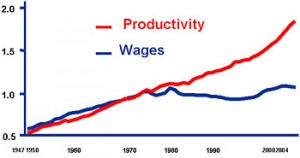
productivity and wages

productivity and wages

Which leads us to our second chart. The moment you lock up everyone who causes trouble (usually for non-violent, non-compliance with drug laws), the moment you crack down on strikes, ordinary people don’t get their share of productivity increases. It’s really just that simple.

This is all of a piece. The closing off of politicians and bureaucrats from public contact, the soaring CEO and executive salaries which allow them to live without seeing anyone who isn’t part of their class or a servitor, the locking up of people who don’t obey laws that make no sense (and drug laws are almost always stupid laws), the crushing of unions, which are a way to give unfettered feedback to politicians and our corporate masters, are all about allowing them to take the lion’s share of the meat of economic gains and leave the scraps for everyone else.

But why did the liberal state fail? Why did this come about? Let’s highlight three reasons: (1) the rise of the disconnected technocrat; (2) the failure to handle the oil crisis, and; (3) the aging of the liberal generations.

The rise of the disconnected technocrat has been discussed often, generally with respect to the Vietnam war. The “best and the brightest” had all the numbers, managed the war, and lost it. They did so because they mistook the numbers for reality and lost control. The numbers they had were managed up, by the people on the ground. They were fake. The kill counts coming out of Vietnam, for example, were completely fake and inflated. Having never worked on the ground, having not “worked their way up from the mail room,” having not served in the military themselves, disconnected technocrats didn’t realize how badly they were being played. They could not call bullshit. This is a version of the same problem which saw the Soviet Politburo lose control over production in the USSR.

The second, specific failure was the inability to manage the oil shocks and the rise of OPEC. As a child in the 1970s, I saw the price of chocolate bars go from 25c to a dollar in a few years. The same thing happened to comic books. The same thing happened to everything. The post-war liberal state was built on cheap oil and the loss of it cascaded through the economy. This is related to the Vietnam war. As with the Iraq war in the 2000s, there was an opportunity cost to war. Attention was on an essentially meaningless war in SE Asia while the important events were occurring in the Middle East. The cost, the financial cost of the war, should have been spent instead on transitioning the economy to a more efficient one — to a “super-analog” world. All the techs were not in place, but enough were there, so that, with temporizing and research starting in the late 1960s, the transition could have been made.

Instead, the attempt was left too late, at which point the liberal state had lost most of its legitimacy. Carter tried, but was a bad politician and not trusted sufficiently. Nor did he truly believe in, or understand, liberalism, which is why Kennedy ran against him in 1980.

But Kennedy didn’t win and neither did Carter. Reagan did. And what Reagan bet was that new oil resources would come online soon enough to bail him out.  He was right. They did and the moment faded. Paul Volcker, as Fed Chairman, appointed by Carter, crushed inflation by crushing wages, but once inflation was crushed and he wanted to give workers their share of the new economy, he was purged and “the Maestro,” Alan Greenspan, was put in charge. Under Greenspan, the Fed treated so-called wage push inflation as the most important form of inflation.

Greenspan’s tenure as Fed chairman can be summed up as follows: Crush wage gains that are faster than inflation and make sure the stock market keeps rising no matter what (the Greenspan Put). Any time the market would falter, Greenspan would be there with cheap money. Any time workers looked like they might get their share of productivity gains, Greenspan would crush the economy. This wasn’t just so the rich could get richer, it was to keep commodity inflation under control, as workers would then spend their wages on activities and items which increased oil consumption.

The third reason for the failure of liberalism was the aging of the liberal generation. Last year, I read Chief Justice Robert Jackson’s brief biography of FDR (which you should read). At the end of the book are brief biographies of main New Deal figures other than Roosevelt. Reading them, I was struck by how many were dying in the 1970s. The great lions who created modern liberalism, who created the New Deal, who understood the moving parts were dead or old. They had not created successors who understood their system, who understood how the economy and the politics of the economy worked, or even who understood how to do rationing properly during a changeover to the new economy.

The hard-core of the liberal coalition, the people who were adults in the Great Depression, who felt in their bones that you had to be fair to the poor, because without the grace of God there go you, were old and dying.  The suburban part of the GI generation was willing to betray liberalism to keep suburbia; it was their version of the good life, for which everything else must be sacrificed. And sacrificed it was, and has been, because suburbia, as it is currently constituted, cannot survive high oil prices without draining the rest of society dry.

Reagan offered a way out, a way that didn’t involve obvious sacrifice. He attacked a liberal establishment which had not handled high oil prices, which had lost the Vietnam war, and which had alienated its core southern supporters by giving Blacks rights.

And he delivered, after a fashion. The economy did improve, many people did well, and inflation was brought under control (granted, it would have been if Carter had his second term, but people don’t think like that). The people who already had good jobs were generally okay, especially if they were older. If you were in your 40s or 50s when Reagan took charge in 1980, it was a good bet that you’d be dead before the bill really came due. You would win the death bet.

Liberalism failed because it couldn’t handle the war and crisis of the late 60s and 70s. The people who could have helped were dead or too old. They had not properly trained successors; those successors were paying attention to the wrong problem and had become disconnected from the reality on the ground. And the New Deal coalition was fracturing, more interested in hating blacks or keeping the “good” suburban lifestyle than in making sure that a rising tide lifted all boats (a prescriptive, not descriptive, statement).

There are those who say liberalism is dying now. That’s true, sort of, in Europe, ex-Britain. The social-democratic European state is being dismantled. The EU is turning, frankly, tyrannical, and the Euro is being used as a tool to extract value from peripheral nations by the core nations. But in the Anglo-American world, liberalism was already dead, with the few great spars like Glass-Steagall, defined benefit pensions, SS, Medicare, welfare, and so on, under constant assault.

Europe was cushioned from what happened to the US by high density and a different political culture. The oil shocks hit them hard, but as they were without significant suburbia, without sprawl, it hit them tolerably. They were able to maintain the social-democratic state. They are now losing it, not because they must, but because their elites want it. Every part of the social-democratic state is something which could be privatized to make money for your lords and masters, or it can be gotten rid of if no money can be made from it and the money once spent on it can be redirected towards elite priorities.

Liberalism died and is dying because liberals aren’t really liberal, and when they are, they can’t do anything about it.

None of this means that modern conservatism (which is far different from the conservatism of my childhood) is a success if one cares about mass well-being. It isn’t. But it is a success in the sense that it has done what its lords and masters wanted —- it has transferred wealth, income, and power to them. It is self-sustaining, in the sense that it transfers power to those who want it to continue. It builds and strengthens its own coalition.

Any political coalition, any ideology behind a political coalition, must do this: It must build and strengthen support. It must have people who know that, if it continues, they will do well, and that if it doesn’t, they won’t. Liberalism failed to make that case to Southerners, who doubled down on cheap factory jobs and racism, as well as to suburbanite GI Generation types, who wanted to keep the value of their homes and knew they couldn’t if oil prices and inflation weren’t controlled. Their perceived interests no longer aligned with liberalism and so they left the coalition.

We can have a new form of liberalism (or whatever we wish to call it) when we understand why the old form failed and can articulate the conditions for our new form’s success. Maybe more on that another time.


If you enjoyed this article, and want me to write more, please DONATE or SUBSCRIBE.
Page 4 of 5

Powered by WordPress & Theme by Anders Norén