The horizon is not so far as we can see, but as far as we can imagine

Category: health care Page 34 of 35

Obama to blogs: Help!

So, Obama had a conference call with bloggers, and urged them to help him pass his health reform bill (a bill most liberal bloggers would have preferred was single payor, something Obama ruled out day one.) I find this… fascinating.

When I was dealing with the various Democratic primary campaigns in 2007 and 8, the one which did the least outreach to bloggers and which was the most closed and insular was the Obama campaign.

When Obama became the nominee, things didn’t change. Well, except once. After the Republican convention, when Obama was behind briefly, suddenly the Obama administration wanted to talk to bloggers. A lot. The moment his numbers improved, the door went back to its prior “one inch open, shout, and maybe someone will ignore you” position.

I found that interesting then. I find it interesting now.

I also do truly hope Obama gets through a bill which includes all his criteria:

the President mentioned his criteria for reform: Does it cover all Americans; Will it drive down costs over the long-term; Will it improve quality; Are prevention and wellness included; Does it contain insurance reforms on issues like pre-existing conditions; does it provide relief to small business; and, is there a serious public option. He warned that the different bills coming from the House and Senate may not have all of those provisions, but the conference committee will be critical.

And I hope it’s not just a pep talk for the gullible troops.  I hope, more, that it’s clear he got all those things in a meaningful form rather than getting a bill through to get a bill through

And hey, last time he stopped talking to us when he didn’t need us.  I’m sure he’ll do the same thing again.  Which, oddly, leaves me hoping that he stops talking to us again soon.

At least he’s still inspiring hope in me.

Americans Lives vs. Insurance Company Profits: the real battle in healthcare reform

Lying about healthcare, indeed fear-mongering about healthcare, has ramped up as insurance companies attempt to keep their profits.  Those profits are created by a system where the US spends 5% more of its economy on healthcare in exchange for the worst results of anywestern nation.  To insurance company executives, their profits, their executive salaries, and their bonuses, are not just worth lying for, but also worth killing for—or at least letting people die.

The Shona Holmes Healthcare Hitjob

Case in point: Shona Holmes is the current poster girl for the liars slandering Canadian health care in an attempt to discredit reform.  Ms. Holmes alleges she was horribly endangered by Canada’s healthcare system:

Both CNN and McConnell made a big deal out of Shona Holmes, an Ontario woman who claims she was forced by Ontario’s health system to go to the United States for life-saving surgery for a brain tumour. She claims that in 2005 delays in access to treatment at home made it necessary to go to the Mayo Clinic in Arizona and pay $97,000 for her care.

Her story sounds bad, doesn’t it?  Except, of course, it’s a lie:

On the Mayo Clinic’s website, Shona Holmes is a success story. But it’s somewhat different story than all the headlines might have implied. Holmes’ “brain tumour” was actually a Rathke’s Cleft Cyst on her pituitary gland. To quote an American source, the John Wayne Cancer Center, “Rathke’s Cleft Cysts are not true tumors or neoplasms; instead they are benign cysts.”

There’s no doubt Holmes had a problem that needed treatment, and she was given appointments with the appropriate specialists in Ontario. She chose not to wait the few months to see them. But it’s a far cry from the life-or-death picture portrayed by Holmes on the TV ads or by McConnell in his attacks.

In other words, her condition was not immediately life threatening, and it was prioritized accordingly.  But Holmes didn’t want to wait behind people who needed care more than she did, so she went the US where she could pay out of pocket to jump to the head of the line.

Healthcare Triage: US vs Canada

Here’s the deal: both the US and Canada prioritize patients, and both engage in health care rationing.  In Canada health care is prioritized by how urgently a patient requires treatment.  In America, to a much greater extent, access to medical care is prioritized by how much money the patient has.  Someone in the US who was sicker than Ms. Holmes was forced to wait longer for treatment because Holmes was rich enough to pay $97,000.

A Personal Perspective on Canadian Healthcare

I should add that I have firsthand experience with how the Canadian system prioritizes treatment.  In 1993, at the age of 25, I became very ill with ulcerative colitis.  I was hospitalized, and put on very expensive drugs.  About a week after being hospitalized, the nurse watching me called in my doctors on a Sunday because I was deteriorating so fast—pain killers were no longer having any effect (i.e., high doses of morphine were not working), I wouldn’t let anyone touch me, and I was becoming delirious.  At about midnight, they wheeled me into the operating chamber and took out my large intestine.  While they were digging around, they found out I had appendicitis, and they took that out too.  It would have burst within 2 days, and in my weakened state, it would have killed me.

Unfortunately, one of the treatments for ulcerative colitis involves immune suppressing drugs.  My immune system basically shut down, my liver almost shut down, and I spent almost another 3 months in the hospital, riddled with extremely painful and crippling infections and other problems.  At one point I was on 9 drugs; one of them was an antibiotic so expensive that only a single doctor in the hospital could approve it.  My gastroenterologist called the treatment the equivalent of “pouring gold dust into your veins.” I wasted away, my weight dropping below 90 lbs.  I often joke that I was old young: I’ve used a walker, crutches and cane.

The Universal Healthcare Bottom Line

The ultimate point of my story is simple: I got the care I needed, when I needed it, and I never paid a single red cent.

Which is good, because I couldn’t have afforded to pay.  I was young and had very little money.  The kind of care I received, even back then, would have cost hundreds of thousands of dollars in the US.

If I  had lived in the US, my parents would have faced a choice between paying for my incredibly expensive treatment, or watching me die.  They were both old, and it would have wiped out their savings entirely and thrown them into bankruptcy, and frankly, I don’t know how they could have supported themselves.  My life, at that cost, would have had too high a price.  I wonder how many Americans have had to make that calculation.

But I survived, and neither I, nor my parents, was bankrupted.  In similar circumstances I doubt all of those things would be true for an American 25-year-old trying to survive the same medical condition in America’s health care industry.

Healthcare Rationing, American-style

I have had two American friends die in the last 5 years who would have survived if they had had fully covered health care. (Note I didn’t say health insurance, that’s not what people need.  They need health care.)

One of them died of the flu.  He didn’t seek treatment because of the cost of his insurance co-payment, and he was found dead.

Another had a heart condition, but didn’t know it, because she didn’t have health care, because she couldn’t afford it.  If she’d had health care, she would probably still be alive.

Both of those people are dead because of people like Holmes, and the people behind her.  My two friends are dead because insurance company executives want to keep their obscene salaries, and force Americans to pay more for health care than they should.

So What’s the Healthcare Reform Fight Really About?

Billions of dollars are at stake in the battle for American healthcare reform.  That’s the sort of money executives, and their lobbyists, and their bought-and-paid-for politicians are willing to kill for: to let you, or your friends, or your family suffer and die. Think of your dead friends and relatives as collateral damage in the fight for health industry profits; that’s how the insurance executives see them.

Health Care Costs Part 1: The Single Payor Challenge To the Public Option

comparative-health-care-costs_html_m36226ab1

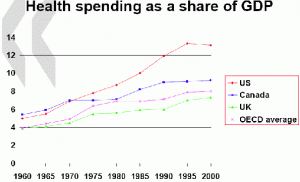
The chart at the top of this post shows what happened to per-capita costs when Canada went to single payor.  What’s interesting is that before Canada went single payor, per capita health costs in Canada were higher than in the US.  Over time, after single-payor was implemented, they they stayed even until about two-thirds of US costs, and then they started rising again.  The rate they rose at was about the same as American health care costs, but they stayed at about two-thirds of the cost.

In other words, single payor is the simplest way to get a one time savings in health care costs.  It has worked for every other country which has tried it (and yes, most European systems are variations on single payor.  They aren’t “pure” but they are still essentially single payor).

canada-hcare-vs-us-hcare

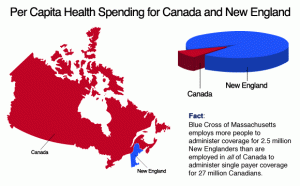
The next graphic shows the difference in administration costs.  This is one main reason why single payer is cheaper than a private system—it takes a lot less people to administer.  American hospitals have billing wings.  Canadian hospitals have a room or two of people who do all the billing.

This is the single-payer challenge to the public option.  Can it hold costs even until they are about one-third less than they would have otherwise been?  Until they are about even with the rest of the civilized world’s costs?

I’d put my money on a simple, heartfelt no.  Look hard in the mirror and try and tell yourself otherwise.

Single payer, or “Medicare for all” isn’t a long term solution to health care costs.  But it could buy the country a good ten years before costs start rising again.  That’s a lot of time.  A lot of money.  And a big challenge for any other plan to meet.

Which leads us to the question of taxes.  Every time someone starts whining about how taxes have to rise to pay for universal healthcare I want to smash my head against the nearest brick wall (since that’s softer than most of the skulls in Congress or the media).  Those per-capita costs above?  They aren’t for just “insured Americans”, they are divided across the entire population.  America is already paying more than enough money to give everyone health care, but because so much of it is being wasted, 48 million are uninisured and 62% of all bankruptcies are caused by health care problems, and 75% of those had what in the US is laughably refered to as “health care insurance”.

If proper health care reform occurs.  Health care reform which holds down costs, taxes might rise, but the overall cost should hold steady or rise only slightly.  If employers who provide insurance now are allowed to keep half the money, and required to give half of it as a raise to the employees losing the insurance benefit, and if corporations and employees are taxes, the average person will have the same amount of money as they did before universal healthcare.  And very quickly, within a few years, they will have more money in pocket than they would have without it.

Does it matter who you pay your health care money to?  The government or the insurance companies, as long as you get care?  And if the government can do it for cheaper, so you’ll have more money left over, for better care (and yes, Virginia, every country in the world with real universal health care has better overall results than the US) why wouldn’t you want that?

But no politicians comes out and says this.  “We are paying too much for health care.  You, my fellow citizens, are paying too much for bad health care.  What we are going to do is make sure that you get good health-care for less money.  Because yes, my friends, the government is better at some things than private companies, and health insurance is one of them.”

This is the bottom line—single payer—Medicare for all—is cheaper and provides better results than the current system.

Can any of the bills going through Congress say the same?  If they can, can they say it to the same extent?

That’s the single-payor challenge.  And like one of those old time boxing challenges where the boxer would take on all comers, I’m betting the public option rube is going to get his clock cleaned.

Which would be no big deal, except that it means a lot of people are going to die and suffer and go bankrupt who wouldn’t have if Congress members weren’t too beholden to insurance companies to do, for once, what is right for Americans.  I don’t know why they won’t do what’s right.  I don’t know why they won’t do what’s proven to work, rather than try and cobble together a rickety unproven plan.

But I can only assume it’s like the old question we used to ask about the Bush administration.  “Evil or stupid?”

Evil – taking health insurance company money and doing what they know is wrong because they’ve been bought.

Stupid-so ideologically blind that they think that even if every other country who’s gone single payer has had it work, it’s still a bad thing because the private sector is always better than the government, no matter how many people it kills or bankrupts.

I don’t know.  But either way, they’re failing the single payer challenge.

(Comparative Graph from OECD. *.pdf)

(New England image from health Insurance 2008)

If the American Medical Association is for something…

well, let’s just say that my reaction is the same, if not quite so virulent, as if George Bush is for something.  At best it’s “what am I missing.  In what way is what they are for evil or stupid and probably both?”

I bring this up because the AMA has endorsed the House health care plan.

The AMA primarily represents the interests of proceduralists in the medical professions.  That is, they look after doctors who get paid for doing things – heart surgery, tests, etc…

Payment by procedure is one of the biggest problems facing the US.  American doctors do more surgeries and order more tests than doctors in any other country.  You might think it’s good, but in fact the data shows it doesn’t improve health outcomes, in fact, too many procedures and tests seem to have a slight negative result.

In their letter the AMA refers to the Sustainable Growth Rate (SGR).  This is the formula by which Congress tries to restrain the growth in Medicare costs.  If they grow too fast, it leads to blanket cuts in rates for future years.  Every year the AMA has to lobby against it, to stop it from taking effect.

There seems to be a wide consensus that the SGR is a bad idea, but it’s also true that increasing rates for procedures is one of the things which is causing health care costs to explode in the US and that paying too much for procedures and too little for other types of preventative and cognitive care (for example, checking medications to be sure they don’t have negative interactions) has lead to perverse incentives.

TNR’s Cohn thinks that if it’s part of a package that tries to reduce health care costs and improve quality, he’s all for it.  But I’m dubious.  The AMA isn’t going to sign onto anything which reduces its members income.

Something else to keep an eye on.

Denying Care Till Profitability: How Insurance Companies Can Force Sick People Onto the Public Plan

One of the biggest concerns with having a public option is the possibility that the sickest people will wind up on it, while the healthiest will be in private insurance.  The House plan does what it can to make sure this doesn’t happen: companies can’t refuse to take people because of their medical history, and they can’t rescind policies because of medical history.

But that still leaves a simple way to reduce the amount of money you have to pay out as an insurer.  Deny care when you can.  Drag your feet when you can’t.  Make it hard for sick people to get the money they need.

This sort of behavior is already common amongst insurers, and it’s very hard to fight.

So what happens if there’s a public option which doesn’t engage in this type of behavior?  People sign up, on the exchanges, for private plans.  When they get sick, the insurance company starts giving them the runaround.  Pretty soon they get sick of it, and they cancel that plan and go on the public plan, which they know won’t give them the runaround.

Voila!  Mission accomplished.  Sick, expensive person, now that they cost more than they bring in, shifted from private plan to public plan!
Anyone who thinks that private insurers won’t do this systematically if they think they can get away with it hasn’t been paying attention.  And odds are pretty high they’ll think they can get away with it.

The House Plan May Gut Employer Offered Insurance

Payroll cost of insurance as a %

Payroll cost of insurance as a %

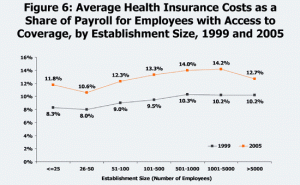
The House plan for health reform has an employer mandate for employers with a payroll of $250,000 or more(pdf).  Businesses with a payroll for $400,000 or more must either provide health insurance, or pay 8% of payroll to “subsidize” health care for their employees.

Take a look at the graph on the right hand side. It’s a little out of date (2005) but it shows payroll percentage costs of insurance.  The numbers are higher than the government numbers, because it only includes companies which do provide insurance and doesn’t average costs in of employees they don’t provide insurance for.

In other words, as of 2005, this was the cost of actually providing insurance for employees.  Since then it’s only gone up, rising faster than inflation.  You’ll notice, that for companies of all sizes, it’s more than 8%, although this doesn’t include the value of any tax deductions to the companies.

The costs do vary by size, both because smaller pools of employees tend to cost more (because variability of claims varies more the smaller the pool) and because larger firms tend to have better plans (the latter seeming to outweigh the former, to my surprise).

This will change as time goes on. The House plan will eliminate discrimination by size, which should decrease costs for smaller employers, but it will also mandate the minimum acceptable plan characteristics, which will probably raise their costs. No matter what the case, however, what’s clear is that from a pure price perspective, for most employers, dropping their health coverage and paying the 8% “subsidy” is the price effective option.  This is especially true since, while a flat 8% is automatically indexed to inflation, if health care costs continue to rise faster than inflation, and I expect they will, despite various efforts to contain them, the bottom line calculus each year will become even more favorable to dropping coverage.

The end result of this will be that more and more employers will simply drop their insurance plans and throw their employees onto the public insurance exchanges.  Assuming that the public option is cheaper and generally comparable to the private plans (not a sure thing, which I may discuss in a later post), this will mean that large numbers of people will wind up in the public plan.  Larger numbers, I think, than the current scoring expects.

Unless the public plan can reduce costs to what would be 8% or less of payroll, this means the cost of the public plan may be higher than expected, and since the private companies shedding their insurance plans won’t be making up the difference (8% being less than their own costs) that means premiums will also be higher than one might otherwise like.

Since companies won’t be (as far as I can tell) forced to return the difference in what they were paying in insurance to employees, that means employees will very likely be more out of pocket than they were before the plan.

And if that’s the case, support for the plan will collapse since at the end of the day people who used to have employer insurance will have less money in pocket than they did when the company was paying for it.

This scenario is what we would expect to play out of employers act in accordance with the incentives embodied in the plan, so I regard it as rather likely unless there are incentives I’m unaware of that would prevent it or if the tax benefits of providing private insurance are large enough to outweigh the additional costs.

This isn’t necessarily either a good or bad thing.  It could well lead to real single payor, for example.  What’s interesting is the question of whether it’s intentional or not.

Senate Democrats Against The Public Option Aren’t Caving They Just Don’t Belive In Real Universal Healthcare

Chris at Americablog wonders why some Senate Democrats are caving on healthcare when 72% want a public option and 85% think the system needs to be fundamentally changed. He thinks it’s because such Dems are spineless.  That fundamentally misunderstands the situation.  To vote against something that 72% of the population wants indicates a Congress member isn’t a panderer to public opinion.  What it indicates instead is that they either:

  • actually don’t believe in a public option, let alone real universal healthcare a la single payor; or,
  • are being paid enough by insurers and other folks who want the current healthcare gravy train to continue that they are willing to vote against what the majority of their constituents want.

Personally, I’d go with both.  They don’t believe in universal healthcare, and they know that their real constituents aren’t the people who vote for them but the people who fund their campaigns and make sure they, their friends and their families are taken care of.  And no, they don’t think that’s you, the voter and taxpayer.

They don’t believe they won’t be reelected if they vote against a public option.  And given re-election rates of Senators, who are the people causing the most problem, they’re probably right, aren’t they?  Their calculation is that voters are sheep and won’t make them pay any real price for killing a good healthcare plan.

I’d say they’re right.  So given that they probably don’t believe in universal healthcare, that they don’t personally need it since they have good healthcare, that they get paid to vote against it and that they’ll pay no price for voting against it, why shouldn’t they kill it?

Seems like a brain dead calculation to me.  I’m sure it does to Diane Feinstein too.  As another entitled aristocrat once said “let them eat cake”.

Senate Finance Committee: We’re Going to Make You Buy Bad Insurance With No Public Option

winged_caduceusSeriously, this is just pathetic:

1) Lower the medicaid coverage rate from 150% to 100% of the Federal poverty line, 133% for kids and pregnant women (once you have the baby, too bad for you)
2) Subsidies stop at 300% of the poverty line (was 400%)
3) No Public Option mentioned
4) Insurance exchanges at the State level
5) Must buy insurance unless it costs more than 15% of your income
6) A fine if you don’t buy insurance unless you’re below the Federal poverty line

For the most part, as Walker discusses, this is actually identical to or slightly worse  than the plan put forward by America’s Health Insurance Plans (AHIP).  Yes, worse than the insurance industry’s plan.  Remarkable.  Baucus is really earning his campaign donations these days.

Of course, this is only one proposal, and in principle others from the House and other Senate committees could be better, and the better ones could be enacted.  Obama has said he wants a public option, and he may whip for it.

But, if something like this is what comes out as the eventual “reform” it is worse than nothing.  Being forced to buy bad insurance, with huge co-pays without a public option to keep prices in check has as its primary value that it is a subsidy for the insurance companies and that it reduces catastrophic healthcare costs for hospitals, because due to forced purchases of bad plans, some of the folks who used to come in at the last minute, after having not gotten care, and then costing the hospital hundreds of thousands of dollars in emergency care, will be partially paid for.  They’ll still come in last minute and not have been properly cared for since the deductibles will mean they didn’t get help, but 70% or 80% of their final death-rattle costs will be paid for.

The problem with this plan is that it won’t control costs.  Without a public option, the insurance companies will have no check on their prices, let alone pressure to actually reduce them.  Because people will be forced to buy bad insurance, they’ll hate the plan, and because “reform” has been passed, we’ll have to wait another 10 or 12 years for another shot.

Obama desperately wants to pass health care “reform”.  The fear is that he may take the easy road, and pass any bill that is “better than nothing”, and that progressives will once again accept the logic that it’s better to get something rather than fight for an actual good bill.

But because Obama does desperately want to pass something, if progressives stand firm in the House or the Senate, and refuse as a bloc to pass anything without a good public option, nothing can pass unless Republicans cross the aisle, which is rather unlikely.

So the answer is to stop being taken for granted.  Stand up for and demand a public option, and refuse to accept a bill which does less.  Don’t let Obama have a cheap victory; a cheap “medicare reform”.  If he wants it, make him whip for a real bill, a good bill, with a public option.  He whipped for money to bail out banks in Eastern Europe.  He whipped for TARP.  He can whip for a good healthcare bill.  And it won’t even cost 700 billion.

Page 34 of 35

Powered by WordPress & Theme by Anders Norén