The horizon is not so far as we can see, but as far as we can imagine

Author: Tony Wikrent Page 48 of 49

Veblen’s Idea of Business Versus Industry

THIS POST IS BY TONY WIKRENT
I had wanted to reply to comments in the thread of Economics as Cultural Warfare: The Case of Adam Smith, where Bruce Wilder makes an important correction to my view of Smith: “Smith’s central argument rather famously is that the division of labor is the primary source of wealth!” Which of course is perfectly true, given that one of Smith’s most famous passages is that describing the impressive productivity of the machines Smith found in a pin making factory.

But my design is to utterly annihilate any respect for Adam Smith by showing that he is little more than an apologist for the imperial looting, immiseration, and devastation the British empire exacted on its colonial subject populations. In my world view, there is nothing about any apologist for the British empire that is worth salvaging. Was it possible that here was an anomaly for which I would have to bend my rules?

As I pondered this over the past week, I realized that tossing Smith’s division of labor argument into the trash bin of history is more easily accomplished by referencing the arguments made by Thorstein Veblen regarding the differences between business and industry. I was not very surprised to find that I could find nothing on the internet about Veblen’s argument worth linking to. Veblen has always been  persona non grata in the mainstream economics profession — which means he probably has gored one or more of the profession’s sacred cows. Which of course makes Veblen all the more attractive in our day, when the stench of the intellectual rot among economic academicians has reached an overpowering level. Modern Monetary Theory may have some weaknesses and faults, but I would rather have it blowing through the academy to dispel as much of the bad air as it can, than leaving the brain dead body to continue rotting and fouling the air.

Researching my attack on Smith, I had taken off my bookshelf Joseph Dorfman’s The Economic Mind in American Civilization. I now opened Dorfman’s book again to see what he had written about Veblen. I was surprised but delighted to find the best summary I had yet read of Veblen’s separating business from industry. In case readers don’t know it, Dorfman wrote a book in 1935 entitled Thorstein Veblen and His America. And what readers certainly do not know is that the descendants of Veblen loathed the book, and spent years trying to persuade, then force, Dorfman to change the book, mostly the parts in which he described Veblen’s personal traits and peccadilloes, including the controversies Veblen stirred up at every university that ever hired him. Veblen’s descendants were unsuccessful. The source for this is Jon Larson, who worked with Veblen’s descendants in the restoration of the Veblen farm.

Despite this sad history, Dorfman’s explanation of Veblen’s ideas on the differences between business and industry are extremely useful today. I hope to see in the comments someone expressing their “eureka” moment — yes, let us bury Adam Smith once and for all, and never hear of him again.

Below excerpted from Chapter XIX, “The Disturbing Voice of Thorstein Veblen,” The Economic Mind in American Civilization, Joseph Dorfman (Viking Press, 1949). 

Week-end Wrap – Political Economy – March 31, 2019

Strategic Political Economy

[Vox, via Naked Capitalism 3-29-19]

The most puzzling critiques have come not from Republicans, but from the center left, broadly speaking. They urge policies to reduce greenhouse gases that are perfectly commensurate with the GND framework … but present them as alternatives to the GND framework. (We’ll look at some examples later.)

The connecting theme, the message, sometimes implicit and sometimes explicit, is this: move more slowly. Accept piecemeal progress rather than a big thing. Don’t push beyond strict carbon policy into social or economic policy….

The only way Democrats can hope to pass any legislation — not big legislation, any legislation — is by radically shaking up the status quo balance of powers. That would mean getting rid of the filibuster, possibly granting statehood to Washington, DC, and Puerto Rico, reforming the electoral college and voting laws, and possibly expanding the Supreme Court.

Every piece of that reform agenda is big, risky, and unlikely to succeed, and at the end of it there would still be an enormous struggle over climate legislation (even getting 51 Democratic senators to be bold is a challenge). If you were in Vegas, you’d bet against any of this happening.

But let’s be clear: The alternative is not small, sensible, bipartisan steps, as so many pundits and pols are promising. The alternative is nothing. And on climate change, nothing means disaster. Those who would ask us to resign ourselves to disaster should, at the very least, frankly acknowledge the implications.

Incrementalism only works with willing partners on the other side, and there are none. (Emphasis in original)

This last is exactly what Brad DeLong said in an interview at the end of February: A Clinton-era centrist Democrat explains why it’s time to give democratic socialists a chance:

We were certainly wrong, 100 percent, on the politics. Barack Obama rolls into office with Mitt Romney’s health care policy, with John McCain’s climate policy, with Bill Clinton’s tax policy, and George H.W. Bush’s foreign policy. He’s all these things not because the technocrats in his administration think they’re the best possible policies, but because [White House adviser] David Axelrod and company say they poll well.

And [Chief of Staff] Rahm Emanuel and company say we’ve got to build bridges to the Republicans. We’ve got to let Republicans amend cap and trade up the wazoo, we’ve got to let Republicans amend the [Affordable Care Act] up the wazoo before it comes up to a final vote, we’ve got to tread very lightly with finance on Dodd-Frank, we have to do a very premature pivot away from recession recovery to “entitlement reform.”
All of these with the idea that you would then collect a broad political coalition behind what is, indeed, Mitt Romney’s health care policy and John McCain’s climate policy and George H.W. Bush’s foreign policy.

And did George H.W. Bush, did Mitt Romney, did John McCain say a single good word about anything Barack Obama ever did over the course of eight solid years?
No, they fucking did not. No allegiance to truth on anything other than the belief that John Boehner, Paul Ryan, and Mitch McConnell are the leaders of the Republican Party, and since they’ve decided on scorched earth, we’re to back them to the hilt. So the politics were completely wrong, and we saw this starting back in the Clinton administration.

Today, there’s literally nobody on the right between those frantically accommodating Donald Trump, on the one hand, and us on the other.

Re: The Green New Deal: First, Shoot the Economists
CounterPunch 3-29-19 [via Jon Larson]

Not content with having acted as apologists for rapidly accumulating environmental crises, economists are now coming out of the woodwork to give their advice on the limitations of any transition program. In the first, the claim is that ‘we’ can’t afford one. In the second, it is that even if we could afford such a program, it would cause inflation. Both assertions proceed from the premise that Western capitalism is a neutral basis from which to proceed….

The affordability argument is a canard: capitalists have already absconded with the “profits” that make a Green New Deal necessary. These profits are either equal to or greater than the cost of cleaning up the environmental mess they created, or the totality of profits is less than their cost in terms of environmental destruction. In the prior, the Green New Deal is affordable. Capitalists have already proven it is by putting its costs in their own pockets. In the latter, three centuries of capitalist production have been a net loser once environmental costs are considered.

Economics as Cultural Warfare: The Case of Adam Smith

Tony Wikrent [Real Economics 3-28-19]

Adam Smith was the voice of the British establishment and the newly minted British commercial oligarchy which vehemently opposed the idea that the United States should attempt to be anything other than producers and suppliers of basic agricultural commodities.

by James K. Galbraith [American Affairs Journal, Volume II, Number 4 (Winter 2018): 79–86.]

Book review of Money and Government: The Past and Future of Economics, by Robert Skidelsky (Yale University Press, 2018)

In the twentieth century, with the gold standard in retreat, Wicksell and Fisher developed the quantity theory of money—more precisely a quantity of money theory of inflation. What really mattered was not the substance of money but control over how much of it there was. Good control would keep prices stable and debts good. Monetarism, the descendant doctrine of Milton Friedman, would triumph at the Federal Reserve with the arrival of Paul Volcker in 1979, even though Volcker was not himself committed to the theory. Chaos and recession ensued, and monetarism was abandoned in the world debt crisis of 1982. Truly nothing changes and very little is learned, over centuries, in economics….

Skidelsky treats these great monetary battles primarily as struggles over ideas. Yet he is aware that behind ideas lie interests, and that the division of economic ideas into binary oppositions reflects the class opposition between creditors and debtors–one dominant and the other oppressed, but each always necessary to the existence of the other. The fact that ideas follow the interests that can pay for them accounts for much of the recurrence of spurious and indefensible ideas in economic thought. Skidelsky, however, is above all a historian of ideas, so this book is cast largely as an account of ideologies and intellectual debates and not of class struggles. There is no doubt, moreover, that some of the most meretricious zealots in the long history of economists’ service to power and wealth were also among the most fiendishly clever…. In the center and on the right, the field is peopled by pompous mediocrities occasionally exposed as such–as in the film Inside Job. They hold their positions only through the interlocking tribalism of American academic life….

But the facts point to an intractable problem: those whose attention cannot be shifted by the collapse of their own worldview are simply beyond reach. This is a problem for the universities, who are stuck with entire departments of stranded intellects, enclosed upon themselves, well-funded by outside sponsors, and a danger to the sound instruction of students and to the future of the world. In the decade since the financial crisis, not one so-called top economics department has hired a single senior professor who had accurately foretold the calamity to come. It should be evident, by this point, that this is not accidental.

[Asia Times, via Naked Capitalism 3-30-19]

The US quest to “contain” China is becoming a lonely one, and for good reasons. Pressuring allies to bar Chinese telecommunications giant Huawei from their fifth-generation (5G) networks could set back their telecom architecture by at least a year or two and cost them billions of dollars. Preventing allies from joining China’s Belt and Road Initiative (BRI) is to demand that they ignore their national interests.

It might be for these reasons that four major European leaders – Prime Minister Giuseppe Conte of Italy, President Emmanuel Macron of France, Chancellor Angela Merkel of Germany and President Jean-Claude Juncker of the European Commission – have defied US President Donald Trump’s warnings on Huawei and the BRI.

Climate and environmental crises

Economics as Cultural Warfare: The Case of Adam Smith

**This Piece Is By Tony Wikrent**

Practical men who believe themselves to be quite exempt from any intellectual influence, are usually the slaves of some defunct economist.—John Maynard Keynes

For over a century now, professional economists have taught that the ideas on which the US economy was built were those of Adam Smith.

I am going to debunk that, and I expect it will cause some people to freak out. For some reason there are many educated people in the US who take it as a personal affront to attack Adam Smith. It’s not that hard to understand–they have had “successful” (read: well remunerated) professional careers based on the fundamentals they were “taught” (read: indoctrinated with) in college. Adam Smith, as the Brahma of modern “scientific” economics, is one of those fundamentals. So allow me to begin by presenting what one of the recognized giants of professional economics thought about Adam Smith.

Joseph Schumpeter, one of the most influential economists of the twentieth century, in his last book (which was never finished) History of Economic Analysis (pdf), conceded the importance of Smith’s work, while also eviscerating it (pages 171-184). Schumpeter basically damned Smith’s actual ideas with faint praise, while acknowledging that Smith obtained enormous influence as a peddler of specific economic doctrines. (Much like Milton Friedman and his neoliberal Freedom to Choose of our current national nightmare.)

Schumpeter begins his evaluation of Smith by noting that Sir James Steuart‘s An Inquiry into the Principles of Political Economy (1767) had “more originality and deeper thought than does the Wealth of Nations.” So, why do we remember Smith today, and not Steuart? Schumpeter concluded that Steuart “was never much of a success in England,” as a result of the elite disfavor Steuart faced for being a Jacobite (an adherent of restoring the Catholic Stuarts to the throne of the United Kingdom). In fact, Steuart was forced to live in exile from 1745 to 1763.

Schumpeter then noted that Adam Smith’s greatest contemporaneous academic achievement was not Wealth of Nations,but A Dissertation on the Origin of Languages, which was appended to the 1767 third edition of the Theory of Moral Sentiments. “Moreover,” wrote Schumpeter, “Smith’s philosophy of riches and of economic activity is there and not in the Wealth of Nations…. the Wealth of Nations contained no really novel ideas and… it cannot rank with Newton’s Principia or Darwin’s Origin as an intellectual achievement…”

Schumpeter concluded that Adam Smith’s undeniable success in Great Britain was due to English elites’ favor for “the policies he advocated–free trade, laissez-faire, colonial policy, and so on.” In other words, Adam Smith was crowned with success for being a prominent apologist for the exploitative brutality of the British empire:

….it was Adam Smith’s good fortune that he was thoroughly in sympathy with the humors of his time. He advocated the things that were in the offing, and he made his analysis serve them. Needless to insist on what this meant both for performance and success: Where would the Wealth of Nations be without free trade and laissez-faire? Also, the ‘unfeeling’ or ‘slothful’ landlords who reap where they have not sown, the employers whose every meeting issues in conspiracy, the merchants who enjoy themselves and let their clerks and accountants do the work, and the poor laborers who support the rest of society in luxury–these are all important parts of the show. It has been held that A. Smith, far ahead of his time, braved unpopularity by giving expression to his social sympathies. This is not so. His sincerity I do not for a moment call into question. But those views were not unpopular. They were in fashion.

In fact, as Smith biographer Salim Rushid details, Adam Smith very carefully and deliberately went about currying favor with Scottish and English ruling elites. Rushid writes”

Smith’s involvement in politics was neither marginal nor ineffective. Strange as it may sound, in today’s parlance he would have been called “street-smart.” He was considered a good judge of what would sell; despite the radicalism of his personal sympathies, Smith tailored his views and his life to be acceptable to the established order. There is little surprise in finding that this cultivation bore fruit and that Smith’s ideas proved serviceable in the defense of conservatism.

Elsewhere, Rushid writes, that during his time: “Adam Smith was not hailed as a new prophet except by some few, but very influential, persons such as Lord Shelburne and William Pitt.” Adam Smith was merely a paid apologist for the ruin and misery Great Britain imposed on millions of colonial people in Ireland, Africa, China, India, and elsewhere. As Philippine economic historian Erle Frayne Argonza wrote in September 2008:

To continue on the theme of laissez faire, a doctrine started by the French physiocrats and systematized further by the Scots, let it be known that the principle of ‘free trade’ generated by physiocracy was largely a doctrinal defense of slave trade…Adam Smith was an ‘intellectual prostitute’ whose services were procured by the British East India Company, precisely for the purpose of crafting in theoretical form the ‘free trade’ doctrine that was to justify, though subtly, the slave trade of that historic juncture.

Schumpeter also very briefly, and very significantly, noted: “that which I cannot help considering relevant, not for his pure economics of course, but all the more for his understanding of human nature–that no woman, excepting his mother, ever played a role in his existence…” In 2012, Katrine Marçal, lead editorial writer for the Swedish newspaper Aftonbladet, published Who Cooked Adam Smith’s Dinner? (English translation: Pegasus Books, 2016), based on one of the most famous sentences in Wealth of Nations: “It is not from the benevolence of the butcher, the brewer, or the baker that we expect our dinner, but from their regard to their own interest.” One reviewer, Ed Walker, Assistant Attorney General of Tennessee for consumer protection and securities, explained how the question posed by Marçal devastated Adam Smith’s economic ideas, and all systems of economics based on them.


Week-end Wrap – Political Economy – March 24, 2019

**This post is by Tony Wikrent**

Economies Adding the Most to Global Growth in 2019
Barry Ritholtz [The Big Picture  3-19-19]

‘Full-Time Freelance’ Is Just the Industry Standard

[Splinter News 3-14-19]

On Monday, David Tamarkin, the site editor at Epicurious, a Condé Nast food publication, tweeted out a job posting for an editorial assistant. The position, Tamarkin wrote, was “full-time freelance,” meaning the person filling the job would work 40 hours a week and perform the duties of a full-time employee. After two days of online outrage and backlash, including users virtuously snitch-tagging the New York State Department of Labor, Tamarkin tweeted on Wednesday that the position would indeed be eligible for benefits.

Wage growth for low-wage workers has been strongest in states with minimum wage increases

[Economic Policy Institute 3-18-19]

Low-wage workers in states that increased the minimum wage between 2013 and 2018 experienced wage growth at a rate 50 percent faster than those in states with no minimum wage increases. Check out EPI’s new interactive map to see the count of workers in each congressional district that would receive wage increases if Congress passes the Raise the Wage Act of 2019.

Record U.S. trade deficit in 2018 reflects failure of Trump’s trade policies
By Robert E. Scott [Economic Policy Institute 3-18-19]
California Jury Finds Roundup Caused Man’s Cancer
[NPR 3-19-19]

A San Francisco federal jury unanimously agreed on Tuesday that Roundup caused a man’s cancer — a potentially massive blow to the company that produces the glyphosate-based herbicide currently facing hundreds of similar lawsuits…. The verdict is the second in the U.S. to find a connection between the herbicide’s key ingredient, glyphosate, and the disease. In August, another San Francisco jury determined Roundup had caused cancer in a former groundskeeper. It also decided Monsanto, the company that developed the popular weed killer, deliberately failed to warn consumers or regulators about the product’s risks.


Monsanto’s Weed Killer is “Substantial Factor” in Cancer, Says Jury

[Spinter News 3-22-19]

Monsanto is about to face 11,200 more trials over the potential carcinogen in Roundup, which has prompted legislation to limit the chemical’s use

Executives in custody as China chemical plant explosion death toll reaches 47, with 640 injured

[South China Morning Post, via Naked Capitalism 3-22-19]
Lambert Strether notes: “Oddly, or not, there seems to be no talk of arresting the executives responsible for the petrochemical fire in Houston.”

Disrupting mainstream economics

Week-end Wrap – Political Economy – March 17, 2019

**This Post Is By Tony Wikrent**

Strategic Political Economy

How Swedes and Norwegians Broke the Power of the ‘One Percent’

[Films for Action, via Naked Capitalism 3-14-19]

By 1935, Norway was on the brink. The Conservative-led government was losing legitimacy daily; the 1 percent became increasingly desperate as militancy grew among workers and farmers. A complete overthrow might be just a couple years away, radical workers thought. However, the misery of the poor became more urgent daily, and the Labor Party felt increasing pressure from its members to alleviate their suffering, which it could do only if it took charge of the government in a compromise agreement with the other side.

This it did. In a compromise that allowed owners to retain the right to own and manage their firms, Labor in 1935 took the reins of government in coalition with the Agrarian Party. They expanded the economy and started public works projects to head toward a policy of full employment that became the keystone of Norwegian economic policy. Labor’s success and the continued militancy of workers enabled steady inroads against the privileges of the one percent, to the point that majority ownership of all large firms was taken by the public interest. (There is an entry on this case as well at the Global Nonviolent Action Database.)

The one percent thereby lost its historic power to dominate the economy and society. Not until three decades later could the Conservatives return to a governing coalition, having by then accepted the new rules of the game, including a high degree of public ownership of the means of production, extremely progressive taxation, strong business regulation for the public good and the virtual abolition of poverty. When Conservatives eventually tried a fling with neoliberal policies, the economy generated a bubble and headed for disaster. (Sound familiar?)

Labor stepped in, seized the three largest banks, fired the top management, left the stockholders without a dime and refused to bail out any of the smaller banks. The well-purged Norwegian financial sector was not one of those that lurched into crisis in 2008; carefully regulated and much of it publicly owned, the sector was solid.

The Birth of Predatory Capitalism: How the Free World Took Four Giant Leaps to Self-Destruction
[Medium, via Mike Norman Economics 2-10-19]

Economics in the real world

“Lawmakers who supported the ban said cashless stores were unintentionally discriminating against people in the community who don’t have debit or credit cards, since they would be unable to make purchases. Cash is also an appealing choice for people who want to keep their purchasing history private from retailers, credit card companies, or perhaps even spouses. It also negates any potential risks, in the event a company is breached and customer information is leaked to hackers. While cash and coins are legal tender, there is no federal law that requires businesses to accept them, according to the Federal Reserve’s website.”

Why not make this a Federal law?

Why the Amazon River Can’t Be Crossed By Bridge

[Conde Nast Traveller, via Naked Capitalism 3-13-19]

“[T]he Amazon is the world’s longest river not crossed by any bridges… For most of its length, the Amazon isn’t anywhere close to too wide to bridge—in the dry season. But during the rainy season, the river rises thirty feet, and crossings that were once three miles wide can balloon to thirty miles in a matter of weeks. The soft sediment that makes up the river bank is constantly eroding, and the river is often full of debris, including floating vegetation islands called matupás, which can measure up to 10 square acres. It’s a civil engineer’s worst nightmare. But the real reason for the lack of bridges is simply this: the Amazon Basin has very few roads for bridges to connect.”

‘They Never Stopped, Ever’: Here Are Some of Your Student Loan Horror Stories

[Splinter News 3-16-19]

Earlier this week, in the aftermath of the college admissions scandal, I wrote about my own experience with college and student loans. After that post, many of you emailed me and relayed your own heartbreaking and ridiculous stories about student loans, and the shit you’ve put yourself through to pay…

What the Hell Actually Happens to Money You Put in A Flexible Spending Account? 

Week-end Wrap, March 10, 2019

This Post Is By TONY WIKRENT

Economics Action Group, North Carolina Democratic Party Progressive Caucus

Seattle General Strike: Labor’s Most Spectacular Revolt

[Labor Notes, via Naked Capitalism 3-4-19]

“On February 6, 1919, Seattle’s workers struck–all of them. In doing so, they took control of the city. The strike was in support of 35,000 shipyard workers, then in conflict with the city’s shipyard owners and the federal government’s U.S. Shipping Board, which was still enforcing wartime wage agreements. The strike rendered the authorities virtually powerless. There was indeed no power that could challenge the workers. There were soldiers in the city, and many more at nearby Camp Lewis, not to mention thousands of newly enlisted, armed deputies—but to unleash these on a peaceful city? The regular police were reduced to onlookers; the generals hesitated. Seattle’s Central Labor Council, representing 110 unions affiliated with the American Federation of Labor (AFL), called the strike. The CLC’s Union Record reported 65,000 union members on strike—a general strike, the first and only of its kind in the U.S. Perhaps as many as 100,000 people participated.”

Wow. Imagine crippling the elites, and all anyone had to do is — just stay home.

[GoErie, via Naked Capitalism 3-8-19].

“Wabtec, which absorbed GE Transportation as a wholly-owned subsidiary on Feb. 25, and the union, which represents about 1,700 employees at the Erie plant [which manufactures railroad locomotives], have agreed to a 90-day deal that’s intended to give the two parties time to negotiate a longer collective bargaining agreement. Signs of the strike — tents, burn barrels, piles of firewood and stacks of strike signs — were quickly cleaned up Thursday morning by union workers who had spent nine days patrolling the vast perimeter of the Lawrence Park locomotive plant…. Wages are high on that list. While Wabtec has agreed to continue paying existing workers at their current pay scale — an average of $35 an hour — the company’s earlier proposal called for paying new employees and those called back to work what “a competitive wage scale” of $16.75 to $25 an hour.”

Disrupting Mainstream Economics

The Failures of Neoliberalism Are Bigger Than Politics
Mike Konczal [Roosevelt Institute, via Mike Norman Economics 3-9-19]

Mike Norman: This is a really good article on how neoliberalism brought about the complete opposite of what they said it would. They said that there maybe a bit more inequality, but overall, most people would become better off as companies would be become more innovative and therefore more profitable.

The second was also a sense that if the government took shackles off of business, they would innovate and grow our way out of social problems. Relaxation of antitrust enforcement would lead to more competition and innovation, as was told. Unions would no longer get in the way of businesses. An unleashed financial sector would fund and lead the entire enterprise. The idea of market power, or concentration, were seen as laughable concepts stacked against the disciplining power of markets themselves.
We saw what happened with the financial sector. But there are two broader things that happened alongside it. First, at the level of individual firms, is that firm dynamism has fallen dramatically. The rate of business startups has fallen. In turn, this has shifted the age curve of businesses further out, with firms over 11-years-old accounting for 70 percent of workers in 2000 but 75 percent of workers in 2014. Labor market dynamism has fallen as well, with workers less likely to quit and move their jobs over the past two decades.

But what is most telling is the effect on the economy overall. Tobin’s Q is a measure of equity over the book value of a firm. If it is ever over 1, it means that firms are too profitable and they should invest more to bring it down back to 1. Tobin’s Q has doubled to well over 1 and shows no sign of slowing down. More broadly, there are several other puzzles that, taken together, point to extensive market power in the economy. As economist Gauti Eggertsson and others have summarized, there’s been a sustained increase in markups, a decrease in the real rate of interest, falling by roughly half since 1980, even while the measured average return on capital is relatively constant, and a break in the link between profits and investments. Another way to look at it: Corporate profits remain high, even as real interest rates have declined over the past several decades. That profits remain so high in nominal terms even as interest rates decline has brought economists to discuss a “profit share”that has increased at the expense of both capital and labor share. All of these factors together—high markups and profits, low interest rates, weak investment—point to a significant market power problem that impacts the macroeconomy.

Portugal Dared to Cast Aside Austerity. It’s Having a Major Revival.

[NYT, via Naked Capitalism 3-4-19]
[Kontrast, via Naked Capitalism 3-3-19]

Considering the booming economy, dropping unemployment numbers and the return of many once-emigrated young Portuguese citizens, it seems Portugal is on the rise. Facing the policies of socialist Prime Minister António Costa, which include properly supporting the welfare state and investing in the public sector instead of austerity measures, right-wing populists don’t stand a chance.

Debunking Deregulation: Bank Credit Guidance and Productive Investment
[Evonomics, 2-19-19, via a reader]

In a new UCL Institute for Innovation and Public Purpose (IIPP) working paper, co-authored with Dutch economists Dirk Bezemer and Lu Zhang and Frank van Lerven, we examine the theoretical, historical and empirical evidence around credit policy and its effects on the allocation of credit.

Our motivation, aside from the crisis, is the remarkable ‘debt shift’ in advanced economies over the past 40 years which has seen banks move away from their primary textbook role of lending to non-financial firms to support productive investment. Whilst total bank credit has roughly doubled relative to GDP since the early 1970s in advanced economies, the share of credit supporting firms has actually fallen, from 60% to 40%. The vast expansion in lending has been mainly to support households to buy houses and, to a lesser extent, consumer goods and the purchase of financial assets.

Mortgage and other asset-market lending typically does not generate income streams sufficient to finance the growth of debt. Instead, the empirical evidence suggests that after a certain point relative to GDP, increases in mortgage debt typically slows growth and increase financial instability as asset prices rise faster than incomes.

These new empirical findings support a much older body of theory that argues that credit markets, left to their own devices, will not optimise the allocation of resources. Instead, following Joseph Schumpeter’s, Keynes’ and Hyman Minsky’s arguments, they will tend to shift financial resources away from real-sector investment and innovation and towards asset markets and speculation; away from equitable income growth and towards capital gains that polarises wealth and income; and away from a robust, stable growth path and towards fragile boom-busts cycles with frequent crises….

The financial liberalisation and deregulation of the 1980s saw the gradual removal of credit guidance and credit control policies which were seen to distort the efficient allocation of capital. This was a key element of the ‘Washington Consensus’ pushed by the World Bank and the IMF to developing countries. Many State Investment Banks were also privatised.

Our empirical investigation of the relationship between credit policy and credit allocation examines two time periods with different samples. Firstly, for the 1973 to 2005 period, for advanced economies, we find that the liberalisation of credit markets and removal of credit guidance is significantly associated with a lower share of lending to non-financial firms, supporting the Schumpeter-Keynes-Minsky hypothesis.

A Look Back at How Reforming Wall Street Failed So Miserably Under Obama
Pam Martens, March 7, 2019 [Wall Street on Parade]

Dean Baker [via Naked Capitalism 3-5-19]
Pam Martens, March 6, 2019 [Wall Street on Parade]

When you’ve studied stock market charts for three decades, you can’t help but notice that something very peculiar has been happening to the U.S. stock market in recent years. Rather than taking off at the opening bell and holding an upward bias or a downward bias for the balance of the trading day – the way stock markets historically behave – the Dow Jones Industrial Average frequently spends the morning hours rotating between sharp upward spikes and big drops as if an invisible force (say an algorithm, for example, operating in the futures market) has the controls.

[Science Daily, via Naked Capitalism 3-8-19]

“The concept of equilibrium is one of the most central ideas in economics. It is one of the core assumptions in the vast majority of economic models, including models used by policymakers on issues ranging from monetary policy to climate change, trade policy and the minimum wage. But is it a good assumption? In a recently-published Science Advances paper, Marco Pangallo, Torsten Heinrich and Doyne Farmer from the University of Oxford, investigate this question in the simple framework of games, and show that when the game gets complicated this assumption is problematic. If these results carry over from games to economics, this raises deep questions about when economics models are useful to understand the real world.”

Strategic Political Economy

What goes up: are predictions of a population crisis wrong?
Darrell Bricker and John Ibbitson [The Guardian, via Mike Norman Economics 3-8-19]

Some good news, World population may peak at below 9 billion and then start to go down. As people become urbanized they don’t want so many children. In the field extra hands are useful, in a city an extra child is an extra mouth to feed. And women want careers and less children.

These remarks offer a window on one of the most compelling questions of our time: how many people will fill the Earth? The United Nations Population Division projects that numbers will swell to more than 11 billion by the end of this century, almost 4 billion more than are alive today. Where will they live? How will we feed them? How many more of us can our fragile planet withstand?

But a growing body of opinion believes the UN is wrong. We will not reach 11 billion by 2100. Instead, the human population will top out at somewhere between 8 and 9 billion around the middle of the century, and then begin to decline.

ørgenRanders, a Norwegian academic who decades ago warned of a potential global catastrophe caused by overpopulation, has changed his mind. “The world population will never reach nine billion people,” he now believes. “It will peak at 8 billion in 2040, and then decline.”Similarly, Prof Wolfgang Lutz and his fellow demographers at Vienna’s International Institute for Applied Systems Analysis predict the human population will stabilise by mid-century and then start to go down.

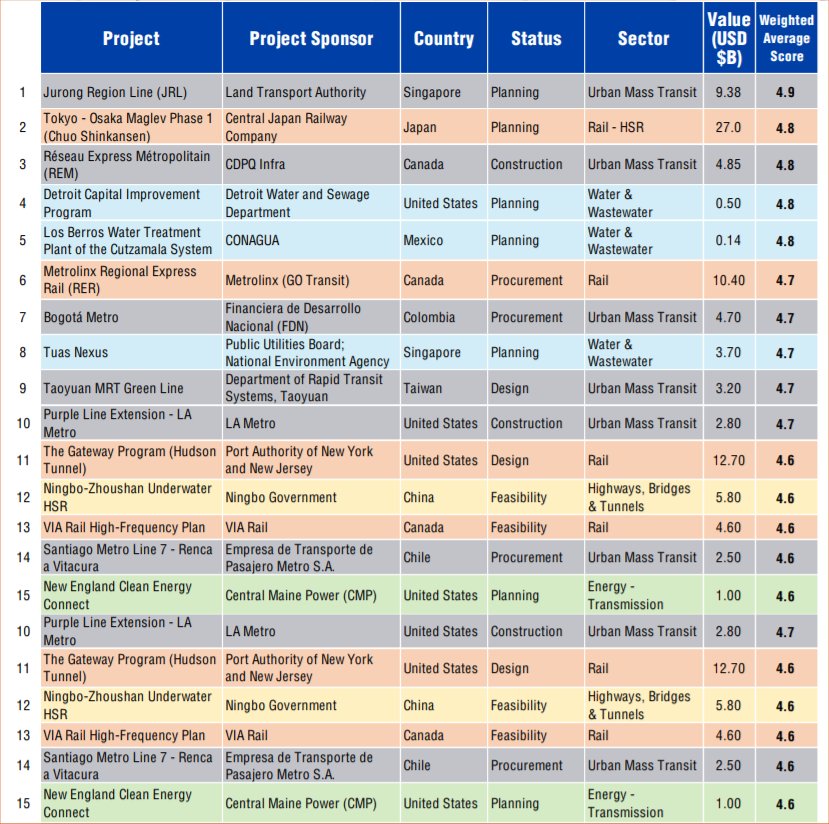
Strategic 100 Global Infrastructure List (pdf)
[via Railway Age 3-7-19]
A list of the 100 largest infrastructure projects in the world. The list includes projects from 30 countries. Compiled by CG/LA Infrastructure Inc., headquartered in Washington, D.C.

Black Agenda [ADOS – American Descendants of Slavery, via Naked Capitalism 3-4-19]

We demand a New Deal for Black America which includes, but is not limited to:

  • We need set asides for American descendants of slavery, not “minorities”, a throw-away category which includes all groups except white men. That categorization has allowed Democrats to use programs like affirmative actions as “giveaways” to all groups in exchange for votes. The bribery must end. That begins with a new designation on the Census with ADOS and another for Black immigrants. Black immigrants should be barred from accessing affirmative action and other set asides intended for ADOS, as should Asians, Latinos, white women, and other “minority” groups. In addition, ADOS hiring and employment data must be demanded for all businesses receiving tax credits, incentives, and governmental support. As well as all governmental agencies national, state and local. It is our belief that this will show that there are minimal if any ADOS professionals in fields including but not limited to engineering, medical, legal and tech.

Economics in the Real World

Barry Ritholtz, March 8, 2019 [The Big Picture]

The $4 trillion drop in Americans’ net worth in Q4 was the single largest quarterly dollar drop on record. As a comparison, the U.S. bear market losses from 2007-2009 = $11 trillion dollars. Markets are now 4X as large, so a 20% drawdown is a third as large as a the peak to trough GFC drop.

You can get this and all of the details from the Z.1 Financial Accounts of the United States:

“The net worth of households and nonprofits fell to $104.3 trillion during the fourth quarter of 2018. The value of directly and indirectly held corporate equities decreased $4.6 trillion and the value of real estate increased $0.3 trillion.”

[Washington Post, via Naked Capitalism 3-4-19]

Lambert Strether: “Obama’s miserably inadequate response to the foreclosure crisis is carefully airbrushed out.”

[Wall Street Journal, via Naked Capitalism 3-8-19]

…the country’s third-biggest liner. Kawasaki Kisen Kaisha Ltd. is shrinking its fleet as it faces an estimated $895 million in losses….The company hopes to save $90 million by canceling some container ship charters and trimming its bulk-vessel count, changes that come as the maritime sector struggles with weak freight rates and a capacity glut in major trade lanes. The shipping line also plans to slim its car-carrier network and focus on bigger dry-bulk vessels. “K” Line’s problems stem in part from its stake in Ocean Network Express, the joint venture with Japan‘s two other shipping lines formed to respond to broader shipping industry woes. ONE had a troubled launch last year, and stresses could grow next year as new emissions rules take effect.”

[The Wall Street Journal, via Naked Capitalism 3-4-19]

“Container ships move things as diverse as clothes, food, furniture, electronics and heavy-industry parts. In the years before the 2008 financial crisis, boxships fueled globalization. Demand for ocean trade rose as much as 8% annually and owners spent billions to buy more vessels. This created loads of excess tonnage that, at the current rate of new ship deliveries, will take at least two years to absorb. It also means that on top of higher fuel expenses, freight rates likely will continue to hover way below break-even levels across some of the biggest ocean trade routes. With China’s economy slowing and shipments taking a hit from the evolving trade war between Washington and Beijing, operators are already cutting their full-year forecasts. ‘We see clearly a global economic growth that is declining,’ Soren Skou, chief executive of A.P. Moller-Maersk AS, the world’s top container operator by capacity, told an investor conference call recently. ‘We see weaknesses, in particular, in China and Europe. We expect container demand growth to fall to 1% to 3% this year from 3.7% to 3.8% last year.’”

Climate and Environmental Crises

[Endocrine News, via Naked Capitalism 3-4-19]

In Sicker, Fatter, Poorer: The Urgent Threat of Hormone-Disrupting Chemicals to Our Health and Future … and What We Can Do About, Trasande exposes the chemicals that disrupt hormonal systems and damages human health in irreparable ways. He discusses where these chemicals hide as well as the workings of policy that protects the continued use of these chemicals in everyone’s lives. Drawing on extensive research and expertise, Trasande outlines dramatic studies and emerging evidence about the rapid increases in neurodevelopmental, metabolic, reproductive, and immunological diseases directly related to the thousands of chemicals the average person is exposed to every day. Unfortunately, we are all currently exposed to EDCs to some degree

Insect Apocalypse: New Study Reveals Stunning Decline in Insect Populations
[The Real News Network 3-6-19]

Dr. Francisco Sanchez-Bayo explains that, if current trends persist, insects could be essentially wiped out within 100 years.

[Wall Street Journal, via Naked Capitalism 3-8-19]

“The ocean is awash in tiny plastic particles shed by fleece jackets and other garments… highlighting how new concerns over pollutants are growing as production of polyester and other synthetics expands…. Textiles contribute 35% of primary microplastics released into the ocean, and research funded by companies like Hennes & Mauritz AB and Patagonia Inc. found that how the fibers are woven and clothes are washed matters. Prewashing garments before they are sold could capture a big share of pollution. H&M is looking at whether clothes can be designed to minimize shedding and says it’s monitoring the development of biodegradable fibers. Some state regulators are weighing labeling requirements, to the dismay of one industry group that says more study is needed.”

The Climate Denier Enablers
[The Real News Network 3-6-19]

Are the leaders of the Democratic Party paying lip service about climate change and creating conditions for a climate denier President to ignore the crisis? – with Jacqueline Luqman, Eugene Puryear, Norman Solomon and host Paul Jay.

No patient left behind

A First Look at Pramila Jayapal’s “Medicare for All Act of 2019”, HR 1384
Lambert Strether [Naked Capitalism 3-4-19]

Dem campaign chief: Medicare for All price tag ‘a little scary’

[The Hill, via Naked Capitalism 3-6-19]

“The House Democrats’ new campaign chief on Tuesday poured cold water on the progressive Medicare for All plan, dismissing it as just ‘one idea’ out there and warning that its estimated $33 trillion price tag was ‘a little scary.’ ‘The ‘Green New Deal’ is an idea. ‘Medicare for all’ is an idea. But there are many others that are out there,’ Rep. Cheri Bustos (Ill.), the chairwoman of the Democratic Congressional Campaign Committee (DCCC), said in an interview with The Hill.”

[The Intercept, via Naked Capitalism 3-7-19]
Lambert Strether: I ran this when it appeared in November 2018, but with HR1834 out, it’s worth a second look:

“‘We’re all focused on 2020,’ Lauren Crawford Shaver, a partner at Forbes-Tate who is helping to manage the [Partnership for America’s Health Care Future] campaign, recently told the National Association of Health Underwriters in a podcast produced by the group. Shaver, a former top staffer for the Hillary Clinton presidential campaign explained to the group that she is working to peel support away from the ‘Medicare for All’ bill sponsored by Sen. Bernie Sanders, I-Vt.”

Restoring Balance to the Economy

[Huffington Post, via Naked Capitalism 3-3-19]

If you have a cell phone, a credit card, or even if you just have a job, there’s a very good chance that you’ve been forced to sign away your right to sue your cell phone company, bank, or boss. Indeed, under the Supreme Court’s forced arbitration cases, your boss may order you to sign away your rights under penalty of termination.

On Thursday, Rep. Hank Johnson (D-GA) and Sen. Richard Blumenthal (D-CT) introduced legislation called the Forced Arbitration Injustice Repeal (FAIR) Act, which seeks to eliminate many forms of forced arbitration. Though versions of this bill have kicked around Congress for more than a decade — often under the name “Arbitration Fairness Act” — the FAIR Act stands out because of the broad coalition of lawmakers who now support it…. According to the Economic Policy Institute, workers and consumers are significantly less likely to prevail before an arbitrator than before a real judge, and they are awarded significantly less money when they do prevail.

[Fast Company, via Naked Capitalism 3-4-19]

“Thanks to a new Vermont law requiring companies that buy and sell third-party personal data to register with the Secretary of State, we’ve been able to assemble a list of 121 data brokers operating in the U.S. It’s a rare, rough glimpse into a bustling economy that operates largely in the shadows, and often with few rules…..”

“All that data can be used to target you with ads, classify the riskiness of your lifestyle, help determine your eligibility for a job. Like the companies themselves, the risks can be hard to see. Apart from the dangers of merely collecting and storing all that data, detailed (and often erroneous) consumer profiles can lead to race or income-based discrimination, in a high-tech version of redlining. Piles of personal data are flowing to political parties attempting to influence your vote and government agencies pursuing non-violent criminal suspects. Meanwhile, people-search websites, accessible to virtually anyone with a credit card, can be a goldmine for doxxers, abusers, and stalkers. (The National Network to End Domestic Violence has assembled a guide to data brokers.)”

Barry Ritholtz, March 6, 2019 [The Big Picture]

Facebook’s new move isn’t about privacy. It’s about domination

[Guardian, via Naked Capitalism 3-8-19]
[Business Insider, via Naked Capitalism 3-8-19]
Spencer Soper, March 7, 2019 [Bloomberg, via Naked Capitalism 3-8-19]

The abrupt cancellation of orders prompted panic this week at the ShopTalk retail conference that drew more than 8,000 retailers, brands and consultants to Las Vegas. Some attendees said Amazon stopped submitting routine orders last week for a variety of products, often without explanation. The drought continued this week, affecting more vendors and leaving them frustrated about the lack of communication from Amazon.
One vendor who has been selling products to Amazon for five years said he got a canned response when he inquired why his routine weekly purchase order never came through. The response gave him no clarity about his standing as a vendor, he said.

Elizabeth Warren’s new plan: Break up Amazon, Google and Facebook
[CNN, via Naked Capitalism 3-8-19]

“The proposal was greeted with a cheer from New York State Sen. Julia Salazar, a Democratic Socialist ally of freshman Rep. Alexandria Ocasio-Cortez and a vocal opponent of New York’s deal to bring Amazon’s second headquarters to Queens… The plan would pose existential threats to the business models that turned certain giant tech firms into money spigots…. Separating Google’s ad business from its Search function, for example, would make Google ads — on which the company depends for nearly all of its revenue — much less valuable. So would requiring Google to divest DoubleClick, the company it acquired in 2008 that vastly expanded the reach of its advertising network.”

Warren’s actual proposal:
Here’s how we can break up Big Tech
Elizabeth Warren [Medium, via Naked Capitalism 3-8-19]

In this tradition, my administration would restore competition to the tech sector by taking two major steps: First, by passing legislation that requires large tech platforms to be designated as “Platform Utilities” and broken apart from any participant on that platform… Second, my administration would appoint regulators committed to reversing illegal and anti-competitive tech mergers….

As these companies have grown larger and more powerful, they have used their resources and control over the way we use the Internet to squash small businesses and innovation, and substitute their own financial interests for the broader interests of the American people. To restore the balance of power in our democracy, to promote competition, and to ensure that the next generation of technology innovation is as vibrant as the last, it’s time to break up our biggest tech companies.

[Business Insider, via Naked Capitalism 3-9-19]

Her proposal threatens to put a spotlight on those companies and their business practices, one that could expose them to reputational harm.

Moreover, it represents an attempt to gain support for a rethinking of antitrust policy, one in which regulators scrutinize the effects of concentrated corporate power on things other than just consumer prices.

Amazon, Facebook, and Alphabet’s power looks benign if viewed only from the lens of consumer prices.

Their power looks much worse if its broader effects are taken into account.

[The Economic Times, via Naked Capitalism 3-4-19]

In its draft National E-Commerce Policy, India has proposed regulating cross-border data flows, locating computing facilities within the country to ensure job creation and setting up a dedicated ‘data authority’ for issues related to sharing of community data.  It has asserted that the data generated in the country is a national asset, and citizens and the government have a sovereign right over it.

[South China Morning Post, via Naked Capitalism 3-9-19]
[MIT Technology Review, via Naked Capitalism 3-8-19]

Gutmanis recalls that dealing with the malware at the petrochemical plant, which had been restarted after the second incident, was a nerve-racking experience. “We knew that we couldn’t rely on the integrity of the safety systems,” he says. “It was about as bad as it could get.”

In attacking the plant, the hackers crossed a terrifying Rubicon. This was the first time the cybersecurity world had seen code deliberately designed to put lives at risk. Safety instrumented systems aren’t just found in petrochemical plants; they’re also the last line of defense in everything from transportation systems to water treatment facilities to nuclear power stations.

Triton’s discovery raises questions about how the hackers were able to get into these critical systems. It also comes at a time when industrial facilities are embedding connectivity in all kinds of equipment—a phenomenon known as the industrial internet of things. This connectivity lets workers remotely monitor equipment and rapidly gather data so they can make operations more efficient, but it also gives hackers more potential targets.

Those behind Triton are now on the hunt for new victims. Dragos, a firm that specializes in industrial cybersecurity, and where Gutmanis now works, says it’s seen evidence over the past year or so that the hacking group that built the malware and inserted it into the Saudi plant is using some of the same digital tradecraft to research targets in places outside the Middle East, including North America. And it’s creating new strains of the code in order to compromise a broader range of safety instrumented systems.

Creating new economic potential – science and technology

[Houston Chronicle (tiered subscription model), via American Wind Energy Association 3-5-19]

Renewables are increasing as states like California, New Jersey, Texas and Massachusetts continue to meet and increase their renewable energy targets, L.M. Sixel writes. Texas, for example, surpassed its 1999 goal to have 10,000 megawatts of installed renewable energy capacity by 2025 in 2009.

DNV GL: New logistics solutions needed to support bigger turbines

[North American Windpower online, via American Wind Energy Association 3-8-19]

Larger turbines are driving down costs and improving wind farm productivity, but new logistical solutions in terms of infrastructure and transportation are needed to ensure the industry maintains a low levelized cost of energy nationwide, says DNV GL. On-site manufacturing, segmented blades that can be transported easier and new transit options via air, rail and the road are areas for improvement, it says.

AWEA’s Kiernan: A clean energy economy is within reach

[The Hill via American Wind Energy Association 3-7-19]

Falling costs and technology put the US in a position to move toward a clean energy economy powered by wind and solar now — not years down the road, writes American Wind Energy Association President and CEO Tom Kiernan. He calls on Congress to support transmission grid updates that will enhance reliability and help the cities and states that need wind most access it.

Duke University won’t allow a portion of a proposed 7.7-mile light-rail line to pass through its campus. The decision effectively kills the project. GoTriangle is tasked with building the $3.3 billion line that would link UNC-Chapel Hill, Duke, downtown Durham and N.C. Central University.

Tom Enders, March 5, 2019 [Aviation Week & Space Technology]

In the mid-1990s, European horizons ended at national borders. Industrial consolidation on a national level was well underway—but cross-border cooperation was limited to joint ventures in the fields of missiles, satellites and helicopters. This changed with the big consolidation wave in the U.S., prompted by the “Last Supper”—the U.S. government’s call for restructuring following the drastic decline in U.S. defense budgets after the end of the Cold War. Boeing’s acquisition of McDonnell Douglas sent shockwaves through Europe’s aerospace boardrooms…. Fortunately, Europe’s response was decisive, with the full merger of three “national champions”—France, Germany and Spain—and the transformation of Airbus into a real corporate entity….

The key challenges of the next 25 years will be fundamentally different:

  • There will be unprecedented changes in technology that have already started to hit us: digitalization, artificial intelligence (AI), robotics and biotech. Data will play at least as important a role as propulsion or aerodynamics. The future competitiveness of European aerospace will be determined by our ability to harvest and utilize this data.
  • Aerospace companies must adapt to tectonic shifts in the competitive landscape as powerful new players emerge, especially in China but maybe also from other industries. Aerospace is already on the agenda of daring billionaires in the Silicon Valley. What if one of the West Coast giants teams or merges with our biggest competitor?
  • People will become even more important. In the era of globalization, competition for the best and brightest—already a scarce resource today—will intensify. And a whole generation of aerospace engineers is about to retire: 30% of Airbus’ workforce will leave in the next 10 years.
  • We must speed up our transition toward sustainable flight. Air passenger growth is expected to keep doubling every 15 years. This is a great business prospect, but it is an even more important responsibility.

SpaceX Crew Dragon Demo Departs Space Station
Irene Klotz, March 8, 2019 [Aerospace Daily & Defense Report / Aviation Week and Space Technology

SpaceX’s first Crew Dragon, nearing the end of an unmanned, six-day demonstration mission, undocked from the International Space Station (ISS) on March 8, aiming for a splashdown in the Atlantic Ocean

Though cargo Dragons have successfully returned from low Earth orbit 17 times since 2010, the new Dragon 2, which is designed to ferry astronauts, has a different, asymmetrically shaped backshell to accommodate eight SuperDraco engines that serve as the capsule’s launch escape system.

Record-breaking device uses sunlight to produce hydrogen at 15% efficiency 

[New Atlas, via Naked Capitalism 3-6-19]

Scientists at KU Leuven in Belgium have developed a device that combines incoming solar energy and water vapor from the surrounding air to produce a record-breaking daily average of 250 liters (66 gal) of hydrogen throughout the year. According to the researchers’ estimations, an array of 20 such panels paired with an underground pressurized tank could provide the totality of a household’s entire electricity and heating needs for a modest price….

Commercial solar panels can easily surpass that figure, often reaching 18 or 20 percent, but the advantage of this approach is that large amounts of hydrogen can be stored in an underground pressurized tank (at a pressure of approximately 400 bar) without the inevitable losses in capacity that come with battery technology. Using fuel cells, the reserves from the tank can then be converted at will into heating, electricity, or fuel for a hydrogen-powered car with a 90 percent conversion efficiency.

The panel generates a record 250 liters (66 gal) of hydrogen per day and could be used to provide local electricity and heating on the cheap.

Researchers 3D Print Mechanical Logic Gates
[Machine Design Today 3-5-19]

Engineers and scientists from the Lawrence Livermore National Laboratory and the University of California, Los Angeles are 3D printing mechanical logic gates, the basic building blocks of computers that can performing any kind of math calculations.
These 3D-printed logic gates could be used to build just about anything, researchers said, embedded into any type of architected material and programmed to react to its environment by physically changing shape without the need for electricity. This would make them useful in areas of high radiation, heat, or pressure…. The gates could be useful in rovers sent to hostile environments such as Venus, as well as in low-power computers intended to survive nuclear or electromagnetic pulse blasts.

Lawrence Livermore National Laboratory scientists and engineers combed mechanical computing with 3D printing to create “sentient” materials that respond to changes in their surroundings, even in extreme environments.

Researchers Gauge Cell Stiffness in Search of Disease
[Machine Design Today, 3-6-19]

Though it is a private, not state, university, the Massachusetts Institute of Technology (MIT) was founded as part of the 1862 Morrill Land-Grant Colleges Act.

A cell’s stiffness or elasticity can reveal much about its health. Cancer cells, for instance, are known to be softer than normal, while asthma-affected cells are rather stiff.

This led researchers at MIT to theorize that determining a cell’s mechanical properties of cells may help doctors diagnose and track the progression of certain diseases. Current methods to do this involve directly probing cells with expensive instruments, such as atomic force microscopes and optical tweezers, which make direct, invasive contact with the cells.

Now MIT engineers have devised a way to assess a cell’s mechanical properties simply by observation. The researchers use standard confocal microscopy to zero in on the constant, jiggling motions of a cell’s particles—telltale movements that can be used to decipher a cell’s stiffness. Unlike optical tweezers, the team’s technique is noninvasive, running little risk of altering or damaging a cell while probing its contents.

[Haaretz, , via Naked Capitalism 3-7-19]

Groundbreaking research shows that when a zebrafish sleeps, so do its nerve cells – freeing them to focus on repairing their DNA

Disrupting Mainstream Politics

James McAuley [New York Review] March 21, 2019
Twilight of the Elites: Prosperity, the Periphery, and the Future of France
by Christophe Guilluy, translated from the French by Malcolm DeBevoise
Yale University Press

First few paragraphs have the details on how a handful of people, with no knowledge of each other, protesting through social media, sparked the gilets jaunes protests in France in November 2018.

The gilets jaunes are more than a protest. This is a modern-day jacquerie, an emotional wildfire stoked in the provinces and directed against Paris and, most of all, the elite…..

Many have said that the gilets jaunes are merely another “populist movement,” although the term is now so broad that it is nearly meaningless. Comparisons have been made to the Britain of Brexit, the United States of Donald Trump, and especially the Italy of Cinque Stelle. But the crucial difference is that the gilets jaunes are apolitical, and militantly so. They have no official platform, no leadership hierarchy, and no reliable communications. Everyone can speak for the movement, and yet no one can. When a small faction within it fielded a list of candidates for the upcoming European parliamentary elections in May, their sharpest opposition came from within: to many gilets jaunes, the ten who had put their names forward—among them a nurse, a truck driver, and an accountant—were traitors to the cause, having dared to replicate the elite that the rest of the movement disdains….

On the whole, the gilets jaunes are not the poorest members of French society, which is not surprising. As Tocqueville remarked, revolutions are fueled not by those who suffer the most, but by those whose economic status has been improving and who then experience a sudden and unexpected fall. So it seems with the gilets jaunes: most live above the poverty line but come from the precarious ranks of the lower middle class, a group that aspires to middle-class stability and seeks to secure it through palliative consumption: certain clothing brands, the latest iPhone, the newest television….

There is an aspect of entitlement to the gilets jaunes, who are also protesting what the French call déclassement, the increasing elusiveness of the middle-class dream in a society in which economic growth has not kept pace with population increase. This entitlement appears to have alienated the gilets jaunes from immigrants and people of color, who are largely absent from their ranks and whose condition is often materially worse….

The gilets jaunes have no substantive ideas: resentment does not an ideology make. They remain a combustible vacuum, and extremist agitators on the far right and the far left have sought to capitalize on their anger. Both Marine Le Pen of the recently renamed Rassemblement National and Jean-Luc Mélenchon of the left-wing La France Insoumise have tried hard to channel the movement’s grassroots energy into their own political parties, but the gilets jaunes have so far resisted these entreaties….

The intellectual void at the heart of an amorphous movement can easily fill with the hatred of an “other.” That may already be happening to the gilets jaunes….

[Business Insider, via Naked Capitalism 3-4-19]

“The majority of America’s largest companies are incorporated in Delaware, and its Supreme Court chief justice, Leo E. Strine, Jr., is a highly influential and outspoken voice on corporate law…. ‘When people talk Bernie Sanders as if he’s a communist, they show a profound ignorance’ of the market and of history, Strine said. He added that while he doesn’t agree with all of Sanders’ proposals, they’re not actually radical from a historical or global perspective. Per Strine, Sanders is actually a centrist by the standards of some of our closest and most prosperous European allies.”

[Law and Political Economy, via Naked Capitalism 3-8-19]

“A generation of organizers and activists who have come of age post-Occupy are articulating visions for transforming the United States, including the relationship of the state to its constituents, and of human communities to each other and the planet. We should all—politicians, professionals, students, engaged community members—embrace the challenge posed by social movements rather than seek to deflect it, as Feinstein did in the meeting with her young constituents. For too long, the agendas of politicians on the center-left have been dominated by top-down, expert-driven, single issue forms of lawmaking supported by sporadic popular mobilization. Think of the Center for American Progress or MoveOn.org as the prototypical institutions oriented toward liberal legislative action in the last two decades. This was the approach used by the Obama Administration to pass its two historic legislative achievements, the Affordable Care Act and the American Recovery and Reinvestment Act. That formula—supported in part by corporate donors to the Democratic Party— tamps down anger with the way things are and prevents people from calling out their enemies in the new American oligarchy. The D.C. “policy-industrial complex” co-opts popular sentiment, demands specific policy proposals, embraces and internalizes public austerity values, and advances their own non-universal half-measures that do not threaten donor interests on Wall Street or in the health insurance and pharmaceutical industries, for example.”

Lambert Strether: “Note that “prevents people from calling out their enemies in the new American oligarchy” and “bringing the country together,” a la Gillibrand et al., are diametrically opposed.”

What Does the Radical Left’s Future Look Like?

[New York Magazine, via Naked Capitalism 3-4-19]
Interview with historian Michael Kazin

What’s promising about this moment, by contrast, is that the left seems to be finding a way to focus on economic issues — enlarging the welfare state, making it more egalitarian — goals that can reach a wider circle of people, while still maintaining connections to the fragments, practitioners of so-called identity politics, which obviously represent the desires and needs of millions of people.

You’re saying DSA has proved itself more adept at wedding identity-based movements to a broad economic message than SDS was?
Yes. I also think, in terms of electoral politics, they’re a lot more practical. Not all members of DSA, of course. Some are unwilling to support Ocasio-Cortez and Sanders and other self-proclaimed socialists when they run as Democrats. But I think most are. And other DSA members have run for local and state offices. Some have done well, some haven’t. But they’re definitely more electorally pragmatic than Students for a Democratic Society was, when I was in it. Of course, it was a different Democratic Party back then in many ways. Democrats were prosecuting a horrible, near-genocidal war in Indochina, so it was difficult to convince radicals to run as Democrats or support Democrats. Harder than it is now.

If Bernie hadn’t run as a Democrat in 2016, most Americans would never have heard of him and he wouldn’t be in a position to mount the kind of campaign he’s going to run. I think the left cannot just be a movement outside the party structure, looking askance at the party and thinking that somehow it can win real reforms and transform American society without engaging with the party. You’ve got to be both radical and Democratic with a capital D.

A Clinton-era centrist Democrat explains why it’s time to give democratic socialists a chance

[Vox, via Naked Capitalism 3-4-19]

“[Brad] DeLong, who served as deputy assistant secretary of the Treasury for economic policy in the Clinton administration, [is] is one of the market-friendly, ‘neoliberal’ Democrats who have dominated the party for the last 20 years. Yet DeLong believes that the time of people like him running the Democratic Party has passed. ‘The baton rightly passes to our colleagues on our left,’ DeLong wrote. ‘We are still here, but it is not our time to lead….’”

“Barack Obama rolls into office with Mitt Romney’s health care policy, with John McCain’s climate policy, with Bill Clinton’s tax policy, and George H.W. Bush’s foreign policy,’ DeLong notes. ‘And did George H.W. Bush, did Mitt Romney, did John McCain say a single good word about anything Barack Obama ever did over the course of eight solid years? No, they fucking did not.’”

Chicago’s next mayor could face emboldened, progressive City Council
[Chicago Tribune, via Naked Capitalism 3-4-19]

“Critics often malign Chicago’s City Council as a rubber-stamp body, slamming its members for advancing Mayor Rahm Emanuel’s agenda often absent any rigorous debate…. [P]olitical organizations and activists are working to change that narrative, pushing to elect a wave of progressive leaders on the City Council … In last Tuesday’s election, the groups succeeded in electing three new progressive aldermen, thumping two incumbents criticized for their ties to Emanuel while replacing a retiring council veteran. Two members of the Democratic Socialists of America won seats outright, and three members of DSA advanced to the April 2 runoff election.

Bernie Sanders Still Doesn’t Pass the Commander-in-Chief Test .
[Foreign Policy, via Naked Capitalism 3-3-19]
The view of the professional class running US foreign relations is constrained, to say the least. The obvious foreign policy program for any truly progressive USA administration is to scrap WTO and the various “free trade” agreements, and begin cooperating with other nations to build the New Green Deal worldwide. $100 trillion over 15 years is about a nine percent boost in world economic output each year, which would ignite the largest boom of economic prosperity in human history. The New Green Deal is not a program too big to fund, it is an opportunity too big to miss. 

Trump’s Election and Brexit Proved “Revolt of the Public” Prophetic (interview)

[The Intercept (B), via Naked Capitalism 3-4-19]

Former CIA analyst Martin Gurri: “The year 2011 proved to be the moment of phase change, when digital anger passed over into political action. That year saw the Arab insurgencies, but also the “indignados” movement in Spain, the ‘tent city’ protests in Israel, and dozens of Occupy movements in the U.S. All these political insurgencies began online. The public we first glimpsed when I was with CIA has since toppled dictators, smashed political parties, and of course elected outlandish populists to high office.”

Lambert Strether: Interesting, but the quoted generalization is incorrect, at least for Tahrir Square, which began with Egyptian organizers (who also had a shadowy color revolution connection via OTPOR). Similarly, capital “O” Occupy in the US was preceded by a distinctly non-online series of state capital occupations. And the Carré Rouge movement in Quebec in 2012, which might be viewed as the “last gasp” of the Occupy “phase change,” began on the ground in Montréal with students rightly ticked off at tuition hikes. Substitute “became visible to CIA analysts” for “began,” and I would agree. But Gurri mistakes the pointing finger for the moon. As digital triumphalists will do. NC readers are, of course, familiar with all this, because we covered it at the time.

The Democrats’ Dilemma 
[Politico, via Naked Capitalism 3-8-19]

“The Minnesota congresswoman, along with the likes of Tlaib and Alexandria Ocasio-Cortez of New York, represent the unapologetic new guard of progressivism, pushing the party’s establishment to embrace tactics and positions that have heretofore been considered outside of the mainstream. Yet they face resistance not just from party elders but from many of their fellow freshmen, centrists who campaigned as fixers not firebrands, moderates who are watching warily as the Democrats’ brand is being hijacked by the far left. One of these members is Omar’s neighbor in Minnesota: Dean Phillips, a wealthy businessman who represents the 3rd District.”

Lambert Strether: Well worth a read. More: “Fifty years old and fabulously wealthy, with black-rimmed glasses and waves of toffee-colored hair swept neatly back and behind his ears, Phillips looks the part of an industry mogul. His family is corporate royalty in the Twin Cities, with a liquor distilling empire that he took over after finishing his MBA and various properties scattered across the metro area.” Omar, on the other hand…

[Vanity Fair, via Naked Capitalism 3-8-19]

As Dan Backer, a campaign finance expert, put it to Fox Business, “Biden represents a process Wall Street knows how to manage.”

Dismantling oligarchy’s first line of defense

Jane Mayer [The New Yorker, Flipboard, 3-9-19]

Fox has long been a bane of liberals, but in the past two years many people who watch the network closely, including some Fox alumni, say that it has evolved into something that hasn’t existed before in the United States. Nicole Hemmer, an assistant professor of Presidential studies at the University of Virginia’s Miller Center and the author of “Messengers of the Right,” a history of the conservative media’s impact on American politics, says of Fox, “It’s the closest we’ve come to having state TV.”

…. “Fox is not just taking the temperature of the base—it’s raising the temperature,” she says. “It’s a radicalization model.” For both Trump and Fox, “fear is a business strategy—it keeps people watching.” As the President has been beset by scandals, congressional hearings, and even talk of impeachment, Fox has been both his shield and his sword. The White House and Fox interact so seamlessly that it can be hard to determine, during a particular news cycle, which one is following the other’s lead. All day long, Trump retweets claims made on the network; his press secretary, Sarah Sanders, has largely stopped holding press conferences, but she has made some thirty appearances on such shows as “Fox & Friends” and “Hannity.” Trump, Hemmer says, has “almost become a programmer.”

….Nothing has formalized the partnership between Fox and Trump more than the appointment, in July, 2018, of Bill Shine, the former co-president of Fox News, as director of communications and deputy chief of staff at the White House. Kristol says of Shine, “When I first met him, he was producing Hannity’s show at Fox, and the two were incredibly close.” Both come from white working-class families on Long Island, and they are so close to each other’s children that they are referred to as “Uncle Bill” and “Uncle Sean.” Another former colleague says, “They spend their vacations together.” A third recalls, “I was rarely in Shine’s office when Sean didn’t call. And I was in Shine’s office a lot. They talked all the time—many times a day.”

[Washington Post, via The Big Picture 3-8-19]

[Washington Monthly, via Naked Capitalism 3-6-19]

Walker Bragman@WalkerBragman
In 2017, billionaire Laurene Powell Jobs inadvertently summed up why the super-rich buying media outlets is awful for journalism: “It was obvious that if we could be part of the creation of cultural narrative, that would enhance and amplify all the work that we’re doing.”
132 people are talking about this
[Snopes, via Naked Capitalism 3-8-19]

“On 6 February 2017, a website of uncertain origin named ‘The Tennessee Star’ was born. At the time, it was unclear who funded or operated this ‘local newspaper,’ which was largely filled with freely licensed content from organizations tied to conservative mega-donors. After some prodding by Politico in early 2018, the Tennessee Star revealed its primary architects to be three Tea Party-connected conservative activists: Michael Patrick Leahy, Steve Gill, and Christina Botteri. Now, a Snopes investigation reveals in detail how these activists used the appearance of local newspapers to promote messages paid for or supported by outside or undisclosed interests…. But this story is about more than just the Tennessee Star. Leahy, Botteri, and Gill have been expanding their version of journalism to other battleground states in the run-up to the 2020 presidential election. They are, they say, co-founders of a new, Delaware-registered company, Star News Digital Media, Inc., whose explicit strategy is to target battleground states with conservative news. So far, Leahy, Gill, and Botteri have added The Ohio Star and The Minnesota Sun to their network of purportedly local newspapers. These papers are effective carbon copies of the Tennessee Star.”

Politics

“They Are Not All Going to Be Able to Raise Enough”: Elizabeth Warren’s Rookie Mistake Foreshadows a 2020 Money War

[Vanity Fair, via Naked Capitalism 3-3-19]

The competition for key Democratic campaign staff has been ferocious, and it sets the stage for the life-and-death battle for campaign cash that will unfold over the next several months, winnowing the field even before anyone caucuses in Iowa next February. The money primary already seems to have one provisional casualty: Elizabeth Warren. She appears to have made a rookie mistake by hiring a relatively large campaign staff, followed by a sluggish fund-raising start….

The length of the campaign, and the lack of a dominant early front-runner, will further squeeze resources. And digital fund-raising is reshaping the primary calendar in more subtle ways. The candidates who survive until the end of 2019—by raising money early and establishing sustainable revenue streams—will live on longer in 2020 than they could have in previous years. “It used to be that if you lost Iowa or New Hampshire, your money dried up and you were dead,” says Joe Trippi, strategist for Howard Dean’s 2004 bid, which set a then-record by raising $59 million. “Well, there are gonna be four or five candidates, maybe more, who through low-dollar, online money-raising have enough to go the whole way in the primaries before we even get to Iowa. A lot of these candidates are gonna last longer than their vote support.”

Booker: “What is the ‘Jim Clyburn model?’ It’s the foundation of Cory Booker’s SC strategy”

[McClatchy, via Naked Capitalism 3-4-19]

“During his first visit to South Carolina last month as an official Democratic candidate for president, U.S. Sen. Cory Booker didn’t spend all his time in the cities with the largest media markets. He didn’t make public appearances with South Carolina’s best-connected Democratic “gatekeepers” — such as Columbia Mayor Steve Benjamin or former Democratic National Committee Chairman Don Fowler — who are often called upon to introduce candidates to voters in the “First in the South” 2020 primary state. Instead, the New Jersey lawmaker held forums at rural high schools and colleges, tailoring a national policy platform to people in the room who were worried about access to hospitals, clean drinking water and reliable Broadband.”

Trump’s Judicial Nominees Aren’t Just Ideologues. They’re Really Young.

[Huffington Post, via Naked Capitalism 3-5-19]

Senate Republicans voted Monday night to advance the nomination of Allison Jones Rushing, yet another of President Donald Trump’s judicial nominees who is troubling for a number of reasons.

Rushing worked for Alliance Defending Freedom, a conservative Christian organization that has been classified as a hate group by the Southern Poverty Law Center. She has argued that there were “moral and practical” reasons for banning same-sex marriage.

But it’s her age that may be most notable: She is 36. If she gets confirmed this week, as expected, she will be the youngest federal judge in the country. She has practiced law for only nine years, and her career has focused on defending corporations. She has tried just four cases to verdict or judgment….

Rushing, who is a partner at the D.C.-based law firm Williams & Connolly, is not the only exceptionally young judicial nominee getting a Senate vote this week. McConnell has teed up votes for U.S. circuit court nominees Eric Murphy and Chad Readler, who are 39 and 46, respectively.

All three have the ideological bent that Trump is looking for in his court picks. Murphy, the solicitor general of Ohio, has fought to make it easier to disenfranchise voters, argued against marriage equality in the landmark 2015 Obergefell v. Hodges case before the Supreme Court and argued against reproductive rights. Readler, who is Trump’s acting assistant attorney general for the Justice Department’s civil division, filed a brief in favor of striking down the Affordable Care Act, defended efforts to weaken voting rights and defended Trump’s banon transgender people serving in the military.

[Vox, via Naked Capitalism 3-3-19]

A motion to recommit is a privileged motion for the House minority — Republicans, these days — giving them an opportunity to amend a bill on the House floor when they otherwise have very little influence in the majoritarian chamber. The minority usually does offer such a motion whenever a bill comes up for a vote on the floor, but they historically almost always fail because the majority will vote the motion down.

The procedural arcana has escalated into a major story for two reasons, it seems: Republicans are being very aggressive and a little clever in the motions that they make, and green House Democrats have gotten mixed signals from leadership about how they should vote on these motions….

The problem had already been simmering for weeks. Politico reported earlier this month these procedural votes were becoming a headache for Pelosi; Democrats kept losing some of their members to the Republicans on them. Democrats actually decided to support one Republican motion en masse, condemning anti-Semitism on an otherwise unrelated bill a few weeks ago, the first successful motion to recommit since 2010.
One handy chart, from Catholic University professor Matthew Green, shows the escalating problem:

The Senate’s rules will make it really hard to pass Medicare-for-all
[Matthew Yglesias, Vox, via Naked Capitalism 3-3-19]

“Medicare-for-all has plenty of obstacles standing in its way — the price tag, tax hikes, American aversion to disruptive change [like, you know, the Civil War or the Sixties or…] — but none might be as intractable as the Senate’s procedural rules…. I’ve spoken with former and current Senate aides, academics who follow congressional procedure, and a former Senate parliamentarian over the past few weeks, and this was the unavoidable conclusion: The rules attached to budget reconciliation would make it nearly impossible to pass the Medicare-for-all bills being proposed by Sanders and Rep. Pramila Jayapal (D-WA). Reconciliation comes with serious fiscal constraints, and the provisions in those single-payer bills that prohibit private insurance and that expand the services covered by Medicare may not be allowed under the rules that govern the process.”


If you enjoyed this article, and want me to read more, please DONATE or SUBSCRIBE.

Liberals and the Left Fail to Notice – and Celebrate – the Intellectual Death of Conservatism

This Post Is By TONY WIKRENT

Faced with Trump’s populist seizure of the Republican Party, establishment conservatives and libertarians are trying to redefine classic republicanism (referring to the ideas on which the USA was established as a republic, not to the Republican Party) to exclude anything other than market capitalism.

The Winter 2019 issue of conservative quarterly National Affairs carries an article, “Republicanism for Republicans,” which marks the intellectual grave of American conservatism. It was written by Brink Lindsey, former director of regulatory studies at the radical libertarian Cato Institute and fromer senior editor of Regulation magazine. Lindsey is now drawing his thirty pieces of silver as vice president and director of the Open Society Project at the Niskanen Center. [1]

Lindsey begins by summoning together the bedraggled and disconsolate disciples of “pure” conservatism and libertarianism. Looking over the smoking ruins and salted earth of their conservative paradise laid waste by Trump and his hordes of “ethno-nationalism”, Lindsey laments that “What was once your political home, or at least a familiar haunt you visited regularly, has been overrun by people or ideas you find repellent.”

We cannot simply wait for Trump to pass from the scene, or for Democrats to win big, and hope that things will then somehow go back to normal. We must face the fact that the Trump presidency is not a freak accident, but rather the culmination of developments that have been corrupting the conservative movement and the Republican Party for many years. To root out this corruption, to build a new center-right that can lift this country up to its noblest aspirations instead of dragging it down to its darkest impulses, we must return to our intellectual foundations and build anew from there.

This is a clear admission that the seven decade rise and ascendancy of modern American conservatism has met its ignoble demise at the hands of a grifting conman and TV huckster. It’s over, there is no life left in it, it has flat-lined: the relentless and richly funded climb of conservatism to national power that began with Strom Thurmond’s states rights Dixiecrats in 1948, the Austrian School economic shit-fest of Ludwig von Mises and Friedrich von Hayek excreted from the rancid rectum of the Hapsburg empire in 1944 and 1945, and tail-gunner Joe’s 1950 discovery of Communist Party membership cards in every desk drawer of the State Department, is finally over.

In a just universe, the fellow travelers of Barry Goldwater, Milton Friedman, William Buckley, David and Charles Koch, Jesse Helms, Lee Atwater, and Karl Rove would pop out of mortal existence and re-emerge in Dante’s infernal eighth circle, suffering each healed wound to be ripped anew. But in this world, justice is only bent toward, so we must suffer for some time the continued brain-dead lurching and staggering of conservatism: an ideological zombie still dangerous in its capacity to inflict harm and consume the flesh of the living.

A large part of the problem is that most leftists have never really bothered to understand the ideological thinking of their enemies, preferring to saute themselves in the purity of their own ideological beliefs. So, I was not too surprised that most liberals and leftists failed to notice the intellectual death of their arch-foe.

And, they have forgotten what republicanism is long ago. Actually, they probably never learned. Rather than master the ideas of statecraft developed by the antique city states of Greece and Italy, the Hanseatic League of the southern Baltic, and England in the time of Cromwell, liberals have busied themselves severing ties with the working class, collecting the contributions and currying the favor of the one percent, or at least the professional class. Meanwhile, leftists willingly descended into a mass act of historical amnesia by dismissing the creation of the United States — supposed to be a republic, but who knows or cares what that means? — as just another act of oppression committed by privileged white men.

Scrambling to control the coming discourse

So we have Brink Lindsey putting forth a project, to dress the zombie in new duds, and keep it staggering on into — who knows when or where?  “To build a new, post-Trump right, we need a new political language in which to express ourselves,” Lindsey writes. Well, of course, because after Newt Ginrich and Frank Luntz finished savaging the English language, every word and utterance of conservatives for years now have been nothing but half-truths at best, outright lies at worst.  “Right to work” has been redefined to mean “surrender to the boss man” and “No child left behind” turns out to mean “no child capable of thinking for him- or her self.”  Say “reduce fossil fuel dependence” and conservatives hear “war on coal.” A federal mandate that everyone purchase health insurance — just like state mandates that every driver have auto insurance — is vilified as “death panels.” Feed the poor, house the homeless, care for the sick, and conservatives don’t see dedication to the injunctions of a great world religion, they see socialism and looming despotism. How can any political language survive such a consistent and persistent record of misuse for diabolical dissembling and massive misinformation? Of course Lindsey feels the need for “a new political language.”

How Jefferson and Hamilton Designed the Republic for Labor

(This article is by Tony Wikrent)

What is our system of government supposed to be? A republic. But a republic is so ill-defined that even John Adams famously wrote “the word republic, as it is used, may signify anything, everything, or nothing.”

According to historian Gordon Wood:

The sacrifice of individual interests to the greater good of the whole formed the essence of republicanism and comprehended for Americans the idealistic goal of their Revolution…. To eighteenth-century American and European radicals alike, living in a world of monarchies, it seemed only too obvious that the great deficiency of existing governments was precisely their sacrificing of the public good to the private greed of small ruling groups. [1]

Just as important: Are there principles and policies of political economy that are supposed to distinguish a republic from other forms of government, i.e., monarchies, oligarchies, plutocracies, dictatorships, etc.?

Since it became clear that President Obama was unwilling to directly confront the power of Wall Street, I have read deeply trying to answer these questions for myself.

Contrary to what many on the left believe, the US Constitution is NOT solely designed to protect the rich. Our system of government definitely has been twisted to that end, but I do not believe that was the intent of Hamilton, the founder most responsible for laying the foundation of the US economy. (And remember, Washington used Treasury Secretary Hamilton basically as a prime minister, and agreed with or acceded to literally all of Hamilton’s economic beliefs and policies. This was in no small part a function of their shared experience at the pinnacle of American military command during the Revolutionary War, when they both identified Britain’s major strategic advantage to be Britain’s ability to raise funds and float debt through its financial system.)

Culturally, the most important aspect of a republic is supposed to be equality, especially economic equality. This is of course contrary to the view that the government was set up solely to protect property and the accumulation thereof. It was not – at least, not by Hamilton.

Economic equality is basic to a republic because, the idea was, no person can be fully independent and be a good citizen if their livelihood depends to some extent or other on another person’s largess, benevolence, or tolerance. This was the basis of the fight between the Hamiltonians and the Jeffersonians. Jefferson believed that only farmers who owned their own land were independent enough to honestly exercise the duties of citizenship. Jefferson wanted to delay the advent of industrialization and subservient factory labor as long as possible. This is why Jefferson acceded to the Louisiana Purchase, which he would otherwise have opposed on the grounds that the federal government has no express power to acquire such territory. [2] With the Louisiana Purchase, yeoman squeezed out of the established eastern seaboard would be able to cross the mountains, and buy, steal, or somehow take the land of the Native Americans and set themselves up as independent farmers.

Hamilton, by contrast, understood that the economy could not be frozen in time and remain entirely agrarian. Industrialization HAD to not only proceed, but be encouraged [3], for the US to have any chance of resisting the intrigues and hostility of the European powers – which remained committed to eradicating the American experiment in self-government until the US Civil War. (France and Spain landed troops in Mexico and Caribbean at the beginning of the war; the Mexican republic was eliminated and Maximilian, younger brother of Austrian emperor Francis Joseph I, was installed as puppet emperor; and the British were preparing to land troops in Canada in 1862, but were deterred by the pro-US street fighting in London and elsewhere which was led by Garibaldi’s revolutionaries.)

Hamilton’s great insight was that economic development depended entirely on improving the productive powers of labor. This meant the development of science and technology, and the spread of machinery to replace muscle power. The correct view of Hamilton must be precise: It was not that Hamilton sought to encourage and protect wealth, but to encourage and protect the CREATION of wealth. (Read Section II, Subsection 2, “As to an extension of the use of Machinery…” in Hamilton’s December 1791 Report to Congress on the Subject of Manufactures, if you want something to read today.)

This is where Marxist analysis fails catastrophically. Yes, much of economic history is that of elites accumulating wealth through exploitation, fraud, and violence. BUT: How was that wealth, which is stolen, created in the first place? Thorstein Veblen, and his discussions of industrial organization versus business organization, are far more useful in understanding the COMPLETE economic story, not just the exploitation side of it. I believe that once you understand this, you can understand why Elon Musk is much more useful to society than Peter Thiel. Musk and Thiel are both rich: Should we therefore oppose and denigrate both because they are rich, and we dislike our system of government, which has been mutated and diminished in order to protect the rich? No. I admire Musk because he has used his PayPal lode to create new wealth (which takes the corporate forms of Tesla, SpaceX, and Solar City), while Thiel has used his PayPal lode to fund libertarian ideas which are fundamentally hostile to what America is supposed to be. In Veblen’s analysis, Musk is an industrialist, while Thiel is merely a businessman.

In the nineteenth century, it was generally understood that the system established by Hamilton was in opposition to the “classical economics” of Adam Smith, David Ricardo, Thomas Malthus, and the other apologists for the death and destruction wrought on entire countries by the British East India Co. and the British empire. In the 1820s, Henry Clay coined the term “American system” to distinguish it from the British system. Michael Hudson has pointed out that, in addition to these two systems of political economy, a third was developed in the nineteenth century: Marxism. [4]

It is easy to be confused by American history, because at the same time that the American system was being built and practiced, the British system was competing with it for control of domestic economy and polity. To the extent that people today mistakenly believe that the American economy was founded on the ideas of Adam Smith — it most emphatically was not, as Hamilton explicitly rejected the ideas of Smith — the British system is winning. Michael Hudson has written at least two excellent overviews of this fight within the US between the American and British systems. [5] For now, the simplified version is that the British system was dominant in the slave South, and fought for free trade in opposition to the American system’s protective tariffs.

Because Hamilton’s American system sees economic strength flowing from increases in the productive power of labor, labor naturally has a favored place in the system. Or, at least, it is not ignored and even denigrated as it is in the British system, which likes to focus more on such things as monetary aggregates, and physical hoardings of “wealth” such as gold or land. What made the New Deal work (and it should be understood that the GI Bill was one of the most important legal enactments of the New Deal, along with financial regulation and Social Security) was that it allowed labor to achieve parity with, if not superiority over, capital, represented by the financial system.

The development of the Eurodollar market in the 1960s allowed US banks to begin sidestepping New Deal regulations. This was augmented, and eventually dominated, by increasing flows of hot money from illegal narcotics and organized crime. In 1976, the pound sterling crisis allowed US financial interests, acting through the International Monetary Fund, to impose economic austerity on Britain, terminating the Labor Party’s policy focus on full employment. In the US, this shift in policy priority from full employment was imposed by the new Chairman of the Federal Reserve, Paul Volcker, who  pushed “interest rates up to record highs in order to break inflation and undermine the wage militancy of American workers…. This restoration of class power, underpinning the neoliberal political project, relied upon high interest rates, recession and market liberalization.” [6]

The slow destruction of the Democratic Party since the Atari Democrats (see Matt Stoller’s recent article on “How Democrats Killed Their Populist Soul”) and then Bill Clinton, is because Democratic Party elites have come to accept the neo-liberal fantasy that finance is more important than labor.


Notes

[1] The Creation of the American Republic, 1776-1787, by Gordon S. Wood, University of North Carolina Press, Chapel Hill, NC, 1969, page 53.

In February 1866, when Massachusetts Senator Charles Sumner delivered an epic speech urging the passage of the Equal Rights Amendment, his direct observations on republicanism covered twelve pages (pages 176 to 188). Sumner’s is as good a summary of what a republic is supposed to be as any you are going to find. It consists of carefully selected quotes from many of the founding fathers. In the 1850s, Senator Sumner was such a persistent and powerful critic of Southern slave holders that in May 1856, South Carolina Congressman Preston Brooks nearly killed Sumner on the floor of the Senate by beating him over the head with a cane. Brooks continued to beat Sumner even after Sumner had lost consciousness. Other Senators were prevented from stopping the attack by Virginia Representative Henry A. Edmundson and South Carolina Representative Laurence Keitt, who brandished a pistol. Sumner required three years to recover before he could return to his Senate seat, and suffered chronic, debilitating pain for the rest of his life. Two weeks after the attack, Ralph Waldo Emerson wrote: “I do not see how a barbarous community and a civilized community can constitute one state. I think we must get rid of slavery, or we must get rid of freedom.”

[2] Jefferson’s original instructions to his envoys to Paris contained no mention whatsoever of acquiring land for the United States, because their mission was to secure for Americans the right of free passage down the Mississippi River. It was the French who proposed the idea to sell the territory, motivated by the need to raise monies for their war with England.

[3] In one of the most remarkable passages in Hamilton’s December 1791 Report to Congress on the Subject of Manufactures, Section VII, Hamilton writes that “the apprehension of failing in new attempts” requires the government to take an active role in promoting and supporting the attempts of private entrepreneurs at “overcoming the obstacles inseparable from first experiments.”

[4] Michael Hudson on the American School of Political Economy

[5] Hudson, America’s Protectionist Takeoff 1815-1914: The Neglected American School of Political Economy, ISLET, 2010, which I quote extensively in HAWB 1791 – Alexander Hamilton rejected Adam Smith. Also by Hudson: Simon Patten on Public Infrastructure and Economic Rent Capture. Another very useful book is James L. Huston, Securing the Fruits of Labor: The American Concept of Wealth Distribution, 1765-1900, Louisiana State University Press, 1998.

[6] Jeremy Green, American Power and the Making of British Capitalism, 04 June, 2013. Green is referring to Sam Gindin and Leo Panitch, The Making of Global Capitalism: The Political Economy of American Empire, Verso, 2012.


Page 48 of 49

Powered by WordPress & Theme by Anders Norén