The horizon is not so far as we can see, but as far as we can imagine

Category: Military Page 1 of 16

We Live In Epochal Times

History has cycles. When dealing with ideas about how to organize societies there are ideological and sub-ideological cycles. Various nations have been capitalist since the 16th century, but what the means kept changing, usually every 50 to 80 years. Britain started very protectionist. It had periods where imperialism and capitalism were very intertwined. It had laisszez faire periods. All of these were forms of capitalism, but they were quite different from each other. The Roman Empire is an empire from Augustus to the end, but the Rome of Augustus is very different from future Romes, with their serfs (something Augustinian Rome didn’t have), their German legionaires, and so on.

In our times there are people alive who remember two and a half transitions:

  • The transition from laissez-faire (in America) to New Deal.
  • The transition of New Deal to Neoliberalism.
  • The transition of neoliberalism to whatever the new system will be called. (This is not the old system, Trump’s crazed tariffs, export controls to major buyers, the severe cutting of research, etc… all show that.)

In China they remember:

  • The change from warlordism and Republicanism to Maoism.
  • The change from Maoism to Dengism.
  • The recent change from Dengism to Xiism.

Globally we remember multiple transitions as well

  • The transition from the multi-great power world centered on America/Europe to the Cold War world dominated by the USSR and US. (Note this transition involved two world wars.)
  • The transition from the cold war world to the unipolar superpower world with the US the world hegemonic power.
  • The current transition from the American hegeomonic world to whatever will replace it.

In energy technology we have one and a half transitions:

  • The transition from the coal world to the petrochem world;
  • The current transition from the petrochem world to the electrical world based on other power sources.

Note that the technological cycle is a LOT slower. (And yes, I’ve left out the digital/telecom, but you could easily make the same sort of schema.

There is also the environmental question, and that’s part of various cycles. We aren’t different from other cultures in this regard: one thesis for the fall of Mesopotamia from the world’s leading region for six to eight thousand years is environmental. They aren’t the only ones.

We have multiple changes income all once:

  • Sub ideological changes in how capitalism and democracy run in Europe and the US.
  • A more or less complete change in China from Dengism to Xi-ism.
  • A change to the world political system, with the rise of China and the weakness of America.
  • Environmental collapse
  • Climate Change

All of these at the same times. Not only is “nothing ever happens” bullshit (as it always was) but we live in a period of radical change, and it’s only going to become more obvious over time.

But there are people alive, albeit not many, who remember the pre-WWII world.

Change is constant. It seems slow to humans, but those who live a long life have seen a great, great deal of change. And we didn’t even discuss the way daily life has changed due to the change from the analog world to the digital one. (A change I personally think was probably more bad than good, though I certainly love large parts of it.) And, of course, there’s the revolution in war making technology, strategy and tactics, as big as the change to trench warfare, then the change to blitzkrieg and air war.

Everything changes. And if you have a perspective longer than a couple decades, everything changes pretty fast, actually. Certainly the world I grew up in, that I remember from the 70s and early 80s no longer exists.

In human affairs nothing is constant save change.

What I write here is for the benefit of everyone, but alas, I live in capitalism and I, and the site, take money to keep running. If you value the writing here and can, please subscribe or donate.

America Doesn’t Have Enough Missiles To Fight Iran

Readers will remember that at the start of the Iran war I said that if it got serious, the Iranians would win, because they would run the US out of missiles, especially air defense missiles.

The math is simple. If Iran keeps firing, and the US/Israel does not take out the launchers and missile stockpiles in large numbers, Iran will run the US and Israel (it has its own variants, but the same supply issues) out of interceptors. At that point Iran hits everything it shoots at.

If Iran just keeps going long enough, it WILL win the war. The main danger is Iran’s leaders accepting a cease-fire too soon.

Well, confirmation from within the government:

“The U.S. is planning for a wider war,” said one U.S. official familiar with internal administration discussions, adding that the Pentagon was increasing the number of military aircraft in the region.
But the official, speaking on the condition of anonymity because they were not authorized to talk to the media, cautioned that the expansion of U.S. operations will be limited by dwindling stockpiles of air defense and long-range munitions and constraints on the ability to surge more troops and aircraft into the area because of battle damage.
“We do not have enough to safely sustain operations, and I don’t think the White House is aware of that,” the official said.

You will notice that I said the main mistake the Iranians could make was going to peace too soon. At least militarily speaking, there were diplomatic reasons to do so, since both Pakistan and China wanted a peace deal, and Pakistan has a defense pact with Saudi Arabia. Iran needed to prove that they had made all possible efforts, to continue receiving the support they need from China and to keep Pakistan out of the war.

There were also significant internal political reasons. What most people don’t understand is that the supreme leader almost never over-rides government consensus. Elijah Manjier is reliable on this (part behind a paywall). He has a lot of contacts in Iran, Hezbollah and Hamas.

The Leader of the Islamic Revolution, Sayyed Mojtaba Khamenei, never trusted the Memorandum of Understanding negotiated with Washington that was too good to be true. From the outset, he reportedly expressed reservations about American real and honest intentions and questioned whether the United States would ultimately implement its commitments. Nevertheless, despite his scepticism, he did not impose his personal assessment on the country’s political institutions or prevent the agreement from proceeding once it had secured substantial institutional support equivalent to the majority of the National Security Council voting.

In doing so, Sayyed Mojtaba Khamenei reportedly followed the political approach adopted by his assassinated father, Ayatollah Ali Khamenei, during the negotiations that produced the 2015 Joint Comprehensive Plan of Action. Although the late Ayatollah Ali Khamenei repeatedly warned that the United States could not be fully trusted, he allowed President Hassan Rouhani, Foreign Minister Mohammad Javad Zarif and the majority supporting them within the Supreme National Security Council to pursue the nuclear agreement because they believed diplomacy remained preferable to confrontation.

This position reflected a broader principle within Iran’s strategic decision-making system. The Leader establishes the general direction of national policy, but crucial security decisions are debated within institutions that include officials elected directly or indirectly by the population and their representatives, among them the president, the parliamentary speaker and senior government and military representatives. When a substantial institutional majority supports a particular course, the Leader permitted that collective judgement to be tested, even where it conflicts with his personal assessment of the risks involved.

However, the MOU’s failure strengthens those in the government who thought it was a waste of time.

The damage extends beyond the current political leadership. Future Iranian governments, regardless of their ideological orientation, will judge the risks of dealing with Washington against the combined experiences of the JCPOA and the more recent Memorandum. Even officials inclined towards negotiation may conclude that engagement carries prohibitive domestic costs unless future arrangements include enforceable guarantees, simultaneous implementation and mechanisms preventing one party from receiving concessions before abandoning its own obligations…

…Yet diplomatic options have not disappeared completely. The Memorandum itself showed that both sides remain capable of negotiating when the military, political and economic costs become sufficiently high. Any renewed process, however, would require a substantially different structure based on reciprocal implementation, verifiable sequencing, the release of assets alongside measurable Iranian steps, and guarantees sufficiently credible to survive political change in Washington or Tehran.

Manjier’s connected. I’d assume the last paragraph reflects what the Iranian government wants said about any possible new agreement.

Meanwhile in the war itself the Iranians are concentrating on taking out US bases, radars, supply depots, command/communications centers and so on. They’re systematically degrading the infrastructure the US uses. Note that they have started attacking in Jordan, which they had rarely done before. Jordan could be considered the “last shield” before Israel, and Israel’s basing of US assets is the next big goal, I suspect.

It seems clear that Iran is taking apart US logistics and command and control, and depleting weapon stocks faster than the US is doing this to Iran.

Again, the simple math.

Anything can happen in war, but I don’t see any way for the US to win this war if Iran stays the course, and we haven’t even included all the shortages coming down the line, especially now Ansar-Allah has closed another strait. The only people with serious leverage over Iran are China and Pakistan (and Pakistan’s is limited. There’s a deal, but they’d have mass riots if they tried to attack Iran. Pakistan’s population support for Iran polls around 80%.)

If America were even marginally competently run this would be the point where Congress would impeach Trump. He won’t admit defeat and oil stockpiles are running low. He has no viable part to victory, but keeps acting as if he does. He’s turning a military defeat into an economic catastrophe thru his delusional disconnect from reality, or perhaps because he’s being blackmailed. Whatever the reason for his behaviour, he needs to go. (Yes, I’m aware this won’t happen, that’s the point.)

In all my life, and I’m getting old now, I have never seen a stupider war or an American elite more determinedly detached from reality.


What I write here is for the benefit of everyone, but alas, I live in capitalism and I, and the site, take money to keep running. If you value the writing here and can, please subscribe or donate.


x

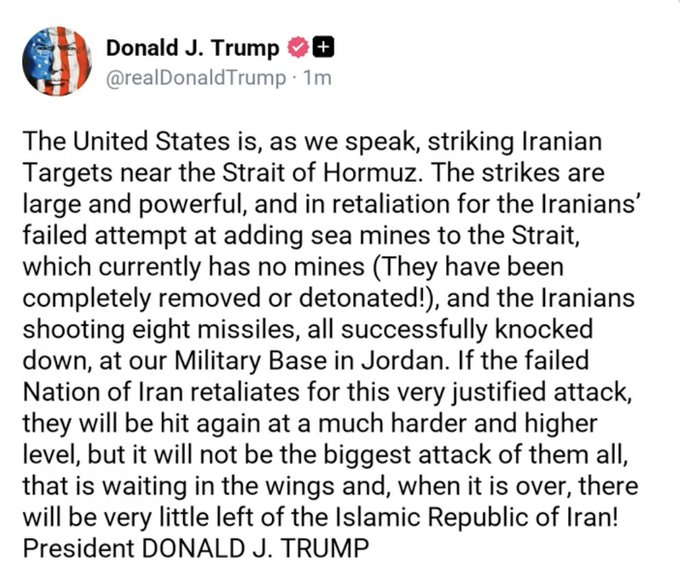
America Attacks Iran & Declares The Truce Over

From the orange man’s mouth:

“As far as I’m concerned, it’s over,” Trump said at the ongoing Nato summit in Ankara when asked if the truce with Iran was now finished.

“It’s just a waste of time dealing with them,” AFP reported.

He blasted Iran’s leaders after Washington launched strikes on the Islamic Republic and Iran said it targeted US bases in the Gulf.

“They’re sick, there’s something wrong with them,” he said.

Treasury also re-instated oil sanctions on Iran.

The simple calculus is that the US was trying to re-open the Strait through Oman waters, and while they got a few ships thru, the Iranians stopped most of them hit some. As long as the Strait stays closed, the US is under pressure, because there is a physical economy, and reserves are running down, leaving aside shortages in fertilizer, helium and so on.

Iran just needs to keep the Strait closed to put pressure on the US homeland. As usual, the US can’t be hit directly by its enemies, so this is Iran’s way of hurting America even though its missiles can’t reach American cities.

On the other hand, the US can directly hit Iran, and if they didn’t actually want peace on the terms of the MOU, which apparently they didn’t (though I think this is a factional dispute inside the administration), then going back to hitting Iran makes sense.

Problem is that if the Iranian military does what it’s threatening to do, which is to blow the hell out of oil infrastructure in the Gulf States, the shortages will last years.

And the US isn’t leaving Iran with a lot of other options in terms of escalation.

Anyway, we’ll see what happens. Trump’s decisions have the consistency of runny jello, the real question is if the Iranian hard line faction wins their internal debate and is given the green light to go all out.

What I write here is for the benefit of everyone, but alas, I live in capitalism and I, and the site, take money to keep running. If you value the writing here and can, please subscribe or donate.

Russia War Situation & A Possible EU/Russia War

This is elevated from comments, by Purple Library Guy.

Picked up and posted on the front page because it’s a balanced assessment. No, Russia isn’t losing, and it’s interesting that so much Western media is suggesting it is. That said, Russia isn’t having everything its way either. – Ian

As to the current war, Russia is winning, but I’d have to say I don’t think they’re real happy with how it’s going. The damage Ukraine is doing to Russia is real, the damage they’re doing to Russian logistics in Crimea is serious and could lead to a Ukrainian offensive with some success in that area. They have had some success in counterattacks in Zaporozhia. Drones have allowed them to hang tough on the defensive for far longer than they could have without that huge technological shift on the battlefield. It is not going all Russia’s way, or how the Russian high command would prefer it to be going. They’d really prefer all that stuff wasn’t happening.

But that said, Russia has nonetheless done FAR more damage to Ukraine and the Ukrainian armed forces than Ukraine has done to them. At the moment, Ukraine and Russia are attacking each other with similar amounts of long-distance drones, but Russia has much better defenses so does not get actually hit with as many. Still more than they’d like, but not as many. But on top of that, Russia is still doing damage with bombs dropped from planes, missiles, and even some old fashioned artillery. Ukraine doesn’t have much of any of that. They do have some missiles, mostly from the Brits, but not in comparable numbers. Where Russia has lost serious logistics capability in one place on the front, Ukraine’s logistics and military capabilities and manufacturing have been seriously eroded over the whole country.

And the attrition at the military level continues at a solid pace. Some hackers claim to have gotten hold of Ukrainian casualty numbers; apparently 2.4 million Ukrainian troops dead or missing, 400,000 of which are from so far this year. I don’t think Ukraine is replacing troops at a rate of 400,000 per half-year. Already I hear some sections of the front are held almost entirely by a few drone squads. At some point men, materiel and/or logistics erode to the point where sections of the front just can’t be held. Probably if they mount a serious counterattack around Crimea, that just accelerates the time when that happens, even if the counterattack is tactically successful.

As to a possible more direct war between Europe and Russia . . . I think they would find themselves dealing with the same problem Russia has, only much worse. Drones favour the defense massively at the level of taking territory. In such a war, Russia would be on the defensive, and Europe would be getting creamed by drones as they tried to advance. The difference being that Russia is fundamentally much stronger than Ukraine, and so the drone revolution on the battlefield can drastically slow the Russian win but cannot in the end stop it. Whereas Europe is not fundamentally much stronger than Russia in military matters, and so trying to take the offensive against a Russia with, now, much more experience in drone warfare than Europe, would lead to European armies being fed into a meat-grinder. And I don’t think Europe has the stones or the unity to keep up an aggressive war of attrition for all that long once the casualties start mounting up.

This is a very good thing, because if Europe attacked Russia and Russia felt really threatened, there would be a nuclear war and we would all die. It really creeps me out that hardly anyone seems to notice this problem any more.

Brief Iran Update

So, Iran closed the Strait because Israel wouldn’t leave Lebanon. Some ships tried to leave to Iran struck the ships. Trump called that a violation of the truce and struck targets in Iran.

As predicted, there is no peace possible if the US won’t control Israel.

Meanwhile in Lebanon the government signed an agreement with Israel saying that Hezbollah is to be disarmed. Hezbollah straight up said:

Hezbollah MP Hassan Fadlallah: ‘Hezbollah considers the Lebanese presidency and government illegal and unconstitutional. We shall not permit this unconstitutional institution to implement any deal on the ground.’

The Lebanese army can’t disarm Hezbollah, Hezbollah is far stronger. I doubt they’ll seriously try, whatever Aoun orders. The deal would amount to ceding southern Lebanon to Israel permanently. Aoun might not care, it’s all Shia land, but Hezbollah won’t go along.

No peace is possible if the US won’t either restrain Israel or cut it loose. “If Iran and Israel fight, we will not intervene.”

Controlling Israel is easy. What Kissinger and Nixon did was just stop weapon shipments. That’s all it takes.

Oh, and Israel lost its battle to take Ali Taher Hill. Wound up begging Hezbollah to allow them to retrieve the corpses of their fallen soldiers. The Israeli ground forces really are absolute crap.

The MOU was very one sided: everything was what Iran wanted, not what the US wanted. That’s because the Strait being closed really will wreck America. This remains true. Iran appears to believe this, and they are willing to go back to war or semi-war until the US disciplines Israel. No signs of cutting Hezbollah loose.

Hope you’re looking forward to very high food prices, bare shelves and eventual food riots. Because if the US doesn’t make peace these are all coming to America. Oil prices have been held artificially low by market manipulation, but there is a real world and in that real world distillates like diesel are running very low.

At this point it’s clear Trump has to go, for America’s sake. Vance is scum, but he’s realistic scum. If it was up to him, there’d be peace.

Here’s hoping the MOU gets back on track. I don’t like the world where it doesn’t.

What I write here is for the benefit of everyone, but alas, I live in capitalism and I, and the site, take money to keep running. If you value the writing here and can, please subscribe or donate.

Can Europe Win A War With Russia?

European elites appear to be preparing for war with Russia. Lots of new military spending, lots of anti-Russia rhetoric, willingness to let Ukraine launch drones from their territory and plenty of provocations like seizing tankers. They’re pretty open about preparing for war.

So, can they win such a war, starting in say 2030?

On paper it shouldn’t be much of a contest. Europe’s GDP is about 8x larger and its population is 3x larger. In principle, Russia should be smoked. Nor does history support “you can never beat Russia”, Germany lost in WWII, yes, but it won in World War one, nor was all of Europe fighting with it.

I’m gong to keep this simple. It isn’t GDP that matters, it’s resources and the ability to turn them into war materials, plus the willingness of the population to fight and die in large numbers.

Right now Russia alone produces more of the type of armaments that matter than all of Europe. Missiles, artillery, drones, glide bombs and so on. It has more oil and more minerals. It does have less population, but Russia’s historically been willing to absorb massive losses to defend the motherland.

Then we come to allies: Europe might have America, Russia might have China.

China is stronger. A lot stronger. Everything that Russia can’t make itself China can provide. Everything Russia needs that it can’t grow or dig up itself can be sent thru China to Russia from China’s African and Asian allies and there is no way for either the US or Europe to intercept all of that.

Nor is there any possibility that China will let Russia lose in any big way to Europe. Europe wants Russia broken up and subordinate to America and Europe. That would be an existential threat to China, and they know it. America can lose Europe and it will suck, but it isn’t existential.

This is how I predicted that Western sanctions would not work on Russia. I predicted it when the war started. Again, because everything Russia needed they could either produce themselves or get from China and even then Western elites were clear that the idea was to break up Russia and that China was the ultimate enemy.

The Chinese would have to be morons not to give Russia whatever support they needed, and unlike the West, China is not ruled by idiots or fools.

Europe can fight a very nasty war with Russia which wrecks both of them. But it can’t win in any meaningful fashion. European elites selling war or genuinely planning on war are either liars or fools or both. Europe’s problems cannot be fixed by war. Keynesian war stimulus will not fix their economic problems which are a result of the fact that they’re falling behind technologically and losing their industry to high input costs, including energy. They have less and less manufactured goods to sell to the rest of the world, can’t force the rest of the world to give them what they want or sell it below cost any more, and have no significant natural resources to sell to the rest of the world. Nor are they big leaders culturally any more, especially as China’s cultural sector takes on the standard great power glow—tons of money and people to work on it, and it must be great because China is great.

If Europe fights a real war with Russia all it will do is drive itself into the ground so it can go back to what it was for most of history: a barbaric backwater irrelevant to most of the rest of the world.

They need to fix their society and economy, and starting wars they can no longer win won’t do that.

What I write here is for the benefit of everyone, but alas, I live in capitalism and I, and the site, take money to keep running. If you value the writing here and can, please subscribe or donate.

Israel’s Support Is Eroding In the US

A friend pointed out to me that Israel’s support is eroding hard. The elite consensus is shifting. Point in case:

The hard core Zionists will keep opposing this deal, of course, but there are two groups that are shiftable. The first is the one that Tapper belongs to: he’s an authority follower. He’s been hardcore pro-Israel and loathes Muslims, but his first instinct is to follow the leader. Trump’s made a clear turn, and Jake is following.

The second group are those who need administrative favor. Their livelihood or plans depend on the levers the President controls favoring them. They were for Iraq, for Ukraine, etc… but they have no strong ideological commitment, only self-interest.

Trump made a mistake letting hard core Zionists roll up media and social media, but there’s still enough run by self-interested or follow the leader types that if Trump stays solid, the American elite zeitgeist will shift towards his stance. Israel is an ideological commitment, it’s not, for most elites and courtiers, all that involved with making lots of money or being part of the in-group. If the window shifts, they’ll shift with it.

At a fundamental level what happened is that America got itself involved in a war which it couldn’t just walk away from. Losing in Vietnam was embarrassing but really, who cares? Just walk away. Losing in Afghanistan, likewise.

But the Iranians have the West’s balls in a vise and the vise was slowly tightening. Key reserves were way down. Oil at Cushing OK is near historic lows. Distillates are getting scarce. Market manipulation of the price of oil was very successful, but actual physical shortages were on the way, starting in a month or so. (Ironically, price manipulation meant that oil reserves drew down faster than if actual price discovery had been allowed.)

There is a real world, and a real economy and Iran had control of it. The econo-morons talking about how the effect of this has been less than the oil shocks are right when looking at market numbers, but it wasn’t going to stay less and even Trump figured that out.

So the neocons and the hard Zionists will attack, but if Trump had the least concern for the actual economy, he had to make a choice.

Meanwhile Israel is still fighting in Lebanon and the first real battle of the Lebanese invasion is taking place.

Both Hezbollah and Israel are concerned there’ll be a new, actually real ceasefire and Israel is seeking to create facts on the ground. Ali Taher hill is an important strategic objective, giving whoever controls it sight lines for miles around. This is the first large engagement I’m aware of in this invasion where Hezbollah has chosen to stand and fight, instead hitting and fading. (That’s not a criticism. Guerilla warfare makes sense for them.)

And so far they’re doing well, because the Israeli ground forces are actually crap.

The Iranians have not gone to Geneva for the signing or negotiations. They are holding firm on Lebanon. And that means Trump can either rein in the Israelis or the vise starts tightening around America’s balls again.

America cannot win this war. It is impossible. Even using nukes probably wouldn’t work fast enough. That’s why they agreed to a deal that is very pro-Iranian.

That has not changed. They can rein in Israel or cut it loose now, or they can do it in two months when the US is in much more pain, or in 4 months when there are food riots.

There’s a real world. America lost a war that matters. There’s going to be a price for that. If America is smart and not completely controlled by Israel, they’ll pay that price now and if necessary cut Israel lose, because the price will go up every day if the MOU fails.

What I write here is for the benefit of everyone, but alas, I live in capitalism and I, and the site, take money to keep running. If you value the writing here and can, please subscribe or donate.


Text of the Iran/US MOU

From Dropsite:

Paragraph 1: (end military ops including in Lebanon: this is the one that may blow it up.)

The United States of America and the Islamic Republic of Iran and their allies in the current war by signing this M.O.U. declare the immediate and permanent termination of military operations on all fronts, including in Lebanon, and undertake from now on not to initiate any war or any military operation against each other, and to refrain [from] the threat or use of force against each other and ensuring the territorial integrity and sovereignty of Lebanon. The final deal will confirm the permanent termination of the war on all fronts, including in Lebanon and other provisions of this paragraph.

Paragraph 2:

The United States of America and the Islamic Republic of Iran undertake to respect each other’s sovereignty and territorial integrity, and to refrain from interfering in each other’s internal affairs.

Paragraph 3: (This ain’t final, more to negotiate.)

The United States of America and the Islamic Republic of Iran commit to negotiating and achieving the final deal in maximum 60 days extendable with mutual consent.

Paragraph 4: (Immediate end of US blockade, Iran has 30 days. US to remove forces.)

Immediately upon the signing of this M.O.U., the United States of America will begin the removal of its naval blockade and any disturbances or impediments against the Islamic Republic of Iran, and will fully end the naval blockade within 30 days. During this period, the traffic of vessels will be in proportion to the numbers of prewar traffic being restored by the Islamic Republic of Iran. The United States of America further undertakes to remove its forces from the proximity of the Islamic Republic of Iran within 30 days after the final deal.

Paragraph 5: (no charge for passage thru the strait. At least for 60 days, I suspect Iran/Oman will try and have charges after that.)

Upon the signing of this M.O.U., the Islamic Republic of Iran will make arrangements using its best efforts for the safe passage of commercial vessels with no charge for 60 days only from the Persian Gulf to the Sea of Oman, and vice versa. The traffic of commercial vessels will immediately start, and considering the need for removing the technical and military obstacles and demining by the Islamic Republic of Iran, will be instated within 30 days. The Islamic Republic of Iran will conduct dialogue with the Sultanate of Oman to define the future administration and maritime services in the Strait of Hormuz, in discussion with other Persian Gulf littoral states in line with the applicable international law and the sovereign rights of coastal states of the Strait of Hormuz.

Paragraph 6: (US pays 300 billion in restitution. This is why Iran agreed to no fees for passage, at least for now.)

The United States of America undertakes with regional partners to develop a definitive, mutually agreed plan with at least U.S.D. 300 billion for the reconstruction and economic development of the Islamic Republic of Iran. The mechanism for the implementation of this plan will be finalized as part of a final deal within 60 days. All required licenses, waivers and permissions needed for the relevant financial transactions will be granted by the United States of America.

Paragraph 7: (End of sanctions.)

The United States of America undertakes to terminate all types of sanctions against the Islamic Republic of Iran, including the United Nations Security Council resolutions, I.A.E.A. Board of Governors resolutions, and all unilateral U.S. sanctions, primary and secondary, in an agreed-upon schedule as part of the final deal. The Islamic Republic of Iran and the United States of America acknowledge the critical importance of the sanctions termination issue above mentioned, and express their intentions to immediately address these issues in the negotiations in order to achieve mutual agreement on them.

Paragraph 8: (No nukes for Iran. Downblending in Iran under IAEA supervision.)

The Islamic Republic of Iran reaffirms that it shall not procure or develop nuclear weapons. The United States of America and the Islamic Republic of Iran have agreed to resolve the disposition of stockpiled, enriched material pursuant to a mechanism that will be mutually agreed upon in accordance with the schedule mentioned in Paragraph 7, with the minimum methodology to be down-blending on site under the supervision of the I.A.E.A. The two parties also agreed to discuss the issue of enrichment and other mutually agreed matters related to the Islamic Republic of Iran’s nuclear needs, based on the statutory framework being agreed upon in the final deal. The final deal will confirm the provisions of this paragraph. The United States of America and the Islamic Republic of Iran acknowledge the critical importance of the nuclear issues above mentioned, and express their intention to immediately address these issues in the negotiation in order to achieve mutual agreement on them.

Paragraph 9: (No new sanctions, no new nuclear program.)

Pending the final deal, the United States of America and the Islamic Republic of Iran agree to maintain the status quo. The Islamic Republic of Iran will maintain the current status quo of its nuclear program, and the United States of America will not impose any new sanctions, and will not deploy additional forces in the region.

Paragraph 10: (Again, end of sanctions: this time for oil products.)

The United States of America undertakes that immediately upon the signing of this M.O.U., and until the termination of sanctions, U.S. Department of Treasury will issue waivers for the export of Iranian crude oil, petroleum products and derivatives, and all associated services, including banking transactions, insurances, transportation, etc.

Paragraph 11: (Release of all frozen funds.)

The United States of America undertakes to make fully available for use the frozen or restricted funds and assets of the Islamic Republic of Iran upon the implementation of this M.O.U. The United States of America and the Islamic Republic of Iran will mutually agree on the procedures related to the release of these funds during the negotiations. Such funds, whether retained in the original account or transferred, shall be made fully usable for payment to any ultimate beneficiary designated by the Central Bank of the Islamic Republic of Iran. The United States of America undertakes to issue all necessary licenses and authorizations accordingly.

Paragraph 12:

The United States of America and Islamic Republic of Iran agree that an executive mechanism will be established to monitor the successful implementation of this M.O.U. and the future compliance of the final deal.

Paragraph 13: (Negotiation not over yet.)

After signing this M.O.U. and subject to the beginning of the implementation of Paragraphs 1, 4, 5, 10 and 11 of this M.O.U., and the continuing implementation of these measures, the United States of America and the Islamic Republic of Iran will start negotiations regarding the final deal exclusively on the other paragraphs.

Paragraph 14:

The final deal will be endorsed by a binding U.N.S.C. resolution.


Commentary:

This is a decisive victory for Iran and a loss for Israel and America, though I’d argue that the US ending sanctions and military efforts in the Middle East is good for America. Still, there’s no question that this is the sort of deal that gets signed when one side (Iran) won and the other side (Israel and the US) lost.

I mean — 300 billion in reparations. The US end their blockade first. The US says it’ll get move forces out of the region. The US ends pretty much all sanctions and gives Iran back their money.

Massive win for Iran. Iran is now a great power in the region, and no one can deny it.

The obvious problem here is Israel. If Iran is serious about an end to violence in Lebanon, then this will wind up as a dead letter unless the US tightens Israel’s leash (which it can do, Israel is entirely dependent on US aid). Alternative the US could simply shrug, and make the deal only between them and Iran, and say “if Israel wants to keep fighting, it’s on its own.)

The question here is the power of the domestic lobby, and whether or not Israel has enough blackmail on Trump. (Signing this deal at all makes it look like the answer to , which I thought was “absolutely” may well be “nope, not enough.” We’ll see.)

The US is no longer a superpower. The world no longer has any superpowers. It’s still a great power with worldwide reach, but the days where it was the world’s “super cop” are over. It can still push around weak nations, but not strong regional powers. Took a little less than 30 years from the fall of the USSR for American elites to screw up a completely dominant position.

What I write here is for the benefit of everyone, but alas, I live in capitalism and I, and the site, take money to keep running. If you value the writing here and can, please subscribe or donate.

Page 1 of 16

Powered by WordPress & Theme by Anders Norén