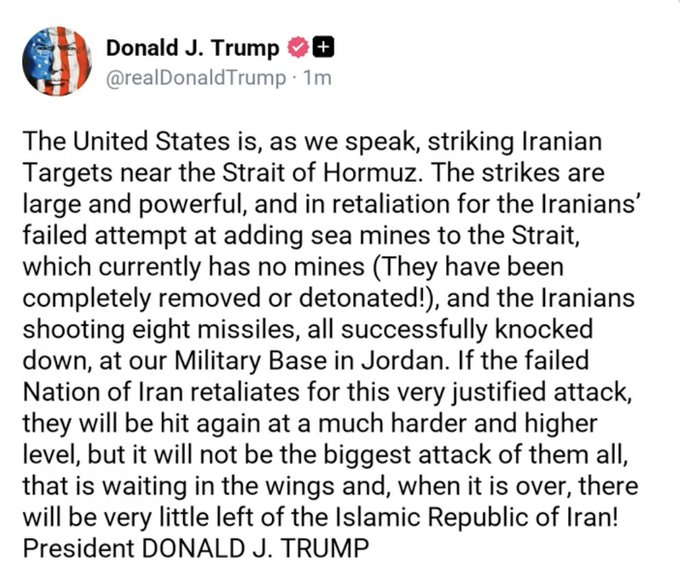
Recently the US started hitting Iranian oil tankers. The Iranians had said that if this happened, they would escalate and they have done just that. This is a very serious change in their strategy: before they retaliated, but did their best to keep casualties low, rarely made serious attacks on US naval ships, and their attacks were relatively small. That’s all changed.
(Footage of the US firing off more than 100 patriot missiles to try and stop an attack in Jordan.)
مشاهد للحظة إطلاق أكثر من 100 صاروخ باتريوت للدفاع الجوي الأميركي في الأردن. https://t.co/YiibkIOeSQ pic.twitter.com/hVqDZ59yhe
— Ali A.bk (@ABKt198990) September 8, 2026
As best I can tell the interceptors also mostly failed to stop the missiles. The attack was much larger than normal, 30 to 50 missiles, showing that the previous smaller attacks were a choice, not an operational necessity. According to CBS 9 planes were damaged on the ground.
The change in doctrine was also confirmed:
Iran Threatens 20 Strikes For Every 2 Targets Hit
General Mohammadi says Iran has reached a new stage of retaliation and laid out its demands to END the War:
1) Completely END the war and military attacks
2) STOP further threats against Iran
3) WITHDRAW Israeli forces from Lebanon
4) END the siege of Yemen
5) RELEASE $24 BILLION in frozen Iranian assets
6) STOP interference in Iran’s NUCLEAR program 7) STOP interference in Iran’s MISSILE program
He says the era of limited retaliation is over.
Attacks on US ships have yet to take any out, but they force the use of interceptors and ships have very limited stockpiles. When they run out they have to pull back and wait for naval resupply or go to Diego Garcia for resupply, since all closer naval bases are no longer operational.
Jordan is the last shield before Israel. They routinely intercepted attacks against Israel from Iran during the early part of the war. Once their ability to do so is damaged, Israel lies open. In addition, the US is running very low on patriots – less than 900 before this attack seems to be the consensus estimate. And they just burned off 100 to protect from one attack.
As I said day one of the war, the math is on Iran’s side: the US will run out of interceptors long before Iran if Iran chooses to go all out. They didn’t because once the Strait was at least partially interdicted, they figured that the long term math favored them economically: the US and world economies would crack before they did. But that calculus changes if the US is going after Iranian tankers, so they’ve escalated. They’ve also been hitting far more tankers from other other countries than previously, again showing that hitting only 3 or 4 a day was a choice, not something they had to do.
Since Iran keeps saying that Israeli occupation of Lebanon is a red line (they’ve dropped Gaza, as I suspected they might) and since the war won’t end as long as Israel tells America to keep going, this war is moving back towards direct attacks on Israel.
This follows the Supreme Leader replacing moderates with hawks in various key positions.
To put it simply, Iran is now on the offensive. It does show that they have a weakness: they need at least some oil sales getting thru, but it also shows that they are militarily dominant in the region, especially against land based assets. And my guess is they still aren’t seriously trying to take out naval ships, but are just firing enough missiles and drones to drain interceptors and force a withdrawal.
Iran also needs to put more pressure, fast, on the US economy before the mid-terms.
Meanwhile, in Yemen, the Houthis are advancing aggressively.
The Yemeni Armed Forces through a series of rapid operations, have achieved significant advances in the Taiz and Hodeidah provinces within just a few hours, covering an area of approximately 2,600 square kilometers, and have liberated numerous areas, including the strategically important port of Al-Mokha.
On the Taiz front, the Yemeni Armed Forces have made rapid progress in the districts of Al-Wazi’iyah and Mozah in western Taiz province. During these rapid advances, with the support of popular committees, the Yemeni Armed Forces have cleared the Al-Wazi’iyah and Al-Mokha, the important Khaled bin Walid base, and areas in the Al-Wazi’iyah district, including Al-Hania, Al-Aqma, and Al-Gheil, extending to the outskirts of Al-Shaqira, the center of the Al-Wazi’iyah district.
In southern Hodeidah province, the Yemeni Armed Forces have taken control of the important towns of Hays and then Al-Khukhah, and by continuing their advance along the coastal strip and liberating Yahtal, they entered and took control of the strategically important port of Al-Mokha.
The advances of this morning are reminiscent of the rapid advances made five years ago in the Hodeidah province, when, in November 2021, the Saudi-led coalition forces were forced to withdraw from the entire coastal strip, from within the city of Hodeidah to north of Al-Khukhah in southern Hodeidah province.
The intense pressure exerted by the Yemeni fighters on all fronts in western Taiz province and southern Hodeidah continues, and the forces of Tariq Saleh are reportedly fleeing the fronts towards Aden.
Overall, with the advances made over the past three days, the conditions have been created for the complete liberation of the southwestern coast of Yemen, and also for the strategic Bab-el-Mandeb Strait.
The Houthis are just better fighters than the mercenary forces Saudi Arabia is using, and the Saudi Army is a joke in any case.
The real battle of the Iranian war is yet to come: once Iran has cleared away the US forces protecting Israel, they will need to force Israel to tell the Americans to go to peace. By clearing the forces they will also make it much harder for America to hit Iranian tankers and infrastructure
Stay tuned. This is the most important war of the last 50 years.
Update:
⭕️ BIG.
Yemen’s Ansarallah possibly struck the East-West pipeline at several points, this morning, and later this evening.
NASA FIRMS detected fire less than an hour ago, and satelite image showed a significant plume of black smoke over the south of Medina. https://t.co/bgWEfUXHXE pic.twitter.com/tNzmzL14uY
— MenchOsint (@MenchOsint) September 10, 2026
What I write here is for the benefit of everyone, but alas, I live in capitalism and I, and the site, take money to keep running. If you value the writing here and can, please subscribe or donate.