
One of the most important things to understand about companies and countries both is the difference between sustainable prosperity and burning down the house.
You’re probably aware that Boeing has serious problems. Those problems have been obviously “on the way” for a long time. When Boeing moved its headquarters from Seattle (where it makes most of its planes) to Chicago, the writing was on the wall.
BUT it was also a good time to buy Boeing stock:
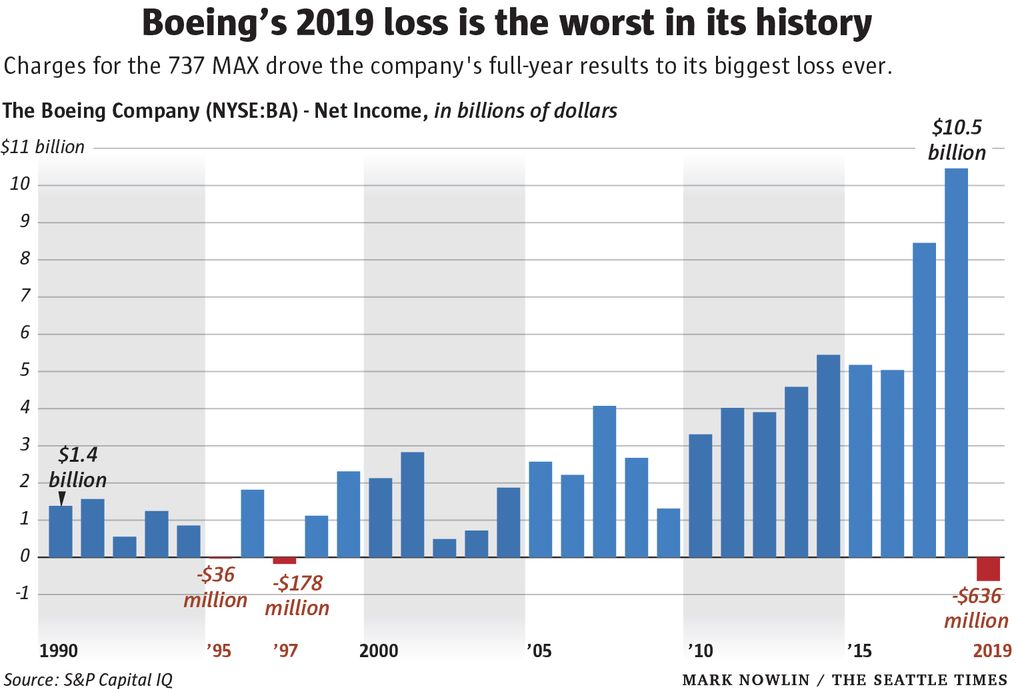
The move to Chicago meant that Boeing’s executives had moved away from the manufacturing floor. It was the sign that Boeing’s culture was no longer “Engineering from top to bottom” but finance driven. And that emphasis on finance, on juicing profits, increasing executive salaries and driving up stock prices (those stock options don’t pay otherwise) had an effect. You can see it in the chart above.
Here’s a more recent chart:
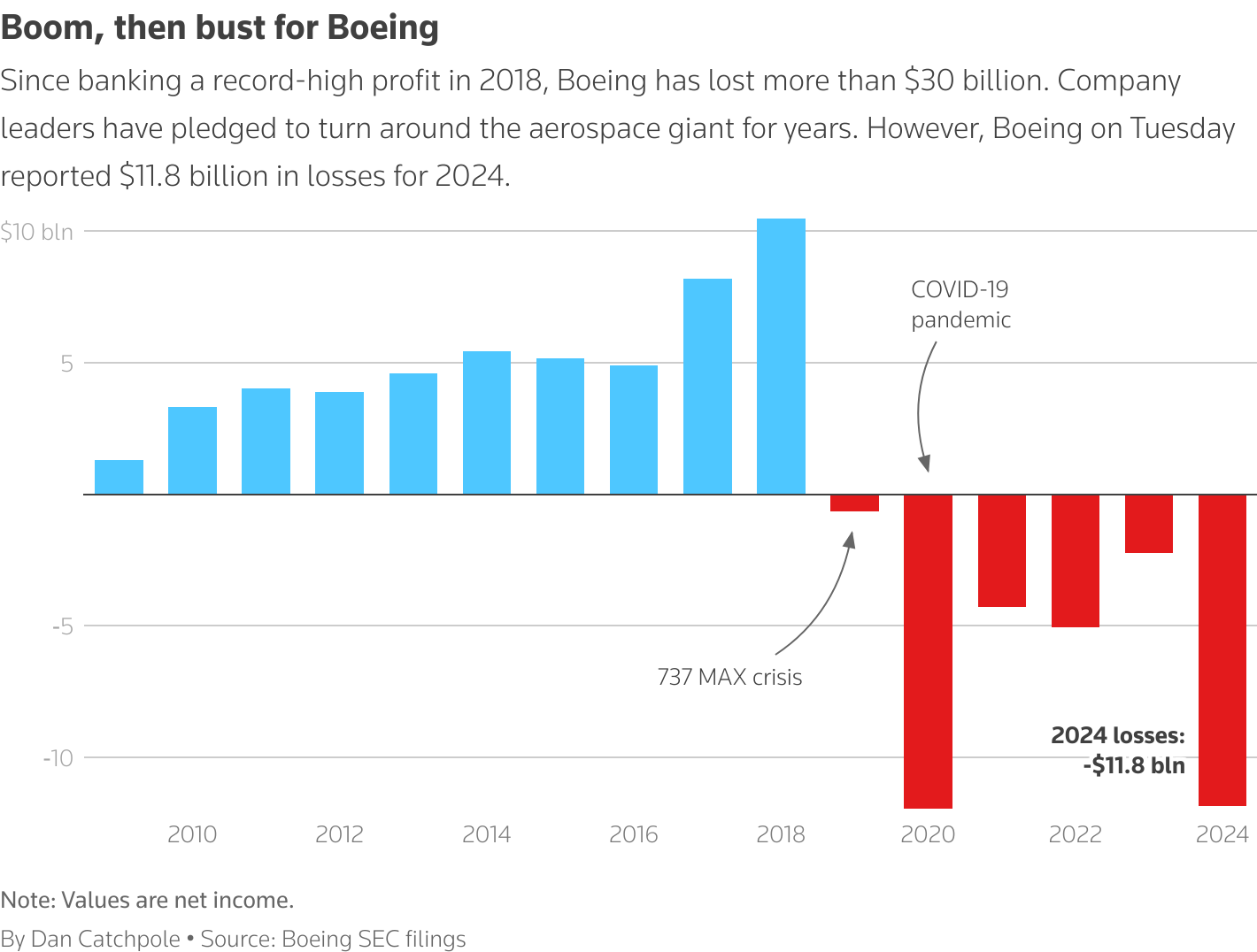
Ouch.
What had happened is that Boeing was forced by the Clinton administration to merge with its competitor McDonnell Douglas in 1997. McDonnell Douglas was an “MBA” firm. Boeing was an engineering firm. The takeover changed Boeing’s culture and leadership, engineering became secondary and for over 20 years, it was good to be a stockholder.
But Boeing’s ability to make and design planes took a huge hit, there were massive quality problems and employees below the executive rank were angry and demoralized. Boeing planes started falling out of the sky. They were unable to make reliable rockets any more and eventually spending all their time on juicing profits blew up in the face.
This is a general law. The same thing happened at General Electric. If you’re old enough you remember GE as an American industrial giant, making everything from turbines to washing machines. It was a technological pioneer. Then Jack Welch took over, started firing 10% of employees every year (the “lowest performers”, supposedly) and turned GE into a finance company. After all, profits from finance are much higher than profits from manufacturing.
Unfortunately, as with American car companies, GE wasn’t really a bank. Its financial profits were still dependent on being a major industrial company, but Welch didn’t believe in manufacturing. And now GE is a shadow of itself. Jack Welch? Well he got rich, he was lionized as one of the great CEOs of the era, and he retired before GE went completely to hell.
GE will never recover, and with it went a big chunk of America’s industrial and technological might.
And it’s unlikely Boeing will really recover. If it wasn’t for China, it would be possible. But China’s building its own civilian airliners now. They’re not caught up yet: they can’t make the jet engines, but they will be able to soon. (They make excellent jet fighters, probably better than the equivalent American planes, as performance in the recent India/Pakistan border incident showed.)
So China’s likely five years out from producing cheaper more reliable planes than Boeing, which is to say, cheaper and more reliable than American jets. The European market is going to turn hard away from Boeing due to Trump’s games and their having Airbus jets as an alternative. So what’s left for Boeing? Geopolitical risk is too high for anyone but Americans to buy their planes, and Chinese jets will cost less. If you don’t want Chinese, buy European.
They screwed up the rocket they were building for NASA, giving the market to SpaceX by default (and perhaps soon other new companies.) American fighter jets are worse than Chinese jets, and even if they’re better than some other alternatives, the market is crashing on them, because with modern software, you can’t use them if the US decides to stop you. They effectively have a kill switch. Given the US has recently threatened both Europe (Greenland) and Canada, who the Hell wants to buy an American jet, when America is the danger?
Buy Russian. Buy Chinese. Buy European. But American? You’d have to be a moron.
Now let’s look at the US economy overall:
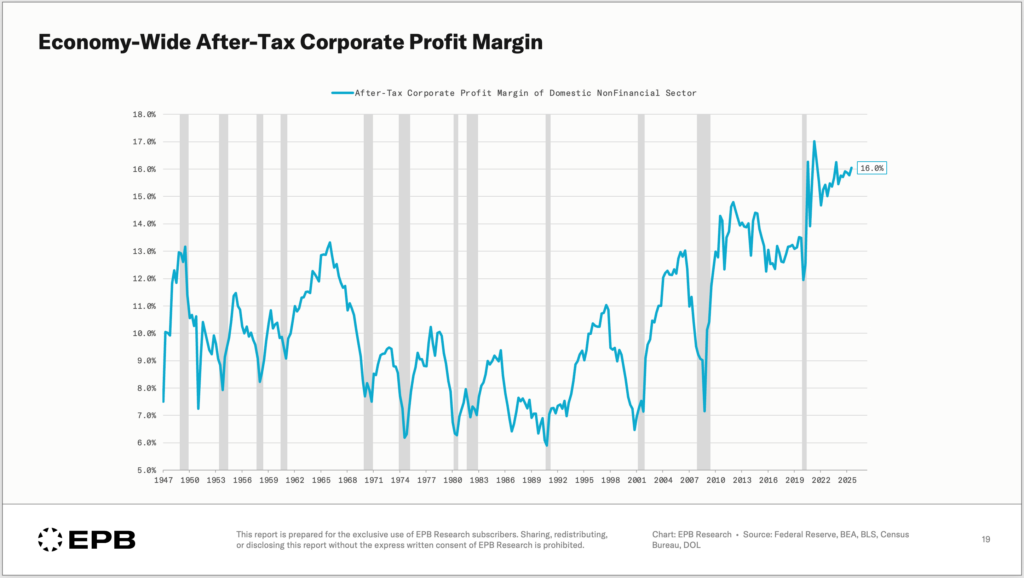
The entire US economy is being burned down. Those high profits aren’t a sign of health, they are a sign that excess profits are being taken at the expense of reinvestment in production and tech; of too high cost structures that make producing in America too expensive (because those profits indicate higher prices); of non-competitive markets, and, generally speaking, of burning down companies or the economy, or both, to make unsustainable profits.
The problem is simple enough. China’s now ahead in 89% of techs. Prices for its goods are much lower. Who the Hell is going to buy American goods? Two years ago there was an answer. American allies would, even at higher costs, because they were scared of China and wanted to stay on America’s good side. But now? After America has proved more dangerous than China to Europe and Canada and after Trump’s on-again, off-again tariffs and other insane trade moves?
China’s looking mighty good, and America is the threat.
Oh people will still “invest” in the US, if you want to call it that. If America’s in its final stages of burning down the house to generate high profits, why not? But I suspect that even that is going to drop significantly because the geopolitical and exchange rate risk is just too high. As America declines, the US dollar will as well, and when you adjust for drops in the dollar, those returns aren’t going to look so great to non Americans.
The “Burning Down the House To Generate Heat” metaphor is one for our age. Not just for Boeing or America and its economy, but for humanity and ecosphere.
Welcome to the end of American Empire.
This site is only viable due to reader donations. If you value it and can, please subscribe or donate.