Some stories are too difficult to tell in the hours, days or weeks after you experience them. Over time, however, they fester; begging to be told; becoming more insistent as the months and years pass. Some even begin to haunt a writer more and more, day by day until the tale must be told. Last night’s nightmare compels me to relate my tale now.
In late November of 2008 my bus from Vietnam to Siem Reap developed issues and required a stopover in the Cambodian capital, Phnom Penh. It had been a sleeper bus so we were told we’d have a full day in the capital and the bus would leave the next day. Traveling plans like war plans rarely survive contact with the road. Growing ever more patient with detours, I inspected my guidebook, back when using Lonely Planet’s was a thing, and planned my day.
Let me be clear: I am no fan of war or atrocity porn, but I do understand its allure, although I am, thankfully, largely immune to it. On the other hand and possibly more importantly, I also recognize and empathize with the need to preserve places where truly reprehensible atrocities of human history occurred. They are to be preserved that future generations witness, feel, and have the opportunity to comprehend even the smallest portion of the enormity that took place underfoot. Maybe, just maybe, such lessons might be passed on to others who will never be able, or be allowed, to experience such hallowed ground.
Many practicing and secular Jews make pilgrimages to sites where the Shoah occurred. I’ve inquired why and each query has been answered universally. They describe a compulsion to bear witness, to honor the fallen, that they remain alive in living memory. Hard to argue with. Because the Armenian genocide occurred in a more dispersed manner Armenian pilgrims face much more significant hurdles. But, when possible Armenians likewise honor their ancestors. I cannot speak to what happened in Rwanda in 1994. I am aware of such places in Guatemala, heard in faint whispers where no gringos are welcome, nor visit, quite understandably.
How to explain how my choices that day were made? I may have only been 13 years-old but the 1984 movie ‘the Killing Fields’ left me with a powerful impression. An impression I recalled that November day and I felt oddly, inexplicably, duty-bound to see what I did not want to see. The killing fields were not my first stop that day however. That honor (poor word choice, I know) fell to the former interrogation and torture center of the Pol Pot Regime’s perceived enemies Tuol Sleng. Here I endured, what I can only describe as a feeling of almost unbearable witness to sickening crimes.
Two, and only two, examples need suffice.
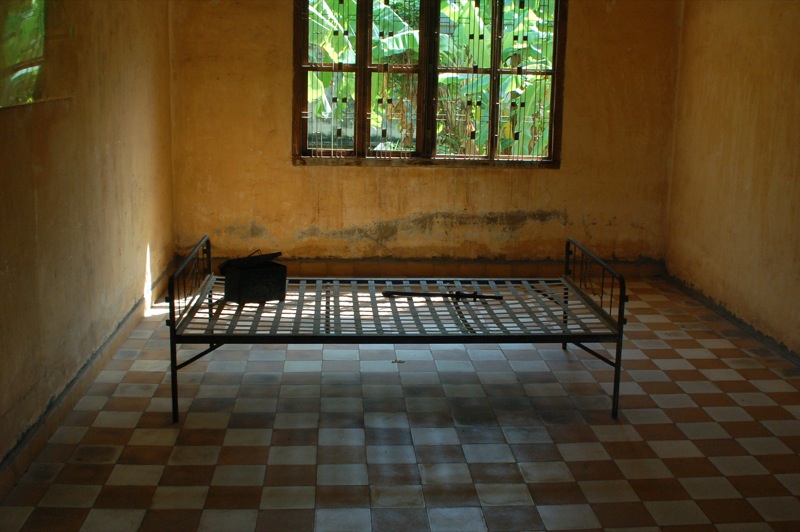 First, in one room of the prison sat a metal frame bed where regime “enemies” were restrained. Once restrained, electrical leads were attached to the frame. Most expired for no reason at all. Sometimes the guards just left the room to have a smoke. At others they left to eat lunch. But most often the guards let them die because they knew no questions they might ask would be satisfactorily answered. They knew they were killing regular people, completely innocent.
The second example is this photo, a photo that haunts me to this day. The walls of Tuol Sleng are papered with them, all of them innocent and to this day they go unnamed. If you cannot feel the fear radiating from this photo you are devoid of the empathy gene.
In all I spent about two hours wandering through Tuol Sleng. I will never return.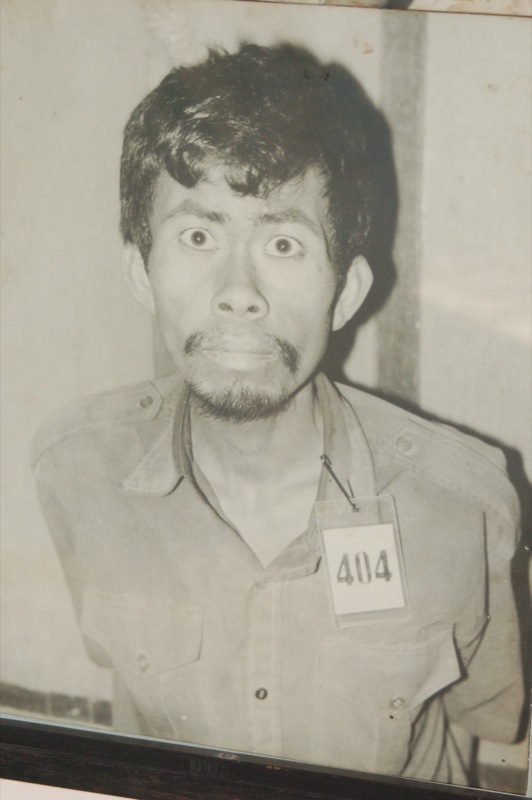
But, my day was far from over. After walking out of Tuol Sleng I hailed a tuk-tuk and asked him to take me to the killing fields, which are about two kilometers outside of Phnom Penh. What I recall most vividly about this horrifying place was the care I had to take where I walked. (NOTE: click on the following links at your own risk.) The ground was uneven and I was told at the entrance to stay on the high ground, as the sunken spaces were mass graves. Christ, I shudder visualizing it even now. Then there were what I can only describe as large glass cases, best suited as terrariums for large pythons or boa constrictors. Each case was filled with one of the following: femurs of the dead, human ulnae and radii, and hip bones. Piling Pelion on top of Ossa, mason jars filled with human teeth sat atop each glass case. Finally, the Cambodians being Buddhists made a four story glass stupa—a Buddhist reliquary—filled with human skulls.
Towards the end of my increasingly heavy-hearted meanderings I noted crimson rays filling the sky. I hailed a cab to my hotel, shambled up to my room, slouched off my backpack and sank onto the bed, sighing deeply from emotional exhaustion. I didn’t know what I felt—except despair. I walked downstairs and asked where the nearest bar was. Now, I am not one to drink alone; but, I confess that I was incapable of dealing with what I was feeling at the time. So, I sat down, alone and in silence and got drunk. Not tipsy, but drunk. I barely recall making it back to my room, but I did. The last thing I recall thinking before I passed out was, “I’m going to be haunted by this for a long time.”
The next morning after dreamless sleep, no ghosts woke me up. All that greeted me were overcast skies, a wicked hangover and my noon bus ticket to Seam Reap.
ME
If you’ve not yet done so, I recommend a trip to Hiroshima.
mago
Agreed that there’s a necessity to bearing witness and I’d like to expand on that idea.
There’s a reason Israel has assassinated some 240 Palestinian journalists (and often family members), and that’s because they’re bearing witness, en vivo, live. Even before this genocide Israelis were in the habit of offing journalists of any nationality if it served them. Assassination Inc.
There’s unlikely to be a holocaust museum for the Palestinians or Genocide memorials for the Sudanese. I don’t know what’s out there for the Armenians or Rwandans, but I’m pretty sure there’s squat for the Native Americans.
Memorials and museums are for the chosen, not those “other people “.
Joan
Thank you for sharing this. I was assigned the killing fields for my senior capstone thesis in college. Just preliminary research had me up all night to avoid the nightmares. I asked to change topics and had to negotiate again, away from the Hiroshima nuclear bombing or the Tokyo fire bombings. It was too much for me and I got a letter from my mental health counselor explaining that I have anxiety. We settled on the making of the Japanese constitution.
Years later I had the chance to visit Hiroshima and spent two days in the museums. It was a similar experience: horrific, tragic, devastating. It’s good that these places still exist because museums like this can convey the suffering well enough that visitors come out with the unshakable conviction of Never Again.
mago
Just wanted to add that the victims of today become the victimizers of tomorrow and today’s genociders are tomorrow’s genocided. It’s a vicious cycle. Gotta grok karma to get it, although it’s easy enough to understand if not accept.
JSR
Went to Tuol Sleng and the Killing Fields 10 years ago. The feeling of profound sadness permeates the place (and me) like no other similar place I’ve been (a few concentration camps and some forest/fields in Europe known for lots of killing during WW2.) It took several days for me to feel better.
In one of the rooms (it previously was a school) in Tuol Sleng, at the exit there was a notebook for people to write something after experiencing the place. I couldn’t think of a thing to write. Unfortunately, as I looked through the notebook many, many people just wrote ‘never again’ to the point I realized it had become just another empty meaningless phrase. Sorry Joan, didn’t mean to step on your sentiment. Just my experience there.
Sean Paul Kelley
Thank you all for your kind words and your recognition that I was not trying to relay atrocity porn. That day has haunted me for 17 years. It was cathartic to write about it and I thank you all for taking the time to read it and express empathy with me and for the victims of those two sad, horrific places. I’m truly grateful for your kindness.