The thing about AI is that it takes previous costs (your engineers and their tools) and makes them more expensive. Often much more expensive:
if you built your saas business before ai, your entire business was designed around one assumption which was that software has ~zero marginal cost.
ai blows that up. every ai action costs money. incumbents now have to create more expensive tiers or introduce usage based pricing. both force customers to make a new purchasing decisions while revenue doesn’t automatically increase just cuz the product became more expensive to operate. so your cost per seat rises, your gross margins compress, & adoption remains uncertain.
meanwhile, the model labs are subsidizing ai usage like crazy, so they can undercut you. ai native startups are burning venture capital to acquire users, so they can undercut you too.
(lack of capitalization in original)
I really don’t know what to think of AI for coding. I’m no longer a coder, haven’t been for almost thirty years now, so I don’t have enough firsthand knowledge, though I did have an AI generate basic sorting and random number generation code just to get my hands a little wet. Among devs I trust, opinion is split. Some love it, some hate it, some are on the margins. Here’s one in the hate category:
Are companies actually seeing massive productivity gains from their AI adoption?…
… All of the AI projects we have observed as a team are failing. Every single one – we have seen 0% success in a year and a half, not only amongst projects we have been asked to participate in, but even within projects that we have observed in passing while doing totally unrelated work. Even if you grant that AI tooling accelerates specific workloads, the method and scale of the current investments is senseless. Frequently the failure is not related to AI itself, but rather that companies are terminally bad at running software projects effectively, and as I have remarked previously, AI projects are subject to all the failure modes of normal projects plus you can get everything right and then still fail because of the method’s novelty. Very few companies are so good at shipping software that they can afford the extra risk profile…
…
our team has quickly learned while on an engagement not to ask anything about ongoing AI projects in any context – by the time that project has started, it is too late for the management team, and intervention is not possible until a crisis point is inevitably reached. There is no conceivable positive outcome. The failure rate is so high that even basic inquiry leaves us in an untenable position. Any coherent question about how it’s going, what the goal is, who is using it, constitutes an inadvertent attack on the chain of command responsible for the work because there are no good answers to anything. Even in rare cases where my interlocutor has stated that things are going well (usually while the project is still mid-flight and failure has not had a chance to manifest), it is generally obvious that they are doomed, but at least in these cases I can simply agree and then go home to scream into a pillow for six hours straight.
All of this is to say that I am very confident that almost every report at a company about “massive AI productivity gains” is untrue as a matter of brute fact. Even if some companies are seeing clear gains, this is the exception, not the norm.
It’s a long post and the entire thing is worth reading. This is a high end engineering consultant who gets a view on a lot of companies.
My feeling/guess is that AI is not mature, that the use cases exist, but that it introduces significant risks of new failure modes because AIs aren’t reliable and aren’t actually intelligent: they don’t know what they’re doing. If you don’t do the work yourself or audit it to the level where you might as well have done it yourself, it seems easy for errors to creep in, for hard to maintain or understand code to be created, and for new failure modes to exist.
If I were an executive in most businesses I wouldn’t be using AI for much, if anything yet, though I’d let a few people have an account and test it, and would do so myself. It’s moving fast, it clearly adds risks and mistakes that we don’t know how to mitigate yet, it’s expensive and that’s with massive subsidies, so becoming dependent on it when prices are likely to increase significantly is unwise.
There are going to be exceptions: if you’re Google, not sure you have much choice. But if you manufacture widgets or sell hamburgers or build homes or are a lawyer (who can’t afford to have the AI hallucinate cites) I’d give it a pass for now, or use it very warily in exploration mode. I use it for research myself, especially as search engines get worse and worse, but I also check the sources it uses.
And, as we’ve discussed before, non open models have huge risks, since prices can easily be raised, the government can intervene to cripple the model or deny to other nations, and the company itself can make changes to the model which make it less useful to you. So even if using AI I’d be primarily focusing on Open models (which means mostly Chinese.)
But my best guess is that this is a real tech, with real uses, which is not yet near to mature and which is being deployed before people understand what it’s good at or how to use it safely and cost effectively, or, more importantly, when NOT to use it. I’d also guess that at least so far, it’s not the second coming, the next great thing, in the way that its evangelists preach.
So far it seems to increase failure rates on real projects and raise costs significantly at the same time. Unless I’m running a business where I must be in it, I think I’d take it slow.
There are very few businesses where “the way we did it in 2022” will expose you to significant risk and costs. If you’re in one of those businesses, chill a little and observe. Let other people pay the price and make the mistakes. If you need to, because it’s the current “everyone must do” just lie and say you’re into it, while doing the minimum.
This is certainly something I could be wrong about. I’m confident that Chinese AI will win, for example, I’m less certain about how useful AI will turn out to be. I do think that I’m almost certainly right that most companies adopting it in a big way, NOW, are making a mistake. Wait. See how it turns out. Let other people figure out what it’s good for, how to manage it, how to mitigate the risks and how to drive costs down.
And remember, even if it’s the true next big thing, early rushers often get badly burned, as with the dot-com bubble. Don’t buy hype, make sure what you’re investing in is real and you understand what it’s good for and what it sucks at.
What I write here is for the benefit of everyone, but alas, I live in capitalism and I, and the site, take money to keep running. If you value the writing here and can, please subscribe or donate.


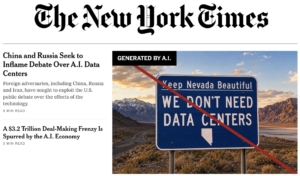
 Regular readers will know that for a couple years I’ve been saying that Chinese open source AI would win the AI “war” because it’s cheaper and non proprietary (prices can’t just be raised suddenly, or capacities taken away.)