
So a *European* startup called IB2 announced *in the US* the invention of an amazing new technology to upgrade low-grade bauxite – previously discarded as waste – into high-grade, which makes it usable to make aluminum and extract critical minerals like gallium, lithium, and rare earths in the process.
In the current context you’d think either Europe or the US would be all over it, right? Wrong. Somehow the first facility that startup ended up building is in Shanxi, China – built in 10 months flat (which, as you can guess, is almost impossibly fast)…
…How? Why? Speed and efficiency. According to the founder and CEO of IB2, Romain Girbal, they received “massive support” from the Shanxi government and were able to move at insane speed. As he puts it: “You could never go that quick anywhere else in the world – only in China. It is unique.”
And no, they didn’t do it by trampling on environmental regulations which, contrary to popular belief, are now actually quite drastic in China. As Girbal puts it: “Building a unit in China is very regulated – environmental and dangerous materials [are subject to] heavier regulation. Of course we followed everything but we had the support from the Shanxi province to help us move forward. Sometimes, being a foreign company, things can be slow with communication issues. When there were sometimes slowdowns, they were here to help and to push.”
The difference here is simple. China has regulations, and the government helps companies meet them. The government wanted this facility so they helped WITHOUT breaking the laws. Here in the West, we’d give them a tax break, and maybe we’d say “it’s OK to break the law this time.” That’s not what Shanxi did.
I am reminded of how US tax authorities built an auto-filing system which filled out tax forms for people, and helped them thru the process where it couldn’t fill them out. Unfortunately there’s a big business doing that already, so Congress, this year, forced the IRS to shut it down.
What the IRS was doing is helping people obey the law, but that threatened TurboTax’s profits, so…
This is how the Russians were able to ramp up weapons production so fast (or part of it.) They made it a priority and the government helped firms.
Safety and environmental regulations exist for good reasons. Most firms will cut every corner they can to make a profit, and those few with ethics will lose to those who say “who cares how many kids die of asthma due to pollution?”
BUT a properly run government doesn’t just make regulations, it helps firms meet those regulations. They aren’t, or shouldn’t be, meant to slow things down, but to make sure corners aren’t cut which will hurt consumers, workers or just the general population.
In most of the West regulators exist to say “no” and to ask for another report. They don’t much care if the business succeeds or not. In China (and, actually, in America before 1980 or so) governments want business to succeed so they help, but they also don’t want businesses to shove their negative externalities onto workers or citizens, so they also make sure they can meet the regulations intended to protect people.
As we’ve noted before, the US couldn’t do this if it wanted to, because contrary to propaganda, the US doesn’t have a ton of federal bureaucrats:
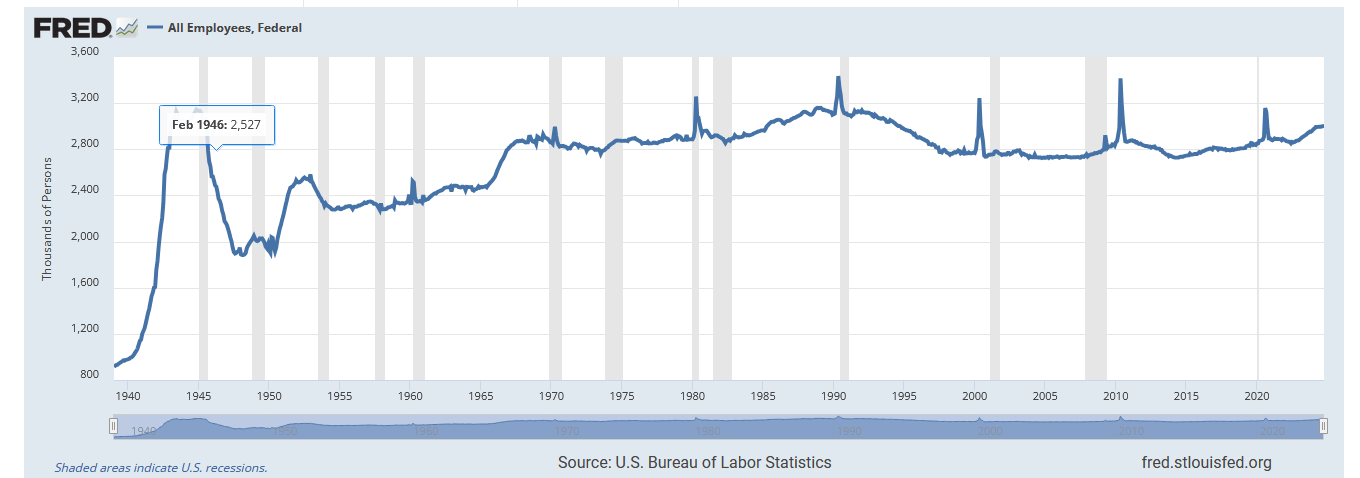
When you consider how much the American population has grown, you can see that the number of bureaucrats per capita has actually dropped significantly. In 1970 (which had about the same number of federal workers) the population was 205 million. Today it is 343 million. Most of that has been outsourced to contractors. Contractors who, of course, cost more than just doing it in house.
A friend of mine is in his early 80s, and he once told me how after Reagan came into office, the local Small Business Administration office, which had been very helpful to him in running his small accountancy business, got rid of half its employees and those who remained were no longer allowed to help as much.
Properly run nations want business to succeed and help them, but they don’t do it by letting them dodge regulations or cutting them for them, they help them by guiding them thru the process of meeting the regulations, and provide other aid as necessary to get the business going.
Once that was us. No more.
This site is only viable due to reader donations. If you value it and can, please subscribe or donate.