The horizon is not so far as we can see, but as far as we can imagine

Category: Europe Page 6 of 18

America Defeats Germany Again, Europe Foolishly Helps

(I’m aware others have made the same US defeats Germany point before this. Just becoming super obvious.)

There’s a good article in Der Spiegel on the German energy/industrial crisis which is worth your time.

Basically industries which have high energy costs are being crushed. In particular this means chemical and automotive, both big in Germany, but extends far further.

(Indeed, the chemical industry was essentially invented by Germany in the 19th century, and American industry exists because the patents were broken in WWI and not reinstated after the war.)

This has a lot of knock-on effects, not only in price increases (which are big), but shortages. For example:

The coronavirus pandemic showed how easily modern production processes can get out of sync. Supply chains interlock like the insides of a clock, and if one cog fails, the entire machinery can grind to a halt.

An example is a small company from Lutherstadt Wittenberg, Germany, which has made it onto the prime-time news broadcasts in recent days because its products are needed almost everywhere. “Our production has been halted completely,” says Torsten Klett, the co-managing director of SKW Stickstoffwerke Piesteritz. “And we will only be able to restart if the gas price drops significantly or if politicians provide us with massive support.” The chemical company is one of Germany’s largest producers of fertilizers and AdBlue. Natural gas has also become too expensive for SKW. If political help doesn’t arrive soon, the company could be forced to send its 860 employees into a work furlough program in October.

Few modern diesel engines can be operated without AdBlue – not those of the fire department, not those used in public transportation and, above all, not the 800,000 or so trucks that transport goods of all kinds across Germany’s roads every day. Should companies no longer receive the products they need for their own production, the result wold be devastating, and almost all sectors would be affected.

The national association representing the logistics industry has begun warning of potential bottlenecks, even though AdBlue is also manufactured by BASF and the Norwegian firm Yara. But BASF began cutting back on ammonia production last year due to increased gas prices. The world’s largest chemical company can still compensate for the shortfall by buying on the world market, though the costs continue to rise.

So, logistics crisis intensifies because of lack AdBlue.

Meanwhile increased energy prices are hammering every single business and homeowner just for electricity, heating and cooling, so much so that it’s causing many retailers to become non-viable. Employment is actually tight (whisper after me “Covid deaths and Long Covid”), so there’s pressure on wages, but prices are increasing faster than wages so consumers don’t want to spend.

Industries that Germany has been powerful in for over a century are being hammered.

Now a lot of Europeans hate Germany, and with good reason. The Euro has been less than Germany would have had given its own currency with their level of exports, but higher than it should be for most other European countries, meaning that German industry was subsidized and other nations like Italy and Finland were penalized.

Germany aggressively policed other European countries, making it near impossible for them to protect their industry thru other means like subsidies, generally under the rubric of “fiscal discipline” and when countries were in crisis engaged in a fair bit of looting.

Meanwhile Eastern Europe was never properly integrated into Europe, remaining primarily a source of cheap labour and not properly moving up value chains.

To Eastern Europeans Germany is a traitor who made deals with the evil Russians to keep their energy prices low and didn’t really share the ensuing prosperity. (Germans would mostly disagree, noting the subsidies. But countries want their own prosperity, not welfare.) To Western Europeans Germany has repeatedly abused its economic and political power to keep its industry strong, even as others lost theirs.

So Germany has a lot of power in the EU, but few true friends, and there’s a lot of resentment.

Still, whatever the causes, Germany is the industrial powerhouse of Europe and Europeans who are laughing at Germany’s loss of industry during this energy crisis are being foolish, because what’s happening is that Europe as a whole is becoming weaker.

But the beautiful icing on the cake (if you’re an American oligarch) is:

A big winner from the energy crisis in Europe: the U.S. economy.

Battered by skyrocketing gas prices, companies in Europe that make steel, fertilizer and other feedstocks of economic activity are shifting operations to the U.S., attracted by more stable energy prices and muscular government support.

As wild swings in energy prices and persistent supply-chain troubles threaten Europe with what some economists warn could be a new era of deindustrialization, Washington has unveiled a raft of incentives for manufacturing and green energy. The upshot is a playing field increasingly tilted in the U.S.’s favor, executives say, particularly for companies placing bets on projects to make chemicals, batteries and other energy-intensive products.

“It’s a no-brainer to go and do that in the United States,” said Ahmed El-Hoshy, chief executive of Amsterdam-based chemical firm OCI NV, which this month announced an expansion of an ammonia plant in Texas.

Some economists have warned that natural-gas producers from Canada to the U.S. and Qatar may struggle to fully replace Russia as a supplier for Europe in the medium term. If so, the continent could face high prices, at least for gas, well into 2024, threatening to make the scarring on Europe’s manufacturing sector permanent.

It’s not other Europeans who are going to win out of this, everyone’s being hurt to some degree and any gains are relative, not absolute. “Well this hurts the Germans so much more than us” is only a relative win. But it weakens Europe overall: the production mostly isn’t moving to other European countries This is the wrong way to deal with a real problem, in other words, and the right way was political and a rejection of neo-liberalism. But since neo-liberalism is religion to Eurocrats, that wasn’t possible. Dealing with Germany couldn’t be done rationally and sensibly, so instead it has been done stupidly and harmfully, so that no one benefits except the US.

As I have said since the start, anti-Russia sanctions primarily hurt Europe and help America. They make Europe weaker and re-enforce the European political position as American satrapies. Since they do very little harm to Russia, the rational course would have been to continue to buy Russian oil while only putting on targeted sanctions (no military or dual use sales), and spend the next 2-4 years gracefully moving to alternatives in a way that would not deeply damage Germany and Europe’s industrial base and wouldn’t cause a general economic crisis in Europe.

Longer term, my forecast is that Europe as a whole will move to second world status. Their decisions around Ukraine have made that a certainty, since they make it a virtual certainty they will also wind up going along with the US in the cold-war against China. Europe has less and less tech and industry that the world must have: there are other consumers available and they no longer have a military worth worrying about.

Europe’s massive living standard was based technological, industrial and military superiority which is going away. The rise of China ends that: there are now 4+ major industrial/technological powers and Europe isn’t needed. As China climbs the tech chain, there will soon be nothing significant they, or anybody else, must get from Europe (jets may be the last holdout, but even that will not last.)

Mishandling of Ukraine, the war and sanctions is Europe’s decision to go ugly into its twilight.
DONATE OR SUBSCRIBE

The European Position at the End of the Unipolar World

It’s hard to remember now, but in the early 2000s, the EU appeared to be the onrushing power. It was gaining new members, who clamored to join, both its economy and the Euro were strong, and it had avoided entanglement in Iraq. Its prestige was high (having nations begging you to let them in their club tends to do that).

What I suggested the Europeans do, at the time, was try and make the Euro into an alternate reserve currency. They also should have increased their military, making them non-reliant on the US in the guise of NATO. Within the EU, steps needed to be taken to stop the abuse of the Euro by Germany as a subsidy for its manufacturing (because the Euro was lower than a pure-German currency would have been) and to allow genuine subsidies in other countries to make up for the disadvantages they would incur as a result of using a Euro — which was priced too high. Aggressive moves towards energy independence would also be necessary, as Europe was –and is — obviously resource deficient.

None of this was done. It appears that EU leaders were comfortable being US subjects, or at least, they didn’t want to challenge it. Germany’s policy towards Russia was trade, sold on the assumption that trade alone would make them good little Europeans, without offering them a path into either NATO or the EU, and with the added insult of allowing and participating in the looting of Russia during the 90s.

As for economic policies like subsidies and some counterweight to German exports, well, that would contravene the neoliberal, technocratic ideology that very much rules Eurocrat elites: the rules are the rules and if your economy gets trashed by them, as Finland and Italy, among others, found out.

In 2008, the Europeans followed the Fed (and, admittedly, everyone else) into a gigantic bank bailout, then spent most of their time since printing money for rich people (a reasonable description of central bank special operations during that era).

Meanwhile, anti-Russia sanctions proliferated, Russia-EU/US relations deteriorated (especially due to to the fight for influence over Ukraine — but that was definitely not the reason), and it all flared into crisis when Russia invaded Ukraine after years of Ukrainian military operations in the Donetsk and Luhansk Republics.

That led to sanctions, which have so far hurt Europe worse than Russia, as the European (and especially German) power grid needs Russia natural gas and coal which they can’t easily obtain elsewhere. Damage to industry has also occurred, and some observers expect it to cost entire German industries and millions of jobs; nor is the rest of Europe unaffected.

The problem now is that a fast move away from natural gas, oil, and coal isn’t possible. Heat exchangers work, but there aren’t enough available. Renewables are great, but transitioning takes time and anti-Xinjiang sanctions mean that 50 percent of the world’s silica supply, along with much of its solar panels, are no longer available.

Meanwhile there’s a heat wave, Europeans don’t have air-conditioning, and live in buildings largely designed for cold weather (with some southern exceptions), and, as everyone loves to say, “Winter is coming.”

Transition is not impossible, but it will take time. It is going to require restarting any nuclear plants which can still work (the numbers do not work without it) and probably building some new nuclear reactors, along with a buildout of various forms of renewable energy. Even moving to imported, and more expensive, US natural gas is not as easy as it seems: it requires infrastructure which does not exist.

Russia, meanwhile, as we’ve discussed before, is restricting natural gas supplies and threatening cutoffs. They can’t buy European goods, and they need the money less than Europe needs gas, coal, and minerals. They are diversifying to the East and South as fast as they can. Add to that to their position as one of the world’s largest grain producers is serendipitous at a time grain production comes under pressure from climate change, and consider that they are capturing a fair bit of Ukraine’s farmland, some of the most productive in the world.

Then there is China. Europe does a lot of business with China and there are massive trade ties. But Europe continues its anti-China rhetoric and keeps putting on additional sanctions against China. China wants the European market, and there are still some advanced items they need to buy from Europe, but political considerations, especially with regards to Taiwan and Xinjiang, may trump such considerations. In particular, it is not in China’s interest for Russia to be defeated or broken up as so many in Europe want, as Russia is a key supplier without which China cannot resist a US naval blockade.

Europe finds itself in a position where it’s scared of Russia and outraged. Eastern Europeans in particular want a complete hardline because they genuinely fear conquest or Finlandization. Without reliable access to Russian resource, Europe is forced to rely on the US and various unpleasant Middle Eastern states and to pay higher prices.

And meanwhile, the simple fact is that transitioning to energy and resources without Russia is hard and will take years. I’d think a full transition, even if done competently, will take a decade or so. Combined with the need for the US in order to stand up to Russia (EU militaries are a joke, Ukraine actually had the largest one), and the Europeans find themselves completely back in US satrapy mode. The US is sending more troops and building bases and that’s how it has to be, if hostility to Russia remains.

Which means that the EU has another task: it has to build its own military, capable of standing up to Russia. This is by no means impossible: Europe is technologically advanced and still has the necessary industry, including world leading aviation, but right now all that is happening is buying more US made weapons and hosting more US troops.

If Europe wants to be anything but a satrapy, it has to fix it energy and resource issues; it has to build a military and it needs to do something even harder—it needs to rethink its ideology, and allow proper industrial policy internally. This is hard to do when it’s dependent on outside resources from a hegemonic power, but if it refuses to do so, it will remain an American satrapy.

How much of this will be done is unclear. Exchanging reliance on Russia for the US may seem like an improvement, but it is still dependence and if Chinese relations sour, the Europeans become “locked in”, with few options.

It’s hard to imagine the current generation of European leadership managing this well, but perhaps they will surprise or, more hopefully, perhaps they will be replaced by more competent politicians.

But overall, it looks like Europe is slowly marching towards its historical norm, less and less important and powerful on the global stage.

A lot, of course, will depend on climate change and who gets hit the worst and handle it the best, but right now Europe looks to be in decline, with an opportunity, if they take it, to use this crisis to come out stronger and less dependent on outsiders.

I hope they take the opportunity.

DONATE OR SUBSCRIBE

Germany Is Being Crushed By “Anti-Russia” Sanctions

One does have to wonder who anti-Russian sanctions are actually designed to hurt.

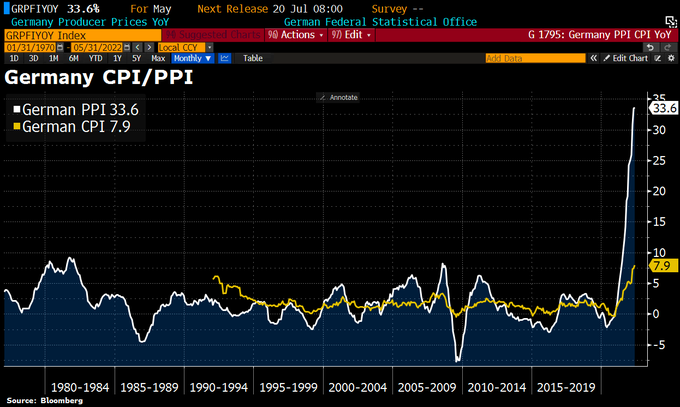
German producer price inflation in May.

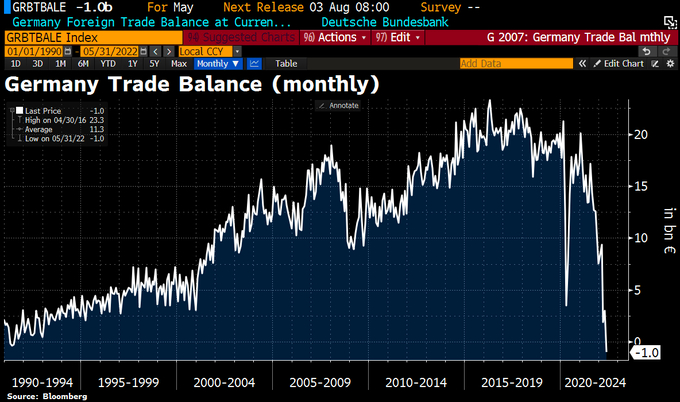
German trade balance:

Hey, the first negative trade balance in 30 years. Of course, it’s not very negative yet, but wow, that’s a decline.

Meanwhile:

Top German industries could face collapse because of cuts in the supplies of Russian natural gas, the country’s top union official warned before crisis talks with Chancellor Olaf Scholz starting Monday.

“Because of the gas bottlenecks, entire industries are in danger of permanently collapsing: aluminum, glass, the chemical industry,” said Yasmin Fahimi, the head of the German Federation of Trade Unions (DGB), in an interview with the newspaper Bild am Sonntag. “Such a collapse would have massive consequences for the entire economy and jobs in Germany.”

The German economy is essentially mercantalist. The Euro, because it includes countries which are net importers, has been  undervalued. The Germans bought cheap materials, made them into high value goods and got pretty rich.

Now the Euro collapsing (it’s almost down to even with the dollar), but it’s not collapsing enough and in any case there’s a problem, one which has been forgotten in the global order.

Physical objects, like natural gas and aluminum and oil and so on are dug up in certain places, refined in other places and shipped thru specific pipelines or on specific trucks over specific roads, or specific trains over specific railroads. They cannot be magically replaced if you cut off a large supplier, and even when they can be replaced they may cost a lot more money and the replacement isn’t instant, as with buying US natural gas.

The PPI increase is “if you can even get it.”

Germany is a manufacturing state which does not have a lot of natural resources in its own borders. It must be a trading state, and Russia was the cheapest place to get a lot of what it needed, plus there isn’t enough excess on the global market to make every good and even when there is it requires logistical solutions (ports, ships, rail lines, refineries, etc…) which are not in place.

Meanwhile the EU has sanctioned goods coming from the Chinese province of Xinjiang. It turns out that Xinjiang produces about half of the world’s supply of polysilicon, which is the primary ingredient in solar panels.

It is to laugh.

Germany is committing economic suicide over Ukraine, and Germany is the industrial heartland of the EU.

Some bottlenecks just aren’t going to be broken without some sort of deal or cut-out, the supply isn’t there.

Others can be dealt with by paying more, some will require money and time measured in years. Europe is going to wind up going nuclear, there’s no other way to make the numbers work. (So will Japan and many other nations.)

But overall the people saying that the EU was hurt more by Russian sanctions are correct.

Now don’t think this is anti-democratic: polls show that most Europeans want to cut off trade ties with Russia.

But we’ll see how they feel as they take the hits required to do so.

DONATE OR SUBSCRIBE

The EU As The Epitome Of the Iron Cage of Bureaucracy

A couple years ago I read “The Dawn of Eurasia” by Bruno Macaes. Macaes was a member of Portuguese government, very neoliberal and fairly awful while in office, but his book proved quite insightful in most areas outside of Russia, where what seems to be fear and contempt for Russia distorts his vision. (I thought this when I read it before the Ukraine invasion.)

He’s most worth reading about Europe and the EU, and one example and one passage particularly struck me at the time.

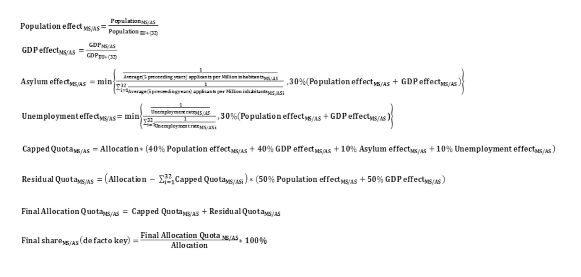
This is the formula for accepting immigrants during the refugee crisis.

Macaes writes:

I was reading the account of the meeting in my office when it suddenly hit me. The European Union is not meant to make political decisions. What it tries to do is develop a system of rules to be applied more or less autonomously to a highly complex political and social reality. Once in place, these rules can be left to operate without human intervention. Of course, the system will need regular and periodic maintenance, much like a robot needs repair, but the point is to create a system of rules that can work on their own. We have entered the end of history in the sense that the repetitive and routine application of a system of rules will have replaced human decision.

Maçães, Bruno. The Dawn of Eurasia (p. 228). Penguin Books Ltd. Kindle Edition.

Weber famously called bureaucratization an iron cage: rule by rules and not people, everyone in the same circumstance was supposed to be treated the same, and who the bureaucrat was didn’t matter: once the rules (in modern terms, the algo) had been set up, the human was just a piece of machinery.

It’s for this reason that technocrats love computers and algorithms so much; they make it almost impossible for ordinary humans to override the rules.

Many years ago I moved from Ontario to BC. My Ontario health care coverage was ended. I applied for BC coverage, but then, unexpectedly, I returned to Ontario. I had no coverage. I went to the provincial health office in person, told the person at the desk, they summoned their boss and it was explained to me that there was a six month wait, but they would fix it.

How? The only way was to finangle the system so it thought I had never stopped having Ontario coverage. There was no human discretion, just a flaw in the system which allowed them to do something they really shouldn’t have done. (This is over 30 years ago now, which is why I feel free to mention it.)

If they hadn’t, I’d have had no coverage anywhere in Canada and I was extremely sick and needed health care right away. (Which is probably why they did jiggle the system.)

The idea of bureaucratization was a good one: previous to that offices had been filled by people with a great deal of latitude, which many of them abused to help their friends and family and to enrich themselves. Even when they didn’t abuse the office, they were inconsistent, and no one knew what the rules really were and thus couldn’t plan. As Weber points out repeatedly, you need calculable law and administration to allow modern capitalism. Decisions don’t necessarily have to be good, but they do have to be consistent, or you can’t plan and one unexpected decision can destroy your business.

We moderns will note that the promise of bureaucratization hasn’t really worked out: it’s been subverted. The rules are made and somehow they always favor the rich.

The law, in its majestic equality, forbids the rich as well as the poor to sleep under bridges, to beg in the streets, and to steal bread.

—Anatole France

Now, the law has always favored the rich, but the idea of bureaucracy combined with democracy was that it would do less of that. In some time periods it did, and does, but in most all it did was change the type of rich it favored, moving from aristocrats and clergy, to oligarchs.

The EU, however, firmly believes in bureaucratization, as Macaes notes. It is what is good. The rules exist, they are followed, humans intervene only to set up the rules and occasionally tweak them, but otherwise it’s a big machine algo, and it runs like that. If it hurts or harms someone, so be it, it is fair, because the rules are being followed.

Macaes has a lovely little anecdote about Brexit and immigration which highlights the issues:

I particularly remember a conversation in Manchester with Ed Llewellyn, David Cameron’s chief of staff, where we tested different ways to reduce immigration numbers, some of them quite feasible. This was during the renegotiation process leading up to the referendum. Llewellyn seemed hopeful for a moment, but then shook his head: ‘These are ways to reduce the numbers. What we need are ways to increase the feeling of control.’

Maçães, Bruno. The Dawn of Eurasia (pp. 231-232). Penguin Books Ltd. Kindle Edition.

What the Brits wanted, in other words, was to have humans regularly making decisions, rather than one algo set up by a committee making the decisions, even if the algo was more favorable to them. Basically, can the Prime Minister or the Home Secretary decide how many immigrants come in? No? Then forget it.

It seems to me that the algo-ing of government, the bureaucratization, is a good thing up to a point: people should be treated about the same in the same circumstances. But as a practical matter,  bureaucratization, the iron cage, is used to elude responsibility. “The algo did it!” or, “That’s what the law says!”

Every algo was created by people, and while there are sometimes unforseen effects, what the algo does is the responsibility of people. If it is producing injustice, or poverty, or massive inequality those who created it, or those who are letting it run are responsible.

The more you hard-code an algo, and take people out of its implementation, or create systems which force people to become machines unable to make exceptions, the more the dead  hand of the past rules the future, and the more that the few people at the top rule everyone else. When middle and low level bureaucrats can’t actually make decisions, injustice inevitably occurs because virtually ever law or algo has blind spots: events and circumstances it did not and cannot deal with.

The evil of three strikes laws and mandatory sentencing, for example, was meant to prevent the evil of judges using their judgment to let people people off if there were mitigating circumstances. Sometimes that discretion was misused, and it would be a big story, but even more often there would be a case of someone’s third crime being stealing a bicycle or a banana.

The ultimate problem is that there’s no getting away from the fact that humans have to make decisions about humans lives. Even if we wound up in a Wall-E world, served by machines, those machines’ initial programing would have been created by humans.

The principles that exceptions need to be made and that humans need to have some control, and that over-bureaucratization removes low and middle level control don’t change the idea that people should be treated equally in the same circumstances. Provincial laws didn’t intend for any Canadian to not be covered by some provincial health care plan; the algo; the rules, had a gap, and a low level bureaucrat could make it work, at least back in the early 90s (today, who knows?)

The same is true at higher levels. There is no escape from human judgment. Attempts to bind everyone with trade deals which are immune to popular sovereignty; with treaties, and to have secret courts and central banks and so on, are all ways to try to avoid responsibility for results.

The problem with our societies is that elites aren’t held responsible for the harm they cause, nor, by and large for any good they do. We have elections without being democratic, because the feedback systems are broken.

All that has happened with bureaucratization, is that the rich still get taken care of, and the poor still get fucked, and it’s done in a way that seems “fair”.

“The algo said” is just a modern version of the “the law says” and it’s just a way to disempower almost everyone while making sure power and money are concentrated at the top.

Any algo or law which doesn’t allow for human discretion to override the algo, with a review mechanism for people who do it often, will do more evil and prove more anti-democratic than even venal spoils systems, which at least don’t pretend that office-holders and other powerful people don’t make decisions and aren’t responsible for their results.

DONATE OR SUBSCRIBE

Who Wins and Loses Because of the Ukraine War?

I’m basing this on current trends and what I see as the most likely outcome.

Russia will take about 30% to 40% of Ukraine: the East and the coast along the Black Sea, areas that are generally Russian ethnic or speaking. While they were pushed back from Kharkiv, I think they’ll take the Oblast by the end of the war. Basically, see where Russians are the majority and that’s the land that Russia will feel it can keep and not fight an endless guerilla war.
They make have to take more land than that to force a peace on terms they can stand, but they won’t want to keep it because everyone knows the West is trying to draw them into a long term guerilla war. (Such a war could be won in Ukraine because of the terrain, but doing so would require a lot of killing, deportatons and camps and many years. It’s not worth it for Russia.)

The Russians original goals will not be met, and Finland and Sweden will joint NATO (although they were already quite integrated), so in one sense it can be said that Russia has “lost”. In certain other senses it can be said to win.

But let’s look at the major players, one by one.

Ukraine: the big loser. Unless this war goes far different than I expect (possible and I’ll admit it if it does) they’re going to come out of it a smaller country with no coast, who has lost their industrial heartland and even if the gas is turned back on, they will lose most of the transit fees in a couple years max as the EU transitions away. They will find that the “rebuilding” they were promised is IMF style neoliberalism and the average person will wind up worse off.

Verdict: Disastrous Loss.

The EU: In the win column, the EU should have built up a larger military long ago and will now do so. They will be more unified, at least initially, feeling they have all supported a war and with fear of Russia acting as unifying glue.

In the lost column they have firmly moved into the US satrapy column. In order to move out they would have to create their own army that is not dependent on US built military equipment and that’s the opposite of what they’re doing. (Foolish, because the US is losing its ability to build either ships or combat planes. The F-35 was a boondogle, Boeing has lost its engineering chops, and they recently decided to decommission built ships because they are so bad.)

The increase in price of fuel (US gas is about 50% more expensive than Russian), commodities and food as well as the general inflation shock from the Ukraine war will lead to a poorer Europe. Spending more money on the military will make ordinary people feel worse off and so will inflation. Industry will be badly damaged by increased fuel and mineral prices. All of this will lead to increased political instability and is likely to help the fascist right and possible the more radical left (if the left ever gets its act together.)

Joining the US in such huge sanctions and seizing Russia’s reserves (“frozen”) means that they are choosing to join the US side of the new cold war world rather than being a third pole, and this will eventually limit their trade options, as they, like the US, cannot be trusted with money.

The EU is, overall, likely to come out of this war poorer, more isolated and with increased political instability, but with a much larger military and feeling more unified at the elite and country to country level (at least until and if political instability changes that.)

Veridict: Slight Loss.

The US: The US has gotten Europe firmly back as a satrapy. NATO expands, the Europeans will spend more more on US military goods and buy expensive US gas and oil. The possibility of Europe becoming independent and forming a third pole in the upcoming cold war between the US and China is now minimal, and essentially zero for at least a decade or two.

On the negative side, Russia is now firmly in the Chinese sphere. Because the US’s strategy in the case of a war with China would be to strangle China with a military enforced trade embargo, this is a big problem. Russia can supply China with massive amounts of food, fuel and commodities, making the “choke them out” strategy against China unlikely to succeed. Likewise a friendly Russia means China has a relatively secure flank to the Northwest. There are even signs of Chinese-Indian rapprochement, and though I’ll believe it when I see it, India not joining against China would be a huge boon to China.

Since China is the “real” threat, not Russia, the one country that can replace the US as the world’s most powerful nation, strengthening China’s position is a loss.

The US also will suffer due to inflation from knock on effects of the Ukraine war, and that will cause increased domestic instability. Elites continue to funnel massive money to the domestic security apparatus (police of various varieties, spies who target US residents), however, and elites feel fairly secure, though I think they’re wrong as they’re funneling resources to police who stand a good chance of joining a right wing uprising.

The final major effect for the US is that freezing Russian reserves and encouraging the massive level of sanctions, is seen by most of the world as evidence it’s not safe to keep money in the US lead banking system, or even to trade with them. This has accelerated de-dollarization and I suspect will be seen as the precipitating event of losing reserve status for the American dollar. The world will split into two financial blocs, one centered around China-Russia, the other around the US-EU. The US receives huge benefits from reserve status and from being at the center of the world financial system, and as with Britain after WWI, it will suffer mightily when it loses this position.

My evaluation is that what the US will likely gain from the Ukraine war is less than it has or will lose: dollar hegemony and being the financial center of the world are a big deal, and confirming Russia as a junior Chinese ally makes their main geopolitical rival far stronger.

Verdict: Loss

Russia: Russia has weathered the initial economic storm well, but most EU countries will move off Russian gas and oil. Some of that gas and oil cannot be brought to market anywhere else for a few years (probably 3) until new pipelines are built and while there are customers, they will pay less than the Europeans did.

Sanctions will not cripple Russia, but there are goods like advanced semiconductors and, more importantly, some tech needed for gas and oil extraction, that they will be cut off from. China cannot immediately replace those oil and gas related goods, and they are at least ten years behind in semiconductors (and themselves cut off from some key capital equipment they can’t yet build). That said the oil and gas tech is probably within quicker reach, and Russia doesn’t need the most advanced semiconductors in large quantities so far as I know.

In most economic terms Russia will be OK: they have a big food surplus; they have more than enough fuel, of course, and they can buy almost everything they don’t make from China, who is not going to cut them off; indeed, rather the reverse. India is also rushing to cut deals with Russian businesses. Sanctions will force more import substitution and help overcome the “resource curse”, making it cost-effective to make more things in Russia (if they aren’t overwhelmed by cheap Chinese goods.)

Sanctions will not cripple Russia the way they have many other countries, though they will be felt. Nor will they cause a revolution and if there is a coup it will be because Putin is old now and may be ill with Parkinsons or something else.

In territorial terms Russia likely to wind up larger. They get the industrial part of Ukraine and the coast, they can send water to Crimea (which has been cut off from years, and whose agriculture was devastated as a result) and while many will say they didn’t win the war, etc… people who want to stand up to them will not be keen on “winning and losing 30% of our country.” If that’s victory, it looks pretty bad.

A unified Europe with more countries in NATO and a bigger military is a loss for Russia, and one can expect that NATO will move more missiles and ABMS close to the Russian border, including hypersonic missiles as soon as they have them. In that sense the war is a clear loss: Russia wanted those weapons removed from near its border, and there will probably be even more of them.

In the end Russia will be able to credibly claim it won the war as a war: it took territory and kept it and it’s hard to say that a country which took its enemy’s territory lost a war. That said, there will be a case that it is a Pyrrhic victory, in that there is an economic hit, NATO has expanded, Europe will have a bigger military and so on.

The counter-case is simple: Ukraine was talking about getting nukes and had started shelling Donetsk in what looked like a prelude to invasion. Russia didn’t get its maximal goals, but it did gut Ukraine as a threat and did secure Ukrainian land in what is likely to be a semi-permanent fashion absent an all out NATO/Russia war.

The maximal goals didn’t happen, but in a bad situation Russia may reasonably claim it got quite a bit. As for sanctions, every year there had been more of them, none had ever been rescinded and all the war did was move them up.

Verdict: Marginal victory.

China: Yes, strictly speaking China isn’t involved in the war, but the war affects China greatly. China needs about 10 years to get to a reasonable parity with the US in semiconductors and aviation, the golden technologies of US hegemonic rule. The Ukraine war has made it clear they probably have less time than that, and that the world economic order is likely to split sooner because China is stuck between US demands to support sanctions and its own strategic needs, which require Russia as an ally, or at least a reliable supplier. Russia being decisively defeated or economically crushed would be catastrophic for China, so they must keep it alive and viable.

Still, all in all having Russia unable to sell to or buy from the West is unbelievably good for China: there is no alternative for Russia. If they can’t go to the West they must go to China. India may be willing to trade, but India’s economy is tiny compared to China’s and its industry scarce. China can make almost everything Russia needs and everything it can’t make it’s working on learning how to make. And, as previously discussed, Russia as an ally makes it impossible for the US to choke China out in a war.

Verdict: Victory

Concluding Remarks: Of course all of this based on a model of how they war will go which may not be the case. Perhaps the maximalists in the West are right, and the Russian military is fundamentally incompetent, can’t do logistics to a disastrous degree, and is on the verge of collapse. If you think Russia can’t even win the conventional war, all of this is is nonsense because a definite loss is likely to lead to regime change and possibly even collapse.

Likewise if you think that sanctions will have much more effect than I do, or that China will not integrate with Russia economically, then this is all wrong.

But overall, this war looks like a case where Russia gets a marginal victory; the US and the EU get some wins but their victories are effectively Pyrrhic, and China is the big winner.

DONATE OR SUBSCRIBE

Macron (Radical Neoliberal) vs. Le Pen (Reactionary Fascist) in France

So, this is probably the best commentary on why it’s close:

https://twitter.com/lib_crusher/status/1512489172090585094

The current French retirement age is 62. Macron has said that, if re-elected, he will increase it to 65. Le Pen will decrease it to 60.

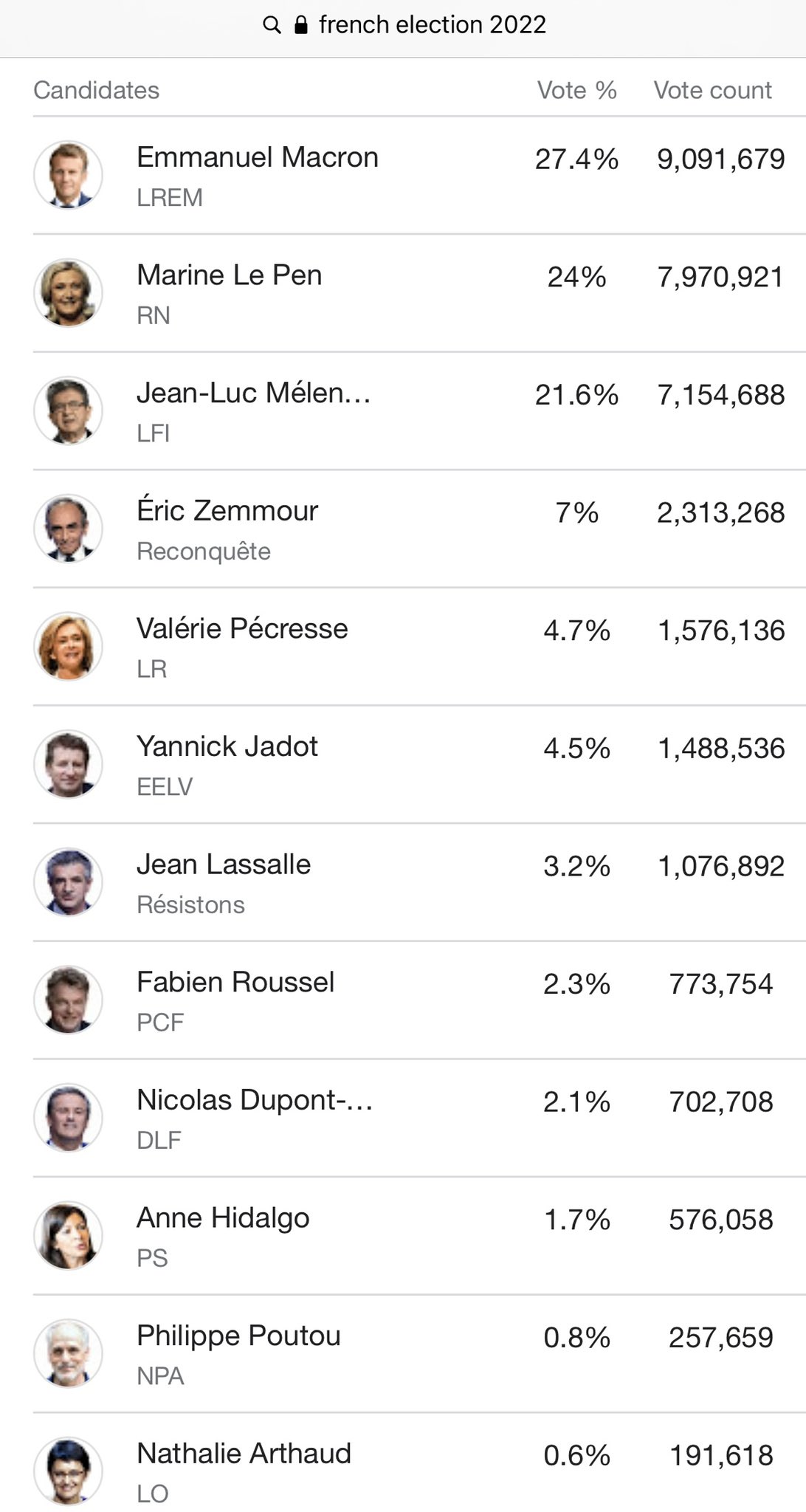
France has a run-off system. The top two candidates are pitted against each other in the second round. In the first round, results were approximately as follows:

Note that Jean-Luc Melenchon, the left-wing candidate, was less than three percent behind Le Pen.

Melenchon’s policies?

His manifesto includes lowering the age of retirement, hiking the minimum wage, and freezing food and fuel prices.

As a public denouncer of the free-market economy, Mr. Melenchon advocates “state intervention in the economy” to spread wealth, guaranteeing what he calls a “dignified life for all workers.” He told a campaign rally in Paris he would heavily tax the wealthy.

Mr. Melenchon said: “The free market, as you see, is chaos. Another world is possible.”

If he takes office, Mr. Melenchon hopes to pass a “social emergency law” as soon as possible, which would increase the minimum wage to €1,400 per month (from €1,269.03 at present) and cap salary differences between workers and CEOs at one to 20.

He pledged to enforce greater controls on the movement of capital, and guaranteed jobs for the long-term unemployed.

He also announced plans to give 800,000 public sector workers on temporary contracts a permanent tenure – as well as plans to prevent top companies listed on the French stock exchange from paying dividends.

He wants to lower the retirement age in France from 62 to 60, unlike Mr. Macron who currently wants to raise it to 65 to “balance the pension bill.”

As a keen proponent of mass wealth redistribution, Mr. Melenchon also wants to boost the capital gains tax up to the same level as income tax and introduce a progressive corporate tax, as well as seize inheritances greater than €12 million.

That’s a very left-wing program in the current context.

Meanwhile, as John Nichols points out:

If supporters of the French Socialist, Communist, Trotskyist, and Green parties had backed left-wing presidential candidate Melenchon, he would not merely have beaten Le Pen. Melanchon would have finished in first place, ahead of Macron.

So, because the left won’t cooperate with each other, they have wasted a good chance of a real-left wing government, and the French are now forced to choose between a nativist fascist (who, among other things, would not allow single women to have in vitro fertilizations), and an arch-neoliberal who wants to make everyone but the rich poorer.

Neoliberals have wanted to cut pensions for ages (true also in the US and almost everywhere else), so Macron is making the bet that people will hold their noses and vote for him, rather than for Le Pen. But the swing is five years; if Macron wins, you retire at 65, while if LaPen wins you retire at 60.

Strangely enough, old people prefer Macron, and young people prefer Le Pen:

Which is to say the strategy of forcing votes against the reactionary right-winger will work, until it doesn’t. Polls suggest it will work, again, this time, but polls have often been wrong in such close cases, and polls suggest it won’t keep working.

The Left will have one more chance to get its act together before the next election. It had best take that chance. Fortunately, Le Pen’s economic  policies are foolish and won’t entirely work (not because of the pension age, but because she still wants to make the rich, richer), but once reactionaries get in power, they tend to use their power to crush the Left.

France is one of the few places in the “developed” world where the Left still stands a good chance of getting into power. Once they do, if they run the economy well (which will be easy, because the world order which made it impossible is dying), then they can create generational change and lock in left-wing politics for 30 to 50 years.

If they don’t, however, the Right will set the new ideological terms.

DONATE OR SUBSCRIBE

Delusion Regarding the Fall of Neoliberalism and Globalization

So, the article below was published December 8th, 2015.

The pull quote is:

Neo-liberalism is nearing the end of its cycle. It will kill a lot of people dying, but its death is now ordained and can only be slowed by fanatical levels of police state repression in a few countries. And its death convulsions and the birth pangs of the new system will create a new age of war and revolution which will kill far more.

This is now as close to inevitable as human affairs, endlessly complicated and subject to unexpected shocks, can be.

Nothing has changed, the process has simply continued. Notice the repression going on in the US right now. Since I wrote it, the UK left the EU, there was massive resistance to Macron in France, and so on. We have massive fires all over the world: Australia, California, South Africa the Amazon and more. Wealth continues to concentrate at the top, etc, etc…

These convulsions take time. Slap the start of the actual fall as 2020, with the UK’s Brexit, and we’ve got 12 to 20 years to go. This one’s going to be bad, really, bad, simply because of climate change and our vast over-exploitation of limited resources. There’s going to be a lot of real hunger and lack of water, and so on.

The next age is undetermined, but one possibility is a centrifugal period. It is hard to imagine a future in which, India, for example, survives as a unified nation. For that matter, I’m not sure I’d put my money on China holding together over the middle run: 50/50 it’s fallen into warlordism by 2050 to 60.

The simple way to make your guesses is ask if a country can feed itself with domestic production AFTER the effects of climate change. If it can’t even feed itself now (or only barely); or if it is going to have serious water issues (water, obviously affects agriculture, so it’s not really two things), then the smart money is that it’s going to break up or lose effective control of various hinterlands.

And if you’ve got resources a more powerful nation on your border wants, well, that could go very badly for you. (My fellow Canadians, who seem clueless about how violent Americans are, should take note here.)

On the upside, this will be a very interesting period to be alive, if you can stay that way.


Natalie Nougayrède writes in the Guardian about The Front National’s victory in France:

Marine Le Pen has no solution for France’s problems, her economic programme is all about retreating from the outside world and Europe. Her social vision is of a mythical, homogeneous France that never existed. What she has to sell is an illusion. It’s only because so little else is on offer that people are buying.

This analysis is, there is no kinder way to put it, delusional.

And Nougayrède should know it, because she writes:

The impact of globalisation marked the end of what the French demographer Jean Fourastié coined Les Trente Glorieuses (The Glorious Thirty), the 1945-1975 period when France was modernising and increasing its international influence. There is much twisted nostalgia in the rise of the National Front.

Nougayrède blames this on the oil shocks, which the entire West failed to handle (note that Japan, far more vulnerable to the oil shock, DID handle it. Their later failure had other causes). She notes that France’s elites have not, since 1975, been able to turn things around, something I have noted as well.

But she is wrong about a retreat from globalization being delusional. The simple fact is that in France and almost every other country (including, by the way, most African countries), growth was better before globalization, and the proceeds of that growth were distributed to their populations much more evenly.

This is a fact, and you can only argue against it by invoking China (which used classic mercantalist policies, and was not meaningfully party to the 1945-1975 consensus economy.)

There will always be trade. There will always be global movement in goods, capital, and ideas, but more is not always better.  In fact, one can easily argue that more is rarely better.

As for “Europe,” the fact is that increased integration has not been to the benefit of most Western Europeans. That assertion is, again, extraordinarily hard to argue against and is especially true of the creation of the Euro.

Nougayrède wants France’s leaders to fix things, and not to fail, but she is very nearly as delusional as them. She admits that their failure has led to the rise of Front National, but cannot admit that their policies have failed, economically, along the lines that Marie Le Pen says they have.

Just because someone is a near-Fascist does not mean they are wrong about everything. I have no tolerance for LePen’s brand of Imperialism and cultural supremacy, but she, like Trump, is telling a lot of truths to a lot of people who feel like their country has been on the wrong track for a long time. (In the U.S., white, working class male salaries peaked in 1968. No matter how much you scream about white privilege, you are a fool if you expect white males to gravitate towards anyone who doesn’t at least pay lip service to reversing that.)

As an economic project, the EU is a failure for many of its members, including France. There are exceptions (Germany, Poland, etc.) but the losers cannot be expected to just sit there and take the beating forever. The “beating” has been exacerbated by Europe’s deliberate imposition of austerity. It is not just that Europe’s elites have failed to create a good economy, it is that they have deliberately made the economy worse for the majority of residents in many of its countries.

Until we can honestly evaluate the failures of neo-liberalism, and gut globalist cant which claims more trade and capital flows are always a good thing (and, even if they aren’t, are “inevitable”) we cannot fix the economy.

France, like about half of the EU, should leave the Euro. It should re-impose tariffs on a wide variety of goods and produce them in their own countries. Yes, they would cost more, but wages would be higher. It should also move radically to non-oil-based energy (as is true of, well, almost everyone).

These basic policies are not difficult. Corbyn is not wrong to say “make the necessary adjustments so it will work today, and go back to post-war policies.”  It failed,  yes, but it was the last economy which spread money evenly through the economy.  Make sure it’s not sexist and racist, update it for new energy technology, and try it. It may not be the best solution (I’d like some fairly radical changes), but it’s certainly not crazy, given that it did give France those 30 great years.

The failure to deal with the oil price shock doomed the post-war world, yes. But it is 40 years later and we have technology and knowledge they did not have.

Until the developed world’s sanctioned intellectuals (as opposed to pariahs like myself and my ilk) and their masters come to grip with these facts, the population will continue to turn elsewhere. They may turn to sane and reasonable people like Corbyn, or they may turn to people like LePen and Trump, but people will not put up with “it’s going to get worse for the forseeable future” forever.

We can have reasonable policies, which will make the world better for everyone (even if that means there will be a lot less billionaires–the Corbyn solution), or we can have the rise of fascists and their left-wing equivalents.

The room in the mushy middle for those who aren’t willing to do something radical to fix the economy and other problems is narrowing. It will continue to narrow.

Our current elites will not adjust, so the question is: Who will we get? Corbyn and FDR? Mussolini, LePen, Trump?

Neo-liberalism is nearing the end of its cycle. It will kill a lot of people dying, but its death is now ordained and can only be slowed by fanatical levels of police state repression in a few countries. And its death convulsions and the birth pangs of the new system will create a new age of war and revolution which will kill far more.

This is now as close to inevitable as human affairs, endlessly complicated and subject to unexpected shocks, can be.


If you enjoyed this article, and want me to write more, please DONATE or SUBSCRIBE.

The European Union

CONTENT WARNING: *** MANDOS POST *** MANDOS POST *** MANDOS POST ***

Both inside and outside Europe, the left is highly divided on the topic of the European Union, with a large current being firmly against it for reasons that are actually quite understandable, from multiple perspectives (not just economic). The recent history, especially the Syriza episode in Greece, does not help the reputation of the EU from a left-wing perspective, and there is a temptation to see anything that damages the EU as being good for the people of Europe.  Jeremy Corbyn’s somewhat incoherent position towards the EU can therefore be dismissed by some as the result of a circumstance impossible for him, whereby a good chunk of Labour voters were supportive of EU membership while a principled leftist like Corbyn would have to, in their inner selves at least, be against it.  The EU’s association with neoliberal economic policy has led some, including a large percentage of this blog’s own commentariat, to view Brexit as just another stick with which to beat the neoliberal dog, so to speak, and to take at best a neutral view of who and how the stick is wielded.

It is absolutely correct to say that EU institutions have developed in such a way as to embed neoliberal attitudes and policies deeply within them. The institutions of European integration were largely built at the very same time as the neoliberal consensus’ apparent accession to the Mandate of Heaven.  (Providence does not hand out these mandates on the basis of evident goodness or wisdom.)  Starting from the late 2000s, it became obvious that neoliberalism was losing the Mandate, and no clear claimant has as yet emerged, a worrying sign.

The dilemma for those who want a more just and sustainable human future is extent to which the active dismantlement of the EU is necessary or warranted.  There is a left-wing position that is a kind of short-term nihilism which celebrates the destruction of institutions as a necessary step in creating the opportunities for beneficial change.  This position should certainly be taken seriously and becomes increasingly relevant as neoliberal institutions continue to operate in “zombie” mode, deprived of the providential imprimatur.

The ideal case is that the dismantlement of the EU would lead to a condition that was more beneficial, i.e., replacement from the ground up with, if not with a single institution, then with a collection of polities that are better empowered to serve the needs of their citizens.  The prospects for this can only be understood in terms of the forces that created the European Union (and its predecessor organizations) in the first place.  Europe as viewed from a Martian height consists of extremely unstable, contentious nation-states with badly drawn borders (as it is impossible in Europe, the birthplace of the nation-state, to draw the borders well).  A handful of these nation-states took advantage of a specific set of historical circumstances to become great colonial-imperial powers, but partly due to their own internal contradictions and external developments eventually lost their own heavenly mandates.  Present-day Europe, ex-EU, is a checkerboard of small states and middling industrial powers which had to reinvent themselves in the latter half of the 20th century.

A cursory, common-sense examination of Europe’s present-day geographic situation indicates that the checkerboard (or chessboard) analogy is more than apt.  European countries sit on geographically strategic (if resource-poor, relatively speaking) real estate between the current hegemonic military powers and become easy prey for the very colonial tactics Europe itself perfected.  The post-WWII architects of European convergence, themselves functionaries of states skilled in colonial tactics, were absolutely correct to surmise that Europe required a super-state level of organization that was at least partly independent of other power blocs in order to prevent being further carved up like a Thanksgiving turkey. The Middle East’s current, long-standing troubles illustrate clearly what can happen in that case.

The adolescence of European institutions during the neoliberal moment presents the central dilemma, because it itself is now a major threat to a protective European unity.  The question is: what is the optimal and most feasible way to lever out zombie neoliberalism without putting European countries at risk of “integration” into the pathologies already evident in the current hegemons?  The question is not an abstract one: one of Brexit’s consequences is that the UK likely will adopt an even harsher internal economic stance with integration into the weaker, less consumer- and worker-friendly economic regulation of the USA.

My own position is that the only way to resolve the deadlock is by the boring, difficult work of building cross-border, cross-polity popular solidarity both inside and outside the current EU.  It is the only way to enshrine the benefits of European integration with the necessary reform of the EU’s economic management.  Anything else — and admittedly, “anything else” is the most likely prospect — risks that those who live in Europe jump from the frying pan into the fire, following a mirage of dead-end cultural-nationalist idylls and emotional appeals to a clean, safe world that never really existed.

Page 6 of 18

Powered by WordPress & Theme by Anders Norén