The horizon is not so far as we can see, but as far as we can imagine

Category: Financial Crisis Page 4 of 13

World Economy Heading for Recession

That seems most likely to me. China has been stalling out for some time, Japan’s “stimulus” didn’t work, Europe has been suffering under austerity for years (despite some minor good news), the other emerging economies are doing badly, the petro-states have been hammered by the drop in oil prices and now the US job market has fallen off a cliff after a few months of excellent results.

Those results were driven almost entirely by the drop in oil prices, but were unsustainable with most of the rest of the world economy in the doldrums.  Low oil prices should be generally good for everyone but oilarchies, but their effect is muted (in comparison to past decades) by the oligarchical and oligopolistic nature of our economy.  Put simply, there are too many barriers to entry for new businesses to arise and even lower oil prices don’t put enough money into ordinary people’s hands to create enough new demand for long enough.

In an economy where individual sectors tend to be controlled by a few companies, and where those companies are already awash with money, more money means little; those with pricing power will simply take it away and add it to the stockpiles of money they already aren’t using for anything productive.

The standard solution to the situation we’re in now would either be to implement very high corporate and individual marginal taxation (if private actors won’t spend, take the money from them) and/or to break up oligopolies and/or to heavily regulate them so that they aren’t sopping up all the excess cash in the economy.  (Why are app stores still allowed to take 30%, for instance?)

Since we refuse to do any of those things, and since we only print money to give to rich people and corporations (thus pooling money at the top, doing little for widespread demand), the western economy (which includes Japan) remains stagnant. You may get a few good months here and there, but that’s all you’re going to get.

Labor Force Participation Rate Graph

Labor Force Participation Rate Graph

Let’s discuss some individual countries and regions. First, take a look at the above labor force participation rate graph. It shows the number of people either looking for work or who have work.  Can you tell that there were a few good months?  That’s how good the American economy is after your few good months. It didn’t really improve much, it just went horizontal.

You need a few years of such job results to make a difference.  And that’s before we get to the fact that most of those jobs were low-paying and that all of the gains of the last economic cycle have gone to the top three to five percent of the population (depending on how you slice it).  And the top 1% has done better than 3%, the top .1% better than the top 1% and so on. This is your economy on unconventional monetary policy.

Japanese monetary base and inflation to early 2015

Japanese monetary base and inflation to early 2015

Ah, unconventional monetary policy. In Japan they call it “Abenomics.”  The idea was to get inflation going in the Japanese economy–get the Japanese to spend and bring Japan out of its 30 year slump. The chart to the right shows how well it has worked.

But don’t think that money has been “wasted!” Abenomics may have done nothing for ordinary people, but it’s helped a lot of rich people become richer. That money went somewhere. In Japan’s case, a ton of it will have gone overseas, with foreigners borrowing for low costs in Japan and then speculating with that money elsewhere for higher gains (or so they hope).

Unconventional monetary policy is, and always has been, about giving money to the rich, wealthy, and corporations. At first, it was about bailing them out after the financial collapse. Now, it’s just about giving them money, lots of money, in a way that the hoi-polloi can’t access.

This brings us to Europe and austerity. Austerity is a wonderful thing, if you’re rich. Public assets are put on the selling-block which you normally could never buy and they are put there for cheap. You get to own more of the economy, your relative wealth increases. While it’s true that one might be richer in a generally prosperous economy, you must remember, this isn’t about absolute wealth. It’s about relative wealth. Better to be somewhat poorer and able to lord it over everyone else, than be richer in a world where the peons don’t have to kowtow to your every whim or don’t have to live miserable, want-filled lives. If the price is a lot more poverty, that doesn’t affect you in any meaningful way.

Not all peons suffer, of course.  A lot of Germans do very well in the current regime.  As the South of Europe suffers under austerity, they’re doing great. The worse the southern economies are, the better for Germany, since it reduces the price of the Euro, increasing German exports. If everyone in the Euro area was doing well, Germans wouldn’t be doing nearly so well. If the price is suicides, widespread poverty, homelessness, and so on, that’s certainly a price Germans are willing for Italians, Spanish, Greeks and Portuguese to pay.

Meanwhile in Canada, there is a housing bubble which kept on going from the point where the US bubble collapsed. Better, inflated prices are guaranteed by the Federal government, so when the bubble bursts, it can cause maximum damage to public finances. With oil prices falling, and with Canada now a petro-state (as I noted almost a decade ago) due to deliberate government policy, those housing prices are looking less and less sustainable.

In the UK, we also have London’s housing bubble (which is to say, the majority of the actual economy of the UK, if you want to call a housing bubble and financial services an economy, which UK politicians do).  This shouldn’t be a surprise, since the UK hired Canada’s ex-central banker to come to the UK and do what he did to Canada: Blow a nice big bubble. The UK hardly has any other economy besides real estate and financial ponzi schemes, so we’ll see how that works out for them.

In general, understand this: The world bailed out bankers and brokers and traders  and they went back to doing what they were doing before. Blowing bubbles. There are CDOs out the wazoo, there are stock market bubbles, there are real-estate bubbles in various places (they just tend to be more localized now, but they’re still huge).

The economy will NEVER be good for everyone until this is changed, but that doesn’t precisely mean this is unsustainable. The elite’s had one fundamental realization and it was this:

“We can print as much money as we want and as long as we make sure it doesn’t get into ordinary people’s hands it won’t blow up the economy.”

Many people expected that unconventional monetary policy would cause general inflation. It hasn’t because the money stayed in the hands of a very few people and major corporations. It did cause massive inflation in the things rich people buy, but not general inflation.

So the rich, and the politicians and central bankers they own, aren’t worried about the various bubbles because they handled them in 2007 and 2008, and they’re sure they can handle them the same way if they burst again. These bubbles may never all burst at the same time again, because if they show signs of doing so, the elites can always just have the central banks print money and buy up assets before they even become distressed.

As long as there is no actual price discovery (and how can there be), there is no real threat to the only part of the economy that matters: The economy of the people with enough money buying up politicians.

Everyone is addicted to this game, even China, which has printed unbelievable amounts of money (more than Japan, America and Europe combined) and has used it to create vast amounts of unused and unusable housing and other boondoggles. China, granted, wants much of the benefits to get to ordinary people (because the Chinese are still willing to riot extremely violently and the Communist party’s leadership knows their lives are on the line), but they’re still playing the late-capitalist game of credit pumping, rather than the mercantilist game which built the Chinese economy. That makes sense, in a way. As China’s customer-economies stagnate, it becomes harder and harder to create widespread growth for the most populous country in the world through simple exports.

The correct strategy would be to start decoupling and move to a domestic market, and in a sense, the Chinese have tried that, but they’ve bungled it on boondoggles. Capitalism of the variety we do today is terrible at redistribution and redistribution is what the Chinese economy needs, in a huge way, in order to boost widespread demand.

So that, my friends, is your world economy on austerity and unconventional monetary policy.  As I predicted right after Obama put out his worthless “stimulus” program in early 2009, for most people, the economy will not recover for at least a generation. It will only recover then if the population is willing and able to rebel, peacefully or violently. If not, we are in for decades of stagnation and decline, exacerbated by the absolute certainty of catastrophic climate change.

And so it goes…


If you enjoyed this article, and want me to write more, please DONATE or SUBSCRIBE.

Do Tsipras and Syriza want to resist Austerity?

By Mark From Ireland (Elevated from the comments)

(In response to my article on whether Syriza got owned, Mark writes):

Did Syriza get owned?

Yes and No. Syriza is a coalition between a variety of factions ranging from PASOK lookalikes to people with genuinely socialist principles. I’ll be interested to see how Alekos Flambouraris for example will react, will he help “sell” this within the Syriza coalition?

If the currently dominant faction (who have always wanted to work within the Euro framework and are very pro-EU) are to succeed in getting Syriza to accept this capitulation they’re going to have to override internal resistance. From whom? My guess would be that the resistance will centre around Panagiotis Lafazanis and the “Left Current/Left platform” grouping. The “Left Current/Left platform” are, I believe, fairly well organised and they do have a consistent critique not only the current state of affairs but also of capitalism per se. Lafazanis and his comrades can truthfully say that in attacking the capitulation to the troika that they are merely defending the platform upon which Syriza stood and that anybody who wants to vary or overturn that platform has to provide cogent and compelling reasons as to why. But the problem that Lafazanis and his comrades face is both one of policy and of internal organisational strenght. Principles are all very well but if you don’t control the party structure you’re going to lose every time. I said above that they’re “fairly well organised” but are they as well organised as Tsipras and his supporters?

Tsipras’ opponents to the left face a very real problem and one which reminds me in a way of the problem faced by the British Labour left when confronted with Tony Blair. Like Blair Tsipras has a substantial personal mandate and like Blair he’s got a record of going over the heads of his critics to party congress (he’s already successfully done this over candidate lists) and also like Blair he’s got a record of successfully campaigning alone – of very pointedly not campaigning alongside the left-wingers. Just like Blair he can say that Syriza’s victory is a personal victory brought about by him. (He’s also tried Blair’s strategy of giving difficult posts to left-wingers* how that will work out is something that will tell us a lot. Blair successfully marginalised his internal opposition using it whether Tsipras can do the same I just don’t know as the Blair/Tsipras analogy can only go so far).

So the question in a way isn’t so much one of whether or not Syriza got owned as one of whether Syriza is a coherent and viable movement without Tsipras and his followers. I have my doubts.

I hope that Greece manages to resist but I doubt they’ll resist if Tsipras remains at the helm as he never wanted to resist in the first place.

*What for purposes of shorthand I’ll call the Bennite and Militant tendencies

Did Syriza get owned?

The details of the Syriza request to the Troika are here, for those who want to read the actual list. The public statement is here.

The best analysis I’ve read of the deal, as compared to Syriza promises, is by Stathis Kouvelakis, in the Jacobin Magazine.

Kouvelakis makes the case, convincingly to me, that Syriza caved, and got virtually nothing of what it wanted.  Here is a summary of what Syriza wanted:

Not consenting to any supervisory or assessment procedures, it requested a four-month transitional “bridge program,” without austerity measures, to secure liquidity and implement at least part of its program within balanced budgets. It also asked that lenders recognize the non-viability of the debt and the need for an immediate new round of across-the-board negotiations.

But the final agreement amounts to a point-by-point rejection of all these demands.

…..

In the Eurogroup’s Friday statement, the existing program is referred to as an “arrangement,” but this changes absolutely nothing essential. The “extension” that the Greek side is now requesting (under the “Master Financial Assistance Facility Agreement”) is to be enacted “in the framework of the existing arrangement” and aims at “successful completion of the review on the basis of the conditions in the current arrangement.”

Kouvelakis goes through the agreement point by point, and backs up his argument.  You should read the entire piece.  More important than proving the obvious (that Syriza got virtually nothing) is why.

The question that emerges, of course, is how we landed in this quandary. How is it possible that, only a few weeks after the historic result of January 25, we have this countermanding of the popular mandate for the overthrow of the memorandum?

The answer is simple: what collapsed in the last two weeks is a specific strategic option that has underlaid the entire approach of SYRIZA, particularly after 2012: the strategy that excluded “unilateral moves” such as suspension of payments…

Kouvelakis calls part of this the “good euro” strategy—the supposition that anyone in power in the Euro area wanted Syriza and Greece to get real debt relief and exist austerity.  This, as I have argued in the past, is delusion:

The key here is psychological. Greeks need to admit that their fellow Europeans do not care how badly they suffer; need to acknowledge that they are not seen as Europeans by their fellow Europeans, and need to look East and South for their survival and future prosperity.

Until Greeks get through their heads, and hearts, that the other European countries are not their friends, they will continue to suffer.

Unilateral is the key word.  Greece cannot depend on any other nation in Europe to look after its interests, let alone Germany (the very idea that the German government cares one whit how much Greeks suffer is so laughable as to move beyond fantasy into insanity).

Greece must do what it can it unilaterally.  This doesn’t mean no negotiation, but that negotiation will not be with Europe or Germany or the ECB, it will be with other countries who need what Greece has to offer enough to make a deal.

Read the Jacobin article.  And understand what just happened, because as Kouvelakis notes the only thing worse than defeat is pretending it was victory.

None of this means that victory is not still possible.  But it is only possible if Syriza spends the next few months planning moves which do not require Europe’s approval.

I genuinely hope they do.  The sooner they do, the sooner Greeks will be better off (though yes, the transition will be painful), and the sooner the current European and World system, which is causing so much unnecessary suffering, will end.


If you enjoyed this article, and want me to write more, please DONATE or SUBSCRIBE.

Syriza and Greece Seem to Have Been Owned

So, the Greeks have an understanding for an extension of the loan agreement.  On Monday they have to present the “reforms” they will be undertaking in exchange for it.

I don’t know what those reforms will be, but I know that the agreement still gives the Troika (now called “institutions”) veto power over Greek policy.  The key text in the mealy-mouthed statement is this one:

The Greek authorities commit to refrain from any rollback of measures and unilateral changes to the policies and structural reforms that would negatively impact fiscal targets, economic recovery or financial stability, as assessed by the institutions.

The Greeks also promised to pay back everything.

Yeah, Tsipras may be attempting to portray this as a victory, but it’s not.

The bottom line here is that Syriza weren’t really willing to default or Grexit.  One can note that they campaigned on ending austerity, but staying in the Euro.

That was always problematic: yes, that’s what many Greeks want, so it was a political winner, but if they were serious (and it appears they were) it left them without the ability to actually negotiate a better deal.

Much has been made of the fact that Greek Finance Minister Varoufkis is an academic specialist in game theory.  In the the early days he seemed serious about being willing to default.  It appears he wasn’t, it was a bluff.

I’m not an expert on game theory, but I do know something about it, and about negotiation and I’ll tell you this, for threats to work they must be credible, and to be credible you must be willing to actually go through with them.  Faking is never as good as sincerity.  Having campaigned on “have your cake and eat it too”, Syriza was in a bad position to negotiate with Europe.

I had hoped they were negotiating to show the Greeks that no good deal was possible, then would be willing to say to Greeks “only default and Grexit is viable.”  So far, it appears not.

It’s worth noting that reports are that Southern politicians in places like Portugal, Spain and Italy were pushing for no debt forgiveness.  For their own political futures, they need to be able to say “there was no alternative”.  But, of course, debt forgiveness would be good for all of those countries, meaning politicians pushing against it for Greece (setting a precedent allowing it for them) are acting  against the best interests of their own countries.  There is a word for such people, and it starts with “T”.

The Greek Communist party refused to join with Syriza in a coalition government because they expected this to happen, they have been proved correct.  If Syriza does not get a very good deal, or spend the next few months making the case to Greeks for default; in other words, if they don’t turn this around, then they will have their one term and the Greeks will turn to someone else.  Golden Dawn, the fascist party, came in third, but Syriza voters, being left-wing, might prefer the Communist party.  We will see.  Syriza, after all, is not very left wing at all.

It should be noted that we don’t know what threats were made behind closed doors. My guess is that they were very harsh: Greece cannot feed itself, it cannot fuel itself, it has very little to offer in exchange for the foreign currency it requires to buy what it needs.  A default and a Grexit where the Troika and other European countries were not trying to punish it could be managed.  But one where they did seek to punish it would be difficult.  Syriza may not have properly gamed out how to survive in that scenario, and may have been surprised by how punitive the Troika intended to be in the case of default and Grexit.

If so, that is political incompetence (and game theory incompetence).  One should always know what one’s best alternative to a negotiated settlement is.

I’ve written in the past how Greece could handle such a scenario.  (Here and here.)  It’s not an insoluble problem, but it does require being willing to backhand Europe as hard as they have backhanded Greece and then to get even nastier.  Greece has a lot to offer Russia, for example, and Russia can take care of Greece’s fuel needs easily in exchange for Greek bases and so on, which essentially cost Greece nothing.

The key here is psychological. Greeks need to admit that their fellow Europeans do not care how badly they suffer; need to acknowledge that they are not seen as Europeans by their fellow Europeans, and need to look East and South for their survival and future prosperity.

Until Greeks get through their heads, and hearts, that the other European countries are not their friends, they will continue to suffer.  Until they are willing to take the losses that Grexit and default will impose, things will continue to get worse.  (Being genuinely willing to take those losses is also the only way they might be avoided.)

I note also that sheer idiotic incompetence of Syriza in not putting in place currency controls to prevent capital flight during the negotiation period.  This is virtually an own-goal it is so stupid, and should bring into question just how smart Varoufkis is (or Tsipras, if he over-ruled Varoufkis.)

I wish the Greeks the best. But as with all those who have been horribly damaged by neo-liberalism and austerity, they need to get through their heads that those in charge of the policy have no fellow feeling for them; that people like Merkel, Shauble and the Germans who support them are enemies, not friends, let alone family members in some big European family which cares about all Europeans.

This is economic war, with the casualties that implies.  The Germans and the ECB are treating it as such; the collaborators in Italy, Portugal and Spain are treating it as such. Until ordinary people, and the representatives they put their faith in start treating it as such, they will continue to lose.


If you enjoyed this article, and want me to write more, please DONATE or SUBSCRIBE.

The Greek Pivot East and the Future of Greece In Europe

In my most recent article on Greece and Syriza’s options I pointed out that cutting deals with other pariah nations might be wise.

Practically the first thing Greece did was say that they will not be onside for any more Russian sanctions.

Russia said they would consider, if asked, bailing out Greece.  (This is a way of saying, “go ahead, ask”.) Given Russia’s own reserve problems, one wonders where it would find the money, BUT my guess this is a “if you default” scenario.  Russia won’t pay off European banks for Greece, but if Greece defaults, it will help Greece running. (Not least, most likely, by selling them heavily discounted hydrocarbons, and probably even loaning them the rubles to buy them with.)

That takes care of one of Greek’s main problems: food, oil/gas, and medicine—what they MUST have which they MUST buy from other countries.

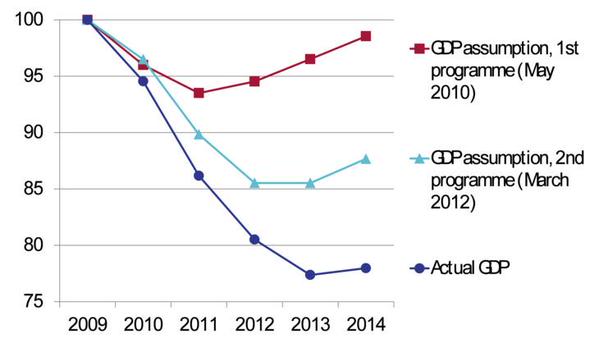
A few words on Greece’s negotiations with Europe are also in order.  First, note that the “bailouts” given to Greece mostly weren’t — 89% just went back to lenders.  Worse, the imposed austerity conditions caused an actual collapse in GDP and employment, which means that the cost of the bailouts was far more to the Greek government and economy than the actual amount of money received.

In other words, this was all just a bullshit way of bailing out banks, and as the FT notes, only because bailing them out direct was “embarrassing”.  To avoid embarrassment, millions were impoverished, people set themselves on fire, and Greece was devastated.

This, people, is why I say, and mean, that Merkel is monster.  A disgusting, rotting excuse for a human being, let alone a statesman.  Millions suffered, not just in Greece but in the other peripheral countries, for no good reason.  Austerity is just the voodoo economics of the modern day, but even more devastating.

The deal Greece wants is more than fair to “lenders”.  And I mean “more than fair” literally.  They deserve to be defaulted on, because they didn’t do their due diligence, and all loans since the financial crisis at the very least, should NEVER have been made.

An independent Bloc is desperately needed in the world.  BRICS plus allies, with their own payment system, reserve currency and international trade and settlement system.  Until it exists, countries like Greece will feel (and often be right) that they have no choice but to buckle under to whatever terms the West sets.

Enough.  This suffering is not required in any world which runs on rational economics AND has as its goals the welfare of everyone.  It never was required.  All of the deaths, job losses, homelessness, hunger and so on was optional.  It was chosen because it suited oligarchs and politicians like Merkel.

This is the world you live in. It must be changed.  Since core westerners are unwilling to change it from withing in time to save millions and millions from suffering; it will have to be changed by those it is most severely impoverishing.


If you enjoyed this article, and want me to write more, please DONATE or SUBSCRIBE.


Let’s Talk Turkey About Greece

In light of the upcoming Greek elections and the possibility of a Euro exist, this article from 2012 is worth revisiting.

1) Greece is very likely to exit the Euro.

2) When Greece exits the Euro it will be punished severely by the monetary authorities.  They intend to let Greeks starve.  They will cut off food supplies, and Greeks will not be able to afford food.  Oil is also going to be a problem.  Greeks will probably not be able to flee to other countries.

3) The reason they will punish the Greeks is because they can.  They couldn’t punish the Argentinians (well, they’re working on it) or the Icelanders, because both those countries can feed themselves.  They can punish the Greeks.  They need to make an example, because they are worried about Spain, Portugal, Ireland and other countries.  (Heck, even the Dutch are having problems.  The Dutch!  If the Dutch can’t make it in the Euro, no one can.)  This isn’t, contra Lagarde about “bad Greeks”, while it is true that Greece should never have been let in to the Euro, well, everyone knew that.  Including the countries that let Greece in.

4) Greece is going to have get hardcore and creative about creating a new economy.  Since the monetary authorities intend to starve them and deprive them of oil, they must retaliate hard.  Greece has a number of options, and this is what Greece should do You don’t play nice with people who are trying to cause a famine in your country.

  • Greece has a large fleet.  Use it to strip mine the Mediterranean of all resources possible.  Yes, the Med is a fragile ecosystem.  If the other Euros don’t like it, they can not punish Greece, otherwise Greece will have to feed itself.  The Euros could send fleets, but as the British-Iceland fishing war proved, that’s prohibitively expensive.
  • Start gun-running and other black market activities up.  European gun-running currently goes through Albania.  Greece has much better ports.  If the Euros don’t like it, they can militarize Greece’s borders at a cost much higher than feeding the Greeks.
  • Become a full on black-hole for banking.  If anyone wants to store money in Greece, they can.  No questions asked, no forms needed.
  • Make deals with other “pariah” and semi-pariah nations.  Start with Iran and Russia for oil (Iran will be happy to give oil in exchange for black market help).  Make a deal with various 2nd world nations for food, start with Argentina, they have no reason to love the IMF or the European Union, which promised to “punish” them for nationalizing oil in Argentina.  In exchange Greece can offer use of their fleet, for cheap, and port rights for the Russian navy.  They’ve wanted a true warm water port for some time.  Offer them a nice island in the Med with a 30 year lease.
  • Hold on for a couple years.  Odds are that soon enough Ireland, Spain, Portugal and maybe others will leave the Euro.  They won’t be in any mood to screw Greece for their ex-Euro masters.  Heck, odds are 50/50 that there won’t be a Euro zone at all in 3 years, since Germany wants to screw everyone, including France.
  • Nationalize basically every industry.  It’s unfortunate, but it’s going to be necessary.  Hundreds of billions of dollars have fled Greece in the past 3 years, in fact that was one of the main reasons for dragging out the “bailouts” (really, bailouts of German banks), to let the money flee.  All Greek assets are going to be frozen overseas, so the Greeks will need to work with what they have.
  • No more money goes out of the country.  Slap on currency controls, to make sure what money is there doesn’t leave (this is aimed at Greece’s rich).  If any banker or anyone else circumvents them, throw them in jail, the sentence should be life, generous, since they are committing treason.
  • Seriously change the tax system, and insist on really taxing the rich.  Go to heavily progressive taxation, reduce the burden on the poor (a large number of people now), this will buy support.
  • A food rationing system, with cards and delivery to every person in the country will be necessary.  It won’t be fun, but combined with the above, you can make sure that no one starves.

Greece has been under siege for years now, and traitors within its own country (its politicians) have betrayed it.  This means Greeks are in serious danger of suffering a famine.  The response to that, by Greeks, will have to be pragmatic and severe.  If non-Greeks don’t like it, that’s too bad.  When millions of people are in danger of starving, a country does what it has to.


If you enjoyed this article, and want me to write more, please DONATE or SUBSCRIBE.

Japanification and the end of the American Dream

Stirling Newberry and I have been writing about Japanafication for years—on blogs, at least since 2004.

Those of us who are old enough remember when Japan was THE miracle economy.  Technologically advanced, vibrant and rich.  It was eating America’s lunch, and most other countries.  For peak alarmism at this fact in a fictional form, read Michael Chrichton’s Rising Sun.

Tokyo real estate was worth more than the entire world’s real estate combined.

Then the bubble crashed.  Japanese policy was to protect the banks, and to bury the bad loans on the books.  They undertook literally decades of stimulative policy, mostly pouring useless concrete (exactly the wrong thing to do unless your country really lacks that sort of infrastructure, which Japan did not.)

To put in terms familiar to my readers, they extended and pretended.

Japan went into semi-permanent stagnation.

We have, now, the news of a quarter drop in GDP of 6.8% annualized for the last quarter.  (This is blamed on increased sales taxes, but it was coming anyway.)

The long stagnation is over (it’s been over for a bit).  Japan is actually in decline.

This is important because Japanification was always the plan for the US after the bubbles: extend and pretend, stagnate wages and employment.  Pretend.

But there were significant differences between the two countries.  Japan started with massive savings and a huge trade surplus.  It is now in trade deficit and savings compared to debt are way down.  Economic equality was relatively high, as well, spreading demand.

America came out of the financial crisis with a trade deficit, a pathetic savings rate and massive inequality.  This is why I predicted that Japanification would not work in the US.  It could not, because there was no saved fat to be used to create the long bright depression the Japanese had.

This brings us to stimulus and development (not just for developing countries).  The money must be used not for pork projects with no follow on, but to create new industries or to bring money off the sides into the economy.  Pouring concrete (and not even bothering to shore up nuclear reactors in areas which were not electorally viable) was pointless in Japan.  Buying bonds is pointless and even harmful.

Likewise you cannot have real open trade flows and expect to keep whatever you are building.  You build it, you make it work and once an industry is systemized, it can be moved to a low cost domiciale. It takes deliberate government policy to prevent that.

Monetary policy in Japan could never work, because the money went to the wrong things, and much of it immediately decamped overseas in the so-called carry trade—borrow low in Japan, buy securities somewhere else where they had a higher return.

All of this should be obvious and uncontroversial. It is not, it flies directly in the face of modern neo-liberal theory and it is that theory, in the face of decades of failure, that the Japanese followed.

The human capacity for ideologically driven stupidity and atrocity is endless. (Those who do not believed me are invited to study Church history and its effect on society from 1000 AD to 1900 AD or so.)  People will ignore the evidence in front of their eyes, years of failure and continue doing the “safe”, “orthodox” thing no matter what the results.  This is true even for well-meaning people.

Of course, in the US, Japanification has a US twist: it massively increases the wealth of the already wealthy, through unconventional monetary policy.  American leaders are far too greedy to make Japanification work: any surplus, or room to lend, or room to print money, must be given away to rich people as quickly as possible.

I point out, finally, that the first sin in Japanification was buying the bad loans.  This was a huge mistake in the US too, bailing out the banks and not forcing them and their share and bondholders to take their losses was the main mistake of the financial crisis.  Yes, things might have been worse if the US had done so (though steps mitigating the hit on the regular economy would have been easy enough to take with the 4 TRILLION dollars used bailing out rich people), but even so, the US would have recovered better afterwards.

Instead the US has an economy in which 90% of the population has seen an actual decrease in income and wealth, while 10% has seen an increase: with the 1% and the .1% and the .01% benefiting most of all.

Japanification was the plan for America. It isn’t working, it could never work, but the policies in place are nonetheless doing what is most important to their architects: they are making the rich richer, and everyone else poorer and doing it quickly.

The Bush years were the long suck.  This is the deep dive, and remember, the US isn’t in recession yet (though it is in depression).  The pain when it happens (and absent nuclear war, there is always another recession), will be unbelievable.


If you enjoyed this article, and want me to write more, please DONATE or SUBSCRIBE.


You will never, again, have a good economy for ordinary people so long as this continues

Reuters on Ben Bernanke’s post-Fed career:

Bernanke was paid at least $250,000 for his first public speaking engagement, in Abu Dhabi, since stepping down in January, according to sources familiar with the matter. That compares to his 2013 paycheck of $199,700, and the appearance was only the first of three around the world this week.’ (two weeks ago)

Ben Bernanke bailed out investors to the tune of trillions of dollars.  Now they are making sure he, personally, will be rich, so that no Federal Reserve Chairman ever thinks of not putting them first, second and last.

You cannot, and will not, have a good egalitarian economy while this sort of thing goes on.  It is not possible.  Those who have been in such positions should be given a very nice pension (say 5x median income) and not allowed to keep any additional earnings for the rest of their lives.

I can hear fools squealing already “gold plated pensions” and “paying them not to work” and “not fair”.

It would be far cheaper than the status quo.  Far, far cheaper.  Right now people like Ben Bernanke and Bill Clinton (worth 100 million after repealing Glass-Stegall and pushing through NAFTA) don’t work for you, they work for the people who will make them rich after they leave office.  That costs you far far more than a generous pension for the rest of their lives.


If you enjoyed this article, and want me to write more, please DONATE or SUBSCRIBE.

Page 4 of 13

Powered by WordPress & Theme by Anders Norén