
So a *European* startup called IB2 announced *in the US* the invention of an amazing new technology to upgrade low-grade bauxite – previously discarded as waste – into high-grade, which makes it usable to make aluminum and extract critical minerals like gallium, lithium, and rare earths in the process.
In the current context you’d think either Europe or the US would be all over it, right? Wrong. Somehow the first facility that startup ended up building is in Shanxi, China – built in 10 months flat (which, as you can guess, is almost impossibly fast)…
…How? Why? Speed and efficiency. According to the founder and CEO of IB2, Romain Girbal, they received “massive support” from the Shanxi government and were able to move at insane speed. As he puts it: “You could never go that quick anywhere else in the world – only in China. It is unique.”
And no, they didn’t do it by trampling on environmental regulations which, contrary to popular belief, are now actually quite drastic in China. As Girbal puts it: “Building a unit in China is very regulated – environmental and dangerous materials [are subject to] heavier regulation. Of course we followed everything but we had the support from the Shanxi province to help us move forward. Sometimes, being a foreign company, things can be slow with communication issues. When there were sometimes slowdowns, they were here to help and to push.”
The difference here is simple. China has regulations, and the government helps companies meet them. The government wanted this facility so they helped WITHOUT breaking the laws. Here in the West, we’d give them a tax break, and maybe we’d say “it’s OK to break the law this time.” That’s not what Shanxi did.
I am reminded of how US tax authorities built an auto-filing system which filled out tax forms for people, and helped them thru the process where it couldn’t fill them out. Unfortunately there’s a big business doing that already, so Congress, this year, forced the IRS to shut it down.
What the IRS was doing is helping people obey the law, but that threatened TurboTax’s profits, so…
This is how the Russians were able to ramp up weapons production so fast (or part of it.) They made it a priority and the government helped firms.
Safety and environmental regulations exist for good reasons. Most firms will cut every corner they can to make a profit, and those few with ethics will lose to those who say “who cares how many kids die of asthma due to pollution?”
BUT a properly run government doesn’t just make regulations, it helps firms meet those regulations. They aren’t, or shouldn’t be, meant to slow things down, but to make sure corners aren’t cut which will hurt consumers, workers or just the general population.
In most of the West regulators exist to say “no” and to ask for another report. They don’t much care if the business succeeds or not. In China (and, actually, in America before 1980 or so) governments want business to succeed so they help, but they also don’t want businesses to shove their negative externalities onto workers or citizens, so they also make sure they can meet the regulations intended to protect people.
As we’ve noted before, the US couldn’t do this if it wanted to, because contrary to propaganda, the US doesn’t have a ton of federal bureaucrats:
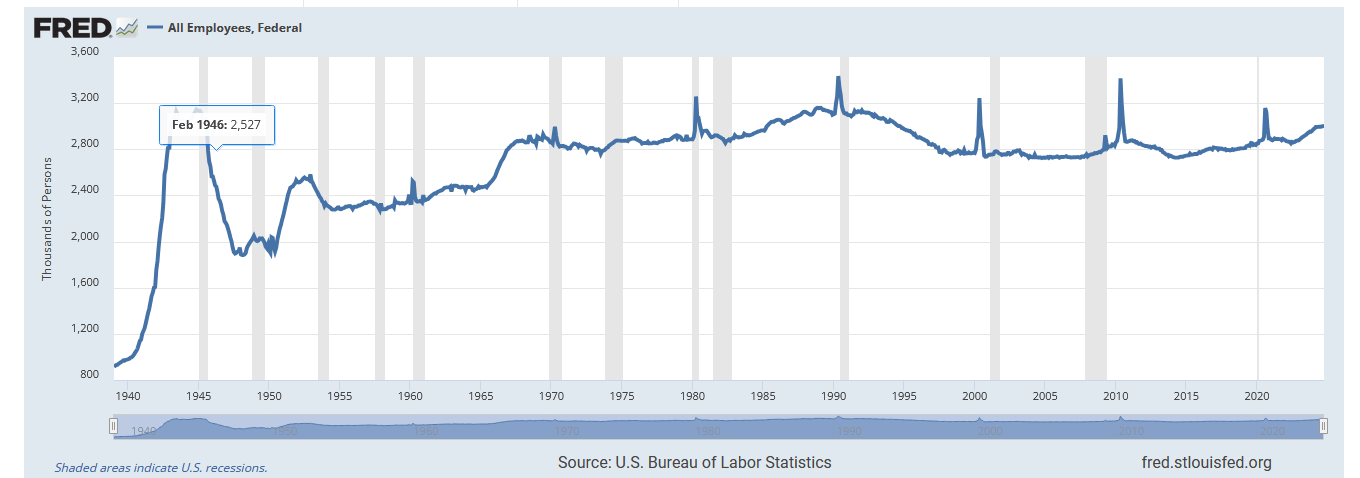
When you consider how much the American population has grown, you can see that the number of bureaucrats per capita has actually dropped significantly. In 1970 (which had about the same number of federal workers) the population was 205 million. Today it is 343 million. Most of that has been outsourced to contractors. Contractors who, of course, cost more than just doing it in house.
A friend of mine is in his early 80s, and he once told me how after Reagan came into office, the local Small Business Administration office, which had been very helpful to him in running his small accountancy business, got rid of half its employees and those who remained were no longer allowed to help as much.
Properly run nations want business to succeed and help them, but they don’t do it by letting them dodge regulations or cutting them for them, they help them by guiding them thru the process of meeting the regulations, and provide other aid as necessary to get the business going.
Once that was us. No more.
This site is only viable due to reader donations. If you value it and can, please subscribe or donate.
Eric Anderson
Read an interesting article today on macroeconomics, described as the process of answering three questions:
1. What does the world look like?
2. Why does it look the way it does?
3. What can we do to make the world better?
Dan Wang in his book titled “Breakneck” provides a lens for No. 2 by parsing differences between the U.S. and China being “because the USA today is a mostly lawyerly society, while China today is a mostly engineering society.”
Hello, government as zealous advocate for those with the money to “petition the government for redress”
Ton of explanatory power there.
Article here: https://www.econforeverybody.com/p/on-thinking-about-growth
Jan Wiklund
I don’t know the conditions in US but here in Europe there are EU laws that say that the state shouldn’t have any industrial priorities at all, the only thing it is allowed to do is “levelling the field”.
That is not how it worked up to ca 1980, and even more radically 1992 when we got the Maastricht agreement and the Growth and stability pact that now tie the hands of governments so that they are unable to swim. Constitutionally regulated paralysis!
Carborundum
Federal employees may be flat over time, but state and municipal employees – which are much, much more relevant to regulation as day to day experience – are not. From 1970 to 2025, US population increased by 67% while the number of non-education state and municipal employees increased by 107%. Put another way, in 1970 there were 43.4 US citizens per state or municipal non-education employee, in 2025 there were 35.0.
In my experience (direct and non-trivial), there are two things at work here:
1) The regulators are not, at the coal face (e.g., inspections), especially speedy. At management and policy echelons (i.e., managing regulators and developing regulation / guidelines for application) they are not very experienced / particularly competent with the activities, processes or forces they are tasked with regulating.
2) Public consultation has become the primary driver of regulation, instead of evidence and experience in the service of coherent, broadly agreed upon, objectives.
Essentially our current situation is one where poorly thought out regulation, to esoteric ends and designed by committee, with the primary object of not pissing anyone off, is slowly and inconsistently applied while potential prosperity bleeds out on the floor. The vast majority of business owners, and those who work for them, would actually like to follow regulation – they just want it to make sense, have some relevance to a social good they recognize, reflect the reality of their business, and have clarity about what they have to do to meet the standards set forth in said regulation. Increasingly frequently this is not true.
John
The rigid neoliberal ideology that infects the minds of ruling elites in the US and its vassal states leaves no other option. The libertarian religious dogma that all collective action, hence government action, is bad cripples any possible solution. Locked into this nihilism, the techbro neofeudalism or chaos can be the only outcome,
Troy
RE: Carborundum
> Federal employees may be flat over time, but state and municipal employees – which are much, much more relevant to regulation as day to day experience – are not. From 1970 to 2025, US population increased by 67% while the number of non-education state and municipal employees increased by 107%. Put another way, in 1970 there were 43.4 US citizens per state or municipal non-education employee, in 2025 there were 35.0.
How many of those were state troopers? Municipal police officers? With those removed, what would the numbers be?
NGG
In the USA, the government definitely assists companies, corporations, etc. Mostly to improve the lot of the already wealthy. The US Government is a money sharing mechanism. Funds come in – funds go out. They just don’t go to help 80% of the citizens. Well, I guess if they helped 80% of the citizens, we’d have to call it a communist system.
ibaien
@ Carborundum
tremendous comment, and very germane to my own personal experience working with various regulatory bodies in southern california. bureaucrats are rarely hired out of the industry they’re regulating, they’re given hundreds or thousands of pages of code to enforce (of which they’ll generally only enforce 25% but with no ability for the regulated to know which 25%) and they’re woefully overworked. on top of this, most of the code is written such that a two person business is expected to obey the same specs as a two hundred person business – thus, of course, putting franchises and large operations at a huge advantage. any bloviation about america being business friendly is bullshit – it’s only friendly to financialized strip-mining. americans travel to europe or LATAM or asia and come home raving about the vibrant street life and small business culture but never stop to ask why they can’t have that here.
NGG
The Republican Party is incapable of governing in any meaningful way. They have devolved into a two trick pony. Tax cuts for the rich and deregulation. Oh, I forgot to mention “trickle down economics” which should be retitled to “trickled on”. Republicans say government doesn’t work ,and then get elected and prove it. There are serious problems in this country , and I don’t see any consensus on solving any of them. Well if your worth a billion – things are going great!
Carborundum
Troy –
I’m not aware of a data series that breaks out State and municipal police numbers. The best I can find was the BJS Census from 2018 – comparing their headcount with non-educational employees indicates that they accounted for about 13% of state and municipal government employees at that time. No good sense of whether they are growing more rapidly than employment generally.
ibaien –
Indeed – and the stats here on the growth of business regulation are mind blowing. Canadian data are that we’re seeing a 2.1% increase in the volume of regulation annually – this doesn’t seem like much but compounding is potent, yielding 37% growth over 15 years. Yes, the world is steadily more complex and we have a better understanding of negative externalities, but I have a tough time believing that the real regulatory need has increased that much. I completely agree with Ian that it would be radically beneficial if they were focused on simultaneously assisting development and compliance, but as it currently stands the phrase “iron rice bowl” springs to mind…
Like & Susbcribe
I’m not going take his word for it or your word for it that China is regulating this effectively. I want to see that INDEPENDENTLY verified and we all know that could never and will never happen. Just because regulations are on the book it doesn’t mean those regulations are effective as written and/or that they are being enforced properly and effectively.
Mark Level
NGG’s first comment is very relevant, and generally the fact that businesses are gov’t.-subsidized and aided to the extent they are Rentier-extraction-oriented is hard not to notice.
In April, 2024, Harper’s published a very good piece on the ramping up of evictions alongside of rents in Columbus, Ohio, resulting in large homeless encampments, etc. The local Rental industry uses AI to jack up rents and many units are bought by Financial sector shell companies. There is no need to engage renters face to face, they can be forced to install apps for payments as a condition of renting. The locals started to push for a rent ceiling or limits on increases, and the Governor was quickly bribed to declare a statewide moratorium on ANY Ohio City restricting rent increases.
Then the article went into a predatory legal group called the Willis Group that serves the landlords who do sudden (say $300 monthly) rent increases and quickie evictions. There is a specific location wherein this is done and bad actors dominate. There was one guy profiled, who runs most of the evictions as a kangaroo court for the Willis group while acting independently and for his own enrichment, as he owns over 30 apartment buildings but calls himself a “small” landlord. He loudly brays repeatedly to the reporter and to those being evicted that they have no “legal” recourse of any kind, refuses to return deposits (theft), etc. He says renting is a “personal” “people” relation without regard to law, and effectively he is mostly correct. There is a small pro bono group in the town that also haunts this “law” court with a sign to help, but a very small portion of victims notice or seek help, which only rarely wins out. The guy who runs the court while not being a direct agent of it makes side deals with victims– agree to leave by this date and we will not report the eviction for your record, etc. The victims are concentrated among the vulnerable, a single black mother who was a health care worker but got injured is one victim of many profiled. She and her son are soon out on the street. Actually there is some aid from the government (it wasn’t made clear whether local or state), they pay for the newly homeless to be transported to crappy local hotels where they get 3 months residence, then are out on the street for real.
This is the Neoliberal USA top to bottom. Okay, Trump gets more obvious looting opportunities, e.g. he hits the Swiss with a large tariff (I believe it was originally 39%) they send a delegation that gives him an engraved gold bar, an expensive Rolodex and other personal gifts, and then he lowers it to 15% out of the goodness (sic) of his heart (sic). Oh, and he steals a Venezuelan Oil Tanker and the oil, open piracy, but the “Rules-Based Order” says USA can do this to countries like Cuba (whence the oil was going) and Venezuela because of the Monroe Doctrine or whatever.
Mao dealt with this kind of Landlord parasitism very directly, which is why China went from a Century of Humiliation under the boot of Western Empires to a century (well, less at the moment, but soon enough) of rapid growth and sovereignty after about 1948. But this is USA!! so I guess the Plebs will never fight back and will die off quietly, as the SCotUS, Executive and Legislative branches desires them to.
bruce wilder
As a sometime economist, I was sometimes asked (even 35+ years ago) about China and economic competitiveness. The product could be as simple as ocean-going shipping containers or as complex as automobiles. I visited Hong Kong and Shenzhen circa 1991. Everyone who ever asked in the West seemed to believe it was at base a simple question of labor costs. That was always the model in their head: a poor schlub earning $0.10 / hour could make anything cheaper than an over(paid) American. The questioner could be an industrial engineer or a Harvard Business School professor — I’ve encountered both — that was always the primary model of cost competitiveness. In the 1990s, “undervalued” currency entered into common consciousness, though oddly from 2010 onward, some smug knowers would dismiss that as “no longer true”. Most saw the exchange rate as just another form of $0.10 / hour.
What I tried to explain about the economics of high productivity industry was the critical importance of context, meaning the elements of what you might metaphorically call the supporting ecosystem. Not government regulatory procedures especially, but the whole neighborhood of infrastructure and technical support services, suppliers and knowledge and skills in the workforce.
As late as the mid-1980s, manufacturing shipping containers in China competitively was quite challenging. This is not an especially complex product to build. There is a critical forging involved, but it is not especially complex. The problems centered on all the other “ecosystem” elements that tended to make production processes chaotic, ballooning costs. Electrical power would fail, not just cutting out entirely but also voltage surges and brownouts. Simple replacement parts could be hard to obtain. Services to repair welding equipment or washing equipment could be problematic. Air conditioning to stabilize environmental factors was not available or could not be serviced and maintained reliably. Skilled welders did not understand engineering requirements and drawings or quality control measurements. The welding filler or shielding gas supplied localled could be unavailable or suddenly of faulty quality.
Taming the chaos to make efficient production processes possible involves tasks and requirements extending far beyond the door to the workshop. It is fairly easy for me to imagine how local government in China evolved into an expert helping hand. Of course, local and provincial governments also are bankers and the owners of major industrial enterprises, not just the operator of the permits and plans office.
bruce wilder
My personal experience with regulatory burden over the last decade of my working life did not involve encounters with state regulatory bureaucrats at all. The plague was brought by contracting officers wanting complex documentation of business processes, formal planning and contingencies. Mostly about computer-based information processing and security. Are credit card processes “secure”? What’s your disaster recovery plan? Is your website accessible? Have your employees completed workplace sensitivity training? Have your consultants committed in writing to keep your customer information confidential?
The physical reality of how information is stored and processed makes all of this very complex — businesses pass information off to payment processors and cloud providers every minute in the day. Microsoft, Google, Amazon. And, the cross currents in political culture are making it worse. You are suppose to annoy your website visitors about “cookies” and tracking by ad service firms you have no contact with, promise “privacy” while working feverishly on targeted marketing schemes. Your employees are entrusted with dozens of accounts and passwords and 2FA methods, which are always being changed because they fail to authenticate.
It is not like cyber security is enhanced by any of this. Nor does that seem to be the ultimate intent of the neurodivergent masters of our universe building out AGI. But, it is a significant burden on productivity in the economy I do not expect to be addressed by public authority pursing the common good.
Meanwhile Carborundum is looking up statistics on public employment.
Carborundum
If you don’t like the metric Bruce, please improve it. I would be very interested to know what fractions of Federal, State and Municipal employees are directly involved in regulatory activities. I have no good sense of the extent to which it varies with level of government.